

ASTM D6436-14(2022)
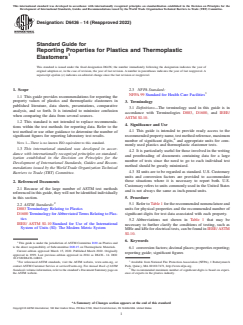
(Guide)Standard Guide for Reporting Properties for Plastics and Thermoplastic Elastomers
General Information
- Abstract
SIGNIFICANCE AND USE
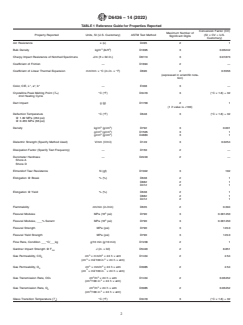
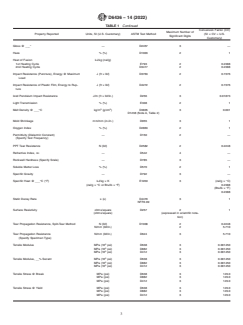
4.1 This guide is intended to provide ready access to the recommended property name, test method reference, maximum number of significant digits,4 and appropriate units for commonly used plastics and thermoplastic elastomer tests.
4.2 It is particularly useful for those involved in the writing and proofreading of documents containing data for a large number of tests since the need to go to each individual test method should be greatly minimized.
4.3 SI units are to be regarded as standard. U.S. Customary units and conversion factors are provided to accommodate those situations where it is necessary to report both. U.S. Customary refers to units commonly used in the United States and is not always the same as inch-pound units.
SCOPE
1.1 This guide provides recommendations for reporting the property values of plastics and thermoplastic elastomers in published literature, data sheets, presentations, comparative analysis, and so forth. It is intended to minimize confusion when comparing the data from several sources.
1.2 This standard is not intended to replace recommendations within the test methods for reporting data. Refer to the test method or use other guidance to determine the number of significant figures for reporting laboratory test results.
Note 1: There is no known ISO equivalent to this standard.
1.3 This international standard was developed in accordance with internationally recognized principles on standardization established in the Decision on Principles for the Development of International Standards, Guides and Recommendations issued by the World Trade Organization Technical Barriers to Trade (TBT) Committee.
- Status
- Published
- Publication Date
- 14-Mar-2022
- Technical Committee
- D20 - Plastics
- Drafting Committee
- D20.15 - Thermoplastic Materials

Overview
ASTM D6436-14(2022), Standard Guide for Reporting Properties for Plastics and Thermoplastic Elastomers, provides comprehensive guidance for reporting the property values of plastics and thermoplastic elastomers in technical documentation, data sheets, comparative analyses, and presentations. Developed by ASTM International, this guide helps standardize the way property data is reported, ensuring consistency, clarity, and minimization of confusion when comparing information from various sources.
The guide serves as a reference for recommended property nomenclature, applicable ASTM test methods, the maximum number of significant digits, and appropriate SI and U.S. Customary units for commonly used property tests. It is particularly valuable for professionals involved in the creation, editing, and review of documents containing data from multiple tests.
Key Topics
Standardized Property Reporting
The guide details recommended property names and references the standard ASTM test methods for each. Following these recommendations enables clear and reliable communication in published literature and technical documentation.Units and Significant Digits
- SI units are identified as the standard for reporting.
- U.S. Customary units and their relevant conversion factors are also included for dual reporting needs.
- Maximum numbers of significant digits to report for each property are specified, supporting precision and minimizing misinterpretation.
Ease of Reference
- A comprehensive table lists physical properties (such as density, tensile strength, impact resistance, melt flow, flammability, and more).
- Each entry includes property, unit (SI and U.S. Customary), relevant ASTM method, and precision recommendations.
- Abbreviations and additional clarifications are drawn from supporting ASTM and IEEE/ASTM standards.
Applicability
- Intended for use by authors of technical documents, laboratories, and manufacturers preparing data sheets or conducting comparative analyses.
- Designed to reduce the burden of consulting individual test methods for reporting conventions, saving time and resources.
Applications
ASTM D6436-14(2022) finds practical application across multiple sectors involved in plastics and thermoplastic elastomers:
Technical Documentation
Ensures that manufacturers, researchers, and suppliers prepare consistent and comparable reports and datasheets for materials.Comparative Analysis
Facilitates reliable comparison between products from different sources, aiding material selection and quality assurance.Quality Control & Laboratory Reporting
Supports laboratories in accurately reporting test results for materials testing, especially when results are disseminated widely or submitted to external partners.Global Compliance and Communication
By standardizing SI units and providing U.S. Customary values where needed, the guide helps bridge communication between international and U.S. stakeholders.
Related Standards
- ASTM D883 - Terminology Relating to Plastics
- ASTM D1600 - Terminology for Abbreviated Terms Relating to Plastics
- IEEE/ASTM SI-10 - Standard for Use of the International System of Units (SI): The Modern Metric System
- NFPA 99 - Standard for Health Care Facilities (for static decay rate and related tests)
- Referenced ASTM Test Methods (such as D495, D638, D792, D1238, D790, D256, and others listed within the guide)
Keywords: plastics property reporting, thermoplastic elastomer data, ASTM D6436-14, significant digits, SI units, U.S. Customary units, ASTM standards, material specification, comparative analysis, laboratory reporting, data sheet standardization.
Relations
- Effective Date
- 01-Feb-2024
- Effective Date
- 01-Nov-2023
- Effective Date
- 01-Jan-2020
- Effective Date
- 01-Aug-2019
- Effective Date
- 15-Apr-2019
- Effective Date
- 01-Feb-2019
- Effective Date
- 01-Dec-2018
- Effective Date
- 01-Nov-2018
- Refers
ASTM D1600-18 - Standard Terminology for Abbreviated Terms Relating to Plastics (Withdrawn 2024) - Effective Date
- 01-Jan-2018
- Effective Date
- 15-Aug-2017
- Effective Date
- 01-Feb-2014
- Effective Date
- 15-Apr-2013
- Effective Date
- 15-Nov-2012
- Effective Date
- 15-May-2011
- Effective Date
- 01-Mar-2008
Get Certified
Connect with accredited certification bodies for this standard

DIN CERTCO
DIN Group product certification.

Smithers Quality Assessments
US management systems and product certification.
Sponsored listings
Frequently Asked Questions
ASTM D6436-14(2022) is a guide published by ASTM International. Its full title is "Standard Guide for Reporting Properties for Plastics and Thermoplastic Elastomers". This standard covers: SIGNIFICANCE AND USE 4.1 This guide is intended to provide ready access to the recommended property name, test method reference, maximum number of significant digits,4 and appropriate units for commonly used plastics and thermoplastic elastomer tests. 4.2 It is particularly useful for those involved in the writing and proofreading of documents containing data for a large number of tests since the need to go to each individual test method should be greatly minimized. 4.3 SI units are to be regarded as standard. U.S. Customary units and conversion factors are provided to accommodate those situations where it is necessary to report both. U.S. Customary refers to units commonly used in the United States and is not always the same as inch-pound units. SCOPE 1.1 This guide provides recommendations for reporting the property values of plastics and thermoplastic elastomers in published literature, data sheets, presentations, comparative analysis, and so forth. It is intended to minimize confusion when comparing the data from several sources. 1.2 This standard is not intended to replace recommendations within the test methods for reporting data. Refer to the test method or use other guidance to determine the number of significant figures for reporting laboratory test results. Note 1: There is no known ISO equivalent to this standard. 1.3 This international standard was developed in accordance with internationally recognized principles on standardization established in the Decision on Principles for the Development of International Standards, Guides and Recommendations issued by the World Trade Organization Technical Barriers to Trade (TBT) Committee.
SIGNIFICANCE AND USE 4.1 This guide is intended to provide ready access to the recommended property name, test method reference, maximum number of significant digits,4 and appropriate units for commonly used plastics and thermoplastic elastomer tests. 4.2 It is particularly useful for those involved in the writing and proofreading of documents containing data for a large number of tests since the need to go to each individual test method should be greatly minimized. 4.3 SI units are to be regarded as standard. U.S. Customary units and conversion factors are provided to accommodate those situations where it is necessary to report both. U.S. Customary refers to units commonly used in the United States and is not always the same as inch-pound units. SCOPE 1.1 This guide provides recommendations for reporting the property values of plastics and thermoplastic elastomers in published literature, data sheets, presentations, comparative analysis, and so forth. It is intended to minimize confusion when comparing the data from several sources. 1.2 This standard is not intended to replace recommendations within the test methods for reporting data. Refer to the test method or use other guidance to determine the number of significant figures for reporting laboratory test results. Note 1: There is no known ISO equivalent to this standard. 1.3 This international standard was developed in accordance with internationally recognized principles on standardization established in the Decision on Principles for the Development of International Standards, Guides and Recommendations issued by the World Trade Organization Technical Barriers to Trade (TBT) Committee.
ASTM D6436-14(2022) is classified under the following ICS (International Classification for Standards) categories: 83.080.20 - Thermoplastic materials. The ICS classification helps identify the subject area and facilitates finding related standards.
ASTM D6436-14(2022) has the following relationships with other standards: It is inter standard links to ASTM D883-24, ASTM D883-23, ASTM D883-20, ASTM D883-19c, ASTM D883-19a, ASTM D883-19, ASTM D883-18a, ASTM D883-18, ASTM D1600-18, ASTM D883-17, ASTM D1600-14, ASTM D1600-13, ASTM D883-12e1, ASTM D883-11, ASTM D883-08. Understanding these relationships helps ensure you are using the most current and applicable version of the standard.
ASTM D6436-14(2022) is available in PDF format for immediate download after purchase. The document can be added to your cart and obtained through the secure checkout process. Digital delivery ensures instant access to the complete standard document.
Standards Content (Sample)
This international standard was developed in accordance with internationally recognized principles on standardization established in the Decision on Principles for the
Development of International Standards, Guides and Recommendations issued by the World Trade Organization Technical Barriers to Trade (TBT) Committee.
Designation: D6436 − 14 (Reapproved 2022)
Standard Guide for
Reporting Properties for Plastics and Thermoplastic
Elastomers
This standard is issued under the fixed designation D6436; the number immediately following the designation indicates the year of
original adoption or, in the case of revision, the year of last revision. A number in parentheses indicates the year of last reapproval. A
superscript epsilon (´) indicates an editorial change since the last revision or reapproval.
1. Scope 2.3 NFPA Standard:
NFPA 99 Standard for Health Care Facilities
1.1 This guide provides recommendations for reporting the
property values of plastics and thermoplastic elastomers in
3. Terminology
published literature, data sheets, presentations, comparative
3.1 Definitions—The terminology used in this guide is in
analysis, and so forth. It is intended to minimize confusion
accordance with Terminologies D883, D1600, and IEEE/
when comparing the data from several sources.
ASTM SI-10.
1.2 This standard is not intended to replace recommenda-
4. Significance and Use
tions within the test methods for reporting data. Refer to the
4.1 This guide is intended to provide ready access to the
test method or use other guidance to determine the number of
recommendedpropertyname,testmethodreference,maximum
significant figures for reporting laboratory test results.
number of significant digits, and appropriate units for com-
NOTE 1—There is no known ISO equivalent to this standard.
monly used plastics and thermoplastic elastomer tests.
1.3 This international standard was developed in accor-
4.2 It is particularly useful for those involved in the writing
dance with internationally recognized principles on standard-
and proofreading of documents containing data for a large
ization established in the Decision on Principles for the
number of tests since the need to go to each individual test
Development of International Standards, Guides and Recom-
method should be greatly minimized.
mendations issued by the World Trade Organization Technical
4.3 SI units are to be regarded as standard. U.S. Customary
Barriers to Trade (TBT) Committee.
units and conversion factors are provided to accommodate
those situations where it is necessary to report both. U.S.
2. Referenced Documents
Customary refers to units commonly used in the United States
2.1 Because of the large number of ASTM test methods
and is not always the same as inch-pound units.
referenced in this guide, they will not be identified individually
in this section. 5. Procedure
5.1 Refer to Table 1 for the recommended nomenclature and
2.2 ASTM Standards:
units for physical properties and the recommended number of
D883 Terminology Relating to Plastics
significant digits for test data associated with each property.
D1600 Terminology forAbbreviatedTerms Relating to Plas-
tics
5.2 Abbreviations not shown in Table 1 that may be
IEEE/ ASTM SI-10 Standard for Use of the International
necessary to further clarify the conditions of testing, such as
System of Units (SI): The Modern Metric System
MHz and kHz for electrical tests, can be found in IEEE/ASTM
SI-10.
6. Keywords
This guide is under the jurisdiction of ASTM Committee D20 on Plastics and
is the direct responsibility of Subcommittee D20.15 on Thermoplastic Materials.
6.1 conversion factors; decimal places; properties reporting;
Current edition approved March 15, 2022. Published March 2022. Originally
reporting guide; significant figures
approved in 1999. Last previous edition approved in 2014 as D6436 - 14. DOI:
10.1520/D6436-14R22.
2 3
For referenced ASTM standards, visit the ASTM website, www.astm.org, or Available from National Fire Protection Association (NFPA), 1 Batterymarch
contact ASTM Customer Service at service@astm.org. For Annual Book of ASTM Park, Quincy, MA 02169-7471, http://www.nfpa.org.
Standards volume information, refer to the standard’s Document Summary page on The recommended maximum number of significant digits is based on experi-
the ASTM website. ence of experts in the plastics industry.
*A Summary of Changes section appears at the end of this standard
Copyright ©ASTM International, 100 Barr Harbor Drive, PO Box C700, West Conshohocken, PA19428-2959. United States
D6436 − 14 (2022)
TABLE 1 Reference Guide for Properties Reported
Conversion Factor (CV)
Maximum Number of
Property Reported Units, SI (U.S. Customary) ASTM Test Method (SI × CV = U.S.
Significant Digits
Customary)
Arc Resistance s (s) D495 2 1
3 3
Bulk Density kg/m (lb/ft ) D1895 3 0.06242
Charpy Impact Resistance of Notched Specimens J/m (ft×lbf ⁄in.) D6110 3 0.01873
Coefficient of Friction — D1894 2 —
Coefficient of Linear Thermal Expansion mm/mm × °C (in./in. × °F) D696 2 0.5556
(expressed in scientific nota-
tion)
Color, CIE, L*, a*, b* — E308 3 —
Crystalline Peak Melting Point (T ) °C (°F) D3418 3 (°C × 1.8) + 32
m
2nd Heating Cycle
Dart Impact g (g) D1709 2 1
(1 if value is <100)
Deflection Temperature °C (°F) D648 3 (°C × 1.8) + 32
@ 1.82 MPa (264 psi)
@ 0.455 MPa (66 psi)
3 3
Density kg/m (g/cm ) D792 3 0.001
3 3
g/cm (g/cm ) D150
...