

ASTM D5160-95(2019)
(Guide)Standard Guide for Gas-Phase Adsorption Testing of Activated Carbon
General Information
- Abstract
SIGNIFICANCE AND USE
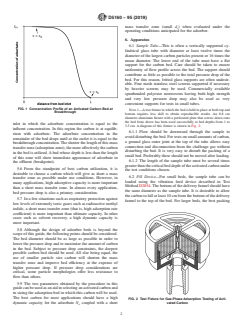
5.1 Activated carbon is used extensively for removing gases and vapors from air or other gas streams. The physical and chemical characteristics of an activated carbon can strongly influence its suitability for a given application. The procedure in this guide allows the evaluation of the dynamic adsorption characteristics of an activated carbon for a particular adsorbate under conditions chosen by the user. It is necessary that the user choose test conditions that are meaningful for the application (see Section 9).
5.2 This guide can also be used to evaluate activated carbons that have been impregnated with materials to enhance their effectiveness at removing gases otherwise poorly adsorbed on activated carbon.
5.3 The procedure given in this guide is not generally applicable for evaluation of carbons used as catalysts for such purposes as decomposition of low levels of ozone or oxidation of SO2 to SO3.
5.4 The procedure given in this guide can be applied to reactivated or regenerated activated carbons.
5.5 Fig. 1 shows the adsorbate concentration profile in an activated carbon bed at breakthrough. The bed has a zone at the inlet in which the adsorbate concentration is equal to the influent concentration. In this region the carbon is at equilibrium with adsorbate. The adsorbate concentration in the remainder of the bed drops until at the outlet it is equal to the breakthrough concentration. The shorter the length of this mass transfer zone (adsorption zone), the more effectively the carbon in the bed is utilized. A bed whose depth is less than the length of this zone will show immediate appearance of adsorbate in the effluent (breakpoint).
FIG. 1 Concentration Profile of an Activated Carbon Bed at Breakthrough
5.6 From the standpoint of best carbon utilization, it is desirable to choose a carbon which will give as short a mass transfer zone as possible under use conditions. However, in many applications, high adsorptive capacity is more important th...
SCOPE
1.1 This guide covers the evaluation of activated carbons for gas-phase adsorption. It presents a procedure for determining the dynamic adsorption capacity, No, and critical bed depth, dc, for an activated carbon used to remove a specific adsorbate from a gas stream under conditions chosen by the user.
1.2 The values stated in SI units are to be regarded as standard. No other units of measurement are included in this standard.
1.3 This standard does not purport to address all of the safety concerns, if any, associated with its use. It is the responsibility of the user of this standard to establish appropriate safety, health, and environmental practices and determine the applicability of regulatory limitations prior to use. Specific hazards statements are given in Section 7.
1.4 This international standard was developed in accordance with internationally recognized principles on standardization established in the Decision on Principles for the Development of International Standards, Guides and Recommendations issued by the World Trade Organization Technical Barriers to Trade (TBT) Committee.
- Status
- Published
- Publication Date
- 31-Aug-2019
- Technical Committee
- D28 - Activated Carbon
- Drafting Committee
- D28.04 - Gas Phase Evaluation Tests
Overview
ASTM D5160-95(2019): Standard Guide for Gas-Phase Adsorption Testing of Activated Carbon provides a comprehensive procedure for evaluating the dynamic adsorption performance of activated carbon in gas-phase applications. Activated carbon is widely used to remove gases and vapors from air and other gas streams. The effectiveness of an activated carbon depends greatly on its physical and chemical properties, which need to be measured under conditions relevant to its real-world application. This standard guide details how to assess essential parameters such as dynamic adsorption capacity and critical bed depth, enabling selection and optimization of activated carbon for a broad range of air purification and industrial processes.
Key Topics
- Dynamic adsorption capacity and critical bed depth: The guide establishes methods for determining how much a specific activated carbon can adsorb under dynamic (flow) conditions and how thick a carbon bed must be to achieve effective filtration.
- Test condition customization: Evaluations are performed under user-selected conditions such as flow rate, adsorbate concentration, temperature, pressure, and relative humidity, to ensure results are aligned with intended applications.
- Performance of impregnated or regenerated carbons: The standard applies not only to virgin activated carbons but also to those treated or reactivated to enhance effectiveness against specific gases.
- Mass transfer zone evaluation: The length of the mass transfer or adsorption zone is measured to determine carbon efficiency. A shorter zone indicates better utilization of the activated carbon bed.
- Impact of particle size and water content: Guidance is provided on sample preparation, including considerations of particle size distribution and pre-adsorbed water, both of which can significantly affect adsorption performance.
Applications
ASTM D5160 is used across a variety of sectors, particularly where gas-phase filtration and air purification are critical. Key application areas include:
- Industrial air treatment - Removal of volatile organic compounds (VOCs), hazardous gases, and odorous substances from manufacturing exhaust or process air.
- Environmental protection - Use in emission control systems to capture harmful pollutants before release into the environment.
- Workplace safety - Evaluation of activated carbon in respiratory protective devices, filters, and scrubbers to safeguard personnel from toxic or radioactive gases.
- Gas processing and purification - Ensuring product purity and equipment protection in chemisorption or catalytic processes.
- Testing of impregnated carbons - Optimization of specialty carbons designed for difficult-to-adsorb gases through testing under targeted conditions.
The guide assists users in selecting carbons with optimal adsorption capacity, balancing factors such as mass transfer zone length, dynamic capacity, and pressure drop for efficient system design.
Related Standards
Several other ASTM standards are referenced for implementation alongside ASTM D5160-95(2019):
- ASTM D2652 - Terminology Relating to Activated Carbon
- ASTM D2854 - Test Method for Apparent Density of Activated Carbon
- ASTM D2867 - Test Methods for Moisture in Activated Carbon
- ASTM D3467 - Test Method for Carbon Tetrachloride Activity of Activated Carbon
- ASTM E300 - Practice for Sampling Industrial Chemicals
These related documents provide additional support for sample characterization, quality control, and standardized terminology, ensuring a robust framework for gas-phase adsorption testing.
Keywords: activated carbon, gas-phase adsorption, dynamic adsorption capacity, critical bed depth, air purification, VOC removal, industrial gas filtration, ASTM D5160, mass transfer zone, impregnated carbon, air treatment standards
Relations
- Effective Date
- 01-Sep-2019
- Effective Date
- 01-Jul-2014
- Refers
ASTM D3467-04(2014) - Standard Test Method for Carbon Tetrachloride Activity of Activated Carbon - Effective Date
- 01-Jul-2014
- Effective Date
- 15-Jun-2011
- Effective Date
- 01-Nov-2009
- Refers
ASTM D3467-04(2009) - Standard Test Method for Carbon Tetrachloride Activity of Activated Carbon - Effective Date
- 01-Apr-2009
- Effective Date
- 01-Apr-2009
- Effective Date
- 01-Jul-2005
- Effective Date
- 01-Jun-2005
- Effective Date
- 01-Oct-2004
- Effective Date
- 01-Aug-2004
- Effective Date
- 01-Apr-2004
- Refers
ASTM D3467-99(2003) - Standard Test Method for Carbon Tetrachloride Activity of Activated Carbon - Effective Date
- 01-Oct-2003
- Effective Date
- 01-Jan-2000
- Effective Date
- 10-Feb-1999
Get Certified
Connect with accredited certification bodies for this standard

ECOCERT
Organic and sustainability certification.

Eurofins Food Testing Global
Global leader in food, environment, and pharmaceutical product testing.

Intertek Bangladesh
Intertek certification and testing services in Bangladesh.
Sponsored listings
Frequently Asked Questions
ASTM D5160-95(2019) is a guide published by ASTM International. Its full title is "Standard Guide for Gas-Phase Adsorption Testing of Activated Carbon". This standard covers: SIGNIFICANCE AND USE 5.1 Activated carbon is used extensively for removing gases and vapors from air or other gas streams. The physical and chemical characteristics of an activated carbon can strongly influence its suitability for a given application. The procedure in this guide allows the evaluation of the dynamic adsorption characteristics of an activated carbon for a particular adsorbate under conditions chosen by the user. It is necessary that the user choose test conditions that are meaningful for the application (see Section 9). 5.2 This guide can also be used to evaluate activated carbons that have been impregnated with materials to enhance their effectiveness at removing gases otherwise poorly adsorbed on activated carbon. 5.3 The procedure given in this guide is not generally applicable for evaluation of carbons used as catalysts for such purposes as decomposition of low levels of ozone or oxidation of SO2 to SO3. 5.4 The procedure given in this guide can be applied to reactivated or regenerated activated carbons. 5.5 Fig. 1 shows the adsorbate concentration profile in an activated carbon bed at breakthrough. The bed has a zone at the inlet in which the adsorbate concentration is equal to the influent concentration. In this region the carbon is at equilibrium with adsorbate. The adsorbate concentration in the remainder of the bed drops until at the outlet it is equal to the breakthrough concentration. The shorter the length of this mass transfer zone (adsorption zone), the more effectively the carbon in the bed is utilized. A bed whose depth is less than the length of this zone will show immediate appearance of adsorbate in the effluent (breakpoint). FIG. 1 Concentration Profile of an Activated Carbon Bed at Breakthrough 5.6 From the standpoint of best carbon utilization, it is desirable to choose a carbon which will give as short a mass transfer zone as possible under use conditions. However, in many applications, high adsorptive capacity is more important th... SCOPE 1.1 This guide covers the evaluation of activated carbons for gas-phase adsorption. It presents a procedure for determining the dynamic adsorption capacity, No, and critical bed depth, dc, for an activated carbon used to remove a specific adsorbate from a gas stream under conditions chosen by the user. 1.2 The values stated in SI units are to be regarded as standard. No other units of measurement are included in this standard. 1.3 This standard does not purport to address all of the safety concerns, if any, associated with its use. It is the responsibility of the user of this standard to establish appropriate safety, health, and environmental practices and determine the applicability of regulatory limitations prior to use. Specific hazards statements are given in Section 7. 1.4 This international standard was developed in accordance with internationally recognized principles on standardization established in the Decision on Principles for the Development of International Standards, Guides and Recommendations issued by the World Trade Organization Technical Barriers to Trade (TBT) Committee.
SIGNIFICANCE AND USE 5.1 Activated carbon is used extensively for removing gases and vapors from air or other gas streams. The physical and chemical characteristics of an activated carbon can strongly influence its suitability for a given application. The procedure in this guide allows the evaluation of the dynamic adsorption characteristics of an activated carbon for a particular adsorbate under conditions chosen by the user. It is necessary that the user choose test conditions that are meaningful for the application (see Section 9). 5.2 This guide can also be used to evaluate activated carbons that have been impregnated with materials to enhance their effectiveness at removing gases otherwise poorly adsorbed on activated carbon. 5.3 The procedure given in this guide is not generally applicable for evaluation of carbons used as catalysts for such purposes as decomposition of low levels of ozone or oxidation of SO2 to SO3. 5.4 The procedure given in this guide can be applied to reactivated or regenerated activated carbons. 5.5 Fig. 1 shows the adsorbate concentration profile in an activated carbon bed at breakthrough. The bed has a zone at the inlet in which the adsorbate concentration is equal to the influent concentration. In this region the carbon is at equilibrium with adsorbate. The adsorbate concentration in the remainder of the bed drops until at the outlet it is equal to the breakthrough concentration. The shorter the length of this mass transfer zone (adsorption zone), the more effectively the carbon in the bed is utilized. A bed whose depth is less than the length of this zone will show immediate appearance of adsorbate in the effluent (breakpoint). FIG. 1 Concentration Profile of an Activated Carbon Bed at Breakthrough 5.6 From the standpoint of best carbon utilization, it is desirable to choose a carbon which will give as short a mass transfer zone as possible under use conditions. However, in many applications, high adsorptive capacity is more important th... SCOPE 1.1 This guide covers the evaluation of activated carbons for gas-phase adsorption. It presents a procedure for determining the dynamic adsorption capacity, No, and critical bed depth, dc, for an activated carbon used to remove a specific adsorbate from a gas stream under conditions chosen by the user. 1.2 The values stated in SI units are to be regarded as standard. No other units of measurement are included in this standard. 1.3 This standard does not purport to address all of the safety concerns, if any, associated with its use. It is the responsibility of the user of this standard to establish appropriate safety, health, and environmental practices and determine the applicability of regulatory limitations prior to use. Specific hazards statements are given in Section 7. 1.4 This international standard was developed in accordance with internationally recognized principles on standardization established in the Decision on Principles for the Development of International Standards, Guides and Recommendations issued by the World Trade Organization Technical Barriers to Trade (TBT) Committee.
ASTM D5160-95(2019) is classified under the following ICS (International Classification for Standards) categories: 71.040.30 - Chemical reagents. The ICS classification helps identify the subject area and facilitates finding related standards.
ASTM D5160-95(2019) has the following relationships with other standards: It is inter standard links to ASTM D5160-95(2014), ASTM D2854-09(2014), ASTM D3467-04(2014), ASTM D2652-11, ASTM D2867-09, ASTM D3467-04(2009), ASTM D2854-09, ASTM D2652-05a, ASTM D2652-05, ASTM D2854-96(2004), ASTM D3467-04, ASTM D2867-04, ASTM D3467-99(2003), ASTM D2854-96(2000), ASTM D2652-94(1999). Understanding these relationships helps ensure you are using the most current and applicable version of the standard.
ASTM D5160-95(2019) is available in PDF format for immediate download after purchase. The document can be added to your cart and obtained through the secure checkout process. Digital delivery ensures instant access to the complete standard document.
Standards Content (Sample)
This international standard was developed in accordance with internationally recognized principles on standardization established in the Decision on Principles for the
Development of International Standards, Guides and Recommendations issued by the World Trade Organization Technical Barriers to Trade (TBT) Committee.
Designation:D5160 −95 (Reapproved 2019)
Standard Guide for
Gas-Phase Adsorption Testing of Activated Carbon
This standard is issued under the fixed designation D5160; the number immediately following the designation indicates the year of
original adoption or, in the case of revision, the year of last revision.Anumber in parentheses indicates the year of last reapproval.A
superscript epsilon (´) indicates an editorial change since the last revision or reapproval.
1. Scope 3.1.1 breakthrough—the appearance in the effluent of a
specified concentration of an adsorbate of interest.
1.1 Thisguidecoverstheevaluationofactivatedcarbonsfor
gas-phase adsorption. It presents a procedure for determining 3.1.2 Other terms relating to this guide are defined in
thedynamicadsorptioncapacity, N ,andcriticalbeddepth, d , Terminology D2652.
o c
for an activated carbon used to remove a specific adsorbate
from a gas stream under conditions chosen by the user. 4. Summary of Guide
4.1 An activated carbon bed that contains a known amount
1.2 The values stated in SI units are to be regarded as
standard. No other units of measurement are included in this ofcarbonischallengedwithanadsorbateinagasstreamunder
conditions of flow rate, adsorbate concentration, temperature,
standard.
pressure, and relative humidity set by the user. The time to
1.3 This standard does not purport to address all of the
breakthrough of a specified concentration of adsorbate is
safety concerns, if any, associated with its use. It is the
measured. The measurement is repeated using the same con-
responsibility of the user of this standard to establish appro-
ditions but varying the amount of carbon in the bed. For many
priate safety, health, and environmental practices and deter-
practicalsystems,aplotofbreakthroughtimeversusamountof
mine the applicability of regulatory limitations prior to use.
carbon is linear. The slope and x-intercept of this line can be
Specific hazards statements are given in Section 7.
usedtocalculatethedynamiccapacity, N (expressedasgrams
o
1.4 This international standard was developed in accor-
adsorbate/grams carbon or grams adsorbate/cm carbon) and
dance with internationally recognized principles on standard-
critical bed depth, d , characteristic of the activated carbon
c
ization established in the Decision on Principles for the
under the conditions used in the test.
Development of International Standards, Guides and Recom-
mendations issued by the World Trade Organization Technical
5. Significance and Use
Barriers to Trade (TBT) Committee.
5.1 Activatedcarbonisusedextensivelyforremovinggases
2. Referenced Documents
and vapors from air or other gas streams. The physical and
2.1 ASTM Standards: chemical characteristics of an activated carbon can strongly
influence its suitability for a given application. The procedure
D2652Terminology Relating to Activated Carbon
D2854Test Method for Apparent Density of Activated in this guide allows the evaluation of the dynamic adsorption
characteristics of an activated carbon for a particular adsorbate
Carbon
D2867Test Methods for Moisture in Activated Carbon under conditions chosen by the user. It is necessary that the
user choose test conditions that are meaningful for the appli-
D3467Test Method for Carbon Tetrachloride Activity of
cation (see Section 9).
Activated Carbon
E300Practice for Sampling Industrial Chemicals
5.2 This guide can also be used to evaluate activated
carbons that have been impregnated with materials to enhance
3. Terminology
their effectiveness at removing gases otherwise poorly ad-
3.1 Definitions:
sorbed on activated carbon.
5.3 The procedure given in this guide is not generally
This guide is under the jurisdiction of ASTM Committee D28 on Activated
applicable for evaluation of carbons used as catalysts for such
Carbon and is the direct responsibility of Subcommittee D28.04 on Gas Phase
purposes as decomposition of low levels of ozone or oxidation
Evaluation Tests.
Current edition approved Sept. 1, 2019. Published September 2019. Originally of SO to SO .
2 3
approved in 1991. Last previous edition approved in 2014 as D5160–95 (2014).
5.4 The procedure given in this guide can be applied to
DOI: 10.1520/D5160-95R19.
For referenced ASTM standards, visit the ASTM website, www.astm.org, or reactivated or regenerated activated carbons.
contact ASTM Customer Service at service@astm.org. For Annual Book of ASTM
5.5 Fig. 1 shows the adsorbate concentration profile in an
Standards volume information, refer to the standard’s Document Summary page on
the ASTM website. activatedcarbonbedatbreakthrough.Thebedhasazoneatthe
Copyright © ASTM International, 100 Barr Harbor Drive, PO Box C700, West Conshohocken, PA 19428-2959. United States
D5160−95 (2019)
mass transfer zone (small d ) when evaluated under the
c
operating conditions anticipated for the adsorber.
6. Apparatus
6.1 Sample Tube—This is often a vertically supported cy-
lindrical glass tube with diameter at least twelve times the
diameter of the largest carbon particles present or 16 times the
mean diameter. The lower end of the tube must have a flat
support for the carbon bed. Care should be taken to ensure
uniformity of flow profile across the bed. The support should
contribute as little as possible to the total pressure drop of the
bed. For this reason, fritted glass supports are often undesir-
able. Fine mesh stainless steel screens supported if necessary
by heavier screens may be used. Commercially available
spunbonded polyester nonwovens having both high strength
and very low pressure drop may also be used as very
convenient supports for tests in small tubes.
FIG. 1 Concentration Profile of an Activated Carbon Bed at
NOTE 1—Atest fixture in which the bed is held in place at both top and
Breakthrough
bottom requires less skill to obtain reproducible results. An 8.8 cm
diameter aluminum fixture with a perforated plate that screws down onto
the bed from above has been used successfully at bed depths from 1 to
inlet in which the adsorbate concentration is equal to the
3.5cm. A diagram of this fixture is shown in Fig. 2.
influent concentration. In this region the carbon is at equilib-
6.1.1 Flow should be downward through the sample to
rium with adsorbate. The adsorbate concentration in the
avoiddisturbingthebed.Fortestsonsmallamountsofcarbon,
remainder of the bed drops until at the outlet it is equal to the
a ground glass outer joint at the top of the tube allows easy
breakthroughconcentration.Theshorterthelengthofthismass
connection and disconnection from the challenge gas without
transferzone(adsorptionzone),themoreeffectivelythecarbon
disturbing the bed. It is very easy to disturb the packing of a
in the bed is utilized.Abed whose depth is less than the length
small bed. Preferably these should not be moved after loading.
of this zone will show immediate appearance of adsorbate in
6.1.2 The length of the sample tube must be several times
the effluent (breakpoint).
greaterthanthecriticalbeddepthoftheactivatedcarbonunder
5.6 From the standpoint of best carbon utilization, it is
the test conditions chosen.
desirable to choose a carbon which will give as short a mass
6.2 Fill Device—For small beds, the sample tube can be
transfer zone as possible under use conditions. However, in
loaded using the vibration feed device described in Test
many applications, high adsorptive capacity is more important
MethodD2854.Thebottomofthedeliveryfunnelshouldhave
than a short mass transfer zone. In almost every application,
the same diameter as the sample tube. It is desirable to allow
bed pressure drop is also a primary consideration.
thecarbontofallatleast10cmfromthebottomofthedelivery
5.7 Inafewsituationssuchasrespiratoryprotectionagainst
funnel to the top of the bed. For larger beds, the best packing
low levels of extremely toxic gases such as radioactive methyl
iodide, a short mass transfer zone (that is, high adsorption rate
coefficient) is more important than ultimate capacity. In other
cases such as solvent recovery, a high dynamic capacity is
more important.
5.8 Although the design of adsorber beds is beyond the
scope of this guide, the following points should be considered.
The bed diameter should be as large as possible in order to
lowerthepressuredropandtomaximizetheamountofcarbon
in the bed. Subject to pressure drop constraints, the deepest
possible carbon bed should be used. All else being equal, the
use of smaller particle size carbon will shorten the mass
transfer zone and improve bed efficiency at the expense of
higher pressure drop. If pressure drop considerations are
critical, some particle morphologies offer less resistance to
flow than others.
5.9 The two parameters obtained by the procedure in this
guidecanbeusedasanaidinselectinganactivatedcarbonand
in sizing the adsorption bed in which this carbon will be used.
The best carbon for most applications should have a high
FIG. 2 Test Fixture for Gas-Phase Adsorption Testing of Acti-
dynamic capacity for the adsorbate N coupled with a short vated Carbon
o
D5160−95 (2019)
is obtained when the carbon falls through a loading column concentrations, the smallest micropores are most effective.
which contains screens to evenly distribute the carbon across Therefore, a carbon with many small pores may have a higher
thebed. Thecolumnshouldhavethesamecrosssectionasthe capacity for a low concentration adsorbate than a carbon with
bed. greatertotalmicroporevolume(higheractivity)butfewervery
small pores. Fig. 3 shows a situation in which high activity is
7. Hazards
not favorable. The 57.9% CTA carbon in this figure is
specially activated to have a high proportion of very small
7.1 Carbons containing toxic or radioactive adsorbates
micropores.
should be disposed of in accordance with applicable federal,
state, and local regulations.
9. Selection of Test Conditions
7.2 Certain gases and vapors have very high heats of
9.1 The user of this guide must decide under what experi-
reaction as they chemisorb on a carbon surface. At high
mental conditions to evaluate the activated carbon. The pre-
concentrations, enough heat can be liberated to cause ignition
ferredprocedureistousethesameadsorbateconcentrationand
of the carbon bed if oxygen is present. An example is
same gas stream velocity as will be encountered in the
chemisorptionofhighconcentrationsofphosphineorarsineon
application. Other factors such as relative humidity,
whetlerized carbon.
temperature, pressure, and breakthrough concentration should
7.3 Another hazard is encountered when large quantities of
also correlate as closely as possible.
easily oxidizable substances such as hydrazines are adsorbed
9.2 Temperature affects the capacity of the activated carbon
on carbon from an inert gas stream. When these carbons are
through its effects on the adsorption isotherm and on diffusion
exposed to air, they often ignite as oxidation rapidly takes
rates. This is usually not a large effect over narrow ranges of
place.Thesamematerialsadsorbedinlowconcentrationsfrom
temperature for fairly non-volatile organic vapors (1). It can
an air stream cause no problems since the oxidation occurs
be much more significant for chemisorption.
slowly during the adsorption process.
9.3 The relative humidity (RH) of the challenge strongly
7.4 Adsorption of high concentrations of strong oxidizers
affects the capacity and adsorption rate of the activated carbon
such as ozone (formation of ozonides), fluorine, hydrogen
(see Fig. 4). The RH of the challenge entering the carbon bed
peroxide, or nitric acid vapors can result in ignition or
explosion of the carbon bed.
The boldface numbers in parentheses refer to a list of references at the end of
8. Selection and Preparatio
...