

ASTM E1797-12(2017)e1
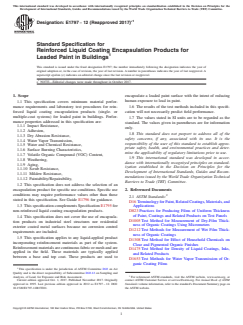
(Specification)Standard Specification for Reinforced Liquid Coating Encapsulation Products for Leaded Paint in Buildings
General Information
- Abstract
ABSTRACT
This specification covers minimum material performance requirements and laboratory test procedures for reinforced liquid coating encapsulation products (single- or multiple-coat systems) for leaded paint in buildings. It applies to any liquid-applied product incorporating reinforcement materials as part of the system. Reinforcement materials are continuous fabric or mesh and are applied in the field. These materials are typically applied between a base and top coat. These products are used to encapsulate a leaded paint surface with the intent of reducing human exposure to lead in paint. These are classified into three types which are Type I which are encapsulation products are intended for interior use, Type II which are encapsulation products intended for exterior use, and Type III which defines encapsulation products intended for either interior or exterior use. Different tests shall be conducted in order to determine the following performance properties for reinforced liquid coating encapsulation products such as impact resistance, adhesion, dry abrasion resistance, water vapor transmission, water resistance, chemical resistance, surface burning characteristics, volatile organic compound content, weathering, aging, scrub resistance, mildew resistance, paint ability and repairability. Testing conducted shall be performed on the entire encapsulation product system, whether single or multiple coat, as applied in the field, except for scrub resistance, volatile organic compound (VOC) content, and permeability, which are performed on the top coat only.
SCOPE
1.1 This specification covers minimum material performance requirements and laboratory test procedures for reinforced liquid coating encapsulation products (single- or multiple-coat systems) for leaded paint in buildings. Performance properties addressed in this specification are:
1.1.1 Impact Resistance,
1.1.2 Adhesion,
1.1.3 Dry Abrasion Resistance,
1.1.4 Water Vapor Transmission,
1.1.5 Water and Chemical Resistance,
1.1.6 Surface Burning Characteristics,
1.1.7 Volatile Organic Compound (VOC) Content,
1.1.8 Weathering,
1.1.9 Aging,
1.1.10 Scrub Resistance,
1.1.11 Mildew Resistance,
1.1.12 Paintability/Repairability,
1.2 This specification does not address the selection of an encapsulation product for specific use conditions. Specific use conditions may require performance values other than those stated in this specification. See Guide E1796 for guidance.
1.3 This specification complements Specification E1795 for non-reinforced liquid coating encapsulation products.
1.4 This specification does not cover the use of encapsulation products on industrial steel structures nor residential exterior coated metal surfaces because no corrosion control requirements are included.
1.5 This specification applies to any liquid-applied product incorporating reinforcement materials as part of the system. Reinforcement materials are continuous fabric or mesh and are applied in the field. These materials are typically applied between a base and top coat. These products are used to encapsulate a leaded paint surface with the intent of reducing human exposure to lead in paint.
1.6 The results of the test methods included in this specification will not necessarily predict field performance.
1.7 The values stated in SI units are to be regarded as the standard. The values given in parentheses are for information only.
1.8 This standard does not purport to address all of the safety concerns, if any, associated with its use. It is the responsibility of the user of this standard to establish appropriate safety, health, and environmental practices and determine the applicability of regulatory limitations prior to use.
1.9 This international standard was developed in accordance with internationally recognized principles on standardization established in the Decision on Principles for the Development of International Sta...
- Status
- Published
- Publication Date
- 30-Sep-2017
- Technical Committee
- D22 - Air Quality
- Drafting Committee
- D22.12 - Sampling and Analysis of Lead for Exposure and Risk Assessment
Overview
ASTM E1797-12(2017)e1: Standard Specification for Reinforced Liquid Coating Encapsulation Products for Leaded Paint in Buildings specifies minimum material performance requirements and laboratory test procedures for reinforced liquid coating encapsulation products. These products, incorporating field-applied reinforcement materials such as continuous fabric or mesh, are designed to encapsulate surfaces coated with lead-based paint. The primary aim is to effectively reduce human exposure to lead hazards in residential, commercial, and institutional buildings.
This ASTM standard defines performance criteria, categorizes encapsulation products by their intended use environments (interior, exterior, or both), and outlines essential laboratory testing protocols to ensure reliable and consistent results across all reinforced liquid coating encapsulation systems.
Key Topics
Performance Requirements: The standard establishes minimum acceptable performance characteristics for encapsulation products, covering:
- Impact resistance
- Adhesion
- Dry abrasion resistance
- Water vapor transmission
- Water and chemical resistance
- Surface burning characteristics
- Volatile organic compound (VOC) content
- Weathering (for exterior products)
- Aging (for both interior and exterior products)
- Scrub resistance
- Mildew resistance
- Paintability and repairability
Classification of Products:
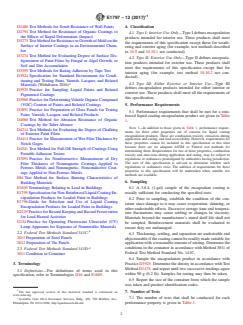
- Type I: For interior use only
- Type II: For exterior use only
- Type III: Suitable for both interior and exterior applications
Testing Procedures: Testing must be conducted on the complete encapsulation system (base coat, reinforcement, top coat) as applied in the field, except for certain tests (scrub resistance, VOC content, permeability), which focus on the top coat.
Limitations: The standard does not address product selection for specific site conditions or performance on industrial steel structures or exterior coated metal surfaces lacking corrosion protection.
Applications
ASTM E1797-12(2017)e1 has practical value in several key areas:
- Lead Hazard Reduction: Used by building owners, contractors, and regulatory agencies to safely manage and mitigate risks from existing leaded paint in buildings without removal or abatement.
- Product Evaluation and Selection: Helps architects, specification writers, and procurement teams understand which reinforced liquid coating encapsulation systems meet minimum performance requirements for designated environments.
- Quality Assurance and Compliance: Assists manufacturers and third-party laboratories in conducting standardized tests to ensure product consistency, reliability, and regulatory compliance.
- Building Maintenance and Renovation: Facilitates safe and compliant renovation projects by specifying reliable encapsulation solutions for surfaces with leaded coatings, minimizing disturbance and worker exposure.
- Public Health and Safety: Supports efforts to achieve healthier indoor environments by reducing lead exposure risks, especially in schools, childcare facilities, and older residential properties.
Related Standards
This specification references several associated ASTM standards for terminology and test methods, ensuring robust and repeatable results:
- ASTM E1795: Standard Specification for Non-Reinforced Liquid Coating Encapsulation Products for Leaded Paint in Buildings
- ASTM E1796: Guide for Selection and Use of Liquid Coating Encapsulation Products for Leaded Paint in Buildings
- ASTM D4541: Test Method for Pull-Off Strength of Coatings Using Portable Adhesion Testers
- ASTM D4060: Test Method for Abrasion Resistance of Organic Coatings by the Taber Abraser
- ASTM D3960: Practice for Determining Volatile Organic Compound (VOC) Content of Paints and Related Coatings
- ASTM D3273 & D3274: Mildew Resistance and Surface Disfigurement Tests
For more information or to access referenced documents, visit the ASTM International website.
Conclusion
The ASTM E1797-12(2017)e1 standard provides manufacturers, regulators, and building professionals with clear, actionable requirements for reinforced liquid coating encapsulation products used for lead hazard control in buildings. By adhering to these specifications, stakeholders can ensure product performance, safety, and regulatory compliance, supporting public health and safer building environments.
Relations
- Effective Date
- 01-Oct-2017
- Effective Date
- 01-Mar-2024
- Effective Date
- 01-Mar-2024
- Effective Date
- 15-Jan-2024
- Effective Date
- 01-Jan-2024
- Effective Date
- 01-Dec-2023
- Refers
ASTM D4214-23 - Standard Test Methods for Evaluating the Degree of Chalking of Exterior Paint Films - Effective Date
- 01-Oct-2023
- Effective Date
- 01-Sep-2023
- Effective Date
- 01-Jun-2020
- Effective Date
- 01-Jun-2020
- Effective Date
- 01-Jun-2020
- Effective Date
- 01-Jul-2019
- Effective Date
- 15-Apr-2019
- Effective Date
- 01-Mar-2019
- Effective Date
- 15-Dec-2018
Frequently Asked Questions
ASTM E1797-12(2017)e1 is a technical specification published by ASTM International. Its full title is "Standard Specification for Reinforced Liquid Coating Encapsulation Products for Leaded Paint in Buildings". This standard covers: ABSTRACT This specification covers minimum material performance requirements and laboratory test procedures for reinforced liquid coating encapsulation products (single- or multiple-coat systems) for leaded paint in buildings. It applies to any liquid-applied product incorporating reinforcement materials as part of the system. Reinforcement materials are continuous fabric or mesh and are applied in the field. These materials are typically applied between a base and top coat. These products are used to encapsulate a leaded paint surface with the intent of reducing human exposure to lead in paint. These are classified into three types which are Type I which are encapsulation products are intended for interior use, Type II which are encapsulation products intended for exterior use, and Type III which defines encapsulation products intended for either interior or exterior use. Different tests shall be conducted in order to determine the following performance properties for reinforced liquid coating encapsulation products such as impact resistance, adhesion, dry abrasion resistance, water vapor transmission, water resistance, chemical resistance, surface burning characteristics, volatile organic compound content, weathering, aging, scrub resistance, mildew resistance, paint ability and repairability. Testing conducted shall be performed on the entire encapsulation product system, whether single or multiple coat, as applied in the field, except for scrub resistance, volatile organic compound (VOC) content, and permeability, which are performed on the top coat only. SCOPE 1.1 This specification covers minimum material performance requirements and laboratory test procedures for reinforced liquid coating encapsulation products (single- or multiple-coat systems) for leaded paint in buildings. Performance properties addressed in this specification are: 1.1.1 Impact Resistance, 1.1.2 Adhesion, 1.1.3 Dry Abrasion Resistance, 1.1.4 Water Vapor Transmission, 1.1.5 Water and Chemical Resistance, 1.1.6 Surface Burning Characteristics, 1.1.7 Volatile Organic Compound (VOC) Content, 1.1.8 Weathering, 1.1.9 Aging, 1.1.10 Scrub Resistance, 1.1.11 Mildew Resistance, 1.1.12 Paintability/Repairability, 1.2 This specification does not address the selection of an encapsulation product for specific use conditions. Specific use conditions may require performance values other than those stated in this specification. See Guide E1796 for guidance. 1.3 This specification complements Specification E1795 for non-reinforced liquid coating encapsulation products. 1.4 This specification does not cover the use of encapsulation products on industrial steel structures nor residential exterior coated metal surfaces because no corrosion control requirements are included. 1.5 This specification applies to any liquid-applied product incorporating reinforcement materials as part of the system. Reinforcement materials are continuous fabric or mesh and are applied in the field. These materials are typically applied between a base and top coat. These products are used to encapsulate a leaded paint surface with the intent of reducing human exposure to lead in paint. 1.6 The results of the test methods included in this specification will not necessarily predict field performance. 1.7 The values stated in SI units are to be regarded as the standard. The values given in parentheses are for information only. 1.8 This standard does not purport to address all of the safety concerns, if any, associated with its use. It is the responsibility of the user of this standard to establish appropriate safety, health, and environmental practices and determine the applicability of regulatory limitations prior to use. 1.9 This international standard was developed in accordance with internationally recognized principles on standardization established in the Decision on Principles for the Development of International Sta...
ABSTRACT This specification covers minimum material performance requirements and laboratory test procedures for reinforced liquid coating encapsulation products (single- or multiple-coat systems) for leaded paint in buildings. It applies to any liquid-applied product incorporating reinforcement materials as part of the system. Reinforcement materials are continuous fabric or mesh and are applied in the field. These materials are typically applied between a base and top coat. These products are used to encapsulate a leaded paint surface with the intent of reducing human exposure to lead in paint. These are classified into three types which are Type I which are encapsulation products are intended for interior use, Type II which are encapsulation products intended for exterior use, and Type III which defines encapsulation products intended for either interior or exterior use. Different tests shall be conducted in order to determine the following performance properties for reinforced liquid coating encapsulation products such as impact resistance, adhesion, dry abrasion resistance, water vapor transmission, water resistance, chemical resistance, surface burning characteristics, volatile organic compound content, weathering, aging, scrub resistance, mildew resistance, paint ability and repairability. Testing conducted shall be performed on the entire encapsulation product system, whether single or multiple coat, as applied in the field, except for scrub resistance, volatile organic compound (VOC) content, and permeability, which are performed on the top coat only. SCOPE 1.1 This specification covers minimum material performance requirements and laboratory test procedures for reinforced liquid coating encapsulation products (single- or multiple-coat systems) for leaded paint in buildings. Performance properties addressed in this specification are: 1.1.1 Impact Resistance, 1.1.2 Adhesion, 1.1.3 Dry Abrasion Resistance, 1.1.4 Water Vapor Transmission, 1.1.5 Water and Chemical Resistance, 1.1.6 Surface Burning Characteristics, 1.1.7 Volatile Organic Compound (VOC) Content, 1.1.8 Weathering, 1.1.9 Aging, 1.1.10 Scrub Resistance, 1.1.11 Mildew Resistance, 1.1.12 Paintability/Repairability, 1.2 This specification does not address the selection of an encapsulation product for specific use conditions. Specific use conditions may require performance values other than those stated in this specification. See Guide E1796 for guidance. 1.3 This specification complements Specification E1795 for non-reinforced liquid coating encapsulation products. 1.4 This specification does not cover the use of encapsulation products on industrial steel structures nor residential exterior coated metal surfaces because no corrosion control requirements are included. 1.5 This specification applies to any liquid-applied product incorporating reinforcement materials as part of the system. Reinforcement materials are continuous fabric or mesh and are applied in the field. These materials are typically applied between a base and top coat. These products are used to encapsulate a leaded paint surface with the intent of reducing human exposure to lead in paint. 1.6 The results of the test methods included in this specification will not necessarily predict field performance. 1.7 The values stated in SI units are to be regarded as the standard. The values given in parentheses are for information only. 1.8 This standard does not purport to address all of the safety concerns, if any, associated with its use. It is the responsibility of the user of this standard to establish appropriate safety, health, and environmental practices and determine the applicability of regulatory limitations prior to use. 1.9 This international standard was developed in accordance with internationally recognized principles on standardization established in the Decision on Principles for the Development of International Sta...
ASTM E1797-12(2017)e1 is classified under the following ICS (International Classification for Standards) categories: 87.040 - Paints and varnishes. The ICS classification helps identify the subject area and facilitates finding related standards.
ASTM E1797-12(2017)e1 has the following relationships with other standards: It is inter standard links to ASTM E1797-12, ASTM E2239-24, ASTM E1796-24, ASTM D2794-93(2024), ASTM D16-24, ASTM E84-23d, ASTM D4214-23, ASTM E84-23c, ASTM D1212-91(2020), ASTM D1005-95(2020), ASTM D4414-95(2020), ASTM E84-19b, ASTM E84-19a, ASTM E84-19, ASTM E1605-18b. Understanding these relationships helps ensure you are using the most current and applicable version of the standard.
ASTM E1797-12(2017)e1 is available in PDF format for immediate download after purchase. The document can be added to your cart and obtained through the secure checkout process. Digital delivery ensures instant access to the complete standard document.
Standards Content (Sample)
This international standard was developed in accordance with internationally recognized principles on standardization established in the Decision on Principles for the
Development of International Standards, Guides and Recommendations issued by the World Trade Organization Technical Barriers to Trade (TBT) Committee.
ϵ1
Designation:E1797 −12 (Reapproved 2017)
Standard Specification for
Reinforced Liquid Coating Encapsulation Products for
Leaded Paint in Buildings
This standard is issued under the fixed designation E1797; the number immediately following the designation indicates the year of
original adoption or, in the case of revision, the year of last revision.Anumber in parentheses indicates the year of last reapproval.A
superscript epsilon (´) indicates an editorial change since the last revision or reapproval.
ε NOTE—Editorial changes were made throughout in October 2017.
1. Scope encapsulate a leaded paint surface with the intent of reducing
human exposure to lead in paint.
1.1 This specification covers minimum material perfor-
mance requirements and laboratory test procedures for rein- 1.6 The results of the test methods included in this specifi-
forced liquid coating encapsulation products (single- or cation will not necessarily predict field performance.
multiple-coat systems) for leaded paint in buildings. Perfor-
1.7 The values stated in SI units are to be regarded as the
mance properties addressed in this specification are:
standard. The values given in parentheses are for information
1.1.1 Impact Resistance,
only.
1.1.2 Adhesion,
1.8 This standard does not purport to address all of the
1.1.3 Dry Abrasion Resistance,
safety concerns, if any, associated with its use. It is the
1.1.4 Water Vapor Transmission,
responsibility of the user of this standard to establish appro-
1.1.5 Water and Chemical Resistance,
priate safety, health, and environmental practices and deter-
1.1.6 Surface Burning Characteristics,
mine the applicability of regulatory limitations prior to use.
1.1.7 Volatile Organic Compound (VOC) Content,
1.9 This international standard was developed in accor-
1.1.8 Weathering,
dance with internationally recognized principles on standard-
1.1.9 Aging,
ization established in the Decision on Principles for the
1.1.10 Scrub Resistance,
Development of International Standards, Guides and Recom-
1.1.11 Mildew Resistance,
mendations issued by the World Trade Organization Technical
1.1.12 Paintability/Repairability,
Barriers to Trade (TBT) Committee.
1.2 This specification does not address the selection of an
encapsulation product for specific use conditions. Specific use
2. Referenced Documents
conditions may require performance values other than those
2.1 ASTM Standards:
stated in this specification. See Guide E1796 for guidance.
D16TerminologyforPaint,RelatedCoatings,Materials,and
1.3 This specification complements Specification E1795 for
Applications
non-reinforced liquid coating encapsulation products.
D823Practices for Producing Films of Uniform Thickness
of Paint, Coatings and Related Products on Test Panels
1.4 This specification does not cover the use of encapsula-
D1005Test Method for Measurement of Dry-Film Thick-
tion products on industrial steel structures nor residential
ness of Organic Coatings Using Micrometers
exterior coated metal surfaces because no corrosion control
D1212Test Methods for Measurement of Wet Film Thick-
requirements are included.
ness of Organic Coatings
1.5 This specification applies to any liquid-applied product
D1308Test Method for Effect of Household Chemicals on
incorporating reinforcement materials as part of the system.
Clear and Pigmented Organic Finishes
Reinforcementmaterialsarecontinuousfabricormeshandare
D1475Test Method for Density of Liquid Coatings, Inks,
applied in the field. These materials are typically applied
and Related Products
between a base and top coat. These products are used to
D1653Test Methods for Water Vapor Transmission of Or-
ganic Coating Films
This specification is under the jurisdiction of ASTM Committee D22 on Air
Quality and is the direct responsibility of Subcommittee D22.12 on Sampling and
Analysis, of Lead, for Exposure and Risk Assessment. For referenced ASTM standards, visit the ASTM website, www.astm.org, or
Current edition approved Oct. 1, 2017. Published November 2017. Originally contact ASTM Customer Service at service@astm.org. For Annual Book of ASTM
approved in 1995. Last previous edition approved in 2012 as E1797–12. DOI: Standards volume information, refer to the standard’s Document Summary page on
10.1520/E1797-12R17E01. the ASTM website.
Copyright © ASTM International, 100 Barr Harbor Drive, PO Box C700, West Conshohocken, PA 19428-2959. United States
ϵ1
E1797−12 (2017)
D2486Test Methods for Scrub Resistance of Wall Paints 4. Classification
D2794Test Method for Resistance of Organic Coatings to
4.1 Type I: Interior Use Only—TypeIdefinesencapsulation
the Effects of Rapid Deformation (Impact)
products intended for interior use. These products shall meet
D3273TestMethodforResistancetoGrowthofMoldonthe
the requirements of this specification except those for weath-
Surface of Interior Coatings in an Environmental Cham-
ering and exterior aging (for example, test methods described
ber
in 10.9 and 10.10.1 not conducted).
D3274Test Method for Evaluating Degree of Surface Dis-
4.2 Type II: Exterior Use Only—Type II defines encapsula-
figurement of Paint Films by Fungal or Algal Growth, or
tion products intended for exterior use. These products shall
Soil and Dirt Accumulation
meet the requirements of this specification except that for
D3359Test Methods for Rating Adhesion by Tape Test
interior aging (for example, test method 10.10.2 not con-
D3924Specification for Standard Environment for Condi-
ducted).
tioning and Testing Paint, Varnish, Lacquer, and Related
3 4.3 Type III: Either Exterior or Interior Use—Type III
Materials (Withdrawn 2016)
defines encapsulation products intended for either interior or
D3925Practice for Sampling Liquid Paints and Related
exterior use. These products shall meet all the requirements of
Pigmented Coatings
this specification.
D3960PracticeforDeterminingVolatileOrganicCompound
(VOC) Content of Paints and Related Coatings 5. Performance Requirements
D3891Practice for Preparation of Glass Panels for Testing
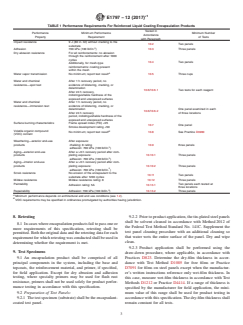
5.1 Performance requirements that shall be met for a rein-
Paint, Varnish, Lacquer, and Related Products
forced liquid coating encapsulation product are given in Table
D4060Test Method for Abrasion Resistance of Organic
1.
Coatings by the Taber Abraser
NOTE 1—In addition to those given in Table 1, performance require-
D4214Test Methods for Evaluating the Degree of Chalking
ments for three other properties are of concern for liquid coating
of Exterior Paint Films
encapsulation products. These are combustion toxicity, emissions during
D4414Practice for Measurement of Wet Film Thickness by application and curing, and lead accessibility. However, requirements for
these properties cannot be included in this specification at this time
Notch Gages
because there are no adequate ASTM or Federal test methods for
D4541Test Method for Pull-Off Strength of Coatings Using
determining them. Requirements for two of these properties, combustion
Portable Adhesion Testers
toxicity and emissions during application and curing, may be subject to
D7091Practice for Nondestructive Measurement of Dry
regulations or ordinances promulgated by authorities having jurisdiction.
The user of this specification is advised to determine whether such
Film Thickness of Nonmagnetic Coatings Applied to
regulations or ordinances exist. The addition of requirements for these
Ferrous Metals and Nonmagnetic, Nonconductive Coat-
properties to this specification will be undertaken when suitable test
ings Applied to Non-Ferrous Metals
methods are available.
E84Test Method for Surface Burning Characteristics of
6. Sampling
Building Materials
E1605Terminology Relating to Lead in Buildings 6.1 A 3.8-L (1-gal) sample of the encapsulant coating is
E1795SpecificationforNon-ReinforcedLiquidCoatingEn-
usually sufficient for conducting the specified tests.
capsulation Products for Leaded Paint in Buildings
6.2 Prior to sampling, establish the condition of the con-
E1796Guide for Selection and Use of Liquid Coating
tainer since damage to it may cause evaporation, skinning, or
Encapsulation Products for Leaded Paint in Buildings
other undesirable effects. Excessive storage time and tempera-
E2239PracticeforRecordKeepingandRecordPreservation
ture fluctuations may cause settling or changes in viscosity.
for Lead Hazard Activities
Materials beyond the manufacturer’s stated shelf life shall not
G154Practice for Operating Fluorescent Ultraviolet (UV)
be sampled. Reinforcement materials shall be evaluated to
Lamp Apparatus for Exposure of Nonmetallic Materials
ensure they are undamaged.
2.2 Federal Test Methods Standard 141C:
6.3 Thickening, settling, and separation are undesirable and
2011Preparation of Steel Panels
objectionableifthecoatingcannotbereadilymadesuitablefor
2012Preparation of Tin Panels
applicationwithareasonableamountofstirring.Determinethe
conditions in the container in accordance with Method3011 of
2.3 Federal Test Methods Standard 141D:
Federal Test Method Standard No. 141C.
3011Condition in Container
6.4 Sample the encapsulation product in accordance with
3. Terminology PracticeD3925.DeterminethedensityinaccordancewithTest
Method D1475, and repeat until two successive readings agree
3.1 Definitions—For definitions of terms used in this
within 90 g (0.2 lb). Samples for testing may then be taken.
specification, refer to Terminologies D16 and E1605.
6.5 Report the size of the container from which the sample
was taken and product identification codes.
The last approved version of this historical standard is referenced on
7. Number of Tests
www.astm.org.
7.1 The number of tests that shall be conducted for each
Available from DLA Document Services, Bldg. 4/D, 700 Robbins Ave.,
Philadelphia, PA 19111-5094, http://quicksearch.dla.mil. performance property is given in Table 1.
ϵ1
E1797−12 (2017)
TABLE 1 Performance Requirements For Reinforced Liquid Coating Encapsulation Products
Tested in
Performance Minimum Performance Minimum Number
Accordance
Property Requirement of Tests
with Paragraph
Impact resistance 9 J (80 in. lbf) without cracking to the
10.2 Two panels
substrate
Adhesion 700 kPa (100 lbf/in. ) 10.3 Three panels
Dry abrasion resistance For all reinforcements: no abrasion
through the reinforcement after 1000
cycles
10.4 Two panels
Additionally, for mesh-type
reinforcements: coating present
within the mesh
A
Water vapor transmission No minimum; report test result 10.5 Three cups
Water and chemical After 1 h recovery period, no
resistance—spot test evidence of blistering, cracking, or
delamination
10.6/10.6.1 Two tests for each reagent
After 24 h recovery,
indistinguishable hardness of the
exposed and unexposed surfaces
Water and chemical After 1 h recovery period, no
resistance—immersion test evidence of blistering, cracking, or
delamination One panel examined in each
10.6/10.6.2
After 24 h recovery of three locations
period, indistinguishable hardness of the
exposed and unexposed surfaces
Surface burning characteristics Flame spread index (FSI) <25
10.7 One panel
Smoke development rating <50
Volatile organic compound
B
No minimum; report test result 10.8 See Practice D3960
(VOC) content
Weathering—exterior end-use After exposure:
products chalking: 8 rating 10.9 three panels
adhesion: 700 kPa (100 lbf/in. )
Aging—exterior end-use After a >6 h recovery period after com-
products pleting exposure: 10.10.1 Three panels
adhesion: 700 kPa (100 lbf/in. )
Aging—interior end-use After a >6 h recovery period after com-
products pleting exposure: 10.10.2 Three panels
adhesion: 700 kPa (100 lbf/in. )
Scrub resistance No erosion of the encapsulant to the
10.11 Two panels
substrate after 1200 cycles
Mildew resistance Mildew resistance rating: 8 10.12 Three panels
Paintability Two panels each tested at
Adhesion rating: 5A 10.13.1
three locations
Repairability Adhesion: 700 kPa (100 lbf/in. ) 10.13.2 Three panels
A
Minimum performance depends on architectural and end use conditions (see 1.2).
B
VOC requirements may be specified in ordinances promulgated by authorities having jurisdiction.
8. Retesting 9.2.2 Priortoproductapplication,thetin-platedsteelpanels
shall be solvent cleaned in accordance with Method2012 of
8.1 Incaseswhereencapsulationproductsfailtopassoneor
the Federal Test Method Standard No. 141C. Supplement the
more requirements of this specification, retesting shall be
test panel cleaning procedure with an additional cleaning so
permitted.Boththeoriginaldataandtheretestingdataforeach
that water wets the entire surface of the panel. Dry and wipe
requirementforwhichretestingwasconductedshallbeusedin
clean.
determining whether the requirement is met.
9.2.3 Product application shall be performed using the
9. Test Specimens
draw-down procedure, where applicable, in accordance with
9.1 An encapsulation product shall be comprised of all Practices D823. Determine the dry-film thickness in accor-
principal components in the system, including the base and
dance with Test Method D1005 for free films or Practice
topcoats, the reinforcement material, and primer, if specified,
D7091 for films on steel panels except when the manufactur-
for field application. Except for dry abrasion and adhesion
er’s written instructions reference only wet-film thickness. In
testing, where specialty primers may be used for flash rust
this case, measure wet-film thickness in accordance with Test
resistance, primers shall not be used solely for product per
...