

ASTM D8283-19
(Practice)Standard Practice for Cleaning and Certification of Specially Prepared Canisters
General Information
- Abstract
SIGNIFICANCE AND USE
5.1 Whole-air sampling vessels are cited and utilized throughout a variety of internationally, nationally, and regionally applied documents and test methods, yet the methods generally fail to uniformly specify criteria used to qualify the use and re-use of sample containers. This practice describes a set of best practices for reusable containers and canister media cleaning, quality control (QC) objectives, and corrective actions necessary to ensure equipment that meets cleanliness needs of their intended use.
SCOPE
1.1 This practice describes procedures to clean and verify the cleanliness of reusable sample containers used in air sampling and analysis applications, which includes but is not limited to passivated stainless steel canisters and rigid containers of other material specifically designed for whole-air sampling. This practice describes the steps used to clean volatile substance from canister interiors and document cleanliness prior to re-use.
1.2 The values stated in SI units are to be regarded as standard. No other units of measurement are included in this standard.
1.3 This standard does not purport to address all of the safety concerns, if any, associated with its use. It is the responsibility of the user of this standard to establish appropriate safety, health, and environmental practices and determine the applicability of regulatory limitations prior to use.
1.4 This international standard was developed in accordance with internationally recognized principles on standardization established in the Decision on Principles for the Development of International Standards, Guides and Recommendations issued by the World Trade Organization Technical Barriers to Trade (TBT) Committee.
- Status
- Published
- Publication Date
- 14-Dec-2019
- Technical Committee
- D22 - Air Quality
- Drafting Committee
- D22.05 - Indoor Air
Overview
ASTM D8283-19: Standard Practice for Cleaning and Certification of Specially Prepared Canisters provides an internationally recognized methodology for cleaning and certifying reusable sample containers primarily used in air sampling and analysis. Published by ASTM International, this standard addresses the critical need for uniform best practices, robust quality control (QC) measures, and effective corrective actions to ensure the cleanliness and suitability of canisters and similar sampling vessels. The guidance is applicable to passivated stainless steel canisters and other rigid, purpose-designed containers, supporting confidence in the reliability of subsequent analytical results.
Key Topics
- Reusable Sample Containers: Procedures for cleaning, certifying, and verifying cleanliness of canisters and containers meant for collecting whole-air samples.
- Best Practices in Cleaning: Recommendations regarding evacuation, purging with zero-grade air or nitrogen, humidity control, and temperature management to remove volatile residues.
- Quality Control Objectives: Criteria for selecting quality control canisters, batch analysis and acceptance criteria to verify the effectiveness of cleaning procedures.
- Corrective Actions: Steps to resolve failures such as leak checks, valve failures, and batch re-cleaning to ensure continued compliance.
- Documentation and Traceability: Requirements for data logging, archiving analytical and cleaning records, and maintaining traceability for regulatory or laboratory audits.
- Health, Safety, and Environmental Considerations: Guidance for minimizing risks associated with electrical hazards, fire, exposure to solvents, and proper waste management.
- Standardized Terminology: Consistent definitions (e.g., passivated canister, cleaning batch, virgin canister, QC canister) simplify communication across laboratories and regulatory agencies.
Applications
The ASTM D8283-19 standard is relevant in a number of key areas:
- Environmental Air Quality Monitoring: Ensures canisters used for volatile organic compound (VOC) sampling are free from cross-contamination, supporting compliance with regulatory methods such as EPA TO-15.
- Industrial Hygiene and Occupational Health: Critical for air sampling in workplaces, helping to maintain reliable monitoring of hazardous substances.
- Analytical Laboratories: Laboratories performing whole-air sampling in canisters for trace-level analysis benefit from defined cleaning cycles and QC protocols, supporting data credibility and regulatory acceptance.
- Military and Governmental Use: Used by defense and environmental agencies following protocols like the DoD Quality Systems Manual for Environmental Laboratories.
- Research and Development: Academics and research institutions use these guidelines to support air sampling and analysis studies demanding high data quality and reproducibility.
Proper implementation of ASTM D8283-19 reduces contamination risk, extends canister life, and upholds high standards in trace-level air analysis.
Related Standards
When applying ASTM D8283-19, consider these related standards and references:
- ASTM D1193: Specification for reagent water, critical for cleaning and rinsing steps.
- ASTM D1356: Terminology relating to sampling and analysis of atmospheres.
- ASTM D5466: Test method for determination of volatile organic compounds in atmospheres (canister sampling methodology).
- EPA Compendium Method TO-15: Determination of VOCs in air collected in specially-prepared canisters.
- NATTs Technical Assistance Document: Guidelines for the National Air Toxics Trends Stations Program.
- DoD Quality Systems Manual for Environmental Laboratories: Governmental reference manual prescribing quality practices for sampling and analysis.
By following ASTM D8283-19 in conjunction with these associated documents, organizations enhance the accuracy, consistency, and quality of air sampling processes, ensuring compliance with both international and national standards.
Relations
- Effective Date
- 01-Sep-2020
- Effective Date
- 15-Mar-2020
- Effective Date
- 15-Oct-2015
- Effective Date
- 01-Jul-2015
- Effective Date
- 01-Dec-2014
- Effective Date
- 01-May-2014
- Effective Date
- 15-Jan-2014
- Effective Date
- 01-Apr-2010
- Effective Date
- 01-Apr-2007
- Effective Date
- 01-Mar-2006
- Effective Date
- 01-May-2005
- Effective Date
- 10-Dec-2001
- Effective Date
- 10-Dec-2001
- Effective Date
- 10-Nov-2000
- Effective Date
- 10-Feb-1999
Get Certified
Connect with accredited certification bodies for this standard

ECOCERT
Organic and sustainability certification.

Eurofins Food Testing Global
Global leader in food, environment, and pharmaceutical product testing.

Intertek Bangladesh
Intertek certification and testing services in Bangladesh.
Sponsored listings
Frequently Asked Questions
ASTM D8283-19 is a standard published by ASTM International. Its full title is "Standard Practice for Cleaning and Certification of Specially Prepared Canisters". This standard covers: SIGNIFICANCE AND USE 5.1 Whole-air sampling vessels are cited and utilized throughout a variety of internationally, nationally, and regionally applied documents and test methods, yet the methods generally fail to uniformly specify criteria used to qualify the use and re-use of sample containers. This practice describes a set of best practices for reusable containers and canister media cleaning, quality control (QC) objectives, and corrective actions necessary to ensure equipment that meets cleanliness needs of their intended use. SCOPE 1.1 This practice describes procedures to clean and verify the cleanliness of reusable sample containers used in air sampling and analysis applications, which includes but is not limited to passivated stainless steel canisters and rigid containers of other material specifically designed for whole-air sampling. This practice describes the steps used to clean volatile substance from canister interiors and document cleanliness prior to re-use. 1.2 The values stated in SI units are to be regarded as standard. No other units of measurement are included in this standard. 1.3 This standard does not purport to address all of the safety concerns, if any, associated with its use. It is the responsibility of the user of this standard to establish appropriate safety, health, and environmental practices and determine the applicability of regulatory limitations prior to use. 1.4 This international standard was developed in accordance with internationally recognized principles on standardization established in the Decision on Principles for the Development of International Standards, Guides and Recommendations issued by the World Trade Organization Technical Barriers to Trade (TBT) Committee.
SIGNIFICANCE AND USE 5.1 Whole-air sampling vessels are cited and utilized throughout a variety of internationally, nationally, and regionally applied documents and test methods, yet the methods generally fail to uniformly specify criteria used to qualify the use and re-use of sample containers. This practice describes a set of best practices for reusable containers and canister media cleaning, quality control (QC) objectives, and corrective actions necessary to ensure equipment that meets cleanliness needs of their intended use. SCOPE 1.1 This practice describes procedures to clean and verify the cleanliness of reusable sample containers used in air sampling and analysis applications, which includes but is not limited to passivated stainless steel canisters and rigid containers of other material specifically designed for whole-air sampling. This practice describes the steps used to clean volatile substance from canister interiors and document cleanliness prior to re-use. 1.2 The values stated in SI units are to be regarded as standard. No other units of measurement are included in this standard. 1.3 This standard does not purport to address all of the safety concerns, if any, associated with its use. It is the responsibility of the user of this standard to establish appropriate safety, health, and environmental practices and determine the applicability of regulatory limitations prior to use. 1.4 This international standard was developed in accordance with internationally recognized principles on standardization established in the Decision on Principles for the Development of International Standards, Guides and Recommendations issued by the World Trade Organization Technical Barriers to Trade (TBT) Committee.
ASTM D8283-19 is classified under the following ICS (International Classification for Standards) categories: 71.040.20 - Laboratory ware and related apparatus. The ICS classification helps identify the subject area and facilitates finding related standards.
ASTM D8283-19 has the following relationships with other standards: It is inter standard links to ASTM D1356-20a, ASTM D1356-20, ASTM D1356-15a, ASTM D1356-15, ASTM D1356-14b, ASTM D1356-14a, ASTM D1356-14, ASTM D1356-05(2010), ASTM D5466-01(2007), ASTM D1193-06, ASTM D1356-05, ASTM D5466-95, ASTM D5466-01, ASTM D1356-00a, ASTM D1193-99. Understanding these relationships helps ensure you are using the most current and applicable version of the standard.
ASTM D8283-19 is available in PDF format for immediate download after purchase. The document can be added to your cart and obtained through the secure checkout process. Digital delivery ensures instant access to the complete standard document.
Standards Content (Sample)
This international standard was developed in accordance with internationally recognized principles on standardization established in the Decision on Principles for the
Development of International Standards, Guides and Recommendations issued by the World Trade Organization Technical Barriers to Trade (TBT) Committee.
Designation:D8283 −19
Standard Practice for
Cleaning and Certification of Specially Prepared Canisters
This standard is issued under the fixed designation D8283; the number immediately following the designation indicates the year of
original adoption or, in the case of revision, the year of last revision. A number in parentheses indicates the year of last reapproval. A
superscript epsilon (´) indicates an editorial change since the last revision or reapproval.
1. Scope 2.2 EPA Documents:
EPA TO-15 Compendium Method TO-15, Determination of
1.1 This practice describes procedures to clean and verify
Volatile Organic Compounds (VOCs) in Air Collected in
the cleanliness of reusable sample containers used in air
Specially-Prepared Canisters and Analyzed by Gas
sampling and analysis applications, which includes but is not
Chromatography/Mass Spectrometry (GC/MS), Compen-
limited to passivated stainless steel canisters and rigid contain-
dium of Methods for the Determination of Toxic Organic
ers of other material specifically designed for whole-air sam-
Compounds in Ambient Air, second edition, January 1999
pling. This practice describes the steps used to clean volatile
NATTs EPA Technical Assistance Document for the Na-
substance from canister interiors and document cleanliness
tional Air Toxics Trends Stations Program, revision 3,
prior to re-use.
October 2016
1.2 The values stated in SI units are to be regarded as 4
2.3 DoD Document:
standard. No other units of measurement are included in this
DoD Department of Defense Quality Systems Manual for
standard.
Environmental Laboratories, version 5.1.1, 2018
1.3 This standard does not purport to address all of the
3. Terminology
safety concerns, if any, associated with its use. It is the
3.1 Definitions—
responsibility of the user of this standard to establish appro-
3.1.1 For definitions of terms used in this practice, refer to
priate safety, health, and environmental practices and deter-
Terminology D1356.
mine the applicability of regulatory limitations prior to use.
1.4 This international standard was developed in accor-
3.2 Definitions of Terms Specific to This Standard:
dance with internationally recognized principles on standard-
3.2.1 cleaning batch, n—a grouping of canisters cleaned
ization established in the Decision on Principles for the
concurrently on the same cleaning “system” (heated isothermal
Development of International Standards, Guides and Recom-
or unheated).
mendations issued by the World Trade Organization Technical
3.2.1.1 Discussion—Typical sizes range from 4 to 20
Barriers to Trade (TBT) Committee.
canisters/batch.
3.2.2 cleaning cycle, n—a standardized duration in which
2. Referenced Documents
canisters are serially filled and evacuated.
2.1 ASTM Standards:
3.2.2.1 Discussion—This process can be automated or
D1193 Specification for Reagent Water
D1356 Terminology Relating to Sampling and Analysis of manual depending on application.
3.2.3 contaminated canister, n—a canister pending cleaning
Atmospheres
D5466 Test Method for Determination of Volatile Organic and cleanliness verification/re-certification.
Compounds in Atmospheres (Canister Sampling Method-
3.2.4 other prepared containers or vessels, n—other rigid
ology)
containers designed for re-use, which may include but is not
limited to inert-coated glass bottles used for collecting whole
air samples.
This practice is under the jurisdiction ofASTM Committee D22 on Air Quality
and is the direct responsibility of Subcommittee D22.05 on Indoor Air.
Current edition approved Dec. 15, 2019. Published February 2020. DOI: AvailablefromUnitedStatesEnvironmentalProtectionAgency(EPA),William
10.1520/D8283-19. Jefferson Clinton Bldg., 1200 Pennsylvania Ave., NW, Washington, DC 20460,
For referenced ASTM standards, visit the ASTM website, www.astm.org, or http://www.epa.gov.
contact ASTM Customer Service at service@astm.org. For Annual Book of ASTM Available from U.S. Government Printing Office, Superintendent of
Standards volume information, refer to the standard’s Document Summary page on Documents, 732 N. Capitol St., NW, Washington, DC 20401-0001, http://
the ASTM website. www.access.gpo.gov.
Copyright © ASTM International, 100 Barr Harbor Drive, PO Box C700, West Conshohocken, PA 19428-2959. United States
D8283−19
3.2.5 passivated canister, n—a stainless steel air sampling 7. Hazards
canister whose inner surface is first electropolished to decrease
7.1 Electrical Shock—All electrical wiring should be peri-
surface roughness.
odically checked for insulation cuts and chafing as electrical
shock can occur from exposed wires.
3.2.5.1 Discussion—The electropolishing may be followed
by application of either a coating of nickel/chromium oxide (or
7.2 Fires—All flammable materials, especially solvents,
similar) or a layer of fused silica (silicon dioxide) so as to
shall be kept clear of the cleaning system and pumps since the
increase the canister’s inertness as compared to untreated
canister heaters generate considerable heat.
stainless steel.
7.3 Pollution Prevention and Waste Management—Air
3.2.6 quality control canister (QC canister), n—canisterthat
purged from canisters via vacuum pumps should be discharged
is selected and analyzed from a cleaning batch to verify
under a fume hood or to the outside air.
canister cleanliness requirements have been satisfied.
8. Equipment and Supplies
3.2.7 virgin canister, n—a canister that is pending its initial
cleaning, verification and certification.
8.1 Initial Evacuation System—A manifold system for
evacuating the canister constituents prior to cleaning may be
3.2.8 zero-grade air or nitrogen, n—“hydrocarbon-free” air
used. While initial evacuation is not necessary, it may assist
or nitrogen used as purge/fill gas, with typically <0.10 ppmv of
expediting the cleaning process and may be used to prevent
total hydrocarbons.
gross contamination of the canister cleaning system.
8.1.1 The vacuum manifold consists of a vacuum pump and
4. Summary of Practice
may include a gas supply connected to a series of canister
4.1 This procedure describes Best Practices for cleaning
positions, which connect directly to the canister to be evacu-
and certifying reusable sample vessels designed for volatile
ated.
organic compound collection. Contaminated and virgin canis-
8.1.2 The purge cycles may be controlled automatically
ters are first evacuated to remove the bulk contents from each
with a three-way solenoid valve; one position connects to the
canister. Once evacuated, the canisters are connected to a
gas source, the second position connects to a pump, and the
cleaning system, where they are serially evacuated and filled
third position connects to the manifold. The canisters are then
with humidified zero air or nitrogen. Depending on canister
purged by serial evacuation and dilution.
cleanliness and the system used, this process may take any-
8.1.3 Recommendations on the quantity and duration of
where from a few hours to a few days to complete. Following
cycles recommendation is not given within this practice, as the
the cleaning process, a minimum of one canister per batch or 5
parameters are dependent on the container contents.
% of the total batch, whichever is larger, is selected as the QC
8.2 Canister Cleaning System—The canister cleaning sys-
canister(s). The QC canister is analyzed for target compounds
tem is comprised of cleaning manifolds, a gas source, high
of concern using the same analytical test method as applied to
vacuum pump(s), vacuum/pressure gauges, humidification ap-
the intended samples, or other accepted analytical method that
paratusifnecessary,andanovencapableofmaintaining100°C
has demonstrated equivalent performance. Following the
6 10°C.
cleaning procedure, the canisters are either pressurized or
evacuated and stored for a minimum of 24 hours to verify that 8.3 Canister Manifolds—Manifolds are, typically, con-
the canisters do not leak. The pressure of each canister is structed of tubing made of stainless steel. Canisters are
evaluated using a calibrated pressure/vacuum gauge and the attached to the oven manifold with a compression fitting. Each
results are recorded. All canister batches that pass both the manifold has its own pump and vacuum gauge, but may share
batch QC and individual leak check are verified as ready for a common gas source.
use. 8.3.1 Vacuum Pumps—Typical pumps that can be used
include, but are not limited to: dual-stage direct driven rotary-
vane type, two-stage oil-less pumping system comprised of a
5. Significance and Use
molecular drag pump backed by a diaphragm-type roughing
5.1 Whole-air sampling vessels are cited and utilized
pump with integrated vacuum controller, or other pump ca-
throughout a variety of internationally, nationally, and region-
pable of allowing the cleaning and final evacuation process to
ally applied documents and test methods, yet the methods
meet the intended use cleanliness objectives.
generally fail to uniformly specify criteria used to qualify the
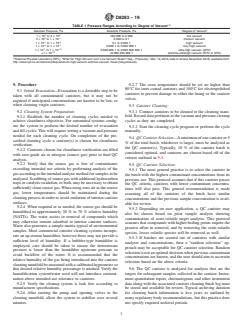
8.3.1.1 A definition criteria table for various vacuum levels
use and re-use of sample containers. This practice describes a
can be found in Table 1.
set of best practices for reusable containers and canister media
8.3.2 Electric Ovens with Single or Multi-Connection
cleaning, quality control (QC) objectives, and corrective ac-
Manifold—Canisters are heated during the cleaning process.
tions necessary to ensure equipment that meets cleanliness
Degradation of the canister coating can occur if the canister
needs of their intended use.
exceeds manufactures specified limits, and so a typical maxi-
mumheatingtemperatureis100°C 610°C,butmaybeashigh
6. Reagents
as 110°C 6 10°C.
6.1 Purity of Water—Unless otherwise indicated, references 8.3.2.1 The maximum allowable oven temperature may be
to water shall be understood to mean reagent water as defined lower than 100°C 6 10°C depending on canister manufacturer
by Type I or II of Specification D1193. recommendations.
D8283−19
A
TABLE 1 Pressure Ranges According to ‘Degree of Vacuum’
Absolute Pressure, Pa Absolute Pressure, Pa ‘Degree of Vacuum’
5 3
1×10 to3×10 100 000 to 3 000 low vacuum
3 -1
3×10 to1×10 3 000 to 0.1 medium vacuum
-1 -4
1×10 to1×10 0.1 to 0.000 1 high vacuum
-4 -7
1×10 to1×10 0.000 1 to 0.000 000 1 very high vacuum
-7 -10
1×10 to1×10 0.000 000 1 to 0.000 000 000 1 ultra-high vacuum (UHV)
-10
<1×10 <0.000 000 000 1 extreme-ultrahigh vacuum (EHV or XHV)
A
National Physical Laboratory (NPL), “What Do ‘High Vacuum’ and ‘Low Vacuum’ Mean? (faq – Pressure),” Mar. 10, 2010, date of access November 2018, available from:
http://www.npl.co.uk/reference/faqs/what-do-high-vacuum-and-low-vacuum-mean-(faq-pressure).
9. Procedure 9.2.7 The oven temperature should be set no higher than
80°C for inert-coated canisters and 100°C for electropolished
9.1 Initial Evacuation—Evacuation is a desirable step to be
canisters to prevent damage to either the lining or the canister
taken with all contaminated canisters, but it may not be
valves.
required if anticipated concentrations are known to be low, or
when cleaning virgin canisters.
9.3 Canister Cleaning:
9.3.1 Connect canisters to be cleaned to the cleaning mani-
9.2 Cleaning System Preparation:
fold. Record data pertinent to the vacuum and pressure cleanup
9.2.1 Establish the number of cleaning cycles needed to
cycles as they are completed.
achieve cleanliness objectives. For automated systems config-
ure the system to perform the desired number of evacuation
9.3.2 Start the cleaning cycle program or perform the cycle
and fill cycles. This will require setting a vacuum and pressure
manually.
needed for each cleaning cycle. On completion of the pre-
9.4 QC Canister Selection—Aminimumofonecanisteror5
scribed cleaning c
...