

ASTM D3159-22
(Specification)Standard Specification for Modified ETFE Fluoropolymer Molding and Extrusion Materials
General Information
- Abstract
ABSTRACT
This specification covers melt processible molding and extrusion materials of modified ETFE-fluoropolymer. The ETFE resin is a copolymer of ethylene containing approximately 75 mass% of tetrafluoroethylene. This specification addresses virgin materials only as performance requirements cannot be met with recycled material. Modified ETFE-fluoropolymers shall be supplied in pellet form and classified into five types according to their specific gravity. Furthermore, the resins of each type are divided into three grades according to their melt flow rate. Materials shall be sampled, prepared, and conditioned as appropriate for testing, wherein the following performance requirements must be met: melting point and flow rate; melting endotherm peak temperature; specific gravity; tensile properties (tensile strength and elongation); and dielectric constant and dissipation factor.
SCOPE
1.1 This specification covers molding and extrusion materials of modified ETFE fluoropolymer. The ETFE resin is a copolymer of ethylene and tetrafluoroethylene. Modified ETFE resin contains no more than 5 mole % of other fluoromonomers.
1.2 The values stated in SI units as detailed in IEEE/ASTM SI-10 are to be regarded as standard. The values given in parentheses are for information only.
Note 1: Although this specification and ISO 20568-1 and ISO 20568-2 differ in approach or detail, data obtained using either are technically equivalent.
1.3 The following safety hazards caveat pertains only to the test method portion, Section 11, of this specification. This standard does not purport to address all of the safety concerns, if any, associated with its use. It is the responsibility of the user of this standard to establish appropriate safety, health, and environmental practices and determine the applicability of regulatory limitations prior to use.
1.4 Recycled material is not appropriate for this specification because performance requirements cannot be met with recycled material. Therefore, this specification is for virgin material only.
1.5 This international standard was developed in accordance with internationally recognized principles on standardization established in the Decision on Principles for the Development of International Standards, Guides and Recommendations issued by the World Trade Organization Technical Barriers to Trade (TBT) Committee.
- Status
- Published
- Publication Date
- 14-Mar-2022
- Technical Committee
- D20 - Plastics
- Drafting Committee
- D20.15 - Thermoplastic Materials
Buy Documents
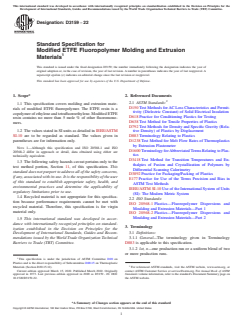
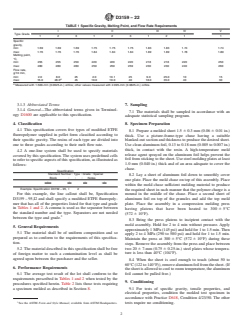
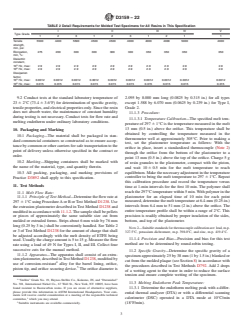
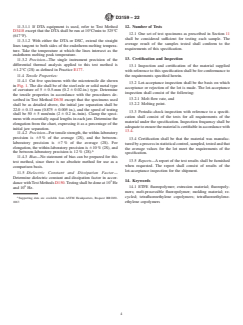
ASTM D3159-22 - Standard Specification for Modified ETFE Fluoropolymer Molding and Extrusion Materials
REDLINE ASTM D3159-22 - Standard Specification for Modified ETFE Fluoropolymer Molding and Extrusion Materials
Overview
ASTM D3159-22: Standard Specification for Modified ETFE Fluoropolymer Molding and Extrusion Materials establishes guidelines for melt processible, virgin modified ETFE (Ethylene Tetrafluoroethylene) fluoropolymer resins intended for molding and extrusion processes. ETFE is a copolymer of ethylene and approximately 75% (by mass) tetrafluoroethylene, with no more than 5 mole % of additional fluoromonomers in the modified resin. This specification ensures high performance, quality, and consistency in ETFE materials, making it a reference point for manufacturers, suppliers, and end-users focused on advanced engineering plastic applications.
Key Topics
- Material Scope: Covers only virgin, not recycled, ETFE fluoropolymers due to the stringent performance requirements that cannot be met with recycled content.
- Classification System:
- Five Types based on specific gravity of the ETFE resin pellets.
- Three Grades within each type determined by melt flow rate.
- Physical and Electrical Performance:
- Melting point and flow rate
- Specific gravity
- Tensile strength and elongation
- Dielectric constant and dissipation factor
- Specimen Preparation and Testing:
- Standardized methods for sampling, specimen molding, and conditioning
- Reference to established ASTM test methods (e.g., D638 for tensile properties, D1238 for melt flow)
- Certification and Packaging:
- Requirements for uniform composition and absence of contamination
- Certified lot-based acceptance inspection
- Packaging and marking as per commercial and regulatory standards
Applications
Modified ETFE fluoropolymer resins specified under ASTM D3159-22 are widely used across industries that demand high-performance polymer materials for both molding and extrusion operations. Typical applications include:
- Wire and Cable Insulation: ETFE’s excellent electrical insulation and chemical resistance make it ideal for high-performance wire and cable jacketing, especially in demanding environments.
- Automotive Components: Used in fuel system components, sensor housings, and electrical connectors due to its durability, temperature stability, and resistance to automotive fluids.
- Aerospace and Defense: Specified for lightweight, durable parts in aircraft and defense systems where consistent performance and safety standards are crucial.
- Industrial and Chemical Processing: Applied in valve linings, pipe coverings, and pump components due to remarkable chemical resistance and mechanical properties.
- Architectural Films: ETFE’s transparency, UV resistance, and mechanical stability support its use in construction for long-lasting and low-maintenance building membranes.
Related Standards
For manufacturers and users of ETFE fluoropolymers, the following related standards provide complementary testing methods and reference specifications:
- ASTM D150 – Test Methods for AC Loss Characteristics and Permittivity (Dielectric Constant) of Solid Electrical Insulation
- ASTM D618 – Conditioning Plastics for Testing
- ASTM D638 – Test Method for Tensile Properties of Plastics
- ASTM D792 – Density and Specific Gravity by Displacement
- ASTM D1238 – Melt Flow Rates of Thermoplastics by Extrusion Plastometer
- ASTM D3892 – Packaging/Packing of Plastics
- ISO 20568-1 & ISO 20568-2 – Plastics-Fluoropolymer Dispersions and Moulding and Extrusion Materials
Practical Value
Adhering to ASTM D3159-22 helps organizations ensure that modified ETFE fluoropolymers used for molding and extrusion meet consistent, internationally recognized technical performance requirements. By following this standard, users obtain materials with verified mechanical and electrical properties for safety-critical and high-performance end-uses, supporting regulatory compliance, product reliability, and market acceptance.
Keywords: modified ETFE fluoropolymer, ASTM D3159, ETFE resin, melt processible fluoropolymer, molding material, extrusion material, wire insulation, dielectric properties, tensile strength, specific gravity, plastics testing standards.
Relations
- Effective Date
- 01-Feb-2024
- Refers
ASTM D1238-23a - Standard Test Method for Melt Flow Rates of Thermoplastics by Extrusion Plastometer - Effective Date
- 15-Nov-2023
- Effective Date
- 01-Nov-2023
- Effective Date
- 01-Jan-2020
- Effective Date
- 01-Aug-2019
- Effective Date
- 15-Apr-2019
- Effective Date
- 01-Feb-2019
- Effective Date
- 01-Dec-2018
- Effective Date
- 01-Nov-2018
- Refers
ASTM D1600-18 - Standard Terminology for Abbreviated Terms Relating to Plastics (Withdrawn 2024) - Effective Date
- 01-Jan-2018
- Effective Date
- 15-Aug-2017
- Effective Date
- 01-Sep-2015
- Effective Date
- 01-May-2014
- Effective Date
- 01-Feb-2014
- Refers
ASTM D1238-13 - Standard Test Method for Melt Flow Rates of Thermoplastics by Extrusion Plastometer - Effective Date
- 01-Aug-2013
Buy Documents
ASTM D3159-22 - Standard Specification for Modified ETFE Fluoropolymer Molding and Extrusion Materials
REDLINE ASTM D3159-22 - Standard Specification for Modified ETFE Fluoropolymer Molding and Extrusion Materials
Get Certified
Connect with accredited certification bodies for this standard

DIN CERTCO
DIN Group product certification.

Smithers Quality Assessments
US management systems and product certification.
Sponsored listings
Frequently Asked Questions
ASTM D3159-22 is a technical specification published by ASTM International. Its full title is "Standard Specification for Modified ETFE Fluoropolymer Molding and Extrusion Materials". This standard covers: ABSTRACT This specification covers melt processible molding and extrusion materials of modified ETFE-fluoropolymer. The ETFE resin is a copolymer of ethylene containing approximately 75 mass% of tetrafluoroethylene. This specification addresses virgin materials only as performance requirements cannot be met with recycled material. Modified ETFE-fluoropolymers shall be supplied in pellet form and classified into five types according to their specific gravity. Furthermore, the resins of each type are divided into three grades according to their melt flow rate. Materials shall be sampled, prepared, and conditioned as appropriate for testing, wherein the following performance requirements must be met: melting point and flow rate; melting endotherm peak temperature; specific gravity; tensile properties (tensile strength and elongation); and dielectric constant and dissipation factor. SCOPE 1.1 This specification covers molding and extrusion materials of modified ETFE fluoropolymer. The ETFE resin is a copolymer of ethylene and tetrafluoroethylene. Modified ETFE resin contains no more than 5 mole % of other fluoromonomers. 1.2 The values stated in SI units as detailed in IEEE/ASTM SI-10 are to be regarded as standard. The values given in parentheses are for information only. Note 1: Although this specification and ISO 20568-1 and ISO 20568-2 differ in approach or detail, data obtained using either are technically equivalent. 1.3 The following safety hazards caveat pertains only to the test method portion, Section 11, of this specification. This standard does not purport to address all of the safety concerns, if any, associated with its use. It is the responsibility of the user of this standard to establish appropriate safety, health, and environmental practices and determine the applicability of regulatory limitations prior to use. 1.4 Recycled material is not appropriate for this specification because performance requirements cannot be met with recycled material. Therefore, this specification is for virgin material only. 1.5 This international standard was developed in accordance with internationally recognized principles on standardization established in the Decision on Principles for the Development of International Standards, Guides and Recommendations issued by the World Trade Organization Technical Barriers to Trade (TBT) Committee.
ABSTRACT This specification covers melt processible molding and extrusion materials of modified ETFE-fluoropolymer. The ETFE resin is a copolymer of ethylene containing approximately 75 mass% of tetrafluoroethylene. This specification addresses virgin materials only as performance requirements cannot be met with recycled material. Modified ETFE-fluoropolymers shall be supplied in pellet form and classified into five types according to their specific gravity. Furthermore, the resins of each type are divided into three grades according to their melt flow rate. Materials shall be sampled, prepared, and conditioned as appropriate for testing, wherein the following performance requirements must be met: melting point and flow rate; melting endotherm peak temperature; specific gravity; tensile properties (tensile strength and elongation); and dielectric constant and dissipation factor. SCOPE 1.1 This specification covers molding and extrusion materials of modified ETFE fluoropolymer. The ETFE resin is a copolymer of ethylene and tetrafluoroethylene. Modified ETFE resin contains no more than 5 mole % of other fluoromonomers. 1.2 The values stated in SI units as detailed in IEEE/ASTM SI-10 are to be regarded as standard. The values given in parentheses are for information only. Note 1: Although this specification and ISO 20568-1 and ISO 20568-2 differ in approach or detail, data obtained using either are technically equivalent. 1.3 The following safety hazards caveat pertains only to the test method portion, Section 11, of this specification. This standard does not purport to address all of the safety concerns, if any, associated with its use. It is the responsibility of the user of this standard to establish appropriate safety, health, and environmental practices and determine the applicability of regulatory limitations prior to use. 1.4 Recycled material is not appropriate for this specification because performance requirements cannot be met with recycled material. Therefore, this specification is for virgin material only. 1.5 This international standard was developed in accordance with internationally recognized principles on standardization established in the Decision on Principles for the Development of International Standards, Guides and Recommendations issued by the World Trade Organization Technical Barriers to Trade (TBT) Committee.
ASTM D3159-22 is classified under the following ICS (International Classification for Standards) categories: 83.080.20 - Thermoplastic materials. The ICS classification helps identify the subject area and facilitates finding related standards.
ASTM D3159-22 has the following relationships with other standards: It is inter standard links to ASTM D883-24, ASTM D1238-23a, ASTM D883-23, ASTM D883-20, ASTM D883-19c, ASTM D883-19a, ASTM D883-19, ASTM D883-18a, ASTM D883-18, ASTM D1600-18, ASTM D883-17, ASTM D3892-15, ASTM E177-14, ASTM D1600-14, ASTM D1238-13. Understanding these relationships helps ensure you are using the most current and applicable version of the standard.
ASTM D3159-22 is available in PDF format for immediate download after purchase. The document can be added to your cart and obtained through the secure checkout process. Digital delivery ensures instant access to the complete standard document.
Standards Content (Sample)
This international standard was developed in accordance with internationally recognized principles on standardization established in the Decision on Principles for the
Development of International Standards, Guides and Recommendations issued by the World Trade Organization Technical Barriers to Trade (TBT) Committee.
Designation:D3159 −22
Standard Specification for
Modified ETFE Fluoropolymer Molding and Extrusion
Materials
This standard is issued under the fixed designation D3159; the number immediately following the designation indicates the year of
original adoption or, in the case of revision, the year of last revision. A number in parentheses indicates the year of last reapproval. A
superscript epsilon (´) indicates an editorial change since the last revision or reapproval.
This standard has been approved for use by agencies of the U.S. Department of Defense.
1. Scope* 2. Referenced Documents
2.1 ASTM Standards:
1.1 This specification covers molding and extrusion mate-
D150 Test Methods forAC Loss Characteristics and Permit-
rials of modified ETFE fluoropolymer. The ETFE resin is a
tivity (Dielectric Constant) of Solid Electrical Insulation
copolymerofethyleneandtetrafluoroethylene.ModifiedETFE
D618 Practice for Conditioning Plastics for Testing
resin contains no more than 5 mole % of other fluoromono-
D638 Test Method for Tensile Properties of Plastics
mers.
D792 Test Methods for Density and Specific Gravity (Rela-
1.2 The values stated in SI units as detailed in IEEE/ASTM
tive Density) of Plastics by Displacement
SI-10 are to be regarded as standard. The values given in
D883 Terminology Relating to Plastics
parentheses are for information only.
D1238 Test Method for Melt Flow Rates of Thermoplastics
by Extrusion Plastometer
NOTE 1—Although this specification and ISO 20568-1 and ISO
D1600 Terminology forAbbreviatedTerms Relating to Plas-
20568-2 differ in approach or detail, data obtained using either are
technically equivalent. tics
D3418 Test Method for Transition Temperatures and En-
1.3 The following safety hazards caveat pertains only to the
thalpies of Fusion and Crystallization of Polymers by
test method portion, Section 11, of this specification. This
Differential Scanning Calorimetry
standard does not purport to address all of the safety concerns,
D3892 Practice for Packaging/Packing of Plastics
if any, associated with its use. It is the responsibility of the user
E177 Practice for Use of the Terms Precision and Bias in
of this standard to establish appropriate safety, health, and
ASTM Test Methods
environmental practices and determine the applicability of
IEEE/ASTM SI-10 Use of the International System of Units
regulatory limitations prior to use.
(SI): The Modern Metric System
1.4 Recycled material is not appropriate for this specifica-
2.2 ISO Standards:
tion because performance requirements cannot be met with
ISO 20568-1 Plastics—Fluoropolymer Dispersions and
recycled material. Therefore, this specification is for virgin
Moulding and Extrusion Materials—Part 1
material only.
ISO 20568-2 Plastics—Fluoropolymer Dispersions and
Moulding and Extrusion Materials—Part 2
1.5 This international standard was developed in accor-
dance with internationally recognized principles on standard-
3. Terminology
ization established in the Decision on Principles for the
Development of International Standards, Guides and Recom- 3.1 Definitions:
3.1.1 General—The terminology given in Terminology
mendations issued by the World Trade Organization Technical
D883 is applicable to this specification.
Barriers to Trade (TBT) Committee.
3.1.2 lot, n—one production run or a uniform blend of two
or more production runs.
This specification is under the jurisdiction of ASTM Committee D20 on
Plastics and is the direct responsibility of Subcommittee D20.15 on Thermoplastic
Materials (Section D20.15.12). For referenced ASTM standards, visit the ASTM website, www.astm.org, or
Current edition approved March 15, 2022. Published March 2022. Originally contact ASTM Customer Service at service@astm.org. For Annual Book of ASTM
approved in 1973. Last previous edition approved in 2020 as D3159 - 20. DOI: Standards volume information, refer to the standard’s Document Summary page on
10.1520/D3159-22. the ASTM website.
*A Summary of Changes section appears at the end of this standard
Copyright © ASTM International, 100 Barr Harbor Drive, PO Box C700, West Conshohocken, PA 19428-2959. United States
D3159−22
TABLE 1 Specific Gravity, Melting Point, and Flow Rate Requirements
I II III IV V
Type Grade
123123121 1
Specific
gravity,
min: 1.69 1.69 1.69 1.75 1.75 1.75 1.83 1.83 1.74 1.74
max: 1.76 1.76 1.76 1.84 1.84 1.84 1.89 1.89 1.78 1.80
Melting point,
°C,
min: 255 255 250 220 220 220 218 218 220 250
max: 280 280 280 259 259 259 230 230 240 260
Flow rate,
g/10 min,
min: 2.0 8.0 25 2.0 10.1 25 9.0 25.0 10 15
A
max: 16.0 28.0 45 10.0 19.0 40 18.0 35.0 40 30
A
Measured with 1.588-mm (0.0625-in.) orifice; other values measured with 2.095-mm (0.0825-in.) orifice.
3.1.3 Abbreviated Terms: 7. Sampling
3.1.4 General—The abbreviated terms given in Terminol-
7.1 The materials shall be sampled in accordance with an
ogy D1600 are applicable to this specification.
adequate statistical sampling program.
4. Classification
8. Specimen Preparation
4.1 This specification covers five types of modified ETFE
8.1 Prepare a molded sheet 1.5 6 0.3 mm (0.06 6 0.01 in.)
fluoropolymer supplied in pellet form classified according to
thick. Use a picture-frame-type chase having a suitable
their specific gravity. The resins of each type are divided into
blanked-out section and thickness to produce the desired sheet.
one to three grades according to their melt flow rate.
Use clean aluminum foil, 0.13 to 0.18 mm (0.005 to 0.007 in.)
thick, in contact with the resin. A high-temperature mold
4.2 A one-line system shall be used to specify materials
release agent sprayed on the aluminum foil helps prevent the
covered by this specification. The system uses predefined cells
foil from sticking to the sheet. Use steel molding plates at least
to refer to specific aspects of this specification, as illustrated as
1.0 mm (0.040 in.) thick and of an area adequate to cover the
follows:
chase.
Specification
Standard Number : Type : Grade : Special
8.2 Lay a sheet of aluminum foil down to smoothly cover
Block : : : Notes
one plate. Place the mold chase on top of this assembly. Place
:: : ,:
within the mold chase sufficient molding material to produce
Example: Specification D3159 – 95, I 2
the required sheet in such manner that the polymer charge is a
For this example, the line callout shall be, Specification
mound in the middle of the chase. Place a second sheet of
D3159 – 95,I2 and shall specify a modified ETFE fluoropoly-
aluminum foil on top of the granules and add the top mold
mer that has all of the properties listed for that type and grade
plate. Place the assembly in a compression molding press
in Tables 1 and 2. A comma is used as the separator between
having platens that have been heated to 300 6 5°C
the standard number and the type. Separators are not needed
(572 6 10°F).
between the type and grade.
8.3 Bring the press platens to incipient contact with the
mold assembly. Hold for 2 to 4 min without pressure. Apply
5. General Requirements
approximately 1 MPa (145 psi) and hold for 1 to 1.5 min.Then
5.1 The material shall be of uniform composition and so
apply 2 to 4 MPa (290 to 580 psi) and hold for 1 to 1.5 min.
prepared as to conform to the requirements of this specifica-
Maintain the press at 300 6 5°C (572 6 10°F) during these
tion.
steps. Remove the assembly from the press and place between
two 20 6 7-mm (0.75 6 0.25-in.) steel plates whose tempera-
5.2 The material described in this specification shall be free
ture is less than 40°C (104°F).
of foreign matter to such a contamination level as shall be
agreed upon between the purchaser and the seller.
8.4 When the sheet is cool enough to touch (about 50 to
60°C(122to140°F)),removealuminumfoilfromthesheet.(If
6. Performance Requirements
the sheet is allowed to cool to room temperature, the aluminum
foil cannot be pulled free.)
6.1 The average test result of the lot shall conform to the
requirements prescribed in Tables 1 and 2 when tested by the
9. Conditioning
procedures specified herein. Table 2 lists those tests requiring
a specimen molded as described in Section 8. 9.1 For tests of specific gravity, tensile properties, and
electrical properties, condition the molded test specimen in
accordance with Practice D618, Condition 4/23/50. The other
See the ASTM Form and Style Manual, available from ASTM Headquarters. tests require no conditioning.
D3159−22
TABLE 2 Detail Requirements for Molded Test Specimens for All Resins in This Specification
I II III IV V
Type Grade
123123121 1
Tensile 5500 4400 5500 4500 4500 4000 4000 4000 5000 4000
strength,
min, psi:
Elongation, 275 200 300 300 300 300 350 350 350 350
min, %:
Dielectric
constant,
10 Hz, max: 2.9 2.9 2.9 2.9 2.9 2.9 2.9 2.9 2.9 2.9
10 Hz, max: 2.9 2.9 2.9 2.9 2.9 2.9 2.9 2.9 2.9 2.9
Dissipation
factor,
10 Hz, max: 0.0012 0.0012 0.0012 0.0012 0.0012 0.0012 0.0012 0.0012 0.0012 0.0012
10 Hz, max: 0.015 0.015 0.015 0.015 0.015 0.015 0.015 0.015 0.015 0.015
9.2 Conduct tests at the standard laboratory temperature of 2.095 by 8.000 mm long (0.0825 by 0.315 in.) for all types
23 6 2°C (73.4 6 3.6°F) for determination of specific gravity,
except 1.588 by 6.070 mm (0.0625 by 0.239 in.) for Type I,
tensileproperties,andelectricalpropertiesonly.Sincetheresin Grade 2.
does not absorb water, the maintenance of constant humidity
11.1.3 Procedure:
during testing is not necessary. Conduct tests for flow rate and
11.1.3.1 Temperature Calibration—The specified melt tem-
melting endotherm und
...
This document is not an ASTM standard and is intended only to provide the user of an ASTM standard an indication of what changes have been made to the previous version. Because
it may not be technically possible to adequately depict all changes accurately, ASTM recommends that users consult prior editions as appropriate. In all cases only the current version
of the standard as published by ASTM is to be considered the official document.
Designation: D3159 − 20 D3159 − 22
Standard Specification for
Modified ETFE Fluoropolymer Molding and Extrusion
Materials
This standard is issued under the fixed designation D3159; the number immediately following the designation indicates the year of
original adoption or, in the case of revision, the year of last revision. A number in parentheses indicates the year of last reapproval. A
superscript epsilon (´) indicates an editorial change since the last revision or reapproval.
This standard has been approved for use by agencies of the U.S. Department of Defense.
1. Scope*
1.1 This specification covers molding and extrusion materials of modified ETFE fluoropolymer. The ETFE resin is a copolymer
of ethylene and tetrafluoroethylene. Modified ETFE resin contains no more than 5 mole % of other fluoromonomers.
1.2 The values stated in SI units as detailed in IEEE/ASTM SI-10 are to be regarded as standard. The values given in parentheses
are for information only.
NOTE 1—Although this specification and ISO 20568-1 and ISO 20568-2 differ in approach or detail, data obtained using either are technically equivalent.
1.3 The following safety hazards caveat pertains only to the test method portion, Section 11, of this specification. This standard
does not purport to address all of the safety concerns, if any, associated with its use. It is the responsibility of the user of this
standard to establish appropriate safety, health, and environmental practices and determine the applicability of regulatory
limitations prior to use.
1.4 Recycled material is not appropriate for this specification because performance requirements cannot be met with recycled
material. Therefore, this specification is for virgin material only.
1.5 This international standard was developed in accordance with internationally recognized principles on standardization
established in the Decision on Principles for the Development of International Standards, Guides and Recommendations issued
by the World Trade Organization Technical Barriers to Trade (TBT) Committee.
2. Referenced Documents
2.1 ASTM Standards:
D150 Test Methods for AC Loss Characteristics and Permittivity (Dielectric Constant) of Solid Electrical Insulation
D618 Practice for Conditioning Plastics for Testing
D638 Test Method for Tensile Properties of Plastics
D792 Test Methods for Density and Specific Gravity (Relative Density) of Plastics by Displacement
D883 Terminology Relating to Plastics
D1238 Test Method for Melt Flow Rates of Thermoplastics by Extrusion Plastometer
D1600 Terminology for Abbreviated Terms Relating to Plastics
This specification is under the jurisdiction of ASTM Committee D20 on Plastics and is the direct responsibility of Subcommittee D20.15 on Thermoplastic Materials
(Section D20.15.12).
Current edition approved July 1, 2020March 15, 2022. Published July 2020March 2022. Originally approved in 1973. Last previous edition approved in 20152020 as
D3159 - 15.D3159 - 20. DOI: 10.1520/D3159-20.10.1520/D3159-22.
For referenced ASTM standards, visit the ASTM website, www.astm.org, or contact ASTM Customer Service at service@astm.org. For Annual Book of ASTM Standards
volume information, refer to the standard’s Document Summary page on the ASTM website.
*A Summary of Changes section appears at the end of this standard
Copyright © ASTM International, 100 Barr Harbor Drive, PO Box C700, West Conshohocken, PA 19428-2959. United States
D3159 − 22
TABLE 1 Specific Gravity, Melting Point, and Flow Rate Requirements
I II III IV V
Type Grade
1 2 3 1 2 3 1 2 1 1
Specific
gravity,
min: 1.69 1.69 1.69 1.75 1.75 1.75 1.83 1.83 1.74 1.74
max: 1.76 1.76 1.76 1.84 1.84 1.84 1.88 1.88 1.78 1.80
max: 1.76 1.76 1.76 1.84 1.84 1.84 1.89 1.89 1.78 1.80
Melting point,
°C,
min: 255 255 250 220 220 220 218 218 220 250
max: 280 280 280 259 259 259 230 230 240 260
Flow rate,
g/10 min,
min: 2.0 8.0 25 2.0 10.1 25 9.0 25.0 10 15
A
max: 16.0 28.0 45 10.0 19.0 40 18.0 35.0 40 30
A
Measured with 1.588-mm (0.0625-in.) orifice; other values measured with 2.095-mm (0.0825-in.) orifice.
D3418 Test Method for Transition Temperatures and Enthalpies of Fusion and Crystallization of Polymers by Differential
Scanning Calorimetry
D3892 Practice for Packaging/Packing of Plastics
E177 Practice for Use of the Terms Precision and Bias in ASTM Test Methods
IEEE/ASTM SI-10 Use of the International System of Units (SI): The Modern Metric System
2.2 ISO Standards:
ISO 20568-1 Plastics—Fluoropolymer Dispersions and Moulding and Extrusion Materials—Part 1
ISO 20568-2 Plastics—Fluoropolymer Dispersions and Moulding and Extrusion Materials—Part 2
3. Terminology
3.1 Definitions:
3.1.1 General—The terminology given in Terminology D883 is applicable to this specification.
3.1.2 lot, n—one production run or a uniform blend of two or more production runs.
3.1.3 Abbreviated Terms:
3.1.4 General—The abbreviated terms given in Terminology D1600 are applicable to this specification.
4. Classification
4.1 This specification covers five types of modified ETFE fluoropolymer supplied in pellet form classified according to their
specific gravity. The resins of each type are divided into one to three grades according to their melt flow rate.
4.2 A one-line system shall be used to specify materials covered by this specification. The system uses predefined cells to refer
to specific aspects of this specification, as illustrated as follows:
Specification
Standard Number : Type : Grade : Special
Block : : : Notes
: : : , :
Example: Specification D3159 – 95, I 2
For this example, the line callout shall be, Specification D3159 – 95,I2 and shall specify a modified ETFE fluoropolymer that
has all of the properties listed for that type and grade in Tables 1 and 2. A comma is used as the separator between the standard
number and the type. Separators are not needed between the type and grade.
See the ASTM Form and Style Manual, available from ASTM Headquarters.
D3159 − 22
TABLE 2 Detail Requirements for Molded Test Specimens for All Resins in This Specification
I II III IV V
Type Grade
1 2 3 1 2 3 1 2 1 1
Tensile 5500 4400 5500 4500 4500 4000 4000 4000 5000 4000
strength,
min, psi:
Elongation, 275 200 300 300 300 350 350 350 350 350
min, %:
Elongation, 275 200 300 300 300 300 350 350 350 350
min, %:
Dielectric
constant,
10 Hz, max: 2.6 2.6 2.6 2.6 2.6 2.6 2.6 2.6 2.6 2.6
10 Hz, max: 2.9 2.9 2.9 2.9 2.9 2.9 2.9 2.9 2.9 2.9
10 Hz, max: 2.7 2.7 2.7 2.7 2.7 2.7 2.7 2.7 2.7 2.7
10 Hz, max: 2.9 2.9 2.9 2.9 2.9 2.9 2.9 2.9 2.9 2.9
Dissipation
factor,
10 Hz, max: 0.0008 0.0008 0.0008 0.0008 0.0008 0.0008 0.0008 0.0008 0.0008 0.0008
10 Hz, max: 0.0012 0.0012 0.0012 0.0012 0.0012 0.0012 0.0012 0.0012 0.0012 0.0012
10 Hz, max: 0.009 0.009 0.009 0.009 0.009 0.009 0.009 0.009 0.009 0.009
10 Hz, max: 0.015 0.015 0.015 0.015 0.015 0.015 0.015 0.015 0.015 0.015
5. General Requirements
5.1 The material shall be of uniform composition and so prepared as to conform to the requirements of this specification.
5.2 The material described in this specification shall be free of foreign matter to such a contamination level as shall be agreed upon
between the purchaser and the seller.
6. Performance Requirements
6.1 The average test result of the lot shall conform to the requirements prescribed in Tables 1 and 2 when tested by the procedures
specified herein. Table 2 lists those tests requiring a specimen molded as described in Section 8.
7. Sampling
7.1 The materials shall be sampled in accordance with an adequate statistical sampling program.
8. Specimen Preparation
8.1 Prepare a molded sheet 1.5 6 0.3 mm (0.06 6 0.01 in.) thick. Use a picture-frame-type chase having a suitable blanked-out
section and thickness to produce the desired sheet. Use clean aluminum foil, 0.13 to 0.18 mm (0.005 to 0.007 in.) thick, in contact
with the resin. A high-temperature mold release agent sprayed on the aluminum foil helps prevent the foil from sticking to the
sheet. Use steel molding plates at least 1.0 mm (0.040 in.) thick and of an area adequate to cover the chase.
8.2 Lay a sheet of aluminum foil down to smoothly cover one plate. Place the mold chase on top of this assembly. Place within
the mold chase sufficient molding material to produce the required sheet in such manner that the polymer charge is a mound in
the middle of the chase. Place a second sheet of aluminum foil on top of the granules and add the top mold plate. Place the assembly
in a compression molding press having platens that have been heated to 300 6 5°C (572 6 10°F).
8.3 Bring the press platens to incipient contact with the mold assembly. Hold for 2 to 4 min without pressure. Apply approximately
1 MPa (145 psi) and hold for 1 to 1.5 min. Then apply 2 to 4 MPa (290 to 580 psi) and hold for 1 to 1.5 min. Maintain the press
at 300 6 5°C (572 6 10°F) during these steps. Remove the assembly from the press and place between two 20 6 7-mm
(0.75 6 0.25-in.) steel plates whose temperature is less than 40°C (104°F).
8.4 When the sheet is cool enough to touch (about 50 to 60°C (122 to 140°F)), remove aluminum foil from the sheet. (If the sheet
is allowed to cool to room temperature, the aluminum foil cannot be pulled free.)
D3159 − 22
9. Conditioning
9.1 For tests of specific gravity, tensile properties, and electrical properties, condition the molded test specimen in accordance with
Practice D618, Condition 4/23/50. The other tests require no conditioning.
9.2 Conduct tests at the standard laboratory temperature of 23 6 2°C (73.4 6 3.6°F) for determination of specific gravity, tensile
properties, and electrical properties only. Since the resin does not absorb water, the maintenance of constant humidity during testing
is not necessary. Conduct tests for flow rate and melting endotherm under ordinary la
...