


ASTM D4551-17
(Specification)Standard Specification for Poly(Vinyl Chloride) (PVC) Plastic Flexible Concealed Water-Containment Membrane
Standard Specification for Poly(Vinyl Chloride) (PVC) Plastic Flexible Concealed Water-Containment Membrane
ABSTRACT
This specification covers poly(vinyl chloride) flexible sheeting which is used without mastic, bedding, or coating for construction of concealed water containment membranes that include fountains, pools, planters, shower and safe pans, tile tubs, or similar wet installations where the membrane is inaccessible once the construction is complete. The plastic materials shall meet the inherent viscosity and compound density requirements and shall be subjected to tests that have been selected to be conducted primarily with liquids that simulate the environment to which the membrane will be subjected during actual use. Qualification tests shall be performed wherein the sheeting shall conform to the following physical property requirements: thickness; stress-strain properties such as tensile strength, tensile stress at elongation, and elongation at break; tear resistance; pinholes; microorganism resistance; puncture resistance; indentation resistance; folding resistance; chemical resistance to distilled water, soapy water, or alkali; hydrostatic pressure resistance; shrinkage; and volatile loss.
SCOPE
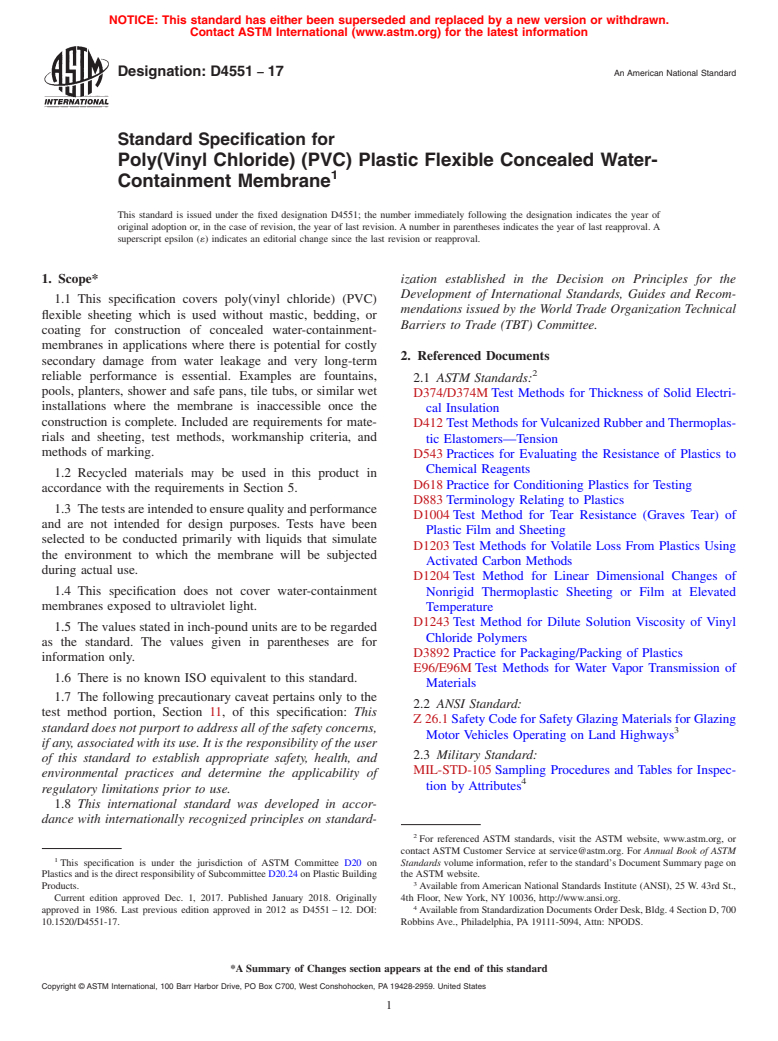
1.1 This specification covers poly(vinyl chloride) (PVC) flexible sheeting which is used without mastic, bedding, or coating for construction of concealed water-containment-membranes in applications where there is potential for costly secondary damage from water leakage and very long-term reliable performance is essential. Examples are fountains, pools, planters, shower and safe pans, tile tubs, or similar wet installations where the membrane is inaccessible once the construction is complete. Included are requirements for materials and sheeting, test methods, workmanship criteria, and methods of marking.
1.2 Recycled materials may be used in this product in accordance with the requirements in Section 5.
1.3 The tests are intended to ensure quality and performance and are not intended for design purposes. Tests have been selected to be conducted primarily with liquids that simulate the environment to which the membrane will be subjected during actual use.
1.4 This specification does not cover water-containment membranes exposed to ultraviolet light.
1.5 The values stated in inch-pound units are to be regarded as the standard. The values given in parentheses are for information only.
1.6 There is no known ISO equivalent to this standard.
1.7 The following precautionary caveat pertains only to the test method portion, Section 11, of this specification: This standard does not purport to address all of the safety concerns, if any, associated with its use. It is the responsibility of the user of this standard to establish appropriate safety, health, and environmental practices and determine the applicability of regulatory limitations prior to use.
1.8 This international standard was developed in accordance with internationally recognized principles on standardization established in the Decision on Principles for the Development of International Standards, Guides and Recommendations issued by the World Trade Organization Technical Barriers to Trade (TBT) Committee.
General Information
Buy Standard


Standards Content (Sample)
NOTICE: This standard has either been superseded and replaced by a new version or withdrawn.
Contact ASTM International (www.astm.org) for the latest information
Designation:D4551 −17 An American National Standard
Standard Specification for
Poly(Vinyl Chloride) (PVC) Plastic Flexible Concealed Water-
1
Containment Membrane
This standard is issued under the fixed designation D4551; the number immediately following the designation indicates the year of
original adoption or, in the case of revision, the year of last revision.Anumber in parentheses indicates the year of last reapproval.A
superscript epsilon (´) indicates an editorial change since the last revision or reapproval.
1. Scope* ization established in the Decision on Principles for the
Development of International Standards, Guides and Recom-
1.1 This specification covers poly(vinyl chloride) (PVC)
mendations issued by the World Trade Organization Technical
flexible sheeting which is used without mastic, bedding, or
Barriers to Trade (TBT) Committee.
coating for construction of concealed water-containment-
membranes in applications where there is potential for costly
2. Referenced Documents
secondary damage from water leakage and very long-term
2
reliable performance is essential. Examples are fountains,
2.1 ASTM Standards:
pools, planters, shower and safe pans, tile tubs, or similar wet
D374/D374MTest Methods for Thickness of Solid Electri-
installations where the membrane is inaccessible once the
cal Insulation
construction is complete. Included are requirements for mate-
D412TestMethodsforVulcanizedRubberandThermoplas-
rials and sheeting, test methods, workmanship criteria, and
tic Elastomers—Tension
methods of marking.
D543Practices for Evaluating the Resistance of Plastics to
Chemical Reagents
1.2 Recycled materials may be used in this product in
D618Practice for Conditioning Plastics for Testing
accordance with the requirements in Section 5.
D883Terminology Relating to Plastics
1.3 Thetestsareintendedtoensurequalityandperformance
D1004Test Method for Tear Resistance (Graves Tear) of
and are not intended for design purposes. Tests have been
Plastic Film and Sheeting
selected to be conducted primarily with liquids that simulate
D1203Test Methods for Volatile Loss From Plastics Using
the environment to which the membrane will be subjected
Activated Carbon Methods
during actual use.
D1204Test Method for Linear Dimensional Changes of
1.4 This specification does not cover water-containment
Nonrigid Thermoplastic Sheeting or Film at Elevated
membranes exposed to ultraviolet light.
Temperature
D1243Test Method for Dilute Solution Viscosity of Vinyl
1.5 Thevaluesstatedininch-poundunitsaretoberegarded
Chloride Polymers
as the standard. The values given in parentheses are for
D3892Practice for Packaging/Packing of Plastics
information only.
E96/E96MTest Methods for Water Vapor Transmission of
1.6 There is no known ISO equivalent to this standard.
Materials
1.7 The following precautionary caveat pertains only to the
2.2 ANSI Standard:
test method portion, Section 11, of this specification: This
Z26.1SafetyCodeforSafetyGlazingMaterialsforGlazing
standard does not purport to address all of the safety concerns,
3
Motor Vehicles Operating on Land Highways
if any, associated with its use. It is the responsibility of the user
2.3 Military Standard:
of this standard to establish appropriate safety, health, and
MIL-STD-105Sampling Procedures and Tables for Inspec-
environmental practices and determine the applicability of
4
tion by Attributes
regulatory limitations prior to use.
1.8 This international standard was developed in accor-
dance with internationally recognized principles on standard-
2
For referenced ASTM standards, visit the ASTM website, www.astm.org, or
contact ASTM Customer Service at service@astm.org. For Annual Book of ASTM
1
This specification is under the jurisdiction of ASTM Committee D20 on Standards volume information, refer to the standard’s Document Summary page on
PlasticsandisthedirectresponsibilityofSubcommitteeD20.24onPlasticBuilding the ASTM website.
3
Products. Available fromAmerican National Standards Institute (ANSI), 25 W. 43rd St.,
Current edition approved Dec. 1, 2017. Published January 2018. Originally 4th Floor, New York, NY 10036, http://www.ansi.org.
4
approved in 1986. Last previous edition approved in 2012 as D4551–12. DOI: AvailablefromStandardizationDocumentsOrderDesk,Bldg.4SectionD,700
10.1520/D4551-17. Robbins Ave., Philadelphia, PA 19111-5094, Attn: NPODS.
*A Summary of Changes section appears at the end of this standard
Copyright ©ASTM International, 100 Barr Harbor Drive, PO Box C700, West Conshohocken, PA19428-2959. United States
1
---------------------- Page: 1 ----------------------
D4551−17
TABLE 2 Quality Assurance Requirements
3. Terminology
Property Unit Specification Specification
3.1 Definitions:
Grade 30 Grade 40
3.1.1 General—Definitions are in accordance with Termi-
nology D883 unless otherwise indicated.
Thickn
...
This document is not an ASTM standard and is intended only to provide the user of an ASTM standard an indication of what changes have been made to the previous version. Because
it may not be technically possible to adequately depict all changes accurately, ASTM recommends that users consult prior editions as appropriate. In all cases only the current version
of the standard as published by ASTM is to be considered the official document.
Designation: D4551 − 12 D4551 − 17 An American National Standard
Standard Specification for
Poly(Vinyl Chloride) (PVC) Plastic Flexible Concealed Water-
1
Containment Membrane
This standard is issued under the fixed designation D4551; the number immediately following the designation indicates the year of
original adoption or, in the case of revision, the year of last revision. A number in parentheses indicates the year of last reapproval. A
superscript epsilon (´) indicates an editorial change since the last revision or reapproval.
1. Scope*
1.1 This specification covers poly(vinyl chloride) (PVC) flexible sheeting which is used without mastic, bedding, or coating for
construction of concealed water-containment-membranes in applications where there is potential for costly secondary damage from
water leakage and very long-term reliable performance is essential. Examples are fountains, pools, planters, shower and safe pans,
tile tubs, or similar wet installations where the membrane is inaccessible once the construction is complete. Included are
requirements for materials and sheeting, test methods, workmanship criteria, and methods of marking.
1.2 Recycled materials may be used in this product in accordance with the requirements in Section 5.
1.3 The tests are intended to ensure quality and performance and are not intended for design purposes. Tests have been selected
to be conducted primarily with liquids that simulate the environment to which the membrane will be subjected during actual use.
1.4 This specification does not cover water-containment membranes exposed to ultraviolet light.
1.5 The values stated in inch-pound units are to be regarded as the standard. The values given in parentheses are for information
only.
1.6 There is no known ISO equivalent to this standard.
1.7 The following precautionary caveat pertains only to the test method portion, Section 1311, of this specification: This
standard does not purport to address all of the safety concerns, if any, associated with its use. It is the responsibility of the user
of this standard to establish appropriate safety safety, health, and healthenvironmental practices and determine the applicability
of regulatory limitations prior to use.
1.8 This international standard was developed in accordance with internationally recognized principles on standardization
established in the Decision on Principles for the Development of International Standards, Guides and Recommendations issued
by the World Trade Organization Technical Barriers to Trade (TBT) Committee.
2. Referenced Documents
2
2.1 ASTM Standards:
D374D374/D374M Test Methods for Thickness of Solid Electrical Insulation (Metric) D0374_D0374M
D412 Test Methods for Vulcanized Rubber and Thermoplastic Elastomers—Tension
D543 Practices for Evaluating the Resistance of Plastics to Chemical Reagents
D618 Practice for Conditioning Plastics for Testing
D883 Terminology Relating to Plastics
D1004 Test Method for Tear Resistance (Graves Tear) of Plastic Film and Sheeting
D1203 Test Methods for Volatile Loss From Plastics Using Activated Carbon Methods
D1204 Test Method for Linear Dimensional Changes of Nonrigid Thermoplastic Sheeting or Film at Elevated Temperature
D1243 Test Method for Dilute Solution Viscosity of Vinyl Chloride Polymers
D3892 Practice for Packaging/Packing of Plastics
D7209 Guide for Waste Reduction, Resource Recovery, and Use of Recycled Polymeric Materials and Products (Withdrawn
3
2015)
E96/E96M Test Methods for Water Vapor Transmission of Materials
1
This specification is under the jurisdiction of ASTM Committee D20 on Plastics and is the direct responsibility of Subcommittee D20.24 on Plastic Building Products.
Current edition approved Oct. 1, 2012Dec. 1, 2017. Published November 2012January 2018. Originally approved in 1986. Last previous edition approved in 20082012
as D4551 – 96D4551 – 12.(2008). DOI: 10.1520/D4551-12.10.1520/D4551-17.
2
For referenced ASTM standards, visit the ASTM website, www.astm.org, or contact ASTM Customer Service at service@astm.org. For Annual Book of ASTM Standards
volume information, refer to the standard’s Document Summary page on the ASTM website.
*A Summary of Changes section appears at the end of this standard
Copyright © ASTM International, 100 Barr Harbor Drive, PO Box C700, West Conshohocken, PA 19428-2959. United States
1
---------------------- Page: 1 ----------------------
D4551 − 17
2.2 ANSI Standard:
3
Z 26.1 Safety Code for Safety Glazing Materials for Glazing Motor Vehicles Operating on Land Highways
2.3 Militar
...
Questions, Comments and Discussion
Ask us and Technical Secretary will try to provide an answer. You can facilitate discussion about the standard in here.