

ASTM D3467-04(2020)
(Test Method)Standard Test Method for Carbon Tetrachloride Activity of Activated Carbon
General Information
- Abstract
SIGNIFICANCE AND USE
5.1 Activity as measured by this test method is basically a measure of the pore volume of the activated carbon sample. This test method is therefore a means of determining the degree of completion of the activation process, hence a useful means of quality control for gas-phase activated carbons. This activity number does not necessarily provide an absolute or relative measure of the effectiveness of the tested carbon on other adsorbates, or at other conditions of operation.
SCOPE
1.1 This test method covers the determination of the activation level of activated carbon. Carbon tetrachloride (CCl4) activity is defined herein as the ratio (in percent) of the weight of CCl4 adsorbed by an activated carbon sample to the weight of the sample, when the carbon is saturated with CCl4 under conditions listed in this test method.
1.2 The values stated in SI units are to be regarded as standard. No other units of measurement are included in this standard.
1.3 This standard does not purport to address all of the safety concerns, if any, associated with its use. It is the responsibility of the user of this standard to establish appropriate safety, health, and environmental practices and determine the applicability of regulatory limitations prior to use. Specific hazards statements are given in Section 7.
1.4 This international standard was developed in accordance with internationally recognized principles on standardization established in the Decision on Principles for the Development of International Standards, Guides and Recommendations issued by the World Trade Organization Technical Barriers to Trade (TBT) Committee.
- Status
- Published
- Publication Date
- 31-Dec-2019
- Technical Committee
- D28 - Activated Carbon
- Drafting Committee
- D28.04 - Gas Phase Evaluation Tests

Overview
ASTM D3467-04(2020) is an established international standard developed by ASTM International for determining the carbon tetrachloride activity of activated carbon. This test method measures the amount of carbon tetrachloride (CCl₄) adsorbed by activated carbon and is used as an indicator of the pore volume and activation level of the material. Primarily, the standard serves as an important tool for quality control in the manufacturing and processing of gas-phase activated carbons.
This method does not directly measure adsorption effectiveness for other substances or under other environmental or operational conditions, but it helps verify the uniformity and readiness of activated carbon for its intended applications.
Key Topics
- Purpose: The test method assesses the degree of completion of the activation process by quantifying the CCl₄ adsorbed under specific test conditions.
- Measurement Principle: Carbon tetrachloride activity is defined as the percentage by weight of CCl₄ adsorbed compared to the activated carbon sample’s weight at saturation.
- Relevance: The result, known as the "activity number," reflects pore volume, which is crucial for the efficiency of gas-phase activated carbons.
- Quality Control: Reliable measurement of CCl₄ activity assists manufacturers and users in ensuring consistent product quality and process verification.
- Safety: Due to the toxicity and environmental concerns related to carbon tetrachloride, the method emphasizes stringent safety practices, including the use of fume hoods, proper ventilation, and adherence to regulatory limits established by health and environmental agencies.
- Limited Application: Results are specific to CCl₄ adsorption and cannot be universally extended to other adsorbates or conditions.
Applications
ASTM D3467-04(2020) is widely used in scenarios including:
- Manufacturing Quality Control: Activated carbon producers use this test to monitor activation consistency during production, ensuring materials meet specific performance specifications for gas-phase filtration.
- Purchasing and Specification: End users and suppliers refer to this standard when establishing acceptance criteria for activated carbon products, especially those used in air and vapor treatment processes.
- R&D and Process Optimization: Laboratories and R&D teams may apply this method while developing new grades of activated carbon or optimizing production processes for improved effectiveness in gas-phase applications.
- Interlaboratory Comparison: The standard provides a foundation for round-robin testing and performance verification among multiple labs, as demonstrated by collaborative studies referenced in the document.
Related Standards
Several other standards interact with or complement ASTM D3467-04(2020):
- ASTM D5742 – Test Method for Determination of Butane Activity of Activated Carbon, recommended as a less hazardous alternative.
- ASTM D2652 – Terminology Relating to Activated Carbon.
- ASTM D2854 – Test Method for Apparent Density of Activated Carbon.
- ASTM D2867 – Test Methods for Moisture in Activated Carbon.
- ASTM E300 – Practice for Sampling Industrial Chemicals.
- ASTM E691 – Practice for Conducting an Interlaboratory Study to Determine the Precision of a Test Method.
Note: Due to carbon tetrachloride’s classification as a Class I ozone-depleting substance and its associated health risks, use of this method is discouraged unless specifically required, and alternative methods such as ASTM D5742 are recommended whenever possible.
Practical Value
The ASTM D3467-04(2020) standard remains valuable for those in industries that require precise measurement of activated carbon’s pore volume. It underpins reliable quality control, supports compliance with international trade and safety requirements, and provides a consistent benchmark for performance verification in air treatment, pollution control, and industrial gas processing applications. Adhering to this standard ensures consistent production, reliable carbon performance, and supports international best practices in activated carbon quality assurance.
Relations
- Refers
ASTM D5742-16(2023) - Standard Test Method for Determination of Butane Activity of Activated Carbon - Effective Date
- 01-Dec-2023
- Effective Date
- 01-Jun-2016
- Refers
ASTM D5742-95(2015) - Standard Test Method for Determination of Butane Activity of Activated Carbon - Effective Date
- 01-Oct-2015
- Effective Date
- 01-Jul-2014
- Effective Date
- 01-May-2013
- Effective Date
- 01-Nov-2011
- Effective Date
- 15-Jun-2011
- Refers
ASTM D5742-95(2010) - Standard Test Method for Determination of Butane Activity of Activated Carbon - Effective Date
- 01-Apr-2010
- Effective Date
- 01-Nov-2009
- Effective Date
- 01-Apr-2009
- Effective Date
- 01-Oct-2008
- Effective Date
- 01-Nov-2005
- Refers
ASTM D5742-95(2005) - Standard Test Method for Determination of Butane Activity of Activated Carbon - Effective Date
- 01-Oct-2005
- Effective Date
- 01-Jul-2005
- Effective Date
- 01-Jun-2005
Get Certified
Connect with accredited certification bodies for this standard

ECOCERT
Organic and sustainability certification.

Eurofins Food Testing Global
Global leader in food, environment, and pharmaceutical product testing.

Intertek Bangladesh
Intertek certification and testing services in Bangladesh.
Sponsored listings
Frequently Asked Questions
ASTM D3467-04(2020) is a standard published by ASTM International. Its full title is "Standard Test Method for Carbon Tetrachloride Activity of Activated Carbon". This standard covers: SIGNIFICANCE AND USE 5.1 Activity as measured by this test method is basically a measure of the pore volume of the activated carbon sample. This test method is therefore a means of determining the degree of completion of the activation process, hence a useful means of quality control for gas-phase activated carbons. This activity number does not necessarily provide an absolute or relative measure of the effectiveness of the tested carbon on other adsorbates, or at other conditions of operation. SCOPE 1.1 This test method covers the determination of the activation level of activated carbon. Carbon tetrachloride (CCl4) activity is defined herein as the ratio (in percent) of the weight of CCl4 adsorbed by an activated carbon sample to the weight of the sample, when the carbon is saturated with CCl4 under conditions listed in this test method. 1.2 The values stated in SI units are to be regarded as standard. No other units of measurement are included in this standard. 1.3 This standard does not purport to address all of the safety concerns, if any, associated with its use. It is the responsibility of the user of this standard to establish appropriate safety, health, and environmental practices and determine the applicability of regulatory limitations prior to use. Specific hazards statements are given in Section 7. 1.4 This international standard was developed in accordance with internationally recognized principles on standardization established in the Decision on Principles for the Development of International Standards, Guides and Recommendations issued by the World Trade Organization Technical Barriers to Trade (TBT) Committee.
SIGNIFICANCE AND USE 5.1 Activity as measured by this test method is basically a measure of the pore volume of the activated carbon sample. This test method is therefore a means of determining the degree of completion of the activation process, hence a useful means of quality control for gas-phase activated carbons. This activity number does not necessarily provide an absolute or relative measure of the effectiveness of the tested carbon on other adsorbates, or at other conditions of operation. SCOPE 1.1 This test method covers the determination of the activation level of activated carbon. Carbon tetrachloride (CCl4) activity is defined herein as the ratio (in percent) of the weight of CCl4 adsorbed by an activated carbon sample to the weight of the sample, when the carbon is saturated with CCl4 under conditions listed in this test method. 1.2 The values stated in SI units are to be regarded as standard. No other units of measurement are included in this standard. 1.3 This standard does not purport to address all of the safety concerns, if any, associated with its use. It is the responsibility of the user of this standard to establish appropriate safety, health, and environmental practices and determine the applicability of regulatory limitations prior to use. Specific hazards statements are given in Section 7. 1.4 This international standard was developed in accordance with internationally recognized principles on standardization established in the Decision on Principles for the Development of International Standards, Guides and Recommendations issued by the World Trade Organization Technical Barriers to Trade (TBT) Committee.
ASTM D3467-04(2020) is classified under the following ICS (International Classification for Standards) categories: 71.040.30 - Chemical reagents. The ICS classification helps identify the subject area and facilitates finding related standards.
ASTM D3467-04(2020) has the following relationships with other standards: It is inter standard links to ASTM D5742-16(2023), ASTM D5742-16, ASTM D5742-95(2015), ASTM D2854-09(2014), ASTM E691-13, ASTM E691-11, ASTM D2652-11, ASTM D5742-95(2010), ASTM D2867-09, ASTM D2854-09, ASTM E691-08, ASTM E691-05, ASTM D5742-95(2005), ASTM D2652-05a, ASTM D2652-05. Understanding these relationships helps ensure you are using the most current and applicable version of the standard.
ASTM D3467-04(2020) is available in PDF format for immediate download after purchase. The document can be added to your cart and obtained through the secure checkout process. Digital delivery ensures instant access to the complete standard document.
Standards Content (Sample)
This international standard was developed in accordance with internationally recognized principles on standardization established in the Decision on Principles for the
Development of International Standards, Guides and Recommendations issued by the World Trade Organization Technical Barriers to Trade (TBT) Committee.
Designation: D3467 − 04 (Reapproved 2020)
Standard Test Method for
Carbon Tetrachloride Activity of Activated Carbon
This standard is issued under the fixed designation D3467; the number immediately following the designation indicates the year of
original adoption or, in the case of revision, the year of last revision. A number in parentheses indicates the year of last reapproval. A
superscript epsilon (´) indicates an editorial change since the last revision or reapproval.
INTRODUCTION
Carbon tetrachloride is classified as a Class I ozone-depleting substance by the U.S. Environmental
Protection Agency. Therefore, use of this test method is discouraged.
Instead, the use ofTest Method D5742 is recommended.The correlation obtained between n-butane
activity values and carbon tetrachloride activity values is contained in that test method.
1. Scope 2. Referenced Documents
2.1 ASTM Standards:
1.1 This test method covers the determination of the acti-
D2652 Terminology Relating to Activated Carbon
vation level of activated carbon. Carbon tetrachloride (CCl )
D2854 Test Method for Apparent Density of Activated
activity is defined herein as the ratio (in percent) of the weight
Carbon
of CCl adsorbed by an activated carbon sample to the weight
D2867 Test Methods for Moisture in Activated Carbon
of the sample, when the carbon is saturated with CCl under
D5742 Test Method for Determination of ButaneActivity of
conditions listed in this test method.
Activated Carbon
1.2 The values stated in SI units are to be regarded as
E300 Practice for Sampling Industrial Chemicals
standard. No other units of measurement are included in this
E691 Practice for Conducting an Interlaboratory Study to
standard. Determine the Precision of a Test Method
1.3 This standard does not purport to address all of the
3. Terminology
safety concerns, if any, associated with its use. It is the
responsibility of the user of this standard to establish appro- 3.1 Definitions—Terms relating to this test method are
defined in Terminology D2652.
priate safety, health, and environmental practices and deter-
mine the applicability of regulatory limitations prior to use.
4. Summary of Test Method
Specific hazards statements are given in Section 7.
1.4 This international standard was developed in accor-
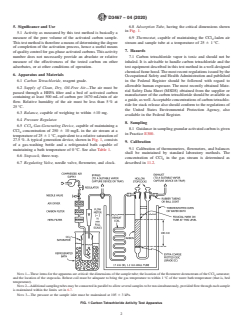
4.1 Activity is determined by flowing CCl -laden air
dance with internationally recognized principles on standard-
through a sample of carbon of known weight, under specified
ization established in the Decision on Principles for the conditions,untilthereisnofurtherincreaseintheweightofthe
Development of International Standards, Guides and Recom- sample, then determining the weight of the CCl adsorbed.The
apparatus required for the test consists essentially of means to
mendations issued by the World Trade Organization Technical
control the supply air pressure, to remove oil and water in both
Barriers to Trade (TBT) Committee.
liquid and vapor states from the supply air, to produce the
specified concentration of CCl in the air flowed through the
carbon sample, and to control the flow rate of the gas (air +
This test method is under the jurisdiction of ASTM Committee D28 on
CCl ) mixture through the sample.
Activated Carbon and is the direct responsibility of Subcommittee D28.04 on Gas
Phase Evaluation Tests.
Current edition approved Jan. 1, 2020. Published January 2020. Originally
approved in 1976. Last previous edition approved in 2014 as D3467 – 04 (2014).
DOI: 10.1520/D3467-04R20. For referenced ASTM standards, visit the ASTM website, www.astm.org, or
Supporting data have been filed at ASTM International Headquarters and may contact ASTM Customer Service at service@astm.org. For Annual Book of ASTM
beobtainedbyrequestingResearchReportRR:D28-1000.ContactASTMCustomer Standards volume information, refer to the standard’s Document Summary page on
Service at service@astm.org. the ASTM website.
Copyright © ASTM International, 100 Barr Harbor Drive, PO Box C700, West Conshohocken, PA 19428-2959. United States
D3467 − 04 (2020)
5. Significance and Use 6.8 Adsorption Tube, having the critical dimensions shown
in Fig. 1.
5.1 Activity as measured by this test method is basically a
measure of the pore volume of the activated carbon sample. 6.9 Thermostat, capable of maintaining the CCl -laden air
Thistestmethodisthereforeameansofdeterminingthedegree stream and sample tube at a temperature of 25 6 1 °C.
of completion of the activation process, hence a useful means
7. Hazards
of quality control for gas-phase activated carbons.This activity
number does not necessarily provide an absolute or relative
7.1 Carbon tetrachloride vapor is toxic and should not be
measure of the effectiveness of the tested carbon on other inhaled. It is advisable to handle carbon tetrachloride and the
adsorbates, or at other conditions of operation.
test equipment described in this test method in a well-designed
chemical fume hood.The most recent regulations issued by the
6. Apparatus and Materials
Occupational Safety and Health Administration and published
in the Federal Register should be followed with regard to
6.1 Carbon Tetrachloride, reagent grade.
allowable human exposure. The most recently obtained Mate-
6.2 Supply of Clean, Dry, Oil-Free Air—The air must be
rial Safety Data Sheet (MSDS) obtained from the supplier or
passed through a HEPA filter and a bed of activated carbon
manufacturer of the carbon tetrachloride should be available as
containing at least 500 mL of carbon per 1670 mL/min of air
aguide,aswell.Acceptableconcentrationsofcarbontetrachlo-
flow. Relative humidity of the air must be less than 5 % at
ride for stack release also should conform to the regulations of
25 °C.
the United States Environmental Protection Agency, also
6.3 Balance, capable of weighing to within 610 mg.
available in the Federal Register.
6.4 Pressure Regulator.
8. Sampling
6.5 CCl Gas-Generating Device, capable of maintaining a
8.1 Guidance in sampling granular activated carbon is given
CCl concentration of 250 6 10 mg/L in the air stream at a
in Practice E300.
temperature of 25 6 1 °C, equivalent to a relative saturation of
27.5 %. A typical generation device, shown in Fig. 1, consists
9. Calibr
...