

ASTM E2641-09(2017)
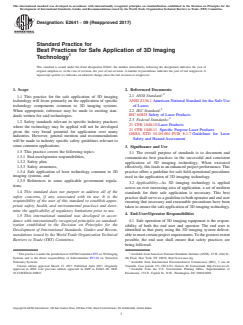
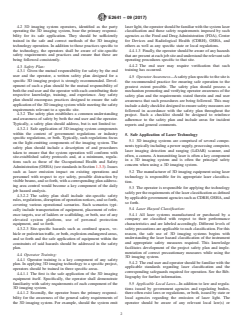
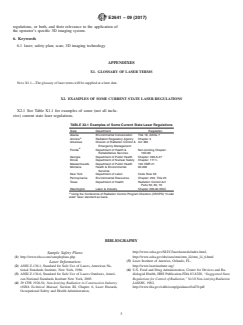
(Practice)Standard Practice for Best Practices for Safe Application of 3D Imaging Technology
General Information
- Abstract
SIGNIFICANCE AND USE
3.1 The overall purpose of standards is to document and communicate best practices in the successful and consistent application of 3D imaging technology. When executed effectively, this leads to an enhanced project performance. This practice offers a guideline for safe field operational procedures used in the application of 3D imaging technology.
3.2 Applicability—As 3D imaging technology is applied across an ever increasing area of application, a set of uniform standards for their safe application is necessary. This best practice shall serve as a guideline to both operator and end user ensuring that necessary and reasonable precautions have been taken to ensure the safe application of 3D imaging technology.
SCOPE
1.1 This practice for the safe application of 3D imaging technology will focus primarily on the application of specific technology components common to 3D imaging systems. When appropriate, reference may be made to existing standards written for said technologies.
1.2 Safety standards relevant to specific industry practices where the technology may be applied will not be developed given the very broad potential for application over many industries. However, general mention and recommendations will be made to industry specific safety guidelines relevant to some common applications.
1.3 This practice covers the following topics:
1.3.1 End-user/operator responsibilities,
1.3.2 Safety plan,
1.3.3 Safety awareness,
1.3.4 Safe application of laser technology common to 3D imaging systems, and
1.3.5 References to some applicable government regulations.
1.4 This standard does not purport to address all of the safety concerns, if any, associated with its use. It is the responsibility of the user of this standard to establish appropriate safety and health practices and determine the applicability of regulatory limitations prior to use.
1.5 This international standard was developed in accordance with internationally recognized principles on standardization established in the Decision on Principles for the Development of International Standards, Guides and Recommendations issued by the World Trade Organization Technical Barriers to Trade (TBT) Committee.
- Status
- Published
- Publication Date
- 14-Mar-2017
- Technical Committee
- E57 - 3D Imaging Systems
- Drafting Committee
- E57.20 - Terrestrial Stationary Systems

Overview
ASTM E2641-09(2017), Standard Practice for Best Practices for Safe Application of 3D Imaging Technology, provides comprehensive guidelines for the safe and effective use of 3D imaging systems. Developed by ASTM International, this standard focuses on documenting and communicating best practices to enhance project performance and ensure safety in the use of 3D imaging technologies. The standard is relevant to both operators and end users, promoting responsibility and awareness in varied environments where 3D imaging, including systems such as LiDAR and laser scanners, are in operation.
Key Topics
ASTM E2641-09(2017) covers a range of critical elements for the safe application of 3D imaging technology:
- End-User and Operator Responsibilities: Emphasizes the shared responsibility for safety between system operators and end users. Operators must be adequately trained and aware of both technology-specific and site-specific safety practices. End users should verify that proper safety protocols are being followed.
- Safety Plan Development: Recommends a site-specific, written safety plan for every project. The plan should address compliance with applicable regulations, detail safe procedures for equipment operation, and outline strategies to manage hazards such as laser emissions, traffic, confined spaces, and use of personal protective equipment.
- Operator Training: Stresses the necessity of operator training in the safe operation of all system components and in the understanding of relevant safety standards and regulations.
- Laser Safety in 3D Imaging Systems: Identifies the application of laser technology as a principal safety concern. Operators must understand laser classifications, comply with government and industry regulations, and address both direct and indirect hazards associated with laser use.
- Regulatory References: Points to key regulatory standards like ANSI Z136.1 (Safe Use of Lasers), IEC 60825 (Safety of Laser Products), and OSHA guidelines. The standard also references specific federal and state requirements regarding laser safety.
Applications
ASTM E2641-09(2017) is applicable across a wide range of industries utilizing 3D imaging technology, including:
- Construction and Civil Engineering: For tasks such as surveying, mapping, and building information modeling, ensuring all laser and imaging systems are operated safely on dynamic job sites.
- Manufacturing and Industrial Inspection: Where 3D imaging devices are used for quality control and precision measurements, adherence to safety best practices ensures reliable operation and worker protection.
- Public Sector and Infrastructure: Applies to agencies and contractors in transportation, utilities, and environmental monitoring who are responsible for the safe deployment of 3D imaging technology in varied and potentially hazardous environments.
- Research and Education: Ensures safe laboratory use of 3D imaging systems, raising awareness around operator training and institutional safety plans.
By following the guidelines of ASTM E2641-09(2017), organizations can mitigate risks, align with regulatory expectations, and foster a culture of safety when implementing 3D imaging solutions.
Related Standards
The practice references and complements several important standards and guidelines:
- ANSI Z136.1 - American National Standard for the Safe Use of Lasers
- IEC 60825 - Safety of Laser Products
- 21 CFR 1040.10 & 1040.11 - FDA regulations for laser products
- OSHA STD 01-05-001-PUB 8-1.7 - Guidelines for Laser Safety and Hazard Assessment
- 29 CFR 1926.54 - OSHA Construction Industry Standards for Non-Ionizing Radiation
Adherence to these related standards ensures comprehensive safety and regulatory compliance when applying 3D imaging technology in any professional setting.
Keywords: 3D imaging technology, laser safety, safety plan, operator training, ASTM E2641, best practices, regulatory compliance, LiDAR, ANSI Z136.1, IEC 60825.
Get Certified
Connect with accredited certification bodies for this standard

BSI Group
BSI (British Standards Institution) is the business standards company that helps organizations make excellence a habit.

NYCE
Mexican standards and certification body.
Sponsored listings
Frequently Asked Questions
ASTM E2641-09(2017) is a standard published by ASTM International. Its full title is "Standard Practice for Best Practices for Safe Application of 3D Imaging Technology". This standard covers: SIGNIFICANCE AND USE 3.1 The overall purpose of standards is to document and communicate best practices in the successful and consistent application of 3D imaging technology. When executed effectively, this leads to an enhanced project performance. This practice offers a guideline for safe field operational procedures used in the application of 3D imaging technology. 3.2 Applicability—As 3D imaging technology is applied across an ever increasing area of application, a set of uniform standards for their safe application is necessary. This best practice shall serve as a guideline to both operator and end user ensuring that necessary and reasonable precautions have been taken to ensure the safe application of 3D imaging technology. SCOPE 1.1 This practice for the safe application of 3D imaging technology will focus primarily on the application of specific technology components common to 3D imaging systems. When appropriate, reference may be made to existing standards written for said technologies. 1.2 Safety standards relevant to specific industry practices where the technology may be applied will not be developed given the very broad potential for application over many industries. However, general mention and recommendations will be made to industry specific safety guidelines relevant to some common applications. 1.3 This practice covers the following topics: 1.3.1 End-user/operator responsibilities, 1.3.2 Safety plan, 1.3.3 Safety awareness, 1.3.4 Safe application of laser technology common to 3D imaging systems, and 1.3.5 References to some applicable government regulations. 1.4 This standard does not purport to address all of the safety concerns, if any, associated with its use. It is the responsibility of the user of this standard to establish appropriate safety and health practices and determine the applicability of regulatory limitations prior to use. 1.5 This international standard was developed in accordance with internationally recognized principles on standardization established in the Decision on Principles for the Development of International Standards, Guides and Recommendations issued by the World Trade Organization Technical Barriers to Trade (TBT) Committee.
SIGNIFICANCE AND USE 3.1 The overall purpose of standards is to document and communicate best practices in the successful and consistent application of 3D imaging technology. When executed effectively, this leads to an enhanced project performance. This practice offers a guideline for safe field operational procedures used in the application of 3D imaging technology. 3.2 Applicability—As 3D imaging technology is applied across an ever increasing area of application, a set of uniform standards for their safe application is necessary. This best practice shall serve as a guideline to both operator and end user ensuring that necessary and reasonable precautions have been taken to ensure the safe application of 3D imaging technology. SCOPE 1.1 This practice for the safe application of 3D imaging technology will focus primarily on the application of specific technology components common to 3D imaging systems. When appropriate, reference may be made to existing standards written for said technologies. 1.2 Safety standards relevant to specific industry practices where the technology may be applied will not be developed given the very broad potential for application over many industries. However, general mention and recommendations will be made to industry specific safety guidelines relevant to some common applications. 1.3 This practice covers the following topics: 1.3.1 End-user/operator responsibilities, 1.3.2 Safety plan, 1.3.3 Safety awareness, 1.3.4 Safe application of laser technology common to 3D imaging systems, and 1.3.5 References to some applicable government regulations. 1.4 This standard does not purport to address all of the safety concerns, if any, associated with its use. It is the responsibility of the user of this standard to establish appropriate safety and health practices and determine the applicability of regulatory limitations prior to use. 1.5 This international standard was developed in accordance with internationally recognized principles on standardization established in the Decision on Principles for the Development of International Standards, Guides and Recommendations issued by the World Trade Organization Technical Barriers to Trade (TBT) Committee.
ASTM E2641-09(2017) is classified under the following ICS (International Classification for Standards) categories: 35.140 - Computer graphics. The ICS classification helps identify the subject area and facilitates finding related standards.
ASTM E2641-09(2017) is available in PDF format for immediate download after purchase. The document can be added to your cart and obtained through the secure checkout process. Digital delivery ensures instant access to the complete standard document.
Standards Content (Sample)
This international standard was developed in accordance with internationally recognized principles on standardization established in the Decision on Principles for the
Development of International Standards, Guides and Recommendations issued by the World Trade Organization Technical Barriers to Trade (TBT) Committee.
Designation: E2641 − 09 (Reapproved 2017)
Standard Practice for
Best Practices for Safe Application of 3D Imaging
Technology
This standard is issued under the fixed designation E2641; the number immediately following the designation indicates the year of
original adoption or, in the case of revision, the year of last revision. A number in parentheses indicates the year of last reapproval. A
superscript epsilon (´) indicates an editorial change since the last revision or reapproval.
1. Scope 2. Referenced Documents
1.1 This practice for the safe application of 3D imaging 2.1 ANSI Standard:
ANSI Z136.1 American National Standard for the Safe Use
technology will focus primarily on the application of specific
of Lasers
technology components common to 3D imaging systems.
2.2 IEC Standard:
When appropriate, reference may be made to existing stan-
IEC 60825 Safety of Laser Products
dards written for said technologies.
2.3 Federal Standards:
1.2 Safety standards relevant to specific industry practices
21 CFR 1040.10 Laser Products
where the technology may be applied will not be developed
21 CFR 1040.11 Specific Purpose Laser Products
given the very broad potential for application over many
OSHA STD 01-05-001-PUB 8-1.7 Guidelines for Laser
industries. However, general mention and recommendations
Safety and Hazard Assessment
will be made to industry specific safety guidelines relevant to
some common applications.
3. Significance and Use
1.3 This practice covers the following topics:
3.1 The overall purpose of standards is to document and
1.3.1 End-user/operator responsibilities,
communicate best practices in the successful and consistent
1.3.2 Safety plan,
application of 3D imaging technology. When executed
1.3.3 Safety awareness,
effectively, this leads to an enhanced project performance.This
1.3.4 Safe application of laser technology common to 3D
practice offers a guideline for safe field operational procedures
imaging systems, and
used in the application of 3D imaging technology.
1.3.5 References to some applicable government regula-
3.2 Applicability—As 3D imaging technology is applied
tions.
across an ever increasing area of application, a set of uniform
1.4 This standard does not purport to address all of the
standards for their safe application is necessary. This best
safety concerns, if any, associated with its use. It is the
practice shall serve as a guideline to both operator and end user
responsibility of the user of this standard to establish appro-
ensuring that necessary and reasonable precautions have been
priate safety, health, and environmental practices and deter-
taken to ensure the safe application of 3D imaging technology.
mine the applicability of regulatory limitations prior to use.
4. End-User/Operator Responsibilities
1.5 This international standard was developed in accor-
dance with internationally recognized principles on standard-
4.1 Safe operation of 3D imaging equipment is the respon-
ization established in the Decision on Principles for the
sibility of both the end user and operator. The end user is
Development of International Standards, Guides and Recom-
identified as that party using the 3D imaging system deliver-
mendations issued by the World Trade Organization Technical
abletomeetcertainprojectrequirements.Tothegreatestextent
Barriers to Trade (TBT) Committee.
possible, the end user shall ensure that safety practices are
being followed.
1 2
This practice is under the jurisdiction ofASTM Committee E57 on 3D Imaging Available from American National Standards Institute (ANSI), 25 W. 43rd St.,
Systems and is the direct responsibility of Subcommittee E57.20 on Terrestrial 4th Floor, New York, NY 10036, http://www.ansi.org.
Stationary Systems. Available from International Electrotechnical Commission (IEC), 3 rue de
Current edition approved March 15, 2017. Published April 2017. Originally Varembé, Case postale 131, CH-1211, Geneva 20, Switzerland, http://www.iec.ch.
approved in 2009. Last previous edition approved in 2009 as E2641–09. DOI: Available from the U.S. Government Printing Office, Superintendent of
10.1520/E2641-09R17.
Documents, 732 N. Capital St., N.W., Washington, DC 20402-0001.
Copyright © ASTM International, 100 Barr Harbor Drive, PO Box C700, West Conshohocken, PA 19428-2959. United States
E2641 − 09 (2017)
4.2 3D imaging system operators, identified as the party laserlight,theoperatorshouldbefamiliarwiththesystemlaser
operating the 3D imaging system, bear the primary responsi- classification and those safety requirements imposed by such
bility for its safe application. They should be sufficiently agencies as the Food and Drug Administration (FDA), Center
trained in the safe and correct methods of the 3D imaging for Devices and Radiological Health (CDRH), OSHA, and
technology operation. In addition to those practices specific to others as well as any specific state or local regulations.
the technology, the operators shall be aware of site-specific
4.4.1.3 Finally, the operator should be aware of any hazards
safety requirements and practices and ensure that these are
thatarepresentateachjobsiteandunderstandtherelevantsafe
being followed consistently. operating procedures specific to that site.
4.4.2 The end user may require verification that such
4.3 Safety Plan:
training has occurred.
4.3.1 Given the mutual responsibility for safety by the end
user and the operator, a written safety plan designed for a
4.5 Operator Awareness—Asafetyplanspecifictothesiteis
specific 3D imaging project is strongly recommended. Devel-
the recommended practice for ensuring safe operation to the
opment of such a plan should be the mutual responsibility of
greatest extent possible. The safety plan should possess a
both the end user and the operator with each contributing their
mechanism promoting and verifying operator awareness of the
respective knowledge, training, and experience. Any safety
safety plan and the requirements stated therein and end user
plan should encompass practices designed to ensure the safe
awareness that such procedures are being followed. This may
application of the 3D imaging system while meeting the safety
includeadailychecklistdesignedtoensuresafetymeasuresare
requirements relevant to a specific site.
followed in accordance with the safety plan throughout the
4.3.2 The safety plan establishes a common understanding
project. Such a checklist should be designed to reinforce
and awareness of safety by both the end user and the operator.
adherence to the safety plan and include areas for incident
Typically, a safety plan should address, but is not limited to:
reports and general comments.
4.3.2.1 Safe application of 3D imaging system components
within the context of government regulations or industry
5. Safe Application of Laser Technology
specific regulations, or both. Typically, such regulations focus
5.1 3D imaging systems are comprised of several compo-
on the light-emitting components of the imaging system. The
nents typically including a power supp
...