

ASTM D2238-22
(Test Method)Standard Test Methods for Absorbance of Polyethylene Due to Methyl Groups at 1378 cm−1
General Information
- Abstract
SIGNIFICANCE AND USE
4.1 When interpreted with the aid of appropriate calibration data, either test method is acceptable for use to compare the total methyl contents of polyethylenes made by similar processes. Data on infrared absorption at certain other wavelengths is potentially useful for information on certain other wavelengths (7).
Note 4: The bias of determination of the concentration of total alkyl groups depends on knowing the concentrations of methyl and ethyl branches present, since these branches have anomalously high absorptivities per group at 1378 cm−1 (7.25 μm).
4.2 Knowledge of total methyl groups in polyethylene, when combined with data on molecular weight and on reactive end groups such as vinyl, is potentially useful so as to lead to assignment of end-group structures and to shed light upon polymerization mechanisms.
4.3 Qualitative correlations are possible between data on total methyl groups in polyethylene with certain polymer properties such as melting point, density, stiffness, and other mechanical properties that are closely dependent on the degree of crystallinity of the polymer.
4.4 These test methods are especially suitable for research. They have not been tested for use in manufacturing control.
SCOPE
1.1 These test methods cover measurement by infrared absorption spectrophotometry of the 1378 cm−1 (7.25 μm) band in polyethylene due to methyl groups. (1, 2, 3-6)2 Two test methods are covered:
1.1.1 Test Method A uses compensation with a standard sample film of known methyl content.
1.1.2 Test Method B uses compensation with a wedge of polymethylene or a polyethylene of known low methyl content.
1.2 These test methods are applicable to polyethylenes of Types I (density 0.910 to 0.925 g/cm3), II (density 0.926 to 0.940 g/cm3), and III (density 0.941 to 0.965 g/cm3).
Note 1: For determination of density, see Specifications D1505.
Note 2: In cases of Type III polyethylene with densities greater than 0.950 g/cm3, different results are obtained with the two test methods.
1.3 The values stated in SI units are to be regarded as the standard. The values given in parentheses are for information only.
1.4 This standard does not purport to address all of the safety concerns, if any, associated with its use. It is the responsibility of the user of this standard to establish appropriate safety, health, and environmental practices and determine the applicability of regulatory limitations prior to use. Specific hazards statements are given in Section 7.
Note 3: There is no known ISO equivalent to this standard.
1.5 This international standard was developed in accordance with internationally recognized principles on standardization established in the Decision on Principles for the Development of International Standards, Guides and Recommendations issued by the World Trade Organization Technical Barriers to Trade (TBT) Committee.
- Status
- Published
- Publication Date
- 31-Aug-2022
- Technical Committee
- D20 - Plastics
- Drafting Committee
- D20.70 - Analytical Methods
Overview
ASTM D2238-22: Standard Test Methods for Absorbance of Polyethylene Due to Methyl Groups at 1378 cm−1 outlines procedures for measuring the absorbance of polyethylene in the infrared (IR) region due to the presence of methyl groups. Using infrared absorption spectrophotometry, the standard specifies methods for identifying and quantifying methyl content, which is crucial for polymer characterization and research. Developed by ASTM International, this standard applies to polyethylene types I, II, and III, and supports insights into polymer structure, processing history, and certain mechanical properties.
Key Topics
- Infrared Absorption Spectrophotometry: Detailed methods for measuring the absorption band at 1378 cm−1 (7.25 μm) in polyethylene related to methyl groups.
- Test Method A (Film Compensation Method): Uses a standard sample film of known methyl content for calibration and compensation.
- Test Method B (Wedge Compensation Method): Uses a wedge of polymethylene or a polyethylene sample with low methyl content as a reference.
- Applicability: Can be used for polyethylenes within specific density ranges (Type I: 0.910–0.925 g/cm³, Type II: 0.926–0.940 g/cm³, Type III: 0.941–0.965 g/cm³).
- Significance: Enables comparison of total methyl contents for polyethylenes produced via similar processes and assists in understanding polymerization mechanisms and end-group structures.
- Instrumentation: Requirements for spectrophotometer calibration, specimen preparation, and data correction are explicitly detailed to ensure method accuracy.
- Limitations: Primarily intended for research and not validated for use in routine manufacturing quality control.
Applications
The ASTM D2238-22 standard has several practical applications in polymer science, material testing, and quality assurance:
- Polymer Characterization: Determining the methyl group content provides insight into the molecular structure, branching, and polymerization behavior of polyethylene.
- Structure-Property Relationships: Correlations between methyl content and properties such as melting point, density, crystallinity, and mechanical properties can be established, which are valuable in product development and performance optimization.
- Research and Development: The test methods are especially suitable for laboratory research, helping scientists analyze and compare polyethylene samples from different sources or production methods.
- Support for Analytical Studies: Knowledge of methyl group concentration, when combined with molecular weight and end-group information, enables detailed assignment of polymer end-group structures.
- Calibration and Standardization: Assists with the standardization of measurement protocols across laboratories, supporting comparability and reliability in polyethylene analysis.
Related Standards
For comprehensive polyethylene analysis and IR spectrophotometry, the following ASTM standards are relevant:
- ASTM D883: Terminology Relating to Plastics
- ASTM D618: Practice for Conditioning Plastics for Testing
- ASTM D1505: Test Method for Density of Plastics by the Density-Gradient Technique
- ASTM E131: Terminology Relating to Molecular Spectroscopy
- ASTM E168: Practices for General Techniques of Infrared Quantitative Analysis
- ASTM E177: Practice for Use of the Terms Precision and Bias in ASTM Test Methods
- IEEE/ASTM SI-10: Standard for Use of the International System of Units (SI)
Note: There is currently no ISO equivalent to ASTM D2238-22.
By following ASTM D2238-22, laboratories and researchers ensure reliable, reproducible measurements of methyl groups in polyethylene via established IR absorbance methods, advancing knowledge in polymer chemistry and materials science.
Relations
- Effective Date
- 01-Feb-2024
- Effective Date
- 01-Nov-2023
- Effective Date
- 01-Jan-2020
- Effective Date
- 01-Aug-2019
- Effective Date
- 15-Apr-2019
- Effective Date
- 01-Feb-2019
- Effective Date
- 01-Dec-2018
- Effective Date
- 01-Nov-2018
- Effective Date
- 15-Aug-2017
- Effective Date
- 01-May-2014
- Effective Date
- 01-May-2013
- Effective Date
- 15-Nov-2012
- Effective Date
- 15-May-2011
- Effective Date
- 01-Oct-2010
- Refers
ASTM D1505-10 - Standard Test Method for Density of Plastics by the Density-Gradient Technique - Effective Date
- 01-Jul-2010
Get Certified
Connect with accredited certification bodies for this standard

DIN CERTCO
DIN Group product certification.

Smithers Quality Assessments
US management systems and product certification.
Sponsored listings
Frequently Asked Questions
ASTM D2238-22 is a standard published by ASTM International. Its full title is "Standard Test Methods for Absorbance of Polyethylene Due to Methyl Groups at 1378 cm<sup>−1</sup>". This standard covers: SIGNIFICANCE AND USE 4.1 When interpreted with the aid of appropriate calibration data, either test method is acceptable for use to compare the total methyl contents of polyethylenes made by similar processes. Data on infrared absorption at certain other wavelengths is potentially useful for information on certain other wavelengths (7). Note 4: The bias of determination of the concentration of total alkyl groups depends on knowing the concentrations of methyl and ethyl branches present, since these branches have anomalously high absorptivities per group at 1378 cm−1 (7.25 μm). 4.2 Knowledge of total methyl groups in polyethylene, when combined with data on molecular weight and on reactive end groups such as vinyl, is potentially useful so as to lead to assignment of end-group structures and to shed light upon polymerization mechanisms. 4.3 Qualitative correlations are possible between data on total methyl groups in polyethylene with certain polymer properties such as melting point, density, stiffness, and other mechanical properties that are closely dependent on the degree of crystallinity of the polymer. 4.4 These test methods are especially suitable for research. They have not been tested for use in manufacturing control. SCOPE 1.1 These test methods cover measurement by infrared absorption spectrophotometry of the 1378 cm−1 (7.25 μm) band in polyethylene due to methyl groups. (1, 2, 3-6)2 Two test methods are covered: 1.1.1 Test Method A uses compensation with a standard sample film of known methyl content. 1.1.2 Test Method B uses compensation with a wedge of polymethylene or a polyethylene of known low methyl content. 1.2 These test methods are applicable to polyethylenes of Types I (density 0.910 to 0.925 g/cm3), II (density 0.926 to 0.940 g/cm3), and III (density 0.941 to 0.965 g/cm3). Note 1: For determination of density, see Specifications D1505. Note 2: In cases of Type III polyethylene with densities greater than 0.950 g/cm3, different results are obtained with the two test methods. 1.3 The values stated in SI units are to be regarded as the standard. The values given in parentheses are for information only. 1.4 This standard does not purport to address all of the safety concerns, if any, associated with its use. It is the responsibility of the user of this standard to establish appropriate safety, health, and environmental practices and determine the applicability of regulatory limitations prior to use. Specific hazards statements are given in Section 7. Note 3: There is no known ISO equivalent to this standard. 1.5 This international standard was developed in accordance with internationally recognized principles on standardization established in the Decision on Principles for the Development of International Standards, Guides and Recommendations issued by the World Trade Organization Technical Barriers to Trade (TBT) Committee.
SIGNIFICANCE AND USE 4.1 When interpreted with the aid of appropriate calibration data, either test method is acceptable for use to compare the total methyl contents of polyethylenes made by similar processes. Data on infrared absorption at certain other wavelengths is potentially useful for information on certain other wavelengths (7). Note 4: The bias of determination of the concentration of total alkyl groups depends on knowing the concentrations of methyl and ethyl branches present, since these branches have anomalously high absorptivities per group at 1378 cm−1 (7.25 μm). 4.2 Knowledge of total methyl groups in polyethylene, when combined with data on molecular weight and on reactive end groups such as vinyl, is potentially useful so as to lead to assignment of end-group structures and to shed light upon polymerization mechanisms. 4.3 Qualitative correlations are possible between data on total methyl groups in polyethylene with certain polymer properties such as melting point, density, stiffness, and other mechanical properties that are closely dependent on the degree of crystallinity of the polymer. 4.4 These test methods are especially suitable for research. They have not been tested for use in manufacturing control. SCOPE 1.1 These test methods cover measurement by infrared absorption spectrophotometry of the 1378 cm−1 (7.25 μm) band in polyethylene due to methyl groups. (1, 2, 3-6)2 Two test methods are covered: 1.1.1 Test Method A uses compensation with a standard sample film of known methyl content. 1.1.2 Test Method B uses compensation with a wedge of polymethylene or a polyethylene of known low methyl content. 1.2 These test methods are applicable to polyethylenes of Types I (density 0.910 to 0.925 g/cm3), II (density 0.926 to 0.940 g/cm3), and III (density 0.941 to 0.965 g/cm3). Note 1: For determination of density, see Specifications D1505. Note 2: In cases of Type III polyethylene with densities greater than 0.950 g/cm3, different results are obtained with the two test methods. 1.3 The values stated in SI units are to be regarded as the standard. The values given in parentheses are for information only. 1.4 This standard does not purport to address all of the safety concerns, if any, associated with its use. It is the responsibility of the user of this standard to establish appropriate safety, health, and environmental practices and determine the applicability of regulatory limitations prior to use. Specific hazards statements are given in Section 7. Note 3: There is no known ISO equivalent to this standard. 1.5 This international standard was developed in accordance with internationally recognized principles on standardization established in the Decision on Principles for the Development of International Standards, Guides and Recommendations issued by the World Trade Organization Technical Barriers to Trade (TBT) Committee.
ASTM D2238-22 is classified under the following ICS (International Classification for Standards) categories: 83.080.20 - Thermoplastic materials. The ICS classification helps identify the subject area and facilitates finding related standards.
ASTM D2238-22 has the following relationships with other standards: It is inter standard links to ASTM D883-24, ASTM D883-23, ASTM D883-20, ASTM D883-19c, ASTM D883-19a, ASTM D883-19, ASTM D883-18a, ASTM D883-18, ASTM D883-17, ASTM E177-14, ASTM E177-13, ASTM D883-12e1, ASTM D883-11, ASTM E177-10, ASTM D1505-10. Understanding these relationships helps ensure you are using the most current and applicable version of the standard.
ASTM D2238-22 is available in PDF format for immediate download after purchase. The document can be added to your cart and obtained through the secure checkout process. Digital delivery ensures instant access to the complete standard document.
Standards Content (Sample)
This international standard was developed in accordance with internationally recognized principles on standardization established in the Decision on Principles for the
Development of International Standards, Guides and Recommendations issued by the World Trade Organization Technical Barriers to Trade (TBT) Committee.
Designation: D2238 − 22
Standard Test Methods for
Absorbance of Polyethylene Due to Methyl Groups at 1378
−1
cm
This standard is issued under the fixed designation D2238; the number immediately following the designation indicates the year of
original adoption or, in the case of revision, the year of last revision.Anumber in parentheses indicates the year of last reapproval.A
superscript epsilon (´) indicates an editorial change since the last revision or reapproval.
1. Scope 2. Referenced Documents
2.1 ASTM Standards:
1.1 These test methods cover measurement by infrared
−1
absorptionspectrophotometryofthe1378cm (7.25µm)band D618Practice for Conditioning Plastics for Testing
D883Terminology Relating to Plastics
in polyethylene due to methyl groups. (1, 2, 3-6) Two test
methods are covered: D1505Test Method for Density of Plastics by the Density-
Gradient Technique
1.1.1 Test Method A uses compensation with a standard
E131Terminology Relating to Molecular Spectroscopy
sample film of known methyl content.
E168Practices for General Techniques of Infrared Quanti-
1.1.2 Test Method B uses compensation with a wedge of
tative Analysis
polymethyleneorapolyethyleneofknownlowmethylcontent.
E177Practice for Use of the Terms Precision and Bias in
1.2 These test methods are applicable to polyethylenes of
ASTM Test Methods
Types I (density 0.910 to 0.925 g/cm ), II (density 0.926 to
IEEE/ASTM SI-10Standard for Use of the International
3 3
0.940 g/cm ), and III (density 0.941 to 0.965 g/cm ).
System of Units (SI): The Modern Metric System
NOTE 1—For determination of density, see Specifications D1505.
NOTE 2—In cases of Type III polyethylene with densities greater than
3. Terminology
0.950 g/cm , different results are obtained with the two test methods.
3.1 For definitions of terms used in these test methods and
1.3 The values stated in SI units are to be regarded as the
associated with plastics issues refer to the terminology con-
standard. The values given in parentheses are for information
tained in Terminology D883.
only.
3.2 Units, symbols, and abbreviations used in this test
1.4 This standard does not purport to address all of the
method appear in Terminology E131 or Practice IEEE/ASTM
safety concerns, if any, associated with its use. It is the
SI-10.
responsibility of the user of this standard to establish appro-
priate safety, health, and environmental practices and deter-
4. Significance and Use
mine the applicability of regulatory limitations prior to use.
4.1 When interpreted with the aid of appropriate calibration
Specific hazards statements are given in Section 7.
data, either test method is acceptable for use to compare the
NOTE 3—There is no known ISO equivalent to this standard.
total methyl contents of polyethylenes made by similar pro-
1.5 This international standard was developed in accor- cesses. Data on infrared absorption at certain other wave-
dance with internationally recognized principles on standard- lengths is potentially useful for information on certain other
ization established in the Decision on Principles for the wavelengths (7).
Development of International Standards, Guides and Recom-
NOTE 4—The bias of determination of the concentration of total alkyl
mendations issued by the World Trade Organization Technical
groups depends on knowing the concentrations of methyl and ethyl
Barriers to Trade (TBT) Committee.
branches present, since these branches have anomalously high absorptivi-
−1
ties per group at 1378 cm (7.25 µm).
4.2 Knowledge of total methyl groups in polyethylene,
1 whencombinedwithdataonmolecularweightandonreactive
These test methods are under the jurisdiction of ASTM Committee D20 on
Plastics and are the direct responsibility of Subcommittee D20.70 on Analytical end groups such as vinyl, is potentially useful so as to lead to
Methods (Section D20.70.08).
Current edition approved Sept. 1, 2022. Published September 2022. Originally
ɛ1
approved in 1964. Last previous edition approved in 2012 as D2238-92 (2012) ,
which was withdrawn January 2021 and reinstated in September 2022. DOI: For referenced ASTM standards, visit the ASTM website, www.astm.org, or
10.1520/D2238-22. contact ASTM Customer Service at service@astm.org. For Annual Book of ASTM
Theboldfacenumbersinparenthesesrefertothelistofreferencesattheendof Standards volume information, refer to the standard’s Document Summary page on
these test methods. the ASTM website.
Copyright © ASTM International, 100 Barr Harbor Drive, PO Box C700, West Conshohocken, PA 19428-2959. United States
D2238 − 22
assignment of end-group structures and to shed light upon 6.4 Metal Plates,approximately150by150by0.5mmwith
polymerization mechanisms. smooth surfaces.
4.3 Qualitative correlations are possible between data on 6.5 Brass Shims,approximately75by75mmorlargerwith
an aperture in the center at least 25 by 38 mm in a series of at
total methyl groups in polyethylene with certain polymer
properties such as melting point, density, stiffness, and other least five thicknesses from 0.1 to 0.5 mm.
mechanical properties that are closely dependent on the degree
6.6 Micrometer Calipers, with graduations of 0.001 mm.
of crystallinity of the polymer.
6.7 Mounts,forfilmspecimenswithapertureatleast6by27
4.4 These test methods are especially suitable for research.
mm.
They have not been tested for use in manufacturing control.
7. Hazards
5. Interferences
7.1 Caution must be used during molding to handle the hot
plates and molds with appropriate gloves for hand protection.
5.1 Compensation minimizes interference from methylene
−1 −1
groupabsorptionbandsat1368cm (7.31µm)and1352cm
8. Preparation of Apparatus
−1
(7.39 µm) with the 1378 cm (7.25 µm) methyl deformation
8.1 The precision obtained using this test method depends
band.
very markedly upon the condition of the spectrophotometer.
5.2 In Test MethodAresidual absorption is often present at
Instrument performance shall be at least equal to that cited in
−1
1352 cm after compensation, but this band is believed not to
the manufacturer’s specifications for a new instrument. Reso-
contribute appreciable interference in the measurement of the
lution shall be checked to assure conformance with 6.1 or 6.2.
−1
methyl peak at 1378 cm in samples with very low methyl
The linearity of the photometric system shall be measured;
content.
linearity shall not deviate from absolute by more than 4% of
thetransmittancerangeofinterest.Frequencyorwavelengthin
6. Apparatus −1
the 1430 to 1250 cm (7 to 8 µm) region shall be calibrated.
6.1 Infrared Spectrophotometer, double beam, with NaCl
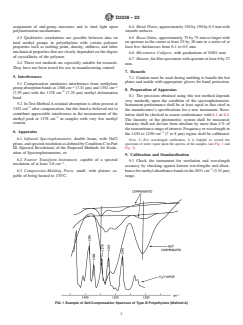
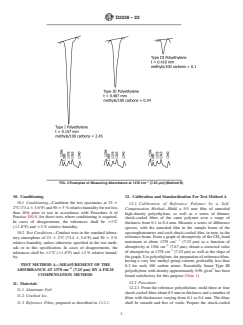
NOTE 5—For wavelength calibration, it is helpful to record the
prism,andspectralresolutionasdefinedbyConditionCinPart
spectrum of water vapor upon the spectra of the samples (see Fig. 1 and
III (Spectral Resolution) of the Proposed Methods for Evalu- Fig. 3).
ation of Spectrophotometers, or
9. Calibration and Standardization
6.2 Fourier Transform Instrument, capable of a spectral
9.1 Check the instrument for resolution and wavelength
−1
resolution of at least 2.0 cm .
accuracy by checking against known wavelengths and absor-
−1
6.3 Compression-Molding Press, small, with platens ca- banceformethylabsorbancebandsinthe2851cm (3.51µm)
pable of being heated to 170°C. range.
FIG. 1 Example of Self-Compensation Spectrum of Type III Polyethylene (Method A)
D2238 − 22
−1
FIG. 3 Examples of Measuring Absorbance at 1378 cm (7.25 µm) (Method B)
10. Conditioning 12. Calibration and Standardization For Test Method A
10.1 Conditioning—Condition the test specimens at 23 6
12.1 Calibration of Reference Polymer by a Self-
2°C(73.4 63.6°F)and50 65%relativehumidityfornotless
Compensation Method—Mold a 0.5 mm film of annealed
than 40h prior to test in accordance with Procedure A of
high-density polyethylene, as well as a series of thinner,
Practice D618, for those tests where conditioning is required.
shock-cooled films of the same polymer over a range of
In cases of disagreement, the tolerances shall be 61°C
thickness from 0.1 to 0.4 mm. Measure a series of difference
(61.8°F) and 62% relative humidity.
spectra, with the annealed film in the sample beam of the
spectrophotometer and each shock-cooled film, in turn, in the
10.2 Test Conditions—Conduct tests in the standard labora-
reference beam. From a graph of absorptivity of the CH band
tory atmosphere of 23 6 2°C (73.4 6 3.6°F) and 50 65% 3
−1
maximum at about 1378 cm (7.25 µm) as a function of
relative humidity, unless otherwise specified in the test meth-
−1
absorptivity at 1304 cm (7.67 µm), obtain a corrected value
ods or in this specification. In cases of disagreements, the
−1
of absorptivity at 1378 cm (7.25 µm) as well as the slope of
tolerances shall be 61°C (61.8°F) and 62% relative humid-
thegraph.Usepolyethylene,forpreparationofreferencefilms,
ity.
having a very low methyl group content, preferably less than
TEST METHOD A—MEASUREMENT OF THE
0.3 for each 100 carbon atoms. Essentially linear Type III
−1
ABSORBANCE AT 1378 cm (7.25 µm) BY A FILM
polyethylene with density approximately 0.96 g/cm has been
COMPENSATION METHOD
found satisfactory for this purpose (Note 1).
12.2 Procedure:
11. Materials
12.2.1 From the reference polyethylene, mold three or four
11.1 Aluminum Foil.
shock-cooledfilmsabout0.5mminthicknessandanumberof
11.2 Crushed Ice.
films with thicknesses varying from 0.1 to 0.4 mm. The films
11.3 Reference Films, prepared as described in 12.2.1. shall be smooth and free of voids. Prepare the shock-cooled
D2238 − 22
films in the following way: Place the desired brass shim on the 12.3.3 Calculate the following quantities for each pair of
aluminumfoilontopofoneofthemetalplates.Placesufficient films:
polymer in the aperture of the shim to fill completely this
α 5 A / d t 2 d t (1)
1378 ~ s s r r!
aperture after pressing. Cover the preparation with a second
β 5 A / d t 2 d t (2)
1304 ~ s s r r!
aluminum foil and metal plate. Heat the press to 170°C. Insert
the mold assembly between the press platens. Preheat for 15 s,
where:
then apply pressure slowly until, after 30 s, the pressure has
−1
A = absorbance at 1378 cm (7.25 µm),
reached 20.7 MPa (3000 psi). Hold the preparation at this −1
A = absorbance at 1304 cm (7.67 µm),
pressure for an additional 30 s. Release the pressure, grasp the 3
d = density of sample film, g/cm ,
s
assembly with pliers, and quickly plunge it into a bucket
d = density of reference film, g/cm ,
r
containing a slurry of ice and water. Carefully remove the film
t = thickness of sample film, cm, and
s
and dry it with a cloth or tissue.
t = thickness of reference film, cm.
r
12.2.2 Anneal several 0.5 mm shock-cooled films by a
12.3.4 Plotthequantityα(Eq1)asordinateagainstβ(Eq2)
suitablepressoroventechniquetoobtainanincreaseindensity
3 as abscissa on graph paper for each pair of films.
at 23°C of at least 0.020 g/cm .
12.3.5 Draw the best straight line through the points on the
12.2.3 Mount each film on a suitable holder. Measure the
graph (see Fig. 2). The intercept on the ordinate is the
thickness in millimeters at three places in the aperture and
absorptivity, K' , in square centimeters per gram, due to the
recordtheaveragethicknessonthesampleholder.Measurethe
−1
methyl band at 1378 cm (7.25 µm). Let R, the slope of the
densityofsmallclippingsmadeclosetobutnotintheaperture
−1
line,=∆α⁄∆β. A value of 0.5 for R at 1378 cm is recom-
of the holder. Measure the density according to Test Method
mended.
D1505.
–1
−1
12.2.4 Scan the spectrum between 909 and 769 cm (11
NOTE 6—Provided that the 1378 cm (7.25 µm) band is normal, the
proportionality factor R for the correction is the same for all polyethyl-
and 13 µm) and reject any film showing interference fringes.
−1 enes.
12.2.5 Measurespectraintherangefrom1430to1250cm
−1
−1
NOTE 7—The center of the 1378 cm (7.25 µm) methyl band is
(7 to 8 µm) and record the absorbance of the 1368 cm (7.31
−1
normally found between 1379 and 1378 cm (7.250 and 7.257 µm).
µm) band on each sample as follows: for prism instruments,
Variation in position of the band center within this range will give a value
place an annealed sample in the sample beam of the spectro-
of R between about 0.40 and 0.52, in direct proportionality.
photometer. Place a shock-cooled film in the reference beam:
12.3.6 For each reference film, correct the measure
...