

ASTM B208-14(2021)
(Practice)Standard Practice for Preparing Tension Test Specimens for Copper Alloy Sand, Permanent Mold, Centrifugal, and Continuous Castings
General Information
- Abstract
SIGNIFICANCE AND USE
4.1 The mechanical properties determined from test bars for sand, permanent mold, and centrifugal castings poured in accordance with this practice represent the properties of the metal going into castings poured from the same heat. These mechanical properties may not be the same as the properties of the corresponding castings because of the solidification effects of varying size, section, and design.
4.2 Test bars for continuous castings are taken from the castings and therefore represent the properties of the castings.
SCOPE
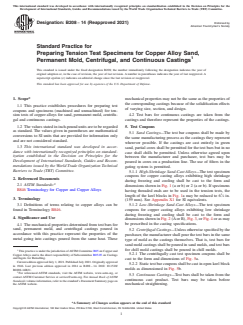
1.1 This practice establishes procedures for preparing test coupons and specimens (machined and unmachined) for tension tests of copper alloys for sand, permanent mold, centrifugal and continuous castings.
1.2 The values stated in inch-pound units are to be regarded as standard. The values given in parentheses are mathematical conversions to SI units that are provided for information only and are not considered standard.
1.3 This international standard was developed in accordance with internationally recognized principles on standardization established in the Decision on Principles for the Development of International Standards, Guides and Recommendations issued by the World Trade Organization Technical Barriers to Trade (TBT) Committee.
- Status
- Published
- Publication Date
- 30-Jun-2021
- Technical Committee
- B05 - Copper and Copper Alloys
- Drafting Committee
- B05.05 - Castings and Ingots for Remelting
Overview
ASTM B208-14(2021), titled Standard Practice for Preparing Tension Test Specimens for Copper Alloy Sand, Permanent Mold, Centrifugal, and Continuous Castings, provides detailed procedures for preparing test specimens used in tension tests on copper alloy castings. Developed and maintained by ASTM International, this standard ensures consistent specimen preparation methods, helping manufacturers, laboratories, and quality assurance teams obtain reliable mechanical property data for copper alloys. The standard covers sand castings, permanent mold castings, centrifugal castings, and continuous castings, contributing to global industry alignment and product quality assurance.
Key Topics
- Specimen Preparation Procedures
- Step-by-step methods for preparing tension test coupons and specimens, both machined and unmachined, for different copper alloy casting processes.
- Requirements for specimen form and dimensions to ensure consistency and comparability in tensile strength testing.
- Casting Method Considerations
- Test bars for sand, permanent mold, and centrifugal castings are poured under controlled conditions that represent the properties of metal from the same heat, though actual casting properties may differ due to variations in casting design.
- For continuous castings, test bars are directly sampled from the casting, providing representation of finished casting properties.
- Test Bar Design and Placement
- Guidance on making test bars using the same manufacturing process as production castings for accurate property representation.
- Special instructions for alloys prone to high or low shrinkage, including recommended test bar forms and conditions for the use of partial cores or filters.
- Dimensional Standards
- Standard values stated primarily in inch-pound (imperial) units; SI equivalents are provided for informational purposes.
- Specifies standard specimen sizes and proportional alternatives for different copper alloy products.
Applications
- Quality Control in Copper Alloy Casting
- Ensures mechanical property data used for acceptance and validation is derived from specimens prepared in a standardized manner.
- Helps distinguish the impact of casting variables on tensile properties, supporting manufacturer and purchaser agreements regarding quality and performance.
- Design and Engineering Validation
- Used by foundries, testing labs, and engineering teams when validating material performance in product development and process optimization.
- Provides the industry with a repeatable practice to compare mechanical behavior across casting methods and suppliers.
- Contractual Specification Compliance
- Offers a recognized method for specimen preparation referenced in purchase agreements and industry specifications, reducing ambiguity in test practices.
- Supports global trade by aligning with international standardization principles, including those of the World Trade Organization Technical Barriers to Trade (TBT) Committee.
Related Standards
- ASTM B846 – Terminology for Copper and Copper Alloys
- Other relevant ASTM casting and test methods, as referenced in procurement or casting process documentation.
By following ASTM B208-14(2021), organizations benefit from improved traceability, reliable tensile testing data, and harmonized quality assurance practices for copper alloy castings across diverse manufacturing processes and markets. Utilizing this international standard promotes consistency, credibility, and confidence in copper alloy casting applications worldwide.
Relations
- Effective Date
- 01-Aug-2019
- Effective Date
- 01-Jan-2019
- Effective Date
- 01-Jun-2011
- Effective Date
- 01-Jan-2011
- Effective Date
- 15-Nov-2009
- Effective Date
- 01-Nov-2009
- Effective Date
- 15-Nov-2006
- Effective Date
- 15-May-2006
- Effective Date
- 01-Nov-2005
- Effective Date
- 10-May-2001
- Effective Date
- 10-May-2001
- Effective Date
- 10-May-2001
Get Certified
Connect with accredited certification bodies for this standard

Element Materials Technology
Materials testing and product certification.

Inštitut za kovinske materiale in tehnologije
Institute of Metals and Technology. Materials testing, metallurgical analysis, NDT.
Sponsored listings
Frequently Asked Questions
ASTM B208-14(2021) is a standard published by ASTM International. Its full title is "Standard Practice for Preparing Tension Test Specimens for Copper Alloy Sand, Permanent Mold, Centrifugal, and Continuous Castings". This standard covers: SIGNIFICANCE AND USE 4.1 The mechanical properties determined from test bars for sand, permanent mold, and centrifugal castings poured in accordance with this practice represent the properties of the metal going into castings poured from the same heat. These mechanical properties may not be the same as the properties of the corresponding castings because of the solidification effects of varying size, section, and design. 4.2 Test bars for continuous castings are taken from the castings and therefore represent the properties of the castings. SCOPE 1.1 This practice establishes procedures for preparing test coupons and specimens (machined and unmachined) for tension tests of copper alloys for sand, permanent mold, centrifugal and continuous castings. 1.2 The values stated in inch-pound units are to be regarded as standard. The values given in parentheses are mathematical conversions to SI units that are provided for information only and are not considered standard. 1.3 This international standard was developed in accordance with internationally recognized principles on standardization established in the Decision on Principles for the Development of International Standards, Guides and Recommendations issued by the World Trade Organization Technical Barriers to Trade (TBT) Committee.
SIGNIFICANCE AND USE 4.1 The mechanical properties determined from test bars for sand, permanent mold, and centrifugal castings poured in accordance with this practice represent the properties of the metal going into castings poured from the same heat. These mechanical properties may not be the same as the properties of the corresponding castings because of the solidification effects of varying size, section, and design. 4.2 Test bars for continuous castings are taken from the castings and therefore represent the properties of the castings. SCOPE 1.1 This practice establishes procedures for preparing test coupons and specimens (machined and unmachined) for tension tests of copper alloys for sand, permanent mold, centrifugal and continuous castings. 1.2 The values stated in inch-pound units are to be regarded as standard. The values given in parentheses are mathematical conversions to SI units that are provided for information only and are not considered standard. 1.3 This international standard was developed in accordance with internationally recognized principles on standardization established in the Decision on Principles for the Development of International Standards, Guides and Recommendations issued by the World Trade Organization Technical Barriers to Trade (TBT) Committee.
ASTM B208-14(2021) is classified under the following ICS (International Classification for Standards) categories: 77.040.10 - Mechanical testing of metals; 77.150.30 - Copper products. The ICS classification helps identify the subject area and facilitates finding related standards.
ASTM B208-14(2021) has the following relationships with other standards: It is inter standard links to ASTM B846-19a, ASTM B846-19, ASTM B846-11a, ASTM B846-11, ASTM B846-09a, ASTM B846-09, ASTM B846-06a, ASTM B846-06, ASTM B846-05, ASTM B846-01, ASTM B846-01e1, ASTM B846-99e1. Understanding these relationships helps ensure you are using the most current and applicable version of the standard.
ASTM B208-14(2021) is available in PDF format for immediate download after purchase. The document can be added to your cart and obtained through the secure checkout process. Digital delivery ensures instant access to the complete standard document.
Standards Content (Sample)
This international standard was developed in accordance with internationally recognized principles on standardization established in the Decision on Principles for the
Development of International Standards, Guides and Recommendations issued by the World Trade Organization Technical Barriers to Trade (TBT) Committee.
Designation: B208 − 14 (Reapproved 2021) Endorsed by
American Foundrymen’s Society
Standard Practice for
Preparing Tension Test Specimens for Copper Alloy Sand,
Permanent Mold, Centrifugal, and Continuous Castings
This standard is issued under the fixed designation B208; the number immediately following the designation indicates the year of
original adoption or, in the case of revision, the year of last revision. A number in parentheses indicates the year of last reapproval. A
superscript epsilon (´) indicates an editorial change since the last revision or reapproval.
This standard has been approved for use by agencies of the U.S. Department of Defense.
1. Scope* mechanical properties may not be the same as the properties of
the corresponding castings because of the solidification effects
1.1 This practice establishes procedures for preparing test
of varying size, section, and design.
coupons and specimens (machined and unmachined) for ten-
sion tests of copper alloys for sand, permanent mold, centrifu- 4.2 Test bars for continuous castings are taken from the
gal and continuous castings. castings and therefore represent the properties of the castings.
1.2 The values stated in inch-pound units are to be regarded
5. Test Coupons
as standard. The values given in parentheses are mathematical
5.1 Sand Castings—The test bar coupons shall be made by
conversions to SI units that are provided for information only
the same manufacturing process as the castings they represent
and are not considered standard.
wherever possible. If the castings are cast entirely in green
1.3 This international standard was developed in accor-
sand, partial cores shall be permitted for the test bars but in no
dance with internationally recognized principles on standard-
case shall chills be permitted. Unless otherwise agreed upon
ization established in the Decision on Principles for the
between the manufacturer and purchaser, test bars may be
Development of International Standards, Guides and Recom-
poured in cores on a production line. The use of filters in the
mendations issued by the World Trade Organization Technical
gating system is permitted.
Barriers to Trade (TBT) Committee.
5.1.1 High-Shrinkage Sand-Cast Alloys—The test specimen
coupons for copper casting alloys exhibiting high shrinkage
2. Referenced Documents
during freezing and cooling shall be cast to the form and
2.1 ASTM Standards:
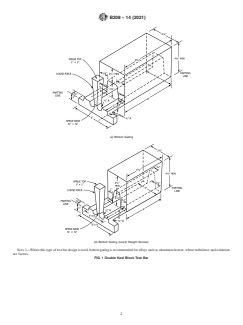
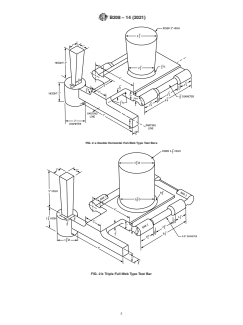
dimensions shown in Fig. 1 (a or b) or 2 (a or b). If specimens
B846 Terminology for Copper and Copper Alloys
having threaded ends are to be used in the tension tests, the
length of the keel blocks in Fig. 1a may be reduced to 6 ⁄4 in.
3. Terminology
(159 mm). See Appendix X1 for SI equivalents.
3.1 Definitions of terms relating to copper alloys can be 5.1.2 Low-Shrinkage Sand-Cast Alloys—The test specimen
found in Terminology B846.
coupons for copper casting alloys exhibiting low shrinkage
during freezing and cooling shall be cast to the form and
4. Significance and Use
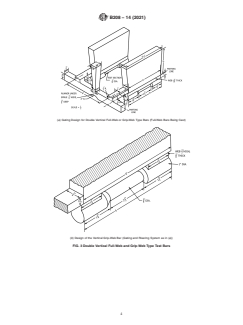
dimensionsshowninFig.2(AorB),Fig.3,orFig.4orasmay
be prescribed in the casting specifications.
4.1 The mechanical properties determined from test bars for
sand, permanent mold, and centrifugal castings poured in
5.2 CentrifugalCastings—Unlessotherwisespecifiedbythe
accordance with this practice represent the properties of the
purchaser, the manufacturer shall pour the test bars in the same
metal going into castings poured from the same heat. These
type of mold as the castings themselves. That is, test bars for
sand mold castings shall be poured in sand molds, and test bars
1 for chill mold castings shall be poured in chill molds.
This practice is under the jurisdiction ofASTM Committee B05 on Copper and
CopperAlloys and is the direct responsibility of Subcommittee B05.05 on Castings 5.2.1 The centrifugally cast test specimen coupons shall be
and Ingots for Remelting.
cast to the form and dimensions of Fig. 5a.
Current edition approved July 1, 2021. Published July 2021. Originally approved
5.2.2 Static test bar coupons shall be cast in open keel block
in 1946. Last previous edition approved in 2014 as B208 – 14. DOI: 10.1520/
molds as dimensioned in Fig. 5b.
B0208-14R21.
For referenced ASTM standards, visit the ASTM website, www.astm.org, or
5.3 Continuous Castings—Test bars shall be taken from the
contact ASTM Customer Service at service@astm.org. For Annual Book of ASTM
continuous cast product. Test bars may be taken before
Standards volume information, refer to the standard’s Document Summary page on
the ASTM website. mechanical straightening.
*A Summary of Changes section appears at the end of this standard
Copyright © ASTM International, 100 Barr Harbor Drive, PO Box C700, West Conshohocken, PA 19428-2959. United States
B208 − 14 (2021)
(a) Bottom Gating
(b) Bottom Gating (Lower Weight Version)
NOTE1—Wherethistypeoftestbardesignisused,bottomgatingisrecommendedforalloyssuchasaluminumbronze,whereturbulenceandoxidation
are factors.
FIG. 1 Double Keel Block Test Bar
B208 − 14 (2021)
FIG. 2 a Double Horizontal Full-Web Type Test Bars
FIG. 2 b Triple Full-Web Type Test Bar
B208 − 14 (2021)
(a) Gating Design for Double Vertical Full-Web or Grip-Web Type Bars (Full-Web Bars Being Cast)
(b) Design of the Vertical Grip-Web Bar (Gating and Risering System as in (a))
FIG. 3 Double Vertical Full-Web and Grip-Web Type Test Bars
B208 − 14 (2021)
FIG. 4 Optional Coupon for As-Cast Tension Test Specimen, Button Head
5.3.1 Test bar coupons shall be taken in a longitudinal specimens are machined, the gage length, parallel sections, and
direction from the continuous cast product at the mid-wall of
fillets shall be machined to the dimensions shown in Fig. 11.
hollow castings or at one-half the distance between the center
6.2 Centrifugally Cast—Tension test specimens shall be
and the side of solid castings as illustrated in Fig. 6.
machined from the coupons described in 5.2.1 and shown in
5.3.2 For irregular shapes, the location of the test bar
Fig. 5. They shall be of the form and dimensions shown in Fig.
coupon shall be as agreed upon between the manufacturer and
11.
purchaser.
5.3.3 Transverse test specimens are allowed for continuous
6.3 Continuous Cast—Tension test specimens shall be ma-
cast product having a cross section thickness, diameter, or wall
chined from the continuous cast product as described in 5.3.1
of 4 in. or more. The cross sections are the diameter of a round
and shown in Fig. 6. They shall be of the form and dimensions
solid, the distance across flats of a solid hexagon, the thickness
as shown in Fig. 11.
of a rectangle, and the wall thickness of a tube.
6.4 Permanent Mold—Tension test specimens shall be cut
5.4 Permanent Mold Castings—The test bar coupons shall
from the test bar coupon shown in Fig. 7 or Fig. 9 and shall be
be made in the permanent die for test bars shown in Fig. 7 or
of the form and dimensions shown in Fig.
...