

ASTM D7083-16(2022)
(Practice)Standard Practice for Determination of Monomeric Plasticizers in Poly (Vinyl Chloride) (PVC) by Gas Chromatography
General Information
- Abstract
SIGNIFICANCE AND USE
5.1 Separation and identification of plasticizer components in PVC is necessary to correlate performance properties with polymer composition. This test method provides a means of determining monomeric plasticizers including adipates, azelates, benzoates, citrates, phthalates, sebacates, and trimellitates.
5.2 Other methods successfully used to analyze plasticizers are column chromatography, HPLC, GPC, FTIR, and GC/MS.
5.3 This method is not applicable to plasticizers with molecular weights over 700 g/mol including epoxidized soybean oil and polymeric plasticizers.
SCOPE
1.1 This practice provides for the separation and identification of monomeric plasticizers in poly (vinyl chloride) (PVC) compounds by gas chromatography (GC).
1.2 The text of this practice references notes and footnotes which provide explanatory material. These notes and footnotes (excluding those in Tables and Figures) shall not be considered as requirements of this standard.
1.3 Test Method D2124 is an alternative infrared procedure.
1.4 The values stated in SI units are to be regarded as standard. No other units of measurement are included in this standard.
1.5 This standard does not purport to address all of the safety concerns, if any, associated with its use. It is the responsibility of the user of this standard to establish appropriate safety, health, and environmental practices and determine the applicability of regulatory limitations prior to use.
Note 1: There is no known ISO equivalent to this standard.
1.6 This international standard was developed in accordance with internationally recognized principles on standardization established in the Decision on Principles for the Development of International Standards, Guides and Recommendations issued by the World Trade Organization Technical Barriers to Trade (TBT) Committee.
- Status
- Published
- Publication Date
- 30-Jun-2022
- Technical Committee
- D20 - Plastics
- Drafting Committee
- D20.70 - Analytical Methods

Overview
ASTM D7083-16(2022) is the globally recognized standard practice for the determination of monomeric plasticizers in poly (vinyl chloride) (PVC) compounds using gas chromatography (GC). Developed by ASTM International, this standard provides guidance for the separation and identification of key monomeric plasticizers, enabling users to correlate the composition of PVC materials with their performance properties. Accurate identification of plasticizer content is essential for product quality, regulatory compliance, and safety in numerous industries that rely on flexible PVC materials.
Key Topics
Monomeric Plasticizers in PVC: The standard focuses on detecting and quantifying monomeric plasticizer types such as adipates, azelates, benzoates, citrates, phthalates, sebacates, and trimellitates. It specifically excludes polymeric plasticizers and those with molecular weights over 700 g/mol, such as epoxidized soybean oil.
Analytical Method - Gas Chromatography (GC): The primary technique described is the analysis of plasticizer extracts using GC, with identification based on retention times or chromatographic fingerprints.
Sample Preparation and Extraction: The practice references procedures for extracting plasticizers from PVC samples, ensuring that only the monomeric portion is assessed.
Instrument and Apparatus: Guidance is provided on the selection of chromatographic columns, detectors, and other apparatus suitable for the temperature and chemical requirements of PVC plasticizer analysis.
Resolution and Interferences: The standard highlights the importance of achieving sufficient chromatographic resolution and identifying potential sources of analytical interference, such as solvent impurities or overlapping retention times.
Applicable Limitations: The method is not appropriate for high-molecular-weight or polymeric plasticizers and stresses the importance of observing standard safety, health, and environmental practices.
Applications
The use of ASTM D7083-16(2022) delivers significant practical value across multiple sectors:
Quality Control: Ensures that PVC compounds meet specified formulations and performance requirements in manufacturing environments such as automotive, construction, medical devices, and consumer goods.
Regulatory Compliance: Supports compliance with regional and international regulations concerning the use of certain types of plasticizers, especially in sensitive applications like children's toys and food-contact materials.
Research & Development: Aids R&D teams in evaluating new PVC formulations by providing accurate compositional analysis of plasticizers, which can affect physical properties such as flexibility, durability, and weatherability.
Failure Analysis: Assists in root cause analysis of product failures where plasticizer composition may impact performance, allowing for corrective actions and improved product reliability.
Related Standards
ASTM D7083-16(2022) is complemented by a range of related standards and methods for plastics analysis and gas chromatography:
- ASTM D2124 – Analysis of PVC components using infrared spectrophotometry (alternative method)
- ASTM D3465 – Guide for purity of monomeric plasticizers by gas chromatography
- ASTM D883 / D1600 – Terminology standards relating to plastics and abbreviations
- ASTM D7823 – Determination of low-level phthalates in PVC plastics by GC/MS
- ASTM E355 / E594 – Practices for gas chromatography terminology and detector testing
- IEEE/ASTM SI-10 – Practice for use of the International System of Units (SI)
While there is no direct ISO equivalent, ASTM D7083-16(2022) is developed in line with international standardization principles, supporting global industry needs for reliable and robust analytical techniques.
Keywords: gas chromatography, monomeric plasticizers, PVC analysis, ASTM D7083, phthalate determination, flexible PVC quality, plasticizer identification, polymer analysis, material compliance, chromatographic separation.
Relations
- Effective Date
- 01-Feb-2024
- Effective Date
- 01-Nov-2023
- Effective Date
- 01-Feb-2020
- Effective Date
- 01-Jan-2020
- Effective Date
- 01-Sep-2019
- Effective Date
- 01-Aug-2019
- Effective Date
- 15-Apr-2019
- Effective Date
- 01-Feb-2019
- Effective Date
- 01-Dec-2018
- Effective Date
- 01-Nov-2018
- Effective Date
- 01-Nov-2018
- Refers
ASTM D1600-18 - Standard Terminology for Abbreviated Terms Relating to Plastics (Withdrawn 2024) - Effective Date
- 01-Jan-2018
- Effective Date
- 15-Aug-2017
- Effective Date
- 01-May-2016
- Effective Date
- 01-Aug-2014
Get Certified
Connect with accredited certification bodies for this standard

DIN CERTCO
DIN Group product certification.

Smithers Quality Assessments
US management systems and product certification.
Sponsored listings
Frequently Asked Questions
ASTM D7083-16(2022) is a standard published by ASTM International. Its full title is "Standard Practice for Determination of Monomeric Plasticizers in Poly (Vinyl Chloride) (PVC) by Gas Chromatography". This standard covers: SIGNIFICANCE AND USE 5.1 Separation and identification of plasticizer components in PVC is necessary to correlate performance properties with polymer composition. This test method provides a means of determining monomeric plasticizers including adipates, azelates, benzoates, citrates, phthalates, sebacates, and trimellitates. 5.2 Other methods successfully used to analyze plasticizers are column chromatography, HPLC, GPC, FTIR, and GC/MS. 5.3 This method is not applicable to plasticizers with molecular weights over 700 g/mol including epoxidized soybean oil and polymeric plasticizers. SCOPE 1.1 This practice provides for the separation and identification of monomeric plasticizers in poly (vinyl chloride) (PVC) compounds by gas chromatography (GC). 1.2 The text of this practice references notes and footnotes which provide explanatory material. These notes and footnotes (excluding those in Tables and Figures) shall not be considered as requirements of this standard. 1.3 Test Method D2124 is an alternative infrared procedure. 1.4 The values stated in SI units are to be regarded as standard. No other units of measurement are included in this standard. 1.5 This standard does not purport to address all of the safety concerns, if any, associated with its use. It is the responsibility of the user of this standard to establish appropriate safety, health, and environmental practices and determine the applicability of regulatory limitations prior to use. Note 1: There is no known ISO equivalent to this standard. 1.6 This international standard was developed in accordance with internationally recognized principles on standardization established in the Decision on Principles for the Development of International Standards, Guides and Recommendations issued by the World Trade Organization Technical Barriers to Trade (TBT) Committee.
SIGNIFICANCE AND USE 5.1 Separation and identification of plasticizer components in PVC is necessary to correlate performance properties with polymer composition. This test method provides a means of determining monomeric plasticizers including adipates, azelates, benzoates, citrates, phthalates, sebacates, and trimellitates. 5.2 Other methods successfully used to analyze plasticizers are column chromatography, HPLC, GPC, FTIR, and GC/MS. 5.3 This method is not applicable to plasticizers with molecular weights over 700 g/mol including epoxidized soybean oil and polymeric plasticizers. SCOPE 1.1 This practice provides for the separation and identification of monomeric plasticizers in poly (vinyl chloride) (PVC) compounds by gas chromatography (GC). 1.2 The text of this practice references notes and footnotes which provide explanatory material. These notes and footnotes (excluding those in Tables and Figures) shall not be considered as requirements of this standard. 1.3 Test Method D2124 is an alternative infrared procedure. 1.4 The values stated in SI units are to be regarded as standard. No other units of measurement are included in this standard. 1.5 This standard does not purport to address all of the safety concerns, if any, associated with its use. It is the responsibility of the user of this standard to establish appropriate safety, health, and environmental practices and determine the applicability of regulatory limitations prior to use. Note 1: There is no known ISO equivalent to this standard. 1.6 This international standard was developed in accordance with internationally recognized principles on standardization established in the Decision on Principles for the Development of International Standards, Guides and Recommendations issued by the World Trade Organization Technical Barriers to Trade (TBT) Committee.
ASTM D7083-16(2022) is classified under the following ICS (International Classification for Standards) categories: 83.080.20 - Thermoplastic materials. The ICS classification helps identify the subject area and facilitates finding related standards.
ASTM D7083-16(2022) has the following relationships with other standards: It is inter standard links to ASTM D883-24, ASTM D883-23, ASTM D7823-20, ASTM D883-20, ASTM E594-96(2019), ASTM D883-19c, ASTM D883-19a, ASTM D883-19, ASTM D883-18a, ASTM D883-18, ASTM D7823-18, ASTM D1600-18, ASTM D883-17, ASTM D7823-16, ASTM D7823-14. Understanding these relationships helps ensure you are using the most current and applicable version of the standard.
ASTM D7083-16(2022) is available in PDF format for immediate download after purchase. The document can be added to your cart and obtained through the secure checkout process. Digital delivery ensures instant access to the complete standard document.
Standards Content (Sample)
This international standard was developed in accordance with internationally recognized principles on standardization established in the Decision on Principles for the
Development of International Standards, Guides and Recommendations issued by the World Trade Organization Technical Barriers to Trade (TBT) Committee.
Designation: D7083 − 16 (Reapproved 2022)
Standard Practice for
Determination of Monomeric Plasticizers in Poly (Vinyl
Chloride) (PVC) by Gas Chromatography
This standard is issued under the fixed designation D7083; the number immediately following the designation indicates the year of
original adoption or, in the case of revision, the year of last revision. A number in parentheses indicates the year of last reapproval. A
superscript epsilon (´) indicates an editorial change since the last revision or reapproval.
1. Scope tometric Technique (Withdrawn 2020)
D3465 Guide for Purity of Monomeric Plasticizers by Gas
1.1 This practice provides for the separation and identifica-
Chromatography
tion of monomeric plasticizers in poly (vinyl chloride) (PVC)
D7823 Test Method for Determination of Low Level Phtha-
compounds by gas chromatography (GC).
lates in Poly (Vinyl Chloride) Plastics by Thermal
1.2 The text of this practice references notes and footnotes
Desorption—Gas Chromatography/Mass Spectrometry
which provide explanatory material. These notes and footnotes
E355 Practice for Gas Chromatography Terms and Relation-
(excluding those inTables and Figures) shall not be considered
ships
as requirements of this standard.
E594 Practice for Testing Flame Ionization Detectors Used
in Gas or Supercritical Fluid Chromatography
1.3 Test Method D2124 is an alternative infrared procedure.
IEEE/ASTM SI-10 Practice for Use of the International
1.4 The values stated in SI units are to be regarded as
System of Units (SI), the Modernized Metric System
standard. No other units of measurement are included in this
standard.
3. Terminology
1.5 This standard does not purport to address all of the
3.1 Definitions:
safety concerns, if any, associated with its use. It is the
3.1.1 For definition of plastic terms used in this standard,
responsibility of the user of this standard to establish appro-
see Terminologies D883 and D1600.
priate safety, health, and environmental practices and deter-
3.2 For units, symbols, and abbreviations used in this
mine the applicability of regulatory limitations prior to use.
standard refer to Practices E594, E355,or IEEE/ASTM SI-10.
NOTE 1—There is no known ISO equivalent to this standard.
3.3 Abbreviations:
1.6 This international standard was developed in accor-
3.3.1 DOA—Bis (2-ethylhexyl) adipate
dance with internationally recognized principles on standard-
3.3.2 DBP—Dibutyl phthalate
ization established in the Decision on Principles for the
3.3.3 DOP—Bis (2-ethylhexyl) phthalate
Development of International Standards, Guides and Recom-
3.3.4 FTIR—Fourier Transform Infrared Spectroscopy
mendations issued by the World Trade Organization Technical
3.3.5 GC—Gas Chromatography
Barriers to Trade (TBT) Committee.
3.3.6 GC/MS—Gas Chromatography/Mass Spectrometry
2. Referenced Documents 3.3.7 GPC—Gel Permeation Chromatography
2 3.3.8 HPLC—High Performance Liquid Chromatography
2.1 ASTM Standards:
3.3.9 PVC—Poly (Vinyl Chloride)
D883 Terminology Relating to Plastics
3.3.10 TCP—Tricresyl phosphate
D1600 Terminology forAbbreviatedTerms Relating to Plas-
3.3.11 TOP—Tris (2-ethylhexyl) phosphate
tics
3.3.12 TOTM—Trioctyl trimellitate
D2124 Test Method forAnalysis of Components in Poly(Vi-
nyl Chloride) Compounds Using an Infrared Spectropho-
4. Summary of Test Method
4.1 A PVC sample is extracted in accordance with Test
This test method is under the jurisdiction ofASTM Committee D20 on Plastics
Method D2124 and the extract residue is re-dissolved in a
and is the direct responsibility of Subcommittee D20.70 on Analytical Methods.
Current edition approved July 1, 2022. Published July 2022. Originally approved solvent. The resulting solution is then analyzed by GC to
in 2004. Last previous edition approved in 2016 as D7083 - 16. DOI: 10.1520/
determine the identity of each plasticizer component. The
D7083-16R22.
For referenced ASTM standards, visit the ASTM website, www.astm.org, or
contact ASTM Customer Service at service@astm.org. For Annual Book of ASTM
Standards volume information, refer to the standard’s Document Summary page on The last approved version of this historical standard is referenced on
the ASTM website. www.astm.org.
Copyright © ASTM International, 100 Barr Harbor Drive, PO Box C700, West Conshohocken, PA 19428-2959. United States
D7083 − 16 (2022)
plasticizer components are identified by retention time, or 8.5 Standards of appropriate monomeric plasticizers for use
chromatographic fingerprint, or both. in constructing an external calibration curve.
NOTE 2—Should the sample contain unknown plasticizers, it is recom-
mended that GC/MS, FTIR or another suitable technique be used to
5. Significance and Use
identify the plasticizers.
5.1 Separation and identification of plasticizer components
in PVC is necessary to correlate performance properties with
9. Safety and Precautions
polymer composition. This test method provides a means of
9.1 Hydrogen is flammable—ensure all leaks are eliminated.
determining monomeric plasticizers including adipates,
azelates, benzoates, citrates, phthalates, sebacates, and trimel-
10. Sample Preparation
litates.
10.1 Refer to the extraction procedure in Test Method
5.2 Other methods successfully used to analyze plasticizers
D2124, subsection 8.2.
are column chromatography, HPLC, GPC, FTIR, and GC/MS.
5.3 This method is not applicable to plasticizers with 11. Preparation of the Gas Chromatograph
molecular weights over 700 g/mol including epoxidized soy-
11.1 Example Conditions: The following conditions were
bean oil and polymeric plasticizers.
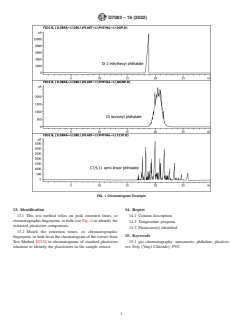
used to obtain the example chromatograms shown in Fig. 1.
NOTE 3—Other columns, detectors, or
...