

ASTM D4441-20
(Specification)Standard Specification for Aqueous Dispersions of Polytetrafluoroethylene
General Information
- Abstract
ABSTRACT
This specification establishes the properties and test methods for aqueous dispersions of polytetrafluoroethylene (PTFE) resins, and is used to determine if a shipment, lot, or container of PTFE dispersions is suitable for its intended use. These resins are homopolymers of tetrafluoroethylene, or in some cases modified homopolymers containing not more than 1% by weight of other fluoromonomers, and the dispersions are usually stabilized by one or more surfactants. Other non-PTFE materials may be present in total at 5% or less by weight for special purposes. This specification is for virgin materials only, and does not cover PTFE copolymers or filled dispersions, and recycled materials as they are not appropriate for dispersions. Materials shall be appropriately sampled for testing on the following: pH value; solid and surfactant content by gravimetric weight loss; solid content by hydrometer; test for coagulated polymer; specific gravity; and melting characteristics.
SCOPE
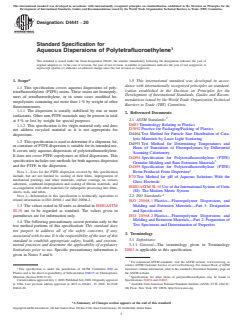
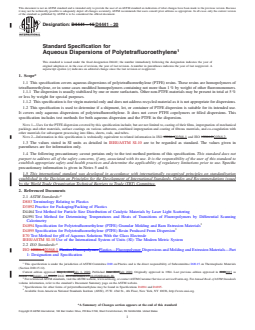
1.1 This specification covers aqueous dispersions of polytetrafluoroethylene (PTFE) resins. These resins are homopolymers of tetrafluoroethylene, or in some cases modified homopolymers containing not more than 1 % by weight of other fluoromonomers.
1.1.1 The dispersion is usually stabilized by one or more surfactants. Other non-PTFE materials may be present in total at 5 % or less by weight for special purposes.
1.1.2 This specification is for virgin material only and does not address recycled material as it is not appropriate for dispersions.
1.2 This specification is used to determine if a shipment, lot, or container of PTFE dispersion is suitable for its intended use. It covers only aqueous dispersions of polytetrafluoroethylene. It does not cover PTFE copolymers or filled dispersions. This specification includes test methods for both aqueous dispersion and the PTFE in the dispersion.
Note 1: Uses for the PTFE dispersion covered by this specification include, but are not limited to, casting of their films, impregnation of mechanical packings and other materials, surface coatings on various substrates, combined impregnation and coating of fibrous materials, and co-coagulation with other materials for subsequent processing into films, sheets, rods, and tubes.
Note 2: Information in this specification is technically equivalent to related information in ISO 20568-1 and ISO 20568-2.
1.3 The values stated in SI units as detailed in IEEE/ASTM SI-10 are to be regarded as standard. The values given in parentheses are for information only.
1.4 The following precautionary caveat pertains only to the test method portions of this specification. This standard does not purport to address all of the safety concerns, if any, associated with its use. It is the responsibility of the user of this standard to establish appropriate safety and health practices and determine the applicability of regulatory limitations prior to use. Specific precautionary information is given in Notes 5 and 6.
1.5 This international standard was developed in accordance with internationally recognized principles on standardization established in the Decision on Principles for the Development of International Standards, Guides and Recommendations issued by the World Trade Organization Technical Barriers to Trade (TBT) Committee.
- Status
- Published
- Publication Date
- 30-Jun-2020
- Technical Committee
- D20 - Plastics
- Drafting Committee
- D20.15 - Thermoplastic Materials
Buy Documents
ASTM D4441-20 - Standard Specification for Aqueous Dispersions of Polytetrafluoroethylene
REDLINE ASTM D4441-20 - Standard Specification for Aqueous Dispersions of Polytetrafluoroethylene
Overview
ASTM D4441-20, titled Standard Specification for Aqueous Dispersions of Polytetrafluoroethylene, establishes the quality requirements and relevant testing methods for aqueous dispersions of polytetrafluoroethylene (PTFE) resins. Developed by ASTM International, this standard ensures that PTFE dispersions meet rigorous criteria for use in demanding industrial applications. It only applies to virgin PTFE materials in aqueous dispersion form, typically stabilized with one or more surfactants, and excludes copolymers, filled dispersions, and recycled materials.
PTFE dispersions governed by ASTM D4441-20 are widely utilized in industrial settings for coating, impregnation, and fabrication of composite structures, thanks to PTFE's outstanding chemical resistance and thermal stability.
Key Topics
Scope and Coverage
- Applies to virgin polytetrafluoroethylene aqueous dispersions.
- Covers both homopolymers of tetrafluoroethylene and modified homopolymers (with ≤1% other fluoromonomers).
- Limits non-PTFE components to ≤5% by weight for specific purposes.
- Excludes PTFE copolymers, filled dispersions, and recycled materials.
Classification
- Dispersions are classified by:
- PTFE content (≤40% or >40%)
- Surfactant level (grades based on percentage)
- Surfactant Tolerance Level (to differentiate dispersion variability)
- Dispersions are classified by:
Sampling and Testing
- Specifies homogenization procedures and sampling methods to ensure representative testing.
- Includes tests for:
- pH value (as per ASTM E70)
- Solid and surfactant content (gravimetric method)
- Solids content (hydrometer method)
- Coagulated polymer content
- Specific gravity
- Melting characteristics (compatibility with ASTM D4895)
- Particle size (turbidimetric method for dispersions with average diameters 0.10–0.35 μm)
Packaging and Marking
- Requirements for secure, contamination-free transport.
- Guidance on marking containers in accordance with ASTM D3892.
Applications
PTFE aqueous dispersions specified by ASTM D4441-20 serve a variety of industrial uses where high-performance coatings and impregnations are required:
- Surface Coatings: Applied on substrates to impart non-stick, low-friction, or chemical-resistant characteristics, such as in cookware, wire insulation, and industrial equipment.
- Film Casting: Used to produce thin, flexible PTFE films with exceptional dielectric and thermal properties.
- Impregnation: Essential for enhancing the durability and chemical resistance of mechanical packings and porous materials.
- Co-coagulation Processes: Combined with other materials to create advanced composites formed into films, sheets, rods, and tubes.
- Textile Treatments: Imparts hydrophobic and stain-resistant properties to fibrous materials.
These applications leverage the unique attributes of PTFE such as thermal stability, chemical inertness, and low coefficient of friction.
Related Standards
For comprehensive quality assurance in PTFE materials, ASTM D4441-20 references several other standards:
- ASTM D883: Terminology Relating to Plastics
- ASTM D3892: Practice for Packaging/Packing of Plastics
- ASTM D4464: Particle Size Distribution of Catalytic Materials
- ASTM D4591: Temperatures and Heats of Transitions of Fluoropolymers
- ASTM D4894/D4895: Specifications for other PTFE forms (granular and resin produced from dispersion)
- ASTM E70: Test Method for pH of Aqueous Solutions
- IEEE/ASTM SI-10: Use of the International System of Units (SI)
- ISO 20568-1 and ISO 20568-2: Designation, specification, and testing of fluoropolymer plastics and dispersions
When specifying or selecting PTFE dispersions, referencing ASTM D4441-20 in conjunction with these related standards ensures regulatory compliance and material performance consistency across diverse applications.
Relations
- Effective Date
- 01-Feb-2024
- Effective Date
- 01-Jan-2024
- Effective Date
- 01-Nov-2023
- Effective Date
- 15-May-2020
- Effective Date
- 01-Jan-2020
- Effective Date
- 01-Aug-2019
- Effective Date
- 01-May-2019
- Effective Date
- 15-Apr-2019
- Effective Date
- 01-Feb-2019
- Effective Date
- 01-Dec-2018
- Effective Date
- 01-Nov-2018
- Effective Date
- 15-Aug-2017
- Effective Date
- 01-May-2016
- Effective Date
- 01-Sep-2015
- Effective Date
- 01-Jun-2015
Buy Documents
ASTM D4441-20 - Standard Specification for Aqueous Dispersions of Polytetrafluoroethylene
REDLINE ASTM D4441-20 - Standard Specification for Aqueous Dispersions of Polytetrafluoroethylene
Get Certified
Connect with accredited certification bodies for this standard

DIN CERTCO
DIN Group product certification.

Smithers Quality Assessments
US management systems and product certification.
Sponsored listings
Frequently Asked Questions
ASTM D4441-20 is a technical specification published by ASTM International. Its full title is "Standard Specification for Aqueous Dispersions of Polytetrafluoroethylene". This standard covers: ABSTRACT This specification establishes the properties and test methods for aqueous dispersions of polytetrafluoroethylene (PTFE) resins, and is used to determine if a shipment, lot, or container of PTFE dispersions is suitable for its intended use. These resins are homopolymers of tetrafluoroethylene, or in some cases modified homopolymers containing not more than 1% by weight of other fluoromonomers, and the dispersions are usually stabilized by one or more surfactants. Other non-PTFE materials may be present in total at 5% or less by weight for special purposes. This specification is for virgin materials only, and does not cover PTFE copolymers or filled dispersions, and recycled materials as they are not appropriate for dispersions. Materials shall be appropriately sampled for testing on the following: pH value; solid and surfactant content by gravimetric weight loss; solid content by hydrometer; test for coagulated polymer; specific gravity; and melting characteristics. SCOPE 1.1 This specification covers aqueous dispersions of polytetrafluoroethylene (PTFE) resins. These resins are homopolymers of tetrafluoroethylene, or in some cases modified homopolymers containing not more than 1 % by weight of other fluoromonomers. 1.1.1 The dispersion is usually stabilized by one or more surfactants. Other non-PTFE materials may be present in total at 5 % or less by weight for special purposes. 1.1.2 This specification is for virgin material only and does not address recycled material as it is not appropriate for dispersions. 1.2 This specification is used to determine if a shipment, lot, or container of PTFE dispersion is suitable for its intended use. It covers only aqueous dispersions of polytetrafluoroethylene. It does not cover PTFE copolymers or filled dispersions. This specification includes test methods for both aqueous dispersion and the PTFE in the dispersion. Note 1: Uses for the PTFE dispersion covered by this specification include, but are not limited to, casting of their films, impregnation of mechanical packings and other materials, surface coatings on various substrates, combined impregnation and coating of fibrous materials, and co-coagulation with other materials for subsequent processing into films, sheets, rods, and tubes. Note 2: Information in this specification is technically equivalent to related information in ISO 20568-1 and ISO 20568-2. 1.3 The values stated in SI units as detailed in IEEE/ASTM SI-10 are to be regarded as standard. The values given in parentheses are for information only. 1.4 The following precautionary caveat pertains only to the test method portions of this specification. This standard does not purport to address all of the safety concerns, if any, associated with its use. It is the responsibility of the user of this standard to establish appropriate safety and health practices and determine the applicability of regulatory limitations prior to use. Specific precautionary information is given in Notes 5 and 6. 1.5 This international standard was developed in accordance with internationally recognized principles on standardization established in the Decision on Principles for the Development of International Standards, Guides and Recommendations issued by the World Trade Organization Technical Barriers to Trade (TBT) Committee.
ABSTRACT This specification establishes the properties and test methods for aqueous dispersions of polytetrafluoroethylene (PTFE) resins, and is used to determine if a shipment, lot, or container of PTFE dispersions is suitable for its intended use. These resins are homopolymers of tetrafluoroethylene, or in some cases modified homopolymers containing not more than 1% by weight of other fluoromonomers, and the dispersions are usually stabilized by one or more surfactants. Other non-PTFE materials may be present in total at 5% or less by weight for special purposes. This specification is for virgin materials only, and does not cover PTFE copolymers or filled dispersions, and recycled materials as they are not appropriate for dispersions. Materials shall be appropriately sampled for testing on the following: pH value; solid and surfactant content by gravimetric weight loss; solid content by hydrometer; test for coagulated polymer; specific gravity; and melting characteristics. SCOPE 1.1 This specification covers aqueous dispersions of polytetrafluoroethylene (PTFE) resins. These resins are homopolymers of tetrafluoroethylene, or in some cases modified homopolymers containing not more than 1 % by weight of other fluoromonomers. 1.1.1 The dispersion is usually stabilized by one or more surfactants. Other non-PTFE materials may be present in total at 5 % or less by weight for special purposes. 1.1.2 This specification is for virgin material only and does not address recycled material as it is not appropriate for dispersions. 1.2 This specification is used to determine if a shipment, lot, or container of PTFE dispersion is suitable for its intended use. It covers only aqueous dispersions of polytetrafluoroethylene. It does not cover PTFE copolymers or filled dispersions. This specification includes test methods for both aqueous dispersion and the PTFE in the dispersion. Note 1: Uses for the PTFE dispersion covered by this specification include, but are not limited to, casting of their films, impregnation of mechanical packings and other materials, surface coatings on various substrates, combined impregnation and coating of fibrous materials, and co-coagulation with other materials for subsequent processing into films, sheets, rods, and tubes. Note 2: Information in this specification is technically equivalent to related information in ISO 20568-1 and ISO 20568-2. 1.3 The values stated in SI units as detailed in IEEE/ASTM SI-10 are to be regarded as standard. The values given in parentheses are for information only. 1.4 The following precautionary caveat pertains only to the test method portions of this specification. This standard does not purport to address all of the safety concerns, if any, associated with its use. It is the responsibility of the user of this standard to establish appropriate safety and health practices and determine the applicability of regulatory limitations prior to use. Specific precautionary information is given in Notes 5 and 6. 1.5 This international standard was developed in accordance with internationally recognized principles on standardization established in the Decision on Principles for the Development of International Standards, Guides and Recommendations issued by the World Trade Organization Technical Barriers to Trade (TBT) Committee.
ASTM D4441-20 is classified under the following ICS (International Classification for Standards) categories: 83.080.20 - Thermoplastic materials. The ICS classification helps identify the subject area and facilitates finding related standards.
ASTM D4441-20 has the following relationships with other standards: It is inter standard links to ASTM D883-24, ASTM E70-24, ASTM D883-23, ASTM D4464-15(2020), ASTM D883-20, ASTM D883-19c, ASTM D4894-19, ASTM D883-19a, ASTM D883-19, ASTM D883-18a, ASTM D883-18, ASTM D883-17, ASTM D4895-16, ASTM D3892-15, ASTM E70-07(2015). Understanding these relationships helps ensure you are using the most current and applicable version of the standard.
ASTM D4441-20 is available in PDF format for immediate download after purchase. The document can be added to your cart and obtained through the secure checkout process. Digital delivery ensures instant access to the complete standard document.
Standards Content (Sample)
This international standard was developed in accordance with internationally recognized principles on standardization established in the Decision on Principles for the
Development of International Standards, Guides and Recommendations issued by the World Trade Organization Technical Barriers to Trade (TBT) Committee.
Designation: D4441 − 20
Standard Specification for
Aqueous Dispersions of Polytetrafluoroethylene
This standard is issued under the fixed designation D4441; the number immediately following the designation indicates the year of
original adoption or, in the case of revision, the year of last revision. A number in parentheses indicates the year of last reapproval. A
superscript epsilon (´) indicates an editorial change since the last revision or reapproval.
1. Scope* 1.5 This international standard was developed in accor-
dance with internationally recognized principles on standard-
1.1 This specification covers aqueous dispersions of poly-
ization established in the Decision on Principles for the
tetrafluoroethylene (PTFE) resins. These resins are homopoly-
Development of International Standards, Guides and Recom-
mers of tetrafluoroethylene, or in some cases modified ho-
mendations issued by the World Trade Organization Technical
mopolymers containing not more than 1 % by weight of other
Barriers to Trade (TBT) Committee.
fluoromonomers.
1.1.1 The dispersion is usually stabilized by one or more
2. Referenced Documents
surfactants. Other non-PTFE materials may be present in total
2.1 ASTM Standards:
at 5 % or less by weight for special purposes.
D883 Terminology Relating to Plastics
1.1.2 This specification is for virgin material only and does
D3892 Practice for Packaging/Packing of Plastics
not address recycled material as it is not appropriate for
D4464 Test Method for Particle Size Distribution of Cata-
dispersions.
lytic Materials by Laser Light Scattering
1.2 This specification is used to determine if a shipment, lot,
D4591 Test Method for Determining Temperatures and
or container of PTFE dispersion is suitable for its intended use.
Heats of Transitions of Fluoropolymers by Differential
It covers only aqueous dispersions of polytetrafluoroethylene.
Scanning Calorimetry
It does not cover PTFE copolymers or filled dispersions. This
D4894 Specification for Polytetrafluoroethylene (PTFE)
specification includes test methods for both aqueous dispersion 3
Granular Molding and Ram Extrusion Materials
and the PTFE in the dispersion.
D4895 Specification for Polytetrafluoroethylene (PTFE)
Resin Produced From Dispersion
NOTE 1—Uses for the PTFE dispersion covered by this specification
include, but are not limited to, casting of their films, impregnation of
E70 Test Method for pH of Aqueous Solutions With the
mechanical packings and other materials, surface coatings on various
Glass Electrode
substrates, combined impregnation and coating of fibrous materials, and
IEEE/ASTM SI-10 Use of the International System of Units
co-coagulation with other materials for subsequent processing into films,
(SI): The Modern Metric System
sheets, rods, and tubes.
NOTE 2—Information in this specification is technically equivalent to
2.2 ISO Standards:
related information in ISO 20568-1 and ISO 20568-2.
ISO 20568-1 Plastics—Fluoropolymer Dispersions and
1.3 The values stated in SI units as detailed in IEEE/ASTM Molding and Extrusion Materials—Part 1: Designation
SI-10 are to be regarded as standard. The values given in and Specification
parentheses are for information only. ISO 20568-2 Plastics—Fluoropolymer Dispersions and
Molding and Extrusion Materials—Part 2: Preparation of
1.4 The following precautionary caveat pertains only to the
Test Specimens and Determination of Properties
test method portions of this specification. This standard does
not purport to address all of the safety concerns, if any,
3. Terminology
associated with its use. It is the responsibility of the user of this
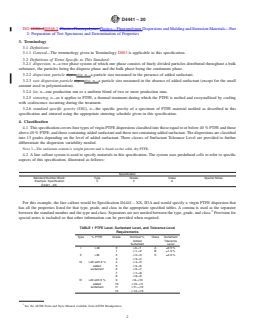
3.1 Definitions:
standard to establish appropriate safety, health, and environ-
3.1.1 General—The terminology given in Terminology
mental practices and determine the applicability of regulatory
D883 is applicable to this specification.
limitations prior to use. Specific precautionary information is
given in Notes 5 and 6.
For referenced ASTM standards, visit the ASTM website, www.astm.org, or
contact ASTM Customer Service at service@astm.org. For Annual Book of ASTM
This specification is under the jurisdiction of ASTM Committee D20 on Standards volume information, refer to the standard’s Document Summary page on
Plastics and is the direct responsibility of Subcommittee D20.15 on Thermoplastic the ASTM website.
Materials (Section D20.15.12). Specifications for other forms of polytetrafluoroethylene may be found in
Current edition approved July 1, 2020. Published July 2020. Originally approved Specifications D4894 and D4895.
in 1984. Last previous edition approved in 2015 as D4441 - 15. DOI: 10.1520/ Available from American National Standards Institute (ANSI), 25 W. 43rd St.,
D4441-20. 4th Floor, New York, NY 10036, http://www.ansi.org.
*A Summary of Changes section appears at the end of this standard
Copyright © ASTM International, 100 Barr Harbor Drive, PO Box C700, West Conshohocken, PA 19428-2959. United States
D4441 − 20
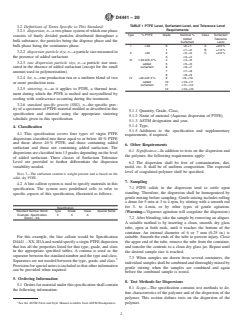
TABLE 1 PTFE Level, Surfactant Level, and Tolerance Level
3.2 Definitions of Terms Specific to This Standard:
Requirements
3.2.1 dispersion, n—a two phase system of which one phase
Type % PTFE Grade Nominal % Class Surfactant
consists of finely divided particles distributed throughout a
Added Tolerance
bulk substance, the particles being the disperse phase and the
Surfactant Level
bulk phase being the continuous phase.
I #40 0 >0–<1 A ±0.5 %
1 $1–<2 B ±1.0 %
3.2.2 dispersion particle size, n—a particle size measured in
II >40 2 $2–<3 C ±2.0 %
the presence of added surfactant. 3 $3–<4
III #40 with 0 % 4 $4–<5
3.2.3 raw dispersion particle size, n—a particle size mea-
added 5 $5–<6
sured in the absence of added surfactant (except for the small surfactant 6 $6–<7
7 $7–<8
amount used in polymerization).
8 $8–<9
3.2.4 lot, n—one production run or a uniform blend of two IV >40 with 0 % 9 $9–<10
added 10 $10–<11
or more production runs.
surfactant 11 $11–<12
3.2.5 sintering, n—as it applies to PTFE, a thermal treat- 12 $12–<13
ment during which the PTFE is melted and recrystallized by
cooling with coalescence occurring during the treatment.
3.2.6 standard specific gravity (SSG), n—the specific grav-
ity of a specimen of PTFE material molded as described in this
5.1.1 Quantity, Grade, Class,
specification and sintered using the appropriate sintering
5.1.2 Name of material (Aqueous dispersion of PTFE),
schedule given in this specification.
5.1.3 ASTM designation and year,
5.1.4 Type,
4. Classification
5.1.5 Additions to the specification and supplementary
4.1 This specification covers four types of virgin PTFE
requirements, if required.
dispersions classified into those equal to or below 40 % PTFE
and those above 40 % PTFE, and those containing added
6. Other Requirements
surfactant and those not containing added surfactant. The
6.1 Significance—In addition to tests on the dispersion and
dispersions are classified into 13 grades depending on the level
the polymer, the following requirements apply:
of added surfactant. Three classes of Surfactant Tolerance
Level are provided to further differentiate the dispersion 6.2 The dispersion shall be free of contamination, dirt,
variability needed. mold, etc. It shall be of uniform composition. The expected
level of coagulated polymer shall be specified.
NOTE 3—The surfactant content is weight percent and is based on the
solid, dry PTFE.
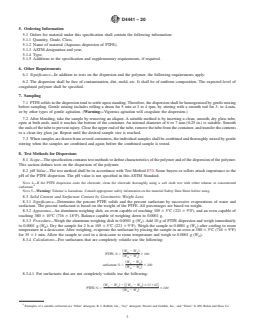
7. Sampling
4.2 A line callout system is used to specify materials in this
7.1 PTFE solids in the dispersion tend to settle upon
specification. The system uses predefined cells to refer to
standing. Therefore, the dispersion shall be homogenized by
specific aspects of this specification, illustrated as follows:
gentle mixing before sampling. Gentle mixing includes rolling
a drum for 5 min at 3 to 4 rpm, by stirring with a smooth rod
for 3- to 4-min, or by other types of gentle agitation.
Specification
Standard Number Block: Type Grade Class Special Notes
(Warning—Vigorous agitation will coagulate the dispersion.)
Example: Specification II 3 A
D4441 - XX, 7.2 After blending, take the sample by removing an aliquot.
A suitable method is by inserting a clean, smooth, dry glass
tube, open at both ends, until it reaches the bottom of the
container. An internal diameter of 6 or 7 mm (0.25 in.) is
For this example, the line callout would be Specification
suitable. Smooth the ends of the tube to prevent injury. Close
D4441 – XX, II3A and would specify a virgin PTFE dispersion
the upper end of the tube, remove the tube from the container,
that has all the properties listed for that type, grade, and class
and transfer the contents to a clean dry glass jar. Repeat until
in the appropriate specified tables. A comma is used as the
the desired sample size is reached.
separator between the standard number and the type and class.
7.3 When samples are drawn from several containers, the
Separators are not needed between the type, grade, and class.
individual samples shall be combined and thoroughly mixed by
Provision for special notes is included so that other information
gentle stirring when the samples are combined and again
can be provided when required.
before the combined sample is tested.
5. Ordering Information
8. Test Methods for Dispersions
5.1 Orders for material under this specification shall contain
8.1 Scope—The specification contains test methods to de-
the following information:
fine characteristics of the polymer and of the dispersion of the
polymer. This section defines tests on the dispersion of the
See the ASTM Form and Style Manual available from ASTM Headquarters. polymer.
D4441 − 20
8.2 pH Value—The test method shall be in accordance with 8.3.6 The results of these tests on solids contents and
Test Method E70. Some buyers or sellers attach importance to surfactant shall conform to one of the types of dispersion listed
the pH of the PTFE dispersion. The pH value is not specified in 4.1.
in this ASTM Standard.
8.4 Solids Content by Hydrometer:
NOTE 4—If the PTFE dispersion coats the electrode, clean the electrode 8.4.1 Significance—An approximate solids content in a
thoroughly using a soft cloth wet with either toluene or concentrated
dispersion is commonly determined from the specific gravity of
surfactant.
the dispersion. The hydrometer reading is a function of the
NOTE 5—Warning: Toluene is hazardous. Consult appropriate safety
solids content, the surfactant content, and other parameters of
information on the material Safety Data Sheet before using.
the dispersion. Therefore, any single conversion table has
8.3 Solid Content and Surfactant Content by Gravimetric
inherent error and cannot be universally applicable. A table
Weight Loss:
should be obtained from the supplier.
8.3.1 Significance—Determine the percent PTFE solids and
8.4.2 Apparatus—A hydrometer or set of hydrometers ca-
the percent surfactant by successive evaporations of water and
pable of measuring specific gravity from 1.000 to 1.500.
surfactant. The percent surfactant is based on the weight of the
Accuracy of the hydrometer shall be 60.001. A graduated
PTFE. All percentages are based on weight.
cylinder large enough to hold the hydrometer.
8.3.2 Apparatus—An aluminum weighing dish, an oven
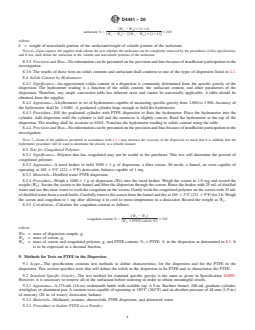
8.4.3 Procedure—Fill the graduated cylinder with PTFE
capable of reaching 105 6 5°C (221 6 9°F), and an oven
dispersion to float the hydrometer. Place the hydrometer into
capable of reaching 380 6 10°C (716 6 18°F). Balance ca-
the cylinder. Add dispersion until the cylinder is full and the
pable of weighing down to 0.0001 g.
meniscus is slightly convex. Read the hydrometer at the top of
8.3.3 Procedure—Weigh the aluminum weighing dish to
the dispersion. The reading shall be accurate to 0.001. Trans-
0.0001 g (W ). Add 10 g of PTFE dispersion and weigh
A
late the hydrometer reading to solids content using the table.
immediately to 0.0001 g (W ). Dry the sample for 2 h at
B
8.4.4 Precision and Bias—No information can be presented
105 6 5°C (221 6 9°F). Weigh the sample to 0.0001 g (W )
C
on the precision and bias because of insufficient participation in
after cooling to room temperature in a desiccator. After
the investigation.
weighing, evaporate the surfactant by placing the sample in an
NOTE 7—Some of the additives permitted in accordance with 1.1.1 may
oven at 380 6 5°C (716 6 9°F) for 35 6 1 min. Allow the
increase the viscosity of the dispersion so much that it is unlikely that the
sample to cool in a desiccator to room temperature and weigh
hydrometer procedure will be used to determine the density in a reliable
to 0.0001 g (W ).
D
manner.
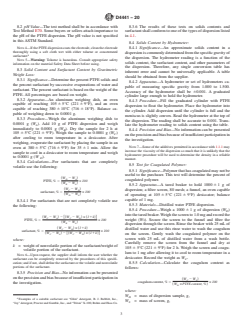
8.3.4 Calculations—For surfactants that are completely
8.5 Test for Coagulated Polymer:
volatile use the following:
8.5.1 Significance—Polymer that has coagulated may not be
useful to the purchaser. This test will determine the percent of
~W 2 W !
D A
coagulated polymer.
PTFE, % 5 × 100
W 2 W
~ !
B A
8.5.2 Apparatus—A tared beaker to hold 1000 6 1 g of
~W 2 W !
C D dispersion; a filter screen, 80 mesh; a funnel, an oven capable
surfactant, % 5 × 100
W 2 W
~ !
of operating at 105 6 5°C (221 6 9°F) desiccator; balance
D A
capable of 1 mg.
8.3.4.1 For surfactants that are not completely volatile use
8.5.3 Materials—Distilled water PTFE dispersion.
the following:
8.5.4 Procedure—Weigh a 1000 6 1 g of dispersion (W )
D
into the tared beaker. Weigh the screen to 1.0 mg and record the
W 2 W 2 W 2 W × 11k
~ ! @~ ! ~ !#
C A C D
weight (W ). Secure the screen to the funnel and filter the
PTFE, % 5 × 100
S
~W 2 W !
B A
dispersion through the screen. Rinse the beaker with 25 mL of
~W 2 W ! × ~11k!
C D distilled water and use this rinse water to wash the coagulum
surfactant, % 5 × 100
W 2 W 2 W 2 W × 11k
~ ! @~ ! ~ !#
C A C D on the screen. Gently wash the coagulated polymer on the
screen with 25 mL of distilled water from a wash bottle.
where:
Carefully remove the screen from the funnel and dry at
k = weight of nonvolatile portion of the surfactant/weight of
105 6 5°C (221 6 9°F) for 2 h. Weigh the screen and coagu-
volatile portion of the surfactant.
lum to 1 mg after allowing it to cool to room temperature in a
NOTE 6—Upon request, the supplier shall inform the user whether the
desiccator. Record the weight as W .
C
surfactant can be completely removed by the procedures of this specifi-
8.5.5 Calculation—Calculate the coagulum content as
cation; and if not, shall define the surfactant or the volatile and nonvolatile
portions of the surf
...
This document is not an ASTM standard and is intended only to provide the user of an ASTM standard an indication of what changes have been made to the previous version. Because
it may not be technically possible to adequately depict all changes accurately, ASTM recommends that users consult prior editions as appropriate. In all cases only the current version
of the standard as published by ASTM is to be considered the official document.
Designation: D4441 − 15 D4441 − 20
Standard Specification for
Aqueous Dispersions of Polytetrafluoroethylene
This standard is issued under the fixed designation D4441; the number immediately following the designation indicates the year of
original adoption or, in the case of revision, the year of last revision. A number in parentheses indicates the year of last reapproval. A
superscript epsilon (´) indicates an editorial change since the last revision or reapproval.
1. Scope*
1.1 This specification covers aqueous dispersions of polytetrafluoroethylene (PTFE) resins. These resins are homopolymers of
tetrafluoroethylene, or in some cases modified homopolymers containing not more than 1 % by weight of other fluoromonomers.
1.1.1 The dispersion is usually stabilized by one or more surfactants. Other non-PTFE materials may be present in total at 5 %
or less by weight for special purposes.
1.1.2 This specification is for virgin material only and does not address recycled material as it is not appropriate for dispersions.
1.2 This specification is used to determine if a shipment, lot, or container of PTFE dispersion is suitable for its intended use.
It covers only aqueous dispersions of polytetrafluoroethylene. It does not cover PTFE copolymers or filled dispersions. This
specification includes test methods for both aqueous dispersion and the PTFE in the dispersion.
NOTE 1—Uses for the PTFE dispersion covered by this specification include, but are not limited to, casting of their films, impregnation of mechanical
packings and other materials, surface coatings on various substrates, combined impregnation and coating of fibrous materials, and co-coagulation with
other materials for subsequent processing into films, sheets, rods, and tubes.
NOTE 2—Information in this specification is technically equivalent to related information in ISO 12086-120568-1 and ISO 12086-2.20568-2.
1.3 The values stated in SI units as detailed in IEEE/ASTM SI-10 are to be regarded as standard. The values given in
parentheses are for information only.
1.4 The following precautionary caveat pertains only to the test method portions of this specification. This standard does not
purport to address all of the safety concerns, if any, associated with its use. It is the responsibility of the user of this standard to
establish appropriate safety and health practices and determine the applicability of regulatory limitations prior to use. Specific
precautionary information is given in Notes 5 and 6.
1.5 This international standard was developed in accordance with internationally recognized principles on standardization
established in the Decision on Principles for the Development of International Standards, Guides and Recommendations issued
by the World Trade Organization Technical Barriers to Trade (TBT) Committee.
2. Referenced Documents
2.1 ASTM Standards:
D883 Terminology Relating to Plastics
D3892 Practice for Packaging/Packing of Plastics
D4464 Test Method for Particle Size Distribution of Catalytic Materials by Laser Light Scattering
D4591 Test Method for Determining Temperatures and Heats of Transitions of Fluoropolymers by Differential Scanning
Calorimetry
D4894 Specification for Polytetrafluoroethylene (PTFE) Granular Molding and Ram Extrusion Materials
D4895 Specification for Polytetrafluoroethylene (PTFE) Resin Produced From Dispersion
E70 Test Method for pH of Aqueous Solutions With the Glass Electrode
IEEE/ASTM SI-10 Use of the International System of Units (SI): The Modern Metric System
2.2 ISO Standards:
ISO 12086-120568-1 Plastics Fluoropolymer Plastics—Fluoropolymer Dispersions and Molding and Extrusion Materials—Part
1: Designation and Specification
This specification is under the jurisdiction of ASTM Committee D20 on Plastics and is the direct responsibility of Subcommittee D20.15 on Thermoplastic Materials
(Section D20.15.12).
Current edition approved May 1, 2015July 1, 2020. Published June 2015July 2020. Originally approved in 1984. Last previous edition approved in 20102015 as
D4441 - 04D4441 - 15.(2010). DOI: 10.1520/D4441-15.10.1520/D4441-20.
For referenced ASTM standards, visit the ASTM website, www.astm.org, or contact ASTM Customer Service at service@astm.org. For Annual Book of ASTM Standards
volume information, refer to the standard’s Document Summary page on the ASTM website.
Specifications for other forms of polytetrafluoroethylene may be found in Specifications D4894 and D4895.
Available from American National Standards Institute (ANSI), 25 W. 43rd St., 4th Floor, New York, NY 10036, http://www.ansi.org.
*A Summary of Changes section appears at the end of this standard
Copyright © ASTM International, 100 Barr Harbor Drive, PO Box C700, West Conshohocken, PA 19428-2959. United States
D4441 − 20
ISO 12086-220568-2 Plastics Fluoropolymer Plastics—Fluoropolymer Dispersions and Molding and Extrusion Materials—Part
2: Preparation of Test Specimens and Determination of Properties
3. Terminology
3.1 Definitions:
3.1.1 General—The terminology given in Terminology D883 is applicable to this specification.
3.2 Definitions of Terms Specific to This Standard:
3.2.1 dispersion, n—a two phase system of which one phase consists of finely divided particles distributed throughout a bulk
substance, the particles being the disperse phase and the bulk phase being the continuous phase.
3.2.2 dispersion particle size—size, n—a particle size measured in the presence of added surfactant.
3.2.3 raw dispersion particle size—size, n—a particle size measured in the absence of added surfactant (except for the small
amount used in polymerization).
3.2.4 lot, n—one production run or a uniform blend of two or more production runs.
3.2.5 sintering, n—as it applies to PTFE, a thermal treatment during which the PTFE is melted and recrystallized by cooling
with coalescence occurring during the treatment.
3.2.6 standard specific gravity (SSG), n—the specific gravity of a specimen of PTFE material molded as described in this
specification and sintered using the appropriate sintering schedule given in this specification.
4. Classification
4.1 This specification covers four types of virgin PTFE dispersions classified into those equal to or below 40 % PTFE and those
above 40 % PTFE, and those containing added surfactant and those not containing added surfactant. The dispersions are classified
into 13 grades depending on the level of added surfactant. Three classes of Surfactant Tolerance Level are provided to further
differentiate the dispersion variability needed.
NOTE 3—The surfactant content is weight percent and is based on the solid, dry PTFE.
4.2 A line callout system is used to specify materials in this specification. The system uses predefined cells to refer to specific
aspects of this specification, illustrated as follows:
Specification
Standard Number Block: Type Grade Class Special Notes
Example: Specification II 3 A
D4441 - XX,
For this example, the line callout would be Specification D4441 – XX, II3A and would specify a virgin PTFE dispersion that
has all the properties listed for that type, grade, and class in the appropriate specified tables. A comma is used as the separator
between the standard number and the type and class. Separators are not needed between the type, grade, and class. Provision for
special notes is included so that other information can be provided when required.
TABLE 1 PTFE Level, Surfactant Level, and Tolerance Level
Requirements
Type % PTFE Grade Nominal % Class Surfactant
Added Tolerance
Surfactant Level
I #40 0 >0–<1 A ±0.5 %
1 $1–<2 B ±1.0 %
II >40 2 $2–<3 C ±2.0 %
3 $3–<4
III #40 with 0 % 4 $4–<5
added 5 $5–<6
surfactant 6 $6–<7
7 $7–<8
8 $8–<9
IV >40 with 0 % 9 $9–<10
added 10 $10–<11
surfactant 11 $11–<12
12 $12–<13
See the ASTM Form and Style Manual available from ASTM Headquarters.
D4441 − 20
5. Ordering Information
5.1 Orders for material under this specification shall contain the following information:
5.1.1 Quantity, Grade, Class,
5.1.2 Name of material (Aqueous dispersion of PTFE),
5.1.3 ASTM designation and year,
5.1.4 Type,
5.1.5 Additions to the specification and supplementary requirements, if required.
6. Other Requirements
6.1 Significance—In addition to tests on the dispersion and the polymer, the following requirements apply:
6.2 The dispersion shall be free of contamination, dirt, mold, etc. It shall be of uniform composition. The expected level of
coagulated polymer shall be specified.
7. Sampling
7.1 PTFE solids in the dispersion tend to settle upon standing. Therefore, the dispersion shall be homogenized by gentle mixing
before sampling. Gentle mixing includes rolling a drum for 5 min at 3 to 4 rpm, by stirring with a smooth rod for 3- to 4-min,
or by other types of gentle agitation. (Warning—Vigorous agitation will coagulate the dispersion.)
7.2 After blending, take the sample by removing an aliquot. A suitable method is by inserting a clean, smooth, dry glass tube,
open at both ends, until it reaches the bottom of the container. An internal diameter of 6 or 7 mm (0.25 in.) is suitable. Smooth
the ends of the tube to prevent injury. Close the upper end of the tube, remove the tube from the container, and transfer the contents
to a clean dry glass jar. Repeat until the desired sample size is reached.
7.3 When samples are drawn from several containers, the individual samples shall be combined and thoroughly mixed by gentle
stirring when the samples are combined and again before the combined sample is tested.
8. Test Methods for Dispersions
8.1 Scope—The specification contains test methods to define characteristics of the polymer and of the dispersion of the polymer.
This section defines tests on the dispersion of the polymer.
8.2 pH Value—The test method shall be in accordance with Test Method E70. Some buyers or sellers attach importance to the
pH of the PTFE dispersion. The pH value is not specified in this ASTM Standard.
NOTE 4—If the PTFE dispersion coats the electrode, clean the electrode thoroughly using a soft cloth wet with either toluene or concentrated
surfactant.
NOTE 5—Warning: Toluene is hazardous. Consult appropriate safety information on the material Safety Data Sheet before using.
8.3 Solid Content and Surfactant Content by Gravimetric Weight Loss:
8.3.1 Significance—Determine the percent PTFE solids and the percent surfactant by successive evaporations of water and
surfactant. The percent surfactant is based on the weight of the PTFE. All percentages are based on weight.
8.3.2 Apparatus—An aluminum weighing dish, an oven capable of reaching 105 6 5°C (221 6 9°F), and an oven capable of
reaching 380 6 10°C (716 6 18°F). Balance capable of weighing down to 0.0001 g.
8.3.3 Procedure—Weigh the aluminum weighing dish to 0.0001 g (W ). Add 10 g of PTFE dispersion and weigh immediately
A
to 0.0001 g (W ). Dry the sample for 2 h at 105 6 5°C (221 6 9°F). Weigh the sample to 0.0001 g (W ) after cooling to room
B C
temperature in a desiccator. After weighing, evaporate the surfactant by placing the sample in an oven at 380 6 5°C (716 6 9°F)
for 35 6 1 min. Allow the sample to cool in a desiccator to room temperature and weigh to 0.0001 g (W ).
D
8.3.4 Calculations—For surfactants that are completely volatile use the following:
W 2 W
~ !
D A
PTFE,% 5 3 100
W 2 W
~ !
B A
~W 2 W !
C D
surfactant,% 5 3 100
W 2 W
~ !
D A
8.3.4.1 For surfactants that are not completely volatile use the following:
W 2 W 2 W 2 W 3 11k
~ ! @~ ! ~ !#
C A C D
PTFE,% 5 3 100
~W 2 W !
B A
Examples of a suitable surfactant are “Glim” detergent, B. J. Babbitt, Inc., “Joy” detergent, Proctor and Gamble, Inc., and “Triton” X-100, Rohm and Haas Co.
D4441 − 20
W 2 W 3 11k
~ ! ~ !
C D
surfactant,% 5 3 100
~W 2 W ! 2 @~W 2 W ! 3 ~11k!#
C A C D
where:
k = weight of nonvolatile portion of the surfactant/weight of volatile portion of the surfactant.
NOTE 6—Upon request, the supplier shall inform the user whether the surfactant can be completely removed by the procedures of this specification;
and if not, shall define the surfactant or the volatile and nonvolatile portions of the surfactant.
8.3.5 Precision and Bias—No information can be presented on the precision and bias because of insufficient participation in the
investigation.
8.3.6 The results of these tests on solids contents and surfactant shall conform to one of the types of dispersion listed in 4.1.
8.4 Solids Content by Hydrometer:
8.4.1 Significance—An approximate solids content in a dispersion is commonly determined from the specific gravity of the
dispersion. The hydrometer reading is a function of the solids content, the surfactant content, and other parameters of the
dispersion. Therefore, any single conversion table has inherent error and cannot be universally applicable. A table should be
obtained from the supplier.
8.4.2 Apparatus—A hydrometer or set of hydrometers capable of measuring specific gravity from 1.000 to 1.500. Accuracy of
the hydrometer shall be 60.001. A graduated cylinder large enough to hold the hydrometer.
8.4.3 Procedure—Fill the graduated cylinder with PTFE dispersion to float the hydrometer. Place the hydrometer into the
cylinder. Add dispersion until the cylinder is full and the meniscus is slightly convex. Read the hydrometer at the top of the
dispersion. The reading shall be accurate to 0.001. Translate the hydrometer reading to solids content using the table.
8.4.4 Precision and Bias—No information can be presented on the precision and bias because of insufficient participation in the
investigation.
NOTE 7—Some of the additives permitted in accordance with 1.1.1 may increase the viscosity of the dispersion so much that it is unlikely that the
hydrometer procedure will be used to determine the density in a reliable manner.
8.5 Test for Coagulated Polymer:
8.5.1 Significance—Polymer that has coagulated may not be useful to the purchaser. This test will determine the percent of
coagulated polymer.
8.5.2 Apparatus—A tared beaker to hold 1000 6 1 g of dispersion; a filter screen, 80 mesh; a funnel, an oven capable of
operating at 105 6 5°C (221 6 9°F) desiccator; balance capable of 1 mg.
8.5.3 Materials—Distilled water PTFE dispersion.
8.5.4 Procedure—Weigh a 1000 6 1 g of dispersion (W ) into the tared beaker. Weigh the screen to 1.0 mg and record the
D
weight (W ). Secure the screen to the funnel and filter the dispersion through the screen. Rinse the beaker with 25 mL of distilled
S
water and use this rinse water to wash the coagulum on the screen. Gently wash the coagulated polymer on the sc
...