

ASTM D5632/D5632M-17(2022)
(Specification)Standard Specification for Halon 1301, Bromotrifluoromethane (CF3Br)
General Information
- Abstract
ABSTRACT
This specification covers the requirements for Halon 1301, or halogenated hydrocarbon compound Bromotrifluoromethane (CF3Br) as a fire-fighting medium. The fire-fighting equipment or hardware that employs Halon 1301, the conditions of employing such equipment (for example, handhelds, fixed installations, etc.), and the storage or transportation of Halon 1301, are not addressed in this specification. The material shall be tested for purity, methanol impurity, acidity, water content, halogen ion content, nonvolatile residue, suspended matter and sediment, and fixed or nonabsorbable gases in the vapor phase.
SCOPE
1.1 This specification covers the requirements for Halon 1301 as a fire-fighting medium.
1.2 This specification does not address the fire-fighting equipment or hardware that employs Halon 1301 or the conditions of employing such equipment (for example, handhelds, fixed installations, etc.).
1.3 This specification does not address the storage or transportation of Halon 1301. Storage, handling, and transportation issues are addressed in Practice D5631.
1.4 The values stated in either SI units or inch-pound units are to be regarded separately as standard. The values stated in each system are not necessarily exact equivalents; therefore, to ensure conformance with the standard, each system shall be used independently of the other, and values from the two systems shall not be combined.
1.5 The following safety hazards caveat pertains only to the test methods portion, Section 6, of this specification: This standard does not purport to address all of the safety concerns, if any, associated with its use. It is the responsibility of the user of this standard to establish appropriate safety, health, and environmental practices and determine the applicability of regulatory limitations prior to use. Specific hazards statements are given in 4.5.
1.6 This international standard was developed in accordance with internationally recognized principles on standardization established in the Decision on Principles for the Development of International Standards, Guides and Recommendations issued by the World Trade Organization Technical Barriers to Trade (TBT) Committee.
- Status
- Published
- Publication Date
- 31-Oct-2022
- Technical Committee
- D26 - Halogenated Organic Solvents and Fire Extinguishing Agents
- Drafting Committee
- D26.09 - Fire Extinguishing Agents
Overview
ASTM D5632/D5632M-17(2022) is the international standard specification for Halon 1301, technically known as bromotrifluoromethane (CF₃Br). Developed by ASTM International, this standard specifies requirements for Halon 1301 as a fire-fighting agent, ensuring proper material quality and purity for use in fire suppression systems. The specification includes detailed criteria and test methods to verify that Halon 1301 meets industry needs for performance, consistency, and safety.
Halon 1301 is a recognized halogenated hydrocarbon widely used in specialized fire protection due to its rapid effectiveness and clean extinguishing properties. This standard is essential for manufacturers, users, and regulators who need to ensure the fire-fighting medium meets stringent quality benchmarks. Note: The standard does not cover hardware, fire suppression equipment, or procedures for storage and transportation, which are addressed by other standards such as ASTM D5631.
Key Topics
- Material Quality Requirements: Halon 1301 must meet strict thresholds for purity and maximum allowable content of impurities such as methanol, acidity (as HBr), water, halogen ions, nonvolatile residue, and non-condensable gases.
- Testing and Analysis: The standard provides guidance on accepted test methods for each parameter, including gas chromatography for purity and procedures for detecting physical contamination.
- Physical Description: Specifies recognizable properties such as appearance and color, ensuring conformity and the absence of suspended matter or sediment.
- Mixture Types: Defines Type I (Halon 1301 with nitrogen up to safe working pressure) and Type II (additionally limiting non-condensable gases), offering flexibility based on application needs.
- Unit Consistency: Both SI and inch-pound units are permitted but must be used independently to maintain accuracy and compliance.
- Safety and Compliance: Contains safety notices, including potential health risks with high concentrations, and references applicable regulatory constraints.
- Marking and Labeling: Requirements for proper identification of Halon 1301 containers during shipping and storage, including compliance with U.S. Department of Transportation and EPA labeling.
Applications
- Fire Suppression Systems: Halon 1301 is vital for protecting sensitive environments such as data centers, aircraft, telecommunications, and high-value archives where water or powder extinguishing could cause damage.
- Special Hazard Protection: Used in locations demanding rapid fire suppression and minimal residue, including shipboard systems, military vehicles, and power generation facilities.
- Quality Assurance: Manufacturers and suppliers rely on this standard to guarantee customers receive Halon 1301 that meets international purity and performance criteria.
- Regulatory Compliance: Ensures organizations purchasing or handling Halon 1301 adhere to national and international safety and environmental laws.
Related Standards
- ASTM D5631: Practice for Handling, Transportation, and Storage of Halon 1301, detailing safe logistics and storage practices.
- ISO 3427: Procedures for sampling gaseous halogenated hydrocarbons.
- AHRI Standard 700-2014 (Appendix C): Analytical methods referenced for determining Halon 1301 quality attributes.
- ASTM D2108: Method for determining the color of halogenated organic solvents, applicable for visual inspection of Halon 1301.
- CFR Title 49, Part 172: U.S. Department of Transportation regulations for hazardous materials labeling and marking.
Keywords: Halon 1301, bromotrifluoromethane, CF3Br, fire-fighting agent, fire suppression, fire protection standards, ASTM D5632, halogenated hydrocarbon, purity requirements, fire suppressant, international standards.
Relations
- Effective Date
- 01-Jan-2020
- Effective Date
- 01-Jun-2015
- Effective Date
- 01-Aug-2011
- Effective Date
- 01-Feb-2010
- Effective Date
- 01-Jan-2008
- Effective Date
- 01-Jan-2007
- Effective Date
- 01-Jun-2005
- Effective Date
- 01-Jun-2005
- Effective Date
- 01-Jan-2001
- Effective Date
- 01-Jan-2001
- Effective Date
- 10-Jan-2000
Get Certified
Connect with accredited certification bodies for this standard

CIS Institut d.o.o.
Personal Protective Equipment (PPE) certification body. Notified Body NB-2890 for EU Regulation 2016/425 PPE.

Kiwa BDA Testing
Building and construction product certification.
Kmetijski inštitut Slovenije
Agricultural Institute of Slovenia. Soil testing, plant health, agricultural product analysis.
Sponsored listings
Frequently Asked Questions
ASTM D5632/D5632M-17(2022) is a technical specification published by ASTM International. Its full title is "Standard Specification for Halon 1301, Bromotrifluoromethane (CF<inf>3</inf>Br)". This standard covers: ABSTRACT This specification covers the requirements for Halon 1301, or halogenated hydrocarbon compound Bromotrifluoromethane (CF3Br) as a fire-fighting medium. The fire-fighting equipment or hardware that employs Halon 1301, the conditions of employing such equipment (for example, handhelds, fixed installations, etc.), and the storage or transportation of Halon 1301, are not addressed in this specification. The material shall be tested for purity, methanol impurity, acidity, water content, halogen ion content, nonvolatile residue, suspended matter and sediment, and fixed or nonabsorbable gases in the vapor phase. SCOPE 1.1 This specification covers the requirements for Halon 1301 as a fire-fighting medium. 1.2 This specification does not address the fire-fighting equipment or hardware that employs Halon 1301 or the conditions of employing such equipment (for example, handhelds, fixed installations, etc.). 1.3 This specification does not address the storage or transportation of Halon 1301. Storage, handling, and transportation issues are addressed in Practice D5631. 1.4 The values stated in either SI units or inch-pound units are to be regarded separately as standard. The values stated in each system are not necessarily exact equivalents; therefore, to ensure conformance with the standard, each system shall be used independently of the other, and values from the two systems shall not be combined. 1.5 The following safety hazards caveat pertains only to the test methods portion, Section 6, of this specification: This standard does not purport to address all of the safety concerns, if any, associated with its use. It is the responsibility of the user of this standard to establish appropriate safety, health, and environmental practices and determine the applicability of regulatory limitations prior to use. Specific hazards statements are given in 4.5. 1.6 This international standard was developed in accordance with internationally recognized principles on standardization established in the Decision on Principles for the Development of International Standards, Guides and Recommendations issued by the World Trade Organization Technical Barriers to Trade (TBT) Committee.
ABSTRACT This specification covers the requirements for Halon 1301, or halogenated hydrocarbon compound Bromotrifluoromethane (CF3Br) as a fire-fighting medium. The fire-fighting equipment or hardware that employs Halon 1301, the conditions of employing such equipment (for example, handhelds, fixed installations, etc.), and the storage or transportation of Halon 1301, are not addressed in this specification. The material shall be tested for purity, methanol impurity, acidity, water content, halogen ion content, nonvolatile residue, suspended matter and sediment, and fixed or nonabsorbable gases in the vapor phase. SCOPE 1.1 This specification covers the requirements for Halon 1301 as a fire-fighting medium. 1.2 This specification does not address the fire-fighting equipment or hardware that employs Halon 1301 or the conditions of employing such equipment (for example, handhelds, fixed installations, etc.). 1.3 This specification does not address the storage or transportation of Halon 1301. Storage, handling, and transportation issues are addressed in Practice D5631. 1.4 The values stated in either SI units or inch-pound units are to be regarded separately as standard. The values stated in each system are not necessarily exact equivalents; therefore, to ensure conformance with the standard, each system shall be used independently of the other, and values from the two systems shall not be combined. 1.5 The following safety hazards caveat pertains only to the test methods portion, Section 6, of this specification: This standard does not purport to address all of the safety concerns, if any, associated with its use. It is the responsibility of the user of this standard to establish appropriate safety, health, and environmental practices and determine the applicability of regulatory limitations prior to use. Specific hazards statements are given in 4.5. 1.6 This international standard was developed in accordance with internationally recognized principles on standardization established in the Decision on Principles for the Development of International Standards, Guides and Recommendations issued by the World Trade Organization Technical Barriers to Trade (TBT) Committee.
ASTM D5632/D5632M-17(2022) is classified under the following ICS (International Classification for Standards) categories: 13.220.10 - Fire-fighting. The ICS classification helps identify the subject area and facilitates finding related standards.
ASTM D5632/D5632M-17(2022) has the following relationships with other standards: It is inter standard links to ASTM D2108-10(2020), ASTM D2108-10(2015), ASTM D5631-11, ASTM D2108-10, ASTM D5631-08, ASTM D5631-07, ASTM D5631-05, ASTM D2108-05, ASTM D2108-97, ASTM D2108-97(2001), ASTM D5631-00. Understanding these relationships helps ensure you are using the most current and applicable version of the standard.
ASTM D5632/D5632M-17(2022) is available in PDF format for immediate download after purchase. The document can be added to your cart and obtained through the secure checkout process. Digital delivery ensures instant access to the complete standard document.
Standards Content (Sample)
This international standard was developed in accordance with internationally recognized principles on standardization established in the Decision on Principles for the
Development of International Standards, Guides and Recommendations issued by the World Trade Organization Technical Barriers to Trade (TBT) Committee.
Designation: D5632/D5632M −17 (Reapproved 2022)
Standard Specification for
Halon 1301, Bromotrifluoromethane (CF Br)
This standard is issued under the fixed designation D5632/D5632M; the number immediately following the designation indicates the
year of original adoption or, in the case of revision, the year of last revision. A number in parentheses indicates the year of last
reapproval. A superscript epsilon (´) indicates an editorial change since the last revision or reapproval.
This standard has been approved for use by agencies of the U.S. Department of Defense.
1. Scope 2. Referenced Documents
2.1 ASTM Standards:
1.1 This specification covers the requirements for Halon
D2108 Test Method for Color of Halogenated Organic
1301 as a fire-fighting medium.
Solvents and Their Admixtures (Platinum-Cobalt Scale)
1.2 This specification does not address the fire-fighting
D5631 Practice for Handling,Transportation, and Storage of
equipment or hardware that employs Halon 1301 or the
Halon 1301, Bromotrifluoromethane (CF Br)
conditions of employing such equipment (for example,
2.2 ISO Standard:
handhelds, fixed installations, etc.).
ISO 3427 Gaseous Halogenated Hydrocarbons (Liquefied
Gases)—Taking of a Sample
1.3 This specification does not address the storage or
2.3 AHRI Standard:
transportation of Halon 1301. Storage, handling, and transpor-
2008 Appendix C for Analytical Procedures for AHRI Stan-
tation issues are addressed in Practice D5631.
dard 700-2014
1.4 The values stated in either SI units or inch-pound units
2.4 U.S. Government Standard:
are to be regarded separately as standard. The values stated in
CFR Title 49, Part 172 U.S. DOT Hazardous Materials
each system are not necessarily exact equivalents; therefore, to
Table, Special Provisions, Hazardous Materials
ensure conformance with the standard, each system shall be
Communications, Emergency Response Information, and
used independently of the other, and values from the two
Training Requirements
systems shall not be combined.
3. Terminology
1.5 The following safety hazards caveat pertains only to the
3.1 Definitions of Terms Specific to This Standard:
test methods portion, Section 6, of this specification: This
standarddoesnotpurporttoaddressallofthesafetyconcerns, 3.1.1 Halon 1301—The halogenated hydrocarbon com-
pound Bromotrifluoromethane used as a fire extinguishing
ifany,associatedwithitsuse.Itistheresponsibilityoftheuser
medium.
of this standard to establish appropriate safety, health, and
3.1.1.1 Discussion—The halon terminology system pro-
environmental practices and determine the applicability of
vides a convenient means to reference halogenated hydrocar-
regulatory limitations prior to use. Specific hazards statements
bon fire extinguishants. Halogenated hydrocarbons are acyclic
are given in 4.5.
saturated hydrocarbons in which one or more of the hydrogen
1.6 This international standard was developed in accor-
atoms have been replaced by atoms from the halogen series
dance with internationally recognized principles on standard-
(that is, fluorine, chlorine, bromine, and iodine). By definition,
ization established in the Decision on Principles for the
the first digit of the halon numbering system represents the
Development of International Standards, Guides and Recom-
mendations issued by the World Trade Organization Technical
Barriers to Trade (TBT) Committee. 2
For referenced ASTM standards, visit the ASTM website, www.astm.org, or
contact ASTM Customer Service at service@astm.org. For Annual Book of ASTM
Standards volume information, refer to the standard’s Document Summary page on
the ASTM website.
1 3
This specification is under the jurisdiction of ASTM Committee D26 on Available from American National Standards Institute (ANSI), 25 W. 43rd St.,
Halogenated Organic Solvents and Fire Extinguishing Agents, and is the direct 4th Floor, New York, NY 10036, http://www.ansi.org.
responsibility of Subcommittee D26.09 on Fire Extinguishing Agents. Available fromAir-Conditioning, Heating, and Refrigeration Institute (AHRI),
Current edition approved Nov. 1, 2022. Published November 2022. Originally 2111 Wilson Blvd, Suite 500, Arlington, VA 22201, http://www.ahrinet.org.
approved in 1994. Last previous edition approved in 2017 as D5632/D5632M-17. Available from U.S. Government Publishing Office (GPO), 732 N. Capitol
DOI: 10.1520/D5632_D5632M-17R22. Street, NW, Washington, DC 20401-0001, http://www.gpo.gov.
Copyright © ASTM International, 100 Barr Harbor Drive, PO Box C700, West Conshohocken, PA 19428-2959. United States
D5632/D5632M − 17 (2022)
numberofcarbonatomsinthecompoundmolecule;thesecond Halon 1301 within a container should not exceed that needed
digit, the number of fluorine atoms; the third digit, the number to achieve complete filling of the container at the maximum
of chlorine atoms; the fourth digit, the number of bromine envisaged storage temperature. For example, for a U.S. DOT
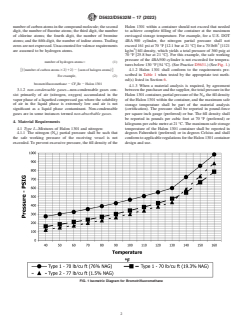
atoms; and the fifth digit, the number of iodine atoms. Trailing 4BA 500 cylinder, the nitrogen partial pressure shall not
zeros are not expressed. Unaccounted for valence requirements exceed 161 psi at 70 °F [12.1 bar at 21 °C] for a 70 lb/ft [1121
are assumed to be hydrogen atoms. kg/m ] fill density, which yields a total pressure of 360 psig at
70 °F [25.8 bar at 21 °C]. For this example, the safe working
pressure of the 4BA500 cylinder is not exceeded for tempera-
number of hydrogen atoms5 (1)
tures below 130 °F [54 °C]. (See Practice D5631.) (See Fig. 1.)
number of carbon atoms 32 12 2 sum of halogen atoms
@~~ ! ! ~ !# 4.1.2 Halon 1301 shall conform to the requirements pre-
scribed in Table 1 when tested by the appropriate test meth-
For example, (2)
od(s) listed in Section 6.
bromotrifluoromethane 2 CF Br 2 Halon 1301
4.1.3 When a material analysis is required, by agreement
3.1.2 non-condensable gases—non-condensable gases con- betweenthepurchaserandthesupplier,thetotalpressureinthe
sist primarily of air (nitrogen, oxygen) accumulated in the
Halon1301container,partialpressureoftheN ,thefilldensity
vapor phase of a liquefied compressed gas where the solubility of the Halon 1301 within the container, and the maximum safe
of air in the liquid phase is extremely low and air is not
storage temperature shall be part of the material analysis
significant as a liquid phase contaminant. Non-condensable (certification). The pressure shall be reported in pound-force
gases are in some instances termed non-absorbable gases.
per square inch gauge (preferred) or bar. The fill density shall
be reported in pounds per cubic foot at 70 °F (preferred) or
4. Material Requirements
kilogramspercubicmetreat21 °C.Themaximumsafestorage
4.1 Type I—Mixtures of Halon 1301 and nitrogen: temperature of the Halon 1301 container shall be reported in
4.1.1 The nitrogen (N ) partial pressure shall be such that degrees Fahrenheit (preferred) or in degrees Celsius and shall
the safe working pressure of the receiving vessel is not conform to applicable regulations for the Halon 1301 container
exceeded. To prevent excessive pressure, the fill density of the design and use.
FIG. 1 Isometric Diagram for Bromotrifluoromethane
D5632/D5632M − 17 (2022)
TABLE 1 Requirements
(b)210 m Chromatographic Column—Connect the two
Property Requirement columns below together with the first column end attached to
Halon 1301 purity, %, mol/mol, min 99.6 (exclusive of any N present) the injection port:
Acidity, ppm by mass, as Hbr, max 3.0
(1) 105 m Rtx -1701 (14 % cyanopropylphenyl – 86 %
Water content, ppm by mass, max 10
methylpolysiloxane), 0.25 mm, 1µm.
Nonvolatile residue, % by weight, max 0.01
Halogen ion Passes test (2) 105 m Rtx -200 (5 % diphenyl – 95 % dimethyl
Suspended matter or sediment None visible
polysiloxane), 0.25 mm, 1µm.
Color Report value
(3) The two columns are attached together, with the first
(Column 1) attached to the injection port of the GC system.
Columns are available from several chromatographic supply
vendors.
4.2 Type II—Halon 1301 shall conform to the requirements
6.1.1.3 Sample Introduction—Take sample from the liquid
ofType I, as listed in 4.1, and shall contain no more than 1.5 %
phase employing the procedure described in 5.1 of this
by volume non-condensable gases in the vapor phase, ex-
specification. Introduce and transfer the sample into the GC
pressed as air when tested by the appropriate test method(s)
using a standard gas-tight syringe.
listed in Section 6.
6.1.1.4 Reagents—The carrier gas shall be a chromato-
graphic grade of helium.
4.3 By agreement between the purchaser and the supplier,
6.1.1.5 Temperature Programming:
analysis may be required and limits established for elements or
(a) Install the column in the gas chromatograph and adjust
compounds not specified in Table 1.
the oven temperature to –20 °C. Inject the sample and hold the
4.4 Unless otherwise specified, Type I is assumed.
column oven at –20 °C for 21 min, then program the tempera-
4.5 Warning—Exposure to concentrations of Halon 1301
ture to rise 15 °C⁄min to a maximum of 165 °C, then post hold
in excess of 7.5 % by volume in air during periods of elevated
for 20 min before recycling.
adrenaline could produce cardiac arrhythmia in some person-
6.1.1.6 Calculation:
nel.
(a) Calculate weight percent of Halon 1301 as follows, and
convert it to mole percent in 6.1.1.6(b) if necessary.
5. Sampling
A 3RRF 3100
i i
W 5 (3)
i
5.1 Samples of Halon 1301 shall be taken from the liquid or
@A 3RRF #
( i i
vaporphaseasappropriate.SamplesofHalon1301,takenfrom
where:
the liquid phase, shall be taken from fil
...