

ASTM D6127-21
(Practice)Standard Practice for Handling, Transportation, and Storage of HFC-23 (Trifluoromethane, CHF3)
General Information
- Abstract
SIGNIFICANCE AND USE
4.1 This practice provides requirements for the handling, transportation, and storage of HFC-23 encountered in distribution through both commercial and military channels. It is intended to ensure that HFC-23 is handled, transported, and stored in such a way its physical property values are not degraded. Transport may be by various means, such as, but not limited to, highway, rail, water, and air.
SCOPE
1.1 This practice covers guidance and direction to suppliers, purchasers, and users in the handling, transportation, and storage of HFC-23.
1.2 The values stated in inch-pound units are to be regarded as standard. The values given in parentheses are mathematical conversions to SI units that are provided for information only and are not considered standard.
1.3 This standard does not purport to address all of the safety concerns, if any, associated with its use. It is the responsibility of the user of this standard to establish appropriate safety, health, and environmental practices and determine the applicability of regulatory limitations prior to use.
1.4 This international standard was developed in accordance with internationally recognized principles on standardization established in the Decision on Principles for the Development of International Standards, Guides and Recommendations issued by the World Trade Organization Technical Barriers to Trade (TBT) Committee.
- Status
- Published
- Publication Date
- 31-May-2021
- Technical Committee
- D26 - Halogenated Organic Solvents and Fire Extinguishing Agents
- Drafting Committee
- D26.09 - Fire Extinguishing Agents
Buy Documents


ASTM D6127-21 - Standard Practice for Handling, Transportation, and Storage of HFC-23 (Trifluoromethane, CHF<inf>3</inf>)

REDLINE ASTM D6127-21 - Standard Practice for Handling, Transportation, and Storage of HFC-23 (Trifluoromethane, CHF<inf>3</inf>)
Overview
ASTM D6127-21: Standard Practice for Handling, Transportation, and Storage of HFC-23 (Trifluoromethane, CHF₃) provides comprehensive requirements for the safe and effective management of HFC-23 throughout its lifecycle. Developed by ASTM International, this standard is applicable to both commercial and military distribution channels for HFC-23. The main objective is to ensure that the physical properties of HFC-23 are reliably maintained during all stages, preventing product degradation, contamination, or safety hazards.
The standard offers guidance to suppliers, purchasers, and end-users, and applies to various modes of transport, including highway, rail, maritime, and air. By following these protocols, organizations can ensure adherence to industry best practices and regulatory compliance.
Key Topics
Comprehensive Handling Guidelines
Personnel involved in handling HFC-23 must be trained in compliance with relevant CGA (Compressed Gas Association) and U.S. Department of Transportation (DOT) regulations. Procedures address safe loading, transfer, and container inspection to avoid contamination or product loss.Transportation Requirements
The standard stipulates transportation in accordance with federal regulations, especially those under Title 49 of the Code of Federal Regulations (CFR). Vehicles and packaging must protect cylinders from mechanical damage, vibration, and environmental extremes.Storage Protocols
Safe storage of HFC-23 requires qualified, properly marked cylinders, equipped with pressure relief devices and maintained through regular inspections. Attention is given to location, physical and environmental protection, and segregation of compliant and non-compliant materials.Container and Cylinder Requirements
The practice mandates appropriate marking, regular hydrostatic testing, correct filling density, and the prevention of contamination from external sources, following detailed guidance in referenced standards.Regulatory Compliance
Users must ensure compliance with safety, health, and environmental practices, including federal and industry regulations such as 40 CFR (EPA requirements), 49 CFR (DOT regulations), and relevant CGA standards.
Applications
This standard applies to organizations and facilities involved in:
- Production and distribution of HFC-23 for use as a fire suppressant (FE-13), explosion suppressant, or in other specialty gas applications.
- Industrial gas handling and transport companies managing high-purity, compressed, and liquefied gases.
- Storage facilities requiring robust protocols to safely store pressurized gas cylinders and minimize product degradation.
- Military logistics and defense sector supply chains managing specialized fire extinguishing agents.
- Environmental and safety compliance officers ensuring adherence to federal, state, and industrial standards relating to handling hazardous gases.
Adhering to ASTM D6127-21 enhances operational safety, product integrity, regulatory compliance, and risk management in all stages of HFC-23 usage.
Related Standards
The following standards are referenced or highly relevant when implementing ASTM D6127-21:
- ASTM D6126/D6126M: Specification for HFC-23 (Trifluoromethane)
- CGA C-6: Standards for Visual Inspection of Steel Compressed Gas Cylinders
- CGA P-1: Standard for Safe Handling of Compressed Gases in Containers
- CGA C-7, SB-1, SB-5, SB-18: Related to labeling, refilling, and storage of compressed and refrigerant gases
- 49 CFR Parts 172, 173, 178, and 180: U.S. DOT regulations for hazardous materials packaging, shipment, and cylinder maintenance
- 40 CFR Part 82.106: EPA warning statement requirements for ozone-depleting substances
By integrating these standards, organizations ensure best practices in handling, transporting, and storing HFC-23, resulting in enhanced safety and product quality.
Relations
- Refers
ASTM D6126/D6126M-11e1 - Standard Specification for HFC-23 (Trifluoromethane, CHF<sub>3</sub>) - Effective Date
- 01-Jan-2011
Buy Documents
ASTM D6127-21 - Standard Practice for Handling, Transportation, and Storage of HFC-23 (Trifluoromethane, CHF<inf>3</inf>)
REDLINE ASTM D6127-21 - Standard Practice for Handling, Transportation, and Storage of HFC-23 (Trifluoromethane, CHF<inf>3</inf>)
Get Certified
Connect with accredited certification bodies for this standard

ECOCERT
Organic and sustainability certification.

CIS Institut d.o.o.
Personal Protective Equipment (PPE) certification body. Notified Body NB-2890 for EU Regulation 2016/425 PPE.

Eurofins Food Testing Global
Global leader in food, environment, and pharmaceutical product testing.
Sponsored listings
Frequently Asked Questions
ASTM D6127-21 is a standard published by ASTM International. Its full title is "Standard Practice for Handling, Transportation, and Storage of HFC-23 (Trifluoromethane, CHF<inf>3</inf>)". This standard covers: SIGNIFICANCE AND USE 4.1 This practice provides requirements for the handling, transportation, and storage of HFC-23 encountered in distribution through both commercial and military channels. It is intended to ensure that HFC-23 is handled, transported, and stored in such a way its physical property values are not degraded. Transport may be by various means, such as, but not limited to, highway, rail, water, and air. SCOPE 1.1 This practice covers guidance and direction to suppliers, purchasers, and users in the handling, transportation, and storage of HFC-23. 1.2 The values stated in inch-pound units are to be regarded as standard. The values given in parentheses are mathematical conversions to SI units that are provided for information only and are not considered standard. 1.3 This standard does not purport to address all of the safety concerns, if any, associated with its use. It is the responsibility of the user of this standard to establish appropriate safety, health, and environmental practices and determine the applicability of regulatory limitations prior to use. 1.4 This international standard was developed in accordance with internationally recognized principles on standardization established in the Decision on Principles for the Development of International Standards, Guides and Recommendations issued by the World Trade Organization Technical Barriers to Trade (TBT) Committee.
SIGNIFICANCE AND USE 4.1 This practice provides requirements for the handling, transportation, and storage of HFC-23 encountered in distribution through both commercial and military channels. It is intended to ensure that HFC-23 is handled, transported, and stored in such a way its physical property values are not degraded. Transport may be by various means, such as, but not limited to, highway, rail, water, and air. SCOPE 1.1 This practice covers guidance and direction to suppliers, purchasers, and users in the handling, transportation, and storage of HFC-23. 1.2 The values stated in inch-pound units are to be regarded as standard. The values given in parentheses are mathematical conversions to SI units that are provided for information only and are not considered standard. 1.3 This standard does not purport to address all of the safety concerns, if any, associated with its use. It is the responsibility of the user of this standard to establish appropriate safety, health, and environmental practices and determine the applicability of regulatory limitations prior to use. 1.4 This international standard was developed in accordance with internationally recognized principles on standardization established in the Decision on Principles for the Development of International Standards, Guides and Recommendations issued by the World Trade Organization Technical Barriers to Trade (TBT) Committee.
ASTM D6127-21 is classified under the following ICS (International Classification for Standards) categories: 13.220.10 - Fire-fighting; 71.080.20 - Halogenated hydrocarbons. The ICS classification helps identify the subject area and facilitates finding related standards.
ASTM D6127-21 has the following relationships with other standards: It is inter standard links to ASTM D6126/D6126M-11e1. Understanding these relationships helps ensure you are using the most current and applicable version of the standard.
ASTM D6127-21 is available in PDF format for immediate download after purchase. The document can be added to your cart and obtained through the secure checkout process. Digital delivery ensures instant access to the complete standard document.
Standards Content (Sample)
This international standard was developed in accordance with internationally recognized principles on standardization established in the Decision on Principles for the
Development of International Standards, Guides and Recommendations issued by the World Trade Organization Technical Barriers to Trade (TBT) Committee.
Designation: D6127 −21
Standard Practice for
Handling, Transportation, and Storage of HFC-23
(Trifluoromethane, CHF )
This standard is issued under the fixed designation D6127; the number immediately following the designation indicates the year of
original adoption or, in the case of revision, the year of last revision. A number in parentheses indicates the year of last reapproval. A
superscript epsilon (´) indicates an editorial change since the last revision or reapproval.
1. Scope SB-1 Hazards of Refilling Compressed Refrigerant (haloge-
nated hydrocarbon) Gas Cylinders
1.1 This practice covers guidance and direction to suppliers,
SB-5 Hazards of Reusing Disposable Refrigerant (Haloge-
purchasers, and users in the handling, transportation, and
nated Hydrocarbon) Gas Cylinders
storage of HFC-23.
SB-18 Use of Refrigerant (Halogenated Hydrocarbon) Re-
1.2 The values stated in inch-pound units are to be regarded
covery Cylinders
as standard. The values given in parentheses are mathematical
2.3 U.S. Government Standards:
conversions to SI units that are provided for information only
49 CFR Part 172 Hazardous Materials Table, Special
and are not considered standard.
Provisions, Hazardous Materials Communications, Emer-
1.3 This standard does not purport to address all of the
gency Response Information, Training Requirements, and
safety concerns, if any, associated with its use. It is the
Security Plan
responsibility of the user of this standard to establish appro-
49 CFR Part 172.101 Purpose and Use of Hazardous Mate-
priate safety, health, and environmental practices and deter-
rials Table
mine the applicability of regulatory limitations prior to use.
49 CFR Part 173 Shippers—General Requirements for Ship-
1.4 This international standard was developed in accor-
ments and Packaging
dance with internationally recognized principles on standard-
49 CFR Part 178 Specifications for Packagings
ization established in the Decision on Principles for the
49 CFR Part 180 Continuing Qualification and Maintenance
Development of International Standards, Guides and Recom-
of Packagings
mendations issued by the World Trade Organization Technical
Barriers to Trade (TBT) Committee.
3. Terminology
2. Referenced Documents
3.1 Definitions of Terms Specific to This Standard:
3.1.1 containers, n—storage vessel for HFC-23.
2.1 ASTM Standard:
D6126/D6126M Specification for HFC-23 3.1.2 cylinders, n—containers of HFC-23.
(Trifluoromethane, CHF )
3.1.3 HFC-23, n—trifluoromethane, a compound used to
2.2 CGA Standards:
inert or suppress a fire or explosion hazard.
C-6 Standards for Visual Inspection of Steel Compressed
3.1.4 insulated, adj—placed in an isolated situation to pro-
Gas Cylinders
tect and prevent the transfer of damage.
C-7 Guide to Classification and Labeling of Compressed
Gases
4. Significance and Use
P-1 Standard for Safe Handling of Compressed Gases in
4.1 This practice provides requirements for the handling,
Containers
transportation, and storage of HFC-23 encountered in distribu-
tion through both commercial and military channels. It is
This practice is under the jurisdiction of ASTM Committee D26 on Haloge-
intended to ensure that HFC-23 is handled, transported, and
nated Organic Solvents and Fire Extinguishing Agents and is the direct responsi-
bility of Subcommittee D26.09 on Fire Extinguishing Agents.
stored in such a way its physical property values are not
Current edition approved June 1, 2021. Published June 2021. Originally
degraded. Transport may be by various means, such as, but not
approved in 1997. Last previous edition approved in 2015 as D6127–11 (2015).
limited to, highway, rail, water, and air.
DOI: 10.1520/D6127-21.
For referenced ASTM standards, visit the ASTM website, www.astm.org, or
contact ASTM Customer Service at service@astm.org. For Annual Book of ASTM
Standards volume information, refer to the standard’s Document Summary page on
the ASTM website. Code of Federal Regulations (CFR) documents are available from U.S.
Available from Compressed Gas Association (CGA), 8484 Westpark Drive, Government Publishing Office (GPO), 732 N. Capitol St., NW, Washington, DC
Suite 220, McLean, VA 22102, http://www.cganet.com. 20401, http://www.gpo.gov.
Copyright © ASTM International, 100 Barr Harbor Drive, PO Box C700, West Conshohocken, PA 19428-2959. United States
D6127 − 21
5. Practice 5.2.6 Handling of materials should be done in a manner that
prevents contamination or comingling of materials other than
5.1 To ensure safe handling, loading, unloading, storing,
HFC-23.
and transporting of material, personnel shall be trained in the
5.2.7 Cylinders shall be free of dirt and contamination that
CGApublications and CFR regulations as listed in 2.2 and 2.3,
would contribute to or would cause deterioration of product
respectively.
during shipment or storage. Precautions should be taken to
5.2 Handling:
prevent the entry of oil, water, or any other foreign matter into
5.2.1 Handling shall be in accordance with CGA Publica-
containers. Un
...
This document is not an ASTM standard and is intended only to provide the user of an ASTM standard an indication of what changes have been made to the previous version. Because
it may not be technically possible to adequately depict all changes accurately, ASTM recommends that users consult prior editions as appropriate. In all cases only the current version
of the standard as published by ASTM is to be considered the official document.
Designation: D6127 − 11 (Reapproved 2015) D6127 − 21
Standard Practice for
Handling, Transportation, and Storage of HFC-23
(Trifluoromethane, CHF )
This standard is issued under the fixed designation D6127; the number immediately following the designation indicates the year of
original adoption or, in the case of revision, the year of last revision. A number in parentheses indicates the year of last reapproval. A
superscript epsilon (´) indicates an editorial change since the last revision or reapproval.
1. Scope
1.1 This practice covers guidance and direction to suppliers, purchasers, and users in the handling, transportation, and storage of
HFC-23.
1.2 The values stated in inch-pound units are to be regarded as standard. The values given in parentheses are mathematical
conversions to SI units that are provided for information only and are not considered standard.
1.3 This standard does not purport to address all of the safety concerns, if any, associated with its use. It is the responsibility
of the user of this standard to establish appropriate safety safety, health, and healthenvironmental practices and determine the
applicability of regulatory limitations prior to use.
1.4 This international standard was developed in accordance with internationally recognized principles on standardization
established in the Decision on Principles for the Development of International Standards, Guides and Recommendations issued
by the World Trade Organization Technical Barriers to Trade (TBT) Committee.
2. Referenced Documents
2.1 ASTM Standards:Standard:
D6126/D6126M Specification for HFC-23 (Trifluoro-methane,(Trifluoromethane, CHF )
2.2 CGA Standards:
C-6 Standards for Visual Inspection of Steel Compressed Gas Cylinders
C-7 Guide to Preparation of Precautionary Labeling and Marking of Compressed Gas ContainersClassification and Labeling of
Compressed Gases
P-1 Standard for Safe Handling of Compressed Gases in Containers
SB-1 Hazards of Refilling Compressed Refrigerant (halogenated hydrocarbon) Gas Cylinders
SB-5 Safety Bulletin: Hazards of Reusing Disposable Refrigerant (Halogenated Hydrocarbon) Gas Cylinders
SB-18 Safety Bulletin: Use of Refrigerant (Halogenated Hydrocarbon) Recovery Cylinders
2.3 U.S. Government Standards:
Code of Federal Regulations (CFR) Title 40, Part 82.106 Environmental Protection Agency, Warning Statement Requirements
This practice is under the jurisdiction of ASTM Committee D26 on Halogenated Organic Solvents and Fire Extinguishing Agents and is the direct responsibility of
Subcommittee D26.09 on Fire Extinguishing Agents.
Current edition approved June 1, 2015June 1, 2021. Published June 2015June 2021. Originally approved in 1997. Last previous edition approved in 20112015 as
D6127–11. –11 (2015). DOI: 10.1520/D6127-11R15.10.1520/D6127-21.
For referenced ASTM standards, visit the ASTM website, www.astm.org, or contact ASTM Customer Service at service@astm.org. For Annual Book of ASTM Standards
volume information, refer to the standard’s Document Summary page on the ASTM website.
Available from Compressed Gas Association (CGA), 14501 George Carter Way, Suite 103, Chantilly, VA 20151-1788,8484 Westpark Drive, Suite 220, McLean, VA
22102, http://www.cganet.com.
Available Code of Federal Regulations (CFR) documents are available from U.S. Government Publishing Office, Office (GPO), 732 N. Capitol St., NW, Washington,
DC 20401-0001,20401, http://www.gpo.gov.
Copyright © ASTM International, 100 Barr Harbor Drive, PO Box C700, West Conshohocken, PA 19428-2959. United States
D6127 − 21
Code of Federal Regulations (CFR) Title 49, 49 CFR Part 172 U.S. Department of Transportation (DOT), Hazardous Materials
Table, Special Provisions, Hazardous Materials Communications, Emergency Response Information, and Training Require-
ments Training Requirements, and Security Plan
Code of Federal Regulations (CFR) Title 49, 49 CFR Part 172.101 U.S. DOT, TablesPurpose and Use of Hazardous Materials
and Special ProvisionsTable
Code of Federal Regulations (CFR) Title 49, 49 CFR Part 173 U.S. DOT, Shippers-General Shippers—General Requirements
for ShippingShipments and PackagingsPackaging
Code of Federal Regulations (CFR) Title 49, 49 CFR Part 178 U.S. DOT, Specifications for Packagings
Code of Federal Regulations (CFR) Title 49, 49 CFR Part 180 U.S. DOT, Continuing Qualification and Maintenance of
Packagings
3. Terminology
3.1 Definitions of Terms Specific to This Standard:
3.1.1 containers—containers, n—storage vessel for HFC-23.
3.1.2 cylinders—cylinders, n—containers of HFC-23.
3.1.3 HFC-23—HFC-23, n—trifluoromethane, a compound used to inert or suppress a fire or explosion hazard.
3.1.4 insulated—insulated, adj—placed in an isolated situation to protect and prevent the transfer of damage.
4. Significance and Use
4.1 This practice provides requirements for the handling, transportation, and storage of HFC-23 encountered in distribution
through both commercial and military channels. It is intended to ensure that HFC-23 is handled, transported, and stored in such
a way its physical property values are not degraded. Transport may be by various means, such as, but not limited to, highway, rail,
water, and air.
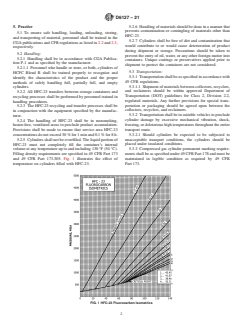
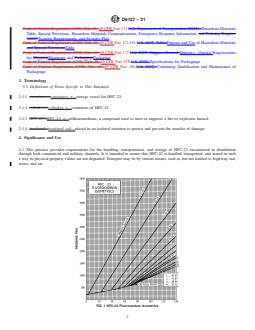
FIG. 1 HFC-23 Fluorocarbon Isometrics
D6127 − 21
5. Practice
5.1 To ensure safe handling, loading, unloading, storing, and transporting of material, personnel shall be trained in the CGA
publications and Title 49 CFR regulations as listed in 2.2 and 2.3, respectively.
5.2 Handling:
5.2.1 Handling shall be in accordance with P-1.CGA Publication P-1 and as specified by the manufacturer.
5.2.1.1 Personnel who handle or store, or both, cylinders of HCFC Blend B shall be trained properly to recognize and identify the
cha
...