

ASTM D6265-23
(Practice)Standard Practice for Separation of Contaminants in Polymers Using an Extruder Filter Test
General Information
- Abstract
SIGNIFICANCE AND USE
5.1 Problems with extrusion and subsequent processing of the material are caused, in part, by the presence of paper, metal, gels, incompatible polymers, or other extraneous contamination found in polymers.
SCOPE
1.1 This practice covers a means to separate the unmolten particles, gels, and impurities contaminating a polymer sample. The procedure may be used to remove gels and incompatible materials that may cause imperfections in the final extruded product. Under pressure, most gels will break up or deform and pass through a wire mesh filter, however high molecular weight gels may not break up or deform.
1.2 Materials isolated on a wire mesh filter can be identified by spectroscopic or other analytical means.
Note 1: Although not presented as a quantitative method, the procedure presented in this practice may be used to provide quantitative results at the discretion of the user. The user assumes the responsibility to verify the reproducibility of quantitative results. Detection limit depends on the mesh size of the filter screen, but the procedure is generally applicable to the separation of immiscible contaminants present at concentrations greater than 0.1 %.
1.3 The values stated in SI units are to be regarded as standard.
1.4 This standard does not purport to address all of the safety concerns, if any, associated with its use. It is the responsibility of the user of this standard to establish appropriate safety, health, and environmental practices and determine the applicability of regulatory limitations prior to use. For specific hazards statements, see Section 8
Note 2: There is no known ISO equivalent to this standard.
1.5 This international standard was developed in accordance with internationally recognized principles on standardization established in the Decision on Principles for the Development of International Standards, Guides and Recommendations issued by the World Trade Organization Technical Barriers to Trade (TBT) Committee.
- Status
- Published
- Publication Date
- 31-Jan-2023
- Technical Committee
- D20 - Plastics
- Drafting Committee
- D20.95 - Recycled Plastics
Buy Documents

ASTM D6265-23 - Standard Practice for Separation of Contaminants in Polymers Using an Extruder Filter Test
REDLINE ASTM D6265-23 - Standard Practice for Separation of Contaminants in Polymers Using an Extruder Filter Test
Overview
ASTM D6265-23: Standard Practice for Separation of Contaminants in Polymers Using an Extruder Filter Test provides a systematic approach to isolating and evaluating unmolten particles, gels, and impurities within polymer samples, especially relevant in polymer processing and recycled plastics industries. By utilizing a filter test with an extruder, this standard assists in identifying contaminants such as paper, metal, incompatible polymers, and other extraneous materials that can compromise the quality and integrity of finished polymer products.
Increasing demand for consistent polymer quality, particularly in recycled and post-consumer plastics, means contamination assessment is crucial. ASTM D6265 enables manufacturers and processors to minimize imperfections caused by such contaminants and to enhance downstream processing reliability.
Key Topics
Purpose and Scope
The practice describes methods for separating and analyzing contaminants, including gels and incompatible materials, that may result in product defects during polymer extrusion and processing.Contaminant Detection
- Applicable for contaminants and immiscible materials at concentrations above 0.1%.
- Isolated materials can be further analyzed using spectroscopic or analytical techniques to identify contaminant type.
Procedure Highlights
- Uses an extruder fitted with a wire mesh filter pack of defined sizes.
- Filtration is conducted under controlled pressure and temperature conditions.
- Screen mesh selection (commonly 60, 100, 200, or 325 mesh) impacts detection sensitivity.
Reporting & Evaluation
- The process does not inherently provide quantitative results; however, with appropriate controls, quantification is possible at the discretion of the user.
- Detailed documentation of mesh size, filter pressures, residue observation, and operational conditions is required.
Safety and Practices
- Strict adherence to safety procedures due to hazards of working with hot polymers and pressurized equipment.
- Evaluation of local regulatory requirements is recommended before conducting the test.
Applications
ASTM D6265-23 is widely used in the following contexts:
Quality Control for Polymer Manufacturers
Detects and reduces contaminate-related defects in extrusion products such as films, fibers, and molded articles.Recycled Plastics Processing
Evaluates the cleanliness and suitability of post-consumer resins by quantifying and characterizing contaminant levels.Analytical Laboratories
Supports research and development efforts focused on polymer formulation improvement and new process development.Supply Chain Assurance
Provides a standardized screening method for incoming raw polymer materials to meet end-user specifications.
Related Standards
To ensure best practices and comprehensive polymer testing, consider these related ASTM standards:
- ASTM D883 - Terminology Relating to Plastics: Provides definitions for commonly used plastics terms.
- ASTM D1238 - Test Method for Melt Flow Rates of Thermoplastics by Extrusion Plastometer: Assesses polymer viscosity and flow characteristics.
- ASTM D1600 - Terminology for Abbreviated Terms Relating to Plastics: Standardizes abbreviations in polymer material documentation.
Note: There is currently no ISO equivalent to ASTM D6265-23, making it a unique reference for extruder filter contamination analysis world-wide.
Keywords: polymer contamination, extruder filter test, ASTM D6265, recycled plastics testing, extruder screen pack, polymer quality control, contaminant separation, gels in polymers, polymer filtration standard.
Relations
- Effective Date
- 01-Feb-2024
- Refers
ASTM D1238-23a - Standard Test Method for Melt Flow Rates of Thermoplastics by Extrusion Plastometer - Effective Date
- 15-Nov-2023
- Effective Date
- 01-Nov-2023
- Effective Date
- 01-Jan-2020
- Effective Date
- 01-Aug-2019
- Effective Date
- 15-Apr-2019
- Effective Date
- 01-Feb-2019
- Effective Date
- 01-Dec-2018
- Effective Date
- 01-Nov-2018
- Refers
ASTM D1600-18 - Standard Terminology for Abbreviated Terms Relating to Plastics (Withdrawn 2024) - Effective Date
- 01-Jan-2018
- Effective Date
- 15-Aug-2017
- Effective Date
- 01-Feb-2014
- Refers
ASTM D1238-13 - Standard Test Method for Melt Flow Rates of Thermoplastics by Extrusion Plastometer - Effective Date
- 01-Aug-2013
- Effective Date
- 15-Apr-2013
- Effective Date
- 15-Nov-2012
Buy Documents
ASTM D6265-23 - Standard Practice for Separation of Contaminants in Polymers Using an Extruder Filter Test
REDLINE ASTM D6265-23 - Standard Practice for Separation of Contaminants in Polymers Using an Extruder Filter Test
Get Certified
Connect with accredited certification bodies for this standard

DIN CERTCO
DIN Group product certification.

Smithers Quality Assessments
US management systems and product certification.
Sponsored listings
Frequently Asked Questions
ASTM D6265-23 is a standard published by ASTM International. Its full title is "Standard Practice for Separation of Contaminants in Polymers Using an Extruder Filter Test". This standard covers: SIGNIFICANCE AND USE 5.1 Problems with extrusion and subsequent processing of the material are caused, in part, by the presence of paper, metal, gels, incompatible polymers, or other extraneous contamination found in polymers. SCOPE 1.1 This practice covers a means to separate the unmolten particles, gels, and impurities contaminating a polymer sample. The procedure may be used to remove gels and incompatible materials that may cause imperfections in the final extruded product. Under pressure, most gels will break up or deform and pass through a wire mesh filter, however high molecular weight gels may not break up or deform. 1.2 Materials isolated on a wire mesh filter can be identified by spectroscopic or other analytical means. Note 1: Although not presented as a quantitative method, the procedure presented in this practice may be used to provide quantitative results at the discretion of the user. The user assumes the responsibility to verify the reproducibility of quantitative results. Detection limit depends on the mesh size of the filter screen, but the procedure is generally applicable to the separation of immiscible contaminants present at concentrations greater than 0.1 %. 1.3 The values stated in SI units are to be regarded as standard. 1.4 This standard does not purport to address all of the safety concerns, if any, associated with its use. It is the responsibility of the user of this standard to establish appropriate safety, health, and environmental practices and determine the applicability of regulatory limitations prior to use. For specific hazards statements, see Section 8 Note 2: There is no known ISO equivalent to this standard. 1.5 This international standard was developed in accordance with internationally recognized principles on standardization established in the Decision on Principles for the Development of International Standards, Guides and Recommendations issued by the World Trade Organization Technical Barriers to Trade (TBT) Committee.
SIGNIFICANCE AND USE 5.1 Problems with extrusion and subsequent processing of the material are caused, in part, by the presence of paper, metal, gels, incompatible polymers, or other extraneous contamination found in polymers. SCOPE 1.1 This practice covers a means to separate the unmolten particles, gels, and impurities contaminating a polymer sample. The procedure may be used to remove gels and incompatible materials that may cause imperfections in the final extruded product. Under pressure, most gels will break up or deform and pass through a wire mesh filter, however high molecular weight gels may not break up or deform. 1.2 Materials isolated on a wire mesh filter can be identified by spectroscopic or other analytical means. Note 1: Although not presented as a quantitative method, the procedure presented in this practice may be used to provide quantitative results at the discretion of the user. The user assumes the responsibility to verify the reproducibility of quantitative results. Detection limit depends on the mesh size of the filter screen, but the procedure is generally applicable to the separation of immiscible contaminants present at concentrations greater than 0.1 %. 1.3 The values stated in SI units are to be regarded as standard. 1.4 This standard does not purport to address all of the safety concerns, if any, associated with its use. It is the responsibility of the user of this standard to establish appropriate safety, health, and environmental practices and determine the applicability of regulatory limitations prior to use. For specific hazards statements, see Section 8 Note 2: There is no known ISO equivalent to this standard. 1.5 This international standard was developed in accordance with internationally recognized principles on standardization established in the Decision on Principles for the Development of International Standards, Guides and Recommendations issued by the World Trade Organization Technical Barriers to Trade (TBT) Committee.
ASTM D6265-23 is classified under the following ICS (International Classification for Standards) categories: 83.020 - Manufacturing processes in the rubber and plastics industries. The ICS classification helps identify the subject area and facilitates finding related standards.
ASTM D6265-23 has the following relationships with other standards: It is inter standard links to ASTM D883-24, ASTM D1238-23a, ASTM D883-23, ASTM D883-20, ASTM D883-19c, ASTM D883-19a, ASTM D883-19, ASTM D883-18a, ASTM D883-18, ASTM D1600-18, ASTM D883-17, ASTM D1600-14, ASTM D1238-13, ASTM D1600-13, ASTM D883-12e1. Understanding these relationships helps ensure you are using the most current and applicable version of the standard.
ASTM D6265-23 is available in PDF format for immediate download after purchase. The document can be added to your cart and obtained through the secure checkout process. Digital delivery ensures instant access to the complete standard document.
Standards Content (Sample)
This international standard was developed in accordance with internationally recognized principles on standardization established in the Decision on Principles for the
Development of International Standards, Guides and Recommendations issued by the World Trade Organization Technical Barriers to Trade (TBT) Committee.
Designation: D6265 − 23
Standard Practice for
Separation of Contaminants in Polymers Using an Extruder
Filter Test
This standard is issued under the fixed designation D6265; the number immediately following the designation indicates the year of
original adoption or, in the case of revision, the year of last revision. A number in parentheses indicates the year of last reapproval. A
superscript epsilon (´) indicates an editorial change since the last revision or reapproval.
1. Scope* 2. Referenced Documents
1.1 This practice covers a means to separate the unmolten 2.1 ASTM Standards:
particles, gels, and impurities contaminating a polymer sample. D883 Terminology Relating to Plastics
The procedure may be used to remove gels and incompatible D1238 Test Method for Melt Flow Rates of Thermoplastics
materials that may cause imperfections in the final extruded by Extrusion Plastometer
product. Under pressure, most gels will break up or deform and D1600 Terminology for Abbreviated Terms Relating to Plas-
pass through a wire mesh filter, however high molecular weight tics
gels may not break up or deform.
3. Terminology
1.2 Materials isolated on a wire mesh filter can be identified
3.1 Definitions—For definitions of terms that appear in this
by spectroscopic or other analytical means.
specification relating to plastics, refer to Terminology D883.
NOTE 1—Although not presented as a quantitative method, the proce-
For abbreviations that appear in the specification, refer to
dure presented in this practice may be used to provide quantitative results
Terminology D1600.
at the discretion of the user. The user assumes the responsibility to verify
the reproducibility of quantitative results. Detection limit depends on the
4. Summary of Practice
mesh size of the filter screen, but the procedure is generally applicable to
the separation of immiscible contaminants present at concentrations
4.1 This practice determines the relative contamination
greater than 0.1 %.
level that can cause undesirable imperfections in the extruded
1.3 The values stated in SI units are to be regarded as
product due to contaminants and gels. Although this practice is
standard.
not designed to provide an absolute measurement of contami-
nation level, using appropriate criteria, the rate of this pressure
1.4 This standard does not purport to address all of the
safety concerns, if any, associated with its use. It is the rise can be correlated to the relative contamination level.
responsibility of the user of this standard to establish appro-
5. Significance and Use
priate safety, health, and environmental practices and deter-
mine the applicability of regulatory limitations prior to use.
5.1 Problems with extrusion and subsequent processing of
For specific hazards statements, see Section 8
the material are caused, in part, by the presence of paper, metal,
gels, incompatible polymers, or other extraneous contamina-
NOTE 2—There is no known ISO equivalent to this standard.
tion found in polymers.
1.5 This international standard was developed in accor-
dance with internationally recognized principles on standard-
6. Apparatus
ization established in the Decision on Principles for the
6.1 Extruder, designed to deliver a continuous supply of
Development of International Standards, Guides and Recom-
molten resin to a filter at a uniform rate with good temperature
mendations issued by the World Trade Organization Technical
control. Extruders with 18 to 64-mm diameters have been
Barriers to Trade (TBT) Committee.
found to be satisfactory.
This test method is under the jurisdiction of ASTM Committee D20 on Plastics
and is the direct responsibility of Subcommittee D20.95 on Recycled Plastics. For referenced ASTM standards, visit the ASTM website, www.astm.org, or
Current edition approved Feb. 1, 2023. Published February 2023. Originally contact ASTM Customer Service at service@astm.org. For Annual Book of ASTM
approved in 1998. Last previous edition approved in 2017 as D6265 - 17. DOI: Standards volume information, refer to the standard’s Document Summary page on
10.1520/D6265-23. the ASTM website.
*A Summary of Changes section appears at the end of this standard
Copyright © ASTM International, 100 Barr Harbor Drive, PO Box C700, West Conshohocken, PA 19428-2959. United States
D6265 − 23
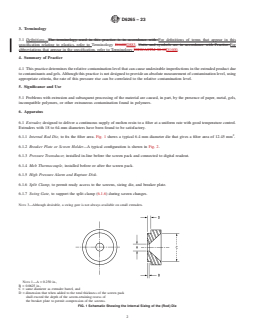
6.1.1 Internal Rod Die, to fix the filter area. Fig. 1 shows a
typical 6.4 mm diameter die that gives a filter area of 12.45
mm .
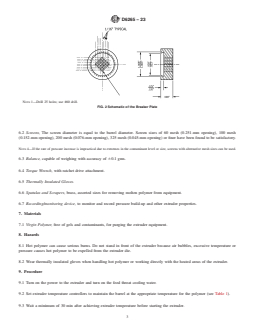
6.1.2 Breaker Plate or Screen Holder—A typical configu-
ration is shown in Fig. 2.
6.1.3 Pressure Transducer, installed in-line before the
screen pack and connected to digital readout.
6.1.4 Melt Thermocouple, installed before or after the
screen pack.
6.1.5 High Pressure Alarm and Rupture Disk.
6.1.6 Split Clamp, to permit ready access to the screens,
sizing die, and breaker plate.
6.1.7 Swing Gate, to support the split clamp (6.1.6) during
screen changes.
NOTE 3—Although desirable, a swing gate is not always available on
small extruders.
NOTE 1—Drill 25 holes; use #60 drill.
FIG. 2 Schematic of the Breaker Plate
6.2 Screens, The screen diameter is equal to the barrel
diameter. Screen sizes of 60 mesh (0.251-mm opening), 100
mesh (0.152-mm opening), 200 mesh (0.076-mm opening),
325 mesh (0.045-mm opening) or finer have been found to be
8. Hazards
satisfactory.
8.1 Hot polymer can cause serious burns. Do not stand in
NOTE 4—If the rate of pressure increase is impractical due to extremes
front of the extruder because air bubbles, excessive tempera-
in the contaminant level or size, screens with alternative mesh sizes can be
ture or pressure causes hot polymer to be expelled from the
used.
extruder die.
6.3 Balance, capable of weighing with accuracy of 60.1
8.2 Wear thermally insulated gloves when handling hot
gms.
polymer or working directly with the heated areas of the
6.4 Torque Wrench, with ratchet drive attachment.
extruder.
6.5 Thermally Insulated Gloves.
9. Procedure
6.6 Spatulas and Scrapers, brass, assorted sizes for remov-
9.1 Turn on the power to the extruder and turn on the feed
ing molten polymer from equipment.
throat cooling water.
6.7 Recording/monitoring device, to monitor and record
9.2 Set extruder temperature controllers to maintain the
pressure build-up and other extruder properties.
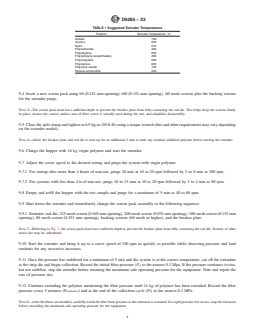
barrel at the appropriate temperature for the polymer (see Table
7. Materials
1).
7.1 Virgin Polymer, free of gels and contaminants, for
9.3 Wait a minimum of 30 min after achieving extruder
purging the extruder equipment.
temperature before s
...
This document is not an ASTM standard and is intended only to provide the user of an ASTM standard an indication of what changes have been made to the previous version. Because
it may not be technically possible to adequately depict all changes accurately, ASTM recommends that users consult prior editions as appropriate. In all cases only the current version
of the standard as published by ASTM is to be considered the official document.
Designation: D6265 − 17 D6265 − 23
Standard Practice for
Separation of Contaminants in Polymers Using an Extruder
Filter Test
This standard is issued under the fixed designation D6265; the number immediately following the designation indicates the year of
original adoption or, in the case of revision, the year of last revision. A number in parentheses indicates the year of last reapproval. A
superscript epsilon (´) indicates an editorial change since the last revision or reapproval.
1. Scope*
1.1 This practice covers a means to separate the unmolten particles, gels, and impurities contaminating a polymer sample. The
procedure may be used to remove gels and incompatible materials that may cause imperfections in the final extruded product.
Under pressure, most gels will break up or deform and pass through a wire mesh filter, however high molecular weight gels may
not break up or deform.
1.2 Materials isolated on a wire mesh filter can be identified by spectroscopic or other analytical means.
NOTE 1—Although not presented as a quantitative method, the procedure presented in this practice may be used to provide quantitative results at the
discretion of the user. The user assumes the responsibility to verify the reproducibility of quantitative results. Detection limit depends on the mesh size
of the filter screen, but the procedure is generally applicable to the separation of immiscible contaminants present at concentrations greater than 0.1 %.
1.3 The values stated in SI units are to be regarded as standard.
1.4 This standard does not purport to address all of the safety concerns, if any, associated with its use. It is the responsibility
of the user of this standard to establish appropriate safety, health, and environmental practices and determine the applicability of
regulatory limitations prior to use. For specific hazards statements, see Section 8
NOTE 2—There is no known ISO equivalent to this standard.
1.5 This international standard was developed in accordance with internationally recognized principles on standardization
established in the Decision on Principles for the Development of International Standards, Guides and Recommendations issued
by the World Trade Organization Technical Barriers to Trade (TBT) Committee.
2. Referenced Documents
2.1 ASTM Standards:
D883 Terminology Relating to Plastics
D1238 Test Method for Melt Flow Rates of Thermoplastics by Extrusion Plastometer
D1600 Terminology for Abbreviated Terms Relating to Plastics
IEEE/ASTM SI-10 Practice for Use of the International System of Units (SI) (the Modernized Metric System)
This test method is under the jurisdiction of ASTM Committee D20 on Plastics and is the direct responsibility of Subcommittee D20.95 on Recycled Plastics.
Current edition approved Dec. 1, 2017Feb. 1, 2023. Published January 2018February 2023. Originally approved in 1998. Last previous edition approved in 20152017 as
D6265 - 15.D6265 - 17. DOI: 10.1520/D6265-17.10.1520/D6265-23.
For referenced ASTM standards, visit the ASTM website, www.astm.org, or contact ASTM Customer Service at service@astm.org. For Annual Book of ASTM Standards
volume information, refer to the standard’s Document Summary page on the ASTM website.
*A Summary of Changes section appears at the end of this standard
Copyright © ASTM International, 100 Barr Harbor Drive, PO Box C700, West Conshohocken, PA 19428-2959. United States
D6265 − 23
3. Terminology
3.1 Definitions—The terminology used in this practice is in accordance with For definitions of terms that appear in this
specification relating to plastics, refer to Terminology D1600D883. Units and symbols are in accordance with Practice For
abbreviations that appear in the specification, refer to Terminology IEEE/ASTM SI-10D1600.
4. Summary of Practice
4.1 This practice determines the relative contamination level that can cause undesirable imperfections in the extruded product due
to contaminants and gels. Although this practice is not designed to provide an absolute measurement of contamination level, using
appropriate criteria, the rate of this pressure rise can be correlated to the relative contamination level.
5. Significance and Use
5.1 Problems with extrusion and subsequent processing of the material are caused, in part, by the presence of paper, metal, gels,
incompatible polymers, or other extraneous contamination found in polymers.
6. Apparatus
6.1 Extruder, designed to deliver a continuous supply of molten resin to a filter at a uniform rate with good temperature control.
Extruders with 18 to 64-mm diameters have been found to be satisfactory.
6.1.1 Internal Rod Die, to fix the filter area. Fig. 1 shows a typical 6.4 mm diameter die that gives a filter area of 12.45 mm .
6.1.2 Breaker Plate or Screen Holder—A typical configuration is shown in Fig. 2.
6.1.3 Pressure Transducer, installed in-line before the screen pack and connected to digital readout.
6.1.4 Melt Thermocouple, installed before or after the screen pack.
6.1.5 High Pressure Alarm and Rupture Disk.
6.1.6 Split Clamp, to permit ready access to the screens, sizing die, and breaker plate.
6.1.7 Swing Gate, to support the split clamp (6.1.6) during screen changes.
NOTE 3—Although desirable, a swing gate is not always available on small extruders.
NOTE 1—A = 0.250 in.,
B = 0.0625 in.,
C = same diameter as extruder barrel, and
D = dimension that when added to the total thickness of the screen pack
shall exceed the depth of the screen-retaining recess of
the breaker plate to permit compression of the screens.
FIG. 1 Schematic Showing the Internal Sizing of the (Rod) Die
D6265 − 23
NOTE 1—Drill 25 holes; use #60 drill.
FIG. 2 Schematic of the Breaker Plate
6.2 Screens, The screen diameter is equal to the barrel diameter. Screen sizes of 60 mesh (0.251-mm opening), 100 mesh
(0.152-mm opening), 200 mesh (0.076-mm opening), 325 mesh (0.045-mm opening) or finer have been found to be satisfactory.
NOTE 4—If the rate of pressure increase is impractical due to extremes in the contaminant level or size, screens with alternative mesh sizes can be used.
6.3 Balance, capable of weighing with accuracy of 60.1 gms.
6.4 Torque Wrench, with ratchet drive attachment.
6.5 Thermally Insulated Gloves.
6.6 Spatulas and Scrapers, brass, assorted sizes for removing molten polymer from equipment.
6.7 Recording/monitoring device, to monitor and record pressure build-up and other extruder properties.
7. Materials
7.1 Virgin Polymer, free of gels and contaminants, for purging the extruder equipment.
8. Hazards
8.1 Hot polymer can cause serious burns. Do not stand in front of the extruder because air bubbles, excessive temperature or
pressure causes hot polymer to be expelled from the extruder die.
8.2 Wear ther
...