


ASTM D7227/D7227M-17
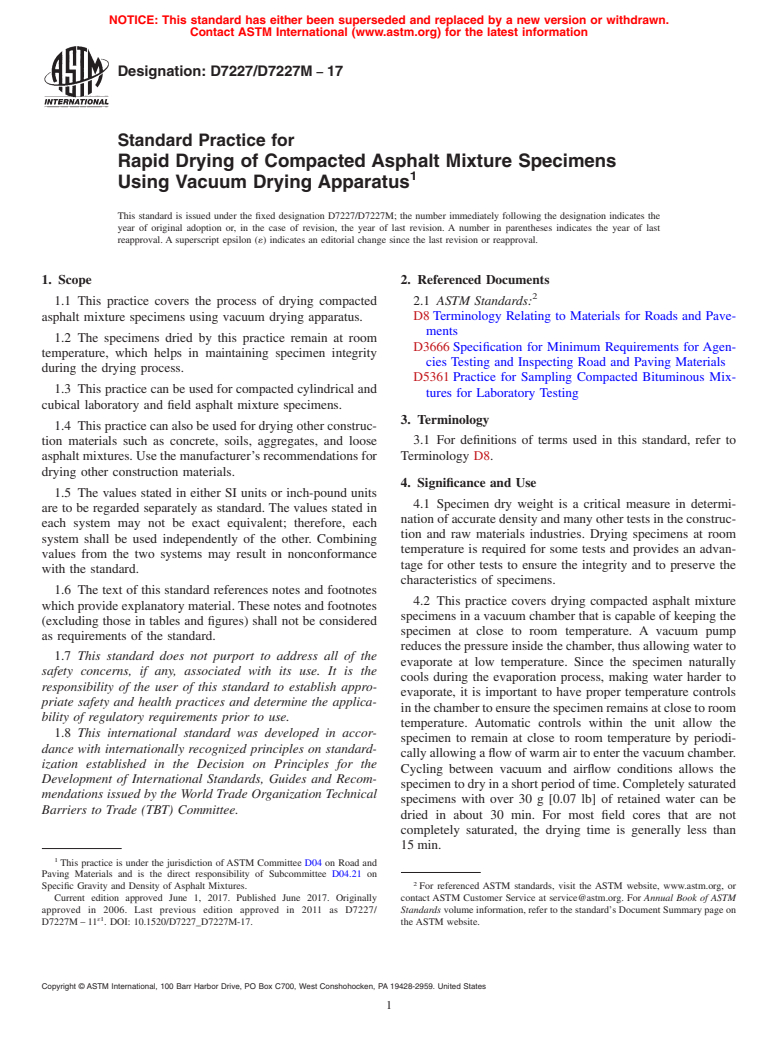
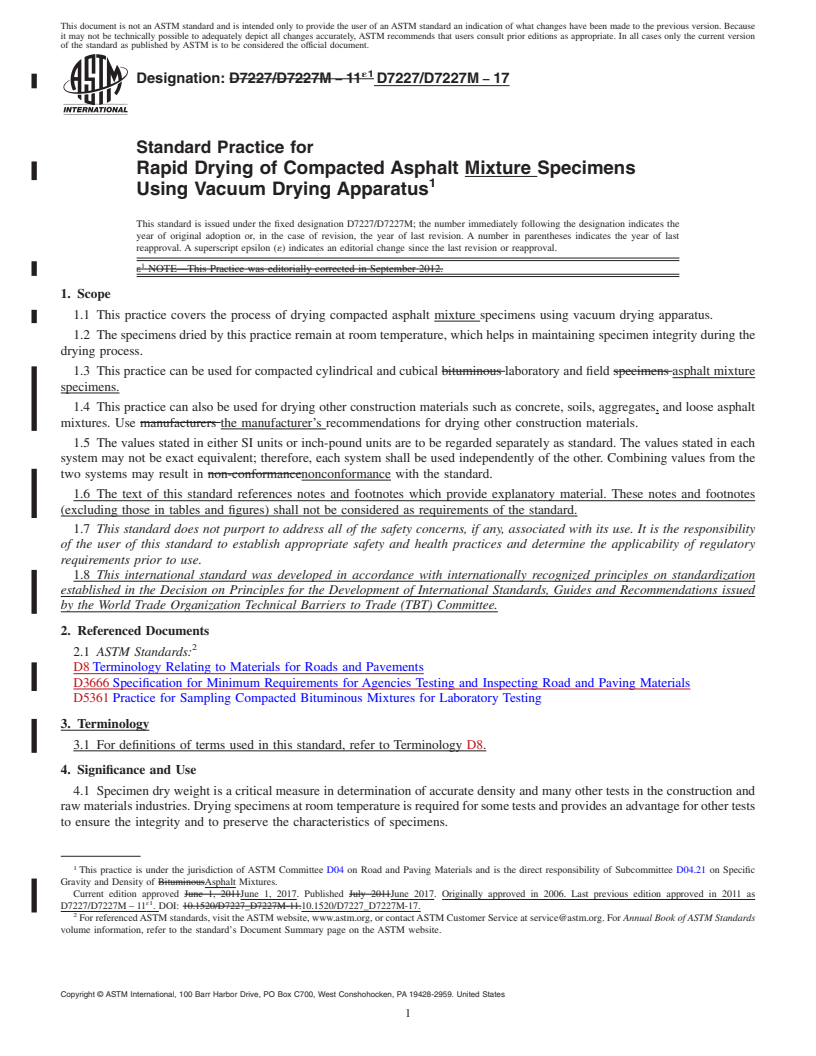
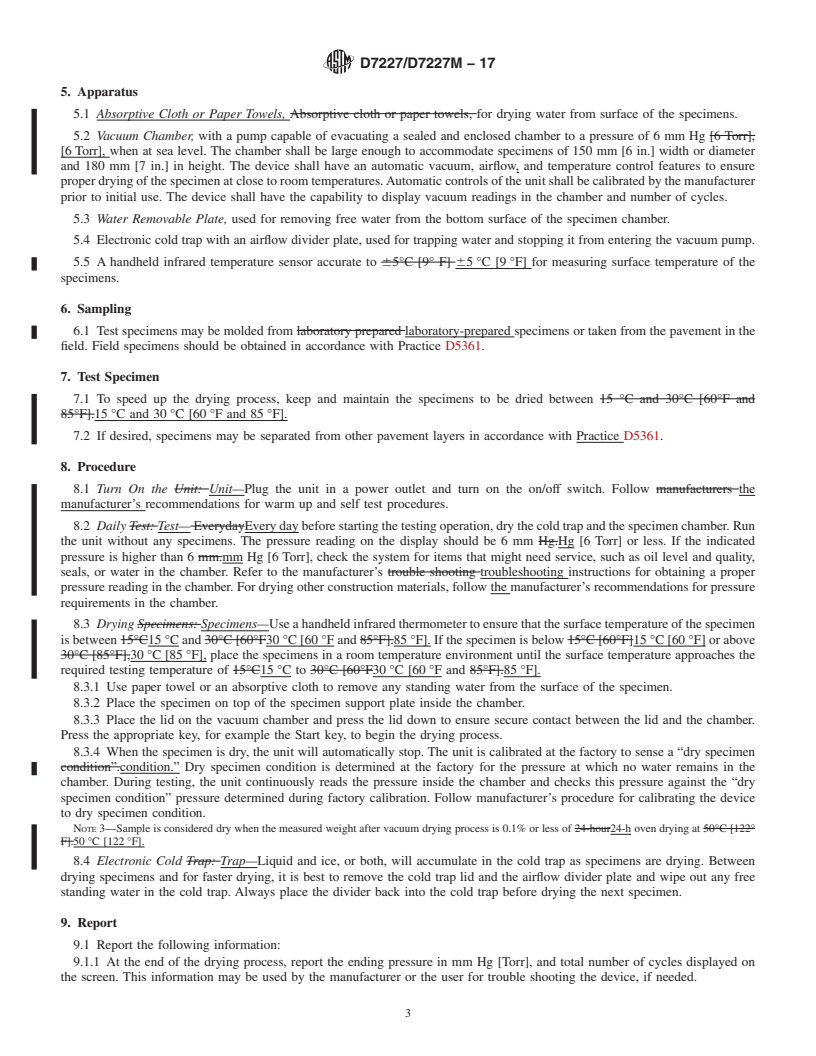
(Practice)Standard Practice for Rapid Drying of Compacted Asphalt Mixture Specimens Using Vacuum Drying Apparatus
Standard Practice for Rapid Drying of Compacted Asphalt Mixture Specimens Using Vacuum Drying Apparatus
SIGNIFICANCE AND USE
4.1 Specimen dry weight is a critical measure in determination of accurate density and many other tests in the construction and raw materials industries. Drying specimens at room temperature is required for some tests and provides an advantage for other tests to ensure the integrity and to preserve the characteristics of specimens.
FIG. 1 Water Removal Plate and Sample Holder Installed in Sample Chamber
4.2 This practice covers drying compacted asphalt mixture specimens in a vacuum chamber that is capable of keeping the specimen at close to room temperature. A vacuum pump reduces the pressure inside the chamber, thus allowing water to evaporate at low temperature. Since the specimen naturally cools during the evaporation process, making water harder to evaporate, it is important to have proper temperature controls in the chamber to ensure the specimen remains at close to room temperature. Automatic controls within the unit allow the specimen to remain at close to room temperature by periodically allowing a flow of warm air to enter the vacuum chamber. Cycling between vacuum and airflow conditions allows the specimen to dry in a short period of time. Completely saturated specimens with over 30 g [0.07 lb] of retained water can be dried in about 30 min. For most field cores that are not completely saturated, the drying time is generally less than 15 min.
Note 1: Cycle time (period) can depend on the material composition. Each cycle involves an alternating period of 30 to 180 s of vacuum operation and 30 to 120 s of air flow.
4.3 This method can be used for 100 mm [4 in.] diameter, 150 mm [6 in.] diameter cylindrical, and cubical compacted asphalt mixture specimens.
4.4 This method can also be used for drying loose asphalt mixtures, aggregate samples, and other solid specimens. Follow the manufacturer’s recommended procedures for drying specimens other than compacted asphalt mixture specimens.
4.5 This method can be used to determine moisture content a...
SCOPE
1.1 This practice covers the process of drying compacted asphalt mixture specimens using vacuum drying apparatus.
1.2 The specimens dried by this practice remain at room temperature, which helps in maintaining specimen integrity during the drying process.
1.3 This practice can be used for compacted cylindrical and cubical laboratory and field asphalt mixture specimens.
1.4 This practice can also be used for drying other construction materials such as concrete, soils, aggregates, and loose asphalt mixtures. Use the manufacturer’s recommendations for drying other construction materials.
1.5 The values stated in either SI units or inch-pound units are to be regarded separately as standard. The values stated in each system may not be exact equivalent; therefore, each system shall be used independently of the other. Combining values from the two systems may result in nonconformance with the standard.
1.6 The text of this standard references notes and footnotes which provide explanatory material. These notes and footnotes (excluding those in tables and figures) shall not be considered as requirements of the standard.
1.7 This standard does not purport to address all of the safety concerns, if any, associated with its use. It is the responsibility of the user of this standard to establish appropriate safety and health practices and determine the applicability of regulatory requirements prior to use.
1.8 This international standard was developed in accordance with internationally recognized principles on standardization established in the Decision on Principles for the Development of International Standards, Guides and Recommendations issued by the World Trade Organization Technical Barriers to Trade (TBT) Committee.
General Information
Buy Standard
Standards Content (Sample)
NOTICE: This standard has either been superseded and replaced by a new version or withdrawn.
Contact ASTM International (www.astm.org) for the latest information
Designation: D7227/D7227M − 17
Standard Practice for
Rapid Drying of Compacted Asphalt Mixture Specimens
1
Using Vacuum Drying Apparatus
This standard is issued under the fixed designation D7227/D7227M; the number immediately following the designation indicates the
year of original adoption or, in the case of revision, the year of last revision. A number in parentheses indicates the year of last
reapproval. A superscript epsilon (´) indicates an editorial change since the last revision or reapproval.
1. Scope 2. Referenced Documents
2
2.1 ASTM Standards:
1.1 This practice covers the process of drying compacted
asphalt mixture specimens using vacuum drying apparatus. D8 Terminology Relating to Materials for Roads and Pave-
ments
1.2 The specimens dried by this practice remain at room
D3666 Specification for Minimum Requirements for Agen-
temperature, which helps in maintaining specimen integrity
cies Testing and Inspecting Road and Paving Materials
during the drying process.
D5361 Practice for Sampling Compacted Bituminous Mix-
1.3 This practice can be used for compacted cylindrical and
tures for Laboratory Testing
cubical laboratory and field asphalt mixture specimens.
3. Terminology
1.4 This practice can also be used for drying other construc-
3.1 For definitions of terms used in this standard, refer to
tion materials such as concrete, soils, aggregates, and loose
asphalt mixtures. Use the manufacturer’s recommendations for Terminology D8.
drying other construction materials.
4. Significance and Use
1.5 The values stated in either SI units or inch-pound units
4.1 Specimen dry weight is a critical measure in determi-
are to be regarded separately as standard. The values stated in
nation of accurate density and many other tests in the construc-
each system may not be exact equivalent; therefore, each
tion and raw materials industries. Drying specimens at room
system shall be used independently of the other. Combining
temperature is required for some tests and provides an advan-
values from the two systems may result in nonconformance
tage for other tests to ensure the integrity and to preserve the
with the standard.
characteristics of specimens.
1.6 The text of this standard references notes and footnotes
4.2 This practice covers drying compacted asphalt mixture
which provide explanatory material. These notes and footnotes
specimens in a vacuum chamber that is capable of keeping the
(excluding those in tables and figures) shall not be considered
specimen at close to room temperature. A vacuum pump
as requirements of the standard.
reduces the pressure inside the chamber, thus allowing water to
1.7 This standard does not purport to address all of the
evaporate at low temperature. Since the specimen naturally
safety concerns, if any, associated with its use. It is the
cools during the evaporation process, making water harder to
responsibility of the user of this standard to establish appro-
evaporate, it is important to have proper temperature controls
priate safety and health practices and determine the applica-
inthechambertoensurethespecimenremainsatclosetoroom
bility of regulatory requirements prior to use.
temperature. Automatic controls within the unit allow the
1.8 This international standard was developed in accor-
specimen to remain at close to room temperature by periodi-
dance with internationally recognized principles on standard-
callyallowingaflowofwarmairtoenterthevacuumchamber.
ization established in the Decision on Principles for the
Cycling between vacuum and airflow conditions allows the
Development of International Standards, Guides and Recom-
specimen to dry in a short period of time. Completely saturated
mendations issued by the World Trade Organization Technical
specimens with over 30 g [0.07 lb] of retained water can be
Barriers to Trade (TBT) Committee.
dried in about 30 min. For most field cores that are not
completely saturated, the drying time is generally less than
15 min.
1
This practice is under the jurisdiction of ASTM Committee D04 on Road and
Paving Materials and is the direct responsibility of Subcommittee D04.21 on
2
Specific Gravity and Density of Asphalt Mixtures. For referenced ASTM standards, visit the ASTM website, www.astm.org, or
Current edition approved June 1, 2017. Published June 2017. Originally contact ASTM Customer Service at service@astm.org. For Annual Book of ASTM
approved in 2006. Last previous edition approved in 2011 as D7227/ Standards volume information, refer to the standard’s Document Summary page on
ɛ1
D7227M – 11 . DOI: 10.1520/D7227_D7227M-17. the ASTM website.
Copyright © ASTM International, 100 Barr Harbor Drive, PO Box C700, West Conshohocken, PA 19428-2959. United States
1
---------------------- Page: 1 ----------------------
D7227/D7227M − 17
FIG. 1 Water Removal Plate and Sample Holder Inst
...
This document is not an ASTM standard and is intended only to provide the user of an ASTM standard an indication of what changes have been made to the previous version. Because
it may not be technically possible to adequately depict all changes accurately, ASTM recommends that users consult prior editions as appropriate. In all cases only the current version
of the standard as published by ASTM is to be considered the official document.
´1
Designation: D7227/D7227M − 11 D7227/D7227M − 17
Standard Practice for
Rapid Drying of Compacted Asphalt Mixture Specimens
1
Using Vacuum Drying Apparatus
This standard is issued under the fixed designation D7227/D7227M; the number immediately following the designation indicates the
year of original adoption or, in the case of revision, the year of last revision. A number in parentheses indicates the year of last
reapproval. A superscript epsilon (´) indicates an editorial change since the last revision or reapproval.
1
ε NOTE—This Practice was editorially corrected in September 2012.
1. Scope
1.1 This practice covers the process of drying compacted asphalt mixture specimens using vacuum drying apparatus.
1.2 The specimens dried by this practice remain at room temperature, which helps in maintaining specimen integrity during the
drying process.
1.3 This practice can be used for compacted cylindrical and cubical bituminous laboratory and field specimens asphalt mixture
specimens.
1.4 This practice can also be used for drying other construction materials such as concrete, soils, aggregates, and loose asphalt
mixtures. Use manufacturers the manufacturer’s recommendations for drying other construction materials.
1.5 The values stated in either SI units or inch-pound units are to be regarded separately as standard. The values stated in each
system may not be exact equivalent; therefore, each system shall be used independently of the other. Combining values from the
two systems may result in non-conformancenonconformance with the standard.
1.6 The text of this standard references notes and footnotes which provide explanatory material. These notes and footnotes
(excluding those in tables and figures) shall not be considered as requirements of the standard.
1.7 This standard does not purport to address all of the safety concerns, if any, associated with its use. It is the responsibility
of the user of this standard to establish appropriate safety and health practices and determine the applicability of regulatory
requirements prior to use.
1.8 This international standard was developed in accordance with internationally recognized principles on standardization
established in the Decision on Principles for the Development of International Standards, Guides and Recommendations issued
by the World Trade Organization Technical Barriers to Trade (TBT) Committee.
2. Referenced Documents
2
2.1 ASTM Standards:
D8 Terminology Relating to Materials for Roads and Pavements
D3666 Specification for Minimum Requirements for Agencies Testing and Inspecting Road and Paving Materials
D5361 Practice for Sampling Compacted Bituminous Mixtures for Laboratory Testing
3. Terminology
3.1 For definitions of terms used in this standard, refer to Terminology D8.
4. Significance and Use
4.1 Specimen dry weight is a critical measure in determination of accurate density and many other tests in the construction and
raw materials industries. Drying specimens at room temperature is required for some tests and provides an advantage for other tests
to ensure the integrity and to preserve the characteristics of specimens.
1
This practice is under the jurisdiction of ASTM Committee D04 on Road and Paving Materials and is the direct responsibility of Subcommittee D04.21 on Specific
Gravity and Density of BituminousAsphalt Mixtures.
Current edition approved June 1, 2011June 1, 2017. Published July 2011June 2017. Originally approved in 2006. Last previous edition approved in 2011 as
ɛ1
D7227/D7227M – 11 . DOI: 10.1520/D7227_D7227M-11.10.1520/D7227_D7227M-17.
2
For referenced ASTM standards, visit the ASTM website, www.astm.org, or contact ASTM Customer Service at service@astm.org. For Annual Book of ASTM Standards
volume information, refer to the standard’s Document Summary page on the ASTM website.
Copyright © ASTM International, 100 Barr Harbor Drive, PO Box C700, West Conshohocken, PA 19428-2959. United States
1
---------------------- Page: 1 ----------------------
D7227/D7227M − 17
FIG. 1 Water Removal Plate and Sample Holder Installed in Sample Chamber
4.2 This practice covers drying compacted asphalt mixture specimens in a vacuum chamber that is capable of keeping the
specimen at close to room temperature. A vacuum pump reduces the pressure inside the chamber, thus allowing water to evaporate
at low temperature. Since the specimen naturally cools during the evaporation process, making water harder to evaporate, it is
important to have proper temperature controls in the chamber to ensure the specimen remains at close
...
Questions, Comments and Discussion
Ask us and Technical Secretary will try to provide an answer. You can facilitate discussion about the standard in here.