

ASTM D6997-12(2020)
(Test Method)Standard Test Method for Distillation of Emulsified Asphalt
General Information
- Abstract
SIGNIFICANCE AND USE
4.1 This test method can be used for quantitative determination of residue and oil distillates in emulsified asphalts for specification acceptance, service evaluation, control, and research. This test method can also be used to obtain residue and oil distillate for further testing. This method may not be appropriate for emulsified asphalts containing latex or polymer; however, some specifying agencies may utilize this method and stipulate a lowered distillation temperature. By stipulating a lowered distillation temperature, the precision and bias statement may not be considered valid. Low-temperature methods such as Test Method D7403 and Practice D7497 are options for obtaining residue for latex or polymer modified emulsified asphalts.
SCOPE
1.1 This test method covers the quantitative determination of residue and oil distillate in emulsified asphalts composed principally of a semisolid or liquid asphaltic base, water, and an emulsifying agent.
1.2 The values stated in SI units are to be regarded as the standard. No other units of measurement are included in this standard.
1.3 This standard does not purport to address all of the safety concerns, if any, associated with its use. It is the responsibility of the user of this standard to establish appropriate safety, health, and environmental practices and determine the applicability of regulatory limitations prior to use.
1.4 This international standard was developed in accordance with internationally recognized principles on standardization established in the Decision on Principles for the Development of International Standards, Guides and Recommendations issued by the World Trade Organization Technical Barriers to Trade (TBT) Committee.
- Status
- Published
- Publication Date
- 14-Oct-2020
- Technical Committee
- D04 - Road and Paving Materials
- Drafting Committee
- D04.42 - Emulsified Asphalt Test
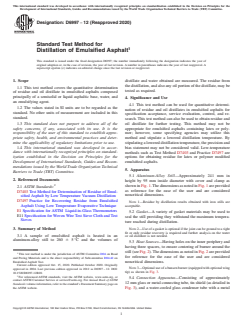

Overview
ASTM D6997-12(2020), titled "Standard Test Method for Distillation of Emulsified Asphalt," is an internationally recognized ASTM standard used for the quantitative determination of residue and oil distillates in emulsified asphalts. Emulsified asphalts are typically composed of an asphaltic base, water, and emulsifying agents. This test method plays a critical role in quality control, specification acceptance, service evaluation, and research for road construction and maintenance applications. It also supports further testing of asphalt residue and oil distillate.
Key Topics
- Residue and Oil Distillate Measurement: The primary aim is to determine the percentage of asphaltic residue and oil distillate present after distillation.
- Testing Procedure: The sample is heated in an aluminum-alloy still, and both the distillate and residue are quantitatively measured.
- Homogenization and Conditioning: Emulsified asphalt samples must be stirred and conditioned at specified temperatures for accurate testing.
- Applicability: While this method is not advised for polymer or latex-modified emulsified asphalt, alternate low-temperature methods (ASTM D7403 and ASTM D7497) can be used in such cases.
- Safety and Compliance: Users are responsible for adhering to safety, health, and environmental practices and for ensuring compliance with regulatory requirements.
Applications
The distillation test for emulsified asphalt is widely applied across various sectors:
- Specification Acceptance: Used by government agencies, contractors, and material suppliers for compliance with official standards in road paving and construction.
- Quality Control: Essential for verifying batch-to-batch consistency in asphalt emulsion production and shipment.
- Performance Evaluation: Enables laboratories to analyze potential pavement performance based on the properties of the recovered residue.
- Research and Development: Supports product innovation by allowing researchers to study changes in distillation residue and oil content under different formulation or curing conditions.
- Further Testing: Residues and oil distillates procured via this method can be used for supplementary physical or chemical analysis.
Note: For latex or polymer-modified emulsified asphalts, reduced distillation temperatures or alternative methods should be considered to maintain accuracy and reliability.
Related Standards
ASTM D6997-12(2020) is closely linked to several other ASTM standards relevant to emulsified asphalt testing and characterization:
- ASTM D7403: Test Method for Determination of Residue of Emulsified Asphalt by Low Temperature Vacuum Distillation - recommended for polymer or latex-modified emulsions.
- ASTM D7497: Practice for Recovering Residue from Emulsified Asphalt Using Low Temperature Evaporative Technique.
- ASTM E1: Specification for ASTM Liquid-in-Glass Thermometers, referenced for temperature measurement in the procedure.
- ASTM E11: Specification for Woven Wire Test Sieve Cloth and Test Sieves, used for residue purification.
Practical Value
Adopting ASTM D6997-12(2020) ensures reliable, reproducible measurements of key properties in emulsified asphalts, supporting both regulatory compliance and optimal performance on roadway projects. This test method underpins essential quality assurance activities, helping the industry maintain standards for durable and safe pavements.
Keywords
emulsified asphalt, distillation test, asphalt emulsion residue, oil distillate, ASTM D6997, road construction materials, asphalt testing standard, specification acceptance, asphalt quality control, residue determination, asphalt research.
Relations
- Effective Date
- 15-Jul-2019
- Effective Date
- 01-Oct-2017
- Effective Date
- 01-Oct-2013
- Effective Date
- 01-May-2013
- Effective Date
- 01-Jun-2009
- Effective Date
- 01-May-2009
- Effective Date
- 01-Jan-2009
- Effective Date
- 01-Nov-2007
- Effective Date
- 01-Nov-2005
- Effective Date
- 01-May-2004
- Effective Date
- 01-Nov-2003
- Effective Date
- 10-May-2003
- Effective Date
- 10-Oct-2001
- Effective Date
- 10-Oct-2001
- Effective Date
- 10-Oct-2001
Get Certified
Connect with accredited certification bodies for this standard

Zavod za gradbeništvo Slovenije (ZAG) - Inšpekcija
ZAG inspection body for construction products, structures, and materials.
Sponsored listings
Frequently Asked Questions
ASTM D6997-12(2020) is a standard published by ASTM International. Its full title is "Standard Test Method for Distillation of Emulsified Asphalt". This standard covers: SIGNIFICANCE AND USE 4.1 This test method can be used for quantitative determination of residue and oil distillates in emulsified asphalts for specification acceptance, service evaluation, control, and research. This test method can also be used to obtain residue and oil distillate for further testing. This method may not be appropriate for emulsified asphalts containing latex or polymer; however, some specifying agencies may utilize this method and stipulate a lowered distillation temperature. By stipulating a lowered distillation temperature, the precision and bias statement may not be considered valid. Low-temperature methods such as Test Method D7403 and Practice D7497 are options for obtaining residue for latex or polymer modified emulsified asphalts. SCOPE 1.1 This test method covers the quantitative determination of residue and oil distillate in emulsified asphalts composed principally of a semisolid or liquid asphaltic base, water, and an emulsifying agent. 1.2 The values stated in SI units are to be regarded as the standard. No other units of measurement are included in this standard. 1.3 This standard does not purport to address all of the safety concerns, if any, associated with its use. It is the responsibility of the user of this standard to establish appropriate safety, health, and environmental practices and determine the applicability of regulatory limitations prior to use. 1.4 This international standard was developed in accordance with internationally recognized principles on standardization established in the Decision on Principles for the Development of International Standards, Guides and Recommendations issued by the World Trade Organization Technical Barriers to Trade (TBT) Committee.
SIGNIFICANCE AND USE 4.1 This test method can be used for quantitative determination of residue and oil distillates in emulsified asphalts for specification acceptance, service evaluation, control, and research. This test method can also be used to obtain residue and oil distillate for further testing. This method may not be appropriate for emulsified asphalts containing latex or polymer; however, some specifying agencies may utilize this method and stipulate a lowered distillation temperature. By stipulating a lowered distillation temperature, the precision and bias statement may not be considered valid. Low-temperature methods such as Test Method D7403 and Practice D7497 are options for obtaining residue for latex or polymer modified emulsified asphalts. SCOPE 1.1 This test method covers the quantitative determination of residue and oil distillate in emulsified asphalts composed principally of a semisolid or liquid asphaltic base, water, and an emulsifying agent. 1.2 The values stated in SI units are to be regarded as the standard. No other units of measurement are included in this standard. 1.3 This standard does not purport to address all of the safety concerns, if any, associated with its use. It is the responsibility of the user of this standard to establish appropriate safety, health, and environmental practices and determine the applicability of regulatory limitations prior to use. 1.4 This international standard was developed in accordance with internationally recognized principles on standardization established in the Decision on Principles for the Development of International Standards, Guides and Recommendations issued by the World Trade Organization Technical Barriers to Trade (TBT) Committee.
ASTM D6997-12(2020) is classified under the following ICS (International Classification for Standards) categories: 93.080.20 - Road construction materials. The ICS classification helps identify the subject area and facilitates finding related standards.
ASTM D6997-12(2020) has the following relationships with other standards: It is inter standard links to ASTM D7403-19, ASTM D7403-09(2017), ASTM E11-13, ASTM E1-13, ASTM D7403-09, ASTM E11-09e1, ASTM D7497-09, ASTM E1-07, ASTM E1-05, ASTM E11-04, ASTM E1-03a, ASTM E1-03, ASTM E1-01, ASTM E1-98e1, ASTM E1-98. Understanding these relationships helps ensure you are using the most current and applicable version of the standard.
ASTM D6997-12(2020) is available in PDF format for immediate download after purchase. The document can be added to your cart and obtained through the secure checkout process. Digital delivery ensures instant access to the complete standard document.
Standards Content (Sample)
This international standard was developed in accordance with internationally recognized principles on standardization established in the Decision on Principles for the
Development of International Standards, Guides and Recommendations issued by the World Trade Organization Technical Barriers to Trade (TBT) Committee.
Designation: D6997 −12 (Reapproved 2020)
Standard Test Method for
Distillation of Emulsified Asphalt
This standard is issued under the fixed designation D6997; the number immediately following the designation indicates the year of
original adoption or, in the case of revision, the year of last revision.Anumber in parentheses indicates the year of last reapproval.A
superscript epsilon (´) indicates an editorial change since the last revision or reapproval.
1. Scope distillate and water obtained are measured. The residue from
thedistillation,andalsoanyoilportionofthedistillate,maybe
1.1 This test method covers the quantitative determination
tested as required.
of residue and oil distillate in emulsified asphalts composed
principally of a semisolid or liquid asphaltic base, water, and
4. Significance and Use
an emulsifying agent.
4.1 This test method can be used for quantitative determi-
1.2 The values stated in SI units are to be regarded as the
nation of residue and oil distillates in emulsified asphalts for
standard. No other units of measurement are included in this
specification acceptance, service evaluation, control, and re-
standard.
search.Thistestmethodcanalsobeusedtoobtainresidueand
1.3 This standard does not purport to address all of the oil distillate for further testing. This method may not be
safety concerns, if any, associated with its use. It is the
appropriate for emulsified asphalts containing latex or poly-
responsibility of the user of this standard to establish appro- mer; however, some specifying agencies may utilize this
priate safety, health, and environmental practices and deter- method and stipulate a lowered distillation temperature. By
mine the applicability of regulatory limitations prior to use. stipulatingalowereddistillationtemperature,theprecisionand
1.4 This international standard was developed in accor- bias statement may not be considered valid. Low-temperature
dance with internationally recognized principles on standard- methods such as Test Method D7403 and Practice D7497 are
ization established in the Decision on Principles for the options for obtaining residue for latex or polymer modified
Development of International Standards, Guides and Recom- emulsified asphalts.
mendations issued by the World Trade Organization Technical
5. Apparatus
Barriers to Trade (TBT) Committee.
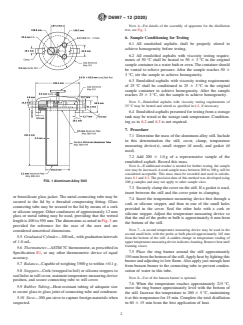
5.1 Aluminum-Alloy Still—Approximately 241 mm in
2. Referenced Documents
height by 95 mm inside diameter with cover and clamp as
showninFig.1.ThedimensionsasnotedinFig.1areprovided
2.1 ASTM Standards:
as reference for the ease of the user and are considered
D7403Test Method for Determination of Residue of Emul-
noncritical dimensions.
sified Asphalt by Low Temperature Vacuum Distillation
D7497Practice for Recovering Residue from Emulsified
NOTE 1—Residue by distillation results obtained with iron stills are
Asphalt Using Low Temperature Evaporative Technique
acceptable.
E1Specification for ASTM Liquid-in-Glass Thermometers
5.2 Gasket—A variety of gasket materials may be used to
E11Specification forWovenWireTest Sieve Cloth andTest
seal the still providing they withstand the maximum tempera-
Sieves
ture reached during distillation.
NOTE2—Useofagasketisoptionalifthejointcanbegroundtoatight
3. Summary of Method
fit or only residue recovery is required and further analysis on the water
3.1 A sample of emulsified asphalt is heated in an
or oil distillate is not needed.
aluminum-alloy still to 260 6 5°C and the volumes of
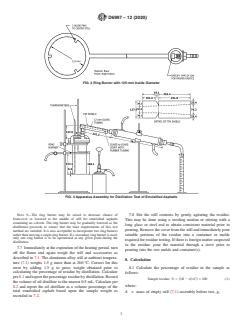
5.3 Heat Sources—Having holes on the inner periphery and
having three spacers, to ensure centering of burner around the
still(seeFig.2).ThedimensionsasnotedinFig.2areprovided
This test method is under the jurisdiction of ASTM Committee D04 on Road
for reference for the ease of the user and are considered
and Paving Materials and is the direct responsibility of Subcommittee D04.42 on
Emulsified Asphalt Test. noncritical dimensions.
Current edition approved Oct. 15, 2020. Published October 2020. Originally
NOTE3—Optionaluseofabunsenburner(equippedwithoptionalwing
approved in 2004. Last previous edition approved in 2012 as D6997–12. DOI:
tip) as shown in Fig. 3.
10.1520/D6997-12R20.
For referenced ASTM standards, visit the ASTM website, www.astm.org, or
5.4 Connection Apparatus—Consisting of approximately
contact ASTM Customer Service at service@astm.org. For Annual Book of ASTM
12mmglassormetalconnectingtube,tinshield(asdetailedin
Standards volume information, refer to the standard’s Document Summary page on
the ASTM website. Fig. 3), and a water-cooled glass condenser tube with a metal
Copyright © ASTM International, 100 Barr Harbor Drive, PO Box C700, West Conshohocken, PA 19428-2959. United States
D6997 − 12 (2020)
NOTE 4—For details of the assembly of apparatus for the distillation
test, see Fig. 3.
6. Sample Conditioning for Testing
6.1 All emulsified asphalts shall be properly stirred to
achieve homogeneity before testing.
6.2 All emulsified asphalts with viscosity testing require-
ments of 50°C shall be heated to 50 6 3°C in the original
samplecontainerinawaterbathoroven.Thecontainershould
be vented to relieve pressure. After the sample reaches 50 6
3°C, stir the sample to achieve homogeneity.
6.3 Emulsified asphalts with viscosity testing requirements
of 25°C shall be conditioned to 25 6 3°C in the original
sample container to achieve homogeneity. After the sample
reaches 25 6 3°C, stir the sample to achieve homogeneity.
NOTE 5—Emulsified asphalts with viscosity testing requirements of
25°C may be heated and stirred as specified in 6.2, if necessary.
6.4 Emulsified asphalts presented for testing from a storage
tank may be tested at the storage tank temperature. Condition-
ing as in 6.2 and 6.3 is not required.
7. Procedure
7.1 Determine the mass of the aluminum-alloy still. Include
in this determination the still, cover, clamp, temperature
measuring device(s), small stopper (if used), and gasket (if
used).
7.2 Add 200 6 1.0g of a representative sample of the
emulsified asphalt. Record this mass.
NOTE 6—If additional residue is needed for further testing, the sample
size may be increased.Atotal sample mass between 200 to 300 g will be
considered acceptable. This mass must be recorded and used in calcula-
tions 8.1 and 8.2. The precision data of this method was developed using
FIG. 1 Aluminum-Alloy Still
200 g samples and may not apply to other sample sizes.
7.3 Securelyclampthecoveronthestill.Ifagasketisused,
insert between the still and the cover prior to clamping.
or borosilicate glass jacket. The metal c
...