

SIST EN 14427:2022
(Main)LPG equipment and accessories - Transportable refillable composite cylinders for LPG - Design and construction
General Information
- Abstract
This document:
— specifies minimum requirements for materials, design, construction, prototype testing and routine manufacturing inspections of fully wrapped composite cylinders with a water capacity from 0,5 litre up to and including 150 litres for liquefied petroleum gases (LPG) exposed to ambient temperatures, with a test pressure of at least 30 bar;
— is only applicable to cylinders which are fitted with a pressure relief valve (see 4.1.3);
— is applicable to cylinders with a liner of metallic material (welded or seamless) or non-metallic material (or a mixture thereof), reinforced by fibres of glass, carbon or aramid (or a mixture thereof);
— is also applicable to composite cylinders without liners.
Cylinders manufactured to this document are suitable for temperatures down to −40 °C.
This document does not address the design, fitting and performance of removable protective sleeves. Where these are fitted, the choice of material and sleeve performance are expected to be considered separately.
- Status
- Published
- Public Enquiry End Date
- 01-Dec-2020
- Publication Date
- 18-Aug-2022
- Technical Committee
- TLP - Pressure vessels
- Current Stage
- 6060 - National Implementation/Publication (Adopted Project)
- Start Date
- 03-Aug-2022
- Due Date
- 08-Oct-2022
- Completion Date
- 19-Aug-2022

Overview
EN 14427:2022 (CEN) specifies minimum requirements for the design, construction, materials, prototype testing and routine manufacturing inspections of transportable, refillable composite cylinders for LPG. It applies to fully wrapped composite cylinders with a water capacity from 0.5 litre up to and including 150 litres, with a test pressure of at least 30 bar, and is only applicable to cylinders fitted with a pressure relief valve. The 2022 edition supersedes EN 14427:2014 and introduces cylinder types, formal rejection criteria and updated testing/inspection rules. Cylinders manufactured to this standard are suitable for service temperatures down to −40 °C.
Key topics and technical requirements
- Cylinder types and design - introduction of defined cylinder types and required design drawings and documentation.
- Materials and construction - applicability to cylinders with metallic (welded or seamless) or non‑metallic liners and to liner‑less composite cylinders; reinforcement by glass, carbon or aramid fibres (or mixes).
- Composite overwrap and winding - material selection, winding procedures and manufacturing controls for fully wrapped composite cylinders.
- Mandatory fitting - requirement for a pressure relief valve (see scope).
- Prototype, design-variant and production testing - detailed test programme covering:
- composite material and liner material tests
- liner burst tests (metallic liners)
- proof pressure and cylinder burst tests
- pressure cycle, artificial ageing and elevated temperature exposure
- impact, drop, spike puncture and fire resistance tests
- permeability testing for specific cylinder types (Type 4 and 5)
- neck strength, neck ring and torque tests
- Manufacturing inspections and rejection criteria - establishment of routine inspection regimes and objective rejection criteria for finished cylinders.
- Marking, documentation and conformity - requirements for traceability and marking consistent with related LPG standards.
Applications and who uses EN 14427:2022
- Cylinder designers and manufacturers of refillable composite LPG cylinders seeking compliance with European safety and design expectations.
- Testing laboratories and certification bodies conducting prototype and production testing per EN 14427.
- Regulators and transport authorities referencing standards in RID/ADR technical annexes.
- OEMs, filling stations and LPG distributors ensuring cylinder compatibility, safety and traceability.
- Safety engineers and QA teams responsible for material selection, production inspection and lifetime performance.
Related standards
EN 14427 references pertinent standards for welded steel/aluminium cylinders (e.g., EN 1442, EN 13110), plastics and test methods (EN ISO 527, EN ISO 75), and marking (EN 14894). Users should consult these normative references and RID/ADR transport regulations where applicable.
Keywords: EN 14427:2022, LPG composite cylinders, transportable refillable composite cylinders, design and construction, CEN, LPG cylinder testing, composite overwrap, pressure relief valve.
Relations
- Effective Date
- 01-Sep-2022
- Effective Date
- 08-Apr-2026
- Effective Date
- 28-Jan-2026
- Effective Date
- 28-Jan-2026
- Effective Date
- 28-Jan-2026
- Effective Date
- 28-Jan-2026
- Effective Date
- 28-Jan-2026
- Effective Date
- 28-Jan-2026
- Effective Date
- 28-Jan-2026
- Effective Date
- 28-Jan-2026
- Effective Date
- 28-Jan-2026
- Effective Date
- 28-Jan-2026
- Effective Date
- 28-Jan-2026
- Effective Date
- 28-Jan-2026
- Effective Date
- 28-Jan-2026
Get Certified
Connect with accredited certification bodies for this standard

Institut za varilstvo d.o.o. (Welding Institute)
Slovenia's leading welding institute since 1952. ISO 3834, EN 1090, pressure equipment certification, NDT personnel, welder qualification. Only IIW Au
Sponsored listings
Frequently Asked Questions
SIST EN 14427:2022 is a standard published by the Slovenian Institute for Standardization (SIST). Its full title is "LPG equipment and accessories - Transportable refillable composite cylinders for LPG - Design and construction". This standard covers: This document: — specifies minimum requirements for materials, design, construction, prototype testing and routine manufacturing inspections of fully wrapped composite cylinders with a water capacity from 0,5 litre up to and including 150 litres for liquefied petroleum gases (LPG) exposed to ambient temperatures, with a test pressure of at least 30 bar; — is only applicable to cylinders which are fitted with a pressure relief valve (see 4.1.3); — is applicable to cylinders with a liner of metallic material (welded or seamless) or non-metallic material (or a mixture thereof), reinforced by fibres of glass, carbon or aramid (or a mixture thereof); — is also applicable to composite cylinders without liners. Cylinders manufactured to this document are suitable for temperatures down to −40 °C. This document does not address the design, fitting and performance of removable protective sleeves. Where these are fitted, the choice of material and sleeve performance are expected to be considered separately.
This document: — specifies minimum requirements for materials, design, construction, prototype testing and routine manufacturing inspections of fully wrapped composite cylinders with a water capacity from 0,5 litre up to and including 150 litres for liquefied petroleum gases (LPG) exposed to ambient temperatures, with a test pressure of at least 30 bar; — is only applicable to cylinders which are fitted with a pressure relief valve (see 4.1.3); — is applicable to cylinders with a liner of metallic material (welded or seamless) or non-metallic material (or a mixture thereof), reinforced by fibres of glass, carbon or aramid (or a mixture thereof); — is also applicable to composite cylinders without liners. Cylinders manufactured to this document are suitable for temperatures down to −40 °C. This document does not address the design, fitting and performance of removable protective sleeves. Where these are fitted, the choice of material and sleeve performance are expected to be considered separately.
SIST EN 14427:2022 is classified under the following ICS (International Classification for Standards) categories: 23.020.35 - Gas cylinders. The ICS classification helps identify the subject area and facilitates finding related standards.
SIST EN 14427:2022 has the following relationships with other standards: It is inter standard links to SIST EN 14427:2014, SIST EN ISO 1183-2:2026, SIST EN ISO 1183-2:2019, SIST EN 1442:2017, SIST EN ISO 21068-3:2024, SIST EN ISO 527-1:2019, SIST EN 13110:2023, SIST EN ISO 1183-3:2000, SIST EN ISO 75-1:2020, SIST EN ISO 9809-3:2019, SIST EN ISO 75-3:2025, SIST EN 14894:2022, SIST EN ISO 2555:2018, SIST EN ISO 527-2:2025, SIST EN ISO 1133-2:2012. Understanding these relationships helps ensure you are using the most current and applicable version of the standard.
SIST EN 14427:2022 is associated with the following European legislation: EU Directives/Regulations: 2008/68/EC, 94/55/EC, 96/49/EC; Standardization Mandates: M/086. When a standard is cited in the Official Journal of the European Union, products manufactured in conformity with it benefit from a presumption of conformity with the essential requirements of the corresponding EU directive or regulation.
SIST EN 14427:2022 is available in PDF format for immediate download after purchase. The document can be added to your cart and obtained through the secure checkout process. Digital delivery ensures instant access to the complete standard document.
Standards Content (Sample)
SLOVENSKI STANDARD
01-september-2022
Nadomešča:
SIST EN 14427:2014
Oprema in pribor za utekočinjeni naftni plin (UNP) - Premične, ponovno polnljive
jeklenke iz kompozitnih materialov za UNP - Konstruiranje in izdelava
LPG equipment and accessories - Transportable refillable composite cylinders for LPG -
Design and construction
Flüssiggas-Geräte und Ausrüstungsteile - Ortsbewegliche wiederbefüllbare
vollumwickelte Flaschen aus Verbundwerkstoff für Flüssiggas (LPG) - Auslegung und
Bau
Équipements pour gaz de pétrole liquéfiés et leurs accessoires - Bouteilles entièrement
bobinées en matériau composite, transportables et rechargeables pour gaz de pétrole
liquéfié (GPL) - Conception et fabrication
Ta slovenski standard je istoveten z: EN 14427:2022
ICS:
23.020.35 Plinske jeklenke Gas cylinders
2003-01.Slovenski inštitut za standardizacijo. Razmnoževanje celote ali delov tega standarda ni dovoljeno.
EN 14427
EUROPEAN STANDARD
NORME EUROPÉENNE
April 2022
EUROPÄISCHE NORM
ICS 23.020.35 Supersedes EN 14427:2014
English Version
LPG equipment and accessories - Transportable refillable
composite cylinders for LPG - Design and construction
Équipements pour gaz de pétrole liquéfiés et leurs Flüssiggas-Geräte und Ausrüstungsteile -
accessoires - Bouteilles entièrement bobinées en Ortsbewegliche wiederbefüllbare vollumwickelte
matériau composite, transportables et rechargeables Flaschen aus Verbundwerkstoff für Flüssiggas (LPG) -
pour gaz de pétrole liquéfié (GPL) - Conception et Auslegung und Bau
fabrication
This European Standard was approved by CEN on 13 March 2022.
CEN members are bound to comply with the CEN/CENELEC Internal Regulations which stipulate the conditions for giving this
European Standard the status of a national standard without any alteration. Up-to-date lists and bibliographical references
concerning such national standards may be obtained on application to the CEN-CENELEC Management Centre or to any CEN
member.
This European Standard exists in three official versions (English, French, German). A version in any other language made by
translation under the responsibility of a CEN member into its own language and notified to the CEN-CENELEC Management
Centre has the same status as the official versions.
CEN members are the national standards bodies of Austria, Belgium, Bulgaria, Croatia, Cyprus, Czech Republic, Denmark, Estonia,
Finland, France, Germany, Greece, Hungary, Iceland, Ireland, Italy, Latvia, Lithuania, Luxembourg, Malta, Netherlands, Norway,
Poland, Portugal, Republic of North Macedonia, Romania, Serbia, Slovakia, Slovenia, Spain, Sweden, Switzerland, Turkey and
United Kingdom.
EUROPEAN COMMITTEE FOR STANDARDIZATION
COMITÉ EUROPÉEN DE NORMALISATION
EUROPÄISCHES KOMITEE FÜR NORMUNG
CEN-CENELEC Management Centre: Rue de la Science 23, B-1040 Brussels
© 2022 CEN All rights of exploitation in any form and by any means reserved Ref. No. EN 14427:2022 E
worldwide for CEN national Members.
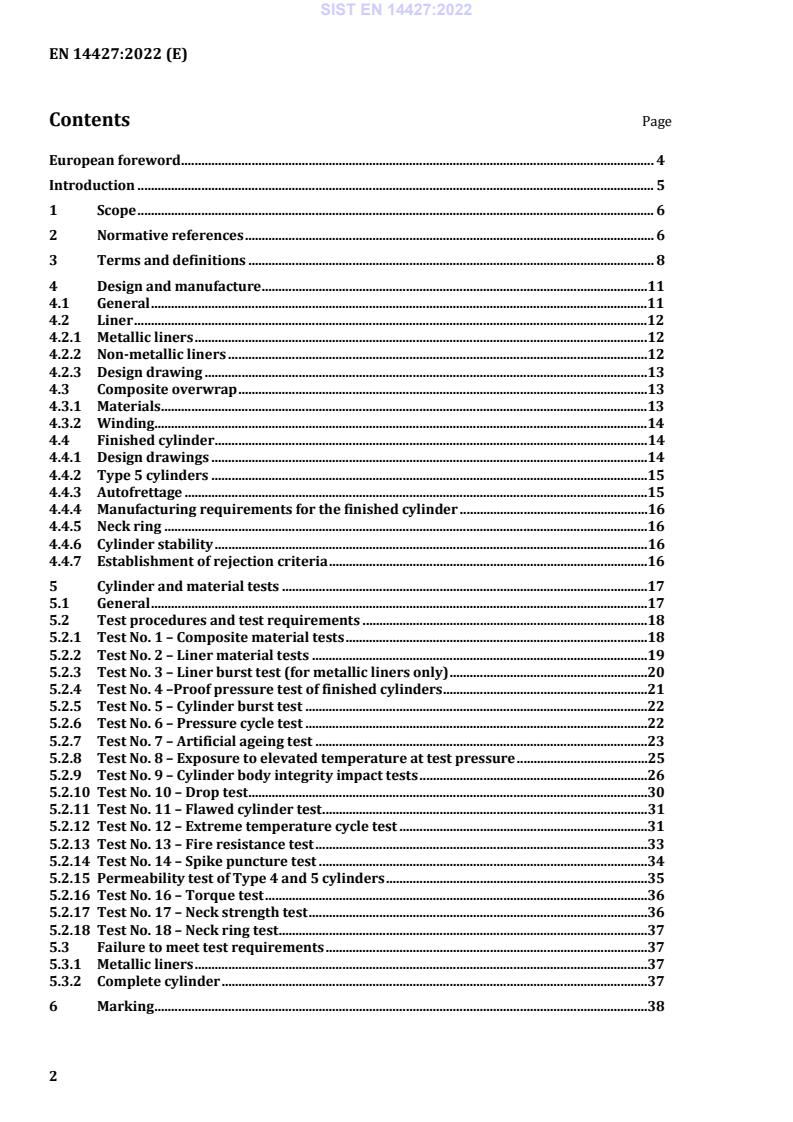
Contents Page
European foreword . 4
Introduction . 5
1 Scope . 6
2 Normative references . 6
3 Terms and definitions . 8
4 Design and manufacture .11
4.1 General .11
4.2 Liner .12
4.2.1 Metallic liners .12
4.2.2 Non-metallic liners .12
4.2.3 Design drawing .13
4.3 Composite overwrap .13
4.3.1 Materials .13
4.3.2 Winding.14
4.4 Finished cylinder .14
4.4.1 Design drawings .14
4.4.2 Type 5 cylinders .15
4.4.3 Autofrettage .15
4.4.4 Manufacturing requirements for the finished cylinder .16
4.4.5 Neck ring .16
4.4.6 Cylinder stability .16
4.4.7 Establishment of rejection criteria .16
5 Cylinder and material tests .17
5.1 General .17
5.2 Test procedures and test requirements .18
5.2.1 Test No. 1 – Composite material tests .18
5.2.2 Test No. 2 – Liner material tests .19
5.2.3 Test No. 3 – Liner burst test (for metallic liners only) .20
5.2.4 Test No. 4 –Proof pressure test of finished cylinders .21
5.2.5 Test No. 5 – Cylinder burst test .22
5.2.6 Test No. 6 – Pressure cycle test .22
5.2.7 Test No. 7 – Artificial ageing test .23
5.2.8 Test No. 8 – Exposure to elevated temperature at test pressure .25
5.2.9 Test No. 9 – Cylinder body integrity impact tests .26
5.2.10 Test No. 10 – Drop test .30
5.2.11 Test No. 11 – Flawed cylinder test .31
5.2.12 Test No. 12 – Extreme temperature cycle test .31
5.2.13 Test No. 13 – Fire resistance test .33
5.2.14 Test No. 14 – Spike puncture test .34
5.2.15 Permeability test of Type 4 and 5 cylinders .35
5.2.16 Test No. 16 – Torque test .36
5.2.17 Test No. 17 – Neck strength test .36
5.2.18 Test No. 18 – Neck ring test .37
5.3 Failure to meet test requirements .37
5.3.1 Metallic liners .37
5.3.2 Complete cylinder .37
6 Marking .38
Annex A (normative) Prototype testing, design variant testing and production testing . 39
A.1 General . 39
A.2 Prototype testing . 39
A.2.1 General . 39
A.2.2 Definition of new design . 40
A.2.3 Prototype testing requirements . 41
A.3 Design variant testing . 43
A.3.1 General . 43
A.3.2 Definition of a design variant . 43
A.3.3 Design variant test requirements . 46
A.4 Production testing . 49
A.4.1 General . 49
A.4.2 Production test requirements . 49
A.4.3 Liner batch tests and inspections . 49
A.4.4 Composite materials batch tests and inspections. 50
A.4.5 Tests and inspections of the finished cylinder . 50
Bibliography . 54
European foreword
This document (EN 14427:2022) has been prepared by Technical Committee CEN/TC 286 “Liquefied
petroleum gas equipment and accessories”, the secretariat of which is held by NSAI.
This European Standard shall be given the status of a national standard, either by publication of an
identical text or by endorsement, at the latest by October 2022, and conflicting national standards shall
be withdrawn at the latest by October 2022.
Attention is drawn to the possibility that some of the elements of this document may be the subject of
patent rights. CEN shall not be held responsible for identifying any or all such patent rights.
This document supersedes EN 14427:2014.
In comparison with the previous edition, the following technical modifications have been made:
— Introduction of cylinder types;
— Addition of criteria for design drawings;
— Establishment of rejection criteria;
— Addition of table – cylinder rejection criteria;
— Further update to 4.3.2.4, 5.2.6, 5.2.7, 5.2.9, 5.2.15, Annex A.
This document has been submitted for reference in:
— the RID [12]; and
— the technical annexes of the ADR [11].
NOTE These regulations take precedence over any clause of this standard. It is emphasized that RID/ADR are
being revised regularly at intervals of two years which can lead to temporary non-compliances with the clauses of
this document.
Any feedback and questions on this document should be directed to the users’ national standards body.
A complete listing of these bodies can be found on the CEN website.
According to the CEN-CENELEC Internal Regulations, the national standards organisations of the
following countries are bound to implement this European Standard: Austria, Belgium, Bulgaria, Croatia,
Cyprus, Czech Republic, Denmark, Estonia, Finland, France, Germany, Greece, Hungary, Iceland, Ireland,
Italy, Latvia, Lithuania, Luxembourg, Malta, Netherlands, Norway, Poland, Portugal, Republic of North
Macedonia, Romania, Serbia, Slovakia, Slovenia, Spain, Sweden, Switzerland, Turkey and the United
Kingdom.
Introduction
This document calls for the use of substances and procedures that can be injurious to health if adequate
precautions are not taken. It refers only to technical suitability and does not absolve the user from legal
obligations relating to health and safety at any stage.
It has been assumed in the drafting of this document that the execution of its provisions is entrusted to
appropriately qualified and experienced people.
Protection of the environment is a key political issue in Europe and elsewhere, for CEN/TC 286 this is
covered in CEN/TS 16765 [5] and this Technical Specification should be read in conjunction with this
document. This Technical Specification provides guidance on the environmental aspects to be considered
regarding equipment and accessories produced for the LPG industry and the following is addressed:
a) design;
b) manufacture;
c) packaging;
d) use and operation; and
e) disposal.
All pressures are gauge pressure unless otherwise stated.
NOTE This document requires measurement of material properties, dimensions and pressures. All such
measurements are subject to a degree of uncertainty due to tolerances in measuring equipment, etc. It may be
beneficial to refer to the leaflet “Measurement uncertainty leaflet SP INFO 2000 27” [13].
1 Scope
This document:
— specifies minimum requirements for materials, design, construction, prototype testing and routine
manufacturing inspections of fully wrapped composite cylinders with a water capacity from 0,5 litre
up to and including 150 litres for liquefied petroleum gases (LPG) exposed to ambient temperatures,
with a test pressure of at least 30 bar;
— is only applicable to cylinders which are fitted with a pressure relief valve (see 4.1.3);
— is applicable to cylinders with a liner of metallic material (welded or seamless) or non-metallic
material (or a mixture thereof), reinforced by fibres of glass, carbon or aramid (or a mixture thereof);
— is also applicable to composite cylinders without liners.
Cylinders manufactured to this document are suitable for temperatures down to −40 °C.
This document does not address the design, fitting and performance of removable protective sleeves.
Where these are fitted, the choice of material and sleeve performance are expected to be considered
separately.
2 Normative references
The following documents are referred to in the text in such a way that some or all of their content
constitutes requirements of this document. For dated references, only the edition cited applies. For
undated references, the latest edition of the referenced document (including any amendments) applies.
EN 1442, LPG equipment and accessories - Transportable refillable welded steel cylinders for LPG - Design
and construction
EN 1964-3, Transportable gas cylinders - Specification for the design and construction of refillable
transportable seamless steel gas cylinders of water capacities from 0,5 litre up to and including 150 litres -
Part 3: Cylinders made of seamless stainless steel with an Rm value of less than 1100 MPa
EN 12165, Copper and copper alloys - Wrought and unwrought forging stock
EN 12807, LPG equipment and accessories - Transportable refillable brazed steel cylinders for liquefied
petroleum gas (LPG) - Design and construction
EN 13110, LPG equipment and accessories - Transportable refillable welded aluminium cylinders for
liquefied petroleum gas (LPG) - Design and construction
EN 14140, LPG equipment and accessories - Transportable refillable welded steel cylinders for LPG -
Alternative design and construction
EN 14717, Welding and allied processes - Environmental check list
EN 14894, LPG equipment and accessories - Cylinder and drum marking
EN ISO 75-1, Plastics - Determination of temperature of deflection under load - Part 1: General test method
(ISO 75-1)
EN ISO 75-3, Plastics - Determination of temperature of deflection under load - Part 3: High-strength
thermosetting laminates (ISO 75-3)
EN ISO 527-1, Plastics - Determination of tensile properties - Part 1: General principles (ISO 527-1)
EN ISO 527-2, Plastics - Determination of tensile properties - Part 2: Test conditions for moulding and
extrusion plastics (ISO 527-2)
EN ISO 1133-1, Plastics - Determination of the melt mass-flow rate (MFR) and melt volume-flow rate (MVR)
of thermoplastics - Part 1: Standard method (ISO 1133-1)
EN ISO 1133-2, Plastics - Determination of the melt mass-flow rate (MFR) and melt volume-flow rate (MVR)
of thermoplastics - Part 2: Method for materials sensitive to time-temperature history and/or moisture (ISO
1133-2)
EN ISO 1183-1, Plastics - Methods for determining the density of non-cellular plastics - Part 1: Immersion
method, liquid pycnometer method and titration method (ISO 1183-1)
EN ISO 1183-2, Plastics - Methods for determining the density of non-cellular plastics - Part 2: Density
gradient column method (ISO 1183-2)
EN ISO 1183-3, Plastics - Methods for determining the density of non-cellular plastics - Part 3: Gas
pyknometer method (ISO 1183-3)
EN ISO 2555, Plastics - Resins in the liquid state or as emulsions or dispersions - Determination of apparent
viscosity using a single cylinder type rotational viscometer method (ISO 2555)
EN ISO 2884-1, Paints and varnishes - Determination of viscosity using rotary viscometers - Part 1: Cone-
and-plate viscometer operated at a high rate of shear (ISO 2884-1)
EN ISO 3146, Plastics - Determination of melting behaviour (melting temperature or melting range) of semi-
crystalline polymers by capillary tube and polarizing-microscope methods (ISO 3146)
EN ISO 7866, Gas cylinders - Refillable seamless aluminium alloy gas cylinders - Design, construction and
testing (ISO 7866)
EN ISO 9227:2017, Corrosion tests in artificial atmospheres - Salt spray tests (ISO 9227:2017)
EN ISO 9809-1, Gas cylinders - Design, construction and testing of refillable seamless steel gas cylinders and
tubes - Part 1: Quenched and tempered steel cylinders and tubes with tensile strength less than 1 100 MPa
(ISO 9809-1)
EN ISO 9809-2, Gas cylinders - Design, construction and testing of refillable seamless steel gas cylinders and
tubes - Part 2: Quenched and tempered steel cylinders and tubes with tensile strength greater than or equal
to 1 100 MPa (ISO 9809-2)
EN ISO 9809-3, Gas cylinders - Design, construction and testing of refillable seamless steel gas cylinders and
tubes - Part 3: Normalized steel cylinders and tubes (ISO 9809-3)
EN ISO 14245, Gas cylinders - Specifications and testing of LPG cylinder valves - Self-closing (ISO 14245)
EN ISO 15995, Gas cylinders - Specifications and testing of LPG cylinder valves - Manually operated (ISO
15995)
EN ISO 15512, Plastics - Determination of water content (ISO 15512)
EN ISO 16474-3:2021, Paints and varnishes - Methods of exposure to laboratory light sources - Part 3:
Fluorescent UV lamps (ISO 16474-3:2021)
ISO 3341, Textile glass — Yarns — Determination of breaking force and breaking elongation
ISO 8521, Glass-reinforced thermosetting plastic (GRP) pipes — Test methods for the determination of the
initial circumferential tensile wall strength
ISO 11357-3, Plastics — Differential scanning calorimetry (DSC) — Part 3: Determination of temperature
and enthalpy of melting and crystallization
ASTM D 2196, Test methods for rheological properties of non-newtonian materials by rotational
(Brookfield type) viscometer
ASTM D 2290A, Standard Test Method for Apparent Hoop Tensile Strength of Plastic or Reinforced Plastic
Pipe
ASTM D 2291, Standard practice for fabrication of ring test specimens for glass-resin composites
ASTM D 2343, Standard test method for tensile properties of glass fibre strands, yarns and rovings used in
reinforced plastics
ASTM D 2344, Standard test method for short-beam strength of polymer matrix composite materials and
their laminates
ASTM D 3418, Standard test method for transition temperatures and enthalpies of fusion and
crystallization of polymers by differential scanning calorimetry
ASTM D 4018, Standard test methods for tensile properties of continuous filament carbon and graphite fibre
tows
3 Terms and definitions
For the purposes of this document, the following terms and definitions apply. ISO and IEC maintain
terminological databases for use in standardization at the following addresses:
— ISO Online browsing platform: available at https://www.iso.org/obp
— IEC Electropedia: available at https://www.electropedia.org/
3.1
liquefied petroleum gas
LPG
low pressure liquefied gas composed of one or more light hydrocarbons which are assigned to UN 1011,
UN 1075, UN 1965, UN 1969 or UN 1978 only and which consists mainly of propane, propene, butane,
butane isomers, butene with traces of other hydrocarbon gases
3.2
ambient test temperature
temperature of surroundings varying between 10 °C and 35 °C (for test purposes only)
3.3
autofrettage
pressure application procedure which strains the metal liner past its yield point sufficiently to cause
permanent plastic deformation, and results in the liner having compressive stresses and the fibres having
tensile stresses when at zero internal gauge pressure
3.4
batch
quantity of fibres, pre-impregnated fibres or components of the matrix system homogeneous
quantity of material, identified and certified as such by the supplier
3.5
batch
quantity of liners of the same nominal diameter, thickness, length and design, made
successively from the same material cast and subjected to the same heat treatment for the same length
of time
3.6
batch
quantity of liners of the same nominal diameter, thickness, length and design, made
successively from the same batch of materials and subjected to the same manufacturing process
3.7
batch
quantity of finished cylinders, plus cylinders for destructive testing, of
the same nominal diameter, thickness, length and design
Note 1 to entry: The batch may contain different batches of liners, providing the batches are nominally the same
and have had the same treatment, fibres and matrix materials.
3.8
batch
quantity of finished cylinders, plus cylinders for destructive testing,
of the same nominal diameter, thickness, length and design
3.9
burst pressure
highest pressure reached in a cylinder or liner during the relevant burst test
3.10
composite overwrap
fibres, or fibres embedded in a matrix taken together as a combined unit
3.11
elastomeric material
material which at ambient temperature can be stretched repeatedly to at least twice its original length
and will return with force to approximately its original length immediately upon release of the stress
3.12
exterior coating
layer of clear or pigmented material applied to the cylinder as protection
3.13
fibre
strand
load-carrying part of the composite overwrap
EXAMPLE glass, aramid or carbon
3.14
fully wrapped composite cylinder
cylinder reinforced by wrapping to take both circumferential and longitudinal stress
Note 1 to entry: These are referred within this document as types 3, 4 and 5 (refer to 3.23, 3.24 and 3.25).
3.15
liner
metallic or non-metallic vessel that retains the LPG in the cylinder, but may also contribute to the
mechanical behaviour of the cylinder
Note 1 to entry: This is a load sharing liner.
3.16
neck ring
collar or ring with or without external threads, securely attached to the cylinder neck by means other
than welding, brazing or soldering
3.17
non-load sharing liner
liner made of material(s) with a stiffness (e-modulus) that is less than 1/10 of the fibre stiffness and is
intended only to prevent diffusion of LPG
3.18
non-metallic liner
liner made from thermoplastic, thermosetting, or elastomer material or a combination thereof
3.19
matrix
material which is used to bind and hold the fibres in place
3.20
thermoplastic
plastics capable of being repeatedly softened by increase of temperature and hardened by decrease of
temperature
3.21
thermoset
plastics which when cured by the application of heat or chemical means changes into a substantially
infusible and insoluble product
3.22
removable protective sleeve
external sleeve intended to provide protection to the cylinder during operation which is not an integral
part of the design, not permanently fixed to the cylinder but which can be removed during service without
destroying the sleeve without the use of special tools
3.23
permanent protective attachment
integral part of the cylinder design affixed to composite cylinders (type 2 to 5) covering part of or the
entire surface of the cylinder, providing functions during handling, transport, and use
3.24
Type 3 cylinder
fully wrapped cylinder with a load-sharing metal liner and composite reinforcement on both cylindrical
and dome ends
3.25
Type 4 cylinder
fully wrapped cylinder with a non-load sharing liner and composite reinforcement on both cylindrical
and dome ends
3.26
Type 5 cylinder
fully wrapped cylinder without a liner and with composite reinforcement on both the cylindrical portion
and the dome ends
3.27
major interruption
where a process is halted for more than 6 hours, due to an unscheduled event
EXAMPLE break down of production equipment needing replacement
4 Design and manufacture
4.1 General
4.1.1 Fully wrapped composite LPG cylinders may be manufactured with a metallic or non-metallic
liner or without a liner. The composite overwrap shall not be manufactured from two or more parts
joined together regardless of the joining methods (e.g. using adhesive).
The thicknesses of the cylinder, including any liner, shall be determined by satisfactory completion of the
performance tests described in Clause 5. No design calculations are required.
The cylinder may also include an external coating and/or additional parts such as valve shrouds/handles,
bases and permanent protective attachments. Where these are an integral part of the design, they shall
be permanently fixed to the cylinder such that they cannot be removed during service without destroying
them, or by use of special tools.
The design of the cylinder shall take the following into account:
— minimizing the use of materials;
— the fittings required for the cylinder;
— minimizing the environmental impact of in service maintenance and end of life disposal;
— efficient transport of finished product.
For the welding associated with metallic liners, the environmental impact of welding and allied processes
shall be assessed in accordance with EN 14717.
The manufacturer should endeavour to minimize wastage of material by selecting appropriately sized
materials related to the finished parts required for manufacture. Unavoidable waste/scrap material
should be recycled where possible.
Noise levels and harmful emissions from the production process should be evaluated and measures put
into place to minimize the impact upon the external environment.
4.1.2 The location of all openings for service connections shall be restricted to one end of the cylinder.
Where it is necessary, for production reasons, to have an opening in both ends, the non-service opening
shall be permanently sealed before completion of the cylinder. The sealing arrangement shall be:
— permanent;
— inaccessible to users of the cylinder in service; and
— designed so that any leakage of product past the seal can only be released local to the service valve(s)
so that it will be detectable during post-fill leak checks.
4.1.3 Due to their limited volumetric expansion, cylinders designed to this document are intended to
be used only when fitted with a pressure relief valve, see EN 13953 [3].
4.2 Liner
4.2.1 Metallic liners
4.2.1.1 Metallic liners shall be manufactured in accordance with the relevant clauses of the following
European Standards:
a) seamless steel liners: EN ISO 9809-1, EN ISO 9809-2 or EN ISO 9809-3, as
appropriate;
b) seamless stainless steel liners: EN 1964-3;
c) seamless aluminium alloy liners: EN ISO 7866;
d) welded steel liners: EN 1442 or EN 14140;
e) brazed steel liners: EN 12807;
f) welded aluminium liners: EN 13110;
g) Brass boss inserts EN 12165 or equivalent (composition).
4.2.1.2 The relevant clauses are those covering: materials, thermal treatments, neck design,
construction and workmanship, mechanical tests.
NOTE This excludes the design requirements, since the design is determined by the manufacturer in
accordance with this document for the design of the composite cylinder.
4.2.2 Non-metallic liners
4.2.2.1 A non-metallic liner shall be designed as non-load sharing. The liner material shall be
compatible with LPG. Guidance to material compatibility is given in EN ISO 11114-2 [6].
4.2.2.2 Where a metal end boss or end boss insert is used in a non-metallic liner, it shall be considered
part of the liner material and shall fulfil the material requirements specified in the relevant standard
listed in 4.2.1.1.
4.2.3 Design drawing
4.2.3.1 A fully dimensioned drawing of the liner shall be produced which shall include the
specification of the material and material properties.
4.2.3.2 The following properties shall be specified for metallic liners:
— minimum yield stress;
— minimum tensile strength;
— minimum elongation; and
— minimum burst pressure.
4.2.3.3 The following properties shall be specified for non-metallic liners:
— density;
— for thermoplastics, the melting point, as determined by EN ISO 3146 or ISO 11357-3;
— for thermoset materials, the temperature of deflection under load, as determined by EN ISO 75-1 and
EN ISO 75-3;
— for thermoset materials, the glass transition temperature as determined by differential scanning
calorimetry;
— composition;
— compatibility with LPG, guidance is provided in EN ISO 11114-2 [6]; and
— end boss material specification.
The end boss material specifications includes:
— minimum tensile strength at yield;
— minimum elongation of the boss material at yield.
4.3 Composite overwrap
4.3.1 Materials
Material requirements for the fibre and the matrix, where applicable, shall be as specified by the
manufacturer.
If glass fibre is used as the structural reinforcement of the cylinder, then only boron free glass fibre shall
be used.
4.3.2 Winding
4.3.2.1 Procedures shall be defined for the winding and curing process to ensure good repeatability
and traceability.
4.3.2.2 For all cylinders, the following parameters shall be defined and monitored:
a) the batch numbers of the fibres used;
b) the number of strands used;
c) the winding tension per strand as determined by the cylinder manufacturer;
d) the winding speed(s);
e) the winding angle and/or pitch for each layer; and
f) the number and order of layers.
The parameters in c) and d) are only applicable when relevant to the manufacturing process.
4.3.2.3 Where a matrix system is used, the following additional parameters shall be defined and
monitored:
a) percentages of the components of the matrix system and their batch numbers;
b) resin bath temperature range, (where applicable);
c) the procedure used to obtain correct impregnation (e.g. wet winding or pre-impregnation);
d) the polymerisation cycle; and
e) the polymerisation process (e.g. thermal cycling, ultrasonic, ultraviolet, or radiation).
4.3.2.4 For thermal polymerisation, the temperature and the length of the polymerisation cycle of
the resin system shall be such that they do not adversely affect the mechanical characteristics of the liner.
In addition, tolerances for holding time and temperature at each stage shall be defined. For non-metallic
liners it shall be shown that the material does not experience any significant alterations such as phase
changes or transitions over the temperature range and duration of the polymerization cycle. This can be
shown using e.g. Differential Scanning Calorimetry, Dynamic Mechanical Thermal Analysis,
Thermogravimetric analysis or similar test methods.
4.4 Finished cylinder
4.4.1 Design drawings
4.4.1.1 A fully dimensioned drawing of all parts that constitute the finished cylinder shall be
produced. The design drawing shall also include tolerances on all dimensions, including out-of-roundness
and straightness.
4.4.1.2 The drawing shall include the specification of the material(s), the material properties and the
reinforcement pattern. The specifications and the reinforcement patterns may be given in a technical
specification referenced on the drawing.
4.4.1.3 The details of any exterior coating and additional, permanently fixed parts, which are an
integral part of the design, shall be specified.
4.4.1.4 The manufacturer shall specify the minimum burst pressure for the design which shall be at
least 67,5 bar (the test pressure shall be at least 30 bar) i.e. a burst ratio of 2,25.
4.4.1.5 The drawing shall specify any special characteristics or special limitations (e.g. maximum
fitting torque restrictions).
4.4.1.6 For designs requiring the fitting of a PRV to pass any or all tests, the drawing shall specify the
requirements for fitting a specific type of relief device including performance criteria used in the fire
resistance test, see 5.2.13. (E.g. start to discharge pressure, flow rates and melting temperature range).
4.4.2 Type 5 cylinders
4.4.2.1 The composition of the composite materials and their properties shall be specified, as follows:
a) tensile strength;
b) tensile modulus;
c) elongation;
d) heat distortion temperature;
e) viscosity.
4.4.2.2 The composite materials shall be compatible with LPG. Guidance to material compatibility is
given in EN ISO 11114-2 [6].
4.4.2.3 Where a metal end boss is used in a Type 5 cylinder the drawing of the cylinder shall include
the specification of the material and material properties of the boss in accordance with 4.2.3.
4.4.3 Autofrettage
4.4.3.1 Internal pressurization to autofrettage pressure of cylinders with metallic liners can be part
of the manufacturing process; if so, this operation shall be executed after polymerisation of the composite
for thermosetting resins or after the consolidation process for thermoplastics.
4.4.3.2 During the autofrettage operation, the following parameters shall be recorded:
a) autofrettage pressure;
b) duration of application of this pressure;
c) expansion at autofrettage pressure;
d) permanent expansion after autofrettage.
4.4.3.3 Where autofrettage is performed, a check shall be made that the procedure has been
effectively performed on all cylinders.
4.4.4 Manufacturing requirements for the finished cylinder
The internal and external surfaces of the finished cylinder shall be free of defects which could adversely
affect the safe working of the cylinder. In addition, there shall be no visible foreign matter present inside
the cylinder (e.g. resin, swarf or other debris).
4.4.5 Neck ring
Where a neck ring is provided, it shall be of a material compatible with that of the cylinder. It shall be
securely attached by a method appropriate to the cylinder or boss material so as to withstand the test
specified in Test No. 18 (see 5.2.18).
4.4.6 Cylinder stability
For cylinders designed to stand on their base, the variation from vertical shall be less than 1 % of their
height. The outer diameter of the surface in contact with the ground shall be greater than 75 % of the
nominal outside diameter.
For cylinders with a height to diameter ratio of 3 or less, the variation from vertical does not have to be
verified.
Due consideration should be given to the safe handling (by mechanical or manual means) in relation to
the size and mass of the cylinder (e.g. handles or lifting points).
4.4.7 Establishment of rejection criteria
4.4.7.1 General
The manufacturer of the cylinder shall establish rejection criteria for defects and damage on the
composite overwrap.
The following types of damage shall be tested:
— abrasion damage;
— impact;
— structural;
— cuts or gouges, bulges;
— chemical;
— heat / fire.
The criteria shall be updated accordingly to reflect the return of experience, for example, discovery of a
new type of damage.
The established criteria shall be made available to the cylinder owner. These criteria should be used as
the basis for checking at the time of filling and periodic control, e.g. EN 1439 [2] and EN 16728 [4].
4.4.7.2 Procedure
For each design of cylinder, the rejection criteria shall be as follows;
a) For each defect, four cylinders with the same defect shall be tested. The size of each defect shall be
recorded, the variation in size between the largest and smallest defect shall not exceed 10 %.
b) Each of the four test cylinders can combine more than one type of defect provided that all four
cylinders have the same defect types.
c) Two cylinders shall be submitted to the cylinder burst test as described in 5.2.5 and two cylinders
shall be submitted to the pressure cycle test as described in 5.2.6.
d) If all the cylinders pass the tests, the type of defect is acceptable. The rejection limit shall then be
defined by the size of the largest defect.
5 Cylinder and material tests
5.1 General
This clause describes the tests to be conducted on fully wrapped composite cylinders, cylinder liners and
the materials used in manufacture of cylinders, as required by Annex A, for:
— prototype testing of new cylinder designs (see A.2);
— design variant testing (see A.3); and
— production testing (see A.4).
NOTE In RID/ADR, “production tests” are referred to as “initial inspection and tests”.
The tests listed are mandatory or optional, as identified in the schedule of testing and inspections in
Annex A.
Cylinders subjected to the tests shall include all permanently fixed parts, unless otherwise specified.
No tests shall be performed with a removable protective sleeve fitted to the cylinder, except where
specified (see Test 10, 5.2.10.1).
Attention is drawn to the risks associated with testing pressurized cylinders. Appropriate safety
precautions should be taken in order to reduce the risks to testing personnel e.g. during positioning and
handling of cylinders they can be depressurised between individual tests.
Consideration should be given to minimizing the environmental impact of the tests specified by including
the possible recovery of test fluids, recycling of mechanical test specimens, safe disposal of chemicals and
destroyed cylinders, etc.
5.2 Test procedures and test requirements
5.2.1 Test No. 1 – Composite material tests
5.2.1.1 Tests on all cylinders
5.2.1.1.1 Procedure
Tests on the composite materials to establish their mechanical properties shall be carried out as follows
for:
a) Tensile properties of fibres in accordance with the following standards:
For glass, aramid:
— ΙSO 8521 or ASTM D 2290A and ASTM D 2291;
— ISO 3341 or ASTM D 2343.
For carbon:
— ASTM D 3418;
— ASTM D 4018.
b) Shear properties for thermosetting plastics in accordance with the following standard:
— ASTM D 2344.
c) Matrix properties in accordance with the following standards:
— glass transition temperature: ASTM D 3418 or ISO 11357-3 by Differential Scanning
Calorimetry;
— heat distortion temperature: EN ISO 75-3;
— viscosity: ASTM D 2196.
NOTE For tests specified above at a, b, and c, alternative standards are acceptable providing that they give
equivalent results.
d) Test temperature:
Material tests specified in a) and b) above shall be carried out at ambient test temperature and at –
+ 0
20 °C (with a tolerance of °C).
− 5
At each temperature, three specimens shall be tested.
As an alternative, the cylinder impact tests (Test No. 9, see 5.2.9) with the cylinders at –20 °C (with a
+ 0
tolerance of °C) can be carried out.
− 5
Where possible, after completing of the tests all material should be processed for recycling.
5.2.1.1.2 Criteria
The mechanical properties shall meet the minimum requirements for the design as specified by the
manufacturer.
The average of the test results at –20 °C shall not be less than 95 % of the lower tolerance level of the
material specification.
5.2.1.2 Additional tests on Type 5 cylinders
5.2.1.2.1 Procedure
...