

SIST EN 13110:2023
(Main)LPG equipment and accessories - Transportable refillable welded aluminium cylinders for liquefied petroleum gas (LPG) - Design and construction
General Information
- Abstract
This document specifies minimum requirements for material, design, construction and workmanship, testing and examination during the manufacture of transportable refillable welded aluminium liquefied petroleum gas (LPG) cylinders, having a water capacity from 0,5 l up to and including 150 l, exposed to ambient temperature.
- Status
- Published
- Public Enquiry End Date
- 02-Jul-2021
- Publication Date
- 08-Mar-2023
- Technical Committee
- TLP - Pressure vessels
- Current Stage
- 6060 - National Implementation/Publication (Adopted Project)
- Start Date
- 09-Feb-2023
- Due Date
- 16-Apr-2023
- Completion Date
- 09-Mar-2023

Overview
EN 13110:2022 - published by CEN - specifies minimum requirements for the design, materials, construction, testing and workmanship of transportable, refillable, welded aluminium cylinders for LPG (liquefied petroleum gas) with a water capacity from 0.5 L up to and including 150 L, intended for use at ambient temperature. This European standard replaces EN 13110:2012+A1:2017 and provides the technical foundation for safe manufacture, type approval and production control of aluminium LPG cylinders.
Keywords: EN 13110, LPG cylinders, aluminium cylinders, design and construction, cylinder testing, transportable refillable welded aluminium cylinders.
Key Topics
The standard covers practical and technical requirements including:
- Materials: selection and qualification of aluminium alloys suitable for LPG cylinders, corrosion resistance checks (annex on corrosion tests).
- Design: calculation of cylindrical wall thickness, end and neck design, openings, stability and valve protection to ensure safe operation and handling.
- Welding & workmanship: welding qualification, welded joint requirements, tolerances (out-of-roundness, wall thickness, straightness), non-pressure attachments and heat treatment.
- Testing and examination: comprehensive type and production tests such as tensile, bend, nick-break, macroscopic weld examination, radiographic inspection, hydraulic burst, fatigue, drop and pressure tests; preparation and requirements for test specimens.
- Type approval & production control: procedures for new cylinder designs, extent of type testing, certificates, batch testing regimes, sampling rates and handling of non-conformances and weld repairs.
- Marking: mandatory identification and marking requirements for traceability and regulatory compliance.
- Scope limitations: applies to transportable cylinders exposed to ambient temperature only.
Keywords: cylinder testing, burst test, fatigue test, radiographic examination, welding qualification.
Applications and Users
EN 13110 is intended for organizations involved in the lifecycle of LPG aluminium cylinders:
- Cylinder manufacturers - to design and produce compliant welded aluminium LPG cylinders.
- Design engineers - to apply material selection, wall thickness calculation and structural design rules.
- Quality & test laboratories - to perform specified mechanical, radiographic and corrosion tests for type approval and production control.
- Regulatory bodies & certification bodies - to evaluate conformity, issue type approval certificates and enforce safety standards.
- Supply chain stakeholders - importers, LPG distributors and equipment specifiers who require compliance evidence.
Keywords: LPG equipment and accessories, transportable refillable cylinders, type approval, production testing.
Related Standards (if applicable)
- Supersedes EN 13110:2012+A1:2017.
- Relevant ICS classifications: 23.020.35 (Gas cylinders) and 77.150.10 (Aluminium products).
- Users should check accompanying CEN/CENELEC regulations and national implementations for additional requirements and referenced normative standards.
Relations
- Effective Date
- 01-Apr-2023
- Effective Date
- 28-Jan-2026
- Effective Date
- 28-Jan-2026
- Effective Date
- 28-Jan-2026
- Effective Date
- 28-Jan-2026
- Effective Date
- 28-Jan-2026
- Effective Date
- 28-Jan-2026
- Effective Date
- 28-Jan-2026
- Effective Date
- 28-Jan-2026
- Effective Date
- 28-Jan-2026
- Effective Date
- 28-Jan-2026
- Effective Date
- 28-Jan-2026
- Effective Date
- 28-Jan-2026
- Effective Date
- 28-Jan-2026
- Effective Date
- 28-Jan-2026
Get Certified
Connect with accredited certification bodies for this standard

Element Materials Technology
Materials testing and product certification.

Inštitut za kovinske materiale in tehnologije
Institute of Metals and Technology. Materials testing, metallurgical analysis, NDT.
Institut za varilstvo d.o.o. (Welding Institute)
Slovenia's leading welding institute since 1952. ISO 3834, EN 1090, pressure equipment certification, NDT personnel, welder qualification. Only IIW Au
Sponsored listings
Frequently Asked Questions
SIST EN 13110:2023 is a standard published by the Slovenian Institute for Standardization (SIST). Its full title is "LPG equipment and accessories - Transportable refillable welded aluminium cylinders for liquefied petroleum gas (LPG) - Design and construction". This standard covers: This document specifies minimum requirements for material, design, construction and workmanship, testing and examination during the manufacture of transportable refillable welded aluminium liquefied petroleum gas (LPG) cylinders, having a water capacity from 0,5 l up to and including 150 l, exposed to ambient temperature.
This document specifies minimum requirements for material, design, construction and workmanship, testing and examination during the manufacture of transportable refillable welded aluminium liquefied petroleum gas (LPG) cylinders, having a water capacity from 0,5 l up to and including 150 l, exposed to ambient temperature.
SIST EN 13110:2023 is classified under the following ICS (International Classification for Standards) categories: 23.020.35 - Gas cylinders; 77.150.10 - Aluminium products. The ICS classification helps identify the subject area and facilitates finding related standards.
SIST EN 13110:2023 has the following relationships with other standards: It is inter standard links to SIST EN 13110:2012+A1:2017, SIST EN ISO 19232-2:2013, SIST EN 12816:2011, SIST EN ISO 4136:2022, SIST EN 14894:2022, SIST EN ISO 11117:2020, SIST EN ISO 15614-2:2025, SIST EN ISO 17636-1:2023, SIST EN ISO 10042:2018, SIST EN ISO 17639:2022, SIST EN ISO 11114-1:2020, SIST EN ISO 16371-2:2018, SIST EN ISO 17636-2:2023, SIST EN ISO 6892-1:2020, SIST EN ISO 19232-1:2013. Understanding these relationships helps ensure you are using the most current and applicable version of the standard.
SIST EN 13110:2023 is associated with the following European legislation: EU Directives/Regulations: 2008/68/EC; Standardization Mandates: M/TDG. When a standard is cited in the Official Journal of the European Union, products manufactured in conformity with it benefit from a presumption of conformity with the essential requirements of the corresponding EU directive or regulation.
SIST EN 13110:2023 is available in PDF format for immediate download after purchase. The document can be added to your cart and obtained through the secure checkout process. Digital delivery ensures instant access to the complete standard document.
Standards Content (Sample)
SLOVENSKI STANDARD
01-april-2023
Nadomešča:
SIST EN 13110:2012+A1:2017
Oprema in pribor za utekočinjeni naftni plin (UNP) - Premične ponovno polnljive
varjene jeklenke iz aluminija za UNP - Konstruiranje in izdelava
LPG equipment and accessories - Transportable refillable welded aluminium cylinders
for liquefied petroleum gas (LPG) - Design and construction
Flüssiggas-Geräte und Ausrüstungsteile - Ortsbewegliche wiederbefüllbare geschweißte
Flaschen aus Aluminium für Flüssiggas (LPG) - Auslegung und Bau
Equipements pour gaz de pétrole liquéfiés et leurs accessoires - Bouteilles soudées
transportables et rechargeables en aluminium pour gaz de pétrole liquéfié (GPL) -
Conception et construction
Ta slovenski standard je istoveten z: EN 13110:2022
ICS:
23.020.35 Plinske jeklenke Gas cylinders
77.150.10 Aluminijski izdelki Aluminium products
2003-01.Slovenski inštitut za standardizacijo. Razmnoževanje celote ali delov tega standarda ni dovoljeno.
EN 13110
EUROPEAN STANDARD
NORME EUROPÉENNE
December 2022
EUROPÄISCHE NORM
ICS 23.020.35 Supersedes EN 13110:2012+A1:2017
English Version
LPG equipment and accessories - Transportable refillable
welded aluminium cylinders for liquefied petroleum gas
(LPG) - Design and construction
Équipements pour gaz de pétrole liquéfiés et leurs Flüssiggas-Geräte und Ausrüstungsteile -
accessoires - Bouteilles soudées transportables et Ortsbewegliche, wiederbefüllbare geschweißte
rechargeables en aluminium pour gaz de pétrole Flaschen aus Aluminium für Flüssiggas (LPG) -
liquéfié (GPL) - Conception et construction Auslegung und Bau
This European Standard was approved by CEN on 28 November 2022.
CEN members are bound to comply with the CEN/CENELEC Internal Regulations which stipulate the conditions for giving this
European Standard the status of a national standard without any alteration. Up-to-date lists and bibliographical references
concerning such national standards may be obtained on application to the CEN-CENELEC Management Centre or to any CEN
member.
This European Standard exists in three official versions (English, French, German). A version in any other language made by
translation under the responsibility of a CEN member into its own language and notified to the CEN-CENELEC Management
Centre has the same status as the official versions.
CEN members are the national standards bodies of Austria, Belgium, Bulgaria, Croatia, Cyprus, Czech Republic, Denmark, Estonia,
Finland, France, Germany, Greece, Hungary, Iceland, Ireland, Italy, Latvia, Lithuania, Luxembourg, Malta, Netherlands, Norway,
Poland, Portugal, Republic of North Macedonia, Romania, Serbia, Slovakia, Slovenia, Spain, Sweden, Switzerland, Türkiye and
United Kingdom.
EUROPEAN COMMITTEE FOR STANDARDIZATION
COMITÉ EUROPÉEN DE NORMALISATION
EUROPÄISCHES KOMITEE FÜR NORMUNG
CEN-CENELEC Management Centre: Rue de la Science 23, B-1040 Brussels
© 2022 CEN All rights of exploitation in any form and by any means reserved Ref. No. EN 13110:2022 E
worldwide for CEN national Members.
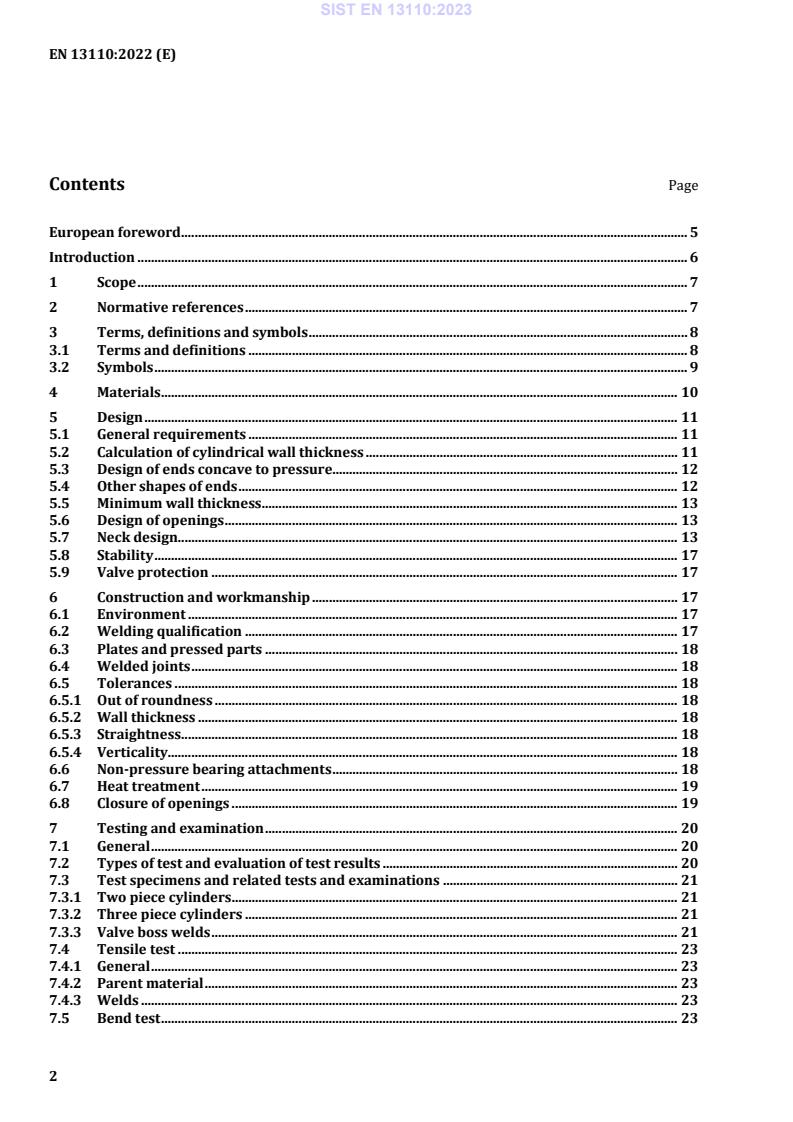
Contents Page
European foreword . 5
Introduction . 6
1 Scope . 7
2 Normative references . 7
3 Terms, definitions and symbols . 8
3.1 Terms and definitions . 8
3.2 Symbols . 9
4 Materials . 10
5 Design . 11
5.1 General requirements . 11
5.2 Calculation of cylindrical wall thickness . 11
5.3 Design of ends concave to pressure. 12
5.4 Other shapes of ends . 12
5.5 Minimum wall thickness . 13
5.6 Design of openings . 13
5.7 Neck design. 13
5.8 Stability . 17
5.9 Valve protection . 17
6 Construction and workmanship . 17
6.1 Environment . 17
6.2 Welding qualification . 17
6.3 Plates and pressed parts . 18
6.4 Welded joints . 18
6.5 Tolerances . 18
6.5.1 Out of roundness . 18
6.5.2 Wall thickness . 18
6.5.3 Straightness . 18
6.5.4 Verticality. 18
6.6 Non-pressure bearing attachments . 18
6.7 Heat treatment . 19
6.8 Closure of openings . 19
7 Testing and examination . 20
7.1 General . 20
7.2 Types of test and evaluation of test results . 20
7.3 Test specimens and related tests and examinations . 21
7.3.1 Two piece cylinders . 21
7.3.2 Three piece cylinders . 21
7.3.3 Valve boss welds . 21
7.4 Tensile test . 23
7.4.1 General . 23
7.4.2 Parent material . 23
7.4.3 Welds . 23
7.5 Bend test . 23
7.5.1 Bend test on parent material . 23
7.5.2 Bend test across the welds . 24
7.5.3 Nick-break test across the welds . 24
7.6 Macroscopic examination of welds . 26
7.6.1 Procedure . 26
7.6.2 Requirements . 26
7.7 Burst test under hydraulic pressure . 27
7.7.1 Procedure . 27
7.7.2 Requirements . 28
7.8 Fatigue test . 28
7.8.1 Procedure . 28
7.8.2 Requirements . 29
7.9 Drop test . 29
7.9.1 Procedure . 29
7.9.2 Requirements . 29
7.10 Visual examination . 30
7.10.1 Procedure . 30
7.10.2 Requirements . 30
7.11 Radiographic examination . 30
7.11.1 Procedure . 30
7.11.2 Assessment. 30
7.11.3 Requirements . 30
7.12 Pressure test . 30
7.12.1 Procedure . 30
7.12.2 Requirements . 31
8 Technical requirements for type approval . 32
8.1 New cylinder design . 32
8.2 Extent of testing . 32
8.3 Type approval certificate . 33
9 Production testing and examination requirements . 33
9.1 Tests and examinations applicable to all cylinders . 33
9.2 Radiographic examination . 34
9.3 Macro examination . 34
9.4 Examination of valve boss weld . 34
9.5 Examination of non-pressure containing attachment welds . 34
9.6 Unacceptable imperfections found by radiographic or macro examinations . 34
9.7 Production batch testing (mechanical/burst tests) . 35
9.7.1 Production batch . 35
9.7.2 Inspection lots. 36
9.7.3 Rate of sampling . 36
9.7.4 Additional checks . 37
9.8 Failure to meet mechanical and burst test requirements . 37
9.8.1 Mechanical . 37
9.8.2 Burst . 37
9.8.3 Production batch retest . 37
9.8.4 Resubmission of a production batch . 38
9.8.5 Weld repairs . 38
10 Marking . 38
Annex A (normative) Corrosion tests . 39
A.1 Test for assessing susceptibility to intercrystalline corrosion . 39
A.1.1 Specimens . 39
A.1.2 Pre-treatment of the specimen before corrosive etching . 39
A.1.3 Corrosive etching process . 40
A.1.4 Preparation of specimens for examination - Method . 41
A.1.5 Micrographic examination of specimens. 41
A.1.6 Interpretation of the micrographic examination . 41
A.2 Tests for assessing susceptibility to stress corrosion . 41
A.2.1 Specimens . 41
A.2.2 Surface preparation before test . 41
A.2.3 Method . 42
A.2.4 Interpretation of the results . 46
A.2.5 Metallographical examination (additional examination) . 46
A.3 Conclusion of corrosion tests . 46
A.4 Test report . 46
Bibliography . 47
European foreword
This document (EN 13110:2022) has been prepared by Technical Committee CEN/TC 286 “Liquefied
petroleum gas equipment and accessories”, the secretariat of which is held by NSAI.
This European Standard shall be given the status of a national standard, either by publication of an
identical text or by endorsement, at the latest by June 2023, and conflicting national standards shall be
withdrawn at the latest by June 2023.
Attention is drawn to the possibility that some of the elements of this document may be the subject of
patent rights. CEN shall not be held responsible for identifying any or all such patent rights.
This document supersedes EN 13110:2012+A1:2017.
EN 13110:2012+A1:2017:
— revision to 5.7 Neck design; and
— revision to 5.9 Valve protection.
This document has been submitted for reference in:
— the RID [10]; and/or
— the technical annexes of the ADR [9].
NOTE These regulations take precedence over any clause of this document. It is emphasized that RID/ADR are
being revised regularly at intervals of two years which might lead to temporary non-compliances with the clauses
of this document.
Any feedback and questions on this document should be directed to the users’ national standards body.
A complete listing of these bodies can be found on the CEN website.
According to the CEN-CENELEC Internal Regulations, the national standards organisations of the
following countries are bound to implement this European Standard: Austria, Belgium, Bulgaria, Croatia,
Cyprus, Czech Republic, Denmark, Estonia, Finland, France, Germany, Greece, Hungary, Iceland, Ireland,
Italy, Latvia, Lithuania, Luxembourg, Malta, Netherlands, Norway, Poland, Portugal, Republic of North
Macedonia, Romania, Serbia, Slovakia, Slovenia, Spain, Sweden, Switzerland, Türkiye and the United
Kingdom.
Introduction
This document calls for the use of substances and procedures that can be injurious to health and/or the
environment if adequate precautions are not taken. It refers only to technical suitability: it does not
absolve the user from their legal obligations at any stage.
Protection of the environment is a key political issue in Europe and elsewhere. For CEN/TC 286 this is
covered in CEN/TS 16765 [2] and this Technical Specification is to be read in conjunction with this
document. The Technical Specification provides guidance on the environmental aspects to be considered
regarding equipment and accessories produced for the LPG industry and the following is addressed:
a) design;
b) manufacture;
c) packaging;
d) use and operation; and
e) disposal.
Users are advised to develop an environmental management policy. For guidance see ISO 14000 series.
Provisions need to be restricted to a general guidance. Limit values are specified in national laws.
It has been assumed in the drafting of this document that the execution of its provisions is entrusted to
appropriately qualified and experienced people.
All pressures are gauged unless otherwise stated.
In this document the unit bar is used, due to its universal use in the field of technical gases. It should,
however, be noted that bar is not an SI unit, and that the corresponding SI unit for pressure is Pa (1
5 5 2
bar = 10 Pa = 10 N/m ).
NOTE This document requires measurement of material properties, dimensions and pressures. All such
measurements are subject to a degree of uncertainty due to tolerances in measuring equipment, etc. It might be
beneficial to refer to the leaflet “measurement uncertainty leaflet” SP INFO 2000 27 [12].
1 Scope
This document specifies minimum requirements for material, design, construction and workmanship,
testing and examination during the manufacture of transportable refillable welded aluminium liquefied
petroleum gas (LPG) cylinders, having a water capacity from 0,5 l up to and including 150 l, exposed to
ambient temperature.
2 Normative references
The following documents are referred to in the text in such a way that some or all of their content
constitutes requirements of this document. For dated references, only the edition cited applies. For
undated references, the latest edition of the referenced document (including any amendments) applies.
EN 10204:2004, Metallic products — Types of inspection documents
EN 12816, LPG equipment and accessories — Transportable refillable LPG cylinders — Disposal
EN 14717, Welding and allied processes — Environmental check list
EN 14784-1, Non-destructive testing — Industrial computed radiography with storage phosphor imaging
plates — Part 1: Classification of systems
EN 14894, LPG equipment and accessories — Cylinder and drum marking
EN ISO 4136, Destructive tests on welds in metallic materials — Transverse tensile test (ISO 4136)
EN ISO 5173, Destructive tests on welds in metallic materials — Bend tests (ISO 5173)
EN ISO 5178, Destructive tests on welds in metallic materials — Longitudinal tensile test on weld metal in
fusion welded joints (ISO 5178)
EN ISO 6892-1, Metallic materials — Tensile testing — Part 1: Method of test at room temperature
(ISO 6892-1)
EN ISO 9606-2, Qualification test of welders — Fusion welding — Part 2: Aluminium and aluminium alloys
(ISO 9606-2)
EN ISO 9712:2022, Non-destructive testing — Qualification and certification of NDT personnel
(ISO 9712:2021)
EN ISO 10042:2018, Welding — Arc-welded joints in aluminium and its alloys — Quality levels for
imperfections (ISO 10042:2018)
EN ISO 11114-1, Gas cylinders — Compatibility of cylinder and valve materials with gas contents — Part 1:
Metallic materials (ISO 11114-1)
EN ISO 11117, Gas cylinders — Valve protection caps and guards — Design, construction and tests
(ISO 11117)
EN ISO 14731:2019, Welding coordination — Tasks and responsibilities (ISO 14731:2019)
EN ISO 14732, Welding personnel — Qualification testing of welding operators and weld setters for
mechanized and automatic welding of metallic materials (ISO 14732)
EN ISO 15607, Specification and qualification of welding procedures for metallic materials — General rules
(ISO 15607)
EN ISO 15609-1, Specification and qualification of welding procedures for metallic materials — Welding
procedure specification — Part 1: Arc welding (ISO 15609-1)
EN ISO 15614-2, Specification and qualification of welding procedures for metallic materials — Welding
procedure test — Part 2: Arc welding of aluminium and its alloys (ISO 15614-2)
EN ISO 16371-2, Non-destructive testing — Industrial computed radiography with storage phosphor
imaging plates — Part 2: General principles for testing of metallic materials using X-rays and gamma rays
(ISO 16371-2)
EN ISO 17636-1:2022, Non-destructive testing of welds — Radiographic testing — Part 1: X- and gamma-
ray techniques with film (ISO 17636-1:2022)
EN ISO 17636-2:2022, Non-destructive testing of welds — Radiographic testing — Part 2: X- and gamma-
ray techniques with digital detectors (ISO 17636-2:2022)
EN ISO 17637, Non-destructive testing of welds — Visual testing of fusion-welded joints (ISO 17637)
EN ISO 17639, Destructive tests on welds in metallic materials — Macroscopic and microscopic examination
of welds (ISO 17639)
EN ISO 19232-1, Non-destructive testing — Image quality of radiographs — Part 1: Determination of the
image quality value using wire-type image quality indicators (ISO 19232-1)
EN ISO 19232-2, Non-destructive testing — Image quality of radiographs — Part 2: Determination of the
image quality value using step/hole-type image quality indicators (ISO 19232-2)
3 Terms, definitions and symbols
3.1 Terms and definitions
For the purposes of this document, the following terms and definitions apply.
ISO and IEC maintain terminology databases for use in standardization at the following addresses:
• ISO Online browsing platform: available at https://www.iso.org/obp
• IEC Electropedia: available at https://www.electropedia.org/
3.1.1
liquefied petroleum gas
LPG
low pressure liquefied gas composed of one or more light hydrocarbons which are assigned to UN 1011,
UN 1075, UN 1965, UN 1969 or UN 1978 only and which consists mainly of propane, propene, butane,
butane isomers, butene with traces of other hydrocarbon gases
3.1.2
cylinder
transportable pressure receptacle with a water capacity not exceeding 150 l
3.1.3
yield strength
0,2 % proof strength R (non-proportional elongation) for aluminium alloys, and the 1 %
ea
proof strength for unalloyed aluminium in the unhardened state
3.1.4
heat treatment
solution heat treatment, quenching and artificial or natural ageing that ensures the strength values
required
3.2 Symbols
a Calculated minimum thickness of the cylindrical part, in mm.
A Actual elongation after fracture, determined by the tensile test specified in 7.4, in %.
a
A Minimum elongation after fracture, guaranteed by the manufacturer for the finished cylinder,
min
in %.
b Calculated minimum thickness of the end of the cylinder, in mm.
C Shape factor (see Table 2, Figure 2 and Figure 3).
d Outside diameter of the bend test former, in mm (see Figure 6 and Figure 7).
D Outside diameter of the cylinder as given in the design drawing, in mm (see Figure 1).
h Height of the cylindrical part of the end, in mm (see Figure 1).
H Outside height of the domed part of the end, in mm (see Figure 1).
L Length of the cylinder, in mm.
n Ratio of diameter of bend test former to the thickness of the test piece (see Table 4).
P Maximum pressure attained during the burst test, in bar.
b
Ph Minimum permissible test pressure, in bar.
r Inside knuckle radius of the end, in mm (see Figure 1).
R Inside dishing radius of the end, in mm (see Figure 1).
R Actual value of yield strength, determined by the tensile test specified in 7.4, in N/mm .
ea
R Minimum value of yield strength, guaranteed by the manufacturer for the finished cylinder, in
eg
N/mm .
R Actual value of tensile strength, determined by the tensile test specified in 7.4, in N/mm .
ma
R Minimum value of tensile strength, guaranteed by the manufacturer for the finished cylinder,
mg
in N/mm .
v Utilization factor for the permissible calculated tension (stress reduction factor).
4 Materials
4.1 The manufacturer shall endeavour to acquire materials and components from suppliers who have
a declared environmental policy.
NOTE For further guidance, see EN ISO 14021 [4], EN ISO 14024 [5] and EN ISO 14025 [6].
4.2 The alloys used shall be in accordance with Table 1, except as permitted in 4.3.
The pressure bearing parts of the cylinder shall be AlMgSi1 or AlMg1Si1, providing that for AIMgSi1 the
requirements for corrosion resistance according to Annex A are satisfied. For non-pressure bearing parts
AlMgSi0,5 may be used.
The manufacturer shall specify the guaranteed minimum values for the yield strength, tensile strength
and elongation in the finished cylinders. In all cases, the elongation after fracture shall not be less than
12 %.
Table 1 — Cast analysis
Material designation
Element AlMgSi1 AlMg1Si1 AlMgSi0,5
Chemical composition
Silicon % 0,7 – 1,3 1,2 – 1,6 0,3 – 0,6
Iron % 0,5 max. 0,5 max. 0,1 – 0,3
Copper % 0,1 max. 0,1 max. 0,1 max.
Manganese % 0,4 – 1,0 0,8 – 1,0 0,1 max.
Magnesium % 0,6 – 1,2 1,0 – 1,4 0,35 – 0,6
Chromium % 0,25 max. 0,1 max. 0,05 max.
Zinc % 0,2 max. 0,2 max. 0,15 max.
Titanium % 0,1 max. 0,2 max. 0,1 max.
Others % each element 0,05 max., total 0,15 max.
Aluminium Remainder Remainder Remainder
NOTE Materials AlMgSi1 and AlMgSi0,5 are equivalent to alloys EN AW-6082 and EN AW-6060 respectively
in EN 573-3 [1].
4.3 Unalloyed aluminium, containing at least 99,5 % aluminium, or aluminium alloys other than those
specified in Table 1 may also be used, provided that all requirements of this document, with the exception
of 4.2, are met and;
a) LPG/material compatibility is checked in accordance with EN ISO 11114-1;
b) the requirements for corrosion resistance according to Annex A are satisfied; and
c) the manufacturer shall demonstrate that the material used is suitable for the manufacture of
cylinders, the expected service life and the likely conditions of use.
4.4 The welding materials selected by the manufacturer shall be compatible with the base materials
and shall produce welds which meet the minimum strength values used in the design of the cylinder and
guaranteed by the manufacturer in the finished cylinders.
4.5 The manufacturer shall keep certificates in accordance with EN 10204:2004 type 3.1, or higher,
covering ladle analysis and mechanical properties for material used for pressure retaining parts of the
cylinder.
4.6 The manufacturer shall maintain a system of identification for materials used in the manufacture
so that all materials used in the manufacture of the cylinder can be traced back to their origin.
5 Design
5.1 General requirements
5.1.1 Calculation of the wall thickness of the pressure bearing parts shall be related to the minimum
guaranteed yield strength (R ) in the finished cylinder.
eg
5.1.2 For calculation purposes the value of R shall be limited to a maximum of 0,85 R .
eg mg
5.1.3 The calculation of wall thickness shall be based on the test pressure Ph of 30 bar.
5.1.4 A fully dimensioned drawing, including material specifications, shall be produced.
5.1.5 The design of the cylinder shall take the following into account:
a) minimizing the waste of materials;
b) the fittings required for the cylinder;
c) minimizing the environmental impact of in service maintenance and end of life disposal; and
d) efficient transport of finished product.
5.2 Calculation of cylindrical wall thickness
The wall thickness of the cylindrical shell, including any cylindrical part of the ends, shall not be less than:
PD
h
a=
20Rv
e g
+ P
h
1,3
where:
— For parts of the cylinder without longitudinal seam: v = 1,0
— For parts of the cylinder with longitudinal seam: v = 0,9
In no case shall the actual thickness be less than that specified in 5.5.
5.3 Design of ends concave to pressure
5.3.1 Except as permitted in 5.4, the shape of ends of cylinders shall meet the following limitations:
— for torispherical ends: R ≤ D; r ≥ 0,1D; h ≥ 4b (see Figure 1);
DD
H= ()Rb+ − Rb+ − Rb+ + − 2 r+ b
( ) ( ) ( )
2 2
— for semi-ellipsoidal ends H ≥ 0,192 D ; h ≥ 4b (see Figure 1).
5.3.2 The wall thickness of the ends of cylinders shall not be less than:
P D C
h
b=
20R
e g
+ P
h
1,3
The value of C shall be obtained from Table 2 or the graphs given in Figure 2 and Figure 3.
5.4 Other shapes of ends
Shapes of ends other than those covered by 5.3 may be used provided that the adequacy of their design
is demonstrated by a fatigue test in accordance to 7.8 or by a stress analysis.
Table 2 — Relationship between H/D and shape factor C
H/D C H/D C
0,25 1,000 0,38 0,612
0,26 0,931 0,39 0,604
0,27 0,885 0,40 0,596
0,28 0,845 0,41 0,588
0,29 0,809 0,42 0,581
0,30 0,775 0,43 0,576
0,31 0,743 0,44 0,572
0,32 0,713 0,45 0,570
0,33 0,687 0,46 0,568
0,34 0,667 0,47 0,566
0,35 0,649 0,48 0,565
0,36 0,633 0,49 0,564
0,37 0,621 0,50 0,564
NOTE Intermediate values can be obtained by linear interpolation.
5.5 Minimum wall thickness
The minimum wall thickness of the cylindrical shell “a” and of the end “b” shall not be less than the value
derived from the following formula:
D
ab + 1,5
The formula applies to cylindrical shells and ends, including any integral cylindrical part, irrespective of
whether they are designed by calculation as specified in 5.2 and 5.3 or by testing as specified in 5.4.
5.6 Design of openings
5.6.1 The location of all openings shall be restricted to one end of the cylinder.
5.6.2 Each opening in the cylinder shall be reinforced by a valve boss (or by other means) so that it is
of adequate strength and does not result in harmful stress concentrations. This shall be confirmed by
design calculations or a fatigue test in accordance with 7.8.
5.7 Neck design
5.7.1 Valve boss threads shall conform to an established dimensional specification which is suitable for
the intended duty.
NOTE Suitable specifications for 17E and 25E threads are included in EN ISO 11363-1 [13].
5.7.2 The external diameter and thickness of the valve boss or neck end of the cylinder shall be
adequate for the torque applied in fitting the valve, including any additional turning for valve alignment.
The manufacturer shall specify the maximum permitted torque and shall demonstrate by tests that the
neck and thread can withstand the specified torque without significant damage.
NOTE The torque required can vary according to the thread diameter and form, and the type of sealant used.
EN ISO 13341 [3] gives guidance on the torque for valve fitting.
= =
Key
1 torispherical end
2 semi-ellipsoidal end
Figure 1 — Illustration of cylinder ends concave to pressure
Dimensions in millimetres
Key
① torispherical end
Figure 2 — Values of shape factor C for H/D between 0,2 and 0,25
Dimensions in millimetres
Key
① torispherical end
Figure 3 — Values of shape factor C for H/D between 0,25 and 0,5
5.8 Stability
To ensure stability, the diameter of the surface of the foot ring, or other part of the cylinder, in contact
with the ground shall not be less than 75 % of the nominal outside diameter.
5.9 Valve protection
The design of a cylinder shall provide protection for valves against damage in order to avoid the release
of the contents, unless the valve(s) is protected by other means.
When the valve protection is integral with the cylinder, this shall be demonstrated by drop testing in
accordance with EN ISO 11117.
When the cylinder is not provided with integral valve protection, the manufacturer shall specify that
cylinders containing LPG shall be conveyed in crates or cradles or shall be provided during transportation
with some other effective valve protection.
Otherwise, the cylinder shall be fitted with valves that have demonstrated, by impact tests in accordance
with EN ISO 14245 [7] or EN ISO 15995 [8], that the valve can withstand damage without leakage of the
contents.
6 Construction and workmanship
6.1 Environment
The environmental impact of welding and allied processes shall be assessed in accordance with
EN 14717.
The manufacturer should endeavour to minimize wastage of material by selecting appropriately sized
materials related to the finished parts required for manufacture. Unavoidable waste/scrap material
should be recycled.
Noise levels from the production process should be evaluated and measures put into place to minimize
the impact upon the external environment.
6.2 Welding qualification
6.2.1 For all welding associated with the pressure envelope, including non-pressure bearing parts,
welding procedures shall be specified and qualified according to EN ISO 15607, EN ISO 15609-1 and
EN ISO 15614-2. Welding procedure approval tests shall be carried out in such a manner that the test
welds are representative of those made in production.
6.2.2 A welding co-ordinator shall be nominated whose qualification is “European Welding Engineer”
(EWE). Their tasks and responsibilities shall be specified according to EN ISO 14731:2019.
Welders for manual welding shall have an approval in accordance with EN ISO 9606-2 and personnel for
automatic welding shall have an approval in accordance with EN ISO 14732 for the specific type of work
and procedures used in production.
6.2.3 Records of approval tests shall be retained by the manufacturer.
6.3 Plates and pressed parts
Before assembly, the pressure bearing parts of the cylinders shall be visually examined for uniform
quality and freedom from defects which could affect the cylinder integrity.
6.4 Welded joints
6.4.1 The welding of pressure bearing joints shall be carried out by a fully mechanised or automatic
process so as to provide welds of consistent and reproducible quality.
6.4.2 Any joint between pressure bearing parts of the cylinder shall be butt welded. Joggle joints are
not permitted.
6.4.3 The fusion of the weld metal with the parent material shall result in full penetration: the surface
shall be smooth and free from overlapping, undercutting or any abrupt irregularity. There shall be no
cracking, notching or porosity in the weld surface or the wall surface adjacent to the weld. Welds shall
meet category C quality level for imperfections, in accordance with EN ISO 10042:2018.
6.5 Tolerances
6.5.1 Out of roundness
The difference between the maximum and the minimum outside diameter of the cylindrical shell, at any
cross-section, shall not exceed 1,5 % of the diameter shown on the drawing.
6.5.2 Wall thickness
The difference between the maximum and minimum wall thickness of the cylindrical shell, at any cross-
section, shall not exceed 10 % of the thickness shown on the drawing.
6.5.3 Straightness
Unless otherwise shown on the drawing and proven by a fatigue test in accordance with 7.8, the deviation
of the cylindrical part of the shell from a straight line shall not exceed 0,3 % of the cylindrical length.
6.5.4 Verticality
For a cylinder standing on its base, the cylindrical shell and the axis of the top opening shall not deviate
more than 1,5° from the vertical.
6.6 Non-pressure bearing attachments
6.6.1 Non-pressure bearing parts shall be attached to the cylinder by welding, and it shall be verified
that these attachments are made of compatible materials (see Clause 4).
6.6.2 Each attachment shall:
— permit inspection of the welds;
— be clear of pressure bearing welds; and
— avoid the trapping of water.
6.6.3 Where a foot ring is fitted, it shall be of adequate strength (see requirements of 7.9), drained and
the space enclosed by the foot ring ventilated e.g. by means of openings.
6.7 Heat treatment
6.7.1 After completion of welding and before pressure testing, each cylinder shall be heat treated
according to 6.7.2 or 6.7.3 as appropriate, depending on material characteristics.
6.7.2 The manufacturer shall specify the relevant temperatures for the solution heat treatment and its
duration. The quenching medium shall also be specified.
6.7.3 The manufacturer shall specify forming technology, pressing, drawing, forging, etc. Should the
temperature of the material during the forming not exceed 400 °C, stabilizing or stress relieving shall be
applied. The applied temperature and duration shall be specified.
...