

SIST EN 301 489-20 V2.1.1:2019
(Main)ElectroMagnetic Compatibility (EMC) standard for radio equipment and services - Part 20: Specific conditions for Mobile Earth Stations (MES) used in the Mobile Satellite Services (MSS) - Harmonised Standard covering the essential requirements of article 3.1(b) of Directive 2014/53/EU
General Information
- Abstract
The present document, together with ETSI EN 301 489-1 [1], covers the assessment of Mobile Earth Stations (MES) as
defined in annex B used within Satellite radio services, and ancillary equipment in respect of ElectroMagnetic
Compatibility (EMC).
Technical specifications related to the antenna port and emissions from the enclosure port of the equipment are not
included in the present document. Such technical specifications are found in the relevant product standards for the
effective use of the radio spectrum.
The present document specifies the applicable test conditions, performance assessment and performance criteria for
MESs and for the associated ancillary equipment.
In case of differences (for instance concerning special conditions, definitions, abbreviations) between the present
document and ETSI EN 301 489-1 [1], the provisions of the present document take precedence.
The environmental classification and the emission and immunity requirements used in the present document are as
stated in ETSI EN 301 489-1 [1], except for any special conditions included in the present document. The applicable
environment(s) referred to in ETSI EN 301 489-1 [1] where the MES may be used, should be declared by the
manufacturer.
For a multimode radio station, the present document only applies to the radio station when operated in the Mobile
Satellite Service mode.
NOTE: The relationship between the present document and essential requirements of article 3.1(b) of Directive
2014/53/EU [i.1] is given in annex A.
- Status
- Published
- Public Enquiry End Date
- 17-Dec-2017
- Publication Date
- 15-Apr-2019
- Technical Committee
- MOC - Mobile Communications
- Current Stage
- 6060 - National Implementation/Publication (Adopted Project)
- Start Date
- 15-Apr-2019
- Due Date
- 20-Jun-2019
- Completion Date
- 16-Apr-2019
Buy Documents

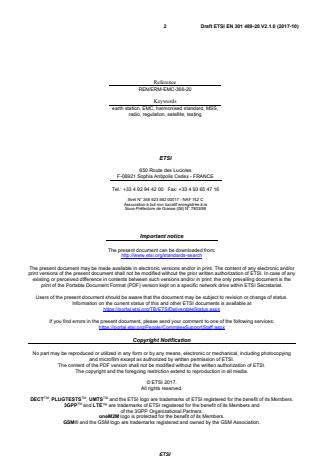
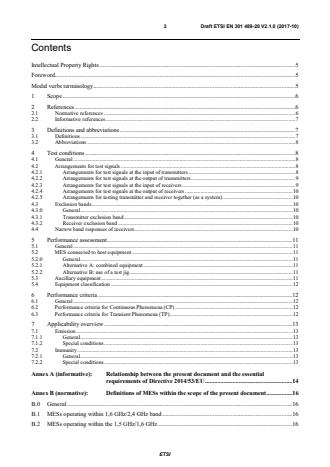
ETSI EN 301 489-20 V2.1.0 (2017-10) - ElectroMagnetic Compatibility (EMC) standard for radio equipment and services; Part 20: Specific conditions for Mobile Earth Stations (MES) used in the Mobile Satellite Services (MSS) Harmonised Standard covering the essential requirements of article 3.1(b) of Directive 2014/53/EU

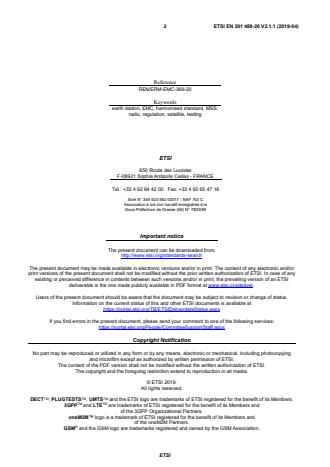
ETSI EN 301 489-20 V2.1.1 (2019-04) - ElectroMagnetic Compatibility (EMC) standard for radio equipment and services; Part 20: Specific conditions for Mobile Earth Stations (MES) used in the Mobile Satellite Services (MSS); Harmonised Standard covering the essential requirements of article 3.1(b) of Directive 2014/53/EU



Overview
SIST EN 301 489-20 V2.1.1:2019 establishes the ElectroMagnetic Compatibility (EMC) requirements for Mobile Earth Stations (MES) operating within the Mobile Satellite Services (MSS). Developed by SIST and harmonized under Directive 2014/53/EU, this standard ensures that MES and ancillary equipment used in satellite radio services meet essential EMC criteria for safety and reliable operation. The standard is designed to be used in conjunction with ETSI EN 301 489-1, which details common technical EMC requirements.
Key Topics
- ElectroMagnetic Compatibility (EMC) Assessment: The standard defines the EMC assessment framework for MES and their ancillary equipment, focusing on emission and immunity requirements, test conditions, and performance criteria.
- Scope and Applicability: Covers MES types, including vehicle-mounted, portable, and fixed stations, as well as multimode radio stations in MSS mode. The environmental and operational conditions are to be declared by manufacturers.
- Testing Requirements: Specifies test setups, performance assessment methods, and documentation to certify conformity. Several types of equipment configurations and applications are addressed, based on their intended use and power supply types.
- Emission and Immunity Criteria: Details performance criteria for continuous and transient phenomena, including the necessity for communication links, signal transmission quality, and avoidance of unintentional transmissions.
- Compliance with Directive 2014/53/EU: Establishes a presumption of conformity when all stipulated requirements are met, facilitating CE marking and market access within the European Union.
Applications
SIST EN 301 489-20 applies to a range of MES products and configurations in the MSS domain:
- Mobile Satellite Communication: Ensures stable and safe operation of MES used on vehicles, air, sea, and other mobile platforms, supporting applications like navigation, remote tracking, and global communications.
- Equipment Manufacturers: Guides producers in testing and documenting MES products to ensure they meet EMC obligations before market release in the EU and EFTA states.
- System Integrators: Provides clear EMC framework for integrating MSS MES with host devices-including requirements for testing in various configurations.
- Regulatory Compliance: Supports manufacturers and suppliers in meeting the essential EMC requirements mandated by Directive 2014/53/EU, essential for CE marking and entering the European market.
- Ancillary Equipment Testing: Covers additional equipment that operates alongside MES to ensure comprehensive EMC management across deployed satellite communication systems.
Related Standards
For complete EMC compliance and harmonization, the following standards are referenced alongside SIST EN 301 489-20:
- ETSI EN 301 489-1: Common EMC technical requirements for radio equipment and services, forming the foundation for product-specific standards like part 20.
- ITU-R Radio Regulations: International guidance and technical definitions relevant to radio frequency operations and bandwidth allocations.
- Directive 2014/53/EU: The Radio Equipment Directive, laying down the essential requirements for placing radio equipment on the EU market.
- Other Parts of EN 301 489 Series: Additional standards covering other radio communication equipment and services, for broader or more specific EMC requirements.
Practical Value
Implementing SIST EN 301 489-20 enables manufacturers and system integrators to demonstrate compliance with essential EMC requirements for MES in the rapidly growing field of mobile satellite communications. By adhering to this harmonized standard, stakeholders can ensure reliable product performance, avoid interference, and meet legal market access conditions across Europe. Integration with related standards ensures interoperability and a consistent, high-quality approach to EMC across the full spectrum of radio communication technologies.
Buy Documents
ETSI EN 301 489-20 V2.1.0 (2017-10) - ElectroMagnetic Compatibility (EMC) standard for radio equipment and services; Part 20: Specific conditions for Mobile Earth Stations (MES) used in the Mobile Satellite Services (MSS) Harmonised Standard covering the essential requirements of article 3.1(b) of Directive 2014/53/EU
ETSI EN 301 489-20 V2.1.1 (2019-04) - ElectroMagnetic Compatibility (EMC) standard for radio equipment and services; Part 20: Specific conditions for Mobile Earth Stations (MES) used in the Mobile Satellite Services (MSS); Harmonised Standard covering the essential requirements of article 3.1(b) of Directive 2014/53/EU
Get Certified
Connect with accredited certification bodies for this standard

ANCE
Mexican certification and testing association.

Intertek Slovenia
Intertek testing, inspection, and certification services in Slovenia.

LNE (Laboratoire National de Métrologie et d'Essais)
French national laboratory for metrology and testing.
Sponsored listings
Frequently Asked Questions
SIST EN 301 489-20 V2.1.1:2019 is a standard published by the Slovenian Institute for Standardization (SIST). Its full title is "ElectroMagnetic Compatibility (EMC) standard for radio equipment and services - Part 20: Specific conditions for Mobile Earth Stations (MES) used in the Mobile Satellite Services (MSS) - Harmonised Standard covering the essential requirements of article 3.1(b) of Directive 2014/53/EU". This standard covers: The present document, together with ETSI EN 301 489-1 [1], covers the assessment of Mobile Earth Stations (MES) as defined in annex B used within Satellite radio services, and ancillary equipment in respect of ElectroMagnetic Compatibility (EMC). Technical specifications related to the antenna port and emissions from the enclosure port of the equipment are not included in the present document. Such technical specifications are found in the relevant product standards for the effective use of the radio spectrum. The present document specifies the applicable test conditions, performance assessment and performance criteria for MESs and for the associated ancillary equipment. In case of differences (for instance concerning special conditions, definitions, abbreviations) between the present document and ETSI EN 301 489-1 [1], the provisions of the present document take precedence. The environmental classification and the emission and immunity requirements used in the present document are as stated in ETSI EN 301 489-1 [1], except for any special conditions included in the present document. The applicable environment(s) referred to in ETSI EN 301 489-1 [1] where the MES may be used, should be declared by the manufacturer. For a multimode radio station, the present document only applies to the radio station when operated in the Mobile Satellite Service mode. NOTE: The relationship between the present document and essential requirements of article 3.1(b) of Directive 2014/53/EU [i.1] is given in annex A.
The present document, together with ETSI EN 301 489-1 [1], covers the assessment of Mobile Earth Stations (MES) as defined in annex B used within Satellite radio services, and ancillary equipment in respect of ElectroMagnetic Compatibility (EMC). Technical specifications related to the antenna port and emissions from the enclosure port of the equipment are not included in the present document. Such technical specifications are found in the relevant product standards for the effective use of the radio spectrum. The present document specifies the applicable test conditions, performance assessment and performance criteria for MESs and for the associated ancillary equipment. In case of differences (for instance concerning special conditions, definitions, abbreviations) between the present document and ETSI EN 301 489-1 [1], the provisions of the present document take precedence. The environmental classification and the emission and immunity requirements used in the present document are as stated in ETSI EN 301 489-1 [1], except for any special conditions included in the present document. The applicable environment(s) referred to in ETSI EN 301 489-1 [1] where the MES may be used, should be declared by the manufacturer. For a multimode radio station, the present document only applies to the radio station when operated in the Mobile Satellite Service mode. NOTE: The relationship between the present document and essential requirements of article 3.1(b) of Directive 2014/53/EU [i.1] is given in annex A.
SIST EN 301 489-20 V2.1.1:2019 is classified under the following ICS (International Classification for Standards) categories: 33.060.01 - Radiocommunications in general; 33.070.40 - Satellite; 33.100.01 - Electromagnetic compatibility in general. The ICS classification helps identify the subject area and facilitates finding related standards.
SIST EN 301 489-20 V2.1.1:2019 is available in PDF format for immediate download after purchase. The document can be added to your cart and obtained through the secure checkout process. Digital delivery ensures instant access to the complete standard document.
Standards Content (Sample)
Draft ETSI EN 301 489-20 V2.1.0 (2017-10)
HARMONISED EUROPEAN STANDARD
ElectroMagnetic Compatibility (EMC) standard
for radio equipment and services;
Part 20: Specific conditions for Mobile Earth Stations (MES)
used in the Mobile Satellite Services (MSS)
2 Draft ETSI EN 301 489-20 V2.1.0 (2017-10)
Reference
REN/ERM-EMC-366-20
Keywords
earth station, EMC, harmonised standard, MSS,
radio, regulation, satellite, testing
ETSI
650 Route des Lucioles
F-06921 Sophia Antipolis Cedex - FRANCE
Tel.: +33 4 92 94 42 00 Fax: +33 4 93 65 47 16
Siret N° 348 623 562 00017 - NAF 742 C
Association à but non lucratif enregistrée à la
Sous-Préfecture de Grasse (06) N° 7803/88
Important notice
The present document can be downloaded from:
http://www.etsi.org/standards-search
The present document may be made available in electronic versions and/or in print. The content of any electronic and/or
print versions of the present document shall not be modified without the prior written authorization of ETSI. In case of any
existing or perceived difference in contents between such versions and/or in print, the only prevailing document is the
print of the Portable Document Format (PDF) version kept on a specific network drive within ETSI Secretariat.
Users of the present document should be aware that the document may be subject to revision or change of status.
Information on the current status of this and other ETSI documents is available at
https://portal.etsi.org/TB/ETSIDeliverableStatus.aspx
If you find errors in the present document, please send your comment to one of the following services:
https://portal.etsi.org/People/CommiteeSupportStaff.aspx
Copyright Notification
No part may be reproduced or utilized in any form or by any means, electronic or mechanical, including photocopying
and microfilm except as authorized by written permission of ETSI.
The content of the PDF version shall not be modified without the written authorization of ETSI.
The copyright and the foregoing restriction extend to reproduction in all media.
© ETSI 2017.
All rights reserved.
TM TM TM
DECT , PLUGTESTS , UMTS and the ETSI logo are trademarks of ETSI registered for the benefit of its Members.
TM
3GPP and LTE™ are trademarks of ETSI registered for the benefit of its Members and
of the 3GPP Organizational Partners.
oneM2M logo is protected for the benefit of its Members.
GSM® and the GSM logo are trademarks registered and owned by the GSM Association.
ETSI
3 Draft ETSI EN 301 489-20 V2.1.0 (2017-10)
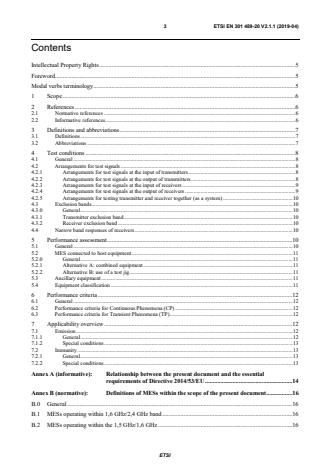
Contents
Intellectual Property Rights . 5
Foreword . 5
Modal verbs terminology . 5
1 Scope . 6
2 References . 6
2.1 Normative references . 6
2.2 Informative references . 7
3 Definitions and abbreviations . 7
3.1 Definitions . 7
3.2 Abbreviations . 8
4 Test conditions . 8
4.1 General . 8
4.2 Arrangements for test signals . 8
4.2.1 Arrangements for test signals at the input of transmitters . 8
4.2.2 Arrangements for test signals at the output of transmitters . 9
4.2.3 Arrangements for test signals at the input of receivers . 9
4.2.4 Arrangements for test signals at the output of receivers . 10
4.2.5 Arrangements for testing transmitter and receiver together (as a system) . 10
4.3 Exclusion bands . 10
4.3.0 General . 10
4.3.1 Transmitter exclusion band . 10
4.3.2 Receiver exclusion band . 10
4.4 Narrow band responses of receivers . 10
5 Performance assessment . 11
5.1 General . 11
5.2 MES connected to host equipment . 11
5.2.0 General . 11
5.2.1 Alternative A: combined equipment . 11
5.2.2 Alternative B: use of a test jig. 11
5.3 Ancillary equipment . 11
5.4 Equipment classification . 12
6 Performance criteria . 12
6.1 General . 12
6.2 Performance criteria for Continuous Phenomena (CP) . 12
6.3 Performance criteria for Transient Phenomena (TP) . 12
7 Applicability overview . 13
7.1 Emission . 13
7.1.1 General . 13
7.1.2 Special conditions . 13
7.2 Immunity . 13
7.2.1 General . 13
7.2.2 Special conditions . 13
Annex A (informative): Relationship between the present document and the essential
requirements of Directive 2014/53/EU . 14
Annex B (normative): Definitions of MESs within the scope of the present document . 16
B.0 General . 16
B.1 MESs operating within 1,6 GHz/2,4 GHz band . . 16
B.2 MESs operating within the 1,5 GHz/1,6 GHz . 16
ETSI
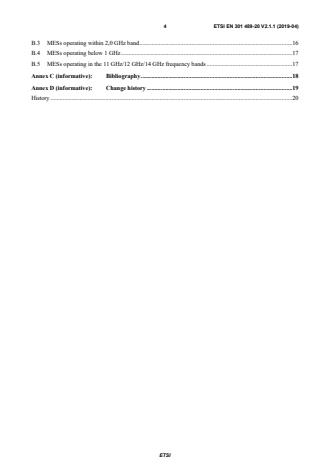
4 Draft ETSI EN 301 489-20 V2.1.0 (2017-10)
B.3 MESs operating within 2,0 GHz band . 16
B.4 MESs operating below 1 GHz . 17
B.5 MESs operating in the 11 GHz/12 GHz/14 GHz frequency bands . 17
Annex C (informative): Bibliography . 18
Annex D (informative): Change history . 19
History . 20
ETSI
5 Draft ETSI EN 301 489-20 V2.1.0 (2017-10)
Intellectual Property Rights
Essential patents
IPRs essential or potentially essential to the present document may have been declared to ETSI. The information
pertaining to these essential IPRs, if any, is publicly available for ETSI members and non-members, and can be found
in ETSI SR 000 314: "Intellectual Property Rights (IPRs); Essential, or potentially Essential, IPRs notified to ETSI in
respect of ETSI standards", which is available from the ETSI Secretariat. Latest updates are available on the ETSI Web
server (https://ipr.etsi.org/).
Pursuant to the ETSI IPR Policy, no investigation, including IPR searches, has been carried out by ETSI. No guarantee
can be given as to the existence of other IPRs not referenced in ETSI SR 000 314 (or the updates on the ETSI Web
server) which are, or may be, or may become, essential to the present document.
Trademarks
The present document may include trademarks and/or tradenames which are asserted and/or registered by their owners.
ETSI claims no ownership of these except for any which are indicated as being the property of ETSI, and conveys no
right to use or reproduce any trademark and/or tradename. Mention of those trademarks in the present document does
not constitute an endorsement by ETSI of products, services or organizations associated with those trademarks.
Foreword
This draft Harmonised European Standard (EN) has been produced by ETSI Technical Committee Electromagnetic
compatibility and Radio spectrum Matters (ERM), and is now submitted for the combined Public Enquiry and Vote
phase of the ETSI standards EN Approval Procedure.
The present document has been prepared under the Commission's standardisation request C(2015) 5376 final [i.2] to
provide one voluntary means of conforming to the essential requirements of Directive 2014/53/EU on the harmonisation
of the laws of the Member States relating to the making available on the market of radio equipment and repealing
Directive 1999/5/EC [i.1].
Once the present document is cited in the Official Journal of the European Union under that Directive, compliance with
the normative clauses of the present document given in table A.1 confers, within the limits of the scope of the present
document, a presumption of conformity with the corresponding essential requirements of that Directive and associated
EFTA regulations.
The present document is part 20 of a multi-part deliverable. Full details of the entire series can be found in part 1 [1].
Proposed national transposition dates
Date of latest announcement of this EN (doa): 3 months after ETSI publication
Date of latest publication of new National Standard
or endorsement of this EN (dop/e): 6 months after doa
Date of withdrawal of any conflicting National Standard (dow): 18 months after doa
Modal verbs terminology
In the present document "shall", "shall not", "should", "should not", "may", "need not", "will", "will not", "can" and
"cannot" are to be interpreted as described in clause 3.2 of the ETSI Drafting Rules (Verbal forms for the expression of
provisions).
"must" and "must not" are NOT allowed in ETSI deliverables except when used in direct citation.
ETSI
6 Draft ETSI EN 301 489-20 V2.1.0 (2017-10)
1 Scope
The present document, together with ETSI EN 301 489-1 [1], covers the assessment of Mobile Earth Stations (MES) as
defined in annex B used within Satellite radio services, and ancillary equipment in respect of ElectroMagnetic
Compatibility (EMC).
Technical specifications related to the antenna port and emissions from the enclosure port of the equipment are not
included in the present document. Such technical specifications are found in the relevant product standards for the
effective use of the radio spectrum.
The present document specifies the applicable test conditions, performance assessment and performance criteria for
MESs and for the associated ancillary equipment.
In case of differences (for instance concerning special conditions, definitions, abbreviations) between the present
document and ETSI EN 301 489-1 [1], the provisions of the present document take precedence.
The environmental classification and the emission and immunity requirements used in the present document are as
stated in ETSI EN 301 489-1 [1], except for any special conditions included in the present document. The applicable
environment(s) referred to in ETSI EN 301 489-1 [1] where the MES may be used, should be declared by the
manufacturer.
For a multimode radio station, the present document only applies to the radio station when operated in the Mobile
Satellite Service mode.
NOTE: The relationship between the present document and essential requirements of article 3.1b of Directive
2014/53/EU [i.1] is given in Annex A.
2 References
2.1 Normative references
References are specific, identified by date of publication and/or edition number or version number. Only the cited
version applies.
Referenced documents which are not found to be publicly available in the expected location might be found at
https://docbox.etsi.org/Reference/.
NOTE: While any hyperlinks included in this clause were valid at the time of publication, ETSI cannot guarantee
their long term validity.
The following referenced documents are necessary for the application of the present document.
[1] ETSI EN 301 489-1 (V2.2.0) (02-2017): "ElectroMagnetic Compatibility (EMC) standard for
radio equipment and services; Part 1: Common technical requirements; Harmonised Standard
covering the essential requirements of article 3.1(b) of Directive 2014/53/EU and the essential
requirements of article 6 of Directive 2014/30/EU".
[2] ITU-R Radio Regulations (2016).
ETSI
7 Draft ETSI EN 301 489-20 V2.1.0 (2017-10)
2.2 Informative references
References are either specific (identified by date of publication and/or edition number or version number) or
non-specific. For specific references, only the cited version applies. For non-specific references, the latest version of the
referenced document (including any amendments) applies.
NOTE: While any hyperlinks included in this clause were valid at the time of publication, ETSI cannot guarantee
their long term validity.
The following referenced documents are not necessary for the application of the present document but they assist the
user with regard to a particular subject area.
[i.1] Directive 2014/53/EU of the European Parliament and of the Council of 16 April 2014 on the
harmonisation of the laws of the Member States relating to the making available on the market of
radio equipment and repealing Directive 1999/5/EC.
[i.2] Commission Implementing Decision C(2015) 5376 final of 4.8.2015 on a standardisation request
to the European Committee for Electrotechnical Standardisation and to the European
Telecommunications Standards Institute as regards radio equipment in support of Directive
2014/53/EU of the European Parliament and of the Council.
3 Definitions and abbreviations
3.1 Definitions
For the purposes of the present document, the terms and definitions given in ETSI EN 301 489-1 [1] and the following
apply:
carrier-on state (allocated a channel): state of an MES when it is transmitting a signal in a continuous or a
non-continuous mode
carrier-off state (idle mode): state of an MES when it is powered-on but not transmitting a signal, i.e. not in a
carrier-on state
host equipment: any equipment which has complete user functionality when not connected to the MES, and to which
connection is necessary for the MES to offer additional functionality
Installable Equipment (IE), Internally Mounted Equipment (IME) and Externally Mounted Equipment (EME):
equipment which is intended to be installed in a vehicle
NOTE: An IE may consist of one or several modules. The IE is composed of modules intended to be externally
mounted and declared by the manufacturer as Externally Mounted Equipment (EME). The remaining
module(s) are defined as Internally Mounted Equipment (IME).
multimode MES: equipment that accommodates radio stations of different radio systems
occupied bandwidth: See ITU-R Radio Regulations [2], part A, chapter 1, Terminology RR 147.
Portable Equipment (PE): equipment generally intended to be self-contained, free standing and portable
NOTE 1: A PE would normally consist of a single module, but may consist of several interconnected modules.
NOTE 2: More than one of the equipment classifications can apply to certain equipment, as described in clause 5.4,
dependent upon the manufacturer's declaration of normal intended use.
transmission disabled state: state of an MES when it is not authorized to transmit by the Network Control
Facilities (NCF)
ETSI
8 Draft ETSI EN 301 489-20 V2.1.0 (2017-10)
3.2 Abbreviations
For the purposes of the present document, the following abbreviations apply:
CP performance criteria for Continuous Phenomena
EMC ElectroMagnetic Compatibility
EME Externally Mounted Equipment
EUT Equipment Under Test
F-MES Fixed MES
IE Installable Equipment
IME Internally Mounted Equipment
LBRDC Low Bit Rate Data Communication
LEO Low Earth Orbit
MES Mobile Earth Station
MSS Mobile Satellite Service
NCF Network Control Facilities
PCN Personal Communication Network
PE Portable Equipment
PEP Peak Envelope Power
P-MES Portable MES
QTMA Quality of Transmission Measurement Apparatus
RF Radio Frequency
S-PCN Satellite Personal Communications Network
STE Special Test Equipment
TP performance criteria for Transient Phenomena
V-MES Vehicle mounted MES
4 Test conditions
4.1 General
For the purposes of the present document, the test conditions of ETSI EN 301 489-1 [1], clause 4, shall apply as
appropriate. Further product related test conditions for MES are specified in the present document.
For MESs with ancillary equipment and/or various ports, the number of test configurations shall be determined. The
assessment shall include sufficient representative configurations of the MES to adequately exercise the equipment.
These configurations shall be recorded in the test report.
In the following clauses, the Equipment Under Test (EUT) is the MES with the selected configuration of ancillary
equipment.
The EUT operational frequencies used during the test, shall be recorded in the test report.
For testing and if physically separated from the MES, any voltage converter shall form part of the EUT.
Whenever the Equipment Under Test (EUT) is provided with an integral antenna, the EUT shall be tested with the
antenna fitted in a manner typical of normal intended use.
For MES for which connection to a host equipment is necessary to offer additional functionality, the test configuration
shall be as defined in clause 5.2.
4.
...
HARMONISED EUROPEAN STANDARD
ElectroMagnetic Compatibility (EMC)
standard for radio equipment and services;
Part 20: Specific conditions for Mobile Earth Stations (MES)
used in the Mobile Satellite Services (MSS);
Harmonised Standard covering the essential requirements
of article 3.1(b) of Directive 2014/53/EU
2 ETSI EN 301 489-20 V2.1.1 (2019-04)
Reference
REN/ERM-EMC-366-20
Keywords
earth station, EMC, harmonised standard, MSS,
radio, regulation, satellite, testing
ETSI
650 Route des Lucioles
F-06921 Sophia Antipolis Cedex - FRANCE
Tel.: +33 4 92 94 42 00 Fax: +33 4 93 65 47 16
Siret N° 348 623 562 00017 - NAF 742 C
Association à but non lucratif enregistrée à la
Sous-Préfecture de Grasse (06) N° 7803/88
Important notice
The present document can be downloaded from:
http://www.etsi.org/standards-search
The present document may be made available in electronic versions and/or in print. The content of any electronic and/or
print versions of the present document shall not be modified without the prior written authorization of ETSI. In case of any
existing or perceived difference in contents between such versions and/or in print, the prevailing version of an ETSI
deliverable is the one made publicly available in PDF format at www.etsi.org/deliver.
Users of the present document should be aware that the document may be subject to revision or change of status.
Information on the current status of this and other ETSI documents is available at
https://portal.etsi.org/TB/ETSIDeliverableStatus.aspx
If you find errors in the present document, please send your comment to one of the following services:
https://portal.etsi.org/People/CommiteeSupportStaff.aspx
Copyright Notification
No part may be reproduced or utilized in any form or by any means, electronic or mechanical, including photocopying
and microfilm except as authorized by written permission of ETSI.
The content of the PDF version shall not be modified without the written authorization of ETSI.
The copyright and the foregoing restriction extend to reproduction in all media.
© ETSI 2019.
All rights reserved.
TM TM TM
DECT , PLUGTESTS , UMTS and the ETSI logo are trademarks of ETSI registered for the benefit of its Members.
TM TM
3GPP and LTE are trademarks of ETSI registered for the benefit of its Members and
of the 3GPP Organizational Partners.
oneM2M™ logo is a trademark of ETSI registered for the benefit of its Members and
of the oneM2M Partners. ®
GSM and the GSM logo are trademarks registered and owned by the GSM Association.
ETSI
3 ETSI EN 301 489-20 V2.1.1 (2019-04)
Contents
Intellectual Property Rights . 5
Foreword . 5
Modal verbs terminology . 5
1 Scope . 6
2 References . 6
2.1 Normative references . 6
2.2 Informative references . 6
3 Definitions and abbreviations . 7
3.1 Definitions . 7
3.2 Abbreviations . 7
4 Test conditions . 8
4.1 General . 8
4.2 Arrangements for test signals . 8
4.2.1 Arrangements for test signals at the input of transmitters . 8
4.2.2 Arrangements for test signals at the output of transmitters . 8
4.2.3 Arrangements for test signals at the input of receivers . 9
4.2.4 Arrangements for test signals at the output of receivers . 9
4.2.5 Arrangements for testing transmitter and receiver together (as a system) . 10
4.3 Exclusion bands . 10
4.3.0 General . 10
4.3.1 Transmitter exclusion band . 10
4.3.2 Receiver exclusion band . 10
4.4 Narrow band responses of receivers . 10
5 Performance assessment . 10
5.1 General . 10
5.2 MES connected to host equipment . 11
5.2.0 General . 11
5.2.1 Alternative A: combined equipment . 11
5.2.2 Alternative B: use of a test jig. 11
5.3 Ancillary equipment . 11
5.4 Equipment classification . 11
6 Performance criteria . 12
6.1 General . 12
6.2 Performance criteria for Continuous Phenomena (CP) . 12
6.3 Performance criteria for Transient Phenomena (TP) . 12
7 Applicability overview . 12
7.1 Emission . 12
7.1.1 General . 12
7.1.2 Special conditions . 13
7.2 Immunity . 13
7.2.1 General . 13
7.2.2 Special conditions . 13
Annex A (informative): Relationship between the present document and the essential
requirements of Directive 2014/53/EU . 14
Annex B (normative): Definitions of MESs within the scope of the present document . 16
B.0 General . 16
B.1 MESs operating within 1,6 GHz/2,4 GHz band . . 16
B.2 MESs operating within the 1,5 GHz/1,6 GHz . 16
ETSI
4 ETSI EN 301 489-20 V2.1.1 (2019-04)
B.3 MESs operating within 2,0 GHz band . 16
B.4 MESs operating below 1 GHz . 17
B.5 MESs operating in the 11 GHz/12 GHz/14 GHz frequency bands . 17
Annex C (informative): Bibliography . 18
Annex D (informative): Change history . 19
History . 20
ETSI
5 ETSI EN 301 489-20 V2.1.1 (2019-04)
Intellectual Property Rights
Essential patents
IPRs essential or potentially essential to normative deliverables may have been declared to ETSI. The information
pertaining to these essential IPRs, if any, is publicly available for ETSI members and non-members, and can be found
in ETSI SR 000 314: "Intellectual Property Rights (IPRs); Essential, or potentially Essential, IPRs notified to ETSI in
respect of ETSI standards", which is available from the ETSI Secretariat. Latest updates are available on the ETSI Web
server (https://ipr.etsi.org/).
Pursuant to the ETSI IPR Policy, no investigation, including IPR searches, has been carried out by ETSI. No guarantee
can be given as to the existence of other IPRs not referenced in ETSI SR 000 314 (or the updates on the ETSI Web
server) which are, or may be, or may become, essential to the present document.
Trademarks
The present document may include trademarks and/or tradenames which are asserted and/or registered by their owners.
ETSI claims no ownership of these except for any which are indicated as being the property of ETSI, and conveys no
right to use or reproduce any trademark and/or tradename. Mention of those trademarks in the present document does
not constitute an endorsement by ETSI of products, services or organizations associated with those trademarks.
Foreword
This Harmonised European Standard (EN) has been produced by ETSI Technical Committee Electromagnetic
compatibility and Radio spectrum Matters (ERM).
The present document has been prepared under the Commission's standardisation request C(2015) 5376 final [i.2] to
provide one voluntary means of conforming to the essential requirements of Directive 2014/53/EU on the harmonisation
of the laws of the Member States relating to the making available on the market of radio equipment and repealing
Directive 1999/5/EC [i.1].
Once the present document is cited in the Official Journal of the European Union under that Directive, compliance with
the normative clauses of the present document given in table A.1 confers, within the limits of the scope of the present
document, a presumption of conformity with the corresponding essential requirements of that Directive and associated
EFTA regulations.
The present document is part 20 of a multi-part deliverable. Full details of the entire series can be found in part 1 [1].
National transposition dates
Date of adoption of this EN: 15 January 2018
Date of latest announcement of this EN (doa): 31 July 2019
Date of latest publication of new National Standard
or endorsement of this EN (dop/e): 31 January 2020
Date of withdrawal of any conflicting National Standard (dow): 31 January 2021
Modal verbs terminology
In the present document "shall", "shall not", "should", "should not", "may", "need not", "will", "will not", "can" and
"cannot" are to be interpreted as described in clause 3.2 of the ETSI Drafting Rules (Verbal forms for the expression of
provisions).
"must" and "must not" are NOT allowed in ETSI deliverables except when used in direct citation.
ETSI
6 ETSI EN 301 489-20 V2.1.1 (2019-04)
1 Scope
The present document, together with ETSI EN 301 489-1 [1], covers the assessment of Mobile Earth Stations (MES) as
defined in annex B used within Satellite radio services, and ancillary equipment in respect of ElectroMagnetic
Compatibility (EMC).
Technical specifications related to the antenna port and emissions from the enclosure port of the equipment are not
included in the present document. Such technical specifications are found in the relevant product standards for the
effective use of the radio spectrum.
The present document specifies the applicable test conditions, performance assessment and performance criteria for
MESs and for the associated ancillary equipment.
In case of differences (for instance concerning special conditions, definitions, abbreviations) between the present
document and ETSI EN 301 489-1 [1], the provisions of the present document take precedence.
The environmental classification and the emission and immunity requirements used in the present document are as
stated in ETSI EN 301 489-1 [1], except for any special conditions included in the present document. The applicable
environment(s) referred to in ETSI EN 301 489-1 [1] where the MES may be used, should be declared by the
manufacturer.
For a multimode radio station, the present document only applies to the radio station when operated in the Mobile
Satellite Service mode.
NOTE: The relationship between the present document and essential requirements of article 3.1(b) of Directive
2014/53/EU [i.1] is given in annex A.
2 References
2.1 Normative references
References are specific, identified by date of publication and/or edition number or version number. Only the cited
version applies.
Referenced documents which are not found to be publicly available in the expected location might be found at
https://docbox.etsi.org/Reference/.
NOTE: While any hyperlinks included in this clause were valid at the time of publication, ETSI cannot guarantee
their long term validity.
The following referenced documents are necessary for the application of the present document.
[1] ETSI EN 301 489-1 (V2.2.0) (03-2017): "ElectroMagnetic Compatibility (EMC) standard for
radio equipment and services; Part 1: Common technical requirements; Harmonised Standard
covering the essential requirements of article 3.1(b) of Directive 2014/53/EU and the essential
requirements of article 6 of Directive 2014/30/EU".
[2] ITU-R Radio Regulations (2016).
2.2 Informative references
References are either specific (identified by date of publication and/or edition number or version number) or
non-specific. For specific references, only the cited version applies. For non-specific references, the latest version of the
referenced document (including any amendments) applies.
NOTE: While any hyperlinks included in this clause were valid at the time of publication, ETSI cannot guarantee
their long term validity.
ETSI
7 ETSI EN 301 489-20 V2.1.1 (2019-04)
The following referenced documents are not necessary for the application of the present document but they assist the
user with regard to a particular subject area.
[i.1] Directive 2014/53/EU of the European Parliament and of the Council of 16 April 2014 on the
harmonisation of the laws of the Member States relating to the making available on the market of
radio equipment and repealing Directive 1999/5/EC.
[i.2] Commission Implementing Decision C(2015) 5376 final of 4.8.2015 on a standardisation request
to the European Committee for Electrotechnical Standardisation and to the European
Telecommunications Standards Institute as regards radio equipment in support of Directive
2014/53/EU of the European Parliament and of the Council.
3 Definitions and abbreviations
3.1 Definitions
For the purposes of the present document, the terms and definitions given in ETSI EN 301 489-1 [1] and the following
apply:
carrier-on state (allocated a channel): state of an MES when it is transmitting a signal in a continuous or a
non-continuous mode
carrier-off state (idle mode): state of an MES when it is powered-on but not transmitting a signal, i.e. not in a
carrier-on state
host equipment: any equipment which has complete user functionality when not connected to the MES, and to which
connection is necessary for the MES to offer additional functionality
Installable Equipment (IE), Internally Mounted Equipment (IME) and Externally Mounted Equipment (EME):
equipment which is intended to be installed in a vehicle
NOTE: An IE may consist of one or several modules. The IE is composed of modules intended to be externally
mounted and declared by the manufacturer as Externally Mounted Equipment (EME). The remaining
module(s) are defined as Internally Mounted Equipment (IME).
multimode MES: equipment that accommodates radio stations of different radio systems
occupied bandwidth: See ITU-R Radio Regulations [2], part A, chapter 1, Terminology RR 147.
Portable Equipment (PE): equipment generally intended to be self-contained, free standing and portable
NOTE 1: A PE would normally consist of a single module, but may consist of several interconnected modules.
NOTE 2: More than one of the equipment classifications can apply to certain equipment, as described in clause 5.4,
dependent upon the manufacturer's declaration of normal intended use.
transmission disabled state: state of an MES when it is not authorized to transmit by the Network Control
Facilities (NCF)
3.2 Abbreviations
For the purposes of the present document, the following abbreviations apply:
CP performance criteria for Continuous Phenomena
EMC ElectroMagnetic Compatibility
EME Externally Mounted Equipment
EUT Equipment Under Test
F-MES Fixed MES
IE Installable Equipment
IME Internally Mounted Equipment
LBRDC Low Bit Rate Data Communication
ETSI
8 ETSI EN 301 489-20 V2.1.1 (2019-04)
LEO Low Earth Orbit
MES Mobile Earth Station
MSS Mobile Satellite Service
NCF Network Control Facilities
PCN Personal Communication Network
PE Portable Equipment
PEP Peak Envelope Power
P-MES Portable MES
QTMA Quality of Transmission Measurement Apparatus
RF Radio Frequency
S-PCN Satellite Personal Communications Network
STE Special Test Equipment
TP performance criteria for Transient Phenomena
V-MES Vehicle mounted MES
4 Test conditions
4.1 General
For the purposes of the present document, the test conditions of ETSI EN 301 489-1 [1], clause 4, shall apply as
appropriate. Further product related test conditions for MES are specified in the present document.
For MESs with ancillary equipment and/or various ports, the number of test configurations shall be determined. The
assessment shall include sufficient representative configurations of the MES to adequately exercise the equipment.
These configurations shall be recorded in the test report.
In the following clauses, the Equipment Under Test (EUT) is the MES with the selected configuration of ancillary
equipment.
The EUT operational frequencies used during the test, shall be recorded in the test report.
For testing and if physically separated from the MES, any voltage converter shall form part of the EUT.
Whenever the Equipment Under Test (EUT) is provided with an integral antenna, the EUT shall be tested with the
antenna fitted in a manner typical of normal intended use.
For MES for which connection to a host equipment is necessary to offer additional functionality, the test configuration
shall be as defined in clause 5.2.
4.2 Arrangements for test signals
4.2.1 Arrangements for test signals at the input of transmitters
The provisions of ETSI EN 301 48
...
2003-01.Slovenski inštitut za standardizacijo. Razmnoževanje celote ali delov tega standarda ni dovoljeno.RELOQLKElectroMagnetic Compatibility (EMC) standard for radio equipment and services - Part 20: Specific conditions for Mobile Earth Stations (MES) used in the Mobile Satellite Services (MSS) - Harmonised Standard covering the essential requirements of article 3.1(b) of Directive 2014/53/EU33.100.01Elektromagnetna združljivost na splošnoElectromagnetic compatibility in general33.070.40SatelitSatellite33.060.01Radijske komunikacije na splošnoRadiocommunications in generalICS:Ta slovenski standard je istoveten z:ETSI EN 301 489-20 V2.1.1 (2019-04)SIST EN 301 489-20 V2.1.1:2019en01-junij-2019SIST EN 301 489-20 V2.1.1:2019SLOVENSKI
STANDARD
HARMONISED EUROPEAN STANDARD SIST EN 301 489-20 V2.1.1:2019
ETSI ETSI EN 301 489-20 V2.1.1 (2019-04)2
Reference REN/ERM-EMC-366-20 Keywords earth station, EMC, harmonised standard, MSS, radio, regulation, satellite, testing ETSI 650 Route des Lucioles F-06921 Sophia Antipolis Cedex - FRANCE
Tel.: +33 4 92 94 42 00
Fax: +33 4 93 65 47 16
Siret N° 348 623 562 00017 - NAF 742 C Association à but non lucratif enregistrée à la Sous-Préfecture de Grasse (06) N° 7803/88
Important notice The present document can be downloaded from: http://www.etsi.org/standards-search The present document may be made available in electronic versions and/or in print. The content of any electronic and/or print versions of the present document shall not be modified without the prior written authorization of ETSI. In case of any existing or perceived difference in contents between such versions and/or in print, the prevailing version of an ETSI deliverable is the one made publicly available in PDF format at www.etsi.org/deliver. Users of the present document should be aware that the document may be subject to revision or change of status. Information on the current status of this and other ETSI documents is available at https://portal.etsi.org/TB/ETSIDeliverableStatus.aspx If you find errors in the present document, please send your comment to one of the following services: https://portal.etsi.org/People/CommiteeSupportStaff.aspx Copyright Notification No part may be reproduced or utilized in any form or by any means, electronic or mechanical, including photocopying and microfilm except as authorized by written permission of ETSI. The content of the PDF version shall not be modified without the written authorization of ETSI. The copyright and the foregoing restriction extend to reproduction in all media.
© ETSI 2019. All rights reserved.
DECTTM, PLUGTESTSTM, UMTSTM and the ETSI logo are trademarks of ETSI registered for the benefit of its Members. 3GPPTM and LTETM are trademarks of ETSI registered for the benefit of its Members and of the 3GPP Organizational Partners. oneM2M™ logo is a trademark of ETSI registered for the benefit of its Members and of the oneM2M Partners. GSM® and the GSM logo are trademarks registered and owned by the GSM Association. SIST EN 301 489-20 V2.1.1:2019
ETSI ETSI EN 301 489-20 V2.1.1 (2019-04)3 Contents Intellectual Property Rights . 5 Foreword . 5 Modal verbs terminology . 5 1 Scope . 6 2 References . 6 2.1 Normative references . 6 2.2 Informative references . 6 3 Definitions and abbreviations . 7 3.1 Definitions . 7 3.2 Abbreviations . 7 4 Test conditions . 8 4.1 General . 8 4.2 Arrangements for test signals . 8 4.2.1 Arrangements for test signals at the input of transmitters . 8 4.2.2 Arrangements for test signals at the output of transmitters . 8 4.2.3 Arrangements for test signals at the input of receivers . 9 4.2.4 Arrangements for test signals at the output of receivers . 9 4.2.5 Arrangements for testing transmitter and receiver together (as a system) . 10 4.3 Exclusion bands . 10 4.3.0 General . 10 4.3.1 Transmitter exclusion band . 10 4.3.2 Receiver exclusion band . 10 4.4 Narrow band responses of receivers . 10 5 Performance assessment . 10 5.1 General . 10 5.2 MES connected to host equipment . 11 5.2.0 General . 11 5.2.1 Alternative A: combined equipment . 11 5.2.2 Alternative B: use of a test jig. 11 5.3 Ancillary equipment . 11 5.4 Equipment classification . 11 6 Performance criteria . 12 6.1 General . 12 6.2 Performance criteria for Continuous Phenomena (CP) . 12 6.3 Performance criteria for Transient Phenomena (TP) . 12 7 Applicability overview . 12 7.1 Emission . 12 7.1.1 General . 12 7.1.2 Special conditions . 13 7.2 Immunity . 13 7.2.1 General . 13 7.2.2 Special conditions . 13 Annex A (informative): Relationship between the present document and the essential requirements of Directive 2014/53/EU . 14 Annex B (normative): Definitions of MESs within the scope of the present document . 16 B.0 General . 16 B.1 MESs operating within 1,6 GHz/2,4 GHz band . 16 B.2 MESs operating within the 1,5 GHz/1,6 GHz . 16 SIST EN 301 489-20 V2.1.1:2019
ETSI ETSI EN 301 489-20 V2.1.1 (2019-04)4 B.3 MESs operating within 2,0 GHz band . 16 B.4 MESs operating below 1 GHz . 17 B.5 MESs operating in the 11 GHz/12 GHz/14 GHz frequency bands . 17 Annex C (informative): Bibliography . 18 Annex D (informative): Change history . 19 History . 20
ETSI ETSI EN 301 489-20 V2.1.1 (2019-04)5 Intellectual Property Rights Essential patents IPRs essential or potentially essential to normative deliverables may have been declared to ETSI. The information pertaining to these essential IPRs, if any, is publicly available for ETSI members and non-members, and can be found in ETSI SR 000 314: "Intellectual Property Rights (IPRs); Essential, or potentially Essential, IPRs notified to ETSI in respect of ETSI standards", which is available from the ETSI Secretariat. Latest updates are available on the ETSI Web server (https://ipr.etsi.org/). Pursuant to the ETSI IPR Policy, no investigation, including IPR searches, has been carried out by ETSI. No guarantee can be given as to the existence of other IPRs not referenced in ETSI SR 000 314 (or the updates on the ETSI Web server) which are, or may be, or may become, essential to the present document. Trademarks The present document may include trademarks and/or tradenames which are asserted and/or registered by their owners. ETSI claims no ownership of these except for any which are indicated as being the property of ETSI, and conveys no right to use or reproduce any trademark and/or tradename. Mention of those trademarks in the present document does not constitute an endorsement by ETSI of products, services or organizations associated with those trademarks. Foreword This Harmonised European Standard (EN) has been produced by ETSI Technical Committee Electromagnetic compatibility and Radio spectrum Matters (ERM). The present document has been prepared under the Commission's standardisation request C(2015) 5376 final [i.2] to provide one voluntary means of conforming to the essential requirements of Directive 2014/53/EU on the harmonisation of the laws of the Member States relating to the making available on the market of radio equipment and repealing Directive 1999/5/EC [i.1]. Once the present document is cited in the Official Journal of the European Union under that Directive, compliance with the normative clauses of the present document given in table A.1 confers, within the limits of the scope of the present document, a presumption of conformity with the corresponding essential requirements of that Directive and associated EFTA regulations. The present document is part 20 of a multi-part deliverable. Full details of the entire series can be found in part 1 [1].
National transposition dates Date of adoption of this EN: 15 January 2018 Date of latest announcement of this EN (doa): 31 July 2019 Date of latest publication of new National Standard or endorsement of this EN (dop/e):
31 January 2020 Date of withdrawal of any conflicting National Standard (dow): 31 January 2021
Modal verbs terminology In the present document "shall", "shall not", "should", "should not", "may", "need not", "will", "will not", "can" and "cannot" are to be interpreted as described in clause 3.2 of the ETSI Drafting Rules (Verbal forms for the expression of provisions). "must" and "must not" are NOT allowed in ETSI deliverables except when used in direct citation. SIST EN 301 489-20 V2.1.1:2019
ETSI ETSI EN 301 489-20 V2.1.1 (2019-04)6 1 Scope The present document, together with ETSI EN 301 489-1 [1], covers the assessment of Mobile Earth Stations (MES) as defined in annex B used within Satellite radio services, and ancillary equipment in respect of ElectroMagnetic Compatibility (EMC). Technical specifications related to the antenna port and emissions from the enclosure port of the equipment are not included in the present document. Such technical specifications are found in the relevant product standards for the effective use of the radio spectrum. The present document specifies the applicable test conditions, performance assessment and performance criteria for MESs and for the associated ancillary equipment. In case of differences (for instance concerning special conditions, definitions, abbreviations) between the present document and ETSI EN 301 489-1 [1], the provisions of the present document take precedence. The environmental classification and the emission and immunity requirements used in the present document are as stated in ETSI EN 301 489-1 [1], except for any special conditions included in the present document. The applicable environment(s) referred to in ETSI EN 301 489-1 [1] where the MES may be used, should be declared by the manufacturer. For a multimode radio station, the present document only applies to the radio station when operated in the Mobile Satellite Service mode. NOTE: The relationship between the present document and essential requirements of article 3.1(b) of Directive 2014/53/EU [i.1] is given in annex A. 2 References 2.1 Normative references References are specific, identified by date of publication and/or edition number or version number. Only the cited version applies. Referenced documents which are not found to be publicly available in the expected location might be found at https://docbox.etsi.org/Reference/. NOTE: While any hyperlinks included in this clause were valid at the time of publication, ETSI cannot guarantee their long term validity. The following referenced documents are necessary for the application of the present document. [1] ETSI EN 301 489-1 (V2.2.0) (03-2017): "ElectroMagnetic Compatibility (EMC) standard for radio equipment and services; Part 1: Common technical requirements; Harmonised Standard covering the essential requirements of article 3.1(b) of Directive 2014/53/EU and the essential requirements of article 6 of Directive 2014/30/EU". [2] ITU-R Radio Regulations (2016). 2.2 Informative references References are either specific (identified by date of publication and/or edition number or version number) or non-specific. For specific references, only the cited version applies. For non-specific references, the latest version of the referenced document (including any amendments) applies. NOTE: While any hyperlinks included in this clause were valid at the time of publication, ETSI cannot guarantee their long term validity. SIST EN 301 489-20 V2.1.1:2019
ETSI ETSI EN 301 489-20 V2.1.1 (2019-04)7 The following referenced documents are not necessary for the application of the present document but they assist the user with regard to a particular subject area. [i.1] Directive 2014/53/EU of the European Parliament and of the Council of 16 April 2014 on the harmonisation of the laws of the Member States relating to the making available on the market of radio equipment and repealing Directive 1999/5/EC. [i.2] Commission Implementing Decision C(2015) 5376 final of 4.8.2015 on a standardisation request to the European Committee for Electrotechnical Standardisation and to the European Telecommunications Standards Institute as regards radio equipment in support of Directive 2014/53/EU of the European Parliament and of the Council. 3 Definitions and abbreviations 3.1 Definitions For the purposes of the present document, the terms and definitions given in ETSI EN 301 489-1 [1] and the following apply: carrier-on state (allocated a channel): state of an MES when it is transmitting a signal in a continuous or a non-continuous mode carrier-off state (idle mode): state of an MES when it is powered-on but not transmitting a signal, i.e. not in a carrier-on state host equipment: any equipment which has complete user functionality when not connected to the MES, and to which connection is necessary for the MES to offer additional functionality Installable Equipment (IE), Internally Mounted Equipment (IME) and Externally Mounted Equipment (EME): equipment which is intended to be installed in a vehicle NOTE: An IE may consist of one or several modules. The IE is composed of modules intended to be externally mounted and declared by the manufacturer as Externally Mounted Equipment (EME). The remaining module(s) are defined as Internally Mounted Equipment (IME). multimode MES: equipment that accommodates radio stations of different radio systems occupied bandwidth: See ITU-R Radio Regulations [2], part A, chapter 1, Terminology RR 147. Portable Equipment (PE): equipment generally intended to be self-contained, free standing and portable NOTE 1: A PE would normally consist of a single module, but may consist of several interconnected modules. NOTE 2: More than one of the equipment classifications can apply to certain equipment, as described in clause 5.4, dependent upon the manufacturer's declaration of normal intended use. transmission disabled state: state of an MES when it is not authorized to transmit by the Network Control Facilities (NCF) 3.2 Abbreviations For the purposes of the present document, the following abbreviations apply: CP performance criteria for Continuous Phenomena EMC ElectroMagnetic Compatibility EME Externally Mounted Equipment EUT Equipment Under Test F-MES Fixed MES IE Installable Equipment IME Internally Mounted Equipment LBRDC Low Bit Rate Data Communication SIST EN 301 489-20 V2.1.1:2019
ETSI ETSI EN 301 489-20 V2.1.1 (2019-04)8 LEO Low Earth Orbit MES Mobile Earth Station MSS Mobile Satellite Service NCF Network Control Facilities PCN Personal Communication Network PE Portable Equipment PEP Peak Envelope Power P-MES Portable MES QTMA Quality of Transmission Measurement Apparatus RF Radio Frequency S-PCN Satellite Personal Communications Network STE Special Test Equipment TP performance criteria for Transient Phenomena V-MES Vehicle mounted MES 4 Test conditions 4.1 General For the purposes of the present document, the test conditions of ETSI EN 301 489-1 [1], clause 4, shall apply as appropriate. Further product related test conditions for MES are specified in the present document. For MESs with ancillary equipment and/or various ports, the number of test configurations shall be determined. The assessment shall include sufficient representative configurations of the MES to adequately exercise the equipment. These configurations shall be recorded in the test report. In the following clauses, the Equipment Under Test (EUT) is the MES with the selected configuration of ancillary equipment. The EUT operational frequencies used during the test, shall be recorded in the test report. For testing and if physically se
...