

oSIST prEN 679:2026
(Main)Determination of the compressive strength of autoclaved aerated concrete
General Information
- Abstract
This document specifies the procedure for the determination of the compressive strength of autoclaved aerated concrete.
- Status
- Not Published
- Public Enquiry End Date
- 23-Jul-2026
- Technical Committee
- BBB - Concrete, reinforced concrete and prestressed concrete
- Current Stage
- 4020 - Public enquire (PE) (Adopted Project)
- Start Date
- 08-Jun-2026
- Due Date
- 26-Oct-2026

Overview
oSIST prEN 679:2026 is a draft European standard developed by the Slovenian Institute for Standardization (SIST), defining the method for the determination of the compressive strength of autoclaved aerated concrete (AAC). This standard specifies the apparatus, sample preparation, conditioning, testing procedures, and reporting requirements for evaluating the compressive strength of AAC products, ensuring consistent quality and safety in construction materials. It supersedes EN 679:2005, incorporating updated methods and aligning with related European standards.
Key Topics
- Compressive Strength Testing: The standard outlines the principles for measuring the compressive strength of AAC by calculating the ratio of rupture load to the cross-sectional area of a test specimen.
- Test Apparatus and Specimens:
- Use of precision equipment such as saws, compression testing machines, calipers, ventilated ovens, and balances.
- Specification of test specimen shape (100 mm cubes preferred), preparation procedures, and measurement accuracy.
- Conditioning Methods:
- Reference conditioning to (6 ± 2)% by mass moisture content at temperatures not exceeding 60°C.
- Alternative oven-dry conditioning at (70 ± 5)°C, with the application of a conversion factor to compressive strength results where necessary.
- Testing Procedure:
- Gradual, controlled application of load until specimen failure, following a specified rate of stress increase.
- Subsequent determination of specimen moisture content and dry density, when required.
- Reporting Requirements: Detailed test reporting to ensure traceability and consistency, including sample identification, conditioning methods, compressive strength results, and observations.
Applications
oSIST prEN 679:2026 provides practical value for a range of professionals within the construction and building materials sectors:
- Quality Control: Manufacturers of AAC products use this standard to verify that their products meet required compressive strength criteria, facilitating compliance with building codes and regulations.
- Structural Assessment: Designers and engineers employ the test method to select appropriate AAC products for structural and non-structural applications, ensuring the safety and reliability of walls, panels, and blocks.
- Regulatory Compliance: Testing laboratories and certification bodies rely on this standard for reporting and validating compressive strength data in accordance with European construction standards.
- Research and Development: Academic and industrial research teams apply the standardized test procedures to develop innovative AAC products and improve material performance.
Related Standards
The determination of the compressive strength of autoclaved aerated concrete is closely linked to several other European standards. Key references include:
- EN 678: Determination of the dry density of autoclaved aerated concrete, used for calculating and validating the density of companion specimens.
- EN 1353: Determination of moisture content of autoclaved aerated concrete, critical for conditioning and result interpretation.
- EN 12390-4: Testing hardened concrete – Part 4: Compressive strength – Specification for testing machines, ensuring that test apparatus meets required accuracy and performance specifications.
These related standards provide a comprehensive framework for the assessment and verification of AAC products, supporting quality assurance, safety, and consistency across the European construction industry.
Keywords: oSIST prEN 679:2026, compressive strength, autoclaved aerated concrete, AAC, testing procedure, construction materials standard, quality control, European standard, concrete products, EN 679
Relations
- Effective Date
- 09-Jul-2025
Get Certified
Connect with accredited certification bodies for this standard

DIBt (Deutsches Institut für Bautechnik)
German Institute for Building Technology.
DIN CERTCO
DIN Group product certification.

Aboma Certification B.V.
Specialized in construction, metal, and transport sectors.
Sponsored listings
Frequently Asked Questions
oSIST prEN 679:2026 is a draft published by the Slovenian Institute for Standardization (SIST). Its full title is "Determination of the compressive strength of autoclaved aerated concrete". This standard covers: This document specifies the procedure for the determination of the compressive strength of autoclaved aerated concrete.
This document specifies the procedure for the determination of the compressive strength of autoclaved aerated concrete.
oSIST prEN 679:2026 is classified under the following ICS (International Classification for Standards) categories: 91.100.30 - Concrete and concrete products. The ICS classification helps identify the subject area and facilitates finding related standards.
oSIST prEN 679:2026 has the following relationships with other standards: It is inter standard links to SIST EN 679:2005. Understanding these relationships helps ensure you are using the most current and applicable version of the standard.
oSIST prEN 679:2026 is associated with the following European legislation: Standardization Mandates: M/100. When a standard is cited in the Official Journal of the European Union, products manufactured in conformity with it benefit from a presumption of conformity with the essential requirements of the corresponding EU directive or regulation.
oSIST prEN 679:2026 is available in PDF format for immediate download after purchase. The document can be added to your cart and obtained through the secure checkout process. Digital delivery ensures instant access to the complete standard document.
Standards Content (Sample)
SLOVENSKI STANDARD
01-julij-2026
Ugotavljanje tlačne trdnosti avtoklaviranega celičastega betona
Determination of the compressive strength of autoclaved aerated concrete
Bestimmung der Druckfestigkeit von dampfgehärtetem Porenbeton
Détermination de la résistance à la compression du béton cellulaire autoclavé
Ta slovenski standard je istoveten z: prEN 679
ICS:
91.100.30 Beton in betonski izdelki Concrete and concrete
products
2003-01.Slovenski inštitut za standardizacijo. Razmnoževanje celote ali delov tega standarda ni dovoljeno.
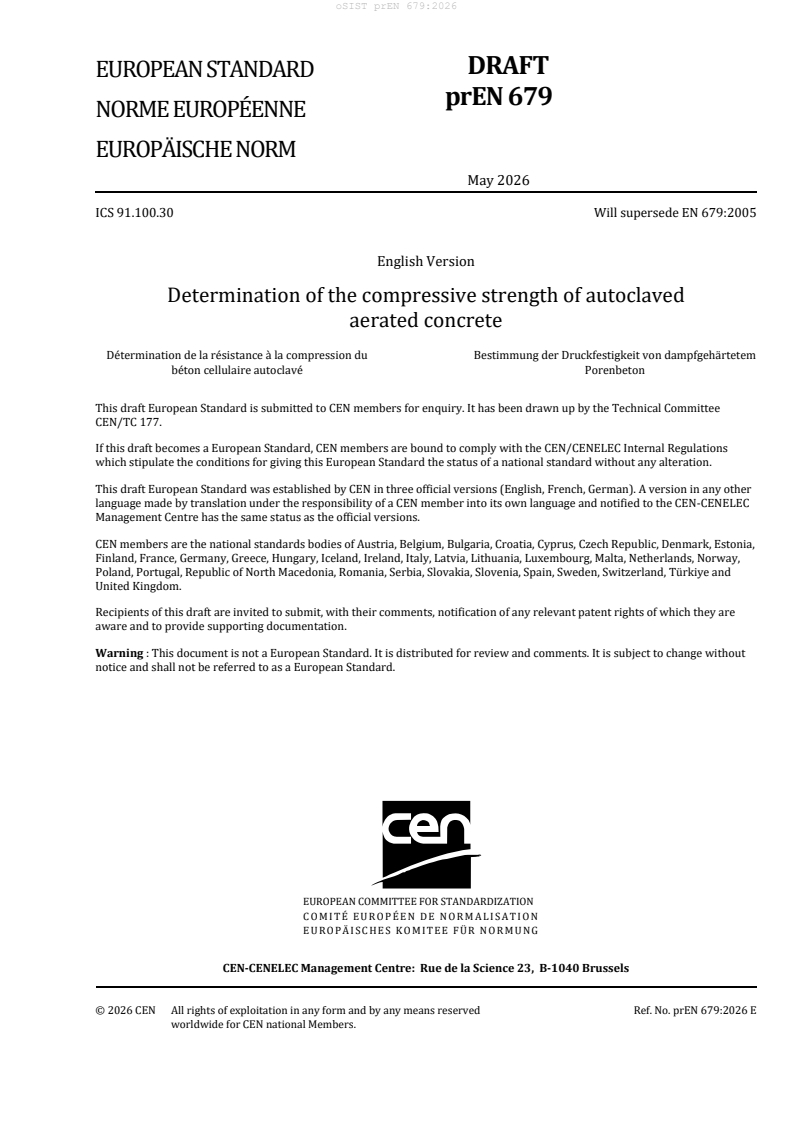
DRAFT
EUROPEAN STANDARD
NORME EUROPÉENNE
EUROPÄISCHE NORM
May 2026
ICS 91.100.30 Will supersede EN 679:2005
English Version
Determination of the compressive strength of autoclaved
aerated concrete
Détermination de la résistance à la compression du Bestimmung der Druckfestigkeit von dampfgehärtetem
béton cellulaire autoclavé Porenbeton
This draft European Standard is submitted to CEN members for enquiry. It has been drawn up by the Technical Committee
CEN/TC 177.
If this draft becomes a European Standard, CEN members are bound to comply with the CEN/CENELEC Internal Regulations
which stipulate the conditions for giving this European Standard the status of a national standard without any alteration.
This draft European Standard was established by CEN in three official versions (English, French, German). A version in any other
language made by translation under the responsibility of a CEN member into its own language and notified to the CEN-CENELEC
Management Centre has the same status as the official versions.
CEN members are the national standards bodies of Austria, Belgium, Bulgaria, Croatia, Cyprus, Czech Republic, Denmark, Estonia,
Finland, France, Germany, Greece, Hungary, Iceland, Ireland, Italy, Latvia, Lithuania, Luxembourg, Malta, Netherlands, Norway,
Poland, Portugal, Republic of North Macedonia, Romania, Serbia, Slovakia, Slovenia, Spain, Sweden, Switzerland, Türkiye and
United Kingdom.
Recipients of this draft are invited to submit, with their comments, notification of any relevant patent rights of which they are
aware and to provide supporting documentation.
Warning : This document is not a European Standard. It is distributed for review and comments. It is subject to change without
notice and shall not be referred to as a European Standard.
EUROPEAN COMMITTEE FOR STANDARDIZATION
COMITÉ EUROPÉEN DE NORMALISATION
EUROPÄISCHES KOMITEE FÜR NORMUNG
CEN-CENELEC Management Centre: Rue de la Science 23, B-1040 Brussels
© 2026 CEN All rights of exploitation in any form and by any means reserved Ref. No. prEN 679:2026 E
worldwide for CEN national Members.
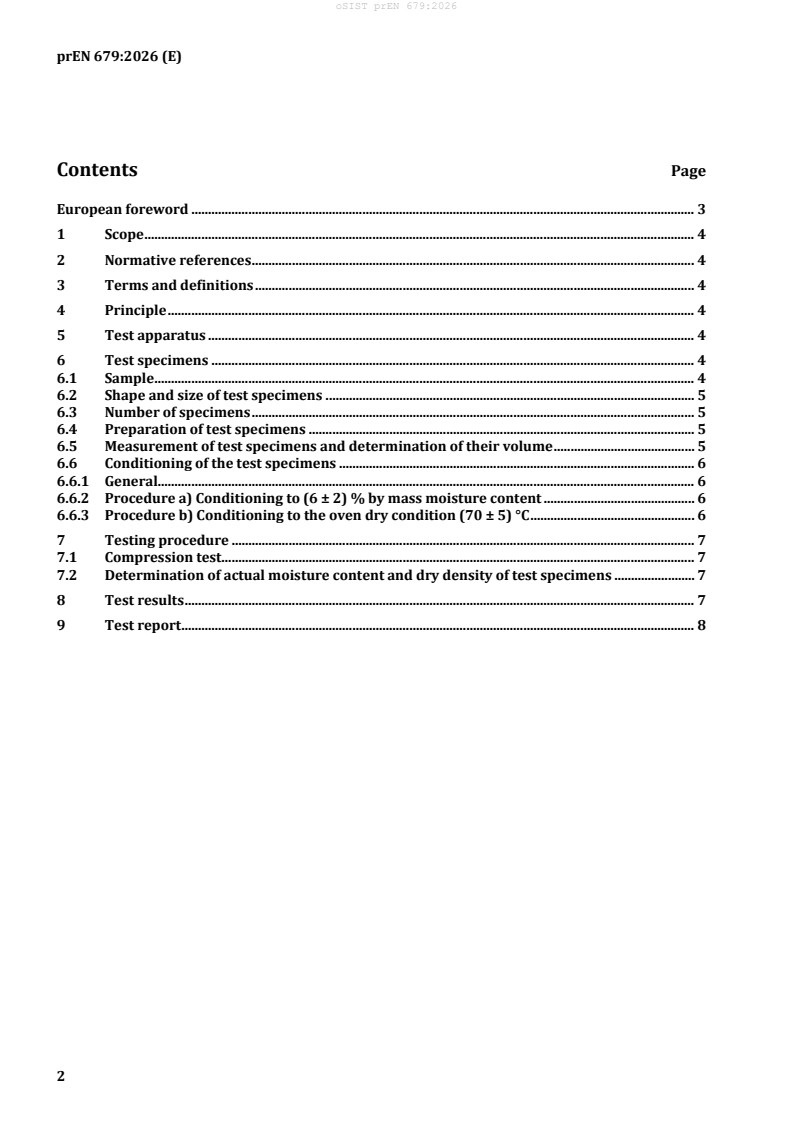
Contents Page
European foreword . 3
1 Scope . 4
2 Normative references . 4
3 Terms and definitions . 4
4 Principle . 4
5 Test apparatus . 4
6 Test specimens . 4
6.1 Sample . 4
6.2 Shape and size of test specimens . 5
6.3 Number of specimens . 5
6.4 Preparation of test specimens . 5
6.5 Measurement of test specimens and determination of their volume . 5
6.6 Conditioning of the test specimens . 6
6.6.1 General. 6
6.6.2 Procedure a) Conditioning to (6 ± 2) % by mass moisture content . 6
6.6.3 Procedure b) Conditioning to the oven dry condition (70 ± 5) °C . 6
7 Testing procedure . 7
7.1 Compression test . 7
7.2 Determination of actual moisture content and dry density of test specimens . 7
8 Test results . 7
9 Test report . 8
European foreword
This document (prEN 679:2026) has been prepared by Technical Committee CEN/TC 177 “Prefabricated
reinforced components of autoclaved aerated concrete or light-weight aggregate concrete with open
structure”, the secretariat of which is held by DIN.
This document is currently submitted to the CEN Enquiry.
This document will supersede EN 679:2005.
This document includes the following significant technical changes with respect to EN 679:2005:
— incorporation of procedure for additional conditioning [drying to constant mass at temperature of
(70 ± 5) °C of specimens before testing as stated in the test standard for masonry units
(EN 772-1:2016, 7.3.3 b))];
— in order to meet the performance requirements as laid down in the product standard for
prefabricated components of autoclaved aerated concrete, a number of standardized test methods
are necessary.
1 Scope
This document specifies the procedure for the determination of the compressive strength of autoclaved
aerated concrete.
2 Normative references
The following documents are referred to in the text in such a way that some or all of their content
constitutes requirements of this document. For dated references, only the edition cited applies. For
undated references, the latest edition of the referenced document (including any amendments) applies.
EN 678, Determination of the dry density of autoclaved aerated concrete
EN 1353, Determination of moisture content of autoclaved aerated concrete
EN 12390-4, Testing hardened concrete — Part 4: Compressive strength — Specification for testing
machines
3 Terms and definitions
No terms and definitions are listed in this document.
ISO and IEC maintain terminology databases for use in standardization at the following addresses:
— ISO Online browsing platform: available at https://www.iso.org/obp
— IEC Electropedia: available at https://www.electropedia.org/
4 Principle
The compressive strength is determined on test specimens as the ratio between the rupture load in axial
compression and the cross-sectional area of the test specimen perpendicular to the loading direction.
5 Test apparatus
a) Saw for cutting test specimens;
b) compression testing machine, which meets the requirements of EN 12390-4, machine class 1 or 2;
c) calipers, capable of reading the dimensions of the test specimens to an accuracy of 0,1 mm;
d) ventilated drying ovens, capable of maintaining required temperatures for conditioning and drying
test specimens: (≤60 °C), (70 ± 5) °C and (105 ± 5) °C;
e) straight edge, at least 200 mm long, a 0,1 mm-feeler gauge, a 1 mm-feeler gauge, and a square;
f) balance, capable of determining the mass of the test specimens to an accuracy of 0,1 %.
6 Test specimens
6.1 Sa
...