

SIST IEC 60050-521:2017
(Main)International Electrotechnical Vocabulary - Part 521: Semiconductor devices and integrated circuits
General Information
- Abstract
This part of IEC 60050 gives the general terminology used in the fields of semiconductor technology and semiconductor design and for types of semiconductors.
This terminology is of course consistent with the terminology developed in the other specialized parts of the IEV.
- Status
- Published
- Publication Date
- 29-Jan-2017
- Technical Committee
- TRM - Terminology
- Current Stage
- 6100 - Translation of adopted SIST standards (Adopted Project)
- Start Date
- 21-Dec-2016
- Due Date
- 20-Dec-2017
- Completion Date
- 27-Jun-2019
Buy Documents




Overview
SIST IEC 60050-521:2017, titled International Electrotechnical Vocabulary - Part 521: Semiconductor devices and integrated circuits, is a comprehensive international standard developed by the International Electrotechnical Commission (IEC). This horizontal standard, prepared under IEC Guide 108, serves as a multilingual vocabulary providing precise terminology and definitions used globally in the fields of semiconductor devices and integrated circuits. Initially published in 1984 and updated in its second edition in 2002, the document enhances clarity and consistency in technical communication across electrical engineering, electronics, and microelectronics sectors.
This part of the IEC 60050 series catalogs essential terms covering everything from the physics of semiconductor materials to specific components such as diodes, transistors, and integrated circuits, including their digital variants. It supports global standardization efforts by offering terms and definitions in multiple languages including English, French, Russian, Chinese, German, Spanish, Japanese, Polish, Portuguese, and Swedish.
Key Topics
SIST IEC 60050-521:2017 is organized into a detailed hierarchical structure, dividing semiconductor device vocabulary into systematic sections to cover specialized areas. Key topics include:
- Atomic Physics Concepts: Fundamentals of atom-level interactions relevant to semiconductor behavior.
- Properties of Semiconductor Materials: Electrical, physical, and chemical properties critical to semiconductor function.
- Semiconductor Material Processing: Techniques for material preparation and treatment in device manufacturing.
- Types of Semiconductor Devices: Categorization of devices such as diodes, transistors, and thyristors.
- General Terms for Semiconductor Devices: Overview of common terminology across various devices.
- Specific Device Terminology:
- Diodes
- Transistors
- Thyristors
- Hall-effect devices and magnetoresistive components
- Integrated Circuits: Definitions and terms pertaining to analog and digital integrated circuits.
- Multilingual Indexing: Facilitates access to terms across different languages to ensure international usability.
Each section provides authoritative definitions, symbolic representations, and associated notes carefully structured for ease of use by engineers, manufacturers, researchers, and standards developers.
Applications
The SIST IEC 60050-521:2017 standard plays a vital role in numerous practical domains:
- Technical Documentation: Enhances accuracy and consistency in datasheets, manuals, and technical papers related to semiconductor devices.
- Product Development: Assists design engineers in correctly applying standard terminology throughout semiconductor and integrated circuit development.
- Global Trade and Compliance: Enables manufacturers and regulatory bodies to align product definitions and specifications worldwide, reducing misinterpretations or discrepancies.
- Standardization Efforts: Acts as a foundational reference to harmonize terminology within national and regional standards for electrical, electronics, and microelectronic fields.
- Education and Training: Serves academia and training institutions with clear, standardized vocabulary supporting education in semiconductor physics and electronics technology.
By offering a unified language, SIST IEC 60050-521:2017 supports innovation, interoperability, and quality assurance across the global semiconductor industry.
Related Standards
SIST IEC 60050-521:2017 is part of the broader IEC 60050 International Electrotechnical Vocabulary (IEV) series, which provides terminology for various electrical engineering areas. Related standards that complement Part 521 include:
- IEC 60050-161 - Electromagnetic Compatibility Vocabulary: Terms related to electromagnetic interference and compatibility in electronic devices.
- IEC 60050-411 - Rotating Machines Vocabulary: Covers terminology for rotating electrical machines, applicable when integrated circuits control motor drives.
- ISO/IEC Directives, Part 3 - Guidelines followed in drafting this standard, ensuring conformity with international documentation practices.
- Other semiconductor-specific IEC standards governed by IEC Technical Committee 47, addressing testing, performance, and safety of semiconductor devices and integrated circuits.
Standards organizations and users harmonize their national terminologies with SIST IEC 60050-521:2017 to maintain consistency in the semiconductor sector, ensuring this vocabulary remains the authoritative reference internationally.
By adopting SIST IEC 60050-521:2017, professionals enhance clear communication and unify understanding in the evolving world of semiconductor devices and integrated circuits, facilitating robust industry growth and collaboration on a global scale.
Buy Documents
Frequently Asked Questions
SIST IEC 60050-521:2017 is a standard published by the Slovenian Institute for Standardization (SIST). Its full title is "International Electrotechnical Vocabulary - Part 521: Semiconductor devices and integrated circuits". This standard covers: This part of IEC 60050 gives the general terminology used in the fields of semiconductor technology and semiconductor design and for types of semiconductors. This terminology is of course consistent with the terminology developed in the other specialized parts of the IEV.
This part of IEC 60050 gives the general terminology used in the fields of semiconductor technology and semiconductor design and for types of semiconductors. This terminology is of course consistent with the terminology developed in the other specialized parts of the IEV.
SIST IEC 60050-521:2017 is classified under the following ICS (International Classification for Standards) categories: 01.040.31 - Electronics (Vocabularies); 31.080.01 - Semiconductor devices in general; 31.200 - Integrated circuits. Microelectronics. The ICS classification helps identify the subject area and facilitates finding related standards.
SIST IEC 60050-521:2017 is available in PDF format for immediate download after purchase. The document can be added to your cart and obtained through the secure checkout process. Digital delivery ensures instant access to the complete standard document.
Standards Content (Sample)
SLOVENSKI STANDARD
01-marec-2017
Mednarodni elektrotehniški slovar - 521. del: Polprevodniški elementi in
integrirana vezja
International Electrotechnical Vocabulary - Part 521: Semiconductor devices and
integrated circuits
Vocabulaire Electrotechnique International - Partie 521: Dispositifs à semiconducteurs et
circuits intégrés
Ta slovenski standard je istoveten z: IEC 60050-521
ICS:
01.040.31 Elektronika (Slovarji) Electronics (Vocabularies)
31.080.01 Polprevodniški elementi Semiconductor devices in
(naprave) na splošno general
31.200 Integrirana vezja, Integrated circuits.
mikroelektronika Microelectronics
2003-01.Slovenski inštitut za standardizacijo. Razmnoževanje celote ali delov tega standarda ni dovoljeno.
NORME CEI
INTERNATIONALE IEC
60050-521
INTERNATIONAL
Deuxième édition
STANDARD
Second edition
2002-05
Vocabulaire Electrotechnique International
Partie 521 :
Dispositifs à semiconducteurs
et circuits intégrés
International Electrotechnical Vocabulary
Part 521:
Semiconductor devices
and integrated circuits
IEC 2002 Droits de reproduction réservés Copyright - all rights reserved
Aucune partie de cette publication ne peut être reproduite ni No part of this publication may be reproduced or utilized in any
utilisée sous quelque forme que ce soit et par aucun procédé, form or by any means, electronic or mechanical, including
électronique ou mécanique, y compris la photocopie et les photocopying and microfilm, without permission in writing from
microfilms, sans l'accord écrit de l'éditeur. the publisher.
International Electrotechnical Commission, 3, rue de Varembé, PO Box 131, CH-1211 Geneva 20, Switzerland
Telephone: +41 22 919 02 11 Telefax: +41 22 919 03 00 E-mail: inmail@iec.ch Web: www.iec.ch
CODE PRIX
XD
PRICE CODE
Commission Electrotechnique Internationale
International Electrotechnical Commission
Международная Электротехническая Комиссия
Pour prix, voir catalogue en vigueur
For price, see current catalogue
– II – 60050-521 CEI:2002
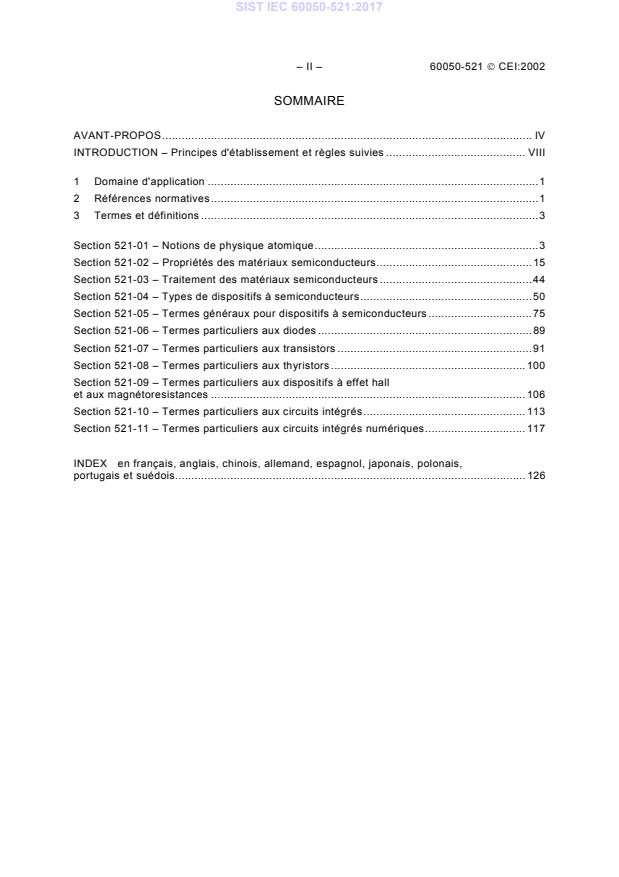
SOMMAIRE
AVANT-PROPOS. IV
INTRODUCTION – Principes d'établissement et règles suivies . VIII
1 Domaine d'application .1
2 Références normatives.1
3 Termes et définitions .3
Section 521-01 – Notions de physique atomique.3
Section 521-02 – Propriétés des matériaux semiconducteurs.15
Section 521-03 – Traitement des matériaux semiconducteurs .44
Section 521-04 – Types de dispositifs à semiconducteurs.50
Section 521-05 – Termes généraux pour dispositifs à semiconducteurs .75
Section 521-06 – Termes particuliers aux diodes .89
Section 521-07 – Termes particuliers aux transistors .91
Section 521-08 – Termes particuliers aux thyristors .100
Section 521-09 – Termes particuliers aux dispositifs à effet hall
et aux magnétoresistances .106
Section 521-10 – Termes particuliers aux circuits intégrés.113
Section 521-11 – Termes particuliers aux circuits intégrés numériques.117
INDEX en français, anglais, chinois, allemand, espagnol, japonais, polonais,
portugais et suédois. 126
60050-521 IEC:2002 – III –
CONTENTS
FOREWORD. V
INTRODUCTION – Principles and rules followed . IX
1 Scope.2
2 Normative references .2
3 Terms and definitions .3
Section 521-01 – Introduction to atomic physics .3
Section 521-02 – Properties of semiconductor materials .15
Section 521-03 – Processing semiconductor materials.44
Section 521-04 – Types of semiconductor devices .50
Section 521-05 – General terms for semiconductor devices .75
Section 521-06 – Specific terms for diodes .89
Section 521-07 – Specific terms for transistors .91
Section 521-08 – Specific terms for thyristors .100
Section 521-09 – Specific terms for hall-effect devices and magnetoresistors .106
Section 521-10 – Specific terms for integrated circuits.113
Section 521-11 – Specific terms for digital integrated circuits.117
INDEX in French, English, Chinese, German, Spanish, Japanese, Polish,
Portuguese and Swedish . 126
– IV – 60050-521 CEI:2002
COMMISSION ÉLECTROTECHNIQUE INTERNATIONALE
____________
VOCABULAIRE ÉLECTROTECHNIQUE INTERNATIONAL
PARTIE 521 : DISPOSITIFS À SEMICONDUCTEURS
ET CIRCUITS INTÉGRÉS
AVANT-PROPOS
1) La CEI (Commission Électrotechnique Internationale) est une organisation mondiale de normalisation
composée de l'ensemble des comités électrotechniques nationaux (Comités nationaux de la CEI). La CEI a
pour objet de favoriser la coopération internationale pour toutes les questions de normalisation dans les
domaines de l'électricité et de l'électronique. A cet effet, la CEI, entre autres activités, publie des Normes
internationales. Leur élaboration est confiée à des comités d'études, aux travaux desquels tout Comité national
intéressé par le sujet traité peut participer. Les organisations internationales, gouvernementales et non
gouvernementales, en liaison avec la CEI, participent également aux travaux. La CEI collabore étroitement
avec l'Organisation Internationale de Normalisation (ISO), selon des conditions fixées par accord entre les
deux organisations.
2) Les décisions ou accords officiels de la CEI concernant les questions techniques représentent, dans la mesure
du possible, un accord international sur les sujets étudiés, étant donné que les Comités nationaux intéressés
sont représentés dans chaque comité d’études.
3) Les documents produits se présentent sous la forme de recommandations internationales. Ils sont publiés
comme normes, spécifications techniques, rapports techniques ou guides et agréés comme tels par les
Comités nationaux.
4) Dans le but d'encourager l'unification internationale, les Comités nationaux de la CEI s'engagent à appliquer de
façon transparente, dans toute la mesure possible, les Normes internationales de la CEI dans leurs normes
nationales et régionales. Toute divergence entre la norme de la CEI et la norme nationale ou régionale
correspondante doit être indiquée en termes clairs dans cette dernière.
5) La CEI n’a fixé aucune procédure concernant le marquage comme indication d’approbation et sa responsabilité
n’est pas engagée quand un matériel est déclaré conforme à l’une de ses normes.
6) L’attention est attirée sur le fait que certains des éléments de la présente Norme internationale peuvent faire
l’objet de droits de propriété intellectuelle ou de droits analogues. La CEI ne saurait être tenue pour
responsable de ne pas avoir identifié de tels droits de propriété et de ne pas avoir signalé leur existence.
La Norme internationale CEI 60050-521 a été établie par le Groupe de Travail 1 du Comité
d'études 47 : Dispositifs à semiconducteurs, sous la responsabilité du comité d'études 1 de la
CEI : Terminologie.
Le texte de cette norme est issu des documents suivants :
FDIS Rapport de vote
1/1830/FDIS 1/1835/RVD
Le rapport de vote indiqué dans le tableau ci-dessus donne toute information sur le vote ayant
abouti à l'approbation de cette norme.
Cette deuxième édition de la CEI 60050-521 est issue de l’édition originale de 1984 et des
termes nouveaux ou modifiés approuvés dans le FDIS en référence.
Cette publication a été rédigée selon les Directives ISO/CEI, Partie 3.
Dans la présente partie du VEI les termes et définitions sont donnés en français et en
anglais : de plus, les termes sont indiqués en chinois (cn), allemand (de), espagnol (es),
japonais (ja), polonais (pl), portugais (pt) et suédois (sv).
60050-521 IEC:2002 – V –
INTERNATIONAL ELECTROTECHNICAL COMMISSION
____________
INTERNATIONAL ELECTROTECHNICAL VOCABULARY
PART 521: SEMICONDUCTOR DEVICES
AND INTEGRATED CIRCUITS
FOREWORD
1) The IEC (International Electrotechnical Commission) is a worldwide organization for standardization comprising
all national electrotechnical committees (IEC National Committees). The object of the IEC is to promote
international co-operation on all questions concerning standardization in the electrical and electronic fields. To
this end and in addition to other activities, the IEC publishes International Standards. Their preparation is
entrusted to technical committees; any IEC National Committee interested in the subject dealt with may
participate in this preparatory work. International, governmental and non-governmental organizations liaising
with the IEC also participate in this preparation. The IEC collaborates closely with the International
Organization for Standardization (ISO) in accordance with conditions determined by agreement between the
two organizations.
2) The formal decisions or agreements of the IEC on technical matters express, as nearly as possible, an
international consensus of opinion on the relevant subjects since each technical committee has representation
from all interested National Committees.
3) The documents produced have the form of recommendations for international use and are published in the form
of standards, technical specifications, technical reports or guides and they are accepted by the National
Committees in that sense.
4) In order to promote international unification, IEC National Committees undertake to apply IEC International
Standards transparently to the maximum extent possible in their national and regional standards. Any
divergence between the IEC Standard and the corresponding national or regional standard shall be clearly
indicated in the latter.
5) The IEC provides no marking procedure to indicate its approval and cannot be rendered responsible for any
equipment declared to be in conformity with one of its standards.
6) Attention is drawn to the possibility that some of the elements of this International Standard may be the subject
of patent rights. The IEC shall not be held responsible for identifying any or all such patent rights.
International Standard IEC 60050-521 has been prepared by Working Group 1 of IEC technical
committee 47: Semiconductor devices, under the responsibility of IEC technical committee 1:
Terminology.
The text of this standard is based on the following documents:
FDIS Report on voting
1/1830/FDIS 1/1835/RVD
Full information on the voting for the approval of this standard can be found in the report on
voting indicated in the above table.
This second edition of IEC 60050-521 is based on 1984 edition and new or modified approved
terms in FDIS in reference.
This publication has been drafted in accordance with the ISO/IEC Directives, Part 3.
In this part of IEV, the terms and definitions are written in French and English; in addition the
terms are given in Chinese (cn), German (de), Spanish (es), Japanese (ja), Polish (pl),
Portuguese (pt) and Swedish (sv).
– VI – 60050-521 CEI:2002
Le comité a décidé que le contenu de cette publication ne sera pas modifié avant 2013.
A cette date, la publication sera
• reconduite ;
• supprimée ;
• remplacée par une édition révisée, ou
• amendée.
60050-521 IEC:2002 – VII –
The committee has decided that the contents of this publication will remain unchanged until 2013.
At this date, the publication will be
• reconfirmed;
• withdrawn;
• replaced by a revised edition, or
• amended.
– VIII – 60050-521 CEI:2002
INTRODUCTION
Principes d'établissement et règles suivies
Généralités
Le VEI (série CEI 60050) est un vocabulaire multilingue à usage général couvrant le champ
de l'électrotechnique, de l'électronique et des télécommunications. Il comprend environ
18 500 articles terminologiques correspondant chacun à une notion. Ces articles sont répartis
dans environ 80 parties, chacune correspondant à un domaine donné.
Exemples :
Partie 161 (CEI 60050-161) : Compatibilité électromagnétique
Partie 411 (CEI 60050-411) : Machines tournantes
Les articles suivent un schéma de classification hiérarchique Partie/Section/Notion, les
notions étant, au sein des sections, classées par ordre systématique.
Les termes, définitions et notes des articles sont donnés dans les trois langues officielles
de la CEI, c'est-à-dire français, anglais et russe (langues principales du VEI).
Dans chaque article, les termes seuls sont également donnés dans les langues additionnelles
du VEI (arabe, chinois, allemand, grec, espagnol, italien, japonais, polonais, portugais et
suédois).
De plus, chaque partie comprend un index alphabétique des termes inclus dans cette partie,
et ce pour chacune des langues du VEI.
NOTE – Certaines langues peuvent manquer.
Constitution d'un article terminologique
Chacun des articles correspond à une notion, et comprend :
–un numéro d'article,
– éventuellement un symbole littéral de grandeur ou d'unité,
puis, pour chaque langue principale du VEI :
– le terme désignant la notion, appelé « terme privilégié », éventuellement accompagné de
synonymes et d'abréviations,
–la définition de la notion,
– éventuellement la source,
– éventuellement des notes,
et enfin, pour les langues additionnelles du VEI, les termes seuls.
Numéro d'article
Le numéro d'article comprend trois éléments, séparés par des traits d'union :
– Numéro de partie : 3 chiffres,
– Numéro de section : 2 chiffres,
– Numéro de la notion : 2 chiffres (01 à 99).
Exemple : 151-13-82
60050-521 IEC:2002 – IX –
INTRODUCTION
Principles and rules followed
General
The IEV (IEC 60050 series) is a general-purpose multilingual vocabulary covering the field of
electrotechnology, electronics and telecommunication. It comprises about 18 500 termino-
logical entries, each corresponding to a concept. These entries are distributed among about
80 parts, each part corresponding to a given field.
Examples:
Part 161 (IEC 60050-161): Electromagnetic compatibility
Part 411 (IEC 60050-411): Rotating machines
The entries follow a hierarchical classification scheme Part/Section/Concept, the concepts
being, within the sections, organized in a systematic order.
The terms, definitions and notes in the entries are given in the three IEC official languages,
that is French, English and Russian (principal IEV languages).
In each entry the terms alone are also given in the additional IEV languages (Arabic, Chinese,
German, Greek, Spanish, Italian, Japanese, Polish, Portuguese and Swedish).
In addition, each part comprises an alphabetical index of the terms included in that part, for
each of the IEV languages.
NOTE – Some languages may be missing.
Organization of a terminological entry
Each of the entries corresponds to a concept, and comprises:
–an entry number,
– possibly a letter symbol for quantity or unit,
then, for each of the principal IEV languages:
– the term designating the concept, called "preferred term", possibly accompanied by
synonyms and abbreviations,
–the definition of the concept,
– possibly the source,
– possibly notes,
and finally, for the additional IEV languages, the terms alone.
Entry number
The entry number is comprised of three elements, separated by hyphens:
– Part number: 3 digits,
– Section number: 2 digits,
– Concept number: 2 digits (01 to 99).
Example: 151-13-82
– X – 60050-521 CEI:2002
Symboles littéraux de grandeurs et unités
Ces symboles, indépendants de la langue, sont donnés sur une ligne séparée suivant le
numéro d'article.
Exemple :
131-11-22
symb. : R
résistance, f
Terme privilégié et synonymes
Le terme privilégié est le terme qui figure en tête d'un article ; il peut être suivi de synonymes.
Il est imprimé en gras.
Synonymes :
Les synonymes sont imprimés sur des lignes séparées sous le terme privilégié : ils sont
également imprimés en gras, sauf les synonymes déconseillés, qui sont imprimés en maigre,
et suivis par l'attribut « (déconseillé) ».
Parties pouvant être omises :
Certaines parties d'un terme peuvent être omises, soit dans le domaine considéré, soit dans
un contexte approprié. Ces parties sont alors imprimées en gras, entre parenthèses :
Exemple: émission (électromagnétique)
Absence de terme approprié :
Lorsqu'il n'existe pas de terme approprié dans une langue, le terme privilégié est remplacé
par cinq points, comme ceci :
.....
« » (et il n'y a alors bien entendu pas de synonymes).
Attributs
Chaque terme (ou synonyme) peut être suivi d'attributs donnant des informations supplé-
mentaires ; ces attributs sont imprimés en maigre, à la suite de ce terme, et sur la même
ligne.
Exemples d'attributs :
– spécificité d'utilisation du terme :
rang (d'un harmonique)
– variante nationale :
unité de traitement CA
– catégorie grammaticale :
électronique, adj
électronique, f
– abréviation : CEM (abréviation)
– déconseillé : déplacement (terme déconseillé)
60050-521 IEC:2002 – XI –
Letter symbols for quantities and units
These symbols, which are language independent, are given on a separate line following the
entry number.
Example:
131-11-22
symb. : R
resistance
Preferred term and synonyms
The preferred term is the term that heads a terminological entry; it may be followed by
synonyms. It is printed in boldface.
Synonyms:
The synonyms are printed on separate lines under the preferred term: they are also printed in
boldface, excepted for deprecated synonyms, which are printed in lightface, and followed by
the attribute "(deprecated)".
Parts that may be omitted:
Some parts of a term may be omitted, either in the field under consideration or in an
appropriate context. Such parts are printed in boldface type, and placed in parentheses:
Example: (electromagnetic) emission
Absence of an appropriate term:
When no adequate term exists in a given language, the preferred term is replaced by five
dots, like this:
.....
" " (and there are of course no synonyms).
Attributes
Each term (or synonym) may be followed by attributes giving additional information, and
printed on the same line as the corresponding term, following this term.
Examples of attributes:
– specific use of the term:
transmission line (in electric power systems)
– national variant: lift GB
– grammatical information:
thermoplastic, noun
AC, qualifier
– abbreviation: EMC (abbreviation)
– deprecated: choke (deprecated)
– XII – 60050-521 CEI:2002
Source
Dans certains cas il a été nécessaire d'inclure dans une partie du VEI une notion prise dans
une autre partie du VEI, ou dans un autre document de terminologie faisant autorité
(VIM, ISO/CEI 2382, etc.), dans les deux cas avec ou sans modification de la définition
(ou éventuellement du terme).
Ceci est indiqué par la mention de cette source, imprimée en maigre, et placée entre crochets
à la fin de la définition :
Exemple : [131-03-13 MOD]
(MOD indique que la définition a été modifiée)
Termes dans les langues additionnelles du VEI
Ces termes sont placés à la fin de l'article, sur des lignes séparées (une ligne par langue),
précédés par le code alpha-2 de la langue, défini dans l'ISO 639, et dans l'ordre alphabétique
de ce code. Les synonymes sont séparés par des points-virgules.
60050-521 IEC:2002 – XIII –
Source
In some cases, it has been necessary to include in an IEV part a concept taken from another
IEV part, or from another authoritative terminology document (VIM, ISO/IEC 2382, etc.), in
both cases with or without modification to the definition (and possibly to the term).
This is indicated by the mention of this source, printed in lightface, and placed between
square brackets at the end of the definition.
Example: [131-03-13 MOD]
(MOD indicates that the definition has been modified)
Terms in additional IEV languages
These terms are placed at the end of the entry, on separate lines (one single line for each
language), preceded by the alpha-2 code for the language defined in ISO 639, and in the
alphabetic order of this code. Synonyms are separated by semicolons.
– 1 – 60050-521 CEI:2002
VOCABULAIRE ÉLECTROTECHNIQUE INTERNATIONAL
PARTIE 521 : DISPOSITIFS À SEMICONDUCTEURS
ET CIRCUITS INTÉGRÉS
1 Domaine d'application
Cette partie de la norme CEI 60050 donne la terminologie générale utilisée dans les
domaines de la technologie des semiconducteurs, du développement des semiconducteurs et
pour les types de semiconducteurs.
Cette terminologie est naturellement en accord avec la terminologie figurant dans les autres
parties spécialisée du VEI.
2 Références normatives
Les références normatives se limitent essentiellement à la CEI 60050 Partie 151 : Dispositifs
électriques et magnétiques, en cours de révision.
60050-521 IEC:2002 – 2 –
INTERNATIONAL ELECTROTECHNICAL VOCABULARY
PART 521: SEMICONDUCTOR DEVICES
AND INTEGRATED CIRCUITS
1Scope
This part of IEC 60050 gives the general terminology used in the fields of semiconductor
technology and semiconductor design and for types of semiconductors.
This terminology is of course consistent with the terminology developed in the other
specialized parts of the IEV.
2 Normative references
Normative references are limited to IEC 60050 Part 151: Electric and magnetic devices, under
revision.
– 3 – 60050-521 CEI:2002
3 Termes et définitions
3 Terms and definitions
PARTIE 521 : DISPOSITIFS À SEMICONDUCTEURS
ET CIRCUITS INTÉGRÉS
PART 521: SEMICONDUCTOR DEVICES
AND INTEGRATED CIRCUITS
Section 521-01 – Notions de physique atomique
Section 521-01 – Introduction to atomic physics
521-01-01
système non quantifié (de particules), m
système de particules dont on suppose que les énergies sont susceptibles de varier de
manière continue. Le nombre des états microscopiques, défini par les positions et les vitesses
des particules à un instant donné, est alors non limité
non-quantized system (of particles)
system of particles whose energies are assumed to be capable of varying in a continuous
manner and in which the number of microscopic states defined by the positions and velocities
of the particles at a given instant is therefore unlimited
cn 非量子化系统非量子化系统非量子化系统非量子化系统(粒子的)
de nichtquantisiertes System (von Teilchen), n
es sistema no cualificado (de partículas)
ja (粒子の)非量子化系(粒子の)非量子化系(粒子の)非量子化系(粒子の)非量子化系
pl układ niekwantowany (cząstek)
pt sistema não quantificado (de partículas)
sv okvantiserat system
521-01-02
système quantifié (de particules), m
système de particules dont les énergies ne peuvent prendre que des valeurs discrètes
quantized system (of particles)
system of particles the energies of which can have discrete values only
cn 量子化系统量子化系统(粒子的量子化系统量子化系统 )
de quantisiertes System (von Teilchen), n
es sistema cuantificado (de partículas)
ja (粒子の)量子化系(粒子の)量子化系(粒子の)量子化系(粒子の)量子化系
pl układ kwantowany (cząstek)
pt sistema quantificado (de partículas)
sv kvantiserat system
60050-521 IEC:2002 – 4 –
521-01-03
statistique de Maxwell-Boltzmann, f
ensemble de probabilités des états macroscopiques d'un système non quantifié de particules
déterminé par les valeurs moyennes des coordonnées de positions, des vitesses ou de
l'énergie, dans un volume très petit, mais non nul du système
Maxwell-Boltzmann statistics
probability distribution of the macroscopic states of a non-quantized system of particles,
defined by the average values of the position, velocity or energy co-ordinates, in a very small,
but finite, volume of the system
麦克斯韦麦克斯韦--玻尔兹曼统计玻尔兹曼统计
cn 麦克斯韦麦克斯韦--玻尔兹曼统计玻尔兹曼统计
de Maxwell-Boltzmann-Statistik, f
es estadística de Maxwell-Boltzmann
ja マックスウェル‐マックスウェル‐マックスウェル‐マックスウェル‐ボルツマン統計ボルツマン統計ボルツマン統計ボルツマン統計
pl rozkład Maxwella-Boltzmanna
pt estatística de Maxwell-Boltzmann
sv Maxwell-Boltzmann-fördelning
521-01-04
relation de Boltzmann, f
relation exprimant que, à une constante additive près, l'entropie d'un système de particules
est égale au produit du logarithme népérien de la probabilité de son état macroscopique par
la constante de Boltzmann
Boltzmann relation
equation stating that, apart from an additive constant, the entropy of a system of particles is
equal to the product of the Napierian (natural) logarithm of the probability of its macroscopic
state and the Boltzmann constant
cn 玻尔兹曼关系玻尔兹曼关系玻尔兹曼关系玻尔兹曼关系
de Boltzmann-Beziehung, f
es relación de Boltzmann
ja ボルツマン関係ボルツマン関係ボルツマン関係ボルツマン関係
pl zależność Boltzmanna
pt relação de Boltzmann
sv Boltzmanns ekvation
– 5 – 60050-521 CEI:2002
521-01-05
loi de distribution des vitesses de Maxwell-Boltzmann, f
relation algébrique donnant le nombre dN de particules d'un système non quantifié dont les
composantes de vitesse sont comprises respectivement dans les intervalles (u, u + du), (v, v + dv),
(w, w + dw) :
2 2 2
− m (u + v + w )
d N = A ⋅ exp du ⋅ dv ⋅ d w
2 kT
où
3/2
m
A = N
(2 π ⋅ kT )
N désigne le nombre total de particules
m la masse d'une particule
T la température thermodynamique
k la constante de Boltzmann
NOTE – dN/N représente la probabilité pour qu'une particule ait ses composantes de vitesse
comprises dans les intervalles considérés.
Maxwell-Boltzmann velocity-distribution law
algebraic equation giving the number dN of particles of a non-quantized system, the
u, u + du), (v, v + dv), (w, w + dw
components of velocity of which are comprised in the intervals ( )
respectively:
2 2 2
− m (u + v + w )
d N = A ⋅ exp d u ⋅ d v ⋅ d w
2 kT
where
3/2
m
A = N
(2 π ⋅ kT )
N is the total number of particles
m is the mass of a particle
T is the thermodynamic temperature
k is the Boltzmann constant
NOTE – dN/N represents the probability that a particle has its components of velocity within the inter-
vals considered.
cn 麦克斯韦麦克斯韦麦克斯韦麦克斯韦----玻尔兹曼速度分布律玻尔兹曼速度分布律玻尔兹曼速度分布律玻尔兹曼速度分布律
de Maxwell-Boltzmann-Geschwindigkeitsverteilung, f
es ley de distribución de las velocidades de Maxwell-Boltzmann
ja マックスウェル‐マックスウェル‐マックスウェル‐マックスウェル‐ボルツマン速度分布則ボルツマン速度分布則ボルツマン速度分布則ボルツマン速度分布則
pl prawo rozkładu prędkości Maxwella-Boltzmanna
pt lei de distribuição das velocidades de Maxwell-Boltzmann
sv Maxwell-Boltzmanns hastighetsfördelning
60050-521 IEC:2002 – 6 –
521-01-06
atome de Bohr, m
modèle de l'atome fondé sur les conceptions de Bohr et de Sommerfeld, d'après lesquelles
les électrons d'un atome décriraient autour du noyau des orbites circulaires ou elliptiques
discrètes
NOTE – A chacun des degrés de liberté de l'atome correspond une série d'états énergétiques qui
déterminent les séries spectrales susceptibles d'être émises par l'atome.
Bohr atom
model of the atom based on the conception of Bohr and Sommerfeld, according to which the
electrons of an atom move around the nucleus in discrete circular or elliptical orbits
NOTE – To each of the degrees of freedom of the atom there corresponds a series of energy states
which determine the spectral series that may be emitted by the atom.
cn 玻尔原子玻尔原子
玻尔原子玻尔原子
de Bohr-Atommodell, n
es átomo de Bohr
ja ボーア原子ボーア原子
ボーア原子ボーア原子
pl atom Bohra
pt átomo de Bohr
sv Bohrs atommodell
521-01-07
nombre quantique (d'un électron dans un atome donné), m
chacun des nombres caractérisant les degrés de liberté d'un électron dans un atome donné :
– le nombre quantique principal n
– le nombre quantique secondaire l
– le nombre quantique de spin s
– le nombre quantique interne j
quantum number (of an electron in a given atom)
each of the numbers characterizing the degree of freedom of an electron in a given atom:
– the principal quantum number n
– the orbital quantum number l
– the spin quantum number s
– the total angular momentum quantum number j
cn 量子数(给定原量子数 子中电子的)
量子数量子数
de Quantenzahl (eines Elektrons in einem gegebenen Atom), f
es número cuántico (de un electrón de un átomo dado)
ja (与えられた原子内の電子の)量子数(与えられた原子内の電子の)量子数
(与えられた原子内の電子の)量子数(与えられた原子内の電子の)量子数
pl liczba kwantowa (elektronu w danym atomie)
pt número quântico (de um electrão num átomo dado)
sv kvanttal
– 7 – 60050-521 CEI:2002
521-01-08
symb. : n
nombre quantique principal, m
nombre quantique entier positif qui caractérise les variations importantes du niveau d'énergie
des électrons dans un atome
NOTE – Selon le modèle de l'atome de Bohr, le nombre quantique principal peut être considéré comme
caractérisant le grandeur de l'orbite d'un électron.
principal quantum number
first quantum number
positive integer number characterizing the important changes of energy level of the electrons
in an atom
NOTE – According to the Bohr atom model, the main quantum number may be considered as
characterizing the size of an electron orbit.
cn 主量子数主量子数主量子数主量子数
de Hauptquantenzahl, f
es número cuántico principal
ja 主量子数;第主量子数;第主量子数;第主量子数;第1量子数量子数量子数量子数
pl liczba kwantowa główna; liczba kwantowa pierwsza
pt número quântico principal
sv huvudkvanttal
521-01-09
symb. : l
nombre quantique secondaire, m
nombre quantique orbital, m
nombre quantique qui peut prendre toutes les valeurs entières de zéro à n–1, n désignant le
nombre quantique principal
NOTE – Selon le modèle de l'atome de Bohr, le nombre quantique secondaire peut être considéré
comme caractérisant le moment cinétique de l'électron dans son mouvement orbital.
orbital quantum number
second quantum number
quantum number which can have all whole values from zero to n–1, n designating the main
quantum number
NOTE – According to the Bohr atom model, the orbital quantum number may be considered as
characterizing the angular momentum of the electron in its orbital motion round the nucleus.
cn 轨道量子数轨道量子数
轨道量子数轨道量子数
de Bahndrehimpulsquantenzahl, f
es número cuántico secundario
ja 軌道量子数;第軌道量子数;第2量子数量子数
軌道量子数;第軌道量子数;第 量子数量子数
pl liczba kwantowa orbitalna; liczba kwantowa druga
pt número quântico orbital; número quântico secundário
sv bikvanttal
60050-521 IEC:2002 – 8 –
521-01-10
symb. : s
(nombre quantique de) spin, m
nombre quantique qui caractérise le moment cinétique de l'électron considéré comme une
petite sphère chargée en rotation autour de son axe
NOTE – Le spin peut prendre deux valeurs : +1/2 et –1/2.
spin (quantum number)
quantum number which gives the angular momentum of the electron considered as a small
charged sphere revolving rotating around its axis
NOTE – The spin may have two values: +1/2 or –1/2.
cn 自旋自旋自旋自旋((((量子数量子数量子数量子数))))
de Spinquantenzahl, f; Spin, m
es espín
ja スピン(量子数)スピン(量子数)スピン(量子数)スピン(量子数)
pl liczba spinowa; spin
pt (número quântico de) spin
sv spinnkvanttal
521-01-11
symb. : j
nombre quantique interne, m
nombre quantique qui caractérise la résultante des champs magnétiques engendrés par
l'électron, d'une part dans son mouvement orbital et d'autre part dans son mouvement de rotation
NOTE – Les valeurs de ce nombre j forment une suite de nombres semi-entiers et entiers.
total angular momentum quantum number
quantum number which gives the resultant of the magnetic field engendered by the electron
due to its orbital movement and due to its revolving on its own axis
NOTE – The values of this number j form a set of integral and semi-integral values.
cn 总角动量量子数总角动量量子数总角动量量子数总角动量量子数
de Gesamtdrehimpulsquantenzahl, f
es número cuántico interno
ja 総角運動量量子数総角運動量量子数総角運動量量子数総角運動量量子数
pl liczba kwantowa całkowitego momentu kątowego
pt (número quântico de) momento angular total
sv kvanttal för totalt rörelsemängdsmoment
521-01-12
niveau d'énergie, m
énergie correspondant à un état quantifié d'un système physique
energy level (of a particle)
energy associated with a quantum state of a physical system
cn 能级能级(粒子的能级能级 )
de Energieniveau (eines Teilchens), n
es nivel de energía (de una partícula); nivel energético (de una partícula)
ja ((((粒子の)エネルギー準位粒子の)エネルギー準位粒子の)エネルギー準位粒子の)エネルギー準位
pl poziom energetyczny (cząstki)
pt nível de energia
sv energinivå
– 9 – 60050-521 CEI:2002
521-01-13
diagramme énergétique, m
diagramme représentant les niveaux d'énergie des particules d'un système quantifié par des
droites horizontales, ayant pour ordonnées l'énergie de ces particules
energy-level diagram
diagram representing the energy levels of the particles of a quantized system by horizontal
lines, having for ordinates the energy of these particles
cn 能级图能级图能级图能级图
de Energieniveau-Diagramm, n
es diagrama energético
ja エネルギー準位図エネルギー準位図エネルギー準位図エネルギー準位図
pl wykres poziomów energetycznych (cząstek)
pt diagrama de níveis de energia; diagrama energético
sv energinivådiagram
521-01-14
principe d'exclusion de Pauli-Fermi, m
principe suivant lequel chaque niveau d'énergie d'un système quantifié ne peut contenir que
zéro, une ou deux particules
NOTE – Dans le cas de deux électrons, les spins sont de signes contraires.
Pauli-Fermi exclusion principle
Pauli principle
principle stating that each energy level of a quantized system can include only none, one or
two particles
NOTE – In the case of two electrons, the spins are of opposite sign.
cn 泡利泡利泡利泡利----费米不相容原理;泡利原理费米不相容原理;泡利原理费米不相容原理;泡利原理费米不相容原理;泡利原理
de Pauli-Prinzip, n
es principio de exclusión de Pauli-Fermi
ja パウリ‐パウリ‐フェルミの排他律;パウリの原理フェルミの排他律;パウリの原理
パウリ‐パウリ‐フェルミの排他律;パウリの原理フェルミの排他律;パウリの原理
pl zasada Pauliego-Fermiego; zakaz Pauliego
pt princípio de exclusão de Pauli-Fermi
sv Pauli-Fermis princip
521-01-15
statistique de Fermi-Dirac, f
statistique de Fermi, f
ensemble de probabilités des états macroscopiques d'un système quantifié de particules,
satisfaisant au principe d'exclusion de Pauli-Fermi
Fermi-Dirac statistics
Fermi statistics
set of probabilities of the macroscopic states of a quantized system of particles, with only
discrete energy levels, obeying the Pauli-Fermi exclusion principle
cn 费米费米费米费米----狄拉克统计;费米统计狄拉克统计;费米统计狄拉克统计;费米统计狄拉克统计;费米统计
de Fermi-Dirac-Statistik, f; Fermi-Statistik, f
es estadística de Fermi-Dirac; estadística de Fermi
ja フェルミ‐フェルミ‐フェルミ‐フェルミ‐ディラック統計;フェルミ統計ディラック統計;フェルミ統計ディラック統計;フェルミ統計ディラック統計;フェルミ統計
pl rozkład Fermiego-Diraca
pt estatística de Fermi-Dirac; estatística de Fermi
sv fermistatistik
60050-521 IEC:2002 – 10 –
521-01-16
fonction de Fermi-Dirac, f
fonction qui exprime la probabilité P(E) pour qu'une particule satisfaisant à la statistique de
Fermi occupe un niveau d'énergie autorisé E
P ( E ) =
E − E
F
1 + exp
kT
où
k est la constante de Boltzmann
T est la température thermodynamique
E est le niveau de Fermi
F
et où ce niveau est quantifié et peut contenir 0, 1 ou 2 électrons.
Fermi-Dirac function
function expressing the probability P(E), for a particle obeying Fermi statistics, that it will
occupy a permitted energy level (E)
P ( E ) =
E − E
F
1 + exp
kT
where
k is the Boltzmann constant
T is the thermodynamic temperature
E is the Fermi-level
F
and where this level is quantized and may contain 0, 1 or 2 electrons.
cn 费米费米费米费米----狄拉克函数狄拉克函数狄拉克函数狄拉克函数
de Fermi-Dirac-Funktion, f
es función de Fermi-Dirac
ja フェルミ‐フェルミ‐フェルミ‐フェルミ‐ディラック関数ディラック関数ディラック関数ディラック関数
pl funkcja Fermiego-Diraca
pt função de Fermi-Dirac
sv Fermi-Dirac-funktion
– 11 – 60050-521 CEI:2002
521-01-17
niveau de Fermi, m
dans un solide, niveau d'énergie qui sépare les états occupés des états inoccupés à la
température de zéro kelvin
NOTE – Quand une bande interdite sépare les états occupés des états inoccupés, le niveau de Fermi
est assigné au milieu de la bande interdite.
Fermi level
in a solid, energy level separating the occupied states from the unoccupied states at a
temperature of zero kelvin
NOTE – When a forbidden band separates the occupied and unoccupied states, the Fermi-level is
assigned to the centre of the forbidden band.
cn 费米能级费米能级费米能级费米能级
de Fermi-Niveau, n
es nivel de Fermi
ja フェルミ準位フェルミ準位フェルミ準位フェルミ準位
pl poziom Fermiego
pt nível de Fermi
sv ferminivå
521-01-18
électron célibataire, m
électron qui se trouve seul sur un niveau d'énergie
lone electron
electron which is alone on an energy level
cn 孤电子孤电子
孤电子孤电子
de Einzelelektron, n
es electrón suelto
ja 孤立電子孤立電子孤立電子孤立電子
pl elektron samotny
pt electrão solitário
sv ensam elektron
60050-521 IEC:2002 – 12 –
521-01-19
loi de distribution des vitesses de Fermi-Dirac-Sommerfeld, f
relation algébrique donnant le nombre de particules dN d'un système quantifié en équilibre,
dont les composantes de vitesse sont comprises dans des intervalles (u, u + du), (v, v + dv),
(w, w + dw) :
m du ⋅ d v ⋅ d w
d N = 2 N ⋅ ⋅
E − E
h
M
1 + exp
kT
où
N désigne le nombre total de particules
m la masse d'une particule
T la température thermodynamique
k la constante de Boltzmann
h la constante de Planck
E l'énergie cinétique d'une particule,
m
2 2 2
E = (u + v + w )
E la fonction de travail interne
M
dN/N représente la probabilité pour qu'une particule ait ses composantes de vitesse
comprises dans les intervalles considérés.
– 13 – 60050-521 CEI:2002
521-01-19
Fermi-Dirac-Sommerfeld velocity distribution law
algebraic equation giving the number dN of particles of a quantized system in equilibrium, the
velocity components of which are included in the intervals (u, u + du), (v, v + dv), (w, w + dw):
respectively:
m du ⋅ d v ⋅ d w
d N = 2 N ⋅ ⋅
E − E
h
M
1 + exp
kT
where
N is the total number of particles
m is the mass of the particle
T is the thermodynamic temperature
k is the Boltzmann constant
h is the Planck constant
E is the kinetic energy of a particle,
m
2 2 2
E = (u + v + w )
E is the inner work function
M
dN/N represents the probability that a particle has its components within the intervals
considered.
cn 费米费米--狄拉克狄拉克--索末菲速度分布律索末菲速度分布律
费米费米--狄拉克狄拉克--索末菲速度分布律索末菲速度分布律
de Fermi-Dirac-Sommerfeld-Geschwindigkeitsverteilung, f
es ley de distribución de las velocidades de Fermi-Dirac-Sommerfeld
ja フェルミ‐フェルミ‐フェルミ‐フェルミ‐ディラックディラックディラックディラック‐‐‐‐ゾンマーフェルト速度分布則ゾンマーフェルト速度分布則ゾンマーフェルト速度分布則ゾンマーフェルト速度分布則
pl prawo rozkładu prędkości Fermiego-Diraca-Sommerfelda
pt lei de distribuição das velocidades de Fermi-Dirac-Sommerfeld
sv fermifördelning
521-01-20
effet photoélectrique, m
phénomène électrique produit par l'absorption de photons
photoelectric effect
electrical phenomena produced by absorption of photons
cn 光电效应光电效应光电效应光电效应
de photoelektrischer Effekt, m; Photoeffekt, m
es efecto fotoeléctrico
ja 光電効果光電効果光電効果光電効果
pl zjawisko fotoelektryczne
pt efeito fotoeléctrico
sv fotoelektrisk effekt
60050-521 IEC:2002 – 14 –
521-01-21
effet photovoltaïque, m
effet photoélectrique dans lequel l'absorption de photons produit une force électromotrice
photovoltaic effect
photoelectric effect in which an e.m.f. is produced by the absorption of photons
cn 光生伏打效应;光伏效应光生伏打效应;光伏效应光生伏打效应;光伏效应光生伏打效应;光伏效应
de Sperrschicht-Photoeffekt, m; photovoltaischer Effekt, m
es efecto fotovoltaico
ja 光起電力効果光起電力効果光起電力効果光起電力効果
pl zjawisko fotowoltaiczne
pt efeito fotovoltaico
sv fotoelektromotorisk effekt
521-01-22
effet photoconductif, m
effet photoélectrique caractérisé par une variation de conductivité électrique
photoconductive effect
photoelectric effect characterized by the variation of electric conductivity
cn 光电导效应光电导效应光电导效应光电导效应
de Photoleiteffekt, m
es efecto fotoconductivo
ja 光導電効果光導電効果光導電効果光導電効果
pl zjawisko fotokonduktywne
pt efeito fotocondutivo
sv fotokonduktiv effekt
521-01-23
effet photoélectromagnétique, m
dans un semiconducteur soumis à un champ magnétique et à un rayonnement électro-
magnétique, apparition d'un champ électrique perpendiculaire au champ magnétique et au
flux des porteurs de charge engendrés par effet photoélectrique et diffusant dans le
semiconducteur
photoelectromagnetic effect
in a semiconductor subjected to a magnetic field and electromagnetic radiation, the develo-
pment of an electric field perpendicular to the magnetic field and to the flow of charge carriers
generated by the photoelectric effect and diffusing in the semiconductor
cn 光磁电效应光磁电效应光磁电效应光磁电效应
de photoelektromagnetischer Effekt, m
es efecto fotoelectromagnético
ja 光電磁効果光電磁効果光電磁効果光電磁効果
pl zjawisko fotomagnetoelektryczne
pt efeito fotoelectromagnético
sv fotoelektromagnetisk effekt
– 15 – 60050-521 CEI:2002
Section 521-02 – Propriétés des matériaux semiconducteurs
Section 521-02 – Properties of semiconductor materials
521-02-01
semiconducteur, m
substance dont la conductivité totale due aux porteurs de charge des deux signes est
normalement comprise entre celle des conducteurs et celle des isolants, et dont la densité
des porteurs de charge peut être modifiée par des excitations extérieures
semiconductor
substance whose total conductivity due to charge carriers of both signs is normally in the
range between that of conductors and insulants, and in which the charge carrier density can
be changed by external means
cn 半导体半导体半导体半导体
de Halbleiter, m
es semiconductor
ja 半導体半導体半導体半導体
pl półprzewodnik
pt semicondutor
sv halvledare
521-02-02
semiconducteur élémentaire, m
semiconducteur constitué à l'état pur d'un seul élément
single-element semiconductor
semiconductor which in the pure state consists of a single element
cn 单元素半导体单元素半导体单元素半导体单元素半导体
de Einzelelement-Halbleiter, m
es semiconductor elemental
ja 単元素半導体単元素半導体単元素半導体単元素半導体
pl półprzewodnik pierwiastkowy
pt semicondutor elementar
sv ettelements
...
SLOVENSKI SIST IEC 60050-521
STANDARD
marec 2017
Mednarodni elektrotehniški slovar –
521. del: Polprevodniški elementi in integrirana vezja
International Electrotechnical Vocabulary –
Part 521: Semiconductor devices and integrated circuits
Vocabulaire Electrotechnique International –
Partie 521: Dispositifs à semiconducteurs et circuits intégrés
Internationales Elektrotechnisches Wörterbuch –
Teil 521: Halbleiterbauelemente und integrierte Schaltungen
Referenčna številka
ICS 01.040.31; 31.080.01; 31.200 SIST IEC 60050-521:2017 (sl)
Nadaljevanje na straneh od 2 do 71
© 2019-07. Slovenski inštitut za standardizacijo. Razmnoževanje celote ali delov tega standarda ni dovoljeno.
SIST IEC 60050-521 : 2017
NACIONALNI UVOD
Standard SIST IEC 60050-521, Mednarodni elektrotehniški slovar – 521. del: Polprevodniški elementi
in integrirana vezja, 2017, ima status slovenskega standarda in je enakovreden mednarodnemu
standardu IEC 60050-521 (en), International Electrotechnical Vocabulary – Part 521: Semiconductor
devices and integrated circuits, 2002.
NACIONALNI PREDGOVOR
Mednarodni standard IEC 60050-521:2002 je pripravil tehnični odbor IEC/TC 47 Polprevodniški
elementi pri tehničnem odboru IEC/TC 1 Terminologija. Slovenski standard SIST IEC 60050-521:2017
je prevod mednarodnega standarda IEC 60050-521:2002. V primeru spora glede besedila
slovenskega prevoda v tem standardu je odločilen izvirni mednarodni standard. Slovensko izdajo
standarda je pripravil tehnični odbor SIST/TC Terminologija.
Prevod standarda SIST IEC 60050-521:2017 so opravili sodelavci Laboratorija za fotovoltaiko in
optoelektroniko v okviru Odbora za terminologijo Elektrotehniške zveze Slovenije, urednik prevajanja
je bil prof. dr. Franc Smole.
Odločitev za prevzem tega standarda je marca 2017 sprejel tehnični odbor SIST/TC Terminologija.
OSNOVA ZA IZDAJO STANDARDA
– prevod standarda IEC 60050-521:2002
OPOMBE
– Nacionalni uvod in nacionalni predgovor nista sestavni del standarda.
SIST IEC 60050-521 : 2017
VSEBINA Stran
Predgovor . 4
521-01 Uvod v atomsko fiziko . 8
521-02 Lastnosti polprevodniških materialov . 13
521-03 Obdelovanje polprevodniških materialov . 23
521-04 Vrste polprevodniških elementov . 25
521-05 Splošni izrazi za polprevodniške elemente . 33
521-06 Izrazi, specifični za diode . 36
521-07 Izrazi, specifični za tranzistorje . 40
521-08 Izrazi, specifični za tiristorje . 43
521-09 Izrazi, specifični za elemente s Hallovim pojavom in magnetoupore . 45
521-10 Izrazi, specifični za integrirana vezja . 48
521-11 Izrazi, specifični za digitalna integrirana vezja . 50
Abecedni slovar slovenskih izrazov . 53
Abecedni slovar angleških izrazov . 58
Abecedni slovar v francoskih izrazov . 62
Abecedni slovar v nemških izrazov . 67
SIST IEC 60050-521 : 2017
MEDNARODNA ELEKTROTEHNIŠKA KOMISIJA
Mednarodni elektrotehniški slovar –
521. del: Polprevodniški elementi in integrirana vezja
PREDGOVOR
1) IEC (Mednarodna elektrotehniška komisija) je svetovna organizacija za standardizacijo, ki združuje vse nacionalne
elektrotehnične komiteje (nacionalni komiteji IEC). Cilj IEC je pospeševati mednarodno sodelovanje v vseh vprašanjih
standardizacije s področja elektrotehnike in elektronike. V ta namen poleg drugih aktivnosti izdaja mednarodne standarde,
tehnične specifikacije, tehnična poročila, javno dostopne specifikacije in vodila (v nadaljevanju: publikacije IEC). Za njihovo
pripravo so odgovorni tehnični odbori (TC). Vsak nacionalni komite IEC, ki ga zanima obravnavana tema, lahko sodeluje v
tem pripravljalnem delu. Prav tako lahko v pripravi sodelujejo mednarodne organizacije ter vladne in nevladne ustanove, ki
so povezane z IEC. IEC deluje v tesni povezavi z mednarodno organizacijo za standardizacijo ISO skladno s pogoji,
določenimi v soglasju med obema organizacijama.
2) Uradne odločitve ali sporazumi IEC o tehničnih vprašanjih, pripravljeni v tehničnih odborih, v katerih so prisotni vsi
nacionalni komiteji, ki jih tema zanima, izražajo, kolikor je mogoče, mednarodno soglasje o obravnavani temi.
3) Izdani dokumenti imajo obliko priporočil za mednarodno uporabo in so objavljeni v obliki standardov, tehničnih poročil ali
navodil in v tem smislu jih sprejemajo nacionalni komiteji.
4) Da bi pospeševali mednarodno poenotenje, so se nacionalni komiteji IEC zavezali, da bodo v svojih nacionalnih in
regionalnih standardih čim pregledneje uporabljali mednarodne standarde. Vsako odstopanje med standardom IEC in
ustreznim nacionalnim ali regionalnim standardom je treba v slednjem jasno označiti.
5) IEC ni določil nobenega postopka označevanja, ki bi kazal na njegovo potrditev in ne more biti odgovoren za katero koli
opremo, ki bi bila deklarirana kot skladna z eno od njegovih publikacij.
6) Opozoriti je treba na možnost, da bi lahko bil kateri od elementov tega mednarodnega standarda predmet patentnih pravic.
IEC ni odgovoren za identificiranje nobene od teh patentnih pravic.
Mednarodni standard IEC 60050-521 je pripravila delovna skupina 1 pri tehničnem odboru IEC/TC 47
Polprevodniški elementi pod odgovornostjo tehničnega odbora IEC/TC 1 Terminologija.
Besedilo tega standarda temelji na naslednjih dokumentih:
FDIS Poročilo glasovanju
1/1830/FDIS 1/1835/RVD
Celovita informacija o glasovanju za odobritev tega standarda je na voljo v poročilu o glasovanju,
navedenem v gornji preglednici.
Ta druga izdaja IEC 60050-521 temelji na izdaji iz leta 1984 ter novih in spremenjenih izrazih iz
navedenega FDIS.
Ta publikacija je bila pripravljena v skladu z dokumentom ISO/IEC Directives, Del 3.
V tem delu IEV so izrazi in definicije podani v francoščini in angleščini, dodani pa so še izrazi v
japonščini (ja), kitajščini (cn), nemščini (de), poljščini (pl), portugalščini (pt), španščini (es) in švedščini
(sv).
Tehnični odbor je sklenil, da bo vsebina tega standarda ostala nespremenjena do leta 2013. Po tem
datumu bo publikacija:
– ponovno potrjena,
– razveljavljena,
– zamenjana z novo izdajo ali
– dopolnjena.
SIST IEC 60050-521 : 2017
UVOD
Načela in upoštevana pravila
Splošno
IEV (skupina standardov 60050) je splošni večjezični slovar za področje elektrotehnike, elektronike in
telekomunikacij. Sestavljen je iz okoli 18 500 terminoloških vnosov, ki pripadajo določeni temi. Vnosi
so razdeljeni v 80 delov, ki predstavljajo posamezna področja.
Primera:
161. del (IEC 60050-161): Elektromagnetna združljivost
411. del (IEC 60050-411): Rotacijski stroji
Vnosi sledijo hierarhični klasifikacijski shemi: del/razdelek/tema. Tudi teme so znotraj razdelka
organizirane sistematično.
Izrazi, definicije in opombe v vnosih so navedeni v treh uradnih jezikih IEC, to je v angleščini,
francoščini in ruščini (osnovnih jezikih IEC).
Izrazi v posameznem vnosu so, kjer je to mogoče, navedeni tudi v dodatnih jezikih IEV: arabščini,
kitajščini, nemščini, grščini, španščini, italijanščini, japonščini, poljščini, portugalščini in švedščini.
Dodatno vsak del vsebuje abecedne sezname vključenih izrazov za vsak jezik IEV.
OPOMBA: Kateri od jezikov lahko manjka.
Organizacija terminološkega vnosa
Vsak vnos pripada določeni temi in je sestavljen iz:
– številke vnosa
– in po potrebi iz črkovnega simbola za veličino ali enoto,
ki mu za vsakega od osnovnih jezikov IEV sledi:
– izraz s področja teme, imenovan »osnovni izraz«, ki mu lahko sledijo tudi sinonimi in okrajšave,
– definicija koncepta,
– vir, če obstaja,
– opombe, če so potrebne,
in na koncu samo izrazi v dodatnih jezikih IEV.
Številka vnosa
Številko vnosa sestavljajo trije elementi, ločeni z vezaji:
– številka dela: 3 mesta,
– številka razdelka: 2 mesti,
– številka teme: 2 mesti (01 do 99).
Primer: 151-13-82
SIST IEC 60050-521 : 2017
Črkovni simboli za veličine in enote
Ti simboli, ki so neodvisni od jezika, so zapisani v ločeni vrstici za številko vnosa.
Primer:
131-11-22
simbol: R
upor
Osnovni izraz in sinonimi
Osnovni izraz je izraz, ki začenja terminološki vnos; sledijo mu lahko sinonimi. Izpisan je s krepkimi
črkami.
Sinonimi:
Sinonimi so zapisani v posebni vrstici pod osnovnim izrazom. Tudi ti so zapisani krepko, razen
nedovoljenih sinonimov, ki so pisani navadno in jim sledi oznaka »(ni dovoljeno)«.
Deli, ki so lahko opuščeni:
Posamezne dele izraza je mogoče opustiti, kadar je področje še v presojanju ali pa pri uporabi v
ustreznem kontekstu. Ti deli so zapisani krepko in v oklepaju:
Primer: oddajanje (elektromagnetnih) motenj
Manjkajoči izrazi:
Kadar v katerem od jezikov ne obstaja ustrezen izraz, se osnovni izraz nadomesti s petimi pikami:
».« (in seveda v tem primeru ni sinonimov).
Oznake
Vsakemu izrazu (ali sinonimu) lahko sledijo oznake, ki podajajo dodatne podatke. Pisane so v isti
vrstici za izrazom.
Primeri oznak:
– specifična raba izraza:
prenosni vod (v elektroenergetskemu sistemu)
– nacionalna variacija izraza: lift GB
– slovnični podatki:
plastomer, samostalnik
AC, določilo
– okrajšava: EMC (okrajšava)
– nedovoljeni izrazi: mašiti (ni dovoljeno)
Vir
V nekaterih primerih je bilo nujno v določen del IEV vključiti teme iz drugih delov IEV ali iz drugih
primernih terminoloških dokumentov (VIM, ISO/IEC 2382 itd.) s spremembami izrazov ali definicij ali
brez njih.
SIST IEC 60050-521 : 2017
To je označeno na koncu definicije; navedba vira je pisana z navadno pisavo, v oglatih oklepajih.
Primer: [131-03-13 MOD]
(MOD označuje, da je definicija spremenjena.)
Izrazi v dodatnih jezikih IEV
Izrazi v dodatnih jezikih IEV so v posameznih vrsticah na koncu zapisa. Vsakemu jeziku je namenjena
ena vrstica. Izrazu sledi dvočrkovna oznaka jezika v skladu z ISO 639, po abecednem redu teh oznak.
Sinonimi so ločeni s podpičjem.
SIST IEC 60050-521 : 2017
Mednarodni elektrotehniški slovar –
521. del: Polprevodniški elementi in integrirana vezja
1 Področje uporabe
V tem delu IEC 60050 so podani splošni izrazi s področij polprevodniške tehnologije in zasnove
poprevodnikov ter vrst polprevodnikov.
2 Zveze s standardi
Normativno sklicevanje je omejeno na IEC 60050-151, Električne in magnetne naprave, ki je v reviziji.
3 Izrazi in definicije
Razdelek 521-01: Uvod v atomsko fiziko
Izraz v slovenščini
Izraz v angleščini
Zap. št. Definicija
Izraz v francoščini
Izraz v nemščini
521-01-01 – nekvantizirani sistem (delcev) Sistem delcev z energijami, za katere se
– non-quantized system predpostavlja, da se lahko spreminjajo
(of particles) zvezno, in je zato v danem trenutku
– système non quantifié število mikroskopskih stanj delcev,
(de particules) definiranih z legami in hitrostmi,
– nichtquantisiertes System neomejeno.
(von Teilchen)
521-01-02 – kvantizirani sistem (delcev) Sistem delcev, katerih energije imajo
– quantized system lahko samo diskretne vrednosti.
(of particles)
– système quantifié
(de particules)
– quantisiertes System
(von Teilchen)
521-01-03 – Maxwell-Boltzmannova statistika Verjetnost porazdelitve makroskopskih
– Maxwell-Boltzmann statistics stanj nekvantiziranega sistema delcev, ki
– statistique de Maxwell-Boltzmann ga določajo srednje vrednosti koordinat
– Maxwell-Boltzmann-Statistik lege, hitrosti ali energije v zelo majhnem,
vendar končnem volumnu sistema.
521-01-04 – Boltzmannova enačba Enačba, ki do aditivne konstante
– Boltzmann relation natančno določa, da je entropija sistema
– relation de Boltzmann delcev enaka zmnožku Neperjevega
– Boltzmann-Beziehung (naravnega) logaritma verjetnosti
makroskopskega stanja sistema in
Boltzmannove konstante.
SIST IEC 60050-521 : 2017
Izraz v slovenščini
Izraz v angleščini
Zap. št. Definicija
Izraz v francoščini
Izraz v nemščini
521-01-05 – Maxwell-Boltzmannov zakon o Algebrska enačba Maxwell-
porazdelitvi hitrosti Boltzmannovega zakona o porazdelitvi
– Maxwell-Boltzmann velocity- hitrosti, ki podaja število delcev dN v
distribution law nekvantiziranem sistemu, ki ima
– loi de distribution des vitesses de komponente hitrosti v intervalih (u, u + du),
Maxwell-Boltzmann (v, v + dv), (w, w + dw):
– Maxwell-Boltzmann-
Geschwindigkeitsverteilung
kjer je:
N skupno število delcev
m masa delca
T termodinamična temperatura
k Boltzmannova konstanta
OPOMBA: dN/N pomeni verjetnost, da ima
delec svoje hitrostne komponente
znotraj obravnavanih intervalov.
521-01-06 – Bohrov model atoma Model atoma, ki temelji na ideji Bohra in
– Bohr atom Sommerfelda, po kateri se elektroni
– atome de Bohr atoma gibljejo okoli jedra po točno
– Bohr-Atommodell določenih krožnih ali eliptičnih tirih.
OPOMBA: Vsaki prostostni stopnji atoma
ustreza vrsta energijskih stanj, ki
določajo spektralne črte, ki jih lahko
atom izseva.
521-01-07 – kvantno število (elektrona v danem Vsako od števil, ki opredeljuje prostostno
atomu) stopnjo elektrona v danem atomu:
– quantum number (of an electron in a
– glavno kvantno število n,
given atom)
– nombre quantique (d'un électron – tirno kvantno število l,
dans un atome donné)
– spinsko kvantno število s,
– Quantenzahl (eines Elektrons in
einem gegebenen Atom)
– kvantno število polne vrtilne količine
j.
Pozitivno celo število, ki opredeljuje
521-01-08 – glavno kvantno število
simbol: n diskretne spremembe energijskih nivojev
– principal quantum number, first elektronov v atomu.
quantum number
OPOMBA: Glede na Bohrov model atoma lahko
– nombre quantique principal
glavno kvantno število predstavlja
– Hauptquantenzahl
mero velikosti tira elektrona.
SIST IEC 60050-521 : 2017
Izraz v slovenščini
Izraz v angleščini
Zap. št. Definicija
Izraz v francoščini
Izraz v nemščini
521-01-09 – tirno kvantno število Kvantno število, ki lahko zajema vsa cela
simbol: l števila med nič in n–1, pri čemer je n
– orbital quantum number, second glavno kvantno število.
quantum number
OPOMBA: Glede na Bohrov model atoma lahko
– nombre quantique secondaire,
tirno kvantno število predstavlja
nombre quantique orbital
mero vrtilne količine elektrona v
– Bahndrehimpulsquanten-zahl
njegovem gibanju po tiru okrog
jedra.
521-01-10 – spin, spinsko kvantno število Kvantno število, ki ustreza vrtilni količini
simbol: s elektrona, obravnavanega v obliki majhne
– spin (quantum number) nabite kroglice, ki se vrti okrog svoje osi.
– (nombre quantique de) spin
OPOMBA: Spin lahko zajame dve diskretni
– Spinquantenzahl
vrednosti: +1/2 ali –1/2.
521-01-11 – kvantno število polne vrtilne Kvantno število, ki ustreza polni vrtilni
količine količini kot vsoti vrtilne količine zaradi
simbol: j tirnega gibanja elektrona in njegove
– total angular momentum quantum lastne vrtilne količine – spina.
number
– nombre quantique interne OPOMBA: Vrednosti tega števila j tvorijo
množico celih in pol-celih vrednosti.
– Gesamtdrehimpulsquanten-zahl
521-01-12 – energijski nivo (delca) Energija, vezana na kvantno stanje
– energy level (of a particle) fizikalnega sistema.
– niveau d'énergie
– Energieniveau (eines Teilchens)
521-01-13 – diagram energijskih nivojev Diagram, ki ponazarja energijske nivoje
– energy-level diagram delcev kvantiziranega sistema v obliki
– diagramme énergétique vodoravnih črt; na ordinatni osi je energija
– Energieniveau-Diagramm teh delcev.
521-01-14 – Pauli-Fermijevo izključitveno Načelo, ki pravi, da vsak energijski nivo
načelo, Paulijev princip kvantiziranega sistema lahko vključuje
– Pauli-Fermi exclusion principle, nič, enega ali največ dva delca.
Pauli principle
OPOMBA: Če nivo zasedata dva elektrona,
– principe d'exclusion de Pauli-Fermi
morata imeti nasprotna spina.
– Pauli-Prinzip
521-01-15 – Fermi-Diracova statistika, Množica verjetnosti makroskopskih stanj
kvantiziranega sistema delcev, ki
Fermijeva statistika
– Fermi-Dirac statistics, Fermi statistics zajemajo zgolj diskretne energijske nivoje
– statistique de Fermi-Dirac, statistique in se podrejajo Pauli-Fermijevemu
de Fermi izključitvenemu načelu.
– Fermi-Dirac-Statistik, Fermi-Statistik
SIST IEC 60050-521 : 2017
Izraz v slovenščini
Izraz v angleščini
Zap. št. Definicija
Izraz v francoščini
Izraz v nemščini
521-01-16 – Fermi-Diracova funkcija Funkcija, ki izraža verjetnost P(E), da bo
– Fermi-Dirac function delec, ki se podreja Fermijevi statistiki,
– fonction de Fermi-Dirac zasedel dovoljen energijski nivo (E)
– Fermi-Dirac-Funktion
kjer so:
k Boltzmannova konstanta
T termodinamična temperatura
EF Fermijev nivo
in kjer je ta nivo kvantiziran in ga lahko
zaseda nič, eden ali dva elektrona.
521-01-17 – Fermijev nivo Energijski nivo v trdni snovi, ki ločuje
– Fermi level zasedena stanja od nezasedenih pri
– niveau de Fermi temperaturi nič kelvinov.
– Fermi-Niveau
OPOMBA: Če zasedena in nezasedena stanja
ločuje prepovedani pas, leži
Fermijev nivo na sredini
prepovedanega pasu.
521-01-18 – samski elektron Elektron, ki obstaja sam na določenem
– lone electron energijskem nivoju.
– électron célibataire
– Einzelelektron
SIST IEC 60050-521 : 2017
Izraz v slovenščini
Izraz v angleščini
Zap. št. Definicija
Izraz v francoščini
Izraz v nemščini
521-01-19 – Fermi-Dirac-Sommerfeldov zakon Algebrska enačba, ki podaja število
porazdelitve hitrosti delcev dN kvantiziranega sistema v
– Fermi-Dirac-Sommerfeld velocity ravnotežju, ki ima komponente hitrosti v
distribution law intervalih (u, u + du), (v, v + dv), (w, w +
– loi de distribution des vitesses de dw):
Fermi-Dirac-Sommerfeld
– Fermi-Dirac-Sommerfeld-
Geschwindigkeitsverteilung
kjer so:
N število delcev
m masa delca
T termodinamična temperatura
k Boltzmannova konstanta
h Planckova konstanta
E kinetična energija delca
EM notranje izstopno delo
dN/N verjetnost, da ima delec svoje
komponente znotraj obravnavanih
intervalov
521-01-20 – fotoelektrični pojav Električni pojav, ki nastane z absorpcijo
– photoelectric effect fotonov.
– effet photoélectrique
– photoelektrischer Effekt, Photoeffekt
521-01-21 – fotonapetostni pojav Fotoelektrični pojav, pri katerem
– photovoltaic effect generatorska napetost nastane z
– effet photovoltaïque absorpcijo fotonov.
– Sperrschicht-Photoeffekt,
photovoltaischer Effekt
521-01-22 – fotoprevodnostni pojav Fotoelektrični pojav, ki ga opredeljuje
– photoconductive effect spreminjanje električne prevodnosti.
– effet photoconductif
– Photoleiteffekt
521-01-23 – fotoelektromagnetni pojav V polprevodniku, izpostavljenem
– photoelectromagnetic effect magnetnemu polju in elektromagnetnemu
– effet photoélectromagnétique sevanju, vzpostavitev električnega polja,
– photoelektromagnetischer Effekt orientiranega pravokotno na magnetno
polje, in difuzijskega toka nosilcev naboja,
ki jih generira fotoelektrični pojav v
polprevodniku.
SIST IEC 60050-521 : 2017
Razdelek 521-02: Lastnosti polprevodniških materialov
Izraz v slovenščini
Izraz v angleščini
Zap. št. Definicija
Izraz v francoščini
Izraz v nemščini
Snov, katere celotna prevodnost se zaradi
521-02-01 – polprevodnik
– semiconductor nosilcev naboja obeh predznakov
– semiconducteur navadno giblje v območju med prevodniki
– Halbleiter in izolanti in v kateri se lahko gostota
nosilcev naboja spreminja s pomočjo
zunanjih virov.
521-02-02 – enoelementni polprevodnik Polprevodnik, ki ga v njegovem čistem
– single-element semiconductor stanju sestavlja en sam element.
– semiconducteur élémentaire
– Einzelelement-Halbleiter
521-02-03 – spojinski polprevodnik Polprevodnik, ki ga v njegovem čistem
– compound semiconductor stanju sestavlja več elementov v
– semiconducteur composé razmerjih blizu stehiometrijski sestavi.
– Verbindungshalbleiter
521-02-04 – nečistota Tuji atomi v enoelementnem polpre-
– impurity vodniku.
– impureté
– Störstelle Tuji atomi oziroma presežek ali primanj-
kljaj atomov glede na stehiometrijsko
sestavo v spojinskem polprevodniku.
521-02-05 – aktivacijska energija nečistote Razlika med vmesnim energijskim
– impurity activation energy nivojem zaradi nečistote in bližnjim
– énergie d'activation des impuretés energijskim pasom.
– Störstellen-Aktivierungsenergie
Polprevodnik, v katerem prevodnost
521-02-06 – ionski polprevodnik
– ionic semiconductor zaradi gibanja ionov prevladuje nad
– semiconducteur ionique prevodnostjo zaradi gibanja elektronov in
– Ionenhalbleiter vrzeli.
521-02-07 – čisti polprevodnik, Skoraj povsem čist in idealen
intrinzični polprevodnik polprevodnik, v katerem sta koncentraciji
– intrinsic semiconductor gibljivih elektronov in vrzeli v termičnem
– semiconducteur intrinsèque ravnovesju skoraj enaki.
– Eigenhalbleiter
521-02-08 – nečisti polprevodnik, Polprevodnik, v katerem je koncentracija
ekstrinzični polprevodnik nosilcev naboja odvisna od nečistot in
– extrinsic semiconductor drugih nepravilnosti.
– semiconducteur extrinsèque
– Störstellen-Halbleiter
521-02-09 – polprevodnik tipa N Ekstrinzični polprevodnik, v katerem
– N-type semiconductor koncentracija gibljivih elektronov presega
– semiconducteur type N koncentracijo vrzeli.
– N-Halbleiter
521-02-10 – polprevodnik tipa P Ekstrinzični polprevodnik, v katerem
– P-type semiconductor koncentracija vrzeli presega koncentracijo
– semiconducteur type P gibljivih elektronov.
– P-Halbleiter
SIST IEC 60050-521 : 2017
Izraz v slovenščini
Izraz v angleščini
Zap. št. Definicija
Izraz v francoščini
Izraz v nemščini
521-02-11 – kompenzirani polprevodnik Polprevodnik, v katerem vplivi nečistot
– compensated semiconductor danega tipa na koncentracijo nosilcev
– semiconducteur compensé naboja delno ali v celoti izničujejo vplive
– Kompensations-Halbleiter nečistot drugega tipa.
521-02-12 – nedegeneriran polprevodnik Polprevodnik, v katerem je Fermijev nivo
– non-degenerate semiconductor od robov energijske reže oddaljen za vsaj
– semiconducteur non dégénéré dvakrat tolikšno razdaljo, kot je zmnožek
– nichtentarteter Halbleiter Boltzmannove konstante in termo-
dinamične temperature.
OPOMBA: Nosilce naboja v nedegeneriranem
polprevodniku opredeljuje Maxwell-
Boltzmannova statistika.
521-02-13 – degeneriran polprevodnik Polprevodnik, v katerem leži Fermijev
– degenerate semiconductor nivo v prevodnem pasu, v valenčnem
– semiconducteur dégénéré pasu ali pa znotraj energijske reže, pri
– entarteter Halbleiter čemer je od robov energijske reže
oddaljen za manj kot dvakrat tolikšno
razdaljo, kot je zmnožek Boltzmannove
konstante in termodinamične temperature.
OPOMBA: Nosilce naboja v degeneriranem
polprevodniku opredeljuje Fermi-
Diracova statistika
521-02-14 – prevodni elektron, Elektron v prevodnem pasu polprevo-
konduktivni elektron dnika, ki se lahko prosto premika pod
– conduction electron vplivom električnega polja.
– électron de conduction
– Leitungselektron
521-02-15 – prevodni tok, konduktivni tok Usmerjeno gibanje prostih nosilcev
– conduction current naboja v snovi pod vplivom električnega
– courant de conduction polja.
– Leitungsstrom
521-02-16 – prevodnik Snov, ki vsebuje proste nosilce naboja, ki
– conductor jih je mogoče premikati pod vplivom
– conducteur električnega polja.
– Leiter (in der Halbleitertechnik)
521-02-17 – vrzel Prosto mesto, ki se pojavi v sicer
– hole zapolnjenem energijskem pasu in ga je
– trou pod vplivom električnega polja mogoče
– Loch, Defektelektron premikati kot osnovni pozitivni naboj.
521-02-18 – prevajanje z vrzelmi Prevajanje električnega toka v kristalni
– hole conduction mreži polprevodnika, po kateri se vrzeli
– conduction par trous gibljejo pod vplivom električnega polja.
– Löcherleitung
521-02-19 – prevajanje z elektroni Prevajanje električnega toka v kristalni
– electron conduction mreži polprevodnika, po kateri se
– conduction par électrons elektroni gibljejo pod vplivom električnega
– Elektronenleitung polja.
SIST IEC 60050-521 : 2017
Izraz v slovenščini
Izraz v angleščini
Zap. št. Definicija
Izraz v francoščini
Izraz v nemščini
521-02-20 – lastno prevajanje, Prevajanje električnega toka v
intrinzično prevajanje polprevodniku zaradi gibanja vrzeli in
– intrinsic conduction prevodnih elektronov, ki jih vzbujajo
– conduction intrinsèque termične generacije parov nosilcev
– Eigenleitung naboja.
521-02-21 – ionsko prevajanje Prevajanje električnega toka, ki ga
– ionic conduction povzroča neposredno gibanje nabojev
– conduction ionique zaradi premika ionov ob trajni prisotnosti
– Ionenleitung zunanjega vira energije.
521-02-22 – prevodni pas Dovoljeni energijski pas, delno zaseden z
– conduction band elektroni, ki se lahko pod vplivom
– bande de conduction zunanjega električnega polja prosto
– Leitungsband gibljejo.
521-02-23 – valenčni pas Dovoljeni pas, ki ga zasedajo valenčni
– valence band elektroni.
– bande de valence
OPOMBA: Valenčni pas v idealnem kristalu je
– Valenzband
popolnoma zaseden pri temperaturi
nič kelvinov.
OPOMBA: Elektroni, ki manjkajo na valenčnem
pasu, vzbujajo prevodne vrzeli v
valenčnem pasu in prevodne
elektrone v prevodnem pasu.
521-02-24 – energijska reža Razmik med spodnjim nivojem
– energy gap prevodnega pasu in zgornjim nivojem
– écart énergétique valenčnega pasu.
– Energielücke
521-02-25 – energijski pas, Blochov pas Navidezno zvezni niz energijskih nivojev v
– energy band, Bloch band snovi.
– bande d'énergie (1), bande de Bloch
– Bloch-Energieband
521-02-26 – energijski pas (v polprevodniku) Območje možnih energijskih nivojev
– energy band (in a semiconductor) elektronov v polprevodniku, omejeno z
– bande d'énergie (dans un najmanjšimi in največjimi vrednostmi
semiconducteur) (2) energij.
– Energieband (in einem Halbleiter)
521-02-27 – delno zasedeni pas Energijski pas, v katerem vsi nivoji niso
– partially occupied band zasedeni s po dvema elektronoma
– bande partiellement occupée nasprotnih spinov.
– teilweise besetztes Band
521-02-28 – vzbujalni pas Energijski pas z območjem sosednjih
– excitation band energijskih nivojev, ki ustrezajo možnim
– bande d'excitation vzbujenim stanjem elektronov v snovi.
– Anregungsband
521-02-29 – dovoljeni pas Energijski pas, v katerem lahko elektroni
– permitted band zasedajo vsak nivo.
– bande permise
– erlaubtes Band
SIST IEC 60050-521 : 2017
Izraz v slovenščini
Izraz v angleščini
Zap. št. Definicija
Izraz v francoščini
Izraz v nemščini
521-02-30 – prepovedani pas Energijski pas, ki ga ne morejo zasedati
– forbidden band elektroni.
– bande interdite
– verbotenes Band
521-02-31 – izolant Snov, v kateri je valenčni pas napolnjen in
– insulant ločen od prvega vzbujalnega pasu s tako
– isolant širokim prepovedanim pasom, da je
– isolierendes Medium energija, potrebna za vzbujanje
(in der Halbleitertechnik) elektronov iz valenčnega pasu v prevodni
pas, tako velika, da bi poškodovala to
snov.
521-02-32 – napolnjeni pas Dovoljeni pas, v katerem pri temperaturi
– filled band nič kelvinov elektroni zasedajo vse
– bande pleine energijske nivoje.
– gefülltes Band
521-02-33 – prazni pas Dovoljeni pas, v katerem pri temperaturi
– empty band nič kelvinov elektroni ne zasedajo
– bande vide nobenega energijskega nivoja.
– leeres Band
521-02-34 – površinski pas Dovoljeni pas, ki ga tvorijo površinski
– surface band nivoji kristala.
– bande de surface
– Oberflächenband
521-02-35 – lokalni nivo Energijski nivo v prepovedanem pasu
– local level zaradi nepravilnosti kristalografske
– niveau local strukture snovi pri nizki koncentraciji
– örtliches Niveau, lokales Niveau defektov.
Lokalni nivo zaradi nečistot.
521-02-36 – nivo nečistoč, nečistotni nivo,
– impurity level
– niveau d'impureté
– Störstellenniveau
521-02-37 – pas nečistoč, nečistotni pas Energijski pas, ki ga tvorijo nečistote
– impurity band enega tipa in se v celoti ali delno nahaja v
– bande d'impureté prepovedanem pasu.
– Störstellenband
521-02-38 – donor Nepravilnost v kristalni mreži, ki, če
– donor prevladuje, z doniranjem elektronov
– donneur dovoljuje prevajanje z elektroni.
– Donator
521-02-39 – akceptor Nepravilnost v kristalni mreži, ki, če
– acceptor prevladuje, s sprejemanjem elektronov
– accepteur dovoljuje prevajanje z vrzelmi.
– Akzeptor
SIST IEC 60050-521 : 2017
Izraz v slovenščini
Izraz v angleščini
Zap. št. Definicija
Izraz v francoščini
Izraz v nemščini
521-02-40 – donorski nivo Vmesni nečistotni nivo v bližini
– donor level prevodnega pasu v nečistem
– niveau donneur polprevodniku.
– Donatorniveau
OPOMBA: Donorski nivo je zaseden pri
temperaturi 0 K, pri katerikoli drugi
temperaturi pa lahko prispeva
elektrone v prevodni pas. Donorski
nivoji lahko tvorijo ozek nečistotni
pas.
521-02-41 – akceptorski nivo Vmesni nečistotni nivo v bližini
– acceptor level valenčnega pasu v nečistem
– niveau accepteur polprevodniku.
– Akzeptorniveau
OPOMBA: Akceptorski nivo je nezaseden pri
temperaturi 0 K, pri katerikoli drugi
temperaturi pa lahko sprejema
elektrone iz valenčnega pasu.
Akceptorski nivoji lahko tvorijo
nečistotni ozek pas.
521-02-42 – površinski nivo Lokalni nivo, ki ga tvorijo nečistote ali
– surface level nepravilnosti kristalografske strukture na
– niveau de surface površini kristala.
– Oberflächenniveau
521-02-43 – ionizacijska energija donorja Najmanjša energija, ki je potrebna, da
– ionizing energy of donor elektron z donorskega nivoja preide v
– énergie d'ionisation d'un donneur prevodni pas.
– Donator-Ionisierungsenergie
521-02-44 – ionizacijska energija akceptorja Najmanjša energija, ki je potrebna, da
– ionizing energy of acceptor elektron z valenčnega pasu preide na
– énergie d'ionisation d'un accepteur akceptorski nivo.
– Akzeptor-Ionisierungsenergie
521-02-45 – idealni kristal Kristal s popolno periodično strukturo, ki
– ideal crystal zato ne vsebuje nobenih nečistot ali
– cristal idéal drugih nepravilnosti.
– Idealkristall
521-02-46 – stehiometrijska sestava Kemična sestava zmesi, pri kateri se
– stochiometric composition elementi nahajajo v natančnih deležih, kot
– composition stœchiométrique jih opisuje kemijska enačba.
– stöchiometrische Zusammensetzung
521-02-47 – nepravilnost (kristalne mreže) Odstopanje strukture od strukture
– imperfection (of a crystal lattice) idealnega kristala.
– imperfection (d’un réseau cristallin)
– Gitterstörstelle
521-02-48 – čista prevodnost, Prevodnost čistega (intrinzičnega)
intrinzična prevodnost polprevodnika.
– intrinsic conductivity
– conductivité intrinsèque
– Eigenleitfähigkeit
SIST IEC 60050-521 : 2017
Izraz v slovenščini
Izraz v angleščini
Zap. št. Definicija
Izraz v francoščini
Izraz v nemščini
521-02-49 – prevodnost tipa N Prevodnost zaradi toka elektronov, ki jih
– N-type conductivity prispevajo donorji.
– conductivité de type N
– N-Leitfähigkeit
521-02-50 – prevodnost tipa P Prevodnost zaradi toka vrzeli, ki jih
– P-type conductivity prispevajo akceptorji.
– conductivité de type P
– P-Leitfähigkeit
521-02-51 – nosilec (naboja) (v polprevodniku) Prevodni elektron ali vrzel ali ion v
– (charge) carrier (in a semiconductor) polprevodniku.
– porteur (de charge) (dans un
semiconducteur)
– Ladungsträger (in einem Halbleiter),
Träger (in einem Halbleiter)
521-02-52 – večinski nosilec (v območju Tip nosilca naboja, ki predstavlja več kot
polprevodnika) polovico celotne gostote nosilcev naboja.
– majority carrier (in a semiconductor
region)
– porteur majoritaire (dans une région
semiconductrice)
– Majoritätsträger (in einer
Halbleiterzone)
521-02-53 – manjšinski nosilec (v območju Tip nosilca naboja, ki predstavlja manj kot
polprevodnika) polovico celotne gostote nosilcev naboja.
– minority carrier (in a semiconductor
region)
– porteur minoritaire (dans une région
semiconductrice)
– Minoritätsträger (in einer
Halbleiterzone)
521-02-54 – presežni nosilec Prevodni elektron ali vrzel, ki predstavlja
– excess carrier presežno število glede na termo-
– porteur en excès dinamično ravnotežje.
– Überschussladungsträger,
Überschussträger
Spreminjanje prevodnosti z injiciranjem
521-02-55 – modulacija prevodnosti
(polprevodnika) presežnih nosilcev ali odstranjevanjem
– conductivity modulation (of a nosilcev naboja.
semiconductor)
– modulation de la conductivité (d’un
semiconducteur)
– Leitfähigkeitsmodulation (eines
Halbleiters)
SIST IEC 60050-521 : 2017
Izraz v slovenščini
Izraz v angleščini
Zap. št. Definicija
Izraz v francoščini
Izraz v nemščini
521-02-56 – hitrost površinskih rekombinacij Hitrost, s katero bi se morali manjšinski
– surface recombination velocity nosilci naboja gibati proti površini
– vitesse de recombinaison en surface polprevodnika, da bi izničili učinek
– Oberflächen- površinskih rekombinacij.
Rekombinationsgeschwindigkeit
OPOMBA: Hitrost površinskih rekombinacij je
enaka količniku:
a) števila rekombinacij na površini
v enoti časa in površine ter
b) koncentracije presežnih
nosilcev naboja tik pod
površino.
521-02-57 – življenjski čas (manjšinskih nosilcev Časovni interval, v katerem dana gostota
v substratu) presežnih manjšinskih nosilcev naboja v
– bulk lifetime (of minority carriers) substratu homogenega polprevodnika
– durée de vie dans le matériau (des zaradi rekombinacij upade na delež 1/e
porteurs minoritaires) svoje prvotne vrednosti.
– Volumenlebensdauer (von
Minoritätsträgern)
521-02-58 – (konduktivna) gibljivost (nosilca Količina, enaka količniku povprečne
naboja) hitrosti nosilca naboja v smeri
– (drift) mobility (of a charge carrier) električnega polja in električne poljske
– mobilité (d’un porteur de charge) jakosti.
– Driftbeweglichkeit (eines
Ladungsträgers)
521-02-59 – difuzija (v polprevodniku) Gibanje delcev izključno zaradi gradienta
– diffusion (in a semiconductor) koncentracije.
– diffusion (dans un semiconducteur)
– Diffusion
521-02-60 – difuzijska dolžina (manjšinskih Razdalja, na kateri gostota manjšinskih
nosilcev) nosilcev naboja zaradi difuzije v
– diffusion length (of minority carriers) homogenem polprevodniku upade na
– largeur de diffusion (des porteurs delež 1/e svoje prvotne gostote.
minoritaires)
– Diffusionslänge (von
Minoritätsträgern)
521-02-61 – difuzijska konstanta (manjšinskih Količnik difuzijske tokovne gostote in
nosilcev) gradienta koncentracije nosilcev naboja.
– diffusion constant (of charge carriers)
– constante de diffusion (des porteurs
de charge)
– Diffusionskoeffizient (von
Ladungsträgern)
SIST IEC 60050-521 : 2017
Izraz v slovenščini
Izraz v angleščini
Zap. št. Definicija
Izraz v francoščini
Izraz v nemščini
521-02-62 – kopičenje nosilcev naboja Lokalno povečanje koncentracije nosilcev
(v polprevodniku) naboja glede na ravnovesno
– charge carrier storage (in a koncentracijo nosilcev naboja brez
semiconductor) vzbujanja.
– accumulation de porteurs de charge
(dans un semiconducteur)
– Ladungsträgerspeicherung (in einem
Halbleiter)
521-02-63 – past Nepravilnost ali nečistota v kristalni mreži,
– trap katere energijski nivo se nahaja znotraj
– piège prepovedanega energijskega pasu in se
– Störstellen-Haftstelle, Haftstelle obnaša kot center, ki lovi elektrone ali
vrzeli.
521-02-64 – rekombinacijski center Nepravilnost ali nečistota v kristalni mreži,
– recombination centre katere energijski nivo se nahaja znotraj
– centre de recombinaison prepovedanega energijskega pasu in
– Rekombinationszentrum omogoča rekombinacijo parov prevodni
elektron-vrzel.
521-02-65 – PN-meja Spoj na prehodnem območju med
– PN boundary materialoma tipa P in tipa N, kjer sta
– limite PN koncentraciji donorjev in akceptorjev
– PN-Grenzfläche enaki.
521-02-66 – prehodno območje Območje med dvema homogenima
– transition region polprevodniškima območjema, v katerem
– région de transition se spremenijo električne lastnosti.
– Übergangszone
OPOMBA: Ti dve homogeni območji nista
nujno iz enakega polprevodniškega
materiala.
521-02-67 – cona prehoda koncentracije Cona, v kateri se koncentracija nečistot
nečistot spremeni iz ene vrednosti v drugo.
– impurity concentration transition zone
– zone de transition de la concentration
des impuretés
– Übergangszone der Störstellendichte
521-02-68 – nevtralno območje Na videz električno nevtralno območje,
– neutral region kjer negativni naboji elektronov in
– région neutre ioniziranih akceptorskih atomov izničijo
– neutrale Zone pozitivne naboje vrzeli in ioniziranih
donorskih atomov.
521-02-69 – potencialni prag Potencialna razlika med dvema
– potential barrier materialoma, ki sta v stiku, ali med
– barrière de potentiel (1) homogenima območjema z različnimi
– Potentialschwelle električnimi lastnostmi zaradi difuzije
nosilcev naboja z obeh strani in kreiranja
območja s prostorskim nabojem.
SIST IEC 60050-521 : 2017
Izraz v slovenščini
Izraz v angleščini
Zap. št. Definicija
Izraz v francoščini
Izraz v nemščini
521-02-70 – potencialni prag (PN-spoja) Potencialni prag med dvema točkama, ki
– potential barrier (of a PN junction) se nahajata v tipu P oziroma tipu N
– barrière de potentiel (d’une jonction nevtralnega območja.
PN) (2)
– Potentialschwelle eines PN-
Übergangs
521-02-71 – Schottkyjeva pregrada Spoj med kovino in polprevodnikom, kjer
– Schottky barrier prehodno območje na površini
– barrière de Schottky polprevodnika deluje kot usmerniška
– Schottky-Barriere pregrada.
521-02-72 – spoj Prehodna plast med polprevodniškima
– junction območjema z različnimi električnimi
– jonction lastnostmi ali med polprevodnikom in
– Übergang plastjo drugega tipa, za katero je značilno,
da ustvari potencialni prag, ki ovira
gibanje nosilcev naboja z enega na drugo
območje.
521-02-73 – nenadni spoj, stopničasti spoj Spoj, katerega širina v smeri gradienta
– abrupt junction nečistota-koncentracija je veliko manjša
– jonction abrupte od širine območja prostorskega naboja.
– abrupter Übergang
521-02-74 – postopni spoj, zvezni spoj Spoj, katerega širina v smeri gradienta
– progressive junction nečistota-koncentracija je primerljiva širini
– jonction progressive območja prostorskega naboja.
– allmählicher Übergang
521-02-75 – legirani spoj Spoj, ki nastane z legiranjem ene ali več
– alloyed junction snovi v polprevodniški kristal.
– jonction par alliage
– legierter Übergang
Spoj, ki nastane z difundiranjem nečistote
521-02-76 – difundirani spoj
– diffused junction v polprevodniški kristal.
– jonction par diffusion
– diffundierter Übergang
521-02-77 – gojeni spoj Spoj, ki nastane med vlečenjem
– grown junction polprevodniškega kristala iz taline.
– jonction par tirage
– gezogener Übergang
521-02-78 – PN-spoj, spoj PN Spoj med tipoma P in N polprevodniških
– PN junction materialov.
– jonction PN
– PN-Übergang
521-02-79 – območje prostorskega naboja Območje, v katerem je neto gostota
– space-charge region električnega naboja različna od nič.
– région de charge d’espace
OPOMBA: Neto naboj je posledica elektronov,
– Raumladungszone
vrzeli ioniziranih akceptorjev in
donorjev.
SIST IEC 60050-521 : 2017
Izraz v slovenščini
Izraz v angleščini
Zap. št. Definicija
Izraz v francoščini
Izraz v nemščini
521-02-80 – območje prostorskega naboja Območje prostorskega naboja med dve-
(PN-spoja) ma nevtralnima območjema tipov P in N.
– space-charge region
(of a PN junction)
– région de charge spatiale
(d’une jonction PN)
– Raumladungszone eines
PN-Übergangs
521-02-81 – vgrajeno električno polje Električno polje, ki je posledica
– internal electric field prostorskih nabojev v polprevodniku.
– champ électrique interne
– inneres elektrisches Feld
521-02-82 – osiromašena plast (polprevodnika) Območje, v katerem koncentracija prostih
– depletion layer (of a semiconductor) nosilcev naboja ne more nevtralizirati neto
– couche d’appauvrissement (d’un fiksne gostote nabojev ioniziranih
semiconducteur), couche de déplétion donorjev in akceptorjev.
– Verarmungsschicht (eines Halbleiters)
521-02-83 – tunelski pojav (v PN-spoju) Proces, pri katerem poteka prevajanje
– tunnel effect (in a PN junction) skozi potencialni prag PN-spoja in pri
– effet tunnel (dans une jonction PN) katerem elektroni prehajajo med
– Tunneleffekt (in einem PN-Übergang) prevodnim pasom N-območja in
valenčnim pasom P-območja ali obratno
OPOMBA: Tuneliranje v nasprotju z difuzijo
nosilcev naboja vključuje le
elektrone; prehodni časi so
zanemarljivi.
521-02-84 – magnetouporovni pojav Sprememba električne upornosti
– magnetoresistive effect polprevodnika ali prevodnika zaradi
– effet magnétorésistant magnetnega polja.
– Magnetowiderstandseffekt
521-02-85 – piezouporovni pojav Sprememba električne upornosti
– piezoresistive effect, polprevodnika ali prevodnika zaradi
tensoresistive effect mehanske obremenitve.
– effet piézorésistant,
effet tensorésistant
– Piezowiderstandseffekt,
Spannungswiderstandseffekt
SIST IEC 60050-521 : 2017
Razdelek 521-03: Obdelovanje polprevodniških materialov
Izraz v slovenščini
Izraz v angleščini
Zap. št. Definicija
Izraz v francoščini
Izraz v nemščini
Izdelava monokristala s postopnim
521-03-01 – rast (monokristala) z vlečenjem
– growing by pulling (of a single crystal), vlečenjem nastajajočega kristala iz taline.
growing by Czochralski’s method
– croissance par tirage (d’un
monocristal), croissance par la
méthode de Czochralski
– Einkristallziehen nach Czochralski
521-03-02 – rast (monokristala) s conskim Izdelava monokristala s pomočjo
taljenjem monokristalnega kala najprej s prehodom
– growing by zone melting (of a single staljene cone skozi del monokristalnega
crystal) kala in potem skozi polikristalni
– croissance d’un monocristal par fusion polprevodniški material, ki tesno nalega
de zone na kal.
– Einkristallziehen durch
Zonenschmelzen
521-03-03 – consko rafiniranje, Prehod ene ali več staljenih
...