

SIST EN 13458-1:2002
(Main)Cryogenic vessels - Static vacuum insulated vessels - Part 1: Fundamental requirements
General Information
- Abstract
This European Standard specifies the fundamental requirements for static vacuum insulated cryogenic vessels designed for a maximum allowable pressure greater than 0,5 bar.
This European Standard applies to static vacuum insulated cryogenic vessels for fluids as specified in 3.1.
For static vacuum insulated cryogenic vessels designed for a maximum allowable pressure of not more than 0,5 bar, this standard may be used as a guide.
This European Standard is not applicable to vessels built on-site.
- Status
- Published
- Publication Date
- 31-Oct-2002
- Technical Committee
- TLP - Pressure vessels
- Current Stage
- 6060 - National Implementation/Publication (Adopted Project)
- Start Date
- 01-Nov-2002
- Due Date
- 01-Nov-2002
- Completion Date
- 01-Nov-2002
- Directive
- 2014/68/EU - Directive 2014/68/EU of the European Parliament and of the Council of 15 May 2014 on the harmonisation of the laws of the Member States relating to the making available on the market of pressure equipmentOJ Ref: C 293/01 OJ Date: 12-Aug-2016
97/23/EC - Pressure equipmentOJ Ref: C 171 OJ Date: 17-Jul-2002



Overview
SIST EN 13458-1:2002 is a European Standard developed by CEN for cryogenic vessels, specifically static vacuum insulated vessels designed for a maximum allowable pressure greater than 0.5 bar. The document outlines fundamental safety and performance requirements for the construction and operation of these vessels when storing refrigerated liquefied gases, commonly referred to as cryogenic fluids. While primarily intended for higher-pressure vessels, the standard can also serve as a valuable guide for those designed for lower pressures, provided they are not constructed onsite.
This standard applies to stationary, factory-built vessels used for storing and handling cryogenic fluids like liquid nitrogen, oxygen, argon, helium, and hydrogen. It plays a critical role in ensuring that cryogenic storage systems operate safely under the mechanical, thermal, and chemical stresses that arise during normal use, testing, and transport.
Key Topics
Scope and Definitions
- Coverage of static, factory-built, vacuum insulated vessels for cryogenic fluids.
- Excludes vessels constructed on-site.
Safety and Performance Fundamentals
- Ensures vessels withstand mechanical loads (installation, testing, transport).
- Addresses chemical compatibility and resistance to degradation.
- Defines acceptable materials for construction and insulation.
Design and Fabrication
- Requires compliance with relevant standards for design, material selection, fabrication, testing, and documentation.
- Includes marking and labelling requirements for traceability and safety.
Inspection and Documentation
- Outlines requirements for final assessment and periodic inspection during the vessel's lifecycle.
- Emphasizes comprehensive technical documentation for manufacturers, users, and owners.
Applications
SIST EN 13458-1:2002 is essential for professionals involved in:
Cryogenic Storage Solutions
- Pharmaceutical, medical, and research laboratories utilizing cryogenic fluids.
- Industrial gas suppliers and users handling liquid oxygen, nitrogen, or argon.
Manufacturing and Engineering
- Manufacturers of vacuum insulated vessels ensuring compliance with European safety requirements.
- Engineers and designers preparing system specifications for new or replacement vessels.
Regulatory Compliance
- Organizations seeking conformity with the Pressure Equipment Directive (PED) 97/23/EC.
- Inspections and audits related to cryogenic vessel operation and maintenance.
The use of this standard increases operational safety, prolongs equipment lifespan, and supports consistent quality across the industry.
Related Standards
For comprehensive compliance and optimal design of cryogenic systems, consider the following related standards:
- EN 1252-1 & EN 1252-2: Cryogenic vessels - Materials - Toughness requirements for subzero temperatures.
- EN 1626: Cryogenic vessels - Valves for cryogenic service.
- EN 1797: Cryogenic vessels - Gas/material compatibility.
- EN 10204: Metallic products - Types of inspection documents.
- EN 12300: Cryogenic vessels - Cleanliness for cryogenic service.
- EN 13371: Cryogenic vessels - Couplings for cryogenic service.
- EN 13458-2: Design, fabrication, inspection, and testing of static vacuum insulated vessels.
- EN 13458-3: Operational requirements for static vacuum insulated vessels.
Following SIST EN 13458-1:2002 alongside its associated standards ensures a safe, reliable, and legally compliant cryogenic vessel installation. This standard is integral to any project involving the storage and handling of liquefied gases under pressure, supporting both manufacturers and end-users in the effective, safe utilization of cryogenic technology in Europe and globally.
Relations
- Refers
SIST EN ISO 23208:2019 - Cryogenic vessels - Cleanliness for cryogenic service (ISO 23208:2017) - Effective Date
- 28-Jan-2026
- Effective Date
- 28-Jan-2026
- Effective Date
- 28-Jan-2026
- Effective Date
- 28-Jan-2026
- Refers
SIST EN 12213:1999 - Cryogenic vessels - Methods for performance evaluation of thermal insulation - Effective Date
- 28-Jan-2026
- Effective Date
- 28-Jan-2026
- Effective Date
- 28-Jan-2026
- Effective Date
- 28-Jan-2026
- Effective Date
- 28-Jan-2026
- Effective Date
- 28-Jan-2026
- Effective Date
- 28-Jan-2026
- Effective Date
- 28-Jan-2026
- Effective Date
- 28-Jan-2026
- Effective Date
- 01-Jul-2024
- Effective Date
- 22-Dec-2008
Get Certified
Connect with accredited certification bodies for this standard

Institut za varilstvo d.o.o. (Welding Institute)
Slovenia's leading welding institute since 1952. ISO 3834, EN 1090, pressure equipment certification, NDT personnel, welder qualification. Only IIW Au
Sponsored listings
Frequently Asked Questions
SIST EN 13458-1:2002 is a standard published by the Slovenian Institute for Standardization (SIST). Its full title is "Cryogenic vessels - Static vacuum insulated vessels - Part 1: Fundamental requirements". This standard covers: This European Standard specifies the fundamental requirements for static vacuum insulated cryogenic vessels designed for a maximum allowable pressure greater than 0,5 bar. This European Standard applies to static vacuum insulated cryogenic vessels for fluids as specified in 3.1. For static vacuum insulated cryogenic vessels designed for a maximum allowable pressure of not more than 0,5 bar, this standard may be used as a guide. This European Standard is not applicable to vessels built on-site.
This European Standard specifies the fundamental requirements for static vacuum insulated cryogenic vessels designed for a maximum allowable pressure greater than 0,5 bar. This European Standard applies to static vacuum insulated cryogenic vessels for fluids as specified in 3.1. For static vacuum insulated cryogenic vessels designed for a maximum allowable pressure of not more than 0,5 bar, this standard may be used as a guide. This European Standard is not applicable to vessels built on-site.
SIST EN 13458-1:2002 is classified under the following ICS (International Classification for Standards) categories: 23.020.40 - Cryogenic vessels. The ICS classification helps identify the subject area and facilitates finding related standards.
SIST EN 13458-1:2002 has the following relationships with other standards: It is inter standard links to SIST EN ISO 23208:2019, SIST EN 1626:2009, SIST EN ISO 21028-2:2018, SIST EN ISO 21028-1:2017, SIST EN 12213:1999, SIST EN 1797:2002, SIST EN 13371:2002, SIST EN ISO 21009-2:2025, SIST EN 10204:2004, SIST EN 13458-2:2003, SIST EN 13648-2:2002, SIST EN 13458-3:2003, SIST EN 1473:2021, oSIST prEN ISO 21009-1:2024; is excused to SIST EN 13458-3:2003. Understanding these relationships helps ensure you are using the most current and applicable version of the standard.
SIST EN 13458-1:2002 is associated with the following European legislation: EU Directives/Regulations: 2014/68/EU, 97/23/EC; Standardization Mandates: M/071. When a standard is cited in the Official Journal of the European Union, products manufactured in conformity with it benefit from a presumption of conformity with the essential requirements of the corresponding EU directive or regulation.
SIST EN 13458-1:2002 is available in PDF format for immediate download after purchase. The document can be added to your cart and obtained through the secure checkout process. Digital delivery ensures instant access to the complete standard document.
Standards Content (Sample)
SLOVENSKI STANDARD
01-november-2002
Kriogene posode - Stabilne, vakuumsko izolirane posode - 1. del: Osnovne
zahteve
Cryogenic vessels - Static vacuum insulated vessels - Part 1: Fundamental requirements
Kryo-Behälter - Ortsfeste, vakuum-isolierte Behälter - Teil 1: Grundanforderungen
Récipients cryogéniques - Récipients fixes, isolés sous vide - Partie 1: Prescriptions
fondamentales
Ta slovenski standard je istoveten z: EN 13458-1:2002
ICS:
23.020.40
2003-01.Slovenski inštitut za standardizacijo. Razmnoževanje celote ali delov tega standarda ni dovoljeno.
EUROPEAN STANDARD
EN 13458-1
NORME EUROPÉENNE
EUROPÄISCHE NORM
May 2002
ICS 23.020.40
English version
Cryogenic vessels - Static vacuum insulated vessels - Part 1:
Fundamental requirements
Récipients cryogéniques - Récipients fixes, isolés sous vide Kryo-Behälter - Ortsfeste, vakuum-isolierte Behälter - Teil
- Partie 1: Exigences fondamentales 1: Grundanforderungen
This European Standard was approved by CEN on 25 March 2002.
CEN members are bound to comply with the CEN/CENELEC Internal Regulations which stipulate the conditions for giving this European
Standard the status of a national standard without any alteration. Up-to-date lists and bibliographical references concerning such national
standards may be obtained on application to the Management Centre or to any CEN member.
This European Standard exists in three official versions (English, French, German). A version in any other language made by translation
under the responsibility of a CEN member into its own language and notified to the Management Centre has the same status as the official
versions.
CEN members are the national standards bodies of Austria, Belgium, Czech Republic, Denmark, Finland, France, Germany, Greece,
Iceland, Ireland, Italy, Luxembourg, Malta, Netherlands, Norway, Portugal, Spain, Sweden, Switzerland and United Kingdom.
EUROPEAN COMMITTEE FOR STANDARDIZATION
COMITÉ EUROPÉEN DE NORMALISATION
EUROPÄISCHES KOMITEE FÜR NORMUNG
Management Centre: rue de Stassart, 36 B-1050 Brussels
© 2002 CEN All rights of exploitation in any form and by any means reserved Ref. No. EN 13458-1:2002 E
worldwide for CEN national Members.
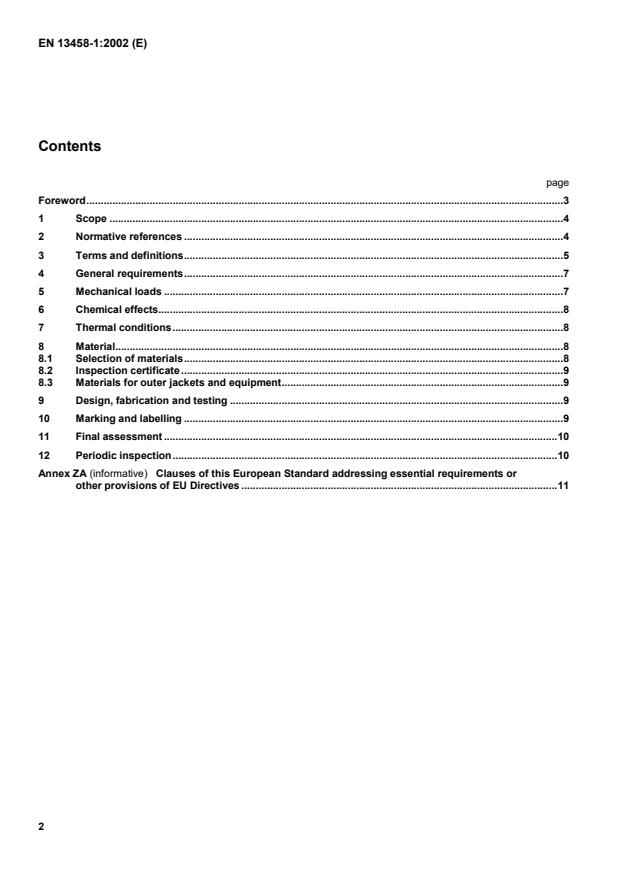
Contents
page
Foreword.3
1 Scope .4
2 Normative references .4
3 Terms and definitions.5
4 General requirements.7
5 Mechanical loads .7
6 Chemical effects.8
7 Thermal conditions.8
8 Material.8
8.1 Selection of materials.8
8.2 Inspection certificate .9
8.3 Materials for outer jackets and equipment.9
9 Design, fabrication and testing .9
10 Marking and labelling .9
11 Final assessment .10
12 Periodic inspection.10
Annex ZA (informative) Clauses of this European Standard addressing essential requirements or
other provisions of EU Directives .11
Foreword
This document EN 13458-1:2002 has been prepared by Technical Committee CEN/TC 268 "Cryogenic vessels",
the secretariat of which is held by AFNOR.
This European Standard shall be given the status of a national standard, either by publication of an identical text or
by endorsement, at the latest by November 2002, and conflicting national standards shall be withdrawn at the latest
by November 2002.
This document has been prepared under a mandate given to CEN by the European Commission and the European
Free Trade Association, and supports essential requirements of EU Directive(s).
For relationship with EU Directive(s), see informative annex ZA, which is an integral part of this document.
EN 13458 consists of the following parts under the general title, Cryogenic vessels – Static vacuum insulated
vessels:
– Part 1: Fundamental requirements.
– Part 2: Design, fabrication, inspection and testing.– Part 3: Operational requirements.
According to the CEN/CENELEC Internal Regulations, the national standards organizations of the following
countries are bound to implement this European Standard: Austria, Belgium, Czech Republic, Denmark, Finland,
France, Germany, Greece, Iceland, Ireland, Italy, Luxembourg, Malta, Netherlands, Norway, Portugal, Spain,
Sweden, Switzerland and the United Kingdom.
1 Scope
This European Standard specifies the fundamental requirements for static vacuum insulated cryogenic vessels
designed for a maximum allowable pressure greater than 0,5 bar.
This European Standard applies to static vacuum insulated cryogenic vessels for fluids as specified in 3.1.
For static vacuum insulated cryogenic vessels designed for a maximum allowable pressure of not more than
0,5 bar, this standard can be used as a guide.
This European Standard is not applicable to vessels built on-site.
2 Normative references
This European Standard incorporates by dated or undated reference, provisions from other publications. These
normative references are cited at the appropriate places in the text, and the publications are listed hereafter. For
dated references, subsequent amendments to or revisions of any of these publications apply to this European
Standard only when incorporated in it by amendment or revision. For undated references the latest edition of the
publication referred to applies (including amendments).
EN 1252-1, Cryogenic vessels - Materials - Part 1: Toughness requirements for temperature below – 80 °C.
EN 1252-2, Cryogenic vessels - Materials - Part 2: Toughness requirements for temperature between – 80 °C and
– 20 °C.
EN 1626, Cryogenic vessels - Valves for cryogenic service.
EN 1797, Cryogenic vessels - Gas/material compatibility.
EN 10204, Metallic products - Types of inspection documents.
EN 12300, Cryogenic vessels - Cleanliness for cryogenic service.
EN 13371, Cryogenic vessels - Couplings for cryogenic service.
prEN 13458-2, Cryogenic vessels - Static vacuum insulated vessels - Part 2: Design, fabrication, inspection and
testing.
prEN 13458-3, Cryogenic vessels – Static vacuum insulated vessels - Part 3: Operational requirements.
3 Terms and definitions
For the purposes of this European Standard, the following terms and definitions apply.
3.1
cryogenic fluid (refrigerated liquefied gas)
1)
gas which is partially liquid because of its low temperature . In the context of all parts of this standard, the
(refrigerated but) non-toxic gases given in Table 1 and mixtures of them are referred to as cryogenic fluids
Table 1 — Refrigerated but non toxic gases
2)
classification
Identification number, name and description
code
3° A Asphyxiant gases
1913 Neon, refrigerated liquid
1951 Argon, refrigerated liquid
1963 Helium, refrigerated liquid
1970 Krypton, refrigerated liquid
1977 Nitrogen, refrigerated liquid
2187 Carbon dioxide, refrigerated liquid
2591 Xenon, refrigerated liquid
3136 Trifluoromethane, refrigerated liquid
3)
Gas, refrigerated liquid, N.O.S.
3° O Oxidizing gases
1003 Air, refrigerated liquid
1073 Oxygen, refrigerated liquid
2201 Nitrous oxide, refrigerated liquid, oxidizing
3)
Gas, refrigerated liquid, oxidizing, N.O.S
3° F Flammable gases
1038 Ethylene, refrigerated liquid
1961 Ethane, refrigerated liquid
1966 Hydrogen, refrigerated liquid
1972 Methane, refrigerated liquid or natural gas, refrigerated liquid, with high methane content
3138 Ethylene, acetylene and propylene mixture, refrigerated liquid, containing at least 71,5 %
ethylene with not more than 22,5 % acetylene and not more than 6 % propylene
3)
Gas, refrigerated liquid, flammable, N.O.S
The flammable gases and mixtures of them may be mixed with: Helium, Neon, Nitrogen, Argon, Carbon dioxide.
NOTE Mixtures of oxidizing and flammable gases are not acceptable.
1) This includes totally evaporated liquids and supercritical fluids.
2) Classification code, identification number, name and description according to ADR.
3) N.O.S. = not otherwise specified.
3.2
static cryogenic vessels
thermally insulated vessel intended for use with one or more cryogenic fluids at a stationary place, consisting of an
inner vessel, an outer jacket and the piping system. This static cryogenic vessel is not intended to be transported
filled. It may be transported empty or containing marginal residues of cryogenic fluid or gas from one static location
to another. This static cryogenic vessel represents a complete assembly ready for putting into service
3.3
thermal insulation
vacuum interspace between the inner vessel and the outer jacket. The space may or may not be filled with material
to reduce the heat transfer between the inner vessel and the outer ja
...