

kSIST-TS FprCEN/TS 15502-3-2:2026
(Main)Gas-fired central heating boilers - Part 3-2: H2NG - Expansion of EN 15502-2-2:2024
General Information
- Abstract
Shall be according to EN 15502-2-2:2024, Clause 1 with the following modifications:
Add at the end of the list, after h), the following:
“i) which are atmospheric fully premixed appliances equipped with a Pneumatic Gas supply (PGS) that are intended to be connected to gas grids for natural gases of the second family where up to 20 mol% H2 is added to the natural gas (H2NG-Y20), where the quality of the distributed gas without adding the hydrogen is not likely to vary to a large extent over the lifetime of the appliance”
Replace:
“ak) appliances that are intended to burn natural gases of the second family where hydrogen is added to the natural gas;”
with:
“ak) appliances that are intended to burn natural gases of the second family where hydrogen is added to the natural gas, except for atmospheric fully premixed appliances equipped with a Pneumatic Gas supply (PGS)(which are covered by this document);”
- Status
- Not Published
- Public Enquiry End Date
- 01-Dec-2026
- Technical Committee
- PLN - Gas appliances for domestic use
- Current Stage
- 5520 - Unique Acceptance Procedure (UAP) (Adopted Project)
- Start Date
- 30-Sep-2026
- Due Date
- 17-Feb-2027

Get Certified
Connect with accredited certification bodies for this standard

DNV
DNV is an independent assurance and risk management provider.

Lloyd's Register
Lloyd's Register is a global professional services organisation specialising in engineering and technology.

DIBt (Deutsches Institut für Bautechnik)
German Institute for Building Technology.
Sponsored listings
Frequently Asked Questions
kSIST-TS FprCEN/TS 15502-3-2:2026 is a draft published by the Slovenian Institute for Standardization (SIST). Its full title is "Gas-fired central heating boilers - Part 3-2: H2NG - Expansion of EN 15502-2-2:2024". This standard covers: Shall be according to EN 15502-2-2:2024, Clause 1 with the following modifications: Add at the end of the list, after h), the following: “i) which are atmospheric fully premixed appliances equipped with a Pneumatic Gas supply (PGS) that are intended to be connected to gas grids for natural gases of the second family where up to 20 mol% H2 is added to the natural gas (H2NG-Y20), where the quality of the distributed gas without adding the hydrogen is not likely to vary to a large extent over the lifetime of the appliance” Replace: “ak) appliances that are intended to burn natural gases of the second family where hydrogen is added to the natural gas;” with: “ak) appliances that are intended to burn natural gases of the second family where hydrogen is added to the natural gas, except for atmospheric fully premixed appliances equipped with a Pneumatic Gas supply (PGS)(which are covered by this document);”
Shall be according to EN 15502-2-2:2024, Clause 1 with the following modifications: Add at the end of the list, after h), the following: “i) which are atmospheric fully premixed appliances equipped with a Pneumatic Gas supply (PGS) that are intended to be connected to gas grids for natural gases of the second family where up to 20 mol% H2 is added to the natural gas (H2NG-Y20), where the quality of the distributed gas without adding the hydrogen is not likely to vary to a large extent over the lifetime of the appliance” Replace: “ak) appliances that are intended to burn natural gases of the second family where hydrogen is added to the natural gas;” with: “ak) appliances that are intended to burn natural gases of the second family where hydrogen is added to the natural gas, except for atmospheric fully premixed appliances equipped with a Pneumatic Gas supply (PGS)(which are covered by this document);”
kSIST-TS FprCEN/TS 15502-3-2:2026 is classified under the following ICS (International Classification for Standards) categories: 27.060.30 - Boilers and heat exchangers; 91.140.10 - Central heating systems; 97.100.20 - Gas heaters. The ICS classification helps identify the subject area and facilitates finding related standards.
kSIST-TS FprCEN/TS 15502-3-2:2026 is available in PDF format for immediate download after purchase. The document can be added to your cart and obtained through the secure checkout process. Digital delivery ensures instant access to the complete standard document.
Standards Content (Sample)
SLOVENSKI STANDARD
01-november-2026
Plinski kotli za centralno ogrevanje - 3-2. del: H2NG - Razširitev standarda EN
15502-2-2:2024
Gas-fired central heating boilers - Part 3-2: H2NG - Expansion of EN 15502-2-2:2024
Heizkessel für gasförmige Brennstoffe - Teil 3-2: H2NG - Erweiterung von EN 15502-2-
2:2024
Ta slovenski standard je istoveten z: FprCEN/TS 15502-3-2
ICS:
91.140.10 Sistemi centralnega Central heating systems
ogrevanja
97.100.20 Plinski grelniki Gas heaters
2003-01.Slovenski inštitut za standardizacijo. Razmnoževanje celote ali delov tega standarda ni dovoljeno.
FINAL DRAFT
TECHNICAL SPECIFICATION
SPÉCIFICATION TECHNIQUE
TECHNISCHE SPEZIFIKATION
November 2026
ICS 27.060.30; 91.140.10
English Version
Gas-fired central heating boilers - Part 3-2: H2NG -
Expansion of EN 15502-2-2:2024
Heizkessel für gasförmige Brennstoffe - Teil 3-2: H2NG
- Erweiterung von EN 15502-2-2:2024
This draft Technical Specification is submitted to CEN members for Vote. It has been drawn up by the Technical Committee
CEN/TC 109.
CEN members are the national standards bodies of Austria, Belgium, Bulgaria, Croatia, Cyprus, Czech Republic, Denmark, Estonia,
Finland, France, Germany, Greece, Hungary, Iceland, Ireland, Italy, Latvia, Lithuania, Luxembourg, Malta, Netherlands, Norway,
Poland, Portugal, Republic of North Macedonia, Romania, Serbia, Slovakia, Slovenia, Spain, Sweden, Switzerland, Türkiye and
United Kingdom.
Recipients of this draft are invited to submit, with their comments, notification of any relevant patent rights of which they are
aware and to provide supporting documentation.
Warning : This document is not a Technical Specification. It is distributed for review and comments. It is subject to change
without notice and shall not be referred to as a Technical Specification.
EUROPEAN COMMITTEE FOR STANDARDIZATION
COMITÉ EUROPÉEN DE NORMALISATION
EUROPÄISCHES KOMITEE FÜR NORMUNG
CEN-CENELEC Management Centre: Rue de la Science 23, B-1040 Brussels
© 2026 CEN All rights of exploitation in any form and by any means reserved Ref. No. FprCEN/TS 15502-3-2:2026 E
worldwide for CEN national Members.
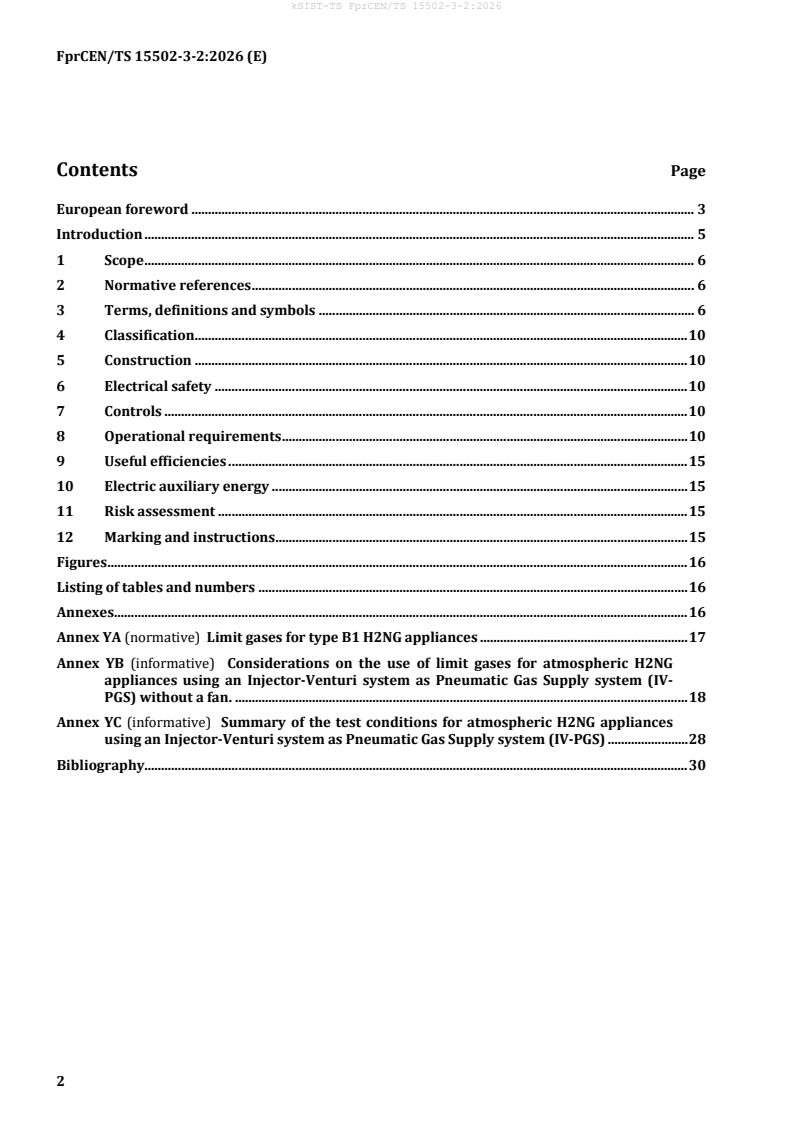
Contents Page
European foreword . 3
Introduction . 5
1 Scope . 6
2 Normative references . 6
3 Terms, definitions and symbols . 6
4 Classification . 10
5 Construction . 10
6 Electrical safety . 10
7 Controls . 10
8 Operational requirements . 10
9 Useful efficiencies . 15
10 Electric auxiliary energy . 15
11 Risk assessment . 15
12 Marking and instructions . 15
Figures . 16
Listing of tables and numbers . 16
Annexes . 16
Annex YA (normative) Limit gases for type B1 H2NG appliances . 17
Annex YB (informative) Considerations on the use of limit gases for atmospheric H2NG
appliances using an Injector-Venturi system as Pneumatic Gas Supply system (IV-
PGS) without a fan. . 18
Annex YC (informative) Summary of the test conditions for atmospheric H2NG appliances
using an Injector-Venturi system as Pneumatic Gas Supply system (IV-PGS) . 28
Bibliography. 30
European foreword
This document (FprCEN/TS 15502-3-2:2026) has been prepared by Technical Committee CEN/TC 109
“Central heating boilers using gaseous fuels”, the secretariat of which is held by NEN.
This document is currently submitted to the Vote on TS.
This document contains an expansion of the scope of EN 15502-2-2:2024 and provides requirements
needed for this expansion.
The only technical change compared to EN 15502-2-2:2024 is this expansion of the scope compared to
EN 15502-2-2:2024.
EN 15502 consists of the following parts under the general title “Gas-fired heating boilers":
— Part 1: General requirements and tests;
— Part 2-1: Specific standard for type C appliances and type B2, B3 and B5 appliances of a nominal heat
input not exceeding 1 000 kW;
— Part 2-2: Specific standard for type B1 appliances;
— Part 2-3: Specific standard for hybrid units combining a gas-fired boiler and an electrical heat pump
in a product;
— Part 3-1: H2NG and ACCF — Expansion of EN 15502-2-1:2022;
— Part 3-2: H2NG — Expansion of EN 15502-2-2:2024;
— Part 3-3: 100 % Hydrogen — Expansion of EN 15502-2-1:2022.
Relationship between this document, EN 15502-2-2:2024 and EN 15502-1:2021+A1:2023, the reader
needs to be aware of the following information:
a) This document (CEN/TS 15502-3-2) is to be used in conjunction with EN 15502-2-2:2024, while
EN 15502-2-2:2024 is to be used in conjunction with EN 15502-1:2021+A1:2023. This means that
this TS is to be used in conjunction with both EN 15502-2-2:2024 and EN 15502-1:2021+A1:2023
and that all information in EN 15502-2-2:2024 and EN 15502-1:2021+A1:2023 applies as well,
unless stated otherwise, see under b).
NOTE 1 To find the actual requirements or information in the (sub)clauses of EN 15502-2-2:2024 referred
to in this TS, one might need to check EN 15502-1:2021+A1:2023 (as EN 15502-2-2:2024 is to be used in
conjunction with EN 15502-1:2021+A1:2023).
b) The numbering structure of this TS is using the numbering structure of EN 15502-2-2:2024 and
expanding on it. Where this TS states “Shall be according to EN 15502-2-2:2024, [clause number]”
the numbering, title and text of that clause of EN 15502-2-2:2024 is to be used (including its sub
clauses and sub clause numbering, tables and table numbering, formulae and formulae numbering,
figures and figure numbering, lists and list numbering.
NOTE 2 The TS and its annexes can refer to (sub)clause numbers that are to be found either in this TS, or
EN 15502-2-2:2024, or EN 15502-1:2021+A1:2023.
c) The relevant text of EN 15502-2-2:2024 is to be adapted accordingly in all cases where this TS states:
FprEN/TS 15502-3-2:2026 (E)
— shall be according to EN 15502-2-2:2024, [clause number] with the following modification;
— shall be according to EN 15502-2-2:2024, [clause number] with the following modification of
[sub clause number(s)];
— shall be according to EN 15502-2-2:2024, [clause number] with the following addition;
— shall be according to EN 15502-2-2:2024, [clause number] with the addition of [sub clause
number(s)] at the end;
— EN 15502-2-2:2024, [clause number] is replaced by the following;
— the title of EN 15502-2-2:2024 [clause number] is replaced by the following;
— EN 15502-2-2:2024, [clause number] is not applicable.
d) Clauses or subclauses in this TS that are additional to the structure of EN 15502-2-2:2024 are
numbered “20x” (e.g. 3.1.201, 8.4.201, Table 201, Formula (201), Figure 201) or designated as Annex
“Y” (e.g. Annex YA, YB, YC, etc.). These additional (sub)clauses provide requirements and information
that is specific for the appliances that are covered in the scope of this TS.
NOTE 3 The additional (sub)clauses in this TS are not indicated as an addition to EN 15502-2-2:2024.
Introduction
The introduction of EN 15502-2-2:2026 applies.
FprEN/TS 15502-3-2:2026 (E)
1 Scope
Shall be according to EN 15502-2-2:2024, Clause 1 with the following modifications:
Add at the end of the list, after h), the following:
“i) which are atmospheric fully premixed appliances equipped with a Pneumatic Gas Supply (PGS) that
are intended to be connected to gas grids for natural gases of the second family where up to 20 mol% H
is added to the natural gas (H2NG-Y20), where the quality of the distributed gas without adding the
hydrogen is not likely to vary to a large extent over the lifetime of the appliance”
Replace:
“ak) appliances that are intended to burn natural gases of the second family where hydrogen is added to
the natural gas;”
with:
“ak) appliances that are intended to burn natural gases of the second family where hydrogen is added to
the natural gas, except for atmospheric fully premixed appliances equipped with a Pneumatic Gas
supply (PGS) (which are covered by this document);”
2 Normative references
The following documents are referred to in the text in such a way that some or all of their content
constitutes requirements of this document. For dated references, only the edition cited applies. For
undated references, the latest edition of the referenced document (including any amendments) applies.
The normative references of EN 15502-2-2:2024 apply.
3 Terms, definitions and symbols
3.1 Terms and definitions
For the purposes of this document, the terms and definitions given in EN 15502-2-2:2024, 3.1 and the
following apply.
ISO and IEC maintain terminology databases for use in standardization at the following addresses:
— ISO Online browsing platform: available at https://www.iso.org/obp/
— IEC Electropedia: available at https://www.electropedia.org/
3.1.201 Definitions introduced in this TS
3.1.201.1
H2NG grid
grid intended to supply gas to H2NG appliances
3.1.201.2
H2NG appliances
appliances that are intended to burn second family gases containing relevant amount of hydrogen
Note 1 to entry: Gas containing less than 0,5 % hydrogen is not considered to contain a relevant amount of hydrogen.
3.1.201.3
appliance category extension Y
appliance category extension for H2NG appliances identifying the maximum hydrogen content of the
H2NG gas, expressed as the molar percentage of the hydrogen content of the gas.
Note 1 to entry: If the maximum hydrogen percentage of the H2NG is 20 %, this is indicated with an extension “Y20”.
Note 2 to entry: An I2E appliance category boiler that is suitable to burn H2NG gases containing up to 20 mol% H2
shall have the extended appliance category I .
2EY20
Note 3 to entry: vol % is equivalent to mol% as the used pressure is almost atmospheric.
3.1.201.4
reduced nominal heat input Q
rn
nominal heat input obtained with the boiler set using the high Wobbe index reference gas at reference
conditions and operated using the low Wobbe index reference gas at reference conditions
Note 1 to entry: This is only used for expressing the reduction on the heat input due to the variation of the gas
composition supplied by H2NG gas grids.
3.1.201.5
reduced nominal heat output P
rn
nominal heat output obtained with the boiler set using the high Wobbe index reference gas at reference
conditions and operated using the low Wobbe index reference gas at reference conditions
Note 1 to entry: This is only used for expressing the reduction on the heat output due to the variation of the gas
composition supplied by H2NG gas grids.
3.1.201.6
distributed gas
gaseous fuel used on the territory of the CEN members and affiliated members
Note 1 to entry: Corresponds to the one given in the Regulation (EU) 2016/426 on gas appliances (article 2.2).
[SOURCE: EN 437:2021, 3.2, modified]
3.1.201.7
distribution Limit Gas DLG
distribution gases that will most likely result in an undesired combustion phenomenon
Note 1 to entry: The DLG depends on the distributed gas and the combustion and mixing technology used in the
appliance and the undesired combustion phenomenon.
Note 2 to entry: The DLG is specifying the normal operating range of gases for which the appliance is suitable for,
as declared in the instructions for installation.
3.1.201.8
test gas
gas intended for the verification of the operational characteristics of gas appliances
Note 1 to entry: Test gases include reference gases and limit gases.
[SOURCE: EN 437:2021, 3.3]
FprEN/TS 15502-3-2:2026 (E)
3.1.201.9
reference gas
test gas with which appliances operate under nominal conditions when they are supplied at the
corresponding normal pressure
[SOURCE: EN 437:2021, 3.4]
Note 1 to entry: In this TS some new appliance categories are used that have two reference gases, as this TS covers
appliances that are intended to be connected to H2NG gas grids.
Note 2 to entry: When this document mentions reference gas without specifying high or low Wobbe index, the high
Wobbe index reference gas is always intended.
3.1.201.10
low Wobbe index reference gas
reference gas containing the maximum amount of hydrogen with which appliances operate under
nominal low Wobbe Index conditions when they are supplied at the corresponding normal pressure
Note 1 to entry: As an example, for a 2 appliance with the reference gas G20, the low Wobbe index reference gas
EY20
has the following composition in volume: CH4 = 80 %; H2 = 20 % (also called G20Y20 in this document).
3.1.201.11
high Wobbe index reference gas
reference gas not containing hydrogen with which appliances operate under nominal high Wobbe index
conditions when they are supplied at the corresponding normal pressure
Note 1 to entry: As an example, for a 2 appliance with reference gas G20, the high Wobbe index
EY20
reference gas is G20.
3.1.201.12
limit gas
test gas representative of the extreme variations in the characteristics of the gases for which appliances
have been designed.
[SOURCE: EN 437:2021, 3.5]
Note 1 to entry: a limit gas that is intended to be used as a test gas where the test conditions, other than the test
pressures, are not required to be at the extremes of the normal operating conditions of the appliance, is referred to
in this document as Extreme Limit Gas (ELG).
Note 2 to entry: a limit gas that is intended to be used as a test gas where the test conditions, including the test
pressures, are required to be at the extremes of the normal operating conditions of the appliance, is referred to in
this document as Distribution Limit Gas (DLG, see 3.1.201.7).
3.1.201.13
test pressure
gas pressure used to verify the operational characteristics of gas appliances, consisting of normal and
limit pressures.
Note1 to entry: Gas pressure is expressed in millibars (mbar) 1 mbar = 100 Pa.
[SOURCE: EN 437:2021, 3.6]
3.1.201.14
normal pressure p
n
pressure under which the appliances operate in nominal conditions when they are supplied with the
corresponding reference gas.
[SOURCE: EN 437:2021, 3.7]
3.1.201.15
limit pressure p , p
max min
pressures representative of the extreme variations in the appliance supply conditions
Note1 to entry: Limit pressures comprise a maximum pressure pmax and a minimum pressure pmin.
[SOURCE: EN 437:2021, 3.8]
3.1.201.16
Propane Equivalent PE
hydrocarbons in the gas being conveyed, other than methane and propane, are expressed as an equivalent
amount of methane and propane which has the same ideal volume and the same average number of
hydrogen and carbon atoms per molecule as the said hydrocarbons
Note 1 to entry: The PE can be calculated based on the composition of the gas. A gas containing 93 % methane, 4 %
ethane, 2 % propane and 1 % butane has a PE of (0,5 × 4 %) + (1 × 2 %) + (1,5 × 1 %) = 5,5 %.
Note 2 to the entry: The propane equivalent is defined as a parameter to express the amount of higher hydrocarbons
in natural gas.
Note 3 to entry: In some specifications the relative density of gas is used as an indication of the amount of higher
hydrocarbons in gas. The density is only a good indicator for that, provided the gas only contains saturated
hydrocarbons and no inert gases, hydrogen or unsaturated hydrocarbons.
3.1.201.17
Pneumatic Gas Supply control PGS
device where the gas supply rate is pneumatically driven by the external gas supply pressure or an
internal appliance pressure regulator
Note 1 to entry: Pneumatically driven means that the product of the density and square of the volume rate of the
gas is proportional to the pressure difference.
Note 2 to entry: The most common PGS controls consist of a nozzle or injector having a turbulent flow.
Note 3 to entry: The Wobbe index, as a key gas quality parameter, was defined having pneumatically driven gas
supply in mind, as this was the only technology used in the past.
Note 4 to entry: An appliance with an injector burner or an atmospheric appliance is called a PGS appliance.
3.2 Symbols
Shall be according to EN 15502-2-2:2024, 3.2 with the following addition at the end: “
FprEN/TS 15502-3-2:2026 (E)
Table 201 — Additional symbols and abbreviations used
Definition Symbol / abbreviation
Reduced nominal heat input [kW] Q
rn
Reduced nominal heat output [kW] P
rn
Air factor [-] λ
p
“.
4 Classification
Shall be according to EN 15502-2-2:2024, Clause 4 with the following modification of 4.1.
4.1 Gases and categories
Shall be according to EN 15502-2-2:2024, 4.1 with the following addition at the end of 4.1:
“New appliance categories and test gases for H2NG appliances are given in Annex YA.
NOTE Annex YA will be updated when EN 437 includes appliance categories and test gases for H2NG
appliances.”.
5 Construction
Shall be according to EN 15502-2-2:2024, Clause 5 with the following modifications to 5.3.1.1 (5.3.1.1 is
in EN 15502-1:2021+A1:2023).
5.3.1.1 General related to the use of materials in gas appliances
Shall be according to EN 15502-2-2:2024, 5.3.1.1 with the following insertion at the end of the first
paragraph:
“For a H2NG appliance, the impact of hydrogen shall be taken into account.”.
6 Electrical safety
Shall be according to EN 15502-2-2:2024, Clause 6.
7 Controls
Shall be according to EN 15502-2-2:2024, Clause 7.
8 Operational requirements
8.1 General
Shall be according to EN 15502-2-2:2024, 8.1.
8.2 Soundness
Shall be according to EN 15502-2-2:2024, 8.2.
8.3 Hydraulic resistance
Shall be according to EN 15502-2-2:2024, 8.3.
8.4 Heat inputs and heat outputs
Shall be according to EN 15502-2-2:2024, 8.4.
8.5 Limiting temperatures
Shall be according to EN 15502-2-2:2024, 8.5.
8.6 Ignition, cross lighting, flame stability
Shall be according to EN 15502-2-2:2024, 8.6 with the following modification to 8.6.2.2 and 8.6.3.
8.6.2.2 Test conditions
EN 15502-2-2:2024, 8.6.2.2 (8.6.2.2 is in EN 15502-1:2021+A1:2023) is replaced with the following:
“For limit gases and limit conditions for type B1 H2NG appliances a suggestion is made in Annex YA.
The burner and ignition burner, if any, fitted with the appropriate injectors, are supplied successively
with each reference gas for the boiler category.
The tests are performed in still air.
The following tests are then carried out:
— Test no 1: ignition and combustion at extreme reduced gas supply pressure
The test is carried out without altering the adjustment of the burner and ignition burner.
The gas pressure at the boiler inlet is reduced to 70 % of the normal pressure for first and second
family gases and to the minimum pressure for third family gases (see 8.1.2.2).
Under these supply conditions, it is checked that the requirements of 8.6.2.1 are met.
This test is repeated at the minimum heat input permitted by the controls if ignition is possible under
these conditions.
For adjustable appliances, test no 1 is reconducted with adjustment of the burner and ignition burner
according technical documentation when the low Wobbe index reference gas is supplied.
— Test no 2: ignition and combustion at extreme overheating sensitive conditions for fully
premixed atmospheric burners with a PGS control
The tests are carried out under extreme overheating conditions.
Without altering the initial adjustment of the burner and ignition burner, the reference gases are
replaced by the corresponding overheating limit gas and the gas pressure at the boiler inlet is
reduced to the minimum pressure.
It is then checked that ignition of the burner, by the ignition burner or ignition device, takes place
correctly and that the above requirements are met.
This test is repeated at the minimum heat input given by the controls, if ignition is possible under
these conditions.
For adjustable appliances, test no 2 is reconducted with adjustment of the burner and ignition burner
according technical documentation when the low Wobbe index reference gas is supplied.
FprEN/TS 15502-3-2:2026 (E)
For boilers intended to be installed in a partially protected place the test is performed at the extremes
of the air supply temperature variation as specified in the installation instructions.
— Test no 3: ignition and combustion at extreme flame lift sensitive conditions
The tests are carried out under extreme flame lift conditions. Without altering the initial adjustment
of the burner and ignition burner and without altering the PGS controller, the reference gases are
replaced by the corresponding flame lift limit gas and the gas pressure at the boiler inlet is reduced
to the maximum pressure and the absence of lift is checked.
This test is performed both at the maximum and the minimum heat input given by the controls, if
ignition is possible under these conditions.
For boilers intended to be installed in a partially protected place the test is performed at the extremes
of the air supply temperature variation as specified in the installation instructions.”.
8.6.3 Special flue conditions
Shall be according to EN 15502-2-2:2024, 8.6.3 with the following modification to 8.6.3.101.2.
8.6.3.101.2 Test conditions
EN 15502-2-2:2024, 8.6.3.101.2 is replaced by the following:
“The boiler is supplied with one of the reference gases for its category at the nominal heat input and the
minimum heat input given by the controls, if such operation is described in the technical instructions.
In addition for H2NG boilers this test is repeated with the low Wobbe index reference gas.
The combustion products discharge safety device, if any, is put out of operation. A first test is carried out
applying a continuous downdraught at 1 m/s and 3 m/s within the test flue (see Figure 105 as a
reference). However, for B boilers, only a test with a downdraught of 3 m/s is done. A second test is
carried out with the flue blocked.”.
8.7 Reduction of gas pressure
Shall be according to EN 15502-2-2:2024, 8.7 with the following modification to 8.7.2 (8.7.2 is in
EN 15502-1:2021+A1:2023):
8.7.2 Test conditions
Shall be according to EN 15502-2-2:2024, 8.7.2 with the following addition at the end:
“In addition for H2NG boilers this test is repeated with the low Wobbe index reference gas.”
8.8 Defective closure of the gas valve immediately upstream of the main burner
Shall be according to EN 15502-2-2:2024, 8.8.
8.9 Pre-purge
Shall be according to EN 15502-2-2:2024, 8.9 with the following modification to 8.9.102.2.
8.9.102.2 Test conditions
EN 15502-2-2:2024, 8.9.102.2 is replaced by the following:
“The boiler is supplied with one of the reference gases at the normal test pressure; it is installed as stated
in 8.1.2.
With the boiler at ambient temperature, a combustible air-gas mixture that is within the flammability
limits of the gas used is introduced upstream of the burner surface or head. The boiler burner could be
used for this purpose if it supplies a fully mixed air/gas mixture.
The electrical igniter is put into service after the time required for filling the combustion chamber and
combustion products evacuation circuit with a combustible gas/air mixture.
It is checked visually that the above requirements are met.
In addition for H2NG boilers this test is repeated with the low Wobbe index reference gas.”.
8.10 Functioning of a permanent ignition burner when the fan stops during the standby
time
Shall be according to EN 15502-2-2:2024, 8.10.
8.11 Adjustment, control and safety device
Shall be according to EN 15502-2-2:2024, 8.11 with the following modification to 8.11.6, 8.11.101 and
8.11.102.
8.11.6 Flame supervision device
Shall be according to EN 15502-2-2:2024, 8.11.6 with the following modification to 8.11.6.2.5.2.
8.11.6.2.5.2 Test conditions
Shall be according to EN 15502-2-2:2024, 8.11.6.2.5.2 with the following addition at the end:
“In addition for H2NG boilers this test is repeated with the low Wobbe index reference gas.”.
8.11.101 Air proving device for type B12 and B13 boilers
Shall be according to EN 15502-2-2:2024, 8.11.101 with the following modification to 8.11.101.1:
8.11.101.1 General
Shall be according to EN 15502-2-2:2024, 8.11.101.1 with the following addition at the end:
“In addition for H2NG boilers this test is repeated with the low Wobbe index reference gas.”.
8.11.102 Combustion products discharge safety device
Shall be according to EN 15502-2-2:2024, 8.11.102 with the following modification to 8.11.102.3.2 and
8.11.102.3.3.
8.11.102.3.2 Test conditions number 1: Tests with complete blockage:
Shall be according to EN 15502-2-2:2024, 8.11.102.3.2 with the following addition at the end:
“In addition for H2NG boilers this test is repeated with the low Wobbe index reference gas.”.
8.11.102.3.3 Test conditions number 2: Tests with partial blockage:
Shall be according to EN 15502-2-2:2024, 8.11.102.3.3 with the following addition at the end:
“In addition for H2NG boilers this test is repeated with the low Wobbe index reference gas.”.
8.12 Carbon monoxide
Shall be according to EN 15502-2-2:2024, 8.12 with the following modifications to 8.12.3.3 and
8.12.101.2.
FprEN/TS 15502-3-2:2026 (E)
8.12.3.3 Flame lift
Shall be according to EN 15502-2-2:2024, 8.12.3.3 with the following modifications to 8.12.3.3.2.
8.12.3.3.2 Test conditions
EN 15502-2-2:2024, 8.12.3.3.2 is replaced by the following:
“The tests are carried out under extreme flame lift conditions. The extreme flame lift condition to be
tested depends on the design of the boiler:
a) for boilers with a PGS without pressure regulators, the gas pressure at the boiler inlet is reduced to the
minimum supply pressure given the technical documentation for the appliance category; The reference
gas is then replaced by the flame lift limit gas. It is checked that the above requirements are met.
b) for boilers with a PGS with pressure regulators, the boiler is adjusted to a heat input equal to 0,95
times the minimum heat input. The reference gas is then replaced by the flame lift limit gas. It is checked
that the above requirements are met.
For boilers intended to be installed in a partially protected place the test is performed at the extremes of
the air supply temperature variation as specified in the installation instructions.
It is checked that the requirements of 8.12.3.3.1 are met.”.
8.12.101.2 Test conditions:
Shall be according to EN 15502-2-2:2024, 8.12.101.2 with the following addition at the end:
“In add
...