


oSIST prEN 2133:2025
(Main)Aerospace series - Cadmium plating of steels with specified tensile strength ≤ 1 450 MPa, copper, copper alloys and nickel alloys
Aerospace series - Cadmium plating of steels with specified tensile strength ≤ 1 450 MPa, copper, copper alloys and nickel alloys
This document specifies the electrolytic cadmium plating of parts and fasteners in steel of tensile strength UTS ≤ 1 450 MPa, copper, copper alloys and nickel alloys, whose temperature in service does not exceed 235 °C.
Luft- und Raumfahrt - Cadmieren von Stählen mit einer Zugfestigkeit ≤ 1 450 MPa, Kupfer, Kupferlegierungen und Nickellegierungen
Dieses Dokument legt das elektrolytische Cadmieren von Teilen aus Stahl mit einer Zugfestigkeit UTS ≤ 1 450 MPa, aus Kupfer, Kupferlegierungen und Nickellegierungen fest, deren Betriebstemperatur 235 °C nicht überschreitet.
Série aérospatiale - Cadmiage électrolytique des aciers de résistance ≤ 1 450 MPa, du cuivre, des alliages de cuivre et des alliages de nickel
Le présent document spécifie le cadmiage électrolytique des pièces et éléments de fixation en acier de résistance à la traction UTS ≤ 1 450 MPa, en cuivre, alliages de cuivre et alliages de nickel, dont la température en service ne dépasse pas 235 °C.
Aeronavtika - Kadmiranje jekla z določeno natezno trdnostjo ≤ 1 450 MPa z bakrom, bakrovimi in nikljevimi zlitinami
General Information
- Status
- Not Published
- Public Enquiry End Date
- 17-Sep-2025
- Technical Committee
- I13 - Imaginarni 13
- Current Stage
- 4020 - Public enquire (PE) (Adopted Project)
- Start Date
- 24-Jul-2025
- Due Date
- 11-Dec-2025
- Completion Date
- 18-Sep-2025

Relations
- Effective Date
- 18-Dec-2024
Overview
oSIST prEN 2133:2025 is a draft European Standard developed by CEN as part of the aerospace series, focusing on the cadmium plating of steels with a specified tensile strength of ≤ 1 450 MPa, copper, copper alloys, and nickel alloys. This standard outlines requirements for the electrolytic cadmium plating process applied to parts and fasteners operating at service temperatures not exceeding 235 °C. The standard supersedes EN 2133:2020, introducing significant technical updates and clarifying process requirements and post-treatment options for aerospace applications.
Cadmium plating is widely used in aerospace due to its excellent corrosion resistance and ability to prevent galvanic corrosion between dissimilar materials. This process is essential for components exposed to harsh environments, providing extended service life and reliability.
Key Topics
Scope and Materials
The standard applies to:- Steels with ultimate tensile strength (UTS) ≤ 1 450 MPa
- Copper and copper alloys
- Nickel alloys
- Service temperature limit: 235 °C
Cadmium Plating Types
- Type 1: As plated (no post-treatment)
- Type 2: With hexavalent chromium based post-treatment
- Type 3: Without hexavalent chromium post-treatment
Coating Thickness Classes
- Class A: 10 µm to 20 µm
- Class B: 5 µm to 14 µm
- Class C: 5 µm to 10 µm
Process and Quality Control
- Surface pre-treatment and masking
- Optional nickel strike for improved adhesion
- Hydrogen-embrittlement-relief heat treatment for steels
- Regular and periodic testing requirements (appearance, adhesion, thickness, corrosion resistance, hydrogen embrittlement)
- Quality assurance measures and process approvals
Restrictions and Limitations
- Contact with titanium or titanium alloys, fuels, and fuel lines must be avoided or is inadmissible above 150 °C
- Specific requirements for removal and reprocessing to avoid substrate damage
Applications
oSIST prEN 2133:2025 is primarily intended for use in the aerospace industry and associated sectors where high-performance coatings are required. Typical applications include:
- Fasteners: Screws, bolts, nuts, and similar hardware where corrosion protection and resistance to hydrogen embrittlement are critical.
- Structural Parts: Components subject to varying environmental exposures, such as landing gear, airframe assemblies, and brackets.
- Electrical Connectors: Critical in preventing galvanic coupling in mixed-material assemblies.
- Other High-Reliability Parts: Used in spacecraft, defense equipment, and advanced aviation products where stringent coatings requirements ensure product longevity and safety.
The standard ensures that manufacturers and suppliers deliver consistent, high-quality cadmium coatings, minimizing the risk of corrosion and mechanical failure in service.
Related Standards
For full compliance and additional technical detail, oSIST prEN 2133:2025 references the following important standards:
- EN ISO 1463: Measurement of coating thickness - microscopical method
- EN 2828: Adhesion test for metallic coatings by burnishing
- EN 2831/2832: Hydrogen embrittlement tests for steels
- EN ISO 9227: Corrosion tests – Salt spray testing
- EN ISO 2082/2177/2178/3497: Coating thickness measurement by various methods
- ASTM B117-19: Salt spray test method
- ASTM F519-18: Hydrogen embrittlement evaluation
- NASM 1312-5/14: Fastener test methods
- EN 9100: Quality management for aerospace (see Bibliography)
Keywords: oSIST prEN 2133:2025, cadmium plating aerospace, CEN standard, steel copper nickel alloys plating, hydrogen embrittlement, corrosion resistance, aerospace fasteners, quality assurance, metallic coatings, heat treatment, coating thickness standards.
Get Certified
Connect with accredited certification bodies for this standard

BUREAU VERITAS Certification Germany
Bureau Veritas certification in Germany.

Element Materials Technology
Materials testing and product certification.

AQMS Ltd.
AQMS provides ISO certification to SMEs across the UK.
Sponsored listings
Frequently Asked Questions
oSIST prEN 2133:2025 is a draft published by the Slovenian Institute for Standardization (SIST). Its full title is "Aerospace series - Cadmium plating of steels with specified tensile strength ≤ 1 450 MPa, copper, copper alloys and nickel alloys". This standard covers: This document specifies the electrolytic cadmium plating of parts and fasteners in steel of tensile strength UTS ≤ 1 450 MPa, copper, copper alloys and nickel alloys, whose temperature in service does not exceed 235 °C.
This document specifies the electrolytic cadmium plating of parts and fasteners in steel of tensile strength UTS ≤ 1 450 MPa, copper, copper alloys and nickel alloys, whose temperature in service does not exceed 235 °C.
oSIST prEN 2133:2025 is classified under the following ICS (International Classification for Standards) categories: 49.040 - Coatings and related processes used in aerospace industry. The ICS classification helps identify the subject area and facilitates finding related standards.
oSIST prEN 2133:2025 has the following relationships with other standards: It is inter standard links to SIST EN 2133:2021. Understanding these relationships helps ensure you are using the most current and applicable version of the standard.
oSIST prEN 2133:2025 is available in PDF format for immediate download after purchase. The document can be added to your cart and obtained through the secure checkout process. Digital delivery ensures instant access to the complete standard document.
Standards Content (Sample)
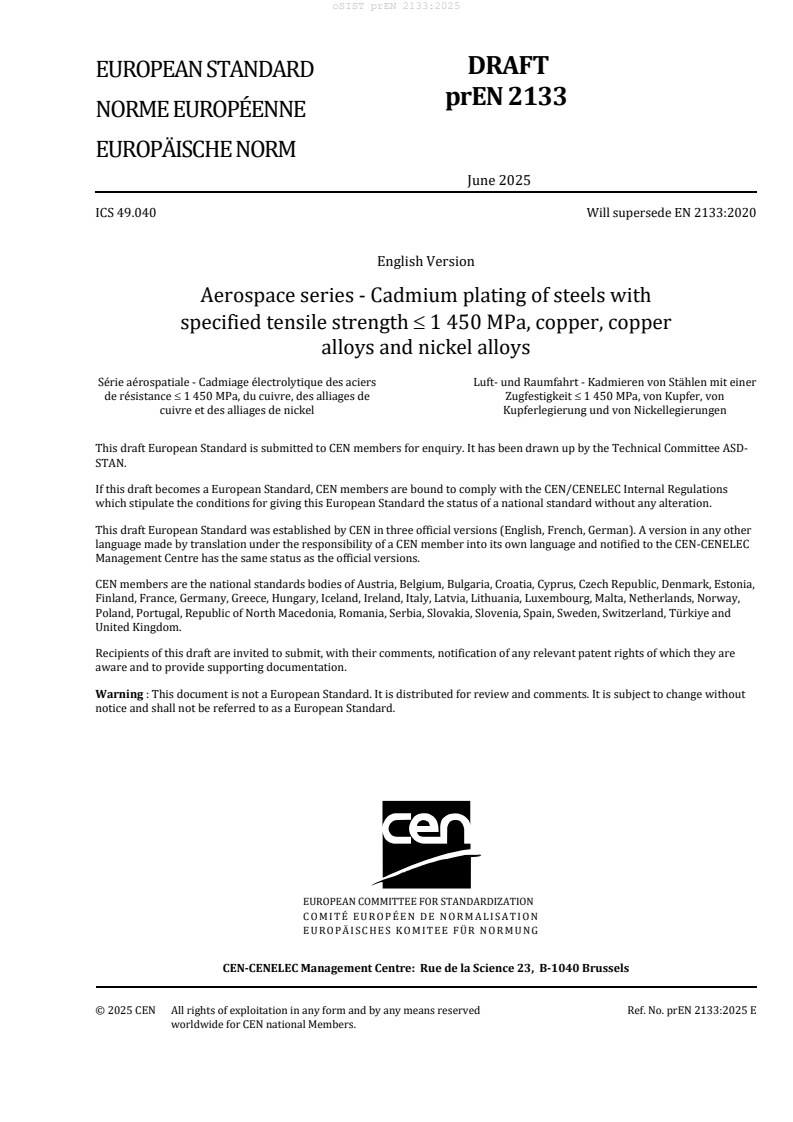
SLOVENSKI STANDARD
01-september-2025
Aeronavtika - Kadmiranje jekla z določeno natezno trdnostjo ≤ 1 450 MPa z
bakrom, bakrovimi in nikljevimi zlitinami
Aerospace series - Cadmium plating of steels with specified tensile strength ≤ 1 450
MPa, copper, copper alloys and nickel alloys
Luft- und Raumfahrt - Cadmieren von Stählen mit einer Zugfestigkeit ≤ 1 450 MPa,
Kupfer, Kupferlegierungen und Nickellegierungen
Série aérospatiale - Cadmiage électrolytique des aciers de résistance ≤ 1 450 MPa, du
cuivre, des alliages de cuivre et des alliages de nickel
Ta slovenski standard je istoveten z: prEN 2133
ICS:
49.040 Prevleke in z njimi povezani Coatings and related
postopki, ki se uporabljajo v processes used in aerospace
letalski in vesoljski industriji industry
2003-01.Slovenski inštitut za standardizacijo. Razmnoževanje celote ali delov tega standarda ni dovoljeno.
DRAFT
EUROPEAN STANDARD
prEN 2133
NORME EUROPÉENNE
EUROPÄISCHE NORM
June 2025
ICS 49.040 Will supersede EN 2133:2020
English Version
Aerospace series - Cadmium plating of steels with
specified tensile strength 1 450 MPa, copper, copper
alloys and nickel alloys
Série aérospatiale - Cadmiage électrolytique des aciers Luft- und Raumfahrt - Kadmieren von Stählen mit einer
de résistance 1 450 MPa, du cuivre, des alliages de Zugfestigkeit 1 450 MPa, von Kupfer, von
cuivre et des alliages de nickel Kupferlegierung und von Nickellegierungen
This draft European Standard is submitted to CEN members for enquiry. It has been drawn up by the Technical Committee ASD-
STAN.
If this draft becomes a European Standard, CEN members are bound to comply with the CEN/CENELEC Internal Regulations
which stipulate the conditions for giving this European Standard the status of a national standard without any alteration.
This draft European Standard was established by CEN in three official versions (English, French, German). A version in any other
language made by translation under the responsibility of a CEN member into its own language and notified to the CEN-CENELEC
Management Centre has the same status as the official versions.
CEN members are the national standards bodies of Austria, Belgium, Bulgaria, Croatia, Cyprus, Czech Republic, Denmark, Estonia,
Finland, France, Germany, Greece, Hungary, Iceland, Ireland, Italy, Latvia, Lithuania, Luxembourg, Malta, Netherlands, Norway,
Poland, Portugal, Republic of North Macedonia, Romania, Serbia, Slovakia, Slovenia, Spain, Sweden, Switzerland, Türkiye and
United Kingdom.
Recipients of this draft are invited to submit, with their comments, notification of any relevant patent rights of which they are
aware and to provide supporting documentation.
Warning : This document is not a European Standard. It is distributed for review and comments. It is subject to change without
notice and shall not be referred to as a European Standard.
EUROPEAN COMMITTEE FOR STANDARDIZATION
COMITÉ EUROPÉEN DE NORMALISATION
EUROPÄISCHES KOMITEE FÜR NORMUNG
CEN-CENELEC Management Centre: Rue de la Science 23, B-1040 Brussels
© 2025 CEN All rights of exploitation in any form and by any means reserved Ref. No. prEN 2133:2025 E
worldwide for CEN national Members.
prEN 2133:2025 (E)
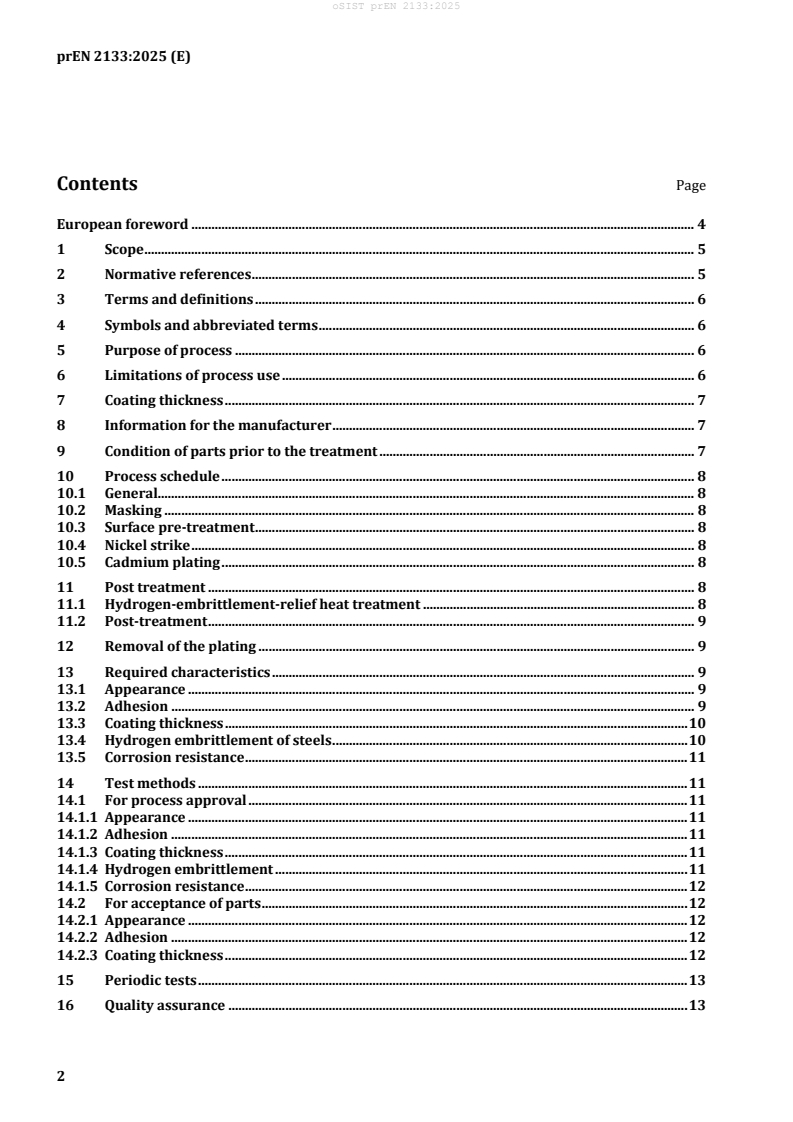
Contents Page
European foreword . 4
1 Scope . 5
2 Normative references . 5
3 Terms and definitions . 6
4 Symbols and abbreviated terms . 6
5 Purpose of process . 6
6 Limitations of process use . 6
7 Coating thickness . 7
8 Information for the manufacturer . 7
9 Condition of parts prior to the treatment . 7
10 Process schedule . 8
10.1 General. 8
10.2 Masking . 8
10.3 Surface pre-treatment . 8
10.4 Nickel strike . 8
10.5 Cadmium plating . 8
11 Post treatment . 8
11.1 Hydrogen-embrittlement-relief heat treatment . 8
11.2 Post-treatment . 9
12 Removal of the plating . 9
13 Required characteristics . 9
13.1 Appearance . 9
13.2 Adhesion . 9
13.3 Coating thickness . 10
13.4 Hydrogen embrittlement of steels . 10
13.5 Corrosion resistance . 11
14 Test methods . 11
14.1 For process approval . 11
14.1.1 Appearance . 11
14.1.2 Adhesion . 11
14.1.3 Coating thickness . 11
14.1.4 Hydrogen embrittlement . 11
14.1.5 Corrosion resistance . 12
14.2 For acceptance of parts . 12
14.2.1 Appearance . 12
14.2.2 Adhesion . 12
14.2.3 Coating thickness . 12
15 Periodic tests . 13
16 Quality assurance . 13
prEN 2133:2025 (E)
16.1 Approval of the manufacturer . 13
16.2 Process approval. 13
16.3 Acceptance . 13
16.4 Reprocessing . 14
16.5 Periodic chemical analysis . 14
17 Designation . 14
Annex A (informative) Process flow . 15
Annex B (informative) Standard evolution form . 16
Bibliography . 19
prEN 2133:2025 (E)
European foreword
This document (prEN 2133:2025) has been prepared by ASD-STAN.
After enquiries and votes carried out in accordance with the rules of this Association, this document has
received the approval of the National Associations and the Official Services of the member countries of
ASD-STAN, prior to its presentation to CEN.
This document is currently submitted to the CEN Enquiry.
This document will supersede EN 2133:2020.
prEN 2133:2025 includes the following significant technical changes with respect to EN 2133:2020:
— making the nickel strike optional instead of mandatory;
— clarifying the definitions of brighteners and wetting agents;
— providing clarification on the heat treatment;
— adding the option to perform de-embrittlement heat treatment after removal and re-plating if both
processes take less than 4 h;
— including information on post-treatment in type 3;
— adding an introductory sentence before the different types of cadmium plating;
— modifying Annex A.
See also Annex B for a list of technical changes.
prEN 2133:2025 (E)
1 Scope
This document specifies the electrolytic cadmium plating of parts and fasteners in steel of tensile strength
UTS ≤ 1 450 MPa, copper, copper alloys and nickel alloys, whose temperature in service does not exceed
235 °C.
2 Normative references
The following documents are referred to in the text in such a way that some or all of their content
constitutes requirements of this document. For dated references, only the edition cited applies. For
undated references, the latest edition of the referenced document (including any amendments) applies.
EN 2828, Aerospace series - Adhesion test for metallic coatings by burnishing
EN 2831, Aerospace series - Hydrogen embrittlement of steels - Test by slow bending
EN 2832, Aerospace series - Hydrogen embrittlement of steels - Notched specimen test
EN ISO 1463, Metallic and oxide coatings - Measurement of coating thickness - Microscopical method (ISO
1463)
EN ISO 2082, Metallic and other inorganic coatings - Electroplated coatings of cadmium with
supplementary treatments on iron or steel (ISO 2082)
EN ISO 2177, Metallic coatings - Measurement of coating thickness - Coulometric method by anodic
dissolution (ISO 2177)
EN ISO 2178, Non-magnetic coatings on magnetic substrates - Measurement of coating thickness - Magnetic
method (ISO 2178)
EN ISO 2409, Paints and varnishes - Cross-cut test (ISO 2409)
EN ISO 2819, Metallic coatings on metallic substrates - Electrodeposited and chemically deposited coatings
- Review of methods available for testing adhesion (ISO 2819)
EN ISO 3497, Metallic coatings - Measurement of coating thickness - X-ray spectrometric methods (ISO
3497)
EN ISO 9227, Corrosion tests in artificial atmospheres - Salt spray tests (ISO 9227)
ISO 2859-1, Sampling procedures for inspection by attributes — Part 1: Sampling schemes indexed by
acceptance quality limit (AQL) for lot-by-lot inspection
ASTM B117-19, Standard Practice for Operating Salt Spray (Fog) Apparatus
ASTM F519-18, Standard test method for mechanical hydrogen embrittlement — Evaluation of
plating/coating process and service environment
NASM 1312-5, Fastener Test Methods — Method 5 — Stress Durability
NASM 1312-14, Fastener Test Methods — Method 14 — Stress Durability, Internally Threaded Fasteners
Published by: ASTM National (US) American Society for Testing and Materials, https://www.astm.org/.
Published by: AIA National (US) Aerospace Industries Association of America, https://www.aia-aerospace.org/.
prEN 2133:2025 (E)
3 Terms and definitions
For the purposes of this document, the following terms and definitions apply.
ISO and IEC maintain terminology databases for use in standardization at the following addresses:
— ISO Online browsing platform: available at https://www.iso.org/obp
— IEC Electropedia: available at https://www.electropedia.org/
3.1
batch
unless otherwise specified, parts of the same type (shape, size, material), treated at the same time in the
same baths
Note 1 to entry: For mechanical parts, hydrogen embrittlement relieved at the same time.
3.2
pre-production part
part representative of future production
3.3
brighteners
organic or metallic compounds that, when added to alkaline cyanide cadmium plating baths, influence
the formation of the electrodeposited cadmium crystals
3.4
wetting agents
chemical that can be added to a liquid to reduce its surface tension and make it more effective in
spreading over and penetrating surfaces
4 Symbols and abbreviated terms
For the purposes of this document, the following symbols and abbreviations apply:
UTS Ultimate tensile strenght
5 Purpose of process
To ensure protection against corrosion or to reduce the effects of galvanic coupling when assembling
different materials, e.g. steel, aluminium or magnesium. Cadmium plating shall be of the following types
defined at the purchase order.
— Type 1: as plated;
— Type 2: with hexavalent chromium based post-treatment;
— Type 3: without hexavalent chromium based post-treatment.
If the type is not specified by the purchase order, the choice between Type 2 or 3 is left to the supplier.
6 Limitations of process use
Contact of cadmium plated parts with titanium, titanium alloys, fuels and fuel lines
— shall be avoided at temperatures < 150 °C;
prEN 2133:2025 (E)
— is inadmissible at temperatures ≥ 150 °C.
7 Coating thickness
Unless otherwise specified in the product standard or definition document, the coating thicknesses are
as follows:
— Class A: 10 µm to 20 µm;
— Class B: 5 µm to 14 µm;
— Class C: 5 µm to 10 µm.
NOTE These thicknesses refer to the cadmium coating only (including the post-treatment). The nickel strike
thicknesses are considered negligible.
8 Information for the manufacturer
— designation, see Clause 17;
— number of the substrate standard and metallurgical condition
...