

oSIST prEN IEC 60086-6:2027
(Main)Primary batteries - Part 6: Guidance on environmental aspects
- Status
- Not Published
- Public Enquiry End Date
- 28-Jan-2027
- Technical Committee
- I09 - Imaginarni 09
- Current Stage
- 4020 - Public enquire (PE) (Adopted Project)
- Start Date
- 10-Nov-2026
- Due Date
- 30-Mar-2027

oSIST prEN IEC 60086-6:2027 is the Slovene adoption of IEC 60086-6, published by IEC as Primary batteries - Part 6: Guidance on environmental aspects. It gives guidance for all chemistries of portable primary cells and batteries standardized in the IEC 60086 series, covering environmental testing, marking, disposal, recycling, and life cycle assessment. For engineers, quality managers, buyers, and recyclers, it is the part of the series that connects battery design and handling to environmental rules and practical verification.
What does oSIST prEN IEC 60086-6:2027 specify?
oSIST prEN IEC 60086-6:2027 specifies guidance on environmental aspects for portable primary cells and batteries in the IEC 60086 series. It brings together scientific test protocols, marking symbols for collection and recycling, and the environmental aspects to consider when assessing batteries with life cycle methods.
The document is organized into clauses 1 to 9, plus four informative annexes. Clause 1 gives the scope, clause 2 gives the normative reference, clause 3 defines key terms, clauses 4 to 9 cover general environmental considerations, heavy metals, disposal, packaging, systematic identification of environmental aspects, and life cycle assessment.
| Annex | What it covers |
|---|---|
| Annex A | Battery-specific laws and regulations in regions and countries |
| Annex B | Global regulations not applicable to batteries |
| Annex C | Compliance checklist |
| Annex D | Basel Convention and hazardous waste movement |
What are the key requirements of oSIST prEN IEC 60086-6:2027?
The main technical content of oSIST prEN IEC 60086-6:2027 is in clauses 5 to 9. It focuses on how battery makers, users, and recyclers should check substances, prepare samples, mark batteries, manage disposal, and assess environmental performance.
Heavy metals, analysis, and marking
Clause 5.3 sets the environmental substance limits for mercury, lead, and cadmium and ties them to the battery types covered by the IEC 60086 series. Table 1 shows which battery chemistries may contain these substances and whether testing is needed. In practice, this is the part a manufacturer uses to decide whether a battery design needs analytical verification and whether a chemistry is expected to require it.
Clause 5.5 points sample preparation and analysis for mercury, cadmium, and lead to IEC 62321-4. That matters because the standard does not leave metal analysis to an informal method - it directs users to a defined laboratory approach.
Clause 5.6 requires the crossed-out wheeled bin symbol on the battery or its packaging where collection and recycling laws apply, and it allows another required symbol where local law demands one. In practice, this affects packaging artwork and market-specific labelling files.
Disassembly and sample preparation
Clause 5.4 gives a disassembly method for dry batteries, especially alkaline batteries and carbon zinc batteries, as preparation for pre-treatment and measurement of substances such as cadmium, mercury, and lead. It recommends sorting the battery into four material categories before analysis, rather than mixing all parts together.
That matters because the document explains that sorting reduces the risk of losing target substances during sample preparation or creating measurement interference. It also states that disassembly should be done by an instructed or skilled person, so the method is meant for competent laboratory or technical staff, not casual handling.
Disposal and hazardous waste checks
Clause 6 says primary batteries that meet the clause 5.3 requirements are not a threat to the environment during normal use and waste management, and they should be disposed of according to local laws and regulations. It also points readers to Annex D for Basel Convention topics and Annex B for regulations that are not directly about batteries but can still affect products containing batteries.
Clause 6.2 checks hazardous waste characteristics through toxicity, ignitability, reactivity, and corrosivity. The text explains why primary batteries generally do not meet those criteria under the conditions described. In practice, this section helps waste handlers and compliance teams decide whether a battery shipment or waste stream needs special control.
Environmental design and life cycle thinking
Clause 7 recommends considering environmental impacts from raw material production through manufacturing, use, collection, and waste treatment. It calls for environmental assessment during design and presents a waste-management hierarchy that includes reduction, reuse, and recycling.
Clause 7.2.4 gives the recycling efficiency concept and formula, and explains how input and output fractions are treated. The practical use is straightforward: recyclers can use it to document process performance, while producers can use it to understand how design choices affect recyclability.
Clause 7.3 adds packaging considerations. It links packaging to safety, quality, and the communication of required information such as warnings, manufacturer contact data, product details, and instructions for use. That means packaging is treated as part of the product system, not only as shipping material.
Clause 8 points standards developers to a systematic approach for identifying product environmental aspects, and clause 9 directs life cycle assessment work to the ISO framework for LCA. For users of the document, that means environmental claims or studies should follow a recognized method rather than ad hoc analysis.
What terms does oSIST prEN IEC 60086-6:2027 define?
oSIST prEN IEC 60086-6:2027 defines a small set of terms that are central to environmental assessment and recycling.
- Environmental impact assessment (EIA) - the process of determining the magnitude and significance of environmental impacts within the goals and scope of life cycle assessment.
- End of life (EOL) - the life cycle stage that starts when a product is finally removed from its intended use.
- Input fraction - the mass of collected waste batteries entering the recycling process.
- Output fraction - the mass of material produced from the input fraction, without further treatment, that has ceased to be waste or is reused for another purpose.
- Life cycle - the linked stages of a system from resource extraction to final disposal of materials or dissipated energy.
- Recycling - reprocessing waste materials in a production process for their original purpose or another purpose, excluding energy recovery.
- Recycling efficiency - the percentage ratio of output fractions to input fractions for a recycling process.
- Recyclability - the property that makes a substance, material, or part able to be recycled.
- Toxicity - the degree to which a substance is harmful to health.
Who uses oSIST prEN IEC 60086-6:2027?
oSIST prEN IEC 60086-6:2027 is used by battery producers, battery designers, recyclers, testing laboratories, and compliance or quality teams working with portable primary cells and batteries. Clause 5.1 specifically tells battery producers to take local laws and regulations into account when designing batteries, selecting suppliers, checking raw materials, and marking products.
It is also useful for buyers and technical specifiers who need to understand environmental labelling, heavy-metal restrictions, and recycling expectations before choosing a battery type. Regulators and standards developers can use Annex A, Annex B, and clause 8 when comparing battery rules with broader environmental requirements.
What changed in oSIST prEN IEC 60086-6:2027 from the previous edition?
oSIST prEN IEC 60086-6:2027 is the second edition and it cancels and replaces the first edition published in 2020. The foreword says this edition is a technical revision.
The stated changes are:
- Annex A adds India - The Battery Waste Management Rules.
- Annexes A.4.1 and A.6.3 add T Chemistry (TR03 and TR6).
- Annex A.4.1 is updated with the full list of restricted substances under China RoHS.
Which standards are used with oSIST prEN IEC 60086-6:2027?
oSIST prEN IEC 60086-6:2027 refers to several standards that support its application.
- IEC 60086-1:2026 - the only normative reference in clause 2, and the source for general primary-battery requirements and marking requirements mentioned in clause 5.6.
- IEC 62321-4:2013/AMD1 2017 - the method reference for sample preparation and analysis of mercury, cadmium, and lead.
- ISO 21268-2:2019 - cited for toxicity testing through the batch leaching procedure.
- ISO 2719:2025 and ISO 3679:2022 - cited for flash-point testing in the ignitability discussion.
- IEC 60746-2:2003 and ISO 9223:2012 - used in the corrosivity discussion.
- ISO 14040:2006/AMD1 2020 and ISO 14044:2006/AMD1 2017/AMD2 2020 - the life cycle assessment framework used in clause 9.
- ISO Guide 82:2019 and IEC GUIDE 109:2012 - cited as guidance for including sustainability and environmental aspects in standards.
- IEC 60050-904:2014 - the source for the defined term “end of life”.
What does the oSIST prEN IEC 60086-6:2027 document contain?
oSIST prEN IEC 60086-6:2027 contains a mix of guidance, tables, figures, and annex material. The body includes a hazardous-substances table for different battery chemistries, a disassembly method for alkaline and carbon zinc batteries, a recycling-efficiency formula, and guidance on hazardous-waste characteristics. It also includes the crossed-out wheeled bin symbol for collection, plus explanatory notes on packaging, environmental assessment, and LCA.
The annexes add practical reference material rather than new core requirements. Annex A lists battery-specific laws and regulations by region, Annex B explains regulations that are not applicable to batteries, Annex C gives a compliance checklist, and Annex D summarizes Basel Convention issues for waste batteries and transboundary movement.
Relations
- Effective Date
- 10-Dec-2024
Get Certified
Connect with accredited certification bodies for this standard

IMQ S.p.A. (Certification)
Italian electrical product certification.

SLG Prüf- und Zertifizierungs GmbH
German testing and certification body.

UL Solutions
Global safety science company with testing, inspection and certification.
Sponsored listings
Frequently Asked Questions
oSIST prEN IEC 60086-6:2027 is a draft published by the Slovenian Institute for Standardization (SIST). Its full title is "Primary batteries - Part 6: Guidance on environmental aspects". This standard covers: Primary batteries - Part 6: Guidance on environmental aspects
Primary batteries - Part 6: Guidance on environmental aspects
oSIST prEN IEC 60086-6:2027 is classified under the following ICS (International Classification for Standards) categories: 29.220.10 - Primary cells and batteries. The ICS classification helps identify the subject area and facilitates finding related standards.
oSIST prEN IEC 60086-6:2027 has the following relationships with other standards: It is inter standard links to SIST EN IEC 60086-6:2020. Understanding these relationships helps ensure you are using the most current and applicable version of the standard.
oSIST prEN IEC 60086-6:2027 is available in PDF format for immediate download after purchase. The document can be added to your cart and obtained through the secure checkout process. Digital delivery ensures instant access to the complete standard document.
Standards Content (Sample)
SLOVENSKI STANDARD
01-januar-2027
Primarne baterije - 6. del: Navodilo glede okoljskih vidikov
Primary batteries - Part 6: Guidance on environmental aspects
Primärbatterien – Teil 6: Leitfaden zu Umweltaspekten
Piles électriques - Partie 6: Recommandation sur les aspects liés à l'environnement
Ta slovenski standard je istoveten z: prEN IEC 60086-6:2026
ICS:
29.220.10 Primarni členi in baterije Primary cells and batteries
2003-01.Slovenski inštitut za standardizacijo. Razmnoževanje celote ali delov tega standarda ni dovoljeno.
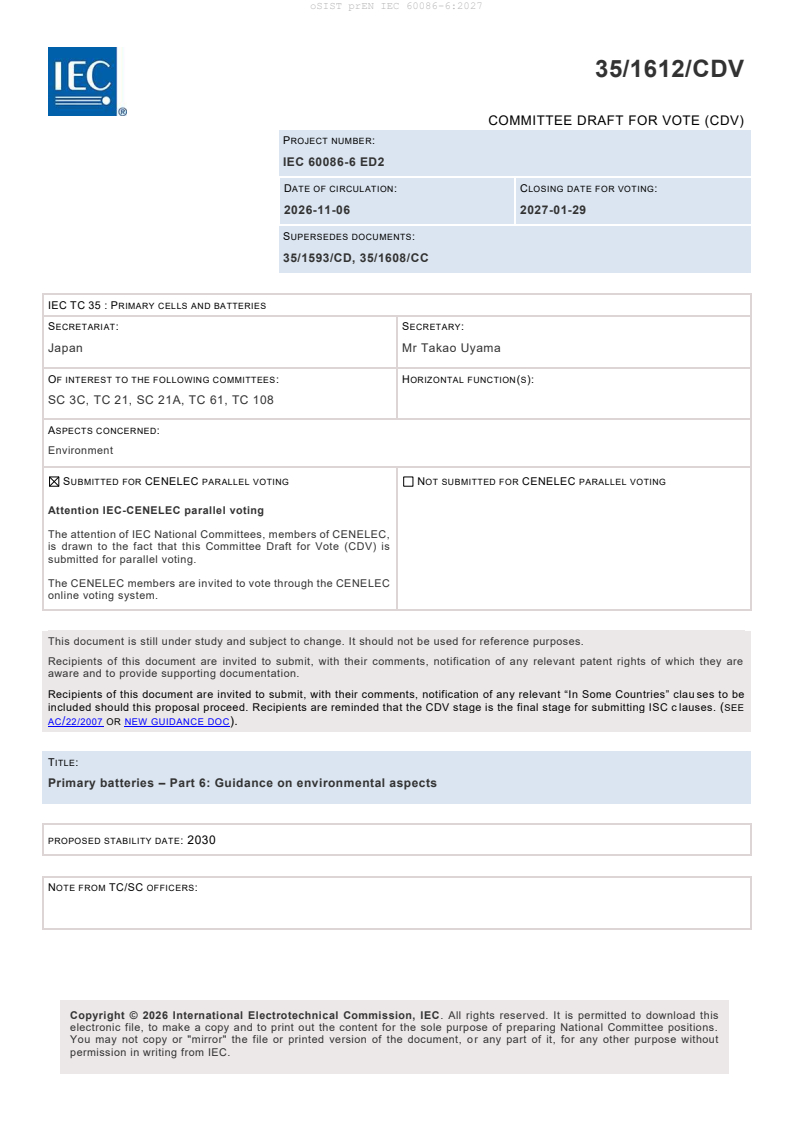
35/1612/CDV
COMMITTEE DRAFT FOR VOTE (CDV)
PROJECT NUMBER:
IEC 60086-6 ED2
DATE OF CIRCULATION: CLOSING DATE FOR VOTING:
2026-11-06 2027-01-29
SUPERSEDES DOCUMENTS:
35/1593/CD, 35/1608/CC
IEC TC 35 : PRIMARY CELLS AND BATTERIES
SECRETARIAT: SECRETARY:
Japan Mr Takao Uyama
OF INTEREST TO THE FOLLOWING COMMITTEES: HORIZONTAL FUNCTION(S):
SC 3C, TC 21, SC 21A, TC 61, TC 108
ASPECTS CONCERNED:
Environment
SUBMITTED FOR CENELEC PARALLEL VOTING NOT SUBMITTED FOR CENELEC PARALLEL VOTING
Attention IEC-CENELEC parallel voting
The attention of IEC National Committees, members of CENELEC,
is drawn to the fact that this Committee Draft for Vote (CDV) is
submitted for parallel voting.
The CENELEC members are invited to vote through the CENELEC
online voting system.
This document is still under study and subject to change. It should not be used for reference purposes.
Recipients of this document are invited to submit, with their comments, notification of any relevant patent rights of which they are
aware and to provide supporting documentation.
Recipients of this document are invited to submit, with their comments, notification of any relevant “In Some Countries” clau ses to be
included should this proposal proceed. Recipients are reminded that the CDV stage is the final stage for submitting ISC c lauses. (SEE
AC/22/2007 OR NEW GUIDANCE DOC).
TITLE:
Primary batteries – Part 6: Guidance on environmental aspects
PROPOSED STABILITY DATE: 2030
NOTE FROM TC/SC OFFICERS:
electronic file, to make a copy and to print out the content for the sole purpose of preparing National Committee positions.
You may not copy or "mirror" the file or printed version of the document, or any part of it, for any other purpose without
permission in writing from IEC.
Link to Committee Draft for Vote (CDV) online document:
Click here
How to access
This link leads you to the Online Standards Development (OSD) platform for National Mirror Committee’s
(NMC) comments. The project draft may be found further down this document.
Resource materials
We recommend NCs to review the available materials to better understand the member commenting on
the OSD platform.
This includes the:
• OSD NC roles overview
• How to add and submit comments to the IEC
Contact
Should you require any assistance, please contact the IEC IT Helpdesk.
IEC CDV 60086-6 © IEC 2026
CONTENTS
FOREWORD . 3
INTRODUCTION . 5
1 Scope . 6
2 Normative references . 6
3 Terms and definitions . 6
4 General considerations . 7
4.1 Overview . 7
4.2 General . 7
4.3 Intent of this document . 7
4.4 Battery selection . 8
4.5 Collection rate . 8
5 Requirements and recommendations for the environment . 8
5.1 Overview . 8
5.2 General . 8
5.3 Requirements and recommendations in regards to heavy metals . 8
5.4 Disassembly method . 9
5.4.1 General . 9
5.4.2 Sorting components . 10
5.4.3 Outline of disassembly procedure . 10
5.4.4 Qualifications for disassembly . 10
5.5 Sample preparation and analysis method . 11
5.6 Marking . 11
6 Disposal of battery. 11
6.1 General . 11
6.2 Confirmation of characteristics of hazardous waste . 11
6.2.1 General . 11
6.2.2 Toxicity . 11
6.2.3 Ignitability . 12
6.2.4 Reactivity . 12
6.2.5 Corrosivity . 12
6.3 Control of hazardous waste. 13
7 Environmental considerations . 13
7.1 General . 13
7.2 Environmental assessment . 13
7.2.1 General . 13
7.2.2 Reduction . 13
7.2.3 Reuse . 13
7.2.4 Recycling . 13
7.2.5 Raw material usage . 14
7.2.6 Manufacturing . 14
7.3 Packaging considerations . 15
7.3.1 General . 15
7.3.2 Maintain safety and quality . 15
7.3.3 Convey required information that is both regulated and voluntary . 15
8 Identifying product environmental aspects using a systematic approach . 15
9 Life cycle assessment . 15
IEC CDV 60086-6 © IEC 2026
Annex A (informative) Battery specific laws and regulations . 17
A.1 General . 17
A.2 Minamata Convention on Mercury . 17
A.3 Africa – Tunisia . 17
A.4 Asia . 18
A.4.1 China . 18
A.4.2 Chinese Taiwan (Province of China) . 19
A.4.3 Japan . 19
A.4.4 Korea, Republic of . 20
A.4.5 India . 20
A.5 Europe . 21
A.5.1 EU . 21
A.5.2 Norway . 21
A.5.3 Switzerland . 22
A.6 Latin America . 22
A.6.1 Argentina . 22
A.6.2 Brazil . 22
A.6.3 Colombia . 23
A.6.4 Costa Rica . 23
A.7 North America . 23
A.7.1 Canada . 23
A.7.2 United States of America . 24
Annex B (informative) Global regulations not applicable to batteries . 26
B.1 General . 26
B.2 WEEE Directive 2012/19/EU . 26
B.3 EuP Directive 2005/32/EC. 26
B.4 ErP 2009/125/EC . 26
B.5 Directive 2005/84/EC Phthalate Directive . 26
B.6 ELV Directive 2000/53/EC. 27
B.7 Safety Data Sheets (SDS) . 27
Annex C (informative) Compliance Checklist . 28
C.1 General . 28
Annex D (informative) Basel Convention . 29
D.1 General . 29
D.2 Classification of hazardous wastes . 29
D.3 Hazardousness of primary batteries . 29
Bibliography . 31
Figure 1 – Crossed-out wheeled bin . 11
Figure A.1 – Chinese Taiwan (Province of China) collection symbol. 19
Figure A.2 – The symbols for collection and recycling of batteries . 23
Table 1 – Actual condition of hazardous substances in batteries . 9
Table A.1 – Products subject to Article 4, paragraph 1 . 17
Table A.2 – Limitations by Battery Type . 18
Table A.3 – Target and restriction (Chinese Taiwan Province of China) . 19
Table C.1 – Compliance Checklist . 28
IEC CDV 60086-6 © IEC 2026
INTERNATIONAL ELECTROTECHNICAL COMMISSION
____________
Primary batteries –
Part 6: Guidance on environmental aspects
FOREWORD
1) The International Electrotechnical Commission (IEC) is a worldwide organization for
standardization comprising all national electrotechnical committees (IEC National Committees).
The object of IEC is to promote international co-operation on all questions concerning
standardization in the electrical and electronic fields. To this end and in addition to other
activities, IEC publishes International Standards, Technical Specifications, Technical Reports,
Publicly Available Specifications (PAS) and Guides (hereafter referred to as “IEC
Publication(s)”). Their preparation is entrusted to technical committees; any IEC National
Committee interested in the subject dealt with may participate in this preparatory work.
International, governmental and non-governmental organizations liaising with the IEC also
participate in this preparation. IEC collaborates closely with the International Organization for
Standardization (ISO) in accordance with conditions determined by agreement between the
two organizations.
2) The formal decisions or agreements of IEC on technical matters express, as nearly as
possible, an international consensus of opinion on the relevant subjects since each technical
committee has representation from all interested IEC National Committees.
3) IEC Publications have the form of recommendations for international use and are accepted
by IEC National Committees in that sense. While all reasonable efforts are made to ensure that
the technical content of IEC Publications is accurate, IEC cannot be held responsible for the
way in which they are used or for any misinterpretation by any end user.
4) In order to promote international uniformity, IEC National Committees undertake to apply
IEC Publications transparently to the maximum extent possible in their national and regional
publications. Any divergence between any IEC Publication and the corresponding national or
regional publication shall be clearly indicated in the latter.
5) IEC itself does not provide any attestation of conformity. Independent certification bodies
provide conformity assessment services and, in some areas, access to IEC marks of conformity.
IEC is not responsible for any services carried out by independent certification bodies.
6) All users should ensure that they have the latest edition of this publication.
7) No liability shall attach to IEC or its directors, employees, servants or agents including
individual experts and members of its technical committees and IEC National Committees for
any personal injury, property damage or other damage of any nature whatsoever, whether direct
or indirect, or for costs (including legal fees) and expenses arising out of the publication, use
of, or reliance upon, this IEC Publication or any other IEC Publications.
8) Attention is drawn to the Normative references cited in this publication. Use of the referenced
publications is indispensable for the correct application of this publication.
9) IEC draws attention to the possibility that the implementation of this document may involve
the use of (a) patent(s). IEC takes no position concerning the evidence, validity or applicability
of any claimed patent rights in respect thereof. As of the date of publication of this document,
IEC [had/had not] received notice of (a) patent(s), which may be required to implement this
document. However, implementers are cautioned that this may not represent the latest
IEC CDV 60086-6 © IEC 2026
information, which may be obtained from the patent database available at https://patents.iec.ch.
IEC shall not be held responsible for identifying any or all such patent rights.
IEC 60086–6 has been prepared by IEC technical committee 35: Primary cells and batteries.
This second edition cancels and replaces the first edition published in 2020. This edition
constitutes a technical revision.
This edition includes the following significant technical changes with respect to the previous
edition:
a) Added A.4.5 India - The Battery Waste Management Rules
b) Added T Chemistry (TR03 & TR6) to A.4.1 and A.6.3
c) Updated A.4.1 with full list of restricted substances under China's RoHS
The text of this International Standard is based on the following documents:
Draft Report on voting
35/XX/XX 35/XX/XX
Full information on the voting for its approval can be found in the report on voting indicated in
the above table.
The language used for the development of this International Standard is English.
This document was drafted in accordance with ISO/IEC Directives, Part 2, and developed in
accordance with ISO/IEC Directives, Part 1 and ISO/IEC Directives, IEC Supplement, available
at www.iec.ch/members_experts/refdocs. The main document types developed by IEC are
described in greater detail at www.iec.ch/publications.
A list of all parts in the IEC 60086 series, published under the general title Primary batteries,
can be found on the IEC website.
The committee has decided that the contents of this document will remain unchanged until the
stability date indicated on the IEC website under webstore.iec.ch in the data related to the
specific document. At this date, the document will be
– reconfirmed,
– withdrawn, or
– revised.
IEC CDV 60086-6 © IEC 2026
INTRODUCTION
Every product has some effect on the environment during its manufacture, distribution, use,
and disposal. These effects can range from slight to significant; they can be short -term or long-
term; and they can occur at the global, regional, or local level. Provisions in battery standards
can significantly influence the extent of these environmental effects.
Environmental stewardship in the battery industry embraces a multiplicity of activities, from
design, manufacturing, transportation, storage, and recycling, to disposal of the batteries.
There are often questions on the applicability of regulations to batteries. This document
provides guidance on regulations applicable and not applicable to batteries, as well as
procedures for measuring environmental characteristics.
Further reading:
IEC GUIDE 109:2012, Environmental aspects – Inclusion in electrotechnical product standards
EPBA Sustainability Report 2024, Looking back, looking ahead, Past achievements, ongoing
efforts and future perspectives of the European portable battery industry Brussels, Belgium:
EPBA, 2011
IEC CDV 60086-6 © IEC 2026
1 Scope
This part of IEC 60086 applies to all chemistries of portable primary cells and batteries
standardized in the 60086 series.
The purpose of this document is to provide guidance on the proper scientific protocols for testing
the environmental performance of batteries; the symbols used to convey messages for
collection, recycling, or other ideas; and the aspects and functional unit(s) to be included in
assessing the environmental impact of batteries with modern life-cycle analysis techniques.
2 Normative references
The following documents are referred to in the text in such a way that some or all of their content
constitutes requirements of this document. For dated references, only the edition cited applies.
For undated references, the latest edition of the referenced document (including any
amendments) applies.
IEC 60086-1:2026, Primary batteries - Part 1: General
3 Terms and definitions
For the purposes of this document, the following terms and definitions apply.
ISO and IEC maintain terminological databases for use in standardization at the following
addresses:
• IEC Electropedia: available at http://www.electropedia.org/
• ISO Online browsing platform: available at http://www.iso.org/obp
3.1
environmental impact assessment
EIA
process to determine the magnitude and significance of environmental impacts within the
confines of the goals, scope, and objective defined in the life cycle assessment
3.2
end of life
EOL
life cycle stage of a product starting when it is finally removed from its intended usage
[SOURCE: [SOURCE: IEC 60050-904: 2014 , 904-01-17, modified – added EOL and modified
from removed to finally removed.]]
3.3
input fraction
mass of collected waste batteries entering the recycling process
3.4
life cycle
consecutive and interlinked stages, and all directly associated significant inputs and outputs, of
a system from the extraction or exploitation of natural resources to the final disposal of all
materials as irretrievable wastes or dissipated energy
IEC CDV 60086-6 © IEC 2026
3.5
"natural" environment
(hereafter referred to as environment) attributes that affect quality of life, such as water, air,
and soil quality; conservation of energy and materials; and avoidance of wastes
3.6
output fraction
mass of materials produced from the input fraction as a result of the recycling process, without
undergoing further treatment, that have ceased to be waste or that will be used for their original
purpose or for other purposes, but excluding energy recovery
3.7
recycling
reprocessing in a production process of waste materials for their original purpose or other
purposes, but excluding energy recovery
3.8
recyclability
property of a substance or a material and parts made thereof that makes it possible to be
recycled
3.9
recycling efficiency
ratio obtained by dividing the mass of output fractions accounting for recycling by the mass of
the waste batteries input fraction expressed as a percentage, to the highest degree that is
technically feasible while avoiding excessive costs
3.10
toxicity
degree to which a particular substance is harmful to health
4 General considerations
4.1 Overview
This document takes into account environmental aspects and considerations as follows.
4.2 General
Attempts to address a given environmental effect might have consequences at any or all of the
stages of a battery's life cycle. Nevertheless, a battery's environmental effects should be
considered when standards are developed. Provisions in standards should reflect generally
accepted environmental improvement strategies, including pollution prevention and resource
conservation.
4.3 Intent of this document
Requirements should reflect generally accepted environmental regulations or national laws and
should not reflect environmental improvement strategies of specific countries or regions.
A review of environmental aspects in battery standards should be considered when innovative
technology provides environmental benefits.
Provisions in standards that are too prescriptive might stifle innovation and environmental
improvements. Consideration about such negative effect is necessary for amendment of
standard.
IEC CDV 60086-6 © IEC 2026
4.4 Battery selection
Whether or not the selection of the electrochemical system is considered to be one of the steps
in the design of a battery, the choice of systems will have an effect on the battery’s
environmental impacts.
Selection of the appropriate electrochemical system for the performance requirements of the
device will have an effect on the battery’s environmental impact. Credible information and clear
guidance will help users to make the right choices when purchasing batteries.
In some applications, the use of rechargeable batteries might offer an environmental advantage
over other types of batteries as they can be recharged and reused. The use of rechargeable
batteries should be considered for those applications, but the decision should address
performance requirements, duty cycle, the presence of toxic or non-renewable materials in the
battery, recharging facilities, and total amount of energy consumed during recharging over the
lifetime of the battery, among other factors, to assure that an environmental and cost-effective
advantage will be achieved.
A rechargeable battery or lithium primary battery will yield environmental benefits when used in
high-drain products, e.g., electric toys, or by heavy users of portable power, regardless of
device. A standard alkaline battery and carbon zinc battery will deliver a favourable
environmental outcome when used in everyday devices with medium to low drains, or in case
of lighter patterns of use.
4.5 Collection rate
Some laws and regulations require a minimum collection rate. The collection rate is calculated
by dividing the total weight of the batteries that are collected during a calendar year by the
average annual weight of batteries that were estimated to have been placed on the market
during the previous three calendar years.
5 Requirements and recommendations for the environment
5.1 Overview
Regulations regarding batteries have been established in various countries. The batteries
placed on the market in these countries should conform to the latest respective regulations as
summarized in Annex A. Annex A is not an exhaustive list of all battery related regulations.
Battery producers should take local laws and regulations into account when considering:
a) Battery design;
b) The purchase of components or the selection of suppliers;
c) Quality control and analysis of components and raw materials; and
d) Marking.
5.2 General
The following applies to hazardous materials, their content limits, the preparation of batteries
for analysis, and the method of analysing hazardous substances in batteries
Components such as attached terminals, lead wires, and exterior cases other than the batteries
should be separately analysed and their contents confirmed. The content of each component
other than the batteries can be obtained by each individual analysis or information of suppliers.
See Annex C for compliance checklist.
5.3 Requirements and recommendations in regards to heavy metals
a) Mercury content shall be no more than 0,000 5 % by weight
IEC CDV 60086-6 © IEC 2026
b) Lead content should be no more than 0,01 % by weight. This restriction shall not apply to
portable zinc-air button cells until 18 August 2028.
c) Cadmium content should be no more than 0,002 % by weight
NOTE The above requirements only apply to the batteries specified in IEC 60086–2. Restriction of hazardous
substances in batteries depends on national regulations.
See Annex A for National Defferences
Some battery chemistries do not include these hazardous substances as shown in Table 1.
Table 1 – Actual condition of hazardous substances in batteries
Letter Type of battery (reference) Mercury Lead Cadmium Verification
Testing
Needed
No Carbon zinc battery XY XY XY Yes
Letter
A Neutral electrolyte zinc air battery XY XY X Yes
B Lithium carbon monofluoride battery NA NA NA No
C Lithium manganese dioxide battery NA NA NA No
E Lithium thionyl chloride battery NA NA NA No
F Lithium iron disulphide battery NA NA NA No
G Lithium copper oxide battery NA NA NA No
L, T Alkaline battery or XY X X Yes
Alkaline zinc manganese dioxide battery
Button shape
Cylindrical shape
P Alkaline zinc air battery XY XY X Yes
S Zinc silver oxide battery XY XY X Yes
W Lithium sulphur dioxide X X X Yes
Y Lithium sulfuryl chloride X X X Yes
Z Nickel oxyhydroxide X X X Yes
Key:
Y: there may be intentional addition
X: there may be inclusion of impurity
NA: there is neither intentional addition nor inclusion of impurity
NOTE Intentional addition means the aim to give a certain function(s) to a battery by addition of certain
substances
5.4 Disassembly method
5.4.1 General
The outline of the disassembly method of dry batteries (alkaline batteries and carbon zinc
batteries) is described below as a preparatory process for pre-treatment (acid decomposition
etc.) and measurement of substances such as Cd, Hg, and Pb.
It is possible to prepare a measurement sample by collectively processing the constituent
components of the battery without sorting, however, it may cause such loss that target
substances (Cd, Hg and Pb) can sublimate or cannot dissolve during sample production, and
may be influenced by interference between elements during measurement. Taking into account
such risk, sorting components before preparing the sample and measuring is favourable to
IEC CDV 60086-6 © IEC 2026
treatment without sorting by specific components. Nevertheless, alternate methods like freezing
and crushing etc. can be adopted if it is difficult to sort battery components for specific reasons.
5.4.2 Sorting components
The components, parts, and materials of a battery are classified into 4 categories. If metal parts
are divided as finely as possible, acid dissolution and measurement become easier. Labels that
can be peeled off are regarded as plastic parts, but those that are baked or painted onto metal
casing are regarded as metal parts. The 4 categories are as following:
a) Cathode mass (including Electrolyte), Carbon rod
b) Anode gel (including Electrolyte), Anode zinc can
c) Plastic, Paper parts (including Separator)
d) Metal parts (Iron-Nickel series parts, Aluminium alloy parts, Copper alloy parts)
5.4.3 Outline of disassembly procedure
5.4.3.1 Alkaline batteries
Batteries should be weighed before disassembly. The parts which can be peeled off like the
label etc. are removed. Regarding adhesive which is used on the outside and inside of a battery,
all should be removed and treated as plastic parts. After removing, the battery is disassembled
and sorted into the 4 categories. If necessary, an electrolyte soaked in separator is washed
with a minimal amount of water and treated as anode gel. With or without washing, the separator
is dried appropriately. In addition, electrolyte which leaked during disassembly is gathered and
treated as anode gel.
All of each component, part, and material should be used for analysis (pre-process).
Alternatively, a portion of them can be sampled and used for analysis (pre-process). In this
case, total weight and sampled weight are measured before analysis in order to convert the
analysis data to the total quantity of hazardous substances.
If a metal part is plated, the base material that has been plated is used as target for sorting. If
the plating material and base material are unknown, confirmation by fluorescent X-ray analysis
and sorting accordingly is recommended.
5.4.3.2 Carbon zinc batteries
Battery should be weighed before disassembly. The parts which can be peeled off like the label
and insulation tube etc. are removed. Regarding paste, adhesive and so on which are used on
the outside and inside of a battery, all should be removed and treated as plastic parts. After
removing, the battery is disassembled by using tools etc. and sorted into the 4 categories. If
necessary, an electrolyte soaked in separator is washed with a minimal amount of water and
treated as cathode mass. With or without washing, the separator is dried appropriately.
All of each component, parts and materials should be used for sample preparation and analysis.
Alternatively, a portion of them can be sampled and used for sample preparation and analysis.
In this case, total weight and sampled weight are measured before analysis in order to convert
the analysis data to the total quantity of hazardous substances.
If a metal part is plated, base material rather than the plating material should be used as a
target for sorting. If the plating material and base material are unknown, confirmation by
fluorescent X-ray analysis and sorting accordingly is recommended.
5.4.4 Qualifications for disassembly
Disassembly should be conducted by an instructed or skilled person.
IEC CDV 60086-6 © IEC 2026
5.5 Sample preparation and analysis method
Sample preparation and analysis for mercury, cadmium and lead should be implemented on the
basis of the following standards.
IEC 62321-4:2013/AMD1 2017
5.6 Marking
Marking requirements are given in IEC 60086-1:2026 . A symbol meaning waste batteries must
be brought to a collection point should be marked on battery or its packaging according to the
following:
a) Where collection and recycling laws or regulations exist, batteries should be marked with
the symbol shown in Figure 1.
b) In countries or regions where a different symbol is required, batteries should be marked with
the required symbol.
c) In countries or regions without a required battery symbol, this symbol does not mean
bringing waste batteries to a collection point is obligated.
Figure 1 – Crossed-out wheeled bin
NOTE 1 Refer to Annex VI of EU 2023/1542
NOTE 2 The URL for the official symbol is https://www.iso.org/obp/ui#iec:grs:60417:6414
6 Disposal of battery
6.1 General
Primary batteries meeting the requirements of 5.3 are not a threat to the environment during
normal use and waste management. Batteries should be disposed of in accordance with local
laws and regulations. See Annex D for additional waste management topics and Annex B for
regulations not directly related to batteries but electrical equipment which might contain
batteries.
NOTE If collected, the United States Department of Transportation in interpretation reference number 09 -0150
concluded that carbon zinc batteries 6V and less and alkaline batteries 9V and less do not need terminal protection
and are not subject to regulation as they do not pose an unreasonable risk in transportation.
6.2 Confirmation of characteristics of hazardous waste
6.2.1 General
Primary batteries including alkaline batteries and carbon zinc batteries are not a threat to the
environment during normal use and waste management as they do not meet the criteria to be
considered a hazardous waste as outlined below. Generally, if waste does not meet any of the
four criteria of toxicity, ignitability, reactivity, and corrosivity, then the waste is not considered
a hazardous waste.
6.2.2 Toxicity
Toxicity is defined through the Toxicity Characteristic Leaching Procedure (TCLP) test
procedure. The TCLP determines whether materials known to be harmful to human health or
the environment can leach into groundwater from landfills. A generally accepted t est method
for determining toxicity is ISO 21268-2:2019 EN Soil quality — Leaching procedures for
IEC CDV 60086-6 © IEC 2026
subsequent chemical and ecotoxicological testing of soil and soil-like materials — Part 2: Batch
test using a liquid to solid ratio of 10 l/kg dry matter.
6.2.3 Ignitability
A solid waste exhibits the characteristic of ignitability if a representative sample of the waste
has any of the following properties:
a) It is a liquid other than an aqueous solution containing less than 24 % alcohol by volume
and has flash point less than 60 °C, as determined by a Pensky-Martens Closed Cup Tester,
using the test method specified in ISO 2719:2025《Determination of flash point —
Pensky-Martens closed cup method》, or a Setaflash Closed Cup Tester, using the test
method specified in ISO 3679:2022
b) It is not a liquid and is capable, under standard temperature and pressure, of causing fire
through friction, absorption of moisture, or spontaneous chemical changes and, when
ignited, burns so vigorously and persistently that it creates a hazard.
c) It is an ignitable compressed gas.
Under standard temperature and pressure conditions, batteries will not cause a fire through
friction, absorption of moisture, or spontaneous chemical changes.
6.2.4 Reactivity
A solid waste exhibits the characteristic of reactivity if a representative sample of the waste has
any of the following properties:
a) It is normally unstable and readily undergoes violent change without detonating.
b) It reacts violently with water.
c) It forms potentially explosive mixtures with water.
d) When mixed with water, it generates toxic gases, vapours, or fumes in a quantity sufficient
to present a danger to human health or the environment.
e) It is a cyanide or sulphide bearing waste which, when exposed to pH conditions between 2
and 12,5, can generate toxic gases, vapours, or fumes in a quantity sufficient to present a
danger to human health or the environment.
f) It is capable of detonation or explosive reaction if it is subjected to a strong initiating source
or if heated under confinement.
g) It is readily capable of detonation or explosive decomposition or reaction at standard
temperature and pressure.
h) It is a forbidden explosive, as defined in United States 49 CFR 173.54, or is a Division 1.1,
1.2, or 1.3 explosive, as defined in Unites States 49 CFR 173.50 and 173.53.
Batteries contain no sulphides or cyanides, and they do not meet any other reactivity criteria,
including “reacts violently with water.”
6.2.5 Corrosivity
A solid waste exhibits the characteristic of corrosivity if a representative sample of the waste
has either of the following properties:
a) It is aqueous and has a pH less than or equal to 2 or greater than or equal to 12,5, as
determined by a pH meter using IEC 60746-2:2003
b) It is a liquid and corrodes steel (SAE 1020) at a rate greater than 6,35 mm per year at a test
temperature of 55 °C, as determined by ISO 9223:2012
Batteries are a solid waste, not a liquid waste. This precludes batteries from being corrosive,
since a corrosive waste, by definition, must be liquid.
IEC CDV 60086-6 © IEC 2026
6.3 Control of hazardous waste
If hazardous material content is confirmed, relevant regulations shall be complied with. Refer
to Annex D as informative regulation.
7 Environmental considerations
7.1 General
Every product has some effect on the environment, occurring at all stages of the product’s life
cycle. Consideration of environmental impacts from raw material production, manufacturing,
consumption, and collection of waste is recommended to limit the effects of batteries on the
environment. Matters and approaches to be considered generally are described in Clause 4 of
ISO Draft GUIDE 64:2008 [1].
7.2 Environmental assessment
7.2.1 General
Environmental impact assessments are recommended during the design of batteries. These
assessments should include the following hierarchy of waste management principles.
7.2.2 Reduction
Batteries should be designed to reduce potential toxicity impacts and consumption of non -
renewable resources.
7.2.3 Reuse
The opportunity to reuse materials should be considered. Examples include the recovery and
reuse of products (e.g., electronic subassemblies, semiconductor devices, and safety devices,
for example), which are physically combined with batteries. It is not possible to effectively and
safely reuse batteries that are collected. The resale and reuse of primary batteries after they
have been originally placed on the market should not be encouraged as this will lead to quality
and safety problems.
7.2.4 Recycling
7.2.4.1 General
The opportunity for recycling can be increased by the design of batteries and by the
development of more cost- and energy-efficient recycling technologies. Battery design can
affect the recyclability of batteries through the selection of materials that are compatible with
recycling processes, as well as by form factors that facilitate separation of parts and materials.
Recycling efficiency
If recycling efficiency is to be evaluated, the recycling efficiency of a process is calculated
simply given as the following theoretical formula:
𝑅𝐸 = ∑𝑚 𝑜𝑢𝑡𝑝𝑢𝑡 /∑𝑚 𝑖𝑛𝑝𝑢𝑡 𝑥 100 (1)
R calculated recycling efficiency of a recycling process [in mass %]
E
m the mass of output fractions accounting for recycling per calendar year
output
m the mass of input fractions entering the battery recycling process per calendar year
input
NOTE This formula shows the concept of calculating the recycling efficiency. Only the recycler can calculate the
actual recycling efficiency.
IEC CDV 60086-6 © IEC 2026
The recycling efficiency is calculated on the basis of the overall chemical composition (at
elemental/compound level) of the input and output fractions. The following applies in respect to
the input fraction:
a) recyclers shall determine the share of different types of waste batteries present in an input
fraction by conducting a sorting analysis of the fraction (by continuous or representative
sampling);
b) the chemical composition of each type of waste battery present in the input fraction is
determined on the basis of the chemical composition of new batteries when placed on the
market, or available data of recyclers, or on information provided by the batter y producers;
c) recyclers shall determine the overall chemical composition of the input fraction by applying
chemical composition analysis to the types of batteries present in the input fraction.
Emissions to the atmosphere are not accounted for the recycling efficiency.
The mass of output fractions accounting for recycling is the mass, on a dry weight basis, of the
elements or compounds contained in fractions resulting from the recycling of waste batteries
per calendar year [in tons]. The following may be accounted for output fractions:
d) the carbon that is actually use
...