

SIST EN ISO/IEC 17007:2026
(Main)Conformity assessment - Guidance for drafting normative documents suitable for use for conformity assessment (ISO/IEC 17007:2026)
General Information
- Abstract
This document specifies principles and gives guidance for developing normative documents that contain:
specified requirements for the object of conformity assessment;
specific methods and procedures for an individual conformity assessment activity (e.g. test methods);
rules and methodology for conformity assessment (as part of conformity assessment schemes, including provisions for organizations that perform conformity assessment activities).
This document is intended for the following users:
standards developers;
regulatory authorities;
conformity assessment scheme owners;
industry associations and consortia;
conformity assessment bodies;
accreditation bodies;
purchasers;
consumers and non-governmental groups;
other interested parties, e.g. insurance organizations.
- Status
- Published
- Public Enquiry End Date
- 02-Jan-2025
- Publication Date
- 15-Mar-2026
- Technical Committee
- UGA - Conformity assessment
- Current Stage
- 6060 - National Implementation/Publication (Adopted Project)
- Start Date
- 05-Mar-2026
- Due Date
- 10-May-2026
- Completion Date
- 16-Mar-2026

Overview
SIST EN ISO/IEC 17007:2026 - Conformity assessment – Guidance for drafting normative documents suitable for use for conformity assessment provides essential principles and recommendations for developing normative documents (such as standards, regulations, and technical specifications) that are fit for use in conformity assessment activities. Published by CEN and harmonized with ISO and IEC, this standard is relevant across industries and regulatory frameworks at national, regional, and international levels.
The guidance is intended for stakeholders involved in standards development, regulatory oversight, conformity assessment, accreditation, industry schemes, purchasing, and consumer organizations. By following SIST EN ISO/IEC 17007:2026, users can develop documents that clearly specify requirements, outline objective methods and procedures, and establish effective rules and methodologies for conformity assessment.
Key Topics
Principles for Drafting Normative Documents
The standard introduces five guiding principles:- Separation of provisions: Clearly distinguish between product/service requirements, methods for assessment, and conformity assessment methodologies.
- Neutrality: Ensure documents are neutral regarding the type of conformity assessment bodies or parties involved.
- Functional approach: Apply a systematic process, including selection, determination, review, decision, attestation, and, where applicable, surveillance.
- Comparability of results: Strive for clarity and unambiguity to produce reproducible and comparable conformity assessment outcomes.
- Good conformity assessment practice: Reference internationally recognized best practices and documentation (e.g., the CASCO Toolbox).
Types of Provisions in Normative Documents
- Specified requirements: Clearly defined needs or expectations for objects of conformity assessment (e.g., products, processes, services, systems).
- Methods and procedures: Step-by-step instructions (e.g., test methods) for conducting individual conformity assessment activities.
- Rules and methodology: Broader procedural frameworks and rules for executing conformity assessment schemes, including the responsibilities of organizations involved.
Applications
SIST EN ISO/IEC 17007:2026 finds broad practical value in:
Standards Development
Enables technical committees and standards bodies to create documents that are precise, unambiguous, and suitable for reliable conformity assessment.Regulatory Frameworks
Assists regulatory authorities and government agencies in specifying technical requirements and assessment provisions, ensuring effective compliance oversight.Conformity Assessment Schemes
Supports scheme owners in developing, maintaining, or updating requirements, methods, and operational rules to ensure systematic and credible assessment outcomes.Industry, Procurement, and Accreditation
Assists organizations in drafting or evaluating technical specifications for products, services, or management systems, and aids accreditation bodies in assessing conformity bodies' competencies.International Trade
Facilitates global compatibility and acceptance of conformity assessment results by promoting the use of harmonized and transparent documentation practices.
Key beneficiaries include:
- Standards developers
- Regulatory authorities
- Conformity assessment bodies
- Industry associations
- Purchasers and consumers
- Accreditation and insurance organizations
Related Standards
For comprehensive conformity assessment implementation, the following related standards are frequently referenced:
- ISO/IEC 17000:2020: Conformity assessment – Vocabulary and general principles
- ISO/IEC 17060: Conformity assessment fundamentals
- ISO/IEC 17067: Conformity assessment – Fundamentals of product certification and related schemes
The “CASCO Toolbox,” referenced in SIST EN ISO/IEC 17007:2026, represents a suite of ISO/IEC standards and guides that establish globally recognized requirements for conformity assessment bodies and activities.
By adhering to SIST EN ISO/IEC 17007:2026, organizations can develop normative documents that provide a robust, harmonized foundation for conformity assessment, supporting regulatory compliance, market access, and international trade.
Get Certified
Connect with accredited certification bodies for this standard

BSI Group
BSI (British Standards Institution) is the business standards company that helps organizations make excellence a habit.

Bureau Veritas
Bureau Veritas is a world leader in laboratory testing, inspection and certification services.

DNV
DNV is an independent assurance and risk management provider.
Sponsored listings
Frequently Asked Questions
SIST EN ISO/IEC 17007:2026 is a standard published by the Slovenian Institute for Standardization (SIST). Its full title is "Conformity assessment - Guidance for drafting normative documents suitable for use for conformity assessment (ISO/IEC 17007:2026)". This standard covers: This document specifies principles and gives guidance for developing normative documents that contain: specified requirements for the object of conformity assessment; specific methods and procedures for an individual conformity assessment activity (e.g. test methods); rules and methodology for conformity assessment (as part of conformity assessment schemes, including provisions for organizations that perform conformity assessment activities). This document is intended for the following users: standards developers; regulatory authorities; conformity assessment scheme owners; industry associations and consortia; conformity assessment bodies; accreditation bodies; purchasers; consumers and non-governmental groups; other interested parties, e.g. insurance organizations.
This document specifies principles and gives guidance for developing normative documents that contain: specified requirements for the object of conformity assessment; specific methods and procedures for an individual conformity assessment activity (e.g. test methods); rules and methodology for conformity assessment (as part of conformity assessment schemes, including provisions for organizations that perform conformity assessment activities). This document is intended for the following users: standards developers; regulatory authorities; conformity assessment scheme owners; industry associations and consortia; conformity assessment bodies; accreditation bodies; purchasers; consumers and non-governmental groups; other interested parties, e.g. insurance organizations.
SIST EN ISO/IEC 17007:2026 is classified under the following ICS (International Classification for Standards) categories: 03.120.20 - Product and company certification. Conformity assessment. The ICS classification helps identify the subject area and facilitates finding related standards.
SIST EN ISO/IEC 17007:2026 is available in PDF format for immediate download after purchase. The document can be added to your cart and obtained through the secure checkout process. Digital delivery ensures instant access to the complete standard document.
Standards Content (Sample)
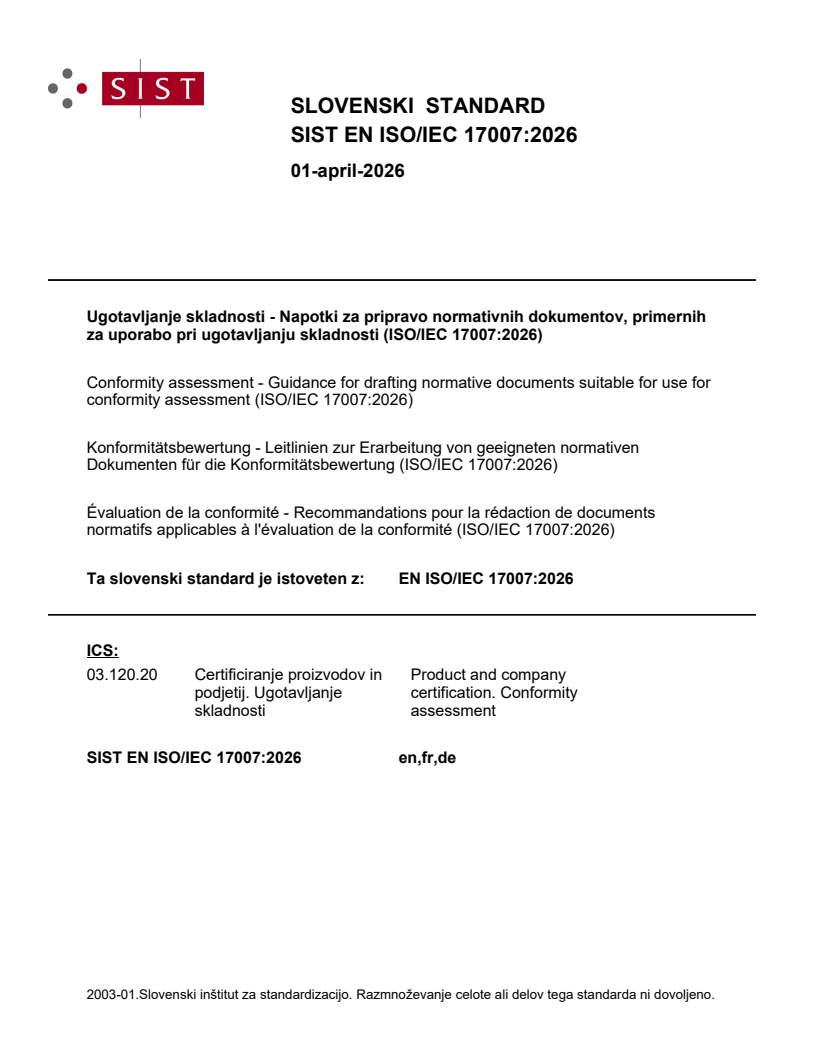
SLOVENSKI STANDARD
01-april-2026
Ugotavljanje skladnosti - Napotki za pripravo normativnih dokumentov, primernih
za uporabo pri ugotavljanju skladnosti (ISO/IEC 17007:2026)
Conformity assessment - Guidance for drafting normative documents suitable for use for
conformity assessment (ISO/IEC 17007:2026)
Konformitätsbewertung - Leitlinien zur Erarbeitung von geeigneten normativen
Dokumenten für die Konformitätsbewertung (ISO/IEC 17007:2026)
Évaluation de la conformité - Recommandations pour la rédaction de documents
normatifs applicables à l'évaluation de la conformité (ISO/IEC 17007:2026)
Ta slovenski standard je istoveten z: EN ISO/IEC 17007:2026
ICS:
03.120.20 Certificiranje proizvodov in Product and company
podjetij. Ugotavljanje certification. Conformity
skladnosti assessment
2003-01.Slovenski inštitut za standardizacijo. Razmnoževanje celote ali delov tega standarda ni dovoljeno.
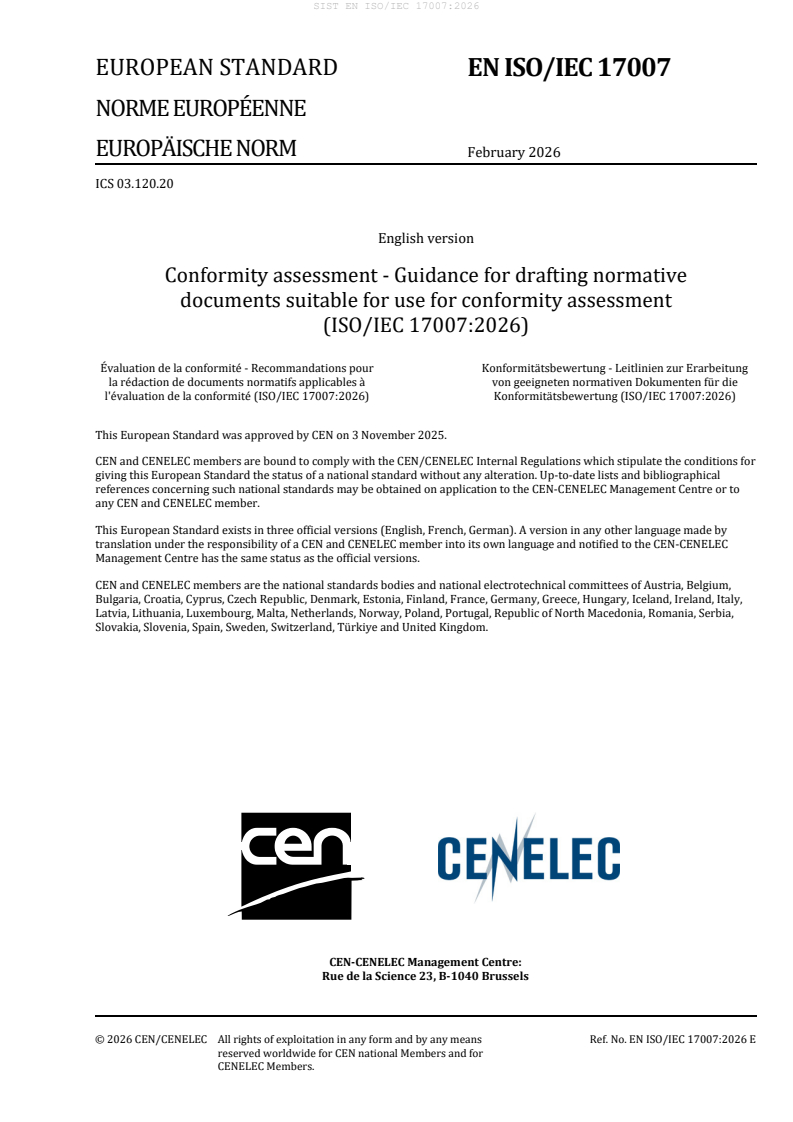
EUROPEAN STANDARD EN ISO/IEC 17007
NORME EUROPÉENNE
EUROPÄISCHE NORM
February 2026
ICS 03.120.20
English version
Conformity assessment - Guidance for drafting normative
documents suitable for use for conformity assessment
(ISO/IEC 17007:2026)
Évaluation de la conformité - Recommandations pour Konformitätsbewertung - Leitlinien zur Erarbeitung
la rédaction de documents normatifs applicables à von geeigneten normativen Dokumenten für die
l'évaluation de la conformité (ISO/IEC 17007:2026) Konformitätsbewertung (ISO/IEC 17007:2026)
This European Standard was approved by CEN on 3 November 2025.
CEN and CENELEC members are bound to comply with the CEN/CENELEC Internal Regulations which stipulate the conditions for
giving this European Standard the status of a national standard without any alteration. Up-to-date lists and bibliographical
references concerning such national standards may be obtained on application to the CEN-CENELEC Management Centre or to
any CEN and CENELEC member.
This European Standard exists in three official versions (English, French, German). A version in any other language made by
translation under the responsibility of a CEN and CENELEC member into its own language and notified to the CEN-CENELEC
Management Centre has the same status as the official versions.
CEN and CENELEC members are the national standards bodies and national electrotechnical committees of Austria, Belgium,
Bulgaria, Croatia, Cyprus, Czech Republic, Denmark, Estonia, Finland, France, Germany, Greece, Hungary, Iceland, Ireland, Italy,
Latvia, Lithuania, Luxembourg, Malta, Netherlands, Norway, Poland, Portugal, Republic of North Macedonia, Romania, Serbia,
Slovakia, Slovenia, Spain, Sweden, Switzerland, Türkiye and United Kingdom.
CEN-CENELEC Management Centre:
Rue de la Science 23, B-1040 Brussels
© 2026 CEN/CENELEC All rights of exploitation in any form and by any means
Ref. No. EN ISO/IEC 17007:2026 E
reserved worldwide for CEN national Members and for
CENELEC Members.
Contents Page
European foreword . 3
European foreword
This document (EN ISO/IEC 17007:2026) has been prepared by Technical Committee ISO/CASCO
"Committee on conformity assessment" in collaboration with Technical Committee CEN-CENELEC/ JTC
1 “Criteria for conformity assessment bodies” the secretariat of which is held by BSI.
This European Standard shall be given the status of a national standard, either by publication of an
identical text or by endorsement, at the latest by August 2026, and conflicting national standards shall
be withdrawn at the latest by August 2026.
Attention is drawn to the possibility that some of the elements of this document may be the subject of
patent rights. CEN-CENELEC shall not be held responsible for identifying any or all such patent rights.
Any feedback and questions on this document should be directed to the users’ national standards
body/national committee. A complete listing of these bodies can be found on the CEN and CENELEC
websites.
According to the CEN-CENELEC Internal Regulations, the national standards organizations of the
following countries are bound to implement this European Standard: Austria, Belgium, Bulgaria,
Croatia, Cyprus, Czech Republic, Denmark, Estonia, Finland, France, Germany, Greece, Hungary, Iceland,
Ireland, Italy, Latvia, Lithuania, Luxembourg, Malta, Netherlands, Norway, Poland, Portugal, Republic of
North Macedonia, Romania, Serbia, Slovakia, Slovenia, Spain, Sweden, Switzerland, Türkiye and the
United Kingdom.
Endorsement notice
The text of ISO/IEC 17007:2026 has been approved by CEN-CENELEC as EN ISO/IEC 17007:2026
without any modification.
International
Standard
ISO/IEC 17007
Second edition
Conformity assessment — Guidance
2026-02
for drafting normative documents
suitable for use for conformity
assessment
Évaluation de la conformité — Recommandations pour la
rédaction de documents normatifs applicables à l'évaluation de
la conformité
Reference number
ISO/IEC 17007:2026(en) © ISO/IEC 2026
ISO/IEC 17007:2026(en)
© ISO/IEC 2026
All rights reserved. Unless otherwise specified, or required in the context of its implementation, no part of this publication may
be reproduced or utilized otherwise in any form or by any means, electronic or mechanical, including photocopying, or posting on
the internet or an intranet, without prior written permission. Permission can be requested from either ISO at the address below
or ISO’s member body in the country of the requester.
ISO copyright office
CP 401 • Ch. de Blandonnet 8
CH-1214 Vernier, Geneva
Phone: +41 22 749 01 11
Email: copyright@iso.org
Website: www.iso.org
Published in Switzerland
© ISO/IEC 2026 – All rights reserved
ii
ISO/IEC 17007:2026(en)
Contents Page
Foreword .iv
Introduction .v
1 Scope . 1
2 Normative references . 1
3 Terms and definitions . 1
4 Principles . 4
4.1 General .4
4.2 Principle 1: separation of types of provisions .4
4.3 Principle 2: neutrality towards parties performing conformity assessment activities .5
4.4 Principle 3: functional approach to conformity assessment .6
4.5 Principle 4: comparability of conformity assessment results.6
4.6 Principle 5: good practice in conformity assessment .7
5 Guidance for the development of normative documents stating specified requirements
for objects of conformity assessment . 7
6 Guidance for the development of normative documents stating specific methods and
procedures for an individual conformity assessment activity . 9
7 Guidance for the development of normative documents stating rules and methodology
for conformity assessment .10
Annex A (informative) The CASCO toolbox .12
Annex B (informative) Approach to identify specified requirements, methods and procedures,
rules and methodology for conformity assessment . 14
Bibliography . 17
© ISO/IEC 2026 – All rights reserved
iii
ISO/IEC 17007:2026(en)
Foreword
ISO (the International Organization for Standardization) and IEC (the International Electrotechnical
Commission) form the specialized system for worldwide standardization. National bodies that are
members of ISO or IEC participate in the development of International Standards through technical
committees established by the respective organization to deal with particular fields of technical activity.
ISO and IEC technical committees collaborate in fields of mutual interest. Other international organizations,
governmental and non-governmental, in liaison with ISO and IEC, also take part in the work.
The procedures used to develop this document and those intended for its further maintenance are described
in the ISO/IEC Directives, Part 1. In particular, the different approval criteria needed for the different types
of document should be noted. This document was drafted in accordance with the editorial rules of the ISO/
IEC Directives, Part 2 (see www.iso.org/directives or www.iec.ch/members_experts/refdocs).
ISO and IEC draw attention to the possibility that the implementation of this document may involve the
use of (a) patent(s). ISO and IEC take no position concerning the evidence, validity or applicability of any
claimed patent rights in respect thereof. As of the date of publication of this document, ISO and IEC had not
received notice of (a) patent(s) which may be required to implement this document. However, implementers
are cautioned that this may not represent the latest information, which may be obtained from the patent
database available at www.iso.org/patents and https://patents.iec.ch. ISO and IEC shall not be held
responsible for identifying any or all such patent rights.
Any trade name used in this document is information given for the convenience of users and does not
constitute an endorsement.
For an explanation of the voluntary nature of standards, the meaning of ISO-specific terms and expressions
related to conformity assessment, as well as information about ISO's adherence to the World Trade
Organization (WTO) principles in the Technical Barriers to Trade (TBT) see www.iso.org/iso/foreword.html.
In the IEC, see www.iec.ch/understanding-standards.
This document was prepared by the ISO Committee on Conformity Assessment (CASCO),in collaboration
with the European Committee for Standardization (CEN) Technical Committee CEN/CLC/JTC 1, Criteria for
conformity assessment bodies, in accordance with the Agreement on technical cooperation between ISO and
CEN (Vienna Agreement).
This second edition cancels and replaces the first edition (ISO/IEC 17007:2009), which has been technically
revised.
The main changes are as follows:
— definitions have been aligned with ISO/IEC 17000:2020 with new definitions added;
— 3 categories of provisions in normative documents have been introduced in the Scope and Clause 4;
— references to ISO/IEC 17067 have been added for content regarding schemes;
— the 5 principles described in Clause 4 have been updated;
— guidance for the development of standards for the three categories of provisions has been updated or
added in Clauses 5, 6 and 7;
— in Annex A, an introductory part has been added before the Table A.1 to describe the conformity
assessment and accreditation bodies specified by the CASCO toolbox; Table A.1 has been updated to
contain all toolbox deliverables;
— Annex B has been replaced by a new one describing the approach to identify specified requirements,
methods and procedures, rules and methodology for conformity assessment.
Any feedback or questions on this document should be directed to the user’s national standards
body. A complete listing of these bodies can be found at www.iso.org/members.html and
www.iec.ch/national-committees.
© ISO/IEC 2026 – All rights reserved
iv
ISO/IEC 17007:2026(en)
Introduction
This document provides principles and guidance on how to develop normative documents, such as standards,
technical specifications, codes of practice and regulations, so that they are concise and clear, especially in
the context of any subsequent conformity assessment activity.
Conformity assessment is a demonstration that specified requirements are fulfilled and includes activities
such as assessment, auditing, design review, evaluation, examination, inspection, testing, surveillance,
validation, verification and certification. The methods and procedures for performing such individual
conformity assessment activities can be stated in normative documents. Likewise, normative documents
can state rules and methodology through which approvals, certificates, consents, licenses, labels, markings,
marks of conformity, permissions, reports and other types of statements of conformity are issued.
Normative documents, developed following the principles and guidance in this document, can be suitable for
use in conformity assessment at national, regional or international levels, both in regulated or non-regulated
applications.
Users of this document can also find useful information in the ISO/IEC Directives, ISO/IEC 17060,ISO/IEC 17067
[38]
and the WTO Agreement on Technical Barriers to Trade, Annex 3.
ISO/IEC Directives, Part 2 covers aspects for conformity assessment, mandatory for standards developers in
ISO, IEC and ISO/IEC committees.
This document also includes reference to documents in the domain of conformity assessment, known as
the CASCO toolbox. These are principally the work of CASCO in cooperation with IEC. Reference to these
standards and guides is included to emphasise that they contain internationally agreed, globally applied
provisions covering conformity assessment. Reliance on these standards and guides as requirements for
conformity assessment bodies and accreditation bodies facilitates acceptance of results around the world.
To make this document as usable as possible, technical terminology has been avoided as much as possible.
However, in some cases, the use of some technical terminology is necessary. For example, the requirements
in normative documents can relate to a particular material, product, service, installation, data, information,
process, system, person or body. In the conformity assessment context, these are all examples of an “object
of conformity assessment”.
In the same context, an “object of conformity assessment” or “object” is a generic term used to represent
anything that can fulfil specified requirements. In a normative document suitable for use in conformity
assessment, the term “object of conformity assessment” or “object” would not be used. A normative document
should include a scope which either explicitly or implicitly specifies the related object of conformity
assessment, for example, a type of product, process, service, installation, project, data, design, material,
claim, person, body, organization, management system, conformity assessment body. In this document, the
term “object of conformity assessment” or “object” is used so that this document can be applied regardless
of the specific scope of any normative document.
© ISO/IEC 2026 – All rights reserved
v
International Standard ISO/IEC 17007:2026(en)
Conformity assessment — Guidance for drafting normative
documents suitable for use for conformity assessment
1 Scope
This document specifies principles and gives guidance for developing normative documents that contain:
— specified requirements for the object of conformity assessment;
— specific methods and procedures for an individual conformity assessment activity (e.g. test methods);
— rules and methodology for conformity assessment (as part of conformity assessment schemes, including
provisions for organizations that perform conformity assessment activities).
This document is intended for the following users:
— standards developers;
— regulatory authorities;
— conformity assessment scheme owners;
— industry associations and consortia;
— conformity assessment bodies;
— accreditation bodies;
— purchasers;
— consumers and non-governmental groups;
— other interested parties, e.g. insurance organizations.
2 Normative references
The following documents are referred to in the text in such a way that some or all of their content constitutes
requirements of this document. For dated references, only the edition cited applies. For undated references,
the latest edition of the referenced document (including any amendments) applies.
ISO/IEC 17000:2020, Conformity assessment — Vocabulary and general principles
3 Terms and definitions
For the purposes of this document, the terms and definitions given in ISO/IEC 17000 and the following apply.
ISO and IEC maintain terminology databases for use in standardization at the following addresses:
— ISO Online browsing platform: available at https:// www .iso .org/ obp
— IEC Electropedia: available at https:// www .electropedia .org/
© ISO/IEC 2026 – All rights reserved
ISO/IEC 17007:2026(en)
3.1
specified requirement
need or expectation that is stated
Note 1 to entry: Specified requirements can be stated in normative documents (3.2).
Note 2 to entry: Specified requirements can be detailed or general.
[SOURCE: ISO/IEC 17000:2020, 5.1, modified — Examples of normative documents have been removed from
note 1 to entry.]
3.2
normative document
document that provides:
a) specified requirements (3.1) for the object of conformity assessment (3.3);
b) specific methods and procedures for an individual conformity assessment activity (3.5) (e.g. test
methods); or
c) rules and methodology (3.10) for conformity assessment (3.4) (as part of conformity assessment schemes
(3.9), including provisions for organizations that undertake conformity assessment)
Note 1 to entry: The term “normative document” is a generic term that covers such documents as standards, technical
specifications, codes of practice, legislation and regulations.
Note 2 to entry: A “document” is to be understood as any medium with information recorded on or in it.
3.3
object of conformity assessment
object
entity to which specified requirements (3.1) apply
EXAMPLE Product, process, service, system, installation, project, data, design, material, claim, person, body or
organization, or any combination thereof.
Note 1 to entry: The term “body” is used in this document to refer to conformity assessment bodies (3.6) and
accreditation bodies (3.8). The term “organization” is used in its general meaning and may include bodies according
to the context. The more specific ISO/IEC Guide 2 definition of an organization as a body based on membership is not
applicable to the field of conformity assessment (3.4).
[SOURCE: ISO/IEC 17000:2020, 4.2]
3.4
conformity assessment
demonstration that specified requirements (3.1) are fulfilled
Note 1 to entry: The process of conformity assessment is described in the functional approach in ISO/IEC 17000:2020,
Annex A as a series of functions and it can have a negative outcome, i.e. demonstrating that the specified requirements
are not fulfilled.
Note 2 to entry: This document does not include a definition of “conformity”. “Conformity” does not feature in the
definition of “conformity assessment”, nor does this document address the concept of compliance.
[SOURCE: ISO/IEC 17000:2020, 4.1, modified — Note 1 to entry has been modified to add "as a series of
functions"; the original notes 2 and 3 to entry have been deleted.]
3.5
conformity assessment activity
activity contributing to any of the functions in the functional approach described in ISO/IEC 17000:2020,
Annex A
Note 1 to entry: Conformity assessment activities include but are not limited to testing, auditing, examination,
evaluation, inspection, validation, verification, certification and accreditation (3.7).
© ISO/IEC 2026 – All rights reserved
ISO/IEC 17007:2026(en)
3.6
conformity assessment body
body that performs conformity assessment activities (3.5), excluding accreditation (3.7)
[SOURCE: ISO/IEC 17000:2020, 4.6]
3.7
accreditation
third-party attestation related to a conformity assessment body (3.6), conveying formal demonstration of its
competence, impartiality and consistent operation in performing specific conformity assessment activities
(3.5)
[SOURCE: ISO/IEC 17000:2020, 7.7]
3.8
accreditation body
authoritative body that performs accreditation (3.7)
Note 1 to entry: The authority of an accreditation body can be derived from government, public authorities, contracts,
market acceptance or scheme owners.
[SOURCE: ISO/IEC 17000:2020, 4.7]
3.9
conformity assessment scheme
conformity assessment programme
set of rules and procedures that describes the objects of conformity assessment (3.3), identifies the specified
requirements (3.1) and provides the methodology (3.10) for performing conformity assessment (3.4)
Note 1 to entry: A conformity assessment scheme can be managed within a conformity assessment system.
Note 2 to entry: A conformity assessment scheme can be operated at an international, regional, national, sub-national,
or industry sector level.
Note 3 to entry: A scheme can cover all or part of the conformity assessment functions explained in ISO/IEC 17000:2020,
Annex A.
[SOURCE: ISO/IEC 17000:2020, 4.9]
3.10
methodology
systematic collection of methods
Note 1 to entry: In conformity assessment (3.4), a systematic approach, or collection of methods, for performing
activities contributing to the functions described in ISO/IEC 17000:2020, Annex A, (the functional approach) is one
part of a conformity assessment scheme (3.9). Individual demonstrations performed in accordance with the same
conformity assessment scheme follow the same methodology.
Note 2 to entry: A method or procedure for a specific individual conformity assessment activity (3.5) within the
functional approach (e.g. a sampling protocol, test method, calibration method, inspection procedure, a general plan
for an audit of a management system, a general plan for validation or verification of a type of claim, the formatting of
a statement of conformity) can be included or referenced in the methodology provided in a conformity assessment
scheme. However, a method or procedure for a specific individual conformity assessment activity is not by itself a
methodology for demonstrating the fulfilment of specified requirements (3.1).
© ISO/IEC 2026 – All rights reserved
ISO/IEC 17007:2026(en)
4 Principles
4.1 General
4.1.1 The principles listed below are the basis for the subsequent guidance in this document. This
document does not provide specific guidance for all situations that can occur. Nevertheless, following the
principles below, users of this document can receive guidance for any situations:
— principle 1: separation of types of provisions (see 4.2);
— principle 2: neutrality towards parties performing conformity assessment activities (see 4.3);
— principle 3: functional approach to conformity assessment (see 4.4);
— principle 4: comparability of conformity assessment results (see 4.5);
— principle 5: good practice in conformity assessment (see 4.6).
4.1.2 Types of provisions in normative documents can be:
a) specified requirements for the object of conformity assessment;
b) specific methods and procedures for an individual conformity assessment activity (e.g. test methods);
c) rules and methodology for conformity assessment (as part of conformity assessment schemes, including
provisions for organizations that undertake conformity assessment).
4.2 Principle 1: separation of types of provisions
4.2.1 Normative documents stating specified requirements for objects of conformity assessment should
not contain the methodology for demonstrating fulfilment of the specified requirements.
4.2.2 Normative documents stating specified requirements for objects of conformity assessment can
include methods and procedures for an individual conformity assessment activity, e.g. for sampling and
testing, when necessary to provide repeatable and reproducible results. In such a situation, the methods
and procedures should be separated from those requirements (e.g. in separate sections). See 3.10 for the
difference between a method for an individual conformity assessment activity and a methodology.
4.2.3 Per the definition of conformity assessment scheme, a scheme “provides” the methodology and
“identifies” the specified requirements for an object of conformity assessment. The methodology should
be stated in a document separate from the document with the specified requirements. This separation is
important since different users of the specified requirements for an object of conformity assessment can
adopt different methodologies for demonstrating fulfilment of those specified requirements. A normative
document stating specified requirements for objects of conformity assessment should not restrict choices of
the methodology for demonstrations of fulfilment.
4.2.4 In addition, the normative document stating specified requirements for objects of conformity
assessment is implemented by the provider of the object of conformity assessment. The normative document
stating the methodology is implemented by those bodies performing a demonstration of these specified
requirements being fulfilled. With the methodology in a separate document, clear contracts, agreements,
regulations etc. can invoke the applicable document to the pertinent party and thus effectively mandate
fulfilment of specified requirements by providers and adherence to the methodology by bodies.
4.2.5 The benefits for maintaining a separation between the types of provisions include:
a) more rigorous consideration in specifying each type of provisions within their proper and individual
contexts;
© ISO/IEC 2026 – All rights reserved
ISO/IEC 17007:2026(en)
b) easier reference to the separate types of provisions for authorities such as regulatory authorities;
c) greater use of the normative document by parties that are not intending to use all the types of provisions,
for example, using only the provisions for the object of conformity assessment, without intending to use
the provisions related to rules and methodology for conformity assessment;
d) greater use of the provisions where assessment methods and procedures can be used for several
specified objects of conformity assessment, or one object can be subjected to multiple methods and
procedures;
e) greater flexibility in the application and choice of the rules and methodology for conformity assessment
such as specifying the use of self-declaration of conformity (declaration, first-party conformity
assessment activity) or certification (third-party conformity assessment activity), with or without
further specifications such as the need for a conformity assessment body to be accredited or belong to a
peer assessment group.
4.2.6 Examples of methodology that should not be in the same document as the specified requirements
for the object of conformity assessment and specific methods and procedures for an individual conformity
assessment activity include:
a) whether one or more activities are to be performed as first, second or third-party conformity assessment
activities (see 4.3);
b) the location for the sampling of the object of conformity assessment;
c) the type of certificate, mark, letter, report, listing on websites to be issued during attestation to indicate
a demonstration of fulfilment has been completed;
d) the type of ongoing surveillance activities (if any) to be performed to assure the statement of conformity
remains valid.
4.2.7 The application of ISO/IEC normative documents, including ISO/IEC standards, is voluntary. Users
of standards can require their use in a wide variety of situations (e.g. through regulations or contracts). To
enable the greatest flexibility in the selection and use of standards, it is important to separate different types
of provisions which users can then select to suit their needs. If the standard encompasses the requirements
for the object of conformity assessment and also encompasses the provisions for subsequent conformity
assessment activities, this then predetermines how the standard can be applied. In this case, the standard is
not to be used. Specified requirements for the object of conformity assessment should be separated from the
rules and methodology for conformity assessment. The user has the flexibility to specify the combination of
standards to best fulfil its needs. To be clear, this does not prohibit standards developers from developing
requirements for the object of conformity assessment on the one hand, and the rules and methodology for
conformity assessment on the other, as long as they are separated and can be applied independently of
one another (e.g. in a separate document, as different parts of a series such as IEC 60947-1, IEC 60947-2 or
ISO 14064-1, ISO 14064-2, ISO 14064-3, or in an informative annex).
4.3 Principle 2: neutrality towards parties performing conformity assessment activities
Normative documents stating specified requirements for objects of conformity assessment should be
written so that demonstrating conformity of these objects to the specified requirements can be performed
as:
— a first-party conformity assessment activity that is performed by the person or organization that
provides or that is the object of conformity assessment (see ISO/IEC 17000:2020, 4.3);
— a second-party conformity assessment activity that is performed by a person or organization that has a
user interest of the object of conformity assessment such as a user or purchaser (see ISO/IEC 17000:2020,
4.4);
© ISO/IEC 2026 – All rights reserved
ISO/IEC 17007:2026(en)
— a third-party conformity assessment activity, that is performed by a person or organization that is
independent of the provider of the object of conformity assessment and has no user interest in the object
(see ISO/IEC 17000:2020, 4.5);
NOTE Examples of users of normative documents that contain specified requirements for objects of conformity
assessment who choose first, second and third-party conformity assessment activities include:
— a facility operator providing a supplier’s declaration of conformity (SDoC; first-party conformity assessment
activity) for not exceeding levels of hazardous materials in waste;
— purchasing organizations performing audits of suppliers’ fulfilment of the requirements of quality management
system standards (second-party conformity assessment activity);
— regulatory authority requiring product certification (third-party conformity assessment activity) based on
regulatory requirements applicable to the product before it enters the market.
4.4 Principle 3: functional approach to conformity assessment
4.4.1 Rules and methodology for conformity assessment should be based on the functional approach to
conformity assessment consisting of the following functions:
a) selection: involves planning and preparation activities (especially sampling, if used) to collect or
produce all the information and input needed for the subsequent determination function;
b) determination: activities undertaken to develop complete information regarding fulfilment of the
specified requirements by the object of conformity assessment or its sample;
c) review, decision and attestation:
1) review: consideration of the suitability, adequacy and effectiveness of selection and determination
activities, and the results of those activities, with regard to fulfilment of specified requirements by
an object of conformity assessment;
2) decision: conclusion, based on the results of review that fulfilment of specified requirements has or
has not been demonstrated;
3) attestation: issue of a statement (statement of conformity), based on a decision that fulfilment of
specified requirements has been demonstrated.
NOTE A statement made in the determination function that the samples or items subjected to determination
activities meet specified requirements is different from the statement of conformity in the review, decision,
attestation function since the latter is a statement that more broadly indicates a suitable, adequate and
effective demonstration has been completed.
d) surveillance (if needed): systematic iteration of activities in the above functions as a basis for
maintaining the validity of a statement of conformity.
4.4.2 These conformity assessment functions are described in detail in ISO/IEC 17000:2020, Annex A. See
ISO/IEC 17067 for further guidance on conformity assessment schemes.
4.5 Principle 4: comparability of conformity assessment results
4.5.1 The specified requirements for objects of conformity assessment should be stated in a clear and
unambiguous manner, including details needed, so that the results of conformity assessment activities are
comparable and reproducible.
4.5.2 The methods and procedures for an individual conformity assessment activity should be stated in
a clear and unambiguous manner, including details needed, so that the results of conformity assessment
activities are comparable and reproducible. Use of the same method or procedure on the same object of
© ISO/IEC 2026 – All rights reserved
ISO/IEC 17007:2026(en)
conformity assessment by different persons or organizations should provide comparable and reproducible
results.
4.5.3 The rules and methodology for conformity assessment should be detailed enough to ensure that
different demonstrations following the same methodology are comparable with respect to assurance that
specified requirements are fulfilled.
4.6 Principle 5: good practice in conformity assessment
4.6.1 Guidance on good practice in conformity assessment can be found in ISO/IEC 17060.
4.6.2 ISO and IEC have developed documents on conformity assessment (commonly known as the
ISO/IEC 17000 set of documents) that set specified requirements for the competence, impartiality and
consistent operation of conformity assessment bodies and accreditation bodies. These documents form the
core of the CASCO toolbox which is a common way to refer to all the documents produced by ISO CASCO.
Using these documents fosters international compatibility and can avoid technical barriers to trade. Annex A
lists all the documents that constitute the CASCO toolbox.
4.6.3 A methodology should reference the applicable documents in the CASCO toolbox and it can provide
rules and procedures for how the conformity assessment bodies and accreditation bodies demonstrate
fulfilment of the requirements in the applicable documents (e.g. self-assessment, peer assessment or
accreditation).
4.6.4 Normative documents related to conformity assessment should reference the applicable documents
in the CASCO toolbox as a source of good practices in conformity assessment.
4.6.5 The persons or organizations (bodies) who perform activities in a demonstration of fulfilment
of specified requirements in accordance with a methodology are conformity assessment bodies and
accreditation bodies. The competence, impartiality and consistent operation of these bodies impact the
assurance provided by the demonstrations which they perform.
5 Guidance for the development of normative documents stating specified
requirements for objects of conformity assessment
5.1 Objects of conformity assessment can be products, processes, services, systems, installations, projects,
data, designs, materials, claims, persons, bodies or organizations (including their management systems), or
any combination thereof.
5.2 Normative documents stating specified requirements should clearly describe the objects or the types
of objects of conformity assessment to which the specified requirements apply.
5.3 Specified requirements relating to the characteristics of the object of conformity assessment should
be stated in the clauses that form the normative parts of the document, if there are informative parts of the
document.
5.4 Specified requirements should be stated in such a way that they are clear, direct and precise to result
in accurate and uniform interpretation. The objective is that parties making use of the normative document
can derive from the contents of the normative document a common understanding of its meaning and intent.
In particular:
a) terms such as “adequate”, “adversely affected”, “sufficiently strong” and “extreme conditions” are
subjective and should be avoided;
b) qualitative nouns and adjectives that can be taken as absolute, e.g. “waterproof”, “unbreakable”, “flat”,
and “safe”, should not be used unless specified;
© ISO/IEC 2026 – All rights reserved
ISO/IEC 17007:2026(en)
c) qualitative nouns and adjectives that describe a measurable property, e.g. “high”, “strong”, “transparent”,
and “accurate”, should not be used unless specified;
d) the term “unless otherwise specified” should not be used, except when the “other specification” is clearly
identified in the requirements;
e) characteristics such as “absence” or “free of” (e.g. “no heavy metals are allowed” or “no Hg is allowed”)
should not be used without referring to an agreed detection limit and its associated measurement
uncertainty;
f) the term “when applicable” (or similar) should be avoided, unless clear conditions are also provided or
applicability is clear based on the context.
5.5 Specified requirements for objects of conformity assessment should focus only on the description or
performance characteristics of the object.
5.6 Specified requirements should be stated in performance-based terms when possible and effective.
Performance requirements should clearly specify the result or outcome that is to be achieved. This can
include specifying acceptance values or tolerances. This also encourages innovation and technological
improvement while avoiding the imposition of specific designs or characteristics, enabling the adoption of
better alternatives.
5.7 Examples of specified requirements for the results or outcomes for a variety of objects of conformity
assessment include:
a) specified requirements for construction products in terms of their measurable performance
characteristics such as the ability to withstand specified loads or impact forces, fire resistance, weather
tightness, and thermal resistance, rather than requirements for particular construction systems, such
as the use of tongue and groove flooring or external panelling;
b) specified requirements related to hazards that can be associated with the use of selected products [e.g.
entrapment, punctures or cuts, strangulation, thermal exposure (heat burn or intense cold freezing),
toxicity thresholds for chemicals such as lead, flammability, exposure to carcinogens] rather than
requirements specifying prescriptive design criteria;
c) specified requirements for safety and efficiency features in electrical products standards to protect the
user from harmful events (e.g. electric shock) or suboptimal energy efficiency outcomes, rather than
prescriptive design requirements that can favour an existing product model over alternatives that
achieve the same or better outcome;
d) specified requirements for environmental, social or economic outcomes, such as in sustainability
standards, that focus on reduction in adverse impact indicators or achieving desired outcomes, rather
than requirements that focus on quantitative resource inputs which can or cannot achieve the desired
outcome;
e) specified requirements for service levels to be achieved, rather than requirements prescribing a certain
number of personnel or input resources that are required;
f) specified requirements for competence of persons based on the knowledge they are required to have,
and the skills necessary to demonstrate that they can use the knowledge effectively, rather than
requirements that focus on specific qualifications or years of experience which can or cannot mean the
individual is competent;
g) specified requirements for information technology applications, including artificial intelligence, by
describing the acceptable outcomes for certain use case scenarios, rather than prescriptive requirements
that try to impose prohibitions or boundaries on user groups or intended user purposes.
5.8 All specified requirements should be individually identifiable, in order to permit their incorporation
by reference in codes, regulations and other standards, or automated (“smart”) applications. This structure
© ISO/IEC 2026 – All rights reserved
ISO/IEC 17007:2026(en)
permits selected clauses to be identified separately in a code or regulation when only part of the normative
document is referenced.
5.9 If specified requirements include requirements stated in another document, the incorporation should
be done by specific reference and clear indication of the referenced version, usually by the date (year) of
publication. If the version of the referenced document is not specified, the conventional understanding is
that the latest version of the document applies, including all amendments and revisions. The use of the term
“latest issue” in conjunction with an undated reference should be avoided. If the referenced document is not
dated, the format and content of the referenced require
...