

SIST-TS CEN/TS 13387-1:2026
(Main)Child care articles - General safety guidelines - Part 1: Safety philosophy and safety assessment
General Information
- Abstract
This document contains the general safety philosophy and a guideline on safety assessment that experts are recommended to use when drafting standards.
It also contains an Annex A with a collection of available anthropometric data and details of the abilities of children from birth to 48 months of age.
The general safety philosophy given in this part is based on the principle that child care articles should be designed to be safe.
Children with special needs have not been taken into account while drafting these guidelines. ISO/IEC Guide 71 can be consulted to ascertain any further requirements to address the hazards and risks associated with children with special needs.
These guidelines do not cover all types of hazards and risks, such as inappropriate use of products, inadequate supervision of children and products used in a non-domestic situation.
Attention is drawn to the importance of ensuring that all other potential hazards relevant to the product are fully addressed, e.g. hygiene, the effects of electrical power etc., where other safety standards can apply.
- Status
- Published
- Public Enquiry End Date
- 14-Sep-2024
- Publication Date
- 14-Dec-2025
- Technical Committee
- OTR - Child use and care article
- Current Stage
- 6060 - National Implementation/Publication (Adopted Project)
- Start Date
- 09-Dec-2025
- Due Date
- 13-Feb-2026
- Completion Date
- 15-Dec-2025

Overview
CEN/TS 13387-1:2025 - Child care articles: General safety guidelines, Part 1: Safety philosophy and safety assessment is a CEN Technical Specification providing non‑normative guidance for experts who draft standards for products intended for children from birth to 48 months. It outlines a safety philosophy, a recommended methodology for hazard and risk assessment, and includes Annex A with collected anthropometric data and descriptions of child abilities (birth–48 months). This document supersedes CEN/TR 13387‑1:2018 and is intended as provisional guidance to harmonize safety approaches across child care articles.
Key topics and technical focus
- Safety philosophy: principle that child care articles should be designed to be safe, balancing protection with product functionality.
- Hazard and risk assessment methodology: systematic steps for identifying hazards, analysing and evaluating risk, and documenting uncertainties.
- Hazard‑based standard structure: recommended workflow for standards development - identify hazards, define requirements, specify test methods, and provide rationale in annexes.
- Anthropometric data and child abilities (Annex A): consolidated measurements and developmental capabilities relevant to children up to 48 months to inform design and testing.
- Scope and exclusions: excludes children with special needs (refer to ISO/IEC Guide 71 for additional requirements) and does not cover hazards from inappropriate use, lack of supervision, or non‑domestic use.
- Links to hazard categories: forms Part 1 of a series addressing chemical (Part 2), mechanical (Part 3), thermal (Part 4) hazards and product information (Part 5).
- Guidance vs. requirements: recommendations are expressed as “should”; normative standards will use “shall”.
Practical applications
- Use in drafting or revising European and national standards for child care products (e.g., strollers, high chairs, feeding equipment, baby carriers).
- Informing product design and engineering decisions based on child dimensions and developmental abilities.
- Framing product risk assessments and preparing technical documentation and test programs.
- Helping manufacturers, conformity assessment bodies, test laboratories, regulators and consumer safety organisations achieve consistent hazard‑based requirements.
Who should use this standard
- Standards committees and technical working groups (CEN/TC 252 and others)
- Product designers and manufacturers of child care articles
- Safety engineers, risk assessors and test laboratories
- Regulators, market surveillance and consumer protection organisations
Related standards and references
- CEN/TS 13387 series: Parts 2–5 (chemical, mechanical, thermal hazards, product information)
- ISO/IEC Guide 71 (guidance on children with special needs)
- Example hazard‑based standards referenced in the text: EN 16120, EN 1930
Keywords: CEN/TS 13387‑1:2025, child care articles, safety assessment, safety philosophy, anthropometric data, hazard‑based standard, risk assessment.
Relations
- Effective Date
- 01-Jan-2026
- Effective Date
- 10-Feb-2026
- Effective Date
- 28-Jan-2026
Frequently Asked Questions
SIST-TS CEN/TS 13387-1:2026 is a technical specification published by the Slovenian Institute for Standardization (SIST). Its full title is "Child care articles - General safety guidelines - Part 1: Safety philosophy and safety assessment". This standard covers: This document contains the general safety philosophy and a guideline on safety assessment that experts are recommended to use when drafting standards. It also contains an Annex A with a collection of available anthropometric data and details of the abilities of children from birth to 48 months of age. The general safety philosophy given in this part is based on the principle that child care articles should be designed to be safe. Children with special needs have not been taken into account while drafting these guidelines. ISO/IEC Guide 71 can be consulted to ascertain any further requirements to address the hazards and risks associated with children with special needs. These guidelines do not cover all types of hazards and risks, such as inappropriate use of products, inadequate supervision of children and products used in a non-domestic situation. Attention is drawn to the importance of ensuring that all other potential hazards relevant to the product are fully addressed, e.g. hygiene, the effects of electrical power etc., where other safety standards can apply.
This document contains the general safety philosophy and a guideline on safety assessment that experts are recommended to use when drafting standards. It also contains an Annex A with a collection of available anthropometric data and details of the abilities of children from birth to 48 months of age. The general safety philosophy given in this part is based on the principle that child care articles should be designed to be safe. Children with special needs have not been taken into account while drafting these guidelines. ISO/IEC Guide 71 can be consulted to ascertain any further requirements to address the hazards and risks associated with children with special needs. These guidelines do not cover all types of hazards and risks, such as inappropriate use of products, inadequate supervision of children and products used in a non-domestic situation. Attention is drawn to the importance of ensuring that all other potential hazards relevant to the product are fully addressed, e.g. hygiene, the effects of electrical power etc., where other safety standards can apply.
SIST-TS CEN/TS 13387-1:2026 is classified under the following ICS (International Classification for Standards) categories: 97.190 - Equipment for children. The ICS classification helps identify the subject area and facilitates finding related standards.
SIST-TS CEN/TS 13387-1:2026 has the following relationships with other standards: It is inter standard links to SIST-TP CEN/TR 13387-1:2018, SIST-V CEN/CLC Guide 14:2009, SIST EN 13126-5:2012+A1:2015. Understanding these relationships helps ensure you are using the most current and applicable version of the standard.
SIST-TS CEN/TS 13387-1:2026 is available in PDF format for immediate download after purchase. The document can be added to your cart and obtained through the secure checkout process. Digital delivery ensures instant access to the complete standard document.
Standards Content (Sample)
SLOVENSKI STANDARD
01-januar-2026
Nadomešča:
SIST-TP CEN/TR 13387-1:2018
Izdelki za otroke - Smernice za splošno varnost - 1. del: Varnostna načela in ocena
varnosti
Child care articles - General safety guidelines - Part 1: Safety philosophy and safety
assessment
Artikel für Säuglinge und Kleinkinder - Sicherheitsleitfaden - Teil 1:
Sicherheitsgrundsätze und Sicherheitsbeurteilung
Articles de puériculture - Conseils relatifs à la sécurité - Partie 1 : Principes de sécurité et
évaluation de la sécurité
Ta slovenski standard je istoveten z: CEN/TS 13387-1:2025
ICS:
97.190 Otroška oprema Equipment for children
2003-01.Slovenski inštitut za standardizacijo. Razmnoževanje celote ali delov tega standarda ni dovoljeno.
CEN/TS 13387-1
TECHNICAL SPECIFICATION
SPÉCIFICATION TECHNIQUE
November 2025
TECHNISCHE SPEZIFIKATION
ICS 97.190 Supersedes CEN/TR 13387-1:2018
English Version
Child care articles - General safety guidelines - Part 1:
Safety philosophy and safety assessment
Articles de puériculture - Conseils relatifs à la sécurité - Artikel für Säuglinge und Kleinkinder -
Partie 1 : Principes de sécurité et évaluation de la Sicherheitsleitfaden - Teil 1: Sicherheitsgrundsätze und
sécurité Sicherheitsbeurteilung
This Technical Specification (CEN/TS) was approved by CEN on 6 October 2024 for provisional application.
The period of validity of this CEN/TS is limited initially to three years. After two years the members of CEN will be requested to
submit their comments, particularly on the question whether the CEN/TS can be converted into a European Standard.
CEN members are required to announce the existence of this CEN/TS in the same way as for an EN and to make the CEN/TS
available promptly at national level in an appropriate form. It is permissible to keep conflicting national standards in force (in
parallel to the CEN/TS) until the final decision about the possible conversion of the CEN/TS into an EN is reached.
CEN members are the national standards bodies of Austria, Belgium, Bulgaria, Croatia, Cyprus, Czech Republic, Denmark, Estonia,
Finland, France, Germany, Greece, Hungary, Iceland, Ireland, Italy, Latvia, Lithuania, Luxembourg, Malta, Netherlands, Norway,
Poland, Portugal, Republic of North Macedonia, Romania, Serbia, Slovakia, Slovenia, Spain, Sweden, Switzerland, Türkiye and
United Kingdom.
EUROPEAN COMMITTEE FOR STANDARDIZATION
COMITÉ EUROPÉEN DE NORMALISATION
EUROPÄISCHES KOMITEE FÜR NORMUNG
CEN-CENELEC Management Centre: Rue de la Science 23, B-1040 Brussels
© 2025 CEN All rights of exploitation in any form and by any means reserved Ref. No. CEN/TS 13387-1:2025 E
worldwide for CEN national Members.
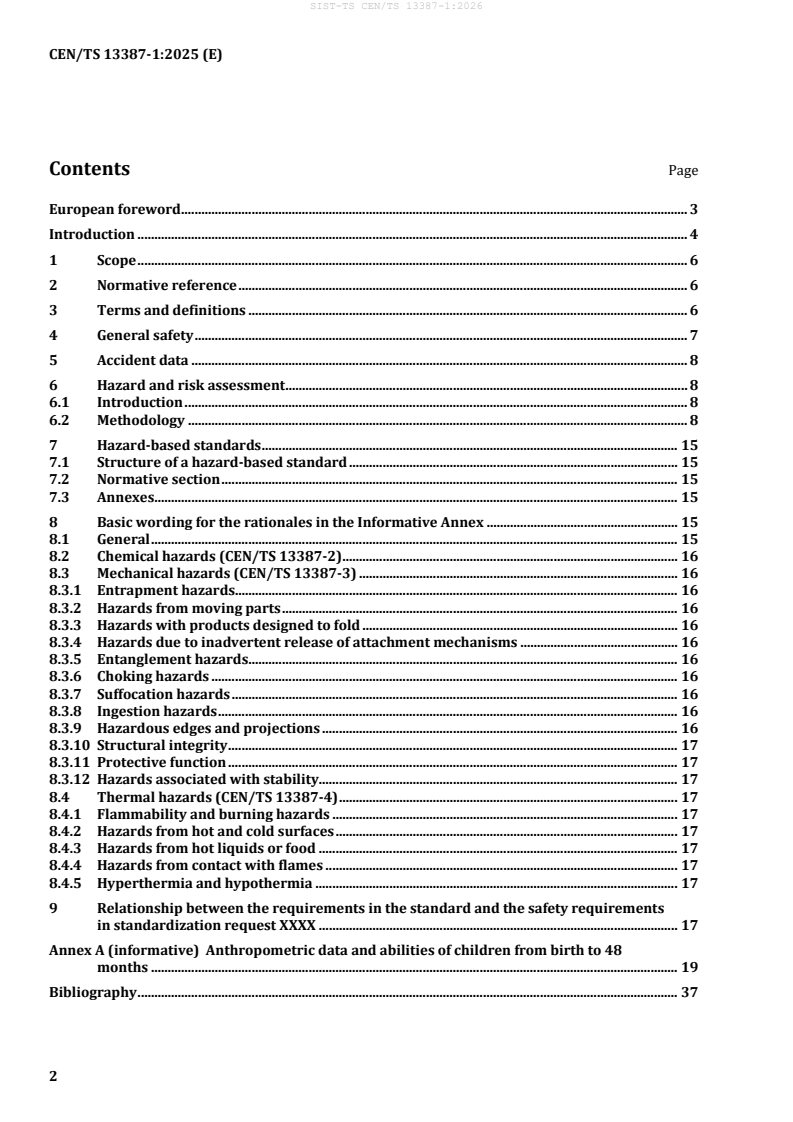
Contents Page
European foreword . 3
Introduction . 4
1 Scope . 6
2 Normative reference . 6
3 Terms and definitions . 6
4 General safety . 7
5 Accident data . 8
6 Hazard and risk assessment . 8
6.1 Introduction . 8
6.2 Methodology . 8
7 Hazard-based standards . 15
7.1 Structure of a hazard-based standard . 15
7.2 Normative section . 15
7.3 Annexes . 15
8 Basic wording for the rationales in the Informative Annex . 15
8.1 General . 15
8.2 Chemical hazards (CEN/TS 13387-2) . 16
8.3 Mechanical hazards (CEN/TS 13387-3) . 16
8.3.1 Entrapment hazards. 16
8.3.2 Hazards from moving parts . 16
8.3.3 Hazards with products designed to fold . 16
8.3.4 Hazards due to inadvertent release of attachment mechanisms . 16
8.3.5 Entanglement hazards . 16
8.3.6 Choking hazards . 16
8.3.7 Suffocation hazards . 16
8.3.8 Ingestion hazards . 16
8.3.9 Hazardous edges and projections . 16
8.3.10 Structural integrity . 17
8.3.11 Protective function . 17
8.3.12 Hazards associated with stability. 17
8.4 Thermal hazards (CEN/TS 13387-4) . 17
8.4.1 Flammability and burning hazards . 17
8.4.2 Hazards from hot and cold surfaces . 17
8.4.3 Hazards from hot liquids or food . 17
8.4.4 Hazards from contact with flames . 17
8.4.5 Hyperthermia and hypothermia . 17
9 Relationship between the requirements in the standard and the safety requirements
in standardization request XXXX . 17
Annex A (informative) Anthropometric data and abilities of children from birth to 48
months . 19
Bibliography . 37
European foreword
This document (CEN/TS 13387-1:2025) has been prepared by Technical Committee CEN/TC 252 “Child
care articles”, the secretariat of which is held by AFNOR.
Attention is drawn to the possibility that some of the elements of this document may be the subject of
patent rights. CEN shall not be held responsible for identifying any or all such patent rights.
This document supersedes CEN/TR 13387-1:2018.
The CEN/TS 13387 series, with the general title Child care articles - General safety guidelines, comprises
the following five parts:
— Part 1: Safety philosophy and safety assessment;
— Part 2: Chemical hazards;
— Part 3: Mechanical hazards;
— Part 4: Thermal hazards;
— Part 5: Product information.
Any feedback and questions on this document should be directed to the users’ national standards body.
A complete listing of these bodies can be found on the CEN website.
According to the CEN/CENELEC Internal Regulations, the national standards organisations of the
following countries are bound to announce this Technical Specification: Austria, Belgium, Bulgaria,
Croatia, Cyprus, Czech Republic, Denmark, Estonia, Finland, France, Germany, Greece, Hungary, Iceland,
Ireland, Italy, Latvia, Lithuania, Luxembourg, Malta, Netherlands, Norway, Poland, Portugal, Republic of
North Macedonia, Romania, Serbia, Slovakia, Slovenia, Spain, Sweden, Switzerland, Türkiye and the
United Kingdom.
Introduction
This document is a revision of CR 13387 first published in 1999. It is a non-normative CEN publication
which provides guidance information on common hazards that should be taken into consideration when
developing safety standards for child care articles.
A general safety philosophy and safety assessment methodology is given in Part 1 of these guidelines
together with a collection of anthropometric data.
Chemical hazards are addressed in Part 2. The chemical risk associated with the use of materials for the
construction, coating and/or packaging of child care articles that can affect children’s health are
considered.
Mechanical hazards are addressed in Part 3. “Mechanical hazard” is a general designation for physical
factors which can give rise to injury due to the mechanical properties of products or parts of products.
Thermal hazards are addressed in Part 4. “Thermal hazards” include hazards associated with
flammability and the burning characteristics of materials, contact with hot and cold surfaces, liquids and
food, contact with flames, contact with products that melt on heating and overheating or exposure of a
child to very low and very high temperatures.
Product information which should be supplied with a child care article is addressed in Part 5. “Product
information” covers all the documentation and information that should be supplied to ensure the safe use
of the product and also the safety of the child using the product.
These guidelines deal with hazards that are common to child care articles. They have been drawn-up by
a working group of experts set up by CEN TC 252 with the prime objective of harmonizing the approach
to hazard and risk assessment and injury prevention. The guidelines give recommendations on
preventive safety measures to avoid injuries that could be caused by child care articles. If the child care
article has a protective function, this should be effective; additionally the product itself should cause no
injury to the child.
The standards being drafted by CEN/TC 252 are for child care articles intended for children from birth
to 48 months of age who form a very vulnerable group in society. Up to 18 months of age the development
of the brain, senses, motoric abilities and knowledge takes place through the combined use of sensory
and motor skills, i.e. children learn to see, hear, taste, smell and feel. Their movements are aimed at
achieving familiarity with their environment. As children become older they achieve increased muscular
control and balance. Even up to 48 months of age children are unpredictable in their behaviour. Special
consideration should be given to the fact that these children cannot understand how to avoid risks and
thus are involuntarily exposed to them.
Child care articles constitute a group with large variations between the different products. However many
safety hazards associated with this diverse group of products are very similar. These guidelines identify
many of these safety hazards and give details that enable similar safety principles to be applied to the
drafting of standards across the group of products.
The information given in these guidelines reflects the state of the art at publication. Standards and
regulations will continuously be developed. Other sources can also provide useful information for the
reader.
How to use these guidelines
The safety requirements and test methods given are intended to give guidance and to lead to consistency
when writing safety standards for child care articles. It is recommended to use these guidelines when
drafting standards.
In addition, these guidelines can assist those with a general professional interest in child safety.
The safety requirements detailed do not constitute an exhaustive set that can be applied to all child care
articles. The application to particular products should be evaluated by experts.
In these guidelines rationales are given to explain the potential hazard. Wherever possible, requirements,
test equipment and test methods are given which can be used when drafting standards. Such standards
can contain requirements (expressed by the word “shall”), whereas this document only contains
recommendations (expressed by the word “should”).
CEN/TC 252 is, wherever possible when writing new standards or revising existing standards, drafting
their standards on a hazard based format (see for example EN 16120 and EN 1930).
The different parts of the CEN/TS 13387 series should enable working groups to draft their standards in
a hazard based format by proceeding in the following way:
— identification of the hazards and assessment of the risk;
— definition of the requirements to address an identified hazard and risk;
— definition of relevant test methods to check that the requirements are met;
— provision of an Annex which indicates the rationale for the inclusion of the requirements.
1 Scope
This document contains the general safety philosophy and a guideline on safety assessment that experts
are recommended to use when drafting standards.
It also contains an Annex A with a collection of available anthropometric data and details of the abilities
of children from birth to 48 months of age.
The general safety philosophy given in this part is based on the principle that child care articles should
be designed to be safe.
Children with special needs have not been taken into account while drafting these guidelines.
ISO/IEC Guide 71 can be consulted to ascertain any further requirements to address the hazards and
risks associated with children with special needs.
These guidelines do not cover all types of hazards and risks, such as inappropriate use of products,
inadequate supervision of children and products used in a non-domestic situation.
Attention is drawn to the importance of ensuring that all other potential hazards relevant to the product
are fully addressed, e.g. hygiene, the effects of electrical power etc., where other safety standards can
apply.
2 Normative reference
There are no normative references in this document.
3 Terms and definitions
For the purposes of this document, the following terms and definitions apply.
ISO and IEC maintain terminology databases for use in standardization at the following addresses:
— ISO Online browsing platform: available at https://www.iso.org/obp
— IEC Electropedia: available at https://www.electropedia.org/
3.1
harm
injury or damage to the health of people, or damage to property or the environment
3.2
hazard
potential source of harm
3.3
risk
combination of the probability of occurrence of harm and the severity of that harm
Note 1 to entry: The probability of occurrence includes the exposure to a hazardous situation, the occurrence of
a hazardous event, and the possibility to avoid or limit the harm.
3.4
hazard characterisation
quantitative evaluation of the nature of the adverse health effects following exposure to a risk source(s)
3.5
hazard identification
identification of a risk source(s) capable of causing adverse effect(s)
3.6
risk analysis
systematic use of available information to identify hazards and to estimate the risk
3.7
risk evaluation
procedure based on the risk analysis to determine whether tolerable risk has been exceeded
3.8
risk assessment
overall process comprising a risk analysis and a risk evaluation
Note 1 to entry: In practical terms this means the evaluation, including the identification of the related uncertainties,
of the likelihood and severity of an adverse effect(s) following exposure under defined means to a risk source(s).
3.9
safety
freedom from risk which is not tolerable
3.10
intended use
use in accordance with information provided together with a product or system, or, in the absence of such
information, by generally understood patterns of usage
4 General safety
Safety is often a balance between being safe from injury and the other demands of a child care article, for
example, ensuring that the item is fit for purpose as well as meeting consumers’ needs and expectations.
Attention should be paid to:
— the child’s stage of development (ability, weight, age, etc.);
— the intended or foreseeable use of the product, bearing in mind a child’s unpredictable behaviour.
This unpredictable behaviour exposes children to injury in ways that differ from those of adults,
making children a particularly vulnerable group in society;
— the hazard presented by the product in the environment where the product is used.
Child care articles should be designed to be safe. Hazards should be eliminated wherever possible. For
cases where a hazard cannot be eliminated or sufficiently minimized – by design or safeguards – product
related information should be given. However, product related information should not be used as an
alternative to safe design.
Where the function of a product or part of a product changes by virtue of its use and is beyond the scope
of child care articles, appropriate requirements should be applied. For example, a high chair that can be
converted into a normal chair.
5 Accident data
Available accident and injury data should be consulted. The absence of an accident history cannot be a
good reason for an automatic presumption of a low level of risk. Other factors should be taken into
account, particularly when the possible severity of injury is high.
Appropriate data might not be available for many reasons, including the absence or ineffectiveness of a
data collection system, the time delay in collating and presenting statistics, changes in product design and
use conditions etc. For example, historical information related to a product or material used in a hot
climate might not apply to its use in colder countries or vice versa.
6 Hazard and risk assessment
6.1 Introduction
The approach to hazard risk assessment described in this clause should ensure that the major hazards
are assessed when considering child safety within standards.
This clause details a process to identify non-chemical hazards and to assess the risks of injury to children
associated with child care articles. The assessment of chemical hazards and risks is included in
CEN/TS 13387-2.
When developing a new child care article safety standard or revising an existing one or working with a
standard where child safety needs to be addressed, it is necessary to conduct a hazard and risk
assessment. This involves gathering together information from a variety of sources such as accident data,
the Rapid Exchange of Information System (RAPEX) and recall notifications, expert opinion and other
reliable sources of information (including scientific literature). Additionally, reference should be made to
relevant child safety guidelines, publications and safety standards.
The hazard risk assessment methodology described in this clause is intended to be used during
development or revision of standards; it is not designed to be used solely during product development or
for assessment of products on the market.
6.2 Methodology
Separate hazard and risk assessment tables are provided in Tables 1 to 3 for mechanical hazards, thermal
hazards and other non-chemical hazards.
All three tables list the known hazards that have been identified through review of available guides and
standards. Additional hazards not listed in the tables can be associated with certain product categories
and should also be considered.
Before the hazard and risk assessment tables can be completed, all available data, such as accident data,
RAPEX and recall notifications, expert opinion and other reliable sources of information (including
scientific literature) require analysis. There is also a need to fully review the products available and to
understand how children will interact with the product. It is also necessary to understand the type of
injuries that can occur and how they are caused, as well as how accidents themselves occur and the likely
outcomes.
Each table contains the same headings which are explained below:
— The hazard list, based on CEN/TS 13387-3, CEN/TS 13387-4, CEN/CLC Guide 14 and
ISO/IEC Guide 50.
— The hazard identification column utilizes available accident data, RAPEX and recall notifications,
reported incidents, expert opinion and other reliable sources of information to identify the hazards
associated with a product.
— The hazard analysis column indicates the worst-case scenario should an accident occur with the
indicated hazard.
— The risk level column indicates the level of risk.
— The risk management measures column identifies those hazards addressed in other similar safety
standards, as well as providing the following three options for dealing with the hazard:
— include safety requirements to address the hazard; or
— include product information to address the hazard; or
— there is no need to address the hazard.
The decision on which option should be taken is based on the information entered in the row and
whether or not the hazard is considered a high, medium or low risk.
Hazards resulting in high or medium risk should be addressed within the standard by safety
requirements. Hazards resulting in low risk should be addressed in the standard by safety
requirements, providing they do not conflict with the requirements for high or medium risk. Product
information should be used to address any hazard that cannot be suitably addressed by safety
requirements.
— The comments column is used to explain the rationale and considerations for the decisions indicated
in the table and should be systematically filled in for each item in the tables.
Once all the relevant data has been analysed it should be easy to complete the relevant hazard risk
analysis table by placing an indication in the relevant boxes. With all the relevant boxes completed in
each row of each table it should be possible to draw a conclusion on the level of risk involved with the
hazard, as well as what action is needed to address the hazard in the safety standard.
Table 1 — Mechanical hazards
Risk Risk management
Hazard list Hazard identification Hazard analysis Comments
level measures
Hazards from gaps and
openings:
- Entrapment of head and
neck
- Entrapment of fingers
- Entrapment of limbs
Hazards due to moving parts,
i.e. shearing and compression
Hazards due to crushing
Hazards due to protrusions
Entanglement hazards in
cords, ribbons and parts used
as ties
Ingestion hazards
Choking hazards
Hazards from plastic decals
or sheeting
Accident data
RAPEX
Recalls
Reported incidents
Product reports
Expert opinion
Minor or reversible injuries
Serious and reversible or
minor and irreversible
injuries
Serious and irreversible
injuries
Death
L (Low) – M (Medium) – H
(High)
Hazard addressed by another
similar safety standard or a
previous version
Hazard to be addressed by
safety requirements
Hazard to be addressed by
product information
Hazard not to be addressed
Risk Risk management
Hazard list Hazard identification Hazard analysis Comments
level measures
Hazards from packaging
materials
Hazardous edges
Hazardous points and wire
Hazards from inadequate
stability
Hazards from inadequate
structural integrity
Hazards from inadequate
protective barrier function
Hazards from inadequate
protective restraint systems
Falling hazards due to
footholds
Hazards due to inadequate
size
Hazards due to inadvertent
release of attachment
mechanisms
Accident data
RAPEX
Recalls
Reported incidents
Product reports
Expert opinion
Minor or reversible injuries
Serious and reversible or
minor and irreversible
injuries
Serious and irreversible
injuries
Death
L (Low) – M (Medium) – H
(High)
Hazard addressed by another
similar safety standard or a
previous version
Hazard to be addressed by
safety requirements
Hazard to be addressed by
product information
Hazard not to be addressed
Table 2 — Thermal hazards
Risk Risk management
Hazard list Hazard identification Hazard analysis Comments
level measures
Hazards due to flash effect
Hazards due to flame
propagation
Hazards from the melting
behaviour of materials
Hazards from contact with
flames
Hazards from hot and cold
surfaces
Hazards from hot and cold
liquids and food
Hypothermia and
hyperthermia hazards
Accident data
RAPEX
Recalls
Reported incidents
Product reports
Expert opinion
Minor or reversible injuries
Serious and reversible or minor
and irreversible injuries
Serious and irreversible injuries
Death
L (Low) – M (Medium) – H (High)
Hazard addressed by another
similar safety standard or a
previous version
Hazard to be addressed by safety
requirements
Hazard to be addressed by
product information
Hazard not to be addressed
Table 3 — Other non-chemical hazards
Risk Risk management
Hazard list Hazard identification Hazard analysis Comments
level measures
Suffocation hazards due to
an enclosed space
Hazardous heights (falls)
Hazards from moving or
rotating objects
Hazards from noise
Drowning hazards
Hazards from suction, i.e.
suction cups
Electric shock hazards
Radiation hazards
High intensity or
concentrated light
Biological hazards
Accident data
RAPEX
Recalls
Reported incidents
Product reports
Expert opinion
Minor or reversible injuries
Serious and reversible or minor
and irreversible injuries
Serious and irreversible injuries
Death
L (Low) – M (Medium) – H (High)
Hazard addressed by another
similar safety standard or a
previous version
Hazard to be addressed by safety
requirements
Hazard to be addressed by
product information
Hazard not to be addressed
Risk Risk management
Hazard list Hazard identification Hazard analysis Comments
level measures
Explosion hazards
Inadequate protective
function
Inadequate information
Accident data
RAPEX
Recalls
Reported incidents
Product reports
Expert opinion
Minor or reversible injuries
Serious and reversible or minor
and irreversible injuries
Serious and irreversible injuries
Death
L (Low) – M (Medium) – H (High)
Hazard addressed by another
similar safety standard or a
previous version
Hazard to be addressed by safety
requirements
Hazard to be addressed by
product information
Hazard not to be addressed
7 Hazard-based standards
7.1 Structure of a hazard-based standard
The standard is separated into a normative section, normative annexes (if necessary) and informative
annexes, one of which may contain the rationales for the inclusion of requirements in the standard.
7.2 Normative section
— Scope;
— Normative references;
— Terms and definitions;
— Test equipment;
— General requirements and test methods;
— Chemical hazards (
...