

kSIST-TP FprCEN/TR 16411:2026
(Main)Child care articles - Compiled interpretations of CEN/TC 252 standards
- Abstract
The purpose of this document is to provide replies to requests for interpretations and clarifications of:
- EN 1273:2005, Child use and care articles — Baby walking frames — Safety requirements and test methods
- EN 1888:2012, Child care articles — Wheeled child conveyances — Safety requirements and test methods
- EN 1888-1:2018, Child care articles — Wheeled child conveyances — Part 1: Pushchairs and prams
- EN1888-2: 2018, Child care articles — Wheeled child conveyances — Part 2: Pushchairs for children above 15 kg up to 22 kg
- EN 1930:2011, Child use and care articles — Safety barriers — Safety requirements and test methods
- EN 12586:2007, Child use and care articles — Soother holder — Safety requirements and test methods
- EN 12790:2009, Child use and care articles — Reclined cradles
- EN 12790-1:2023, Child care articles — Reclined cradles — Part 1: Reclined cradles for children up to when they start to try to sit up
- EN 12221-1:2008, Changing units for domestic use — Part 1: Safety requirements
- EN 12221-2:2008, Changing units for domestic use — Part 2: Test methods
- EN 1466:2004+A1:2007, Child care articles — Carry cots and stands — Safety requirements and test methods
- EN 14350-2:2004, Child use and care articles — Drinking equipment — Part 2: Chemical requirements and tests
- EN 1400:2013+A1:2014, Child use and care articles — Soothers for babies and young children — Safety requirements and test methods
- EN 1400:2013+A2:2018, Child use and care articles — Soothers for babies and young children — Safety requirements and test methods
- EN 14372:2004, Child use and care articles — Cutlery and feeding utensils — Safety requirements and tests
- EN 16120:2012, Child use and care articles — Chair mounted seat
- EN 16120:2012+A2:2016, Child use and care articles — Chair mounted seat
- EN 14350-1:2004, Child use and care articles — Drinking equipment — Part 1: General and mechanical requirements and tests
- EN 16232:2013, Child use and care articles — Infant swings
- EN 16232:2013+A2:2023, Child use and care articles — Infant swings
- EN 17022:2018, Child care articles — Bathing aids — Safety requirements and test methods
- EN 17072:2018, Child care articles — Bath tubs, stands and non-standalone bathing aids — Safety requirements and test methods
- EN 12586:2007+A1:2011, Child care articles — Soother holder — Safety requirements and test methods
- EN 14350:2020, Child care articles — Drinking equipment — Safety requirements and test methods
- EN 13209-1:2004, Child use and care articles — Baby carriers — Safety requirements and test methods — Part 1: Framed back carriers
- EN 13209-1:2021, Child care articles — Child carriers — Safety requirements and test methods — Part 1: Framed back carrier
- EN 1466:2023, Child care articles — Carry cots and stands for domestic use — Safety requirements and test methods
- EN 14350:2020, Child care articles — Drinking equipment — Safety requirements and test methods
- EN 13210-1:2020, Child care articles — Part 1: Children´s harnesses, reins — Safety requirements and test methods
- Status
- Not Published
- Public Enquiry End Date
- 02-Jan-2027
- Technical Committee
- OTR - Child use and care article
- Current Stage
- 5520 - Unique Acceptance Procedure (UAP) (Adopted Project)
- Start Date
- 02-Nov-2026
- Due Date
- 22-Mar-2027

kSIST-TP FprCEN/TR 16411:2026 is a Slovenian adoption of the CEN draft Technical Report FprCEN/TR 16411. It compiles replies to interpretation and clarification requests for CEN/TC 252 child care article standards, so manufacturers, test laboratories, and conformity assessors can apply those standards in a consistent way.
The document is guidance on how existing clauses have been understood in practice, not a new product safety standard. It covers a wide range of child care articles, including walkers, pushchairs, safety barriers, soother holders, reclined cradles, changing units, carry cots, drinking equipment, soothers, cutlery, chair mounted seats, infant swings, bathing aids, child carriers, and children’s harnesses.
What does kSIST-TP FprCEN/TR 16411:2026 specify?
kSIST-TP FprCEN/TR 16411:2026 specifies replies to requests for interpretations and clarifications of standards written by CEN/TC 252 “Child care articles”. It does not set new product requirements on its own; it explains how to read and apply clauses in the named EN standards.
The document is organized as a process document followed by standard-by-standard interpretation chapters. After the foreword and introduction, it gives:
- Scope
- Normative references
- Terms and definitions
- Clause-by-clause interpretation chapters for the covered standards
- Informative annexes for additional replies on EN 12586
| Annex | What it covers |
|---|---|
| Annex A | Interpretation 3 on 3.9 and 5.1.4.2 in EN 12586:2007 |
| Annex B | Reply to interpretation 3 on 3.9 and 5.1.4.2 in EN 12586:2007 |
| Annex C | Reply to interpretation 1 on 5.1.10 in EN 12586:2007 |
In practice, this structure helps readers find the right answer by product standard and clause number. That is important for laboratories and manufacturers because the interpretation is tied to the exact clause being disputed.
What are the key requirements of kSIST-TP FprCEN/TR 16411:2026?
The most important content in kSIST-TP FprCEN/TR 16411:2026 is how the working groups interpret test setups, product configurations, warnings, and product information. The report is especially useful where a standard leaves room for different laboratory practices.
Interpretation status and how requests are handled
The introduction of kSIST-TP FprCEN/TR 16411:2026 says interpretations are only clarifications of meaning. They do not overrule the standard text, and they are based on expert-group replies that may lead to an interpretation, a no-action decision, or a proposal to amend the standard.
For users, this means the report is best read as a consistency aid. If a clause is ambiguous in day-to-day testing, the report shows how CEN/TC 252 has treated the issue and whether a later amendment may be needed.
Testing configuration and the most onerous condition
In EN 1888-related chapters, the report repeatedly applies the principle of the most onerous condition. The product should be tested in the configuration that presents the hardest valid case for the specific test, including adjustable seat units, pram bodies, handles, car seats, and accessories.
This matters because a stroller or child conveyance may have several valid setups. Laboratories need to select the setup that gives the most severe result for that test, not just a convenient one.
Stair, irregular-surface, and stability testing
For EN 1273 and EN 1888, the report clarifies how to orient the product during stair and irregular-surface tests. In EN 1273, the intended travel direction for the stair hazard test follows the direction of the pulling mass in the relevant setup, including sideward testing.
For EN 1888, the report also addresses handle strength and irregular-surface testing. It says telescopic handles are positioned at the highest setting for reproducibility, adjustable parts are aligned with the handle frame, and alternative arrangements are split across the required cycles. In practical terms, the same vehicle may need to be checked in more than one configuration to cover normal use.
Small-part, label, and entrapment concerns
The report treats labels and other added parts as relevant test items in EN 1888. It clarifies that label material does not exempt it from the relevant hazard assessment, so soft labels are not automatically ignored.
For EN 1930, the report reinforces the use of the prescribed probes and test forces for finger entrapment and opening checks. That matters because the method must be followed as written, not replaced by a modified probe or an informal lab practice.
Product information and point-of-sale information
Several chapters deal with product information, warnings, and purchase information. In EN 1888 and EN 14350, the report treats point-of-sale information as part of the compliance picture, including online sales pages where the product is sold through the internet.
This is important for manufacturers and importers because conformity is not only about the physical product. The information visible to the buyer is also part of the standard’s application.
Soother holder ventilation holes and movable parts
EN 12586 is the most heavily treated standard in the annexes. The report clarifies ventilation holes, movable parts, and how a fastener should be checked when it can be moved into different positions.
The practical message is that a movable fastener or similar part must be assessed in all possible positions that can affect the ventilation path or opening size. That avoids inconsistent laboratory practice when a soother holder has a slider, clip, or other moving element.
Changing units, carry cots, and reclined cradles
For EN 12221, EN 1466, and EN 12790, the report focuses on measurements, removable parts, and test setup. It addresses changing-area dimensions, hoods, aprons, handles, internal height, internal length, wheels or castors, angle assessment, and stability-related questions.
This matters because these products often have folding, adjustable, or removable parts. The report shows how the working groups expect those parts to be treated when the product is measured or tested.
Who uses kSIST-TP FprCEN/TR 16411:2026?
kSIST-TP FprCEN/TR 16411:2026 is used by manufacturers of child care articles, testing laboratories, conformity assessment bodies, technical committees, importers, and market surveillance authorities. It is also relevant to quality managers and buyers who need to understand how a product will be assessed against the CEN/TC 252 standards.
The main tasks are:
- selecting the correct test configuration
- interpreting ambiguous clauses
- aligning laboratory practice with CEN/TC 252 replies
- preparing technical files, test plans, and product information
- deciding whether a clarification points to a future amendment
What changed in kSIST-TP FprCEN/TR 16411:2026 from the previous edition?
kSIST-TP FprCEN/TR 16411:2026 supersedes CEN/TR 16411:2022.
What does the kSIST-TP FprCEN/TR 16411:2026 document contain?
kSIST-TP FprCEN/TR 16411:2026 contains a foreword, an introduction explaining the interpretation process, a scope, chapter-by-chapter replies for the covered child care article standards, and informative annexes focused on EN 12586. The body is organized into many clause-linked tables that summarize interpretation requests and give the corresponding replies.
The document includes summary tables and detailed question-and-answer tables for each covered standard. Those tables are used to trace a request to the relevant clause or subclause, which is useful for testing, conformity assessment, and resolving technical disputes.
The annexes add deeper discussion on soother holder ventilation holes and movable parts. The document also includes a bibliography and a process figure that explains how interpretation requests move through CEN/TC 252.
Relations
- Revises
SIST-TP CEN/TR 16411:2023 - Child care articles - Compiled interpretations of CEN/TC 252 standards - Effective Date
- 01-Dec-2026
Frequently Asked Questions
kSIST-TP FprCEN/TR 16411:2026 is a draft published by the Slovenian Institute for Standardization (SIST). Its full title is "Child care articles - Compiled interpretations of CEN/TC 252 standards". This standard covers: The purpose of this document is to provide replies to requests for interpretations and clarifications of: - EN 1273:2005, Child use and care articles — Baby walking frames — Safety requirements and test methods - EN 1888:2012, Child care articles — Wheeled child conveyances — Safety requirements and test methods - EN 1888-1:2018, Child care articles — Wheeled child conveyances — Part 1: Pushchairs and prams - EN1888-2: 2018, Child care articles — Wheeled child conveyances — Part 2: Pushchairs for children above 15 kg up to 22 kg - EN 1930:2011, Child use and care articles — Safety barriers — Safety requirements and test methods - EN 12586:2007, Child use and care articles — Soother holder — Safety requirements and test methods - EN 12790:2009, Child use and care articles — Reclined cradles - EN 12790-1:2023, Child care articles — Reclined cradles — Part 1: Reclined cradles for children up to when they start to try to sit up - EN 12221-1:2008, Changing units for domestic use — Part 1: Safety requirements - EN 12221-2:2008, Changing units for domestic use — Part 2: Test methods - EN 1466:2004+A1:2007, Child care articles — Carry cots and stands — Safety requirements and test methods - EN 14350-2:2004, Child use and care articles — Drinking equipment — Part 2: Chemical requirements and tests - EN 1400:2013+A1:2014, Child use and care articles — Soothers for babies and young children — Safety requirements and test methods - EN 1400:2013+A2:2018, Child use and care articles — Soothers for babies and young children — Safety requirements and test methods - EN 14372:2004, Child use and care articles — Cutlery and feeding utensils — Safety requirements and tests - EN 16120:2012, Child use and care articles — Chair mounted seat - EN 16120:2012+A2:2016, Child use and care articles — Chair mounted seat - EN 14350-1:2004, Child use and care articles — Drinking equipment — Part 1: General and mechanical requirements and tests - EN 16232:2013, Child use and care articles — Infant swings - EN 16232:2013+A2:2023, Child use and care articles — Infant swings - EN 17022:2018, Child care articles — Bathing aids — Safety requirements and test methods - EN 17072:2018, Child care articles — Bath tubs, stands and non-standalone bathing aids — Safety requirements and test methods - EN 12586:2007+A1:2011, Child care articles — Soother holder — Safety requirements and test methods - EN 14350:2020, Child care articles — Drinking equipment — Safety requirements and test methods - EN 13209-1:2004, Child use and care articles — Baby carriers — Safety requirements and test methods — Part 1: Framed back carriers - EN 13209-1:2021, Child care articles — Child carriers — Safety requirements and test methods — Part 1: Framed back carrier - EN 1466:2023, Child care articles — Carry cots and stands for domestic use — Safety requirements and test methods - EN 14350:2020, Child care articles — Drinking equipment — Safety requirements and test methods - EN 13210-1:2020, Child care articles — Part 1: Children´s harnesses, reins — Safety requirements and test methods
The purpose of this document is to provide replies to requests for interpretations and clarifications of: - EN 1273:2005, Child use and care articles — Baby walking frames — Safety requirements and test methods - EN 1888:2012, Child care articles — Wheeled child conveyances — Safety requirements and test methods - EN 1888-1:2018, Child care articles — Wheeled child conveyances — Part 1: Pushchairs and prams - EN1888-2: 2018, Child care articles — Wheeled child conveyances — Part 2: Pushchairs for children above 15 kg up to 22 kg - EN 1930:2011, Child use and care articles — Safety barriers — Safety requirements and test methods - EN 12586:2007, Child use and care articles — Soother holder — Safety requirements and test methods - EN 12790:2009, Child use and care articles — Reclined cradles - EN 12790-1:2023, Child care articles — Reclined cradles — Part 1: Reclined cradles for children up to when they start to try to sit up - EN 12221-1:2008, Changing units for domestic use — Part 1: Safety requirements - EN 12221-2:2008, Changing units for domestic use — Part 2: Test methods - EN 1466:2004+A1:2007, Child care articles — Carry cots and stands — Safety requirements and test methods - EN 14350-2:2004, Child use and care articles — Drinking equipment — Part 2: Chemical requirements and tests - EN 1400:2013+A1:2014, Child use and care articles — Soothers for babies and young children — Safety requirements and test methods - EN 1400:2013+A2:2018, Child use and care articles — Soothers for babies and young children — Safety requirements and test methods - EN 14372:2004, Child use and care articles — Cutlery and feeding utensils — Safety requirements and tests - EN 16120:2012, Child use and care articles — Chair mounted seat - EN 16120:2012+A2:2016, Child use and care articles — Chair mounted seat - EN 14350-1:2004, Child use and care articles — Drinking equipment — Part 1: General and mechanical requirements and tests - EN 16232:2013, Child use and care articles — Infant swings - EN 16232:2013+A2:2023, Child use and care articles — Infant swings - EN 17022:2018, Child care articles — Bathing aids — Safety requirements and test methods - EN 17072:2018, Child care articles — Bath tubs, stands and non-standalone bathing aids — Safety requirements and test methods - EN 12586:2007+A1:2011, Child care articles — Soother holder — Safety requirements and test methods - EN 14350:2020, Child care articles — Drinking equipment — Safety requirements and test methods - EN 13209-1:2004, Child use and care articles — Baby carriers — Safety requirements and test methods — Part 1: Framed back carriers - EN 13209-1:2021, Child care articles — Child carriers — Safety requirements and test methods — Part 1: Framed back carrier - EN 1466:2023, Child care articles — Carry cots and stands for domestic use — Safety requirements and test methods - EN 14350:2020, Child care articles — Drinking equipment — Safety requirements and test methods - EN 13210-1:2020, Child care articles — Part 1: Children´s harnesses, reins — Safety requirements and test methods
kSIST-TP FprCEN/TR 16411:2026 is classified under the following ICS (International Classification for Standards) categories: 97.190 - Equipment for children. The ICS classification helps identify the subject area and facilitates finding related standards.
kSIST-TP FprCEN/TR 16411:2026 has the following relationships with other standards: It is inter standard links to SIST-TP CEN/TR 16411:2023. Understanding these relationships helps ensure you are using the most current and applicable version of the standard.
kSIST-TP FprCEN/TR 16411:2026 is available in PDF format for immediate download after purchase. The document can be added to your cart and obtained through the secure checkout process. Digital delivery ensures instant access to the complete standard document.
Standards Content (Sample)
SLOVENSKI STANDARD
01-december-2026
Izdelki za otroke - Zbrane interpretacije standardov CEN/TC 252
Child care articles - Compiled interpretations of CEN/TC 252 standards
Artikel für Säuglinge und Kleinkinder - Gesammelte Interpretationen der CEN/TC 252-
Normen
Articles de puériculture - Compilation des interprétations des normes du CEN/TC 252
Ta slovenski standard je istoveten z: FprCEN/TR 16411
ICS:
97.190 Otroška oprema Equipment for children
2003-01.Slovenski inštitut za standardizacijo. Razmnoževanje celote ali delov tega standarda ni dovoljeno.
FINAL DRAFT
TECHNICAL REPORT
RAPPORT TECHNIQUE
TECHNISCHER REPORT
October 2026
ICS 97.190 Will supersede CEN/TR 16411:2022
English Version
Child care articles - Compiled interpretations of CEN/TC
252 standards
Articles de puériculture - Compilation des Artikel für Säuglinge und Kleinkinder - Gesammelte
interprétations des normes du CEN/TC 252 Interpretationen der CEN/TC 252-Normen
This draft Technical Report is submitted to CEN members for Vote. It has been drawn up by the Technical Committee CEN/TC
252.
CEN members are the national standards bodies of Austria, Belgium, Bulgaria, Croatia, Cyprus, Czech Republic, Denmark, Estonia,
Finland, France, Germany, Greece, Hungary, Iceland, Ireland, Italy, Latvia, Lithuania, Luxembourg, Malta, Netherlands, Norway,
Poland, Portugal, Republic of North Macedonia, Romania, Serbia, Slovakia, Slovenia, Spain, Sweden, Switzerland, Türkiye and
United Kingdom.
Recipients of this draft are invited to submit, with their comments, notification of any relevant patent rights of which they are
aware and to provide supporting documentation.
Warning : This document is not a Technical Report. It is distributed for review and comments. It is subject to change without
notice and shall not be referred to as a Technical Report.
EUROPEAN COMMITTEE FOR STANDARDIZATION
COMITÉ EUROPÉEN DE NORMALISATION
EUROPÄISCHES KOMITEE FÜR NORMUNG
CEN-CENELEC Management Centre: Rue de la Science 23, B-1040 Brussels
© 2026 CEN All rights of exploitation in any form and by any means reserved Ref. No. FprCEN/TR 16411:2026 E
worldwide for CEN national Members.
Contents Page
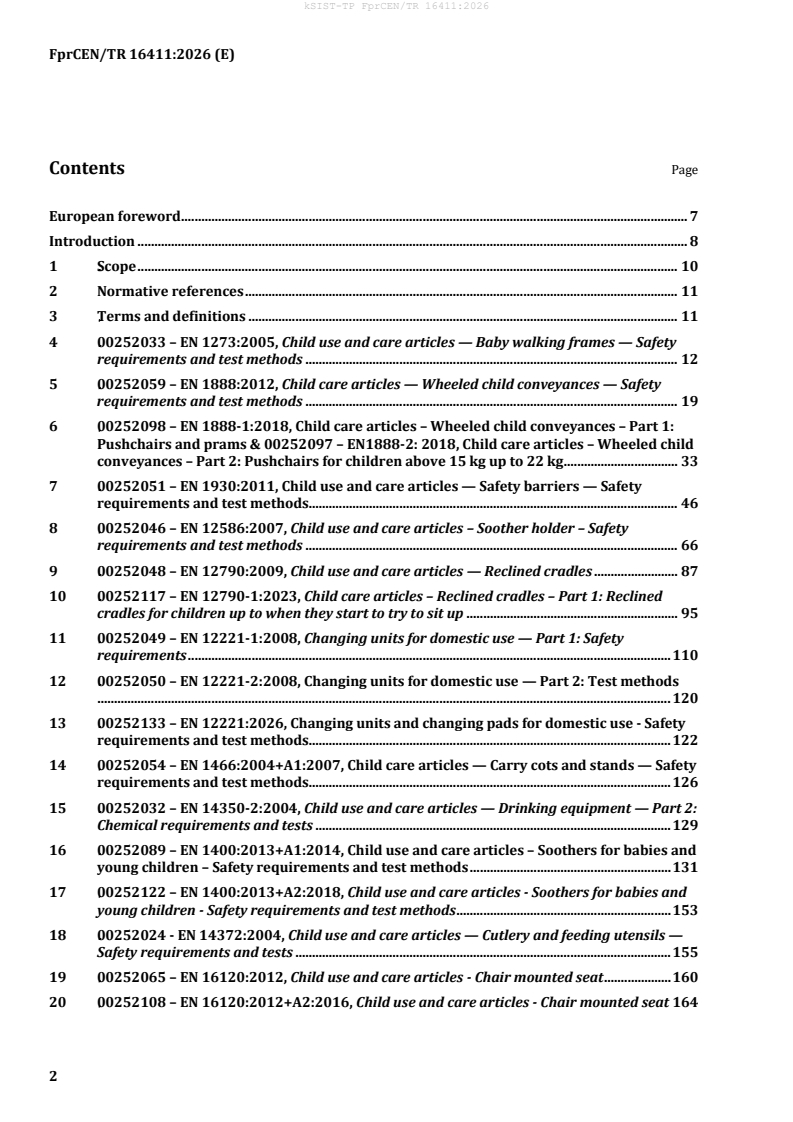
European foreword . 7
Introduction . 8
1 8BScope . 10
2 Normative references . 11
3 10BTerms and definitions . 11
4 11B00252033 – EN 1273:2005, Child use and care articles — Baby walking frames — Safety
requirements and test methods . 12
5 12B00252059 – EN 1888:2012, Child care articles — Wheeled child conveyances — Safety
requirements and test methods . 19
6 13B00252098 – EN 1888-1:2018, Child care articles – Wheeled child conveyances – Part 1:
Pushchairs and prams & 00252097 – EN1888-2: 2018, Child care articles – Wheeled child
conveyances – Part 2: Pushchairs for children above 15 kg up to 22 kg . 33
7 14B00252051 – EN 1930:2011, Child use and care articles — Safety barriers — Safety
requirements and test methods. 46
8 15B00252046 – EN 12586:2007, Child use and care articles – Soother holder – Safety
requirements and test methods . 66
9 16B00252048 – EN 12790:2009, Child use and care articles — Reclined cradles . 87
10 16B00252117 – EN 12790-1:2023, Child care articles – Reclined cradles – Part 1: Reclined
cradles for children up to when they start to try to sit up . 95
11 17B00252049 – EN 12221-1:2008, Changing units for domestic use — Part 1: Safety
requirements . 110
12 18B00252050 – EN 12221-2:2008, Changing units for domestic use — Part 2: Test methods
........................................................................................................................................................................... 120
13 18B00252133 – EN 12221:2026, Changing units and changing pads for domestic use - Safety
requirements and test methods. 122
14 19B00252054 – EN 1466:2004+A1:2007, Child care articles — Carry cots and stands — Safety
requirements and test methods. 126
15 20B00252032 – EN 14350-2:2004, Child use and care articles — Drinking equipment — Part 2:
Chemical requirements and tests . 129
16 21B00252089 – EN 1400:2013+A1:2014, Child use and care articles – Soothers for babies and
young children – Safety requirements and test methods . 131
17 22B00252122 – EN 1400:2013+A2:2018, Child use and care articles - Soothers for babies and
young children - Safety requirements and test methods . 153
18 23B00252024 - EN 14372:2004, Child use and care articles — Cutlery and feeding utensils —
Safety requirements and tests . 155
19 24B00252065 – EN 16120:2012, Child use and care articles - Chair mounted seat . 160
20 25B00252108 – EN 16120:2012+A2:2016, Child use and care articles - Chair mounted seat 164
21 26B00252023 – EN 14350-1:2004, Child use and care articles - Drinking equipment - Part 1:
General and mechanical requirements and tests . 170
22 27B00252058 – EN 16232:2013, Child use and care articles – Infant swings . 174
23 28B27B00252146 – EN 16232:2013+A2:2023, Child use and care articles – Infant swings . 177
24 00252099 – EN 17022:2018, Child care articles – Bathing aids – Safety requirements and
test methods . 178
25 29B00252100 – EN 17072:2018, Child care articles – Bath tubs, stands and non-standalone
bathing aids - Safety requirements and test methods . 185
26 30B00252069 – EN 12586:2007+A1:2011, Child care articles – Soother holder – Safety
requirements and test methods . 196
27 31B00252114 – EN 14350:2020, Child care articles — Drinking equipment — Safety
requirements and test methods . 204
28 32B00252036 – EN 13209-1:2004, Child use and care articles — Baby carriers - Safety
requirements and test methods - Part 1: Framed back carriers . 216
29 33B00252071 – EN 13209-1:2021, Child care articles — Child carriers - Safety requirements
and test methods - Part 1: Framed back carrier . 218
30 33B00252110 – EN 1466:2023, Child care articles - Carry cots and stands for domestic use -
Safety requirements and test methods . 220
31 31B00252114 – EN 14350:2020, Child care articles — Drinking equipment — Safety
requirements and test methods . 226
32 00252120 – EN 13210-1:2020, Child care articles — Part 1: Children´s harnesses, reins—
Safety requirements and test methods . 231
Annex A 5B(informative) Interpretation 3 on 3.9 and 5.1.4.2 in EN 12586:2007, Child use and care
articles — Soother holder — Safety requirements and test methods (WI 00252046) . 233
Annex B 6B(informative) Reply to interpretation 3 on 3.9 and 5.1.4.2 in EN 12586:2007, Child use
and care articles — Soother holder — Safety requirements and test methods (WI
00252046) . 236
Annex C 7B(informative) Reply to interpretation 1 on 5.1.10 in EN 12586:2007 Child use and care
articles — Soother holder — Safety requirements and test methods (WI 00252046) . 238
Bibliography . 244
Tables
Table 1 — Summary table of the request for interpretations classified in the order of the
clauses/subclauses of EN 1273:2005 . 12
Table 2 — Table of the request for interpretation/clarification for EN 1273:2005 . 12
Table 3 — Summary table of the request for interpretations classified in the order of the
clauses/subclauses of EN 1888:2012 . 19
Table 4 — Table of the request for interpretation/clarification for EN 1888:2012 . 20
Table 5 — Summary table of the request for interpretations classified in the order of the
clauses/subclauses of EN 1888-1 & 2:2018 . 33
Table 6 — Table of the request for interpretation/clarification for EN 1888-1 & 2:2018 . 34
Table 7 — Summary table of the request for interpretations classified in the order of the
clauses/subclauses of EN 1930:2011 . 46
Table 8 — Table of the request for interpretation/clarification for EN 1930:2011 . 47
Table 9 — Summary table of the request for interpretations classified in the order of the
clauses/subclauses of EN 12586:2007 . 66
Table 10 — Table of the request for interpretation/clarification for EN 12586:2007 . 67
Table 11 — Summary table of the request for interpretations classified in the order of the
clauses/subclauses of EN 12790:2009 . 87
Table 12 — Table of the request for interpretation/clarification for EN 12790:2009 . 87
Table 13 — Summary table of the request for interpretations classified in the order of the
clauses/subclauses of EN 12790-1:2023 . 95
Table 14 — Table of the request for interpretation/clarification for EN 12790-1:2023 . 96
Table 15 — Summary table of the request for interpretations classified in the order of the
clauses/subclauses of the EN 12221–1:2008. 110
Table 16 — Table of the request for interpretation/clarification for EN 12221–1:2008 . 110
Table 17 — Summary table of the request for interpretations classified in the order of the
clauses/subclauses of EN 12221–2:2008 . 120
Table 18 — Table of the request for interpretation/clarification for EN 12221–2:2008 . 120
Table 19 — Summary table of the request for interpretations classified in the order of the
clauses/subclauses of EN 12221–2:2008 . 122
Table 20 — Table of the request for interpretation/clarification for EN 12221–2:2008 . 122
Table 21 — Summary table of the request for interpretations classified in the order of the
clauses/subclauses of EN 1466:2004+A1:2007 . 126
Table 22 — Table of the request for interpretation/clarification for EN 1466:2004+A1:2007 . 126
Table 23 — Summary table of the request for interpretations classified in the order of the
clauses/subclauses of EN 14350–2:2004 . 129
Table 24 —Table of the request for interpretation/clarification for EN 14350–2:2004 . 129
Table 25 — Summary table of the request for interpretations classified in the order of the
clauses/subclauses of EN 1400:2013 . 131
Table 26 — Table of the request for interpretation/clarification for EN 1400:2013 . 132
Table 27 — Summary table of the request for interpretations classified in the order of the
clauses/subclauses of EN 1400:2013+A2:2018 . 153
Table 28 — Table of the request for interpretation/clarification for EN 1400:2013+A2:2018 . 153
Table 29 — Summary table of the request for interpretations classified in the order of the
clauses/subclauses of the EN 14372:2004 . 155
Table 30 — Table of the request for interpretation/clarification for EN 14372:2004 . 155
Table 31 — Summary table of the request for interpretations classified in the order of the
clauses/subclauses of the EN 16120:2012 . 160
Table 32 — Table of the request for interpretation/clarification for EN 16120:2012 . 160
Table 33 — Summary table of the request for interpretations classified in the order of the
clauses/subclauses of the EN 16120:2012+A2:2016 . 164
Table 34 — Table of the request for interpretation/clarification for EN 16120:2012+A2:2016 . 164
Table 35 — Summary table of the request for interpretations classified in the order of the
clauses/subclauses of EN 14350-1:2004 . 170
Table 36 — Table of the request for interpretation/clarification for EN 14350-1:2004 . 170
Table 37 — Summary table of the request for interpretations classified in the order of the
clauses/subclauses of EN 16232:2013 . 174
Table 38 — Table of the request for interpretation/clarification for EN 16232:2013 . 174
Table 39 — Summary table of the request for interpretations classified in the order of the
clauses/subclauses of EN 16232+A2:2023 . 177
Table 40 — Table of the request for interpretation/clarification for EN 16232+A2:2023 . 177
Table 41 — Summary table of the request for interpretations classified in the order of the
clauses/subclauses of EN 17022:2018 . 178
Table 42 — Table of the request for interpretation/clarification for EN 17022:2018 . 178
Table 43 — Summary table of the request for interpretations classified in the order of the
clauses/subclauses of EN 17072:2018 . 185
Table 44 — Table of the request for interpretation/clarification for EN 17072:2018 . 185
Table 45 — Summary table of the request for interpretations classified in the order of the
clauses/subclauses of EN 12586:2007+A1:2011 . 196
Table 46 — Table of the request for interpretation/clarification for EN 12586:2007 . 197
Table 47 — Summary table of the request for interpretations classified in the order of the
clauses/subclauses of EN 14350:2020 . 204
Table 48 —Table of the request for interpretation/clarification for EN 14350:2020. 204
Table 49 — Summary table of the request for interpretations classified in the order of the
clauses/subclauses of EN 13209-1:2004 . 216
Table 50 —Table of the request for interpretation/clarification for EN 13209-1:2004 . 216
Table 51 — Summary table of the request for interpretations classified in the order of the
clauses/subclauses of EN 13209-1:2021 . 218
Table 52 —Table of the request for interpretation/clarification for EN 13209-1:2021 . 218
Table 53 — Summary table of the request for interpretations classified in the order of the
clauses/subclauses of EN 1466:2023 . 220
Table 54 —Table of the request for interpretation/clarification for EN 1466:2023 . 220
Table 55 — Summary table of the request for interpretations classified in the order of the
clauses/subclauses of EN 14350:2020 . 226
Table 56 —Table of the request for interpretation/clarification for EN 14350:2020 . 226
Table 57 — Summary table of the request for interpretations classified in the order of the
clauses/subclauses of EN 13210-1:2020 . 231
Table 58 —Table of the request for interpretation/clarification for EN 13210-1:2020 . 231
European foreword
This document (FprCEN/TR 16411:2026) has been prepared by Technical Committee CEN/TC 252
“Child care articles”, the secretariat of which is held by AFNOR.
This document is currently submitted to the Vote on TR.
This document will supersede CEN/TR 16411:2022.
Introduction
This document contains replies to requests for interpretation and clarifications with regard to the
understanding of clauses in the standards elaborated within CEN/TC 252. The replies concern those
requests which have resulted in an interpretation or the decision that no action is necessary.
An interpretation does not have the same status as the text of the standard, nor can it overrule the text of
the standard. However, following an interpretation should give assurance that the relevant clause of the
standard has been correctly applied. An interpretation will only be regarded as a clarification of the
meaning of the standard.
a) Disclaimer:
The interpretations and clarifications have been derived by expert groups of CEN/TC 252. The
information contained herein is for guidance only and does not reflect the formal approval by CEN
or CEN member bodies. It should be noted that the interpretations are neither part of any standard
nor have been referenced in the Official Journal of the European Union.
b) Requests for interpretation/clarification:
Requests for interpretations may be submitted by a CEN member body through its national
committee directly to the CEN/TC 252/WG or by a CEN/TC 252 liaison (but not directly by an
individual or a company) – in accordance with the interpretation protocols agreed by CEN/TC 252.
The requests are then channelled to the relevant CEN/TC 252 working group which will deal with
the request.
A request for an interpretation may lead to:
1) an interpretation of the standard:
this should reflect a reasonable interpretation of how the standard should be used, whilst
taking into account:
i) the wording of the standard;
ii) the rationale of the standard;
iii) the history of the standard;
2) a no-action decision:
this is applicable when it is agreed that the standard appropriately specifies how a child care
article should be assessed;
3) a proposal for an amendment of the standard:
this is applicable when it is agreed that the standard is deficient in some way.
NOTE Interpretations are published in CEN/TR 16411, which will be updated on a regular basis.
Proposals for amendments will be progressed as new work item proposals in accordance with CEN
rules.
c) Answers to requests for interpretations:
Since requests for interpretations are submitted through a CEN member body, it is assumed that the
member body will keep itself informed about decisions concerning the request and its progress and
will itself inform the originator of the request as appropriate.
Figure 1 — Process
1 8BScope
The purpose of this document is to provide replies to requests for interpretations and clarifications of:
— EN 1273:2005, Child use and care articles — Baby walking frames — Safety requirements and test
methods
— EN 1888:2012, Child care articles — Wheeled child conveyances — Safety requirements and test
methods
— EN 1888-1:2018, Child care articles — Wheeled child conveyances — Part 1: Pushchairs and prams
— EN1888-2: 2018, Child care articles — Wheeled child conveyances — Part 2: Pushchairs for children
above 15 kg up to 22 kg
— EN 1930:2011, Child use and care articles — Safety barriers — Safety requirements and test methods
— EN 12586:2007, Child use and care articles — Soother holder — Safety requirements and test methods
— EN 12790:2009, Child use and care articles — Reclined cradles
— EN 12790-1:2023, Child care articles — Reclined cradles — Part 1: Reclined cradles for children up to
when they start to try to sit up
— EN 12221-1:2008, Changing units for domestic use — Part 1: Safety requirements
— EN 12221-2:2008, Changing units for domestic use — Part 2: Test methods
— EN 1466:2004+A1:2007, Child care articles — Carry cots and stands — Safety requirements and test
methods
— EN 14350-2:2004, Child use and care articles — Drinking equipment — Part 2: Chemical requirements
and tests
— EN 1400:2013+A1:2014, Child use and care articles — Soothers for babies and young children — Safety
requirements and test methods
— EN 1400:2013+A2:2018, Child use and care articles — Soothers for babies and young children — Safety
requirements and test methods
— EN 14372:2004, Child use and care articles — Cutlery and feeding utensils — Safety requirements and
tests
— EN 16120:2012, Child use and care articles — Chair mounted seat
— EN 16120:2012+A2:2016, Child use and care articles — Chair mounted seat
— EN 14350-1:2004, Child use and care articles — Drinking equipment — Part 1: General and mechanical
requirements and tests
— EN 16232:2013, Child use and care articles — Infant swings
— EN 16232:2013+A2:2023, Child use and care articles — Infant swings
— EN 17022:2018, Child care articles — Bathing aids — Safety requirements and test methods
— EN 17072:2018, Child care articles — Bath tubs, stands and non-standalone bathing aids — Safety
requirements and test methods
— EN 12586:2007+A1:2011, Child care articles — Soother holder — Safety requirements and test
methods
— EN 14350:2020, Child care articles — Drinking equipment — Safety requirements and test methods
— EN 13209-1:2004, Child use and care articles — Baby carriers — Safety requirements and test methods
— Part 1: Framed back carriers
— EN 13209-1:2021, Child care articles — Child carriers — Safety requirements and test methods — Part
1: Framed back carrier
— EN 1466:2023, Child care articles — Carry cots and stands for domestic use — Safety requirements and
test methods
— EN 14350:2020, Child care articles — Drinking equipment — Safety requirements and test methods
— EN 13210-1:2020, Child care articles — Part 1: Children´s harnesses, reins — Safety requirements and
test methods
2 Normative references
There are no normative references in this document.
3 10BTerms and definitions
No terms and definitions are listed in this document.
4 11B00252033 – EN 1273:2005, Child use and care articles — Baby walking frames — Safety requirements and test
methods
Table 1 — Summary table of the request for interpretations classified in the order of the clauses/subclauses of EN 1273:2005
Clause/Subclause Title Interpretation n°
6.1.1 1/2013
6.6.2.3 2/2014
8 Packaging 3/2019
8.11 Hazards due to falling down stairs 5/2021
8.11.2.3 Sideways facing step test 4/2021
Table 2 — Table of the request for interpretation/clarification for EN 1273:2005
Clause/ Paragraph/
N° Subclause/ Figure/ Question Reply
Annex Table/Note
For the tests order shall we follow 6.1.1. but what is the “test order of the
1 6.1.1 standard”? Is it the order of requirement §5 or order of tests methods
§6? In one case the §5.9 should be done after §5.14.
Clause/ Paragraph/
N° Subclause/ Figure/ Question Reply
Annex Table/Note
In certain designs of baby walking frames (e.g. non-castor wheels in the
back), after the sideways step test in accordance with 6.6.2.3, the product
stops with only one front wheel off the platform and with the rear wheels
almost in the initial position (see picture).
As neither in 6.6.2.3 nor 6.6.3.2 there is an
indication to change the position of the
product from the position where it has
stopped after the test in 6.6.2.3, that the
2 6.6.2.3 tip over test in 6.6.3.2 is performed
starting from the position in which the
The mirror committee has been made aware of a lab manually moving
product has stopped after the step test in
the product before performing the tip over test in 6.6.3.2 so that one
6.6.2.3 without changing the position of
front wheel and one back wheel will be off the platform.
the product or of its wheels.
Is the intention of the standard to perform the tip over test starting from
the position in which the product has stopped after the step test in
6.6.2.3 (see picture above) or is it correct to move the product between
6.6.2.3 and 6.6.3.2 so that both the front and the rear wheels on one side
are always off the platform?
Clause/ Paragraph/
N° Subclause/ Figure/ Question Reply
Annex Table/Note
The following wording (highlighted in red) has caused a problem with a
laboratory which insists that all bags, including screw bags of 50mm,
must be marked with the warning in all languages:
8 Packaging
Bags made of flexible plastics which are used for packaging and which The term All bags should be read as
have an opening perimeter greater than 380 mm, shall have an average referring to all bags mentioned in the
sheet thickness of not less than 0,038 mm, and their means of closing shall first paragraph of this clause, i.e. bags
not be drawstring or cord. The average thickness shall be determined made of flexible plastics which are used
for packaging and which have an opening
from measurements taken at 10 places on the diagonal of a sample sheet.
perimeter greater than 380 mm.
The requirements for thickness does not apply to the following:
3 8
To avoid possible interpretation issues
a) shrunk-on film packaging, which is normally destroyed when the
the clause has been revised in the draft of
packaging is opened by the user;
the revised standard currently in
b) bags made of perforated film, which makes it possible for the child to Enquiry stage to align with the most
breathe through the film, and which is unable to form a vacuum and stick
recent approach given in
to the face of the child. To comply with this requirement any area of
CEN/TR 13387-3.
maximum dimensions 30 mm x 30 mm shall have a minimum hole area of
1 %.
All bags shall be conspicuously marked with:
WARNING — Keep covering away from children to avoid suffocation.
Clause/ Paragraph/
N° Subclause/ Figure/ Question Reply
Annex Table/Note
The requirement currently states
“Ensure that all castors face in the direction of the intended travel”
This requirement is not clearly indicating the arrangement of the castor The working group decides that the
wheels for the test set-up intended direction of travel of the baby
4 8.11.2.3 walker shall be the direction of the
It is our belief that the intended traveling direction changes based on
pulling mass in the relevant test set-ups
the test requirement (i.e. forward, rearward, sideways) and are of the
under subclause 8.11.2.
opinion that the wording should be amended accordingly.
If a single direction of the castor wheels was intended, i.e. forward, then
this could have been stated in cl. 8.11.2.1, General.
Clause/ Paragraph/
N° Subclause/ Figure/ Question Reply
Annex Table/Note
The standard EN 1273:2020 in the hazard due to following down stair
clause (8.11), requires a specific positioning of the castors/wheels to
perform the test.
In the clauses 8.11.2.2; 8.11.2.3 and 8.11.2.4 the following text is used
to explain how position the castors:
Ensure that all castors face in the direction of the intended travel.
The text could create a misunderstanding especially in the sideward
test where the baby walker is positioned so that plane B is
perpendicular to the front edge of the platform.
In the sideward test the product faces to a side of the test platform but The working group decides that the
the product moves sideward. It is not clear which is the intended travel intended direction of travel of the baby
direction. walker shall be the direction of the
pulling mass in the relevant test set-ups
In the EN 1273:2005 the text was different and the repositioning helps
under subclause 8.11.2.
5 8.11 to better understand the test:
Ensure that castors face in the direction of the intended travel by moving
the baby walking frame away from the front edge and back again to the Therefore, the correct castors position
start position. for sideways testing is the one shown in
example B.
Additionally, in a draft of the actual EN 1273:2020 (document N463)
the text had been modified as following but then deleted:
While holding the baby walking frame stationary, attach a 3,6 kg mass
to the front of the baby walking frame base at plane B by means of a
rope and a pulley and adjust the pulley so that the force is applied
horizontally. Ensure that castors face in the direction of the intended
travel by moving the baby walking frame away from the front edge and
back again to the start position and parallel to plane B.
Following two examples of possible castor positioning:
Example A : red arrow is the intended travel direction
Example A : castor position
Example B : red arrow is the intended travel direction
Clause/ Paragraph/
N° Subclause/ Figure/ Question Reply
Annex Table/Note
Example B : castor position
5 12B00252059 – EN 1888:2012, Child care articles — Wheeled child conveyances — Safety requirements and test
methods
Table 3 — Summary table of the request for interpretations classified in the order of the clauses/subclauses of EN 1888:2012
Clause/Subclause Title Interpretation n°
4.2 Principle of the most onerous condition 19/2018
8.4 17/2018
8.5 Choking and ingestion hazards 14/2017
18/2018
8.5.2.3 Bite test 16/2017
8.10.3 & 8.10.6 8.10.3 Irregular surface test 19/2018
8.10.6 Handle strength
10.3 Purchase information 20/2018
8.1.3.24 Restraint system 21/2025
8.9 Basket 22/2025
8.10.3.2 Handle(s) 23/2025
24/2025
Product comprises a seat unit that converts into a pram body
8.1.1.1.1
Table 4 — Table of the request for interpretation/clarification for EN 1888:2012
Clause/
N° Subclause/ Question Reply
Annex
Following label would be tested according to Torque test and Tensile
test by some accredited labs, but according to others it's excepted from
this requirement. Depending on material of the label, but criteria test
or not test are not clear. Herewith the interpretations we received:
1. NO TEST because it’s made of fabric: Quotation Lab A: “This kind of
labels are usually made of fabric; we do not consider fabric as posing
choking hazard (such as in EN71-1 on toys) and we do not test them. If The current standard does not exclude any
your label is covered with plastic however, we will test it as a small kind of material from the requirement.
part” Therefore, the working group decides that all
types of labels shall be tested, even if made of
2. TEST Depends on permeability Quotation Lab B: “we use test method
14 8.5
paper, fabric or any permeable material.
for fabric permeability evaluation like defined in EK2 AK2.2 for toys
The question will be raised to TC252/WG6 for
(see below) « If a drop of water is not entirely soaked up after 10
seconds, the “fabric” is considered as not enough permeable and is a common approach on this issue which
considered as hazardous small part.” concerns all childcare articles standards.
Clause/
N° Subclause/ Question Reply
Annex
How to interpret “pinch the materials of the bumper bar between
finger and thumb and attach the bite tester…”
Our understanding is that clause explicitly requires the tester to pinch
the materials between the thumb and forefinger and then apply the
This interpretation is correct. The standard
bite tester. We have experience with labs that only use the bite tester to
clearly says that the materials shall be pinched
determine the “smallest amount” and they do this by opening the bite
between thumb and forefinger.
tester slightly and then pushing it into the material until a small
16 8.5.2.3
The method used by the laboratory is not
amount of material is between the teeth after which they close the
correct. This method has been developed and
tester and perform the test. We believe that this method is both not
validated by the TC252/WG6 and introduced
realistic and in non-conformance with the test method. Additionally,
in all relevant standards.
we have experience with labs that do perform this method according to
our interpretation which causes confusion and inconsistency.
We would like to know what the commission says and how this method
should be interpreted.
We are asking in prEN 1888-1 to look also for cords and loops which
originate outside of the occupant space but can be brought inside the
occupant space by pulling them with a force of 25N.
Is the intention of this requirement to fail stroller bags like these two No, it was not the intention of the working
represented below (imagine the first picture with the seat unit instead group to consider and fail such handles. The
of the carry cot)? main reason is that they are not part of the
17 8.4
product.
If we want to keep the measurement approach, shouldn’t we define
that if the strap is larger than xx mm than it is not to be considered a
cord anymore? In fact we speak about narrow fabrics in 8.4.1, but we
do not give any specification of what narrow means…
Can we please discuss this during the next WG3 meeting in June?
Clause/
N° Subclause/ Question Reply
Annex
Clause/
N° Subclause/ Question Reply
Annex
“When tested in accordance with 8.5.2.1 and 8.5.2.2 any component or
part of a component within the protected volume that is removed,
whether intended to be removed without the use of a tool or not, shall
not fit entirely within the small parts cylinder (5.6) in any orientation
without compression.”
To assess if a cover can be removed by the
“When tested in accordance with 8.5.2.3 no filling, rubber, plastic, foam,
child during use; relevant conditions can be
etc. shall be detached from the bumper bar. If components indicate
found into the mattress standard,
signs of detachment carry out tests in accordance with 8.5.2.1 and
EN 16890:2017, 8.3.2.2.3.
8.5.2.2 at the position where the components show signs of
detachment.”
The working group decides that the bite test
shall then be conducted in accordance with the
Regarding 8.5.2.3 (Bite Test)
procedure described, on the inner cover.
1. How can “a cover that can be removed by the child during use” be
18 8.5.1
assessed?
2. How shall foam of the bumper bar be assessed, when it is covered The accessibility of the filling material through
openings on both sides of the bumper bar
by a non-removable cover, but which is not fully closed at both ends?
(these openings can be more or less reduced
In the example below, where the bumper bar had 2 covers (one outer
by elastic straps or the like) is another concern
with zipper and an inner which enclosed the foam from one end to the
that needs to be addressed by amendment to
other), the lab has
the current wording of the standard.
1. Opened the zipper of the outer cover
2. Pushed the inner cover back to reach the foam
3. => Failed
Does this procedure correspond to the standard?
Clause/
N° Subclause/ Question Reply
Annex
If the cover is not removable (no zipper) but not completely closed at
both ends, shall the cover be partially removed to show direct access to
the foam inside?
(“Not completely closed” means in this case, that it is somehow
possible to push/pull it back)
4.2 Principle of the most onerous condition
The working group agrees that the most
onerous condition can only be determined by
Unless otherwise stated each test shall be conducted with the vehicle in
testing all different configuration, but we need
the most onerous condition for that test in terms of:
to ensure the test is reproducible. It is
- […]
reminded that in case of control of the market
only one sample is tested.
- the adjustment of seat units, pram bodies, handles, car seats, and any
4.2
other adjustable features or accessories, or any other optional
19 8.10.3
arrangement of the vehicle allowed in the manufacturer's instructions or
To ensure reproducibility the proposal is
otherwise approved by the manufacturer.
8.10.6
accepted:
- telescopic handle shall be positioned in its
8.10.3.2 Irregular surface test – Test method
highest position
The vehicle shall be placed on the irregular surface test equipment (5.10)
- adjustable (e.g. pivoting) part of the
in a position so that the vehicle handle(s) can be attached to the
handle shall be aligned with the handle frame
independent articulating arms (5.10.2). The handle(s) shall be attached
Clause/
N° Subclause/ Question Reply
Annex
to the articulating arms initially positioned horizontally so that the free
- in the pushchair configuration, the seat
movement of the handle(s) is not restricted
unit is placed in the forward-facing direction
(corresponding to the most current use) –
or controlled by the articulating arms. Where there are more than two
where it is possible.
handles the articulating arms shall be attached to the outer pair of
handles.
[…]
In the case of a simple pushchair with
reversible handle, the working group decides
For vehicles having alternative arrangements, the test shall be carried
that the number of cycles shall be divide
...