

SIST EN 4913:2026
(Main)Aerospace series - Use of regrinds and recycled materials in thermoplastic parts
General Information
- Abstract
This document gives guidance on the use of regrinds and recycled materials for thermoplastic parts for aerospace use.
This document does not apply to reinforced thermoplastic materials, such as short fibre-reinforced plastics, due to their distinct processing characteristics, material degradation concerns, and stringent aerospace performance requirements.
The intended manufacturing processes for these virgin/regrind blends include standard thermoplastic methods such as injection moulding, extrusion, and blow moulding, among others as appropriate to the application.
- Status
- Published
- Public Enquiry End Date
- 30-Jan-2025
- Publication Date
- 03-May-2026
- Technical Committee
- I13 - Imaginarni 13
- Current Stage
- 6060 - National Implementation/Publication (Adopted Project)
- Start Date
- 17-Apr-2026
- Due Date
- 22-Jun-2026
- Completion Date
- 04-May-2026

Overview
SIST EN 4913:2026 is a European Standard developed by CEN for the aerospace sector, guiding the use of regrinds and recycled materials in thermoplastic parts. Its main objective is to facilitate greater sustainability in aerospace manufacturing without compromising performance or quality. The standard outlines requirements for the inclusion of regrinds and recycled thermoplastics, excluding reinforced thermoplastic materials such as short fibre-reinforced plastics due to their unique processing needs and material properties. Guidance in SIST EN 4913:2026 pertains to aerospace components produced by standard thermoplastic manufacturing methods, such as injection moulding, extrusion, and blow moulding.
Key Topics
Regrinds in Thermoplastics:
The standard defines regrind as reprocessed scrap material from the same grade of virgin thermoplastic used in the production process. It limits the use of regrind to no more than 25% by weight in aerospace thermoplastic parts unless specific verifications prove suitability for higher proportions.Recycled Plastic Materials:
The document covers requirements for recycled thermoplastic materials, focusing on traceability and maintaining batch integrity. For recycled materials, rigorous evaluation is needed to ensure consistent material properties.Material Traceability and Quality:
SIST EN 4913:2026 places strong emphasis on traceability, specifying that only qualified and specified materials are to be used. Adequate documentation is required to track both regrind and recycled materials throughout the manufacturing process.Testing and Validation:
The standard requires essential tests-such as tensile strength, tensile modulus, Charpy impact resistance, and differential scanning calorimetry-especially when higher regrind contents are involved. Flammability testing is also mandated where regulations apply.Exclusions:
The guidance does not apply to thermoplastics reinforced with fibres or similar reinforcements, as these materials have distinct degradation and structural characteristics demanding more stringent controls.
Applications
SIST EN 4913:2026 is relevant for:
Aerospace Component Manufacturers:
Applicable to companies producing fuselage, interior parts, panels, ducts, and other thermoplastic components for aircraft using processes like injection moulding, extrusion, or blow moulding.Sustainability Programs:
Supports aerospace companies’ environmental objectives by enabling validated incorporation of regrinds and recycled polymers, reducing waste and reliance on virgin materials.Quality and Compliance Teams:
Provides a reference for maintaining material performance and documentation integrity when incorporating recycled materials into supply chains.Material Suppliers and Processors:
Helps material suppliers define acceptable regrind and recycled content levels to supply compliant thermoplastic grades for aerospace applications.
Related Standards
For comprehensive compliance and best practices, SIST EN 4913:2026 references and complements several internationally recognized standards, including:
- EN 9103 - Aerospace series - Quality management systems - Variation management of key characteristics
- EN 10204 - Metallic products - Types of inspection documents (focus on traceability through certificates)
- ISO 179-1 - Plastics - Determination of Charpy impact properties
- ISO 472 - Plastics - Vocabulary
- ISO 527-2 - Plastics - Determination of tensile properties (testing for moulding and extrusion plastics)
- ISO 11357-1 - Plastics - Differential scanning calorimetry (DSC) - General principles
- CS-25 - Certification Specifications for Large Aeroplanes (especially flammability requirements)
SIST EN 4913:2026 serves as a critical guideline in adopting sustainable materials practices in aerospace, ensuring high-performing, reliable, and compliant thermoplastic parts through responsible recycling and quality assurance.
Get Certified
Connect with accredited certification bodies for this standard

BUREAU VERITAS Certification Germany
Bureau Veritas certification in Germany.

Element Materials Technology
Materials testing and product certification.

AQMS Ltd.
AQMS provides ISO certification to SMEs across the UK.
Sponsored listings
Frequently Asked Questions
SIST EN 4913:2026 is a standard published by the Slovenian Institute for Standardization (SIST). Its full title is "Aerospace series - Use of regrinds and recycled materials in thermoplastic parts". This standard covers: This document gives guidance on the use of regrinds and recycled materials for thermoplastic parts for aerospace use. This document does not apply to reinforced thermoplastic materials, such as short fibre-reinforced plastics, due to their distinct processing characteristics, material degradation concerns, and stringent aerospace performance requirements. The intended manufacturing processes for these virgin/regrind blends include standard thermoplastic methods such as injection moulding, extrusion, and blow moulding, among others as appropriate to the application.
This document gives guidance on the use of regrinds and recycled materials for thermoplastic parts for aerospace use. This document does not apply to reinforced thermoplastic materials, such as short fibre-reinforced plastics, due to their distinct processing characteristics, material degradation concerns, and stringent aerospace performance requirements. The intended manufacturing processes for these virgin/regrind blends include standard thermoplastic methods such as injection moulding, extrusion, and blow moulding, among others as appropriate to the application.
SIST EN 4913:2026 is classified under the following ICS (International Classification for Standards) categories: 49.025.40 - Rubber and plastics. The ICS classification helps identify the subject area and facilitates finding related standards.
SIST EN 4913:2026 is available in PDF format for immediate download after purchase. The document can be added to your cart and obtained through the secure checkout process. Digital delivery ensures instant access to the complete standard document.
Standards Content (Sample)
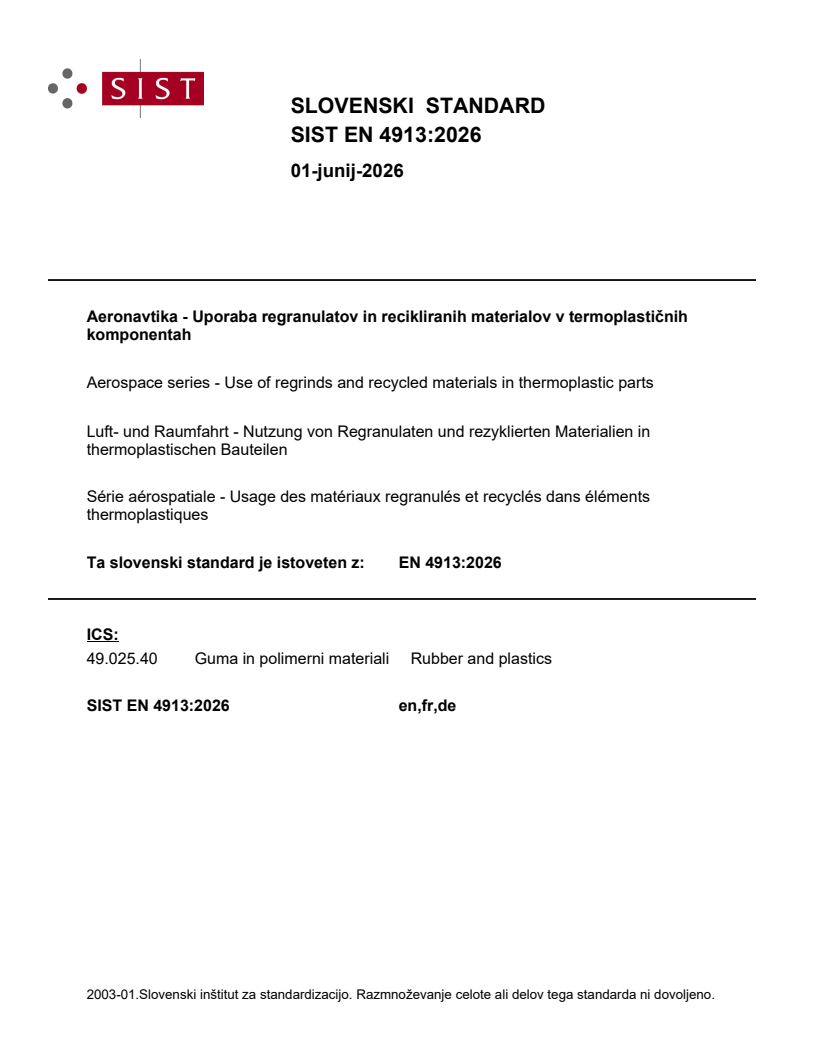
SLOVENSKI STANDARD
01-junij-2026
Aeronavtika - Uporaba regranulatov in recikliranih materialov v termoplastičnih
komponentah
Aerospace series - Use of regrinds and recycled materials in thermoplastic parts
Luft- und Raumfahrt - Nutzung von Regranulaten und rezyklierten Materialien in
thermoplastischen Bauteilen
Série aérospatiale - Usage des matériaux regranulés et recyclés dans éléments
thermoplastiques
Ta slovenski standard je istoveten z: EN 4913:2026
ICS:
49.025.40 Guma in polimerni materiali Rubber and plastics
2003-01.Slovenski inštitut za standardizacijo. Razmnoževanje celote ali delov tega standarda ni dovoljeno.
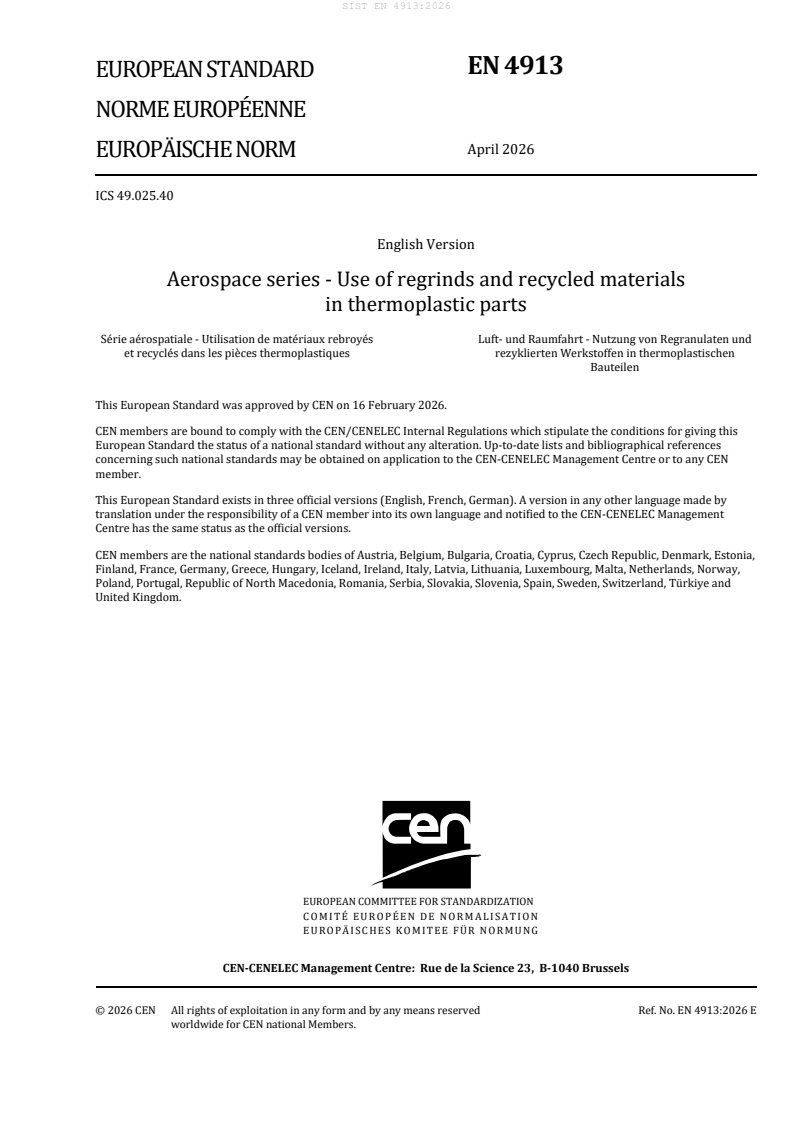
EN 4913
EUROPEAN STANDARD
NORME EUROPÉENNE
April 2026
EUROPÄISCHE NORM
ICS 49.025.40
English Version
Aerospace series - Use of regrinds and recycled materials
in thermoplastic parts
Série aérospatiale - Utilisation de matériaux rebroyés Luft- und Raumfahrt - Nutzung von Regranulaten und
et recyclés dans les pièces thermoplastiques rezyklierten Werkstoffen in thermoplastischen
Bauteilen
This European Standard was approved by CEN on 16 February 2026.
CEN members are bound to comply with the CEN/CENELEC Internal Regulations which stipulate the conditions for giving this
European Standard the status of a national standard without any alteration. Up-to-date lists and bibliographical references
concerning such national standards may be obtained on application to the CEN-CENELEC Management Centre or to any CEN
member.
This European Standard exists in three official versions (English, French, German). A version in any other language made by
translation under the responsibility of a CEN member into its own language and notified to the CEN-CENELEC Management
Centre has the same status as the official versions.
CEN members are the national standards bodies of Austria, Belgium, Bulgaria, Croatia, Cyprus, Czech Republic, Denmark, Estonia,
Finland, France, Germany, Greece, Hungary, Iceland, Ireland, Italy, Latvia, Lithuania, Luxembourg, Malta, Netherlands, Norway,
Poland, Portugal, Republic of North Macedonia, Romania, Serbia, Slovakia, Slovenia, Spain, Sweden, Switzerland, Türkiye and
United Kingdom.
EUROPEAN COMMITTEE FOR STANDARDIZATION
COMITÉ EUROPÉEN DE NORMALISATION
EUROPÄISCHES KOMITEE FÜR NORMUNG
CEN-CENELEC Management Centre: Rue de la Science 23, B-1040 Brussels
© 2026 CEN All rights of exploitation in any form and by any means reserved Ref. No. EN 4913:2026 E
worldwide for CEN national Members.
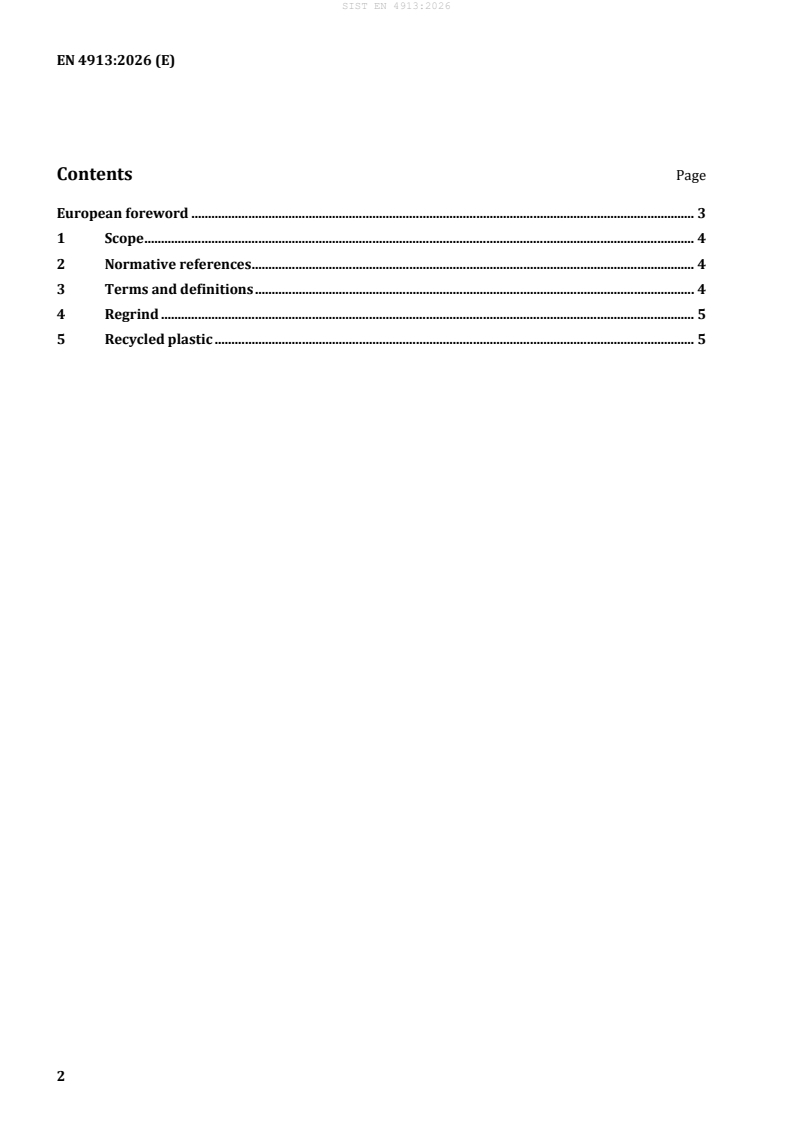
Contents Page
European foreword . 3
1 Scope . 4
2 Normative references . 4
3 Terms and definitions . 4
4 Regrind . 5
5 Recycled plastic . 5
European foreword
This document (EN 4913:2026) has been prepared by ASD-STAN.
After enquiries and votes carried out in accordance with the rules of this Association, this
document has received the approval of the National Associations and the Official Services of the
member countries of ASD-STAN, prior to its presentation to CEN.
This European Standard shall be given the status of a national standard, either by publication of an
identical text or by endorsement, at the latest by October 2026, and conflicting national standards shall
be withdrawn at the latest by October 2026.
Attention is drawn to the possibility that some of the elements of this document may be the subject of
patent rights. CEN shall not be held responsible for identifying any or all such patent rights.
Any feedback and questions on this document should be directed to the users’ national standards body.
A complete listing of these bodies can be found on the CEN website.
According to the CEN-CENELEC Internal Regulations, the national standards organizations of the
following countries are bound to implement this European Standard: Austria, Belgium, Bulgaria,
Croatia, Cyprus, Czec
...