

SIST EN 13022-2:2006/kFprA1:2009
(Amendment)Glass in building - Structural sealant glazing - Part 2: Assembly rules
General Information
- Abstract
This European Standard deals with the assembling and bonding of glass elements in a frame, window, door or curtain walling construction, or directly into the building by means of structural bonding of the glass element into or onto framework or directly into the building.
It gives information to the assembler to enable him to organise his work and comply with requirements regarding quality control.
Structural sealant glazing can be incorporated into the façade as follows:
- either vertically; or
- up to 7° from the horizontal, i.e. 83o from the vertical..
This European Standard only deals with the bonding to glass surfaces, i.e. coated or uncoated, and metallic surfaces, i.e. aluminium (anodized or coated), stainless steel, as considered in clause G.2 of EN 15434.
- Status
- Not Published
- Public Enquiry End Date
- 29-Dec-2009
- Technical Committee
- STV - Steklo, svetloba in razsvetljava v gradbeništvu
- Current Stage
- 98 - Abandoned project (Adopted Project)
- Start Date
- 14-Apr-2011
- Due Date
- 19-Apr-2011
- Completion Date
- 15-Apr-2011


Overview
SIST EN 13022-2:2006/kFprA1:2009, published by CEN (the European Committee for Standardization), is a key European standard for the use of glass in building applications, specifically focused on structural sealant glazing. This standard outlines essential assembly rules for bonding and integrating glass elements into window frames, doors, curtain walling, or directly into building structures using structural sealants. It guides professionals in organizing and executing their tasks while ensuring compliance with rigorous quality control requirements.
By addressing both coated and uncoated glass surfaces as well as metallic substrates such as anodized and coated aluminium or stainless steel, SIST EN 13022-2:2006/kFprA1:2009 supports the implementation of safe, reliable, and high-quality glazing solutions in modern construction.
Key Topics
Assembly and Bonding Procedures
Details procedures for correctly assembling glass components using structural sealants. This includes bonding glass to metallic surfaces and suitable frameworks, ensuring safety and durability.Quality Control Requirements
Provides the assembler with requirements for maintaining consistent quality during the installation process, from site organization to final checks.Scope of Application
Covers bonding of glass to glass or metallic (aluminium, stainless steel) surfaces in building façades, either vertically or inclined up to 7° from the horizontal.Test Specimens and Calculations
Sets out conditioning procedures for test specimens and specifies calculation models to assess structural reliability and safety, referencing essential European directives.
Applications
SIST EN 13022-2:2006/kFprA1:2009 has a broad range of practical applications in the construction industry, particularly in projects involving:
Curtain Walling Systems
Facilitates the design and installation of glass curtain walls where structural bonding is integral to aesthetics and performance.Windows and Doors
Guides the secure integration of glass into window and door frameworks, addressing both coated and uncoated surfaces.Direct Glazing into Buildings
Enables structural sealant glazing of glass elements directly into buildings, supporting innovative architectural designs.Residential and Commercial Building Façades
Supports both vertical and inclined glazing up to 7° from the horizontal, expanding design possibilities for modern façades.
Implementing this standard helps ensure that glass bonding is performed safely, with reliable structural integrity and long-term durability. It gives clear direction for installers and manufacturers to fulfill requirements on quality and performance, leading to safer and more sustainable buildings.
Related Standards
EN 13022-1: Glass in Building - Structural Sealant Glazing - Part 1: Requirements
Focuses on the general performance requirements for structural sealant glazing systems.EN 15434:
Addresses relevant aspects of bonding to metallic surfaces, providing technical references for compatibility.EN 1990: Eurocode - Basis of Structural Design
Referenced for safety and reliability calculations, ensuring harmonization across structural assessment.EN 1279 Series: Glass in Building - Insulating Glass Units
Covers supplementary requirements for insulating glass, complementing structural glazing guidelines.
By following SIST EN 13022-2:2006/kFprA1:2009 and its related standards, construction professionals can ensure that glass assemblies in building façades, windows, and doors meet stringent European safety, quality, and performance requirements. This not only boosts structural safety and quality assurance but also expands possibilities in architectural design by supporting a variety of modern, energy-efficient glazing solutions.
Relations
- Consolidated By
SIST EN 13022-2:2006+A1:2010 - Glass in building - Structural sealant glazing - Part 2: Assembly rules - Effective Date
- 18-Jan-2023
Frequently Asked Questions
SIST EN 13022-2:2006/kFprA1:2009 is a draft published by the Slovenian Institute for Standardization (SIST). Its full title is "Glass in building - Structural sealant glazing - Part 2: Assembly rules". This standard covers: This European Standard deals with the assembling and bonding of glass elements in a frame, window, door or curtain walling construction, or directly into the building by means of structural bonding of the glass element into or onto framework or directly into the building. It gives information to the assembler to enable him to organise his work and comply with requirements regarding quality control. Structural sealant glazing can be incorporated into the façade as follows: - either vertically; or - up to 7° from the horizontal, i.e. 83o from the vertical.. This European Standard only deals with the bonding to glass surfaces, i.e. coated or uncoated, and metallic surfaces, i.e. aluminium (anodized or coated), stainless steel, as considered in clause G.2 of EN 15434.
This European Standard deals with the assembling and bonding of glass elements in a frame, window, door or curtain walling construction, or directly into the building by means of structural bonding of the glass element into or onto framework or directly into the building. It gives information to the assembler to enable him to organise his work and comply with requirements regarding quality control. Structural sealant glazing can be incorporated into the façade as follows: - either vertically; or - up to 7° from the horizontal, i.e. 83o from the vertical.. This European Standard only deals with the bonding to glass surfaces, i.e. coated or uncoated, and metallic surfaces, i.e. aluminium (anodized or coated), stainless steel, as considered in clause G.2 of EN 15434.
SIST EN 13022-2:2006/kFprA1:2009 is classified under the following ICS (International Classification for Standards) categories: 81.040.20 - Glass in building. The ICS classification helps identify the subject area and facilitates finding related standards.
SIST EN 13022-2:2006/kFprA1:2009 has the following relationships with other standards: It is inter standard links to SIST EN 13022-2:2006+A1:2010. Understanding these relationships helps ensure you are using the most current and applicable version of the standard.
SIST EN 13022-2:2006/kFprA1:2009 is associated with the following European legislation: EU Directives/Regulations: 305/2011, 89/106/EEC; Standardization Mandates: M/135. When a standard is cited in the Official Journal of the European Union, products manufactured in conformity with it benefit from a presumption of conformity with the essential requirements of the corresponding EU directive or regulation.
SIST EN 13022-2:2006/kFprA1:2009 is available in PDF format for immediate download after purchase. The document can be added to your cart and obtained through the secure checkout process. Digital delivery ensures instant access to the complete standard document.
Standards Content (Sample)
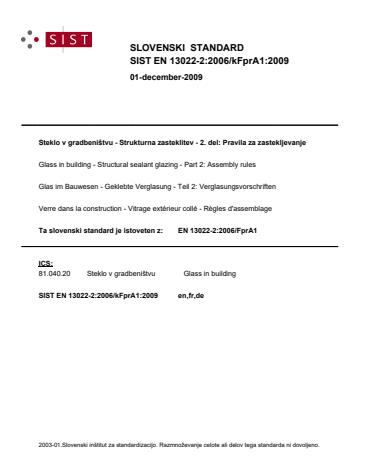
SLOVENSKI STANDARD
01-december-2009
Steklo v gradbeništvu - Strukturna zasteklitev - 2. del: Pravila za zastekljevanje
Glass in building - Structural sealant glazing - Part 2: Assembly rules
Glas im Bauwesen - Geklebte Verglasung - Teil 2: Verglasungsvorschriften
Verre dans la construction - Vitrage extérieur collé - Règles d'assemblage
Ta slovenski standard je istoveten z: EN 13022-2:2006/FprA1
ICS:
81.040.20 Steklo v gradbeništvu Glass in building
2003-01.Slovenski inštitut za standardizacijo. Razmnoževanje celote ali delov tega standarda ni dovoljeno.
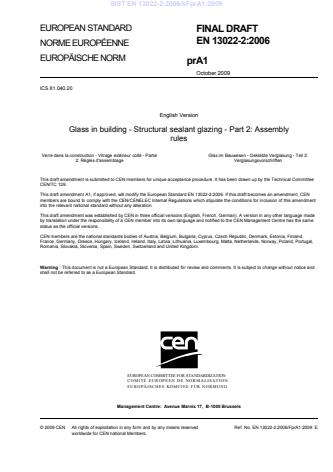
EUROPEAN STANDARD
FINAL DRAFT
EN 13022-2:2006
NORME EUROPÉENNE
EUROPÄISCHE NORM
prA1
October 2009
ICS 81.040.20
English Version
Glass in building - Structural sealant glazing - Part 2: Assembly
rules
Verre dans la construction - Vitrage extérieur collé - Partie Glas im Bauwesen - Geklebte Verglasung - Teil 2:
2: Règles d'assemblage Verglasungsvorschriften
This draft amendment is submitted to CEN members for unique acceptance procedure. It has been drawn up by the Technical Committee
CEN/TC 129.
This draft amendment A1, if approved, will modify the European Standard EN 13022-2:2006. If this draft becomes an amendment, CEN
members are bound to comply with the CEN/CENELEC Internal Regulations which stipulate the conditions for inclusion of this amendment
into the relevant national standard without any alteration.
This draft amendment was established by CEN in three official versions (English, French, German). A version in any other language made
by translation under the responsibility of a CEN member into its own language and notified to the CEN Management Centre has the same
status as the official versions.
CEN members are the national standards bodies of Austria, Belgium, Bulgaria, Cyprus, Czech Republic, Denmark, Estonia, Finland,
France, Germany, Greece, Hungary, Iceland, Ireland, Italy, Latvia, Lithuania, Luxembourg, Malta, Netherlands, Norway, Poland, Portugal,
Romania, Slovakia, Slovenia, Spain, Sweden, Switzerland and United Kingdom.
Warning : This document is not a European Standard. It is distributed for review and comments. It is subject to change without notice and
shall not be referred to as a European Standard.
EUROPEAN COMMITTEE FOR STANDARDIZATION
COMITÉ EUROPÉEN DE NORMALISATION
EUROPÄISCHES KOMITEE FÜR NORMUNG
Management Centre: Avenue Marnix 17, B-1000 Brussels
© 2009 CEN All rights of exploitation in any form and by any means reserved Ref. No. EN 13022-2:2006/FprA1:2009: E
worldwide for CEN national Members.
Contents Page
Foreword .
...