

SIST ISO 13878:1999
(Main)Soil quality - Determination of total nitrogen content by dry combustion ("elemental analysis")
General Information
- Abstract
- Status
- Published
- Publication Date
- 28-Feb-1999
- Technical Committee
- KAT - Soil quality
- Current Stage
- 6060 - National Implementation/Publication (Adopted Project)
- Start Date
- 01-Mar-1999
- Due Date
- 01-Mar-1999
- Completion Date
- 01-Mar-1999
Buy Documents

ISO 13878:1998 - Soil quality — Determination of total nitrogen content by dry combustion ("elemental analysis") Released:3/19/1998
ISO 13878:1998 - Qualité du sol — Détermination de la teneur totale en azote par combustion seche ("analyse élémentaire") Released:3/19/1998
Overview
SIST ISO 13878:1999 – Soil Quality: Determination of Total Nitrogen Content by Dry Combustion specifies a reliable method for determining the total nitrogen content in soils through dry combustion, often referred to as "elemental analysis." This international standard, published by ISO, is applicable to all soil types and supports accurate, repeatable soil nitrogen analysis, essential for environmental monitoring, agriculture, land management, and soil research.
Total nitrogen analysis by dry combustion is an important chemical testing method that informs soil fertility management, environmental assessments, and agronomic planning. The method, originally based on the Dumas procedure, benefits from modern automated equipment, improving efficiency and reproducibility in laboratories.
Key Topics
- Scope and Applicability
- Suitable for all soil types.
- Applies modern combustion analysis for accurate nitrogen quantification.
- Fundamental Principle
- Soil samples are combusted at temperatures of at least 900°C in an oxygen atmosphere.
- Nitrogen compounds in the sample convert to nitrogen oxides and molecular nitrogen, which are then quantified, typically using a thermal conductivity detector.
- Sample Preparation and Calibration
- Samples are pre-treated following ISO 11464 to ensure consistency.
- Calibration utilizes certified substances with known nitrogen content, such as acetanilide or L-aspartic acid.
- Equipment and Reagents
- High-precision analytical balance and specialized combustion apparatus required.
- Analytical-grade oxygen and catalyst chemicals as specified by equipment manufacturer.
- Measurement and Reporting
- Results expressed as milligrams nitrogen per gram of dry soil or mass percent.
- Emphasis on repeatability and reliability of results.
- Inclusion of comprehensive reporting requirements and identification of analyzed samples.
Applications
The method outlined in SIST ISO 13878:1999 is widely applicable in the following areas:
- Soil Fertility and Agricultural Research
- Assesses total nitrogen levels to inform fertilizer application and soil management practices.
- Supports sustainable agricultural productivity through precise nitrogen monitoring.
- Environmental Monitoring
- Helps track changes in soil composition due to pollution, land use change, or remediation.
- Essential for regulatory compliance and reporting in environmental projects.
- Land Reclamation and Remediation
- Assesses baseline and post-treatment nitrogen levels in disturbed or restored soils.
- Soil Science and Academic Research
- Provides standardized measurement for comparative soil studies.
- Facilitates research in soil chemistry, nutrient cycling, and ecosystem health.
Related Standards
SIST ISO 13878:1999 is closely associated with other ISO standards relevant to soil quality and chemical analysis:
- ISO 11464:1994 – Soil quality - Pretreatment of samples for physico-chemical analyses
- ISO 11465:1993 – Soil quality - Determination of dry matter and water content on a mass basis - Gravimetric method
- ISO 11261:1995 – Soil quality - Determination of total nitrogen - Modified Kjeldahl method
- ISO 5725-2:1994 – Accuracy (trueness and precision) of measurement methods and results - Part 2: Determination of repeatability and reproducibility of a standard measurement method
These standards provide a comprehensive framework for soil sample handling, nitrogen determination, and data quality assurance. Adopting SIST ISO 13878:1999 ensures internationally recognized, consistent, and accurate assessment of soil nitrogen content, essential for laboratory analysis, environmental consultancy, and agricultural management.
Keywords: ISO 13878, soil quality, nitrogen analysis, dry combustion, elemental analysis, soil testing, environmental monitoring, laboratory standards, soil fertility, chemical analysis, repeatability.
Relations
- Effective Date
- 25-Aug-2026
Buy Documents
ISO 13878:1998 - Soil quality — Determination of total nitrogen content by dry combustion ("elemental analysis") Released:3/19/1998
ISO 13878:1998 - Qualité du sol — Détermination de la teneur totale en azote par combustion seche ("analyse élémentaire") Released:3/19/1998
Get Certified
Connect with accredited certification bodies for this standard

CIS Institut d.o.o.
Personal Protective Equipment (PPE) certification body. Notified Body NB-2890 for EU Regulation 2016/425 PPE.

Kiwa BDA Testing
Building and construction product certification.
Kmetijski inštitut Slovenije
Agricultural Institute of Slovenia. Soil testing, plant health, agricultural product analysis.
Sponsored listings
Frequently Asked Questions
SIST ISO 13878:1999 is a standard published by the Slovenian Institute for Standardization (SIST). Its full title is "Soil quality - Determination of total nitrogen content by dry combustion ("elemental analysis")". This standard covers: Soil quality - Determination of total nitrogen content by dry combustion ("elemental analysis")
Soil quality - Determination of total nitrogen content by dry combustion ("elemental analysis")
SIST ISO 13878:1999 is classified under the following ICS (International Classification for Standards) categories: 13.080.10 - Chemical characteristics of soils. The ICS classification helps identify the subject area and facilitates finding related standards.
SIST ISO 13878:1999 has the following relationships with other standards: It is inter standard links to SIST EN ISO 15175:2011. Understanding these relationships helps ensure you are using the most current and applicable version of the standard.
SIST ISO 13878:1999 is associated with the following European legislation: EU Directives/Regulations: 2017-01-3098, 2019-01-2991, 2022-01-2545, TP255. When a standard is cited in the Official Journal of the European Union, products manufactured in conformity with it benefit from a presumption of conformity with the essential requirements of the corresponding EU directive or regulation.
SIST ISO 13878:1999 is available in PDF format for immediate download after purchase. The document can be added to your cart and obtained through the secure checkout process. Digital delivery ensures instant access to the complete standard document.
Standards Content (Sample)
SLOVENSKI STANDARD
01-marec-1999
Kakovost tal - Določevanje celotnega dušika s suhim sežigom (elementna analiza)
Soil quality - Determination of total nitrogen content by dry combustion ("elemental
analysis")
Qualité du sol - Détermination de la teneur totale en azote par combustion sèche
("analyse élémentaire")
Ta slovenski standard je istoveten z: ISO 13878:1998
ICS:
13.080.10 Kemijske značilnosti tal Chemical characteristics of
soils
2003-01.Slovenski inštitut za standardizacijo. Razmnoževanje celote ali delov tega standarda ni dovoljeno.
INTERNATIONAL ISO
STANDARD 13878
First edition
1998-03-15
Soil quality — Determination of total
nitrogen content by dry combustion
(“elemental analysis”)
Qualité du sol — Détermination de la teneur totale en azote par combustion
sèche («analyse élémentaire»)
A Reference number
Foreword
ISO (the International Organization for Standardization) is a worldwide
federation of national standards bodies (ISO member bodies). The work of
preparing International Standards is normally carried out through ISO
technical committees. Each member body interested in a subject for which
a technical committee has been established has the right to be represented
on that committee. International organizations, governmental and non-
governmental, in liaison with ISO, also take part in the work. ISO
collaborates closely with the International Electrotechnical Commission
(IEC) on all matters of electrotechnical standardization.
Draft International Standards adopted by the technical committees are
circulated to the member bodies for voting. Publication as an International
Standard requires approval by at least 75 % of the member bodies casting
a vote.
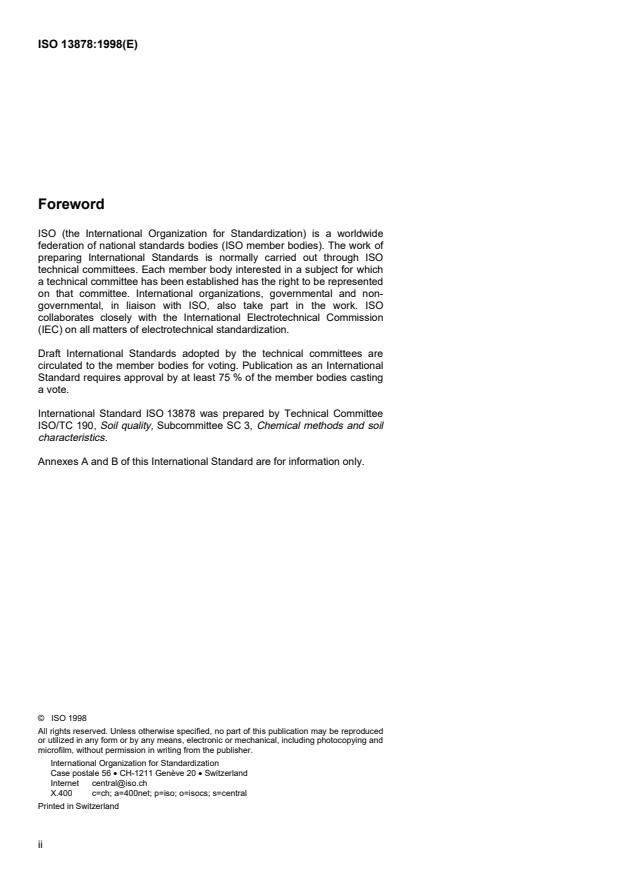
International Standard ISO 13878 was prepared by Technical Committee
ISO/TC 190, Soil quality, Subcommittee SC 3, Chemical methods and soil
characteristics.
Annexes A and B of this International Standard are for information only.
© ISO 1998
All rights reserved. Unless otherwise specified, no part of this publication may be reproduced
or utilized in any form or by any means, electronic or mechanical, including photocopying and
microfilm, without permission in writing from the publisher.
International Organization for Standardization
Case postale 56 • CH-1211 Genève 20 • Switzerland
Internet central@iso.ch
X.400 c=ch; a=400net; p=iso; o=isocs; s=central
Printed in Switzerland
ii
©
INTERNATIONAL STANDARD ISO ISO 13878:1998(E)
Soil quality — Determination of total nitrogen content by
dry combustion (“elemental analysis”)
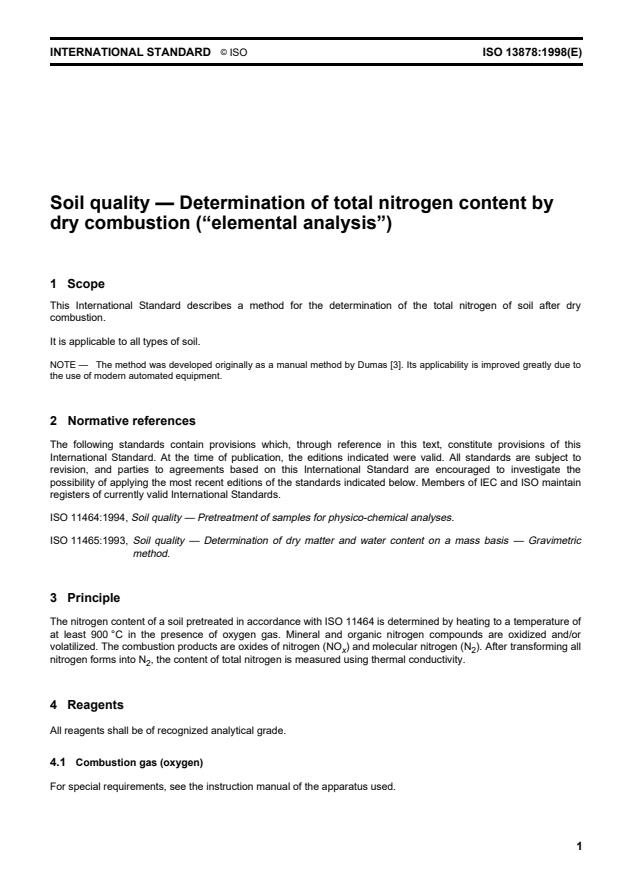
1 Scope
This International Standard describes a method for the determination of the total nitrogen of soil after dry
combustion.
It is applicable to all types of soil.
NOTE — The method was developed originally as a manual method by Dumas [3]. Its applicability is improved greatly due to
the use of modern automated equipment.
2 Normative references
The following standards contain provisions which, through reference in this text, constitute provisions of this
International Standard. At the time of publication, the editions indicated were valid. All standards are subject to
revision, and parties to agreements based on this International Standard are encouraged to investigate the
possibility of applying the most recent editions of the standards indicated below. Members of IEC and ISO maintain
registers of currently valid International Standards.
ISO 11464:1994, Soil quality — Pretreatment of samples for physico-chemical analyses.
ISO 11465:1993, Soil quality — Determination of dry matter and water content on a mass basis — Gravimetric
method.
3 Principle
The nitrogen content of a soil pretreated in accordance with ISO 11464 is determined by heating to a temperature of
at least 900 °C in the presence of oxygen gas. Mineral and organic nitrogen compounds are oxidized and/or
volatilized. The combustion products are oxides of nitrogen (NO ) and molecular nitrogen (N ). After transforming all
x 2
nitrogen forms into N , the content of total nitrogen is measured using thermal conductivity.
4 Reagents
All reagents shall be of recognized analytical grade.
4.1 Combustion gas (oxygen)
For special requirements, see the instruction manual of the apparatus used.
©
ISO
4.2 Chemicals and/or catalysts
For reduction, oxidation, removal and/or fixing of combustion gases which interfere with the analysis.
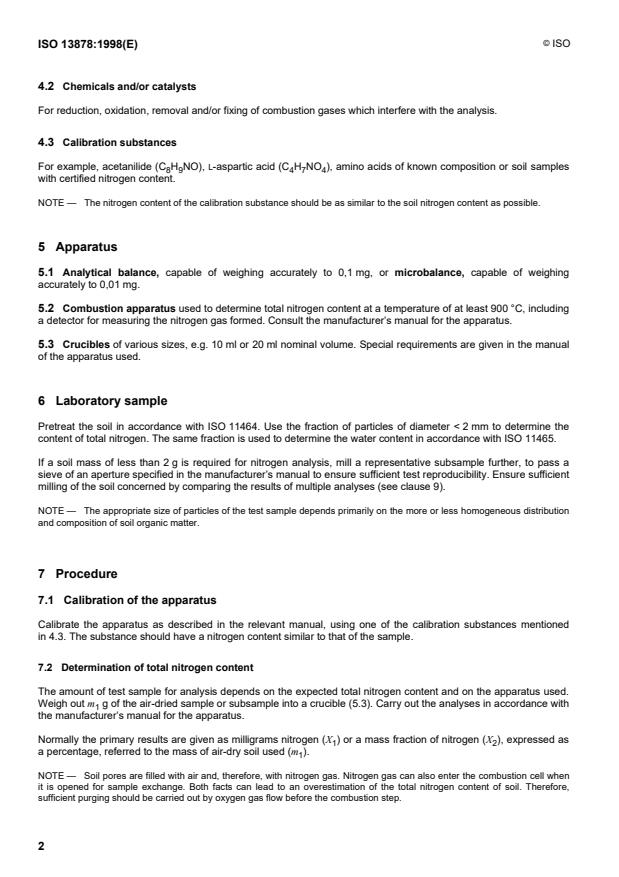
4.3 Calibration substances
For example, acetanilide (C H NO), L-aspartic acid (C H NO ), amino acids of known composition or soil samples
8 9 4 7 4
with certified nitrogen content.
NOTE — The nitrogen content of the calibration substance should be as similar to the soil nitrogen content as possible.
5 Apparatus
5.1 Analytical balance, capable of weighing accurately to 0,1 mg, or microbalance, capable of weighing
accurately to 0,01 mg.
5.2 Combustion apparatus used to determine total nitrogen content at a temperature of at least 900 °C, including
a detector for measur
...
INTERNATIONAL ISO
STANDARD 13878
First edition
1998-03-15
Soil quality — Determination of total
nitrogen content by dry combustion
(“elemental analysis”)
Qualité du sol — Détermination de la teneur totale en azote par combustion
sèche («analyse élémentaire»)
A Reference number
Foreword
ISO (the International Organization for Standardization) is a worldwide
federation of national standards bodies (ISO member bodies). The work of
preparing International Standards is normally carried out through ISO
technical committees. Each member body interested in a subject for which
a technical committee has been established has the right to be represented
on that committee. International organizations, governmental and non-
governmental, in liaison with ISO, also take part in the work. ISO
collaborates closely with the International Electrotechnical Commission
(IEC) on all matters of electrotechnical standardization.
Draft International Standards adopted by the technical committees are
circulated to the member bodies for voting. Publication as an International
Standard requires approval by at least 75 % of the member bodies casting
a vote.
International Standard ISO 13878 was prepared by Technical Committee
ISO/TC 190, Soil quality, Subcommittee SC 3, Chemical methods and soil
characteristics.
Annexes A and B of this International Standard are for information only.
© ISO 1998
All rights reserved. Unless otherwise specified, no part of this publication may be reproduced
or utilized in any form or by any means, electronic or mechanical, including photocopying and
microfilm, without permission in writing from the publisher.
International Organization for Standardization
Case postale 56 • CH-1211 Genève 20 • Switzerland
Internet central@iso.ch
X.400 c=ch; a=400net; p=iso; o=isocs; s=central
Printed in Switzerland
ii
©
INTERNATIONAL STANDARD ISO ISO 13878:1998(E)
Soil quality — Determination of total nitrogen content by
dry combustion (“elemental analysis”)
1 Scope
This International Standard describes a method for the determination of the total nitrogen of soil after dry
combustion.
It is applicable to all types of soil.
NOTE — The method was developed originally as a manual method by Dumas [3]. Its applicability is improved greatly due to
the use of modern automated equipment.
2 Normative references
The following standards contain provisions which, through reference in this text, constitute provisions of this
International Standard. At the time of publication, the editions indicated were valid. All standards are subject to
revision, and parties to agreements based on this International Standard are encouraged to investigate the
possibility of applying the most recent editions of the standards indicated below. Members of IEC and ISO maintain
registers of currently valid International Standards.
ISO 11464:1994, Soil quality — Pretreatment of samples for physico-chemical analyses.
ISO 11465:1993, Soil quality — Determination of dry matter and water content on a mass basis — Gravimetric
method.
3 Principle
The nitrogen content of a soil pretreated in accordance with ISO 11464 is determined by heating to a temperature of
at least 900 °C in the presence of oxygen gas. Mineral and organic nitrogen compounds are oxidized and/or
volatilized. The combustion products are oxides of nitrogen (NO ) and molecular nitrogen (N ). After transforming all
x 2
nitrogen forms into N , the content of total nitrogen is measured using thermal conductivity.
4 Reagents
All reagents shall be of recognized analytical grade.
4.1 Combustion gas (oxygen)
For special requirements, see the instruction manual of the apparatus used.
©
ISO
4.2 Chemicals and/or catalysts
For reduction, oxidation, removal and/or fixing of combustion gases which interfere with the analysis.
4.3 Calibration substances
For example, acetanilide (C H NO), L-aspartic acid (C H NO ), amino acids of known composition or soil samples
8 9 4 7 4
with certified nitrogen content.
NOTE — The nitrogen content of the calibration substance should be as similar to the soil nitrogen content as possible.
5 Apparatus
5.1 Analytical balance, capable of weighing accurately to 0,1 mg, or microbalance, capable of weighing
accurately to 0,01 mg.
5.2 Combustion apparatus used to determine total nitrogen content at a temperature of at least 900 °C, including
a detector for measuring the nitrogen gas formed. Consult the manufacturer’s manual for the apparatus.
5.3 Crucibles of various sizes, e.g. 10 ml or 20 ml nominal volume. Special requirements are given in the manual
of the apparatus used.
6 Laboratory sample
Pretreat the soil in accordance with ISO 11464. Use the fraction of particles of diameter < 2 mm to determine the
content of total nitrogen. The same fraction is used to determine the water content in accordance with ISO 11465.
If a soil mass of less than
...
NORME ISO
INTERNATIONALE 13878
Première édition
1998-03-15
Qualité du sol — Détermination de la teneur
totale en azote par combustion sèche
(«analyse élémentaire»)
Soil quality — Determination of total nitrogen content by dry combustion
(“elemental analysis”)
A
Numéro de référence
Avant-propos
L'ISO (Organisation internationale de normalisation) est une fédération
mondiale d'organismes nationaux de normalisation (comités membres de
l'ISO). L'élaboration des Normes internationales est en général confiée aux
comités techniques de l'ISO. Chaque comité membre intéressé par une
étude a le droit de faire partie du comité technique créé à cet effet. Les
organisations internationales, gouvernementales et non gouvernementales,
en liaison avec l'ISO participent également aux travaux. L'ISO collabore
étroitement avec la Commission électrotechnique internationale (CEI) en
ce qui concerne la normalisation électrotechnique.
Les projets de Normes internationales adoptés par les comités techniques
sont soumis aux comités membres pour vote. Leur publication comme
Normes internationales requiert l'approbation de 75 % au moins des
comités membres votants.
La Norme internationale ISO 13878 a été élaborée par le comité technique
ISO/TC 190, Qualité du sol, sous-comité SC 3, Méthodes chimiques et
caractéristiques du sol.
Les annexes A et B de la présente Norme internationale sont données
uniquement à titre d’information.
© ISO 1998
Droits de reproduction réservés. Sauf prescription différente, aucune partie de cette publi-
cation ne peut être reproduite ni utilisée sous quelque forme que ce soit et par aucun pro-
cédé, électronique ou mécanique, y compris la photocopie et les microfilms, sans l'accord
écrit de l'éditeur.
Organisation internationale de normalisation
Case postale 56 • CH-1211 Genève 20 • Suisse
Internet central@iso.ch
X.400 c=ch; a=400net; p=iso; o=isocs; s=central
Imprimé en Suisse
ii
©
NORME INTERNATIONALE ISO ISO 13878:1998(F)
Qualité du sol — Détermination de la teneur totale en azote
par combustion sèche («analyse élémentaire»)
1 Domaine d'application
La présente Norme internationale spécifie une méthode de détermination de la teneur totale en azote d’un sol après
une combustion sèche.
Elle est applicable à tous les types de sol.
NOTE — La méthode, mise au point par Dumas [3], était au départ manuelle. Son mode d’application s’est fortement
amélioré grâce à l’utilisation d’un matériel moderne automatisé.
2 Références normatives
Les normes suivantes contiennent des dispositions qui, par suite de la référence qui en est faite, constituent des
dispositions valables pour la présente Norme internationale. Au moment de la publication, les éditions indiquées
étaient en vigueur. Toute norme est sujette à révision et les parties prenantes des accords fondés sur la présente
Norme internationale sont invitées à rechercher la possibilité d'appliquer les éditions les plus récentes des normes
indiquées ci-après. Les membres de la CEI et de l’ISO possèdent le registre des Normes internationales en vigueur
à un moment donné.
ISO 11464:1994, Qualité du sol — Prétraitement des échantillons pour analyses physico-chimiques.
ISO 11465:1994, Qualité du sol — Détermination de la teneur pondérale en matière sèche et en eau — Méthode
gravimétrique.
3 Principe
La teneur en azote d’un sol, préalablement traité conformément à l’ISO 11464, est déterminée en le chauffant à une
température d’au moins 900 °C en présence d’oxygène gazeux. Les composés minéraux ou organiques de l’azote
sont oxydés et/ou volatilisés. Les produits de la combustion sont des oxydes d’azote (NO ) et de l’azote moléculaire
x
(N ). Après transformation de toutes les formes d’azote en N , la teneur totale en azote est mesurée par
2 2
conductibilité thermique.
4 Réactifs
Tous les réactifs doivent être de qualité analytique reconnue.
4.1 Gaz de combustion (oxygène)
Pour les spécifications particulières, voir le manuel d’utilisation de l’appareil.
©
ISO
4.2 Produits chimiques et/ou catalyseurs, pour la réduction, l’oxydation, le dégagement ou la fixation des gaz
de combustion qui perturbent l’analyse.
4.3 Substances d’étalonnage, par exemple, l’acétanilide (C H NO), l’acide L-aspartique (C H NO ), les acides
8 9 4 7 4
aminés de composition connue ou des échantillons de sol dont la teneur en azote est certifiée.
NOTE — Il convient que la teneur en azote de la substance d’étalonnage soit aussi proche que possible de celle du sol.
5 Appareillage
5.1 Balance analytique, capable de peser à 0,1 mg près, ou microbalance, capable de peser à 0,01 mg près.
5.2 Appareillage de combustion, utilisé pour déterminer la teneur totale en azote à une température d’au moins
900 °C, comprenant un détecteur pour mesurer l’azote gazeux formé. Consulter le manuel du fabricant relatif à
l’appareillage.
5.3 Creusets de différentes tailles, par exemple d’un volume nominal de 10 ml ou de 20 ml. Des spécifications
sont fournies dans le manuel d’utilisation de l’appareil.
6 Échantillon pour laboratoire
Traiter préalablement le sol conformément à l’ISO 11464. Utiliser la fraction des particules de diamètre inférieur à
2 mm pour déterminer la teneur totale en azote. La même fraction est utilisée pour déterminer la teneur en eau
conformément à l’ISO 11465.
Si la masse de sol, exigée pour les analyses, est inf
...