

SIST ES 202 504-2 V1.1.1:2008
Open Service Access (OSA) - Parlay X Web Services - Part 2: Third Party Call (Parlay X 3)
General Information
- Abstract
New edition of ParlayX specification based on requirements in EG 201 988-4, corresponding to 3GPP TS 29.199 Rel-7. The present document is part 2 of the Stage 3 Parlay X 3 Web Services specification for Open Service Access (OSA).
The OSA specifications define an architecture that enables application developers to make use of network functionality through an open standardized interface, i.e. the OSA APIs.
The present document specifies the Third Party Call Web Service. The following are defined here:
• Name spaces.
• Sequence diagrams.
• Data definitions.
• Interface specification plus detailed method descriptions.
• Fault definitions.
• Service Policies.
• WSDL Description of the interfaces.
- Status
- Published
- Publication Date
- 14-Jul-2008
- Technical Committee
- SPN - Services and Protocols for Networks
- Current Stage
- 6060 - National Implementation/Publication (Adopted Project)
- Start Date
- 18-Jun-2008
- Due Date
- 23-Aug-2008
- Completion Date
- 15-Jul-2008
Buy Documents
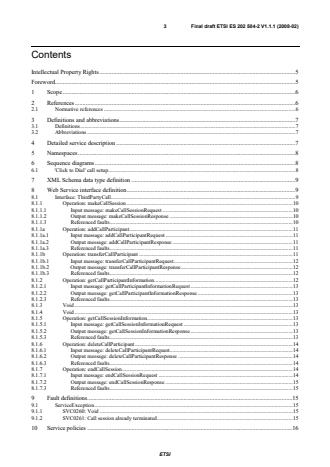
ETSI ES 202 504-2 V1.1.1 (2008-02) - Open Service Access (OSA); Parlay X Web Services; Part 2: Third Party Call (Parlay X 3)
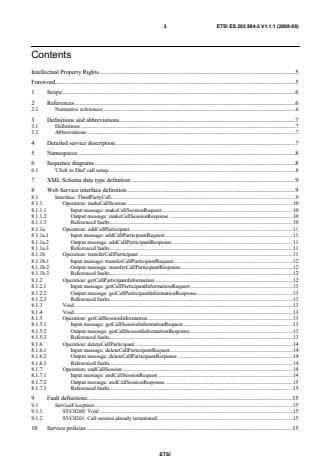

ETSI ES 202 504-2 V1.1.1 (2008-05) - Open Service Access (OSA); Parlay X Web Services; Part 2: Third Party Call (Parlay X 3)

Overview
SIST ES 202 504-2 V1.1.1:2008 defines the "Open Service Access (OSA) - Parlay X Web Services - Part 2: Third Party Call (Parlay X 3)." Developed by SIST and aligned with European Telecommunications Standards Institute (ETSI) and 3GPP specifications, this standard outlines an open, network-independent interface for advanced call control capabilities within telecommunication networks. Specifically, it describes the Third Party Call Web Service, offering a simplified model for initiating and managing calls through web-based APIs, which minimizes the need for deep telecom expertise among application developers.
Key Topics
- Open Service Access (OSA) Architecture: The standard delivers an open architecture that enables the exposure of network services through standardized Parlay X APIs.
- Third Party Call Web Service: Focuses on enabling applications to initiate, manage, and terminate call sessions between two or more participants.
- Service Interface Operations:
- makeCallSession: Initiates a call session between designated parties.
- addCallParticipant / deleteCallParticipant: Adds or removes individuals from an active call session.
- transferCallParticipant: Moves a participant between sessions.
- getCallParticipantInformation / getCallSessionInformation: Retrieves real-time status of the call or participants.
- endCallSession: Ends the ongoing call session and releases participants.
- Data Definitions and Namespaces: Uses web-service standards such as XML Schema for type definitions and consistent namespace usage for interoperability.
- Fault Definitions: Specifies standard error handling, including handling invalid input values, unsupported media types, and limits on participants.
- Service Policies: Includes configurations like maximum participants, allowed media types, charging options, and multimedia support for comprehensive session management.
- WSDL Specification: Provides a machine-readable Web Services Description Language (WSDL) for automated integration and deployment.
Applications
SIST ES 202 504-2 V1.1.1 empowers application developers to embed advanced call control features into a variety of business and consumer-facing platforms, without requiring extensive telecom knowledge:
- Click to Dial: Enables self-service web portals to set up instant phone calls between disparate endpoints (such as connecting customers to sales agents) with a single click.
- Customer Interaction Services: Integrates call initiation and management in customer relationship management (CRM) software, enhancing contact center efficiency.
- Brokerage and Financial Notifications: Automatically connects brokers and clients when specific events occur (such as stock triggers), optimizing response time.
- Multimedia Communication: Supports calls with multiple media types, including voice and video, thereby facilitating rich, interactive conferencing features for modern business applications.
- Workflow Automation: Automates call flows in business logic systems, improving operational efficiency and customer engagement.
By leveraging open, standardized interfaces, organizations can accelerate time-to-market for new telecom-enabled applications and reduce the complexity of integration with diverse network infrastructures.
Related Standards
For comprehensive implementation and interoperability, the following related Parlay X and OSA standards should be considered:
- ETSI ES 202 504-1: Parlay X Web Services - Part 1: Common (Parlay X 3)
- ETSI ES 202 504-12: Parlay X Web Services - Part 12: Multimedia Conference (Parlay X 3)
- 3GPP TS 29.199: OSA Parlay X Web Services specifications
- W3C XML Schema: For consistent data type specification
- Other parts of Parlay X Web Services series: Including Call Notification, Short Messaging, Account Management, and more, for extended service functions.
By adhering to SIST ES 202 504-2 V1.1.1, service providers and developers can ensure robust, flexible, and interoperable third party call capabilities through standard web service APIs, facilitating modern communication solutions in today's converged telecommunications environment.
Buy Documents
ETSI ES 202 504-2 V1.1.1 (2008-02) - Open Service Access (OSA); Parlay X Web Services; Part 2: Third Party Call (Parlay X 3)
ETSI ES 202 504-2 V1.1.1 (2008-05) - Open Service Access (OSA); Parlay X Web Services; Part 2: Third Party Call (Parlay X 3)
Get Certified
Connect with accredited certification bodies for this standard

BSI Group
BSI (British Standards Institution) is the business standards company that helps organizations make excellence a habit.

NYCE
Mexican standards and certification body.
Sponsored listings
Frequently Asked Questions
SIST ES 202 504-2 V1.1.1:2008 is a standard published by the Slovenian Institute for Standardization (SIST). Its full title is "Open Service Access (OSA) - Parlay X Web Services - Part 2: Third Party Call (Parlay X 3)". This standard covers: New edition of ParlayX specification based on requirements in EG 201 988-4, corresponding to 3GPP TS 29.199 Rel-7. The present document is part 2 of the Stage 3 Parlay X 3 Web Services specification for Open Service Access (OSA). The OSA specifications define an architecture that enables application developers to make use of network functionality through an open standardized interface, i.e. the OSA APIs. The present document specifies the Third Party Call Web Service. The following are defined here: • Name spaces. • Sequence diagrams. • Data definitions. • Interface specification plus detailed method descriptions. • Fault definitions. • Service Policies. • WSDL Description of the interfaces.
New edition of ParlayX specification based on requirements in EG 201 988-4, corresponding to 3GPP TS 29.199 Rel-7. The present document is part 2 of the Stage 3 Parlay X 3 Web Services specification for Open Service Access (OSA). The OSA specifications define an architecture that enables application developers to make use of network functionality through an open standardized interface, i.e. the OSA APIs. The present document specifies the Third Party Call Web Service. The following are defined here: • Name spaces. • Sequence diagrams. • Data definitions. • Interface specification plus detailed method descriptions. • Fault definitions. • Service Policies. • WSDL Description of the interfaces.
SIST ES 202 504-2 V1.1.1:2008 is classified under the following ICS (International Classification for Standards) categories: 35.100.01 - Open systems interconnection in general. The ICS classification helps identify the subject area and facilitates finding related standards.
SIST ES 202 504-2 V1.1.1:2008 is available in PDF format for immediate download after purchase. The document can be added to your cart and obtained through the secure checkout process. Digital delivery ensures instant access to the complete standard document.
Standards Content (Sample)
Final draft ETSI ES 202 504-2 V1.1.1 (2008-02)
ETSI Standard
Open Service Access (OSA);
Parlay X Web Services;
Part 2: Third Party Call
(Parlay X 3)
�
2 Final draft ETSI ES 202 504-2 V1.1.1 (2008-02)
Reference
DES/TISPAN-01034-2-OSA
Keywords
API, OSA, service
ETSI
650 Route des Lucioles
F-06921 Sophia Antipolis Cedex - FRANCE
Tel.: +33 4 92 94 42 00 Fax: +33 4 93 65 47 16
Siret N° 348 623 562 00017 - NAF 742 C
Association à but non lucratif enregistrée à la
Sous-Préfecture de Grasse (06) N° 7803/88
Important notice
Individual copies of the present document can be downloaded from:
http://www.etsi.org
The present document may be made available in more than one electronic version or in print. In any case of existing or
perceived difference in contents between such versions, the reference version is the Portable Document Format (PDF).
In case of dispute, the reference shall be the printing on ETSI printers of the PDF version kept on a specific network drive
within ETSI Secretariat.
Users of the present document should be aware that the document may be subject to revision or change of status.
Information on the current status of this and other ETSI documents is available at
http://portal.etsi.org/tb/status/status.asp
If you find errors in the present document, please send your comment to one of the following services:
http://portal.etsi.org/chaircor/ETSI_support.asp
Copyright Notification
No part may be reproduced except as authorized by written permission.
The copyright and the foregoing restriction extend to reproduction in all media.
© European Telecommunications Standards Institute 2008.
© The Parlay Group 2008.
All rights reserved.
TM TM TM TM
DECT , PLUGTESTS , UMTS , TIPHON , the TIPHON logo and the ETSI logo are Trade Marks of ETSI registered
for the benefit of its Members.
TM
3GPP is a Trade Mark of ETSI registered for the benefit of its Members and of the 3GPP Organizational Partners.
ETSI
3 Final draft ETSI ES 202 504-2 V1.1.1 (2008-02)
Contents
Intellectual Property Rights.5
Foreword.5
1 Scope.6
2 References.6
2.1 Normative references.6
3 Definitions and abbreviations.7
3.1 Definitions.7
3.2 Abbreviations.7
4 Detailed service description .7
5 Namespaces.8
6 Sequence diagrams.8
6.1 'Click to Dial' call setup.8
7 XML Schema data type definition .9
8 Web Service interface definition.9
8.1 Interface: ThirdPartyCall.9
8.1.1 Operation: makeCallSession.10
8.1.1.1 Input message: makeCallSessionRequest .10
8.1.1.2 Output message: makeCallSessionResponse .10
8.1.1.3 Referenced faults.10
8.1.1a Operation: addCallParticipant.11
8.1.1a.1 Input message: addCallParticipantRequest.11
8.1.1a.2 Output message: addCallParticipantResponse.11
8.1.1a.3 Referenced faults.11
8.1.1b Operation: transferCallParticipant.11
8.1.1b.1 Input message: transferCallParticipantRequest.12
8.1.1b.2 Output message: transferCallParticipantResponse.12
8.1.1b.3 Referenced faults.12
8.1.2 Operation: getCallParticipantInformation.12
8.1.2.1 Input message: getCallParticipantInformationRequest .13
8.1.2.2 Output message: getCallParticipantInformationResponse.13
8.1.2.3 Referenced faults.13
8.1.3 Void.13
8.1.4 Void.13
8.1.5 Operation: getCallSessionInformation.13
8.1.5.1 Input message: getCallSessionInformationRequest .13
8.1.5.2 Output message: getCallSessionInformationResponse .13
8.1.5.3 Referenced faults.13
8.1.6 Operation: deleteCallParticipant.14
8.1.6.1 Input message: deleteCallParticipantRequest.14
8.1.6.2 Output message: deleteCallParticipantResponse .14
8.1.6.3 Referenced faults.14
8.1.7 Operation: endCallSession.14
8.1.7.1 Input message: endCallSessionRequest.14
8.1.7.2 Output message: endCallSessionResponse .15
8.1.7.3 Referenced faults.15
9 Fault definitions.15
9.1 ServiceException.15
9.1.1 SVC0260: Void .15
9.1.2 SVC0261: Call session already terminated.15
10 Service policies .16
ETSI
4 Final draft ETSI ES 202 504-2 V1.1.1 (2008-02)
Annex A (normative): WSDL for Third Party Call.17
Annex B (informative): Bibliography.18
History .19
ETSI
5 Final draft ETSI ES 202 504-2 V1.1.1 (2008-02)
Intellectual Property Rights
IPRs essential or potentially essential to the present document may have been declared to ETSI. The information
pertaining to these essential IPRs, if any, is publicly available for ETSI members and non-members, and can be found
in ETSI SR 000 314: "Intellectual Property Rights (IPRs); Essential, or potentially Essential, IPRs notified to ETSI in
respect of ETSI standards", which is available from the ETSI Secretariat. Latest updates are available on the ETSI Web
server (http://webapp.etsi.org/IPR/home.asp).
Pursuant to the ETSI IPR Policy, no investigation, including IPR searches, has been carried out by ETSI. No guarantee
can be given as to the existence of other IPRs not referenced in ETSI SR 000 314 (or the updates on the ETSI Web
server) which are, or may be, or may become, essential to the present document.
Foreword
This ETSI Standard (ES) has been produced by ETSI Technical Committee Telecommunications and Internet
converged Services and Protocols for Advanced Networking (TISPAN), and is now submitted for the ETSI standards
Membership Approval Procedure.
The present document is part 2 of a multi-part deliverable covering Open Service Access (OSA); Parlay X 3 Web
Services, as identified below:
Part 1: "Common";
Part 2: "Third Party Call";
Part 3: "Call Notification";
Part 4: "Short Messaging";
Part 5: "Multimedia Messaging";
Part 6: "Payment";
Part 7: "Account Management";
Part 8: "Terminal Status";
Part 9: "Terminal Location";
Part 10: "Call Handling";
Part 11: "Audio Call";
Part 12: "Multimedia Conference";
Part 13: "Address List Management";
Part 14: "Presence";
Part 15: "Message Broadcast";
Part 16: "Geocoding";
Part 17: "Application-driven Quality of Service (QoS)";
Part 18: "Device Capabilities and Configuration";
Part 19: "Multimedia Streaming Control";
Part 20: "Multimedia Multicast Session Management".
The present document is equivalent to 3GPP TS 29.199-02 V7.4.0 (Release 7).
ETSI
6 Final draft ETSI ES 202 504-2 V1.1.1 (2008-02)
1 Scope
The present document is part 2 of the Stage 3 Parlay X 3 Web Services specification for Open Service Access (OSA).
The OSA specifications define an architecture that enables application developers to make use of network functionality
through an open standardized interface, i.e. the OSA APIs.
The present document specifies the Third Party Call Web Service. The following are defined here:
• Name spaces.
• Sequence diagrams.
• Data definitions.
• Interface specification plus detailed method descriptions.
• Fault definitions.
• Service Policies.
• WSDL Description of the interfaces.
2 References
References are either specific (identified by date of publication and/or edition number or version number) or non-
specific.
• For a specific reference, subsequent revisions do not apply.
• Non-specific reference may be made only to a complete document or a part thereof and only in the following
cases:
- if it is accepted that it will be possible to use all future changes of the referenced document for the
purposes of the referring document;
- for informative references.
Referenced documents which are not found to be publicly available in the expected location might be found at
http://docbox.etsi.org/Reference.
For online referenced documents, information sufficient to identify and locate the source shall be provided. Preferably,
the primary source of the referenced document should be cited, in order to ensure traceability. Furthermore, the
reference should, as far as possible, remain valid for the expected life of the document. The reference shall include the
method of access to the referenced document and the full network address, with the same punctuation and use of upper
case and lower case letters.
NOTE: While any hyperlinks included in this clause were valid at the time of publication ETSI cannot guarantee
their long term validity.
2.1 Normative references
The following referenced documents are indispensable for the application of the present document. For dated
references, only the edition cited applies. For non-specific references, the latest edition of the referenced document
(including any amendments) applies.
[1] W3C Recommendation (2 May 2001): "XML Schema Part 2: Datatypes".
NOTE: Available at http://www.w3.org/TR/2001/REC-xmlschema-2-20010502/.
ETSI
7 Final draft ETSI ES 202 504-2 V1.1.1 (2008-02)
[2] ETSI ES 202 504-1: "TISPAN; Open Service Access (OSA); Parlay X Web Services; Part 1:
Common (Parlay X 3)".
[3] ETSI ES 202 504-12: "TISPAN; Open Service Access (OSA); Parlay X Web Services; Part 12:
Multimedia Conference (Parlay X 3)".
3 Definitions and abbreviations
3.1 Definitions
For the purposes of the present document, the terms and definitions given in ES 202 504-1 [2] apply.
3.2 Abbreviations
For the purposes of the present document, the abbreviations given in ES 202 504-1 [2] apply.
4 Detailed service description
Currently, in order to perform a third party call in telecommunication networks we have to write applications using
specific protocols to access Call Control functions provided by network elements (specifically operations to initiate a
call from applications). This approach requires a high degree of network expertise. We can also use the OSA gateway
approach, invoking standard interfaces to gain access to call control capabilities, but these interfaces are usually
perceived to be quite complex by application IT developers. Developers must have advanced telecommunication skills
to use Call Control OSA interfaces.
In this clause we describe a Parlay X 3 Web Service, Third Party Call, for creating and managing a call initiated by an
application (third party call). The overall scope of this Web Service is to provide functions to application developers to
create a call in a simple way. Using the Third Party Call Web Service, application developers can invoke call handling
functions without detailed telecommunication knowledge.
The underlying model of the service is based on the following entities:
• Call Session: a call (uniquely identified) to which participants can be added/removed.
• Call Participant: each of the call parties (uniquely identified) involved in the call session.
• Media: the call can utilize multiple media types to support the participants' communication. In particular both
audio and video streams are available, including the specific stream direction (i.e. incoming, outgoing,
bidirectional).
NOTE 1: Call participants in a Call Session are anticipated to be uniquely identifiable using their URI address.
An application setting up a call session must initially invoke the makeCallSession. The result of such invocation is the
creation of a "context" that represents a call session with usually two participants, or at a minimum one participant
connected; a unique identifier is assigned to the just-created call session. Subsequently the application may wish to add,
remove, park or transfer call participants. In order to do so the operations addCallParticipant,
transferCallParticipant, deleteCallParticipant can be used. Furthermore the call session or call participant status
including the media details can be read. In order to do so the operations getCallParticipantInformation, and
getCallSessionInformation can be used. It is also possible to retrieve only the media details using the
getMediaForParticipant or getMediaForCall operations of the Audio Call web service.
The application can also force the call session and all its participants to be terminated with the operation
endCallSession.
ETSI
8 Final draft ETSI ES 202 504-2 V1.1.1 (2008-02)
NOTE 2: A call session allows the application to avail of other web service features that can add value to the
created call session. For example the Audio Call web service can provide multimedia message delivery to
call participants in the
...
ETSI Standard
Open Service Access (OSA);
Parlay X Web Services;
Part 2: Third Party Call
(Parlay X 3)
�
2 ETSI ES 202 504-2 V1.1.1 (2008-05)
Reference
DES/TISPAN-01034-2-OSA
Keywords
API, OSA, service
ETSI
650 Route des Lucioles
F-06921 Sophia Antipolis Cedex - FRANCE
Tel.: +33 4 92 94 42 00 Fax: +33 4 93 65 47 16
Siret N° 348 623 562 00017 - NAF 742 C
Association à but non lucratif enregistrée à la
Sous-Préfecture de Grasse (06) N° 7803/88
Important notice
Individual copies of the present document can be downloaded from:
http://www.etsi.org
The present document may be made available in more than one electronic version or in print. In any case of existing or
perceived difference in contents between such versions, the reference version is the Portable Document Format (PDF).
In case of dispute, the reference shall be the printing on ETSI printers of the PDF version kept on a specific network drive
within ETSI Secretariat.
Users of the present document should be aware that the document may be subject to revision or change of status.
Information on the current status of this and other ETSI documents is available at
http://portal.etsi.org/tb/status/status.asp
If you find errors in the present document, please send your comment to one of the following services:
http://portal.etsi.org/chaircor/ETSI_support.asp
Copyright Notification
No part may be reproduced except as authorized by written permission.
The copyright and the foregoing restriction extend to reproduction in all media.
© European Telecommunications Standards Institute 2008.
© The Parlay Group 2008.
All rights reserved.
TM TM TM TM
DECT , PLUGTESTS , UMTS , TIPHON , the TIPHON logo and the ETSI logo are Trade Marks of ETSI registered
for the benefit of its Members.
TM
3GPP is a Trade Mark of ETSI registered for the benefit of its Members and of the 3GPP Organizational Partners.
ETSI
3 ETSI ES 202 504-2 V1.1.1 (2008-05)
Contents
Intellectual Property Rights.5
Foreword.5
1 Scope.6
2 References.6
2.1 Normative references.6
3 Definitions and abbreviations.7
3.1 Definitions.7
3.2 Abbreviations.7
4 Detailed service description .7
5 Namespaces.8
6 Sequence diagrams.8
6.1 'Click to Dial' call setup.8
7 XML Schema data type definition .9
8 Web Service interface definition.9
8.1 Interface: ThirdPartyCall.9
8.1.1 Operation: makeCallSession.10
8.1.1.1 Input message: makeCallSessionRequest .10
8.1.1.2 Output message: makeCallSessionResponse .10
8.1.1.3 Referenced faults.10
8.1.1a Operation: addCallParticipant.11
8.1.1a.1 Input message: addCallParticipantRequest.11
8.1.1a.2 Output message: addCallParticipantResponse.11
8.1.1a.3 Referenced faults.11
8.1.1b Operation: transferCallParticipant.11
8.1.1b.1 Input message: transferCallParticipantRequest.12
8.1.1b.2 Output message: transferCallParticipantResponse.12
8.1.1b.3 Referenced faults.12
8.1.2 Operation: getCallParticipantInformation.12
8.1.2.1 Input message: getCallParticipantInformationRequest .13
8.1.2.2 Output message: getCallParticipantInformationResponse.13
8.1.2.3 Referenced faults.13
8.1.3 Void.13
8.1.4 Void.13
8.1.5 Operation: getCallSessionInformation.13
8.1.5.1 Input message: getCallSessionInformationRequest .13
8.1.5.2 Output message: getCallSessionInformationResponse .13
8.1.5.3 Referenced faults.13
8.1.6 Operation: deleteCallParticipant.14
8.1.6.1 Input message: deleteCallParticipantRequest.14
8.1.6.2 Output message: deleteCallParticipantResponse .14
8.1.6.3 Referenced faults.14
8.1.7 Operation: endCallSession.14
8.1.7.1 Input message: endCallSessionRequest.14
8.1.7.2 Output message: endCallSessionResponse .15
8.1.7.3 Referenced faults.15
9 Fault definitions.15
9.1 ServiceException.15
9.1.1 SVC0260: Void .15
9.1.2 SVC0261: Call session already terminated.15
10 Service policies .15
ETSI
4 ETSI ES 202 504-2 V1.1.1 (2008-05)
Annex A (normative): WSDL for Third Party Call.16
Annex B (informative): Bibliography.17
History .18
ETSI
5 ETSI ES 202 504-2 V1.1.1 (2008-05)
Intellectual Property Rights
IPRs essential or potentially essential to the present document may have been declared to ETSI. The information
pertaining to these essential IPRs, if any, is publicly available for ETSI members and non-members, and can be found
in ETSI SR 000 314: "Intellectual Property Rights (IPRs); Essential, or potentially Essential, IPRs notified to ETSI in
respect of ETSI standards", which is available from the ETSI Secretariat. Latest updates are available on the ETSI Web
server (http://webapp.etsi.org/IPR/home.asp).
Pursuant to the ETSI IPR Policy, no investigation, including IPR searches, has been carried out by ETSI. No guarantee
can be given as to the existence of other IPRs not referenced in ETSI SR 000 314 (or the updates on the ETSI Web
server) which are, or may be, or may become, essential to the present document.
Foreword
This ETSI Standard (ES) has been produced by ETSI Technical Committee Telecommunications and Internet
converged Services and Protocols for Advanced Networking (TISPAN).
The present document is part 2 of a multi-part deliverable covering Open Service Access (OSA); Parlay X 3 Web
Services, as identified below:
Part 1: "Common";
Part 2: "Third Party Call";
Part 3: "Call Notification";
Part 4: "Short Messaging";
Part 5: "Multimedia Messaging";
Part 6: "Payment";
Part 7: "Account Management";
Part 8: "Terminal Status";
Part 9: "Terminal Location";
Part 10: "Call Handling";
Part 11: "Audio Call";
Part 12: "Multimedia Conference";
Part 13: "Address List Management";
Part 14: "Presence";
Part 15: "Message Broadcast";
Part 16: "Geocoding";
Part 17: "Application-driven Quality of Service (QoS)";
Part 18: "Device Capabilities and Configuration";
Part 19: "Multimedia Streaming Control";
Part 20: "Multimedia Multicast Session Management".
The present document is equivalent to 3GPP TS 29.199-02 V7.4.0 (Release 7).
ETSI
6 ETSI ES 202 504-2 V1.1.1 (2008-05)
1 Scope
The present document is part 2 of the Stage 3 Parlay X 3 Web Services specification for Open Service Access (OSA).
The OSA specifications define an architecture that enables application developers to make use of network functionality
through an open standardized interface, i.e. the OSA APIs.
The present document specifies the Third Party Call Web Service. The following are defined here:
• Name spaces.
• Sequence diagrams.
• Data definitions.
• Interface specification plus detailed method descriptions.
• Fault definitions.
• Service Policies.
• WSDL Description of the interfaces.
2 References
References are either specific (identified by date of publication and/or edition number or version number) or non-
specific.
• For a specific reference, subsequent revisions do not apply.
• Non-specific reference may be made only to a complete document or a part thereof and only in the following
cases:
- if it is accepted that it will be possible to use all future changes of the referenced document for the
purposes of the referring document;
- for informative references.
Referenced documents which are not found to be publicly available in the expected location might be found at
http://docbox.etsi.org/Reference.
For online referenced documents, information sufficient to identify and locate the source shall be provided. Preferably,
the primary source of the referenced document should be cited, in order to ensure traceability. Furthermore, the
reference should, as far as possible, remain valid for the expected life of the document. The reference shall include the
method of access to the referenced document and the full network address, with the same punctuation and use of upper
case and lower case letters.
NOTE: While any hyperlinks included in this clause were valid at the time of publication ETSI cannot guarantee
their long term validity.
2.1 Normative references
The following referenced documents are indispensable for the application of the present document. For dated
references, only the edition cited applies. For non-specific references, the latest edition of the referenced document
(including any amendments) applies.
[1] W3C Recommendation (2 May 2001): "XML Schema Part 2: Datatypes".
NOTE: Available at http://www.w3.org/TR/2001/REC-xmlschema-2-20010502/.
ETSI
7 ETSI ES 202 504-2 V1.1.1 (2008-05)
[2] ETSI ES 202 504-1: "TISPAN; Open Service Access (OSA); Parlay X Web Services; Part 1:
Common (Parlay X 3)".
[3] ETSI ES 202 504-12: "TISPAN; Open Service Access (OSA); Parlay X Web Services; Part 12:
Multimedia Conference (Parlay X 3)".
3 Definitions and abbreviations
3.1 Definitions
For the purposes of the present document, the terms and definitions given in ES 202 504-1 [2] apply.
3.2 Abbreviations
For the purposes of the present document, the abbreviations given in ES 202 504-1 [2] apply.
4 Detailed service description
Currently, in order to perform a third party call in telecommunication networks we have to write applications using
specific protocols to access Call Control functions provided by network elements (specifically operations to initiate a
call from applications). This approach requires a high degree of network expertise. We can also use the OSA gateway
approach, invoking standard interfaces to gain access to call control capabilities, but these interfaces are usually
perceived to be quite complex by application IT developers. Developers must have advanced telecommunication skills
to use Call Control OSA interfaces.
In this clause we describe a Parlay X 3 Web Service, Third Party Call, for creating and managing a call initiated by an
application (third party call). The overall scope of this Web Service is to provide functions to application developers to
create a call in a simple way. Using the Third Party Call Web Service, application developers can invoke call handling
functions without detailed telecommunication knowledge.
The underlying model of the service is based on the following entities:
• Call Session: a call (uniquely identified) to which participants can be added/removed.
• Call Participant: each of the call parties (uniquely identified) involved in the call session.
• Media: the call can utilize multiple media types to support the participants' communication. In particular both
audio and video streams are available, including the specific stream direction (i.e. incoming, outgoing,
bidirectional).
NOTE 1: Call participants in a Call Session are anticipated to be uniquely identifiable using their URI address.
An application setting up a call session must initially invoke the makeCallSession. The result of such invocation is the
creation of a "context" that represents a call session with usually two participants, or at a minimum one participant
connected; a unique identifier is assigned to the just-created call session. Subsequently the application may wish to add,
remove, park or transfer call participants. In order to do so the operations addCallParticipant,
transferCallParticipant, deleteCallParticipant can be used. Furthermore the call session or call participant status
including the media details can be read. In order to do so the operations getCallParticipantInformation, and
getCallSessionInformation can be used. It is also possible to retrieve only the media details using the
getMediaForParticipant or getMediaForCall operations of the Audio Call web service.
The application can also force the call session and all its participants to be terminated with the operation
endCallSession.
ETSI
8 ETSI ES 202 504-2 V1.1.1 (2008-05)
NOTE 2: A call session allows the application to avail of other web service features that can add value to the
created call session. For example the Audio Call web service can provide multimedia message delivery to
call
...
SLOVENSKI STANDARD
01-september-2008
Odprti dostop do storitve (OSA) - Spletne storitve Parlay X - 2. del: Klic tretjega
(Parlay X 3)
Open Service Access (OSA) - Parlay X Web Services - Part 2: Third Party Call (Parlay X
3)
Ta slovenski standard je istoveten z: ES 202 504-2 Version 1.1.1
ICS:
35.100.01 Medsebojno povezovanje Open systems
odprtih sistemov na splošno interconnection in general
2003-01.Slovenski inštitut za standardizacijo. Razmnoževanje celote ali delov tega standarda ni dovoljeno.
ETSI Standard
Open Service Access (OSA);
Parlay X Web Services;
Part 2: Third Party Call
(Parlay X 3)
�
2 ETSI ES 202 504-2 V1.1.1 (2008-05)
Reference
DES/TISPAN-01034-2-OSA
Keywords
API, OSA, service
ETSI
650 Route des Lucioles
F-06921 Sophia Antipolis Cedex - FRANCE
Tel.: +33 4 92 94 42 00 Fax: +33 4 93 65 47 16
Siret N° 348 623 562 00017 - NAF 742 C
Association à but non lucratif enregistrée à la
Sous-Préfecture de Grasse (06) N° 7803/88
Important notice
Individual copies of the present document can be downloaded from:
http://www.etsi.org
The present document may be made available in more than one electronic version or in print. In any case of existing or
perceived difference in contents between such versions, the reference version is the Portable Document Format (PDF).
In case of dispute, the reference shall be the printing on ETSI printers of the PDF version kept on a specific network drive
within ETSI Secretariat.
Users of the present document should be aware that the document may be subject to revision or change of status.
Information on the current status of this and other ETSI documents is available at
http://portal.etsi.org/tb/status/status.asp
If you find errors in the present document, please send your comment to one of the following services:
http://portal.etsi.org/chaircor/ETSI_support.asp
Copyright Notification
No part may be reproduced except as authorized by written permission.
The copyright and the foregoing restriction extend to reproduction in all media.
© European Telecommunications Standards Institute 2008.
© The Parlay Group 2008.
All rights reserved.
TM TM TM TM
DECT , PLUGTESTS , UMTS , TIPHON , the TIPHON logo and the ETSI logo are Trade Marks of ETSI registered
for the benefit of its Members.
TM
3GPP is a Trade Mark of ETSI registered for the benefit of its Members and of the 3GPP Organizational Partners.
ETSI
3 ETSI ES 202 504-2 V1.1.1 (2008-05)
Contents
Intellectual Property Rights.5
Foreword.5
1 Scope.6
2 References.6
2.1 Normative references.6
3 Definitions and abbreviations.7
3.1 Definitions.7
3.2 Abbreviations.7
4 Detailed service description .7
5 Namespaces.8
6 Sequence diagrams.8
6.1 'Click to Dial' call setup.8
7 XML Schema data type definition .9
8 Web Service interface definition.9
8.1 Interface: ThirdPartyCall.9
8.1.1 Operation: makeCallSession.10
8.1.1.1 Input message: makeCallSessionRequest .10
8.1.1.2 Output message: makeCallSessionResponse .10
8.1.1.3 Referenced faults.10
8.1.1a Operation: addCallParticipant.11
8.1.1a.1 Input message: addCallParticipantRequest.11
8.1.1a.2 Output message: addCallParticipantResponse.11
8.1.1a.3 Referenced faults.11
8.1.1b Operation: transferCallParticipant.11
8.1.1b.1 Input message: transferCallParticipantRequest.12
8.1.1b.2 Output message: transferCallParticipantResponse.12
8.1.1b.3 Referenced faults.12
8.1.2 Operation: getCallParticipantInformation.12
8.1.2.1 Input message: getCallParticipantInformationRequest .13
8.1.2.2 Output message: getCallParticipantInformationResponse.13
8.1.2.3 Referenced faults.13
8.1.3 Void.13
8.1.4 Void.13
8.1.5 Operation: getCallSessionInformation.13
8.1.5.1 Input message: getCallSessionInformationRequest .13
8.1.5.2 Output message: getCallSessionInformationResponse .13
8.1.5.3 Referenced faults.13
8.1.6 Operation: deleteCallParticipant.14
8.1.6.1 Input message: deleteCallParticipantRequest.14
8.1.6.2 Output message: deleteCallParticipantResponse .14
8.1.6.3 Referenced faults.14
8.1.7 Operation: endCallSession.14
8.1.7.1 Input message: endCallSessionRequest.14
8.1.7.2 Output message: endCallSessionResponse .15
8.1.7.3 Referenced faults.15
9 Fault definitions.15
9.1 ServiceException.15
9.1.1 SVC0260: Void .15
9.1.2 SVC0261: Call session already terminated.15
10 Service policies .15
ETSI
4 ETSI ES 202 504-2 V1.1.1 (2008-05)
Annex A (normative): WSDL for Third Party Call.16
Annex B (informative): Bibliography.17
History .18
ETSI
5 ETSI ES 202 504-2 V1.1.1 (2008-05)
Intellectual Property Rights
IPRs essential or potentially essential to the present document may have been declared to ETSI. The information
pertaining to these essential IPRs, if any, is publicly available for ETSI members and non-members, and can be found
in ETSI SR 000 314: "Intellectual Property Rights (IPRs); Essential, or potentially Essential, IPRs notified to ETSI in
respect of ETSI standards", which is available from the ETSI Secretariat. Latest updates are available on the ETSI Web
server (http://webapp.etsi.org/IPR/home.asp).
Pursuant to the ETSI IPR Policy, no investigation, including IPR searches, has been carried out by ETSI. No guarantee
can be given as to the existence of other IPRs not referenced in ETSI SR 000 314 (or the updates on the ETSI Web
server) which are, or may be, or may become, essential to the present document.
Foreword
This ETSI Standard (ES) has been produced by ETSI Technical Committee Telecommunications and Internet
converged Services and Protocols for Advanced Networking (TISPAN).
The present document is part 2 of a multi-part deliverable covering Open Service Access (OSA); Parlay X 3 Web
Services, as identified below:
Part 1: "Common";
Part 2: "Third Party Call";
Part 3: "Call Notification";
Part 4: "Short Messaging";
Part 5: "Multimedia Messaging";
Part 6: "Payment";
Part 7: "Account Management";
Part 8: "Terminal Status";
Part 9: "Terminal Location";
Part 10: "Call Handling";
Part 11: "Audio Call";
Part 12: "Multimedia Conference";
Part 13: "Address List Management";
Part 14: "Presence";
Part 15: "Message Broadcast";
Part 16: "Geocoding";
Part 17: "Application-driven Quality of Service (QoS)";
Part 18: "Device Capabilities and Configuration";
Part 19: "Multimedia Streaming Control";
Part 20: "Multimedia Multicast Session Management".
The present document is equivalent to 3GPP TS 29.199-02 V7.4.0 (Release 7).
ETSI
6 ETSI ES 202 504-2 V1.1.1 (2008-05)
1 Scope
The present document is part 2 of the Stage 3 Parlay X 3 Web Services specification for Open Service Access (OSA).
The OSA specifications define an architecture that enables application developers to make use of network functionality
through an open standardized interface, i.e. the OSA APIs.
The present document specifies the Third Party Call Web Service. The following are defined here:
• Name spaces.
• Sequence diagrams.
• Data definitions.
• Interface specification plus detailed method descriptions.
• Fault definitions.
• Service Policies.
• WSDL Description of the interfaces.
2 References
References are either specific (identified by date of publication and/or edition number or version number) or non-
specific.
• For a specific reference, subsequent revisions do not apply.
• Non-specific reference may be made only to a complete document or a part thereof and only in the following
cases:
- if it is accepted that it will be possible to use all future changes of the referenced document for the
purposes of the referring document;
- for informative references.
Referenced documents which are not found to be publicly available in the expected location might be found at
http://docbox.etsi.org/Reference.
For online referenced documents, information sufficient to identify and locate the source shall be provided. Preferably,
the primary source of the referenced document should be cited, in order to ensure traceability. Furthermore, the
reference should, as far as possible, remain valid for the expected life of the document. The reference shall include the
method of access to the referenced document and the full network address, with the same punctuation and use of upper
case and lower case letters.
NOTE: While any hyperlinks included in this clause were valid at the time of publication ETSI cannot guarantee
their long term validity.
2.1 Normative references
The following referenced documents are indispensable for the application of the present document. For dated
references, only the edition cited applies. For non-specific references, the latest edition of the referenced document
(including any amendments) applies.
[1] W3C Recommendation (2 May 2001): "XML Schema Part 2: Datatypes".
NOTE: Available at http://www.w3.org/TR/2001/REC-xmlschema-2-20010502/.
ETSI
7 ETSI ES 202 504-2 V1.1.1 (2008-05)
[2] ETSI ES 202 504-1: "TISPAN; Open Service Access (OSA); Parlay X Web Services; Part 1:
Common (Parlay X 3)".
[3] ETSI ES 202 504-12: "TISPAN; Open Service Access (OSA); Parlay X Web Services; Part 12:
Multimedia Conference (Parlay X 3)".
3 Definitions and abbreviations
3.1 Definitions
For the purposes of the present document, the terms and definitions given in ES 202 504-1 [2] apply.
3.2 Abbreviations
For the purposes of the present document, the abbreviations given in ES 202 504-1 [2] apply.
4 Detailed service description
Currently, in order to perform a third party call in telecommunication networks we have to write applications using
specific protocols to access Call Control functions provided by network elements (specifically operations to initiate a
call from applications). This approach requires a high degree of network expertise. We can also use the OSA gateway
approach, invoking standard interfaces to gain access to call control capabilities, but these interfaces are usually
perceived to be quite complex by application IT developers. Developers must have advanced telecommunication skills
to use Call Control OSA interfaces.
In this clause we describe a Parlay X 3 Web Service, Third Party Call, for creating and managing a call initiated by an
application (third party call). The overall scope of this Web Service is to provide functions to application developers to
create a call in a simple way. Using the Third Party Call Web Service, application developers can invoke call handling
functions without detailed telecommunication knowledge.
The underlying model of the service is based on the following entities:
• Call Session: a call (uniquely identified) to which participants can be added/removed.
• Call Participant: each of the call parties (uniquely identified) involved in the call session.
• Media: the call can utilize multiple media types to support the participants' communication. In particular both
audio and video streams are available, including the specific stream direction (i.e. incoming, outgoing,
bidirectional).
NOTE 1: Call participants in a Call Session are anticipated to be uniquely identifiable using their URI address.
An application setting up a call session must initially invoke the makeCallSession. The result of such invocation is the
creation of a "context" that represents a call session with usually two participants, or at a minimum one participant
connected; a unique identifier is assigned to the just-created call session. Subsequently the application may wish to add,
remove, park or transfer call participants. In order to do so the operations addCallParticipant,
transferCallParticipant, deleteCallParticipant can be used. Furthermore the call session or call participant status
including the media details can be read. In order to do so the operations getCallParticipantInformation, and
getCallSessionInformation can be used. It is also possible to retrieve only the media details using the
getMediaForParticipant or getMediaForCall operations of the Audio Call web service.
The application can also force the call session and all its participants to be terminated with the operation
endCallSession.
ETSI
---------------------- Pag
...