

SIST EN 319 412-5 V2.2.1:2018
(Main)Electronic Signatures and Infrastructures (ESI) - Certificate Profiles - Part 5: QCStatements
General Information
- Abstract
The present document defines specific QCStatement for the qcStatements extension as defined in IETF
RFC 3739 [2], clause 3.2.6, including requirements for their use in EU qualified certificates. Some of these
QCStatements can be used for other forms of certificate.
The QCStatements defined in the present document can be used in combination with any certificate profile, either
defined in ETSI EN 319 412-2 [i.2], ETSI EN 319 412-3 [i.5] and ETSI EN 319 412-4 [i.6], or defined elsewhere.
The QCStatements defined in clause 4.3 may be applied to regulatory environments outside the EU. Other
requirements specified in clause 4 are specific to Regulation (EU) No 910/2014 [i.8] but may be adapted for other
regulatory environments.
- Status
- Published
- Public Enquiry End Date
- 20-Nov-2017
- Publication Date
- 06-Dec-2017
- Technical Committee
- SPN - Services and Protocols for Networks
- Current Stage
- 6060 - National Implementation/Publication (Adopted Project)
- Start Date
- 29-Nov-2017
- Due Date
- 03-Feb-2018
- Completion Date
- 07-Dec-2017
- Mandate
- M/460
Buy Documents

ETSI EN 319 412-5 V2.2.0 (2017-08) - Electronic Signatures and Infrastructures (ESI); Certificate Profiles; Part 5: QCStatements

ETSI EN 319 412-5 V2.2.1 (2017-11) - Electronic Signatures and Infrastructures (ESI); Certificate Profiles; Part 5: QCStatements

Overview
SIST EN 319 412-5 V2.2.1:2018 specifies requirements and profiles for Qualified Certificate Statements (QCStatements) in electronic certificates used for electronic signatures and trust services. Developed by SIST and aligned with ETSI standards, this document addresses implementation of the qcStatements extension as defined in IETF RFC 3739, particularly within the context of the EU’s Regulation (EU) No 910/2014 (eIDAS). The standard provides both EU-focused and generic QCStatements, enabling use in various regulatory and technical environments.
By standardizing explicit, machine-readable statements in public key certificates, SIST EN 319 412-5 supports higher levels of assurance, trust, and legal recognition for electronic signatures, seals, and website authentication.
Key Topics
- QCStatements Extension: Defines the inclusion and structure of Qualified Certificate Statements within the qcStatements extension of X.509 certificates.
- EU Qualified Certificates: Outlines specific statements required for certificates that comply with the eIDAS Regulation for electronic signatures, electronic seals, and website authentication.
- Compliance Claims: Enables certificate authorities to claim compliance with EU and other regulatory requirements effectively.
- Type Identification: Distinguishes between certificates issued for electronic signatures, electronic seals, or website authentication.
- Transaction Limits & Retention: Provides mechanisms to declare transaction value limitations and data retention periods within certificates.
- PKI Disclosure Statement (PDS) URLs: Allows certification authorities to link to PKI disclosure statements, supporting transparency and informed reliance.
Applications
Implementing SIST EN 319 412-5 brings practical benefits across industries employing electronic signatures and qualified certificates, especially where regulatory compliance is vital. Use cases include:
- Trust Service Providers: Certification authorities can indicate that issued certificates meet specific legal and regulatory standards, such as those defined by eIDAS, building trust in e-commerce and public sector digital services.
- Public Sector & Regulated Industries: Government departments, financial services, and healthcare organizations can rely on qualified certificates with standardized QCStatements for secure digital transactions and electronic document workflows.
- Relying Parties & Service Integrators: Organizations relying on qualified certificates can automate validation and enforce compliance by parsing explicit QCStatements embedded in certificates, streamlining verification for legal transactions.
- International Adaptability: While the standard specifically addresses EU requirements, the flexible definition of QCStatements allows adaptation for use in other jurisdictions.
Related Standards
SIST EN 319 412-5 V2.2.1:2018 forms part of a broader suite of standards aimed at establishing trust in electronic signatures and certificates. Related standards include:
- ETSI EN 319 412-1: Overview and common data structures for certificate profiles.
- ETSI EN 319 412-2: Certificate profiles for natural persons.
- ETSI EN 319 412-3: Certificate profiles for legal persons.
- ETSI EN 319 412-4: Certificate profiles for website authentication.
- IETF RFC 3739: Defines the Qualified Certificate Profile for X.509 certificates, including the qcStatements extension.
- Regulation (EU) No 910/2014 (eIDAS): Establishes the EU framework for electronic identification and trust services.
- ETSI EN 319 411-1: Policy and security requirements for trust service providers issuing certificates.
- IETF RFC 5280: General profile for the Internet X.509 Public Key Infrastructure.
Conclusion
By specifying a comprehensive set of QCStatements for qualified certificates, SIST EN 319 412-5 V2.2.1:2018 enables robust, interoperable, and legally recognized electronic signature environments. Adoption of this standard enhances trust, regulatory compliance, and technical interoperability in digital trust services, benefiting government, business, and end users in the EU and beyond.
Buy Documents
ETSI EN 319 412-5 V2.2.0 (2017-08) - Electronic Signatures and Infrastructures (ESI); Certificate Profiles; Part 5: QCStatements
ETSI EN 319 412-5 V2.2.1 (2017-11) - Electronic Signatures and Infrastructures (ESI); Certificate Profiles; Part 5: QCStatements
Get Certified
Connect with accredited certification bodies for this standard

BSI Group
BSI (British Standards Institution) is the business standards company that helps organizations make excellence a habit.

Bureau Veritas
Bureau Veritas is a world leader in laboratory testing, inspection and certification services.

DNV
DNV is an independent assurance and risk management provider.
Sponsored listings
Frequently Asked Questions
SIST EN 319 412-5 V2.2.1:2018 is a standard published by the Slovenian Institute for Standardization (SIST). Its full title is "Electronic Signatures and Infrastructures (ESI) - Certificate Profiles - Part 5: QCStatements". This standard covers: The present document defines specific QCStatement for the qcStatements extension as defined in IETF RFC 3739 [2], clause 3.2.6, including requirements for their use in EU qualified certificates. Some of these QCStatements can be used for other forms of certificate. The QCStatements defined in the present document can be used in combination with any certificate profile, either defined in ETSI EN 319 412-2 [i.2], ETSI EN 319 412-3 [i.5] and ETSI EN 319 412-4 [i.6], or defined elsewhere. The QCStatements defined in clause 4.3 may be applied to regulatory environments outside the EU. Other requirements specified in clause 4 are specific to Regulation (EU) No 910/2014 [i.8] but may be adapted for other regulatory environments.
The present document defines specific QCStatement for the qcStatements extension as defined in IETF RFC 3739 [2], clause 3.2.6, including requirements for their use in EU qualified certificates. Some of these QCStatements can be used for other forms of certificate. The QCStatements defined in the present document can be used in combination with any certificate profile, either defined in ETSI EN 319 412-2 [i.2], ETSI EN 319 412-3 [i.5] and ETSI EN 319 412-4 [i.6], or defined elsewhere. The QCStatements defined in clause 4.3 may be applied to regulatory environments outside the EU. Other requirements specified in clause 4 are specific to Regulation (EU) No 910/2014 [i.8] but may be adapted for other regulatory environments.
SIST EN 319 412-5 V2.2.1:2018 is classified under the following ICS (International Classification for Standards) categories: 03.080.99 - Other services; 35.030 - IT Security; 35.040.01 - Information coding in general. The ICS classification helps identify the subject area and facilitates finding related standards.
SIST EN 319 412-5 V2.2.1:2018 is associated with the following European legislation: Standardization Mandates: M/460. When a standard is cited in the Official Journal of the European Union, products manufactured in conformity with it benefit from a presumption of conformity with the essential requirements of the corresponding EU directive or regulation.
SIST EN 319 412-5 V2.2.1:2018 is available in PDF format for immediate download after purchase. The document can be added to your cart and obtained through the secure checkout process. Digital delivery ensures instant access to the complete standard document.
Standards Content (Sample)
Draft ETSI EN 319 412-5 V2.2.0 (2017-08)
EUROPEAN STANDARD
Electronic Signatures and Infrastructures (ESI);
Certificate Profiles;
Part 5: QCStatements
2 Draft ETSI EN 319 412-5 V2.2.0 (2017-08)
Reference
REN/ESI-0019412-5v221
Keywords
e-commerce, electronic signature, security, trust
services
ETSI
650 Route des Lucioles
F-06921 Sophia Antipolis Cedex - FRANCE
Tel.: +33 4 92 94 42 00 Fax: +33 4 93 65 47 16
Siret N° 348 623 562 00017 - NAF 742 C
Association à but non lucratif enregistrée à la
Sous-Préfecture de Grasse (06) N° 7803/88
Important notice
The present document can be downloaded from:
http://www.etsi.org/standards-search
The present document may be made available in electronic versions and/or in print. The content of any electronic and/or
print versions of the present document shall not be modified without the prior written authorization of ETSI. In case of any
existing or perceived difference in contents between such versions and/or in print, the only prevailing document is the
print of the Portable Document Format (PDF) version kept on a specific network drive within ETSI Secretariat.
Users of the present document should be aware that the document may be subject to revision or change of status.
Information on the current status of this and other ETSI documents is available at
https://portal.etsi.org/TB/ETSIDeliverableStatus.aspx
If you find errors in the present document, please send your comment to one of the following services:
https://portal.etsi.org/People/CommiteeSupportStaff.aspx
Copyright Notification
No part may be reproduced or utilized in any form or by any means, electronic or mechanical, including photocopying
and microfilm except as authorized by written permission of ETSI.
The content of the PDF version shall not be modified without the written authorization of ETSI.
The copyright and the foregoing restriction extend to reproduction in all media.
© ETSI 2017.
All rights reserved.
TM TM TM
DECT , PLUGTESTS , UMTS and the ETSI logo are trademarks of ETSI registered for the benefit of its Members.
TM
3GPP and LTE™ are trademarks of ETSI registered for the benefit of its Members and
of the 3GPP Organizational Partners.
oneM2M logo is protected for the benefit of its Members.
GSM® and the GSM logo are trademarks registered and owned by the GSM Association.
ETSI
3 Draft ETSI EN 319 412-5 V2.2.0 (2017-08)
Contents
Intellectual Property Rights . 4
Foreword . 4
Modal verbs terminology . 4
Introduction . 5
1 Scope . 6
2 References . 6
2.1 Normative references . 6
2.2 Informative references . 6
3 Definitions and abbreviations . 7
3.1 Definitions . 7
3.2 Abbreviations . 7
4 Qualified certificate statements . 8
4.1 General requirements . 8
4.2 QCStatements claiming compliance with the EU legislation . 8
4.2.1 QCStatement claiming that the certificate is a EU qualified certificate . 8
4.2.2 QCStatement claiming that the private key related to the certified public key resides in a QSCD . 8
4.2.3 QCStatement claiming that the certificate is a EU qualified certificate of a particular type . 9
4.3 Generic QCStatements . 9
4.3.1 Introduction. 9
4.3.2 QCStatement regarding limits on the value of transactions . 9
4.3.3 QCStatement indicating the duration of the retention period of material information . 10
4.3.4 QCStatement regarding location of PKI Disclosure Statements (PDS) . 10
5 Requirements on QCStatements in EU qualified certificates . 11
Annex A (informative): Relationship with the Regulation (EU) No 910/2014 . 12
A.1 EU qualified certificates for electronic signatures . 12
A.2 EU qualified certificates for electronic seals . 13
A.3 EU qualified certificates for website authentication . 14
Annex B (normative): ASN.1 declarations. 15
Annex C (informative): Change History . 17
History . 18
ETSI
4 Draft ETSI EN 319 412-5 V2.2.0 (2017-08)
Intellectual Property Rights
Essential patents
IPRs essential or potentially essential to the present document may have been declared to ETSI. The information
pertaining to these essential IPRs, if any, is publicly available for ETSI members and non-members, and can be found
in ETSI SR 000 314: "Intellectual Property Rights (IPRs); Essential, or potentially Essential, IPRs notified to ETSI in
respect of ETSI standards", which is available from the ETSI Secretariat. Latest updates are available on the ETSI Web
server (https://ipr.etsi.org/).
Pursuant to the ETSI IPR Policy, no investigation, including IPR searches, has been carried out by ETSI. No guarantee
can be given as to the existence of other IPRs not referenced in ETSI SR 000 314 (or the updates on the ETSI Web
server) which are, or may be, or may become, essential to the present document.
Trademarks
The present document may include trademarks and/or tradenames which are asserted and/or registered by their owners.
ETSI claims no ownership of these except for any which are indicated as being the property of ETSI, and conveys no
right to use or reproduce any trademark and/or tradename. Mention of those trademarks in the present document does
not constitute an endorsement by ETSI of products, services or organizations associated with those trademarks.
Foreword
This draft European Standard (EN) has been produced by ETSI Technical Committee Electronic Signatures and
Infrastructures (ESI), and is now submitted for the combined Public Enquiry and Vote phase of the ETSI standards EN
Approval Procedure.
The present document is part 5 of multi-part deliverable covering the Certificates Profiles. Full details of the entire
series can be found in part 1 [i.1].
The present document was previously published as ETSI TS 101 862 [i.4].
Proposed national transposition dates
Date of latest announcement of this EN (doa): 3 months after ETSI publication
Date of latest publication of new National Standard
or endorsement of this EN (dop/e): 6 months after doa
Date of withdrawal of any conflicting National Standard (dow): 6 months after doa
Modal verbs terminology
In the present document "shall", "shall not", "should", "should not", "may", "need not", "will", "will not", "can" and
"cannot" are to be interpreted as described in clause 3.2 of the ETSI Drafting Rules (Verbal forms for the expression of
provisions).
"must" and "must not" are NOT allowed in ETSI deliverables except when used in direct citation.
ETSI
5 Draft ETSI EN 319 412-5 V2.2.0 (2017-08)
Introduction
ITU and ISO issued standards for certification of public keys in Recommendation ITU-T X.509 | ISO/IEC 9594-8 [i.7]
which are used for the security of communications and data for a wide range of electronic applications.
The IETF qualified certificate profile, IETF RFC 3739 [2] defines an extension to X.509 certificates, the
qcStatements extension, which can include statements relevant for qualified certificates. IETF RFC 3739 [2]
defines qualified certificates in a general context as "a certificate whose primary purpose is to identify a person with a
high level of assurance, where the certificate meets some qualification requirements defined by an applicable legal
framework". The use of IETF RFC 3739 [2] qcStatements in the present document goes beyond the scope of the
RFC which is directed at natural persons only.
The qcStatements certificate extension can contain any statement by the certificate issuer that can be useful to the
relying party in determining the applicability of the certificate for an intended usage. Such statement can be a
declaration that the certificate fulfils specific legal requirements for qualified certificates according to a defined legal
framework.
The present document is aiming to meet the general requirements of the international community to provide trust and
confidence in electronic transactions including, amongst others, applicable requirements from Regulation (EU)
No 910/2014 [i.8] Annexes I, III and IV.
ETSI
6 Draft ETSI EN 319 412-5 V2.2.0 (2017-08)
1 Scope
The present document defines specific QCStatement for the qcStatements extension as defined in IETF
RFC 3739 [2], clause 3.2.6, including requirements for their use in EU qualified certificates. Some of these
QCStatements can be used for other forms of certificate.
The QCStatements defined in the present document can be used in combination with any certificate profile, either
defined in ETSI EN 319 412-2 [i.2], ETSI EN 319 412-3 [i.5] and ETSI EN 319 412-4 [i.6], or defined elsewhere.
The QCStatements defined in clause 4.3 may be applied to regulatory environments outside the EU. Other
requirements specified in clause 4 are specific to Regulation (EU) No 910/2014 [i.8] but may be adapted for other
regulatory environments.
2 References
2.1 Normative references
References are either specific (identified by date of publication and/or edition number or version number) or
non-specific. For specific references, only the cited version applies. For non-specific references, the latest version of the
referenced document (including any amendments) applies.
Referenced documents which are not found to be publicly available in the expected location might be found at
https://docbox.etsi.org/Reference.
NOTE: While any hyperlinks included in this clause were valid at the time of publication, ETSI cannot guarantee
their long term validity.
The following referenced documents are necessary for the application of the present document.
[1] ISO 639-1:2002: "Codes for the representation of names of languages -- Part 1: Alpha-2 code".
[2] IETF RFC 3739: "Internet X.509 Public Key Infrastructure: Qualified Certificates Profile".
[3] Recommendation ITU-T X.680-X.699: "Information technology - Abstract Syntax Notation One
(ASN.1)".
[4] ISO 4217: "Codes for the representation of currencies and funds".
[5] IETF RFC 2818: "HTTP Over TLS".
2.2 Informative references
References are either specific (identified by date of publication and/or edition number or version number) or
non-specific. For specific references, only the cited version applies. For non-specific references, the latest version of the
referenced document (including any amendments) applies.
NOTE: While any hyperlinks included in this clause were valid at the time of publication, ETSI cannot guarantee
their long term validity.
The following referenced documents are not necessary for the application of the present document but they assist the
user with regard to a particular subject area.
[i.1] ETSI EN 319 412-1: "Electronic Signatures and Infrastructures (ESI); Certificate Profiles;
Part 1: Overview and common data structures".
[i.2] ETSI EN 319 412-2: "Electronic Signatures and Infrastructures (ESI); Certificate Profiles;
Part 2: Certificate Profile for certificates issued to natural persons".
[i.3] Directive 1999/93/EC of the European Parliament and of the Council of 13 December 1999 on a
Community framework for electronic signatures.
ETSI
7 Draft ETSI EN 319 412-5 V2.2.0 (2017-08)
[i.4] ETSI TS 101 862: "Qualified Certificate profile".
[i.5] ETSI EN 319 412-3: "Electronic Signatures and Infrastructures (ESI); Certificate Profiles;
Part 3: Certificate Profile for certificates issued to legal persons".
[i.6] ETSI EN 319 412-4: "Electronic Signatures and Infrastructures (ESI); Certificate Profiles;
Part 4: Certificate profile for web site certificates".
[i.7] Recommendation ITU-T X.509 | ISO/IEC 9594-8: "Information technology - Open systems
interconnection - The Directory: Public-key and attribute certificate frameworks".
[i.8] Regulation (EU) No 910/2014 of the European Parliament and of the Council on electronic
identification and trust services for electronic transactions in the internal market and repealing
Directive 1999/93/EC.
[i.9] IETF RFC 5280: "Internet X.509 Public Key Infrastructure Certificate and Certificate Revocation
List (CRL) Profile".
[i.10] ETSI EN 319 411-1: "Electronic Signatures and Infrastructures (ESI); Policy and security
requirements for Trust Service Providers issuing certificates; Part 1: General requirements".
[i.11] CA/Browser Forum: "Baseline Requirements for the Issuance and Management of Publicly-
Trusted Certificates".
[i.12] CA/Browser Forum: "Guidelines for The Issuance and Management of Extended Validation
Certificates".
3 Definitions and abbreviations
3.1 Definitions
For the purposes of the present document, the terms and definitions given in ETSI EN 319 412-1 [i.1] and the following
apply:
EU qualified certificate: qualified certificate that is stated to be in accordance with Annex I, III or IV of the Regulation
(EU) No 910/2014 [i.8] or Annex I of the Directive 1999/93/EC [i.3] whichever is in force at the time of issuance
QCStatement: statement for inclusion in a qcStatements certificates extension as specified in IETF RFC 3739 [2]
qualified electronic signature/seal creation device: As specified in Regulation (EU) No 910/2014 [i.8].
secure signature creation device: As specified in Directive 1999/93 [i.3].
3.2 Abbreviations
For the purposes of the present document, the following abbreviations apply:
ASN.1 Abstract Syntax Notation One
CA Certification Authority
CRL Certificate Revocation List
EC European Commission
EU European Union
IETF Internet Engineering Task Force
ISO International Organization for Standardization
PDS PKI Disclosure Statements
PKI Public Key Infrastructure
QC Qualified Certificate
QSCD Qualified electronic Signature/Seal Creation Device
RFC Request For Comments
URL Uniform Resource Locator
ETSI
8 Draft ETSI EN 319 412-5 V2.2.0 (2017-08)
4 Qualified certificate statements
4.1 General requirements
The qcStatements extension shall be as specified in clause 3.2.6 of IETF RFC 3739 [2]. The qcStatements
extension shall not be marked as critical.
The following clauses define a number of individual QCStatements to be included in the qcStatements
extension.
The syntax of the defined statements shall comply with ASN.1 [3]. The complete ASN.1 module for all defined
statements shall be as provided in Annex B; it takes precedence over the ASN.1 definitions provided in the body of the
present document, in case of discrepancy.
NOTE: This extension is not processed as part of IETF RFC 5280 [i.9] path validation and there are no security
implications with accepting a certificate in a system that cannot parse this extension.
4.2 QCStatements claiming compliance with the EU
legislation
4.2.1 QCStatement claiming that the certificate is a EU qualified
certificate
This Qcstatement claims that the certificate is an EU qualified certificate that is issued according to Directive
1999/93/EC [i.3] or the Annex I, III or IV of the Regulation (EU) No 910/2014 [i.8] whichever is in force at the time of
issuance.
Syntax:
esi4-qcStatement-1 QC-STATEMENT ::= { IDENTIFIED BY id-etsi-qcs-QcCompliance }
id-etsi-qcs-QcCompliance OBJECT IDENTIFIER ::= { id-etsi-qcs 1 }
The precise meaning of this statement is enhanced by the QC type statement defined in clause 4.2.3 according to the
table 1.
Table 1: esi4-qcStatement-1 meaning
QC type statement Meaning of this statement (esi4-qcStatement-1)
(clause 4.2.3)
Absent The certificate is issued according to Directive 1999/93/EC [i.3] or Annex I of the Regulation
(EU) No 910/2014 [i.8] (for electronic signatures).
Present The certificate is issued according to Annex I, III or IV of Regulation (EU) No 910/2014 [i.8]
as of the types declared by the QC type statement in accordance with clause 4.2.3.
A certificate that includes this statement shall comply with all requirements defined in clause 5.
4.2.2 QCStatement claiming that the private key related to the certified
public key resides in a QSCD
This Qcstatement declares that the private key related to the certified public key resides in a Qualified
Signature/Seal Creation Device (QSCD) according to the Regulation (EU) No 910/2014 [i.8] or a secure signature
creation device as defined in the Directive 1999/93/EC [i.3].
Syntax:
esi4-qcStatement-4 QC-STATEMENT ::= { IDENTIFIED BY id-etsi-qcs-QcSSCD }
ETSI
9 Draft ETSI EN 319 412-5 V2.2.0 (2017-08)
id-etsi-qcs-QcSSCD OBJECT IDENTIFIER ::= { id-etsi-qcs 4 }
4.2.3 QCStatement claiming that the certificate is a EU qualified
certificate of a particular type
This QCStatement declares that a certificate is issued as one and only one of the purposes of electronic signature,
electronic seal or web site authentication.
This QCStatements states that an EU qualified certificate is issued as one specific types according to Annexes I, III or
IV of the Regulation (EU) No 910/2014 [i.8] when used in combination with the qcStatement as defined in clause 4.2.1.
When used on its own it indicates that it is used for the purposes of electronic signatures, seals or web sites for "non-
qualified certificates" within the context of Regulation (EU) No 910/2014 [i.8].
NOTE: This statement, without the one defined in clause 4.2.1, can be potentially used in other regulatory
environments which use electronic signature, electronic seal or web site with the same meaning.
Syntax:
esi4-qcStatement-6 QC-STATEMENT ::= { SYNTAX QcType IDENTIFIED
BY id-etsi-qcs-QcType }
Id-etsi-qcs-QcType OBJECT IDENTIFIER ::= { id-etsi-qcs 6 }
QcType::= SEQUENCE OF OBJECT IDENTIFIER (id-etsi-qct-esign | id-etsi-qct-eseal |
id-etsi-qct-web
...
EUROPEAN STANDARD
Electronic Signatures and Infrastructures (ESI);
Certificate Profiles;
Part 5: QCStatements
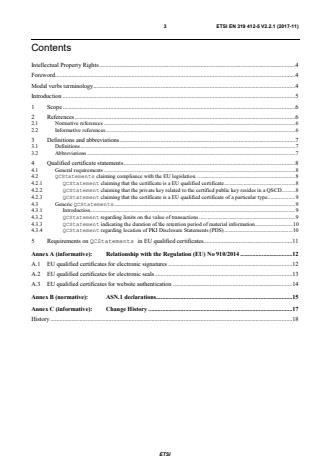
2 ETSI EN 319 412-5 V2.2.1 (2017-11)
Reference
REN/ESI-0019412-5v221
Keywords
e-commerce, electronic signature, security,
trust services
ETSI
650 Route des Lucioles
F-06921 Sophia Antipolis Cedex - FRANCE
Tel.: +33 4 92 94 42 00 Fax: +33 4 93 65 47 16
Siret N° 348 623 562 00017 - NAF 742 C
Association à but non lucratif enregistrée à la
Sous-Préfecture de Grasse (06) N° 7803/88
Important notice
The present document can be downloaded from:
http://www.etsi.org/standards-search
The present document may be made available in electronic versions and/or in print. The content of any electronic and/or
print versions of the present document shall not be modified without the prior written authorization of ETSI. In case of any
existing or perceived difference in contents between such versions and/or in print, the only prevailing document is the
print of the Portable Document Format (PDF) version kept on a specific network drive within ETSI Secretariat.
Users of the present document should be aware that the document may be subject to revision or change of status.
Information on the current status of this and other ETSI documents is available at
https://portal.etsi.org/TB/ETSIDeliverableStatus.aspx
If you find errors in the present document, please send your comment to one of the following services:
https://portal.etsi.org/People/CommiteeSupportStaff.aspx
Copyright Notification
No part may be reproduced or utilized in any form or by any means, electronic or mechanical, including photocopying
and microfilm except as authorized by written permission of ETSI.
The content of the PDF version shall not be modified without the written authorization of ETSI.
The copyright and the foregoing restriction extend to reproduction in all media.
© ETSI 2017.
All rights reserved.
TM TM TM
DECT , PLUGTESTS , UMTS and the ETSI logo are trademarks of ETSI registered for the benefit of its Members.
TM
3GPP and LTE™ are trademarks of ETSI registered for the benefit of its Members and
of the 3GPP Organizational Partners.
oneM2M logo is protected for the benefit of its Members.
GSM® and the GSM logo are trademarks registered and owned by the GSM Association.
ETSI
3 ETSI EN 319 412-5 V2.2.1 (2017-11)
Contents
Intellectual Property Rights . 4
Foreword . 4
Modal verbs terminology . 4
Introduction . 5
1 Scope . 6
2 References . 6
2.1 Normative references . 6
2.2 Informative references . 6
3 Definitions and abbreviations . 7
3.1 Definitions . 7
3.2 Abbreviations . 7
4 Qualified certificate statements . 8
4.1 General requirements . 8
4.2 QCStatements claiming compliance with the EU legislation . 8
4.2.1 QCStatement claiming that the certificate is a EU qualified certificate . 8
4.2.2 QCStatement claiming that the private key related to the certified public key resides in a QSCD . 8
4.2.3 QCStatement claiming that the certificate is a EU qualified certificate of a particular type . 9
4.3 Generic QCStatements . 9
4.3.1 Introduction. 9
4.3.2 QCStatement regarding limits on the value of transactions . 9
4.3.3 QCStatement indicating the duration of the retention period of material information . 10
4.3.4 QCStatement regarding location of PKI Disclosure Statements (PDS) . 10
5 Requirements on QCStatements in EU qualified certificates . 11
Annex A (informative): Relationship with the Regulation (EU) No 910/2014 . 12
A.1 EU qualified certificates for electronic signatures . 12
A.2 EU qualified certificates for electronic seals . 13
A.3 EU qualified certificates for website authentication . 14
Annex B (normative): ASN.1 declarations. 15
Annex C (informative): Change History . 17
History . 18
ETSI
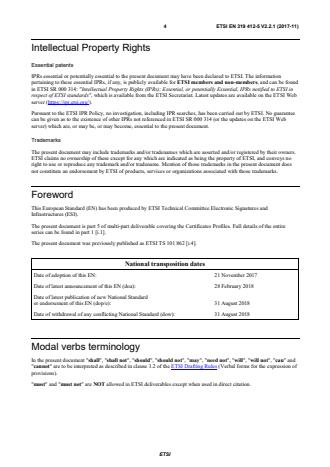
4 ETSI EN 319 412-5 V2.2.1 (2017-11)
Intellectual Property Rights
Essential patents
IPRs essential or potentially essential to the present document may have been declared to ETSI. The information
pertaining to these essential IPRs, if any, is publicly available for ETSI members and non-members, and can be found
in ETSI SR 000 314: "Intellectual Property Rights (IPRs); Essential, or potentially Essential, IPRs notified to ETSI in
respect of ETSI standards", which is available from the ETSI Secretariat. Latest updates are available on the ETSI Web
server (https://ipr.etsi.org/).
Pursuant to the ETSI IPR Policy, no investigation, including IPR searches, has been carried out by ETSI. No guarantee
can be given as to the existence of other IPRs not referenced in ETSI SR 000 314 (or the updates on the ETSI Web
server) which are, or may be, or may become, essential to the present document.
Trademarks
The present document may include trademarks and/or tradenames which are asserted and/or registered by their owners.
ETSI claims no ownership of these except for any which are indicated as being the property of ETSI, and conveys no
right to use or reproduce any trademark and/or tradename. Mention of those trademarks in the present document does
not constitute an endorsement by ETSI of products, services or organizations associated with those trademarks.
Foreword
This European Standard (EN) has been produced by ETSI Technical Committee Electronic Signatures and
Infrastructures (ESI).
The present document is part 5 of multi-part deliverable covering the Certificates Profiles. Full details of the entire
series can be found in part 1 [i.1].
The present document was previously published as ETSI TS 101 862 [i.4].
National transposition dates
Date of adoption of this EN: 21 November 2017
Date of latest announcement of this EN (doa): 28 February 2018
Date of latest publication of new National Standard
or endorsement of this EN (dop/e): 31 August 2018
Date of withdrawal of any conflicting National Standard (dow): 31 August 2018
Modal verbs terminology
In the present document "shall", "shall not", "should", "should not", "may", "need not", "will", "will not", "can" and
"cannot" are to be interpreted as described in clause 3.2 of the ETSI Drafting Rules (Verbal forms for the expression of
provisions).
"must" and "must not" are NOT allowed in ETSI deliverables except when used in direct citation.
ETSI
5 ETSI EN 319 412-5 V2.2.1 (2017-11)
Introduction
ITU and ISO issued standards for certification of public keys in Recommendation ITU-T X.509 | ISO/IEC 9594-8 [i.7]
which are used for the security of communications and data for a wide range of electronic applications.
The IETF qualified certificate profile, IETF RFC 3739 [2] defines an extension to X.509 certificates, the
qcStatements extension, which can include statements relevant for qualified certificates. IETF RFC 3739 [2]
defines qualified certificates in a general context as "a certificate whose primary purpose is to identify a person with a
high level of assurance, where the certificate meets some qualification requirements defined by an applicable legal
framework". The use of IETF RFC 3739 [2] qcStatements in the present document goes beyond the scope of the
RFC which is directed at natural persons only.
The qcStatements certificate extension can contain any statement by the certificate issuer that can be useful to the
relying party in determining the applicability of the certificate for an intended usage. Such statement can be a
declaration that the certificate fulfils specific legal requirements for qualified certificates according to a defined legal
framework.
The present document is aiming to meet the general requirements of the international community to provide trust and
confidence in electronic transactions including, amongst others, applicable requirements from Regulation (EU)
No 910/2014 [i.8] Annexes I, III and IV.
ETSI
6 ETSI EN 319 412-5 V2.2.1 (2017-11)
1 Scope
The present document defines specific QCStatement for the qcStatements extension as defined in IETF
RFC 3739 [2], clause 3.2.6, including requirements for their use in EU qualified certificates. Some of these
QCStatements can be used for other forms of certificate.
The QCStatements defined in the present document can be used in combination with any certificate profile, either
defined in ETSI EN 319 412-2 [i.2], ETSI EN 319 412-3 [i.5] and ETSI EN 319 412-4 [i.6], or defined elsewhere.
The QCStatements defined in clause 4.3 may be applied to regulatory environments outside the EU. Other
requirements specified in clause 4 are specific to Regulation (EU) No 910/2014 [i.8] but may be adapted for other
regulatory environments.
2 References
2.1 Normative references
References are either specific (identified by date of publication and/or edition number or version number) or
non-specific. For specific references, only the cited version applies. For non-specific references, the latest version of the
referenced document (including any amendments) applies.
Referenced documents which are not found to be publicly available in the expected location might be found at
https://docbox.etsi.org/Reference.
NOTE: While any hyperlinks included in this clause were valid at the time of publication, ETSI cannot guarantee
their long term validity.
The following referenced documents are necessary for the application of the present document.
[1] ISO 639-1:2002: "Codes for the representation of names of languages -- Part 1: Alpha-2 code".
[2] IETF RFC 3739: "Internet X.509 Public Key Infrastructure: Qualified Certificates Profile".
[3] Recommendation ITU-T X.680-X.699: "Information technology - Abstract Syntax Notation One
(ASN.1)".
[4] ISO 4217: "Codes for the representation of currencies and funds".
[5] IETF RFC 2818: "HTTP Over TLS".
2.2 Informative references
References are either specific (identified by date of publication and/or edition number or version number) or
non-specific. For specific references, only the cited version applies. For non-specific references, the latest version of the
referenced document (including any amendments) applies.
NOTE: While any hyperlinks included in this clause were valid at the time of publication, ETSI cannot guarantee
their long term validity.
The following referenced documents are not necessary for the application of the present document but they assist the
user with regard to a particular subject area.
[i.1] ETSI EN 319 412-1: "Electronic Signatures and Infrastructures (ESI); Certificate Profiles;
Part 1: Overview and common data structures".
[i.2] ETSI EN 319 412-2: "Electronic Signatures and Infrastructures (ESI); Certificate Profiles;
Part 2: Certificate Profile for certificates issued to natural persons".
[i.3] Directive 1999/93/EC of the European Parliament and of the Council of 13 December 1999 on a
Community framework for electronic signatures.
ETSI
7 ETSI EN 319 412-5 V2.2.1 (2017-11)
[i.4] ETSI TS 101 862: "Qualified Certificate profile".
[i.5] ETSI EN 319 412-3: "Electronic Signatures and Infrastructures (ESI); Certificate Profiles;
Part 3: Certificate Profile for certificates issued to legal persons".
[i.6] ETSI EN 319 412-4: "Electronic Signatures and Infrastructures (ESI); Certificate Profiles;
Part 4: Certificate profile for web site certificates".
[i.7] Recommendation ITU-T X.509 | ISO/IEC 9594-8: "Information technology - Open systems
interconnection - The Directory: Public-key and attribute certificate frameworks".
[i.8] Regulation (EU) No 910/2014 of the European Parliament and of the Council on electronic
identification and trust services for electronic transactions in the internal market and repealing
Directive 1999/93/EC.
[i.9] IETF RFC 5280: "Internet X.509 Public Key Infrastructure Certificate and Certificate Revocation
List (CRL) Profile".
[i.10] ETSI EN 319 411-1: "Electronic Signatures and Infrastructures (ESI); Policy and security
requirements for Trust Service Providers issuing certificates; Part 1: General requirements".
[i.11] CA/Browser Forum: "Baseline Requirements for the Issuance and Management of Publicly-
Trusted Certificates".
[i.12] CA/Browser Forum: "Guidelines for The Issuance and Management of Extended Validation
Certificates".
3 Definitions and abbreviations
3.1 Definitions
For the purposes of the present document, the terms and definitions given in ETSI EN 319 412-1 [i.1] and the following
apply:
EU qualified certificate: qualified certificate that is stated to be in accordance with Annex I, III or IV of the Regulation
(EU) No 910/2014 [i.8] or Annex I of the Directive 1999/93/EC [i.3] whichever is in force at the time of issuance
QCStatement: statement for inclusion in a qcStatements certificates extension as specified in IETF RFC 3739 [2]
qualified electronic signature/seal creation device: As specified in Regulation (EU) No 910/2014 [i.8].
secure signature creation device: As specified in Directive 1999/93 [i.3].
3.2 Abbreviations
For the purposes of the present document, the following abbreviations apply:
ASN.1 Abstract Syntax Notation One
CA Certification Authority
CRL Certificate Revocation List
EC European Commission
EU European Union
IETF Internet Engineering Task Force
ISO International Organization for Standardization
PDS PKI Disclosure Statements
PKI Public Key Infrastructure
QC Qualified Certificate
QSCD Qualified electronic Signature/Seal Creation Device
RFC Request For Comments
URL Uniform Resource Locator
ETSI
8 ETSI EN 319 412-5 V2.2.1 (2017-11)
4 Qualified certificate statements
4.1 General requirements
The qcStatements extension shall be as specified in clause 3.2.6 of IETF RFC 3739 [2]. The qcStatements
extension shall not be marked as critical.
The following clauses define a number of individual QCStatements to be included in the qcStatements
extension.
The syntax of the defined statements shall comply with ASN.1 [3]. The complete ASN.1 module for all defined
statements shall be as provided in Annex B; it takes precedence over the ASN.1 definitions provided in the body of the
present document, in case of discrepancy.
NOTE: This extension is not processed as part of IETF RFC 5280 [i.9] path validation and there are no security
implications with accepting a certificate in a system that cannot parse this extension.
4.2 QCStatements claiming compliance with the EU
legislation
4.2.1 QCStatement claiming that the certificate is a EU qualified
certificate
This Qcstatement claims that the certificate is an EU qualified certificate that is issued according to Directive
1999/93/EC [i.3] or the Annex I, III or IV of the Regulation (EU) No 910/2014 [i.8] whichever is in force at the time of
issuance.
Syntax:
esi4-qcStatement-1 QC-STATEMENT ::= { IDENTIFIED BY id-etsi-qcs-QcCompliance }
id-etsi-qcs-QcCompliance OBJECT IDENTIFIER ::= { id-etsi-qcs 1 }
The precise meaning of this statement is enhanced by the QC type statement defined in clause 4.2.3 according to the
table 1.
Table 1: esi4-qcStatement-1 meaning
QC type statement Meaning of this statement (esi4-qcStatement-1)
(clause 4.2.3)
Absent The certificate is issued according to Directive 1999/93/EC [i.3] or Annex I of the Regulation
(EU) No 910/2014 [i.8] (for electronic signatures).
Present The certificate is issued according to Annex I, III or IV of Regulation (EU) No 910/2014 [i.8]
as of the types declared by the QC type statement in accordance with clause 4.2.3.
A certificate that includes this statement shall comply with all requirements defined in clause 5.
4.2.2 QCStatement claiming that the private key related to the certified
public key resides in a QSCD
This Qcstatement declares that the private key related to the certified public key resides in a Qualified
Signature/Seal Creation Device (QSCD) according to the Regulation (EU) No 910/2014 [i.8] or a secure signature
creation device as defined in the Directive 1999/93/EC [i.3].
Syntax:
esi4-qcStatement-4 QC-STATEMENT ::= { IDENTIFIED BY id-etsi-qcs-QcSSCD }
ETSI
9 ETSI EN 319 412-5 V2.2.1 (2017-11)
id-etsi-qcs-QcSSCD OBJECT IDENTIFIER ::= { id-etsi-qcs 4 }
4.2.3 QCStatement claiming that the certificate is a EU qualified
certificate of a particular type
This QCStatement declares that a certificate is issued as one and only one of the purposes of electronic signature,
electronic seal or web site authentication.
This QCStatements states that an EU qualified certificate is issued as one specific types according to Annexes I, III or
IV of the Regulation (EU) No 910/2014 [i.8] when used in combination with the qcStatement as defined in clause 4.2.1.
When used on its own it indicates that it is used for the purposes of electronic signatures, seals or web sites for "non-
qualified certificates" within the context of Regulation (EU) No 910/2014 [i.8].
NOTE: This statement, without the one defined in clause 4.2.1, can be potentially used in other regulatory
environments which use electronic signature, electronic seal or web site with the same meaning.
Syntax:
esi4-qcStatement-6 QC-STATEMENT ::= { SYNTAX QcType IDENTIFIED
BY id-etsi-qcs-QcType }
Id-etsi-qcs-QcType OBJECT IDENTIFIER ::= { id-etsi-qcs 6 }
QcType::= SEQUENCE OF OBJECT IDENTIFIER (id-etsi-qct-esign | id-etsi-qct-eseal |
id-etsi-qct-web, .)
-- QC type identifiers
id-etsi-qct-esign OBJECT IDENTIFIER ::= { id-etsi-
...
SLOVENSKI STANDARD
01-januar-2018
Elektronski podpisi in infrastruktura (ESI) - Profili potrdil - 5. del: Izjave QC
Electronic Signatures and Infrastructures (ESI) - Certificate Profiles - Part 5:
QCStatements
Ta slovenski standard je istoveten z: ETSI EN 319 412-5 V2.2.1 (2017-11)
ICS:
03.080.99 Druge storitve Other services
35.040.01 Kodiranje informacij na Information coding in general
splošno
2003-01.Slovenski inštitut za standardizacijo. Razmnoževanje celote ali delov tega standarda ni dovoljeno.
EUROPEAN STANDARD
Electronic Signatures and Infrastructures (ESI);
Certificate Profiles;
Part 5: QCStatements
2 ETSI EN 319 412-5 V2.2.1 (2017-11)
Reference
REN/ESI-0019412-5v221
Keywords
e-commerce, electronic signature, security,
trust services
ETSI
650 Route des Lucioles
F-06921 Sophia Antipolis Cedex - FRANCE
Tel.: +33 4 92 94 42 00 Fax: +33 4 93 65 47 16
Siret N° 348 623 562 00017 - NAF 742 C
Association à but non lucratif enregistrée à la
Sous-Préfecture de Grasse (06) N° 7803/88
Important notice
The present document can be downloaded from:
http://www.etsi.org/standards-search
The present document may be made available in electronic versions and/or in print. The content of any electronic and/or
print versions of the present document shall not be modified without the prior written authorization of ETSI. In case of any
existing or perceived difference in contents between such versions and/or in print, the only prevailing document is the
print of the Portable Document Format (PDF) version kept on a specific network drive within ETSI Secretariat.
Users of the present document should be aware that the document may be subject to revision or change of status.
Information on the current status of this and other ETSI documents is available at
https://portal.etsi.org/TB/ETSIDeliverableStatus.aspx
If you find errors in the present document, please send your comment to one of the following services:
https://portal.etsi.org/People/CommiteeSupportStaff.aspx
Copyright Notification
No part may be reproduced or utilized in any form or by any means, electronic or mechanical, including photocopying
and microfilm except as authorized by written permission of ETSI.
The content of the PDF version shall not be modified without the written authorization of ETSI.
The copyright and the foregoing restriction extend to reproduction in all media.
© ETSI 2017.
All rights reserved.
TM TM TM
DECT , PLUGTESTS , UMTS and the ETSI logo are trademarks of ETSI registered for the benefit of its Members.
TM
3GPP and LTE™ are trademarks of ETSI registered for the benefit of its Members and
of the 3GPP Organizational Partners.
oneM2M logo is protected for the benefit of its Members.
GSM® and the GSM logo are trademarks registered and owned by the GSM Association.
ETSI
3 ETSI EN 319 412-5 V2.2.1 (2017-11)
Contents
Intellectual Property Rights . 4
Foreword . 4
Modal verbs terminology . 4
Introduction . 5
1 Scope . 6
2 References . 6
2.1 Normative references . 6
2.2 Informative references . 6
3 Definitions and abbreviations . 7
3.1 Definitions . 7
3.2 Abbreviations . 7
4 Qualified certificate statements . 8
4.1 General requirements . 8
4.2 QCStatements claiming compliance with the EU legislation . 8
4.2.1 QCStatement claiming that the certificate is a EU qualified certificate . 8
4.2.2 QCStatement claiming that the private key related to the certified public key resides in a QSCD . 8
4.2.3 QCStatement claiming that the certificate is a EU qualified certificate of a particular type . 9
4.3 Generic QCStatements . 9
4.3.1 Introduction. 9
4.3.2 QCStatement regarding limits on the value of transactions . 9
4.3.3 QCStatement indicating the duration of the retention period of material information . 10
4.3.4 QCStatement regarding location of PKI Disclosure Statements (PDS) . 10
5 Requirements on QCStatements in EU qualified certificates . 11
Annex A (informative): Relationship with the Regulation (EU) No 910/2014 . 12
A.1 EU qualified certificates for electronic signatures . 12
A.2 EU qualified certificates for electronic seals . 13
A.3 EU qualified certificates for website authentication . 14
Annex B (normative): ASN.1 declarations. 15
Annex C (informative): Change History . 17
History . 18
ETSI
4 ETSI EN 319 412-5 V2.2.1 (2017-11)
Intellectual Property Rights
Essential patents
IPRs essential or potentially essential to the present document may have been declared to ETSI. The information
pertaining to these essential IPRs, if any, is publicly available for ETSI members and non-members, and can be found
in ETSI SR 000 314: "Intellectual Property Rights (IPRs); Essential, or potentially Essential, IPRs notified to ETSI in
respect of ETSI standards", which is available from the ETSI Secretariat. Latest updates are available on the ETSI Web
server (https://ipr.etsi.org/).
Pursuant to the ETSI IPR Policy, no investigation, including IPR searches, has been carried out by ETSI. No guarantee
can be given as to the existence of other IPRs not referenced in ETSI SR 000 314 (or the updates on the ETSI Web
server) which are, or may be, or may become, essential to the present document.
Trademarks
The present document may include trademarks and/or tradenames which are asserted and/or registered by their owners.
ETSI claims no ownership of these except for any which are indicated as being the property of ETSI, and conveys no
right to use or reproduce any trademark and/or tradename. Mention of those trademarks in the present document does
not constitute an endorsement by ETSI of products, services or organizations associated with those trademarks.
Foreword
This European Standard (EN) has been produced by ETSI Technical Committee Electronic Signatures and
Infrastructures (ESI).
The present document is part 5 of multi-part deliverable covering the Certificates Profiles. Full details of the entire
series can be found in part 1 [i.1].
The present document was previously published as ETSI TS 101 862 [i.4].
National transposition dates
Date of adoption of this EN: 21 November 2017
Date of latest announcement of this EN (doa): 28 February 2018
Date of latest publication of new National Standard
or endorsement of this EN (dop/e): 31 August 2018
Date of withdrawal of any conflicting National Standard (dow): 31 August 2018
Modal verbs terminology
In the present document "shall", "shall not", "should", "should not", "may", "need not", "will", "will not", "can" and
"cannot" are to be interpreted as described in clause 3.2 of the ETSI Drafting Rules (Verbal forms for the expression of
provisions).
"must" and "must not" are NOT allowed in ETSI deliverables except when used in direct citation.
ETSI
5 ETSI EN 319 412-5 V2.2.1 (2017-11)
Introduction
ITU and ISO issued standards for certification of public keys in Recommendation ITU-T X.509 | ISO/IEC 9594-8 [i.7]
which are used for the security of communications and data for a wide range of electronic applications.
The IETF qualified certificate profile, IETF RFC 3739 [2] defines an extension to X.509 certificates, the
qcStatements extension, which can include statements relevant for qualified certificates. IETF RFC 3739 [2]
defines qualified certificates in a general context as "a certificate whose primary purpose is to identify a person with a
high level of assurance, where the certificate meets some qualification requirements defined by an applicable legal
framework". The use of IETF RFC 3739 [2] qcStatements in the present document goes beyond the scope of the
RFC which is directed at natural persons only.
The qcStatements certificate extension can contain any statement by the certificate issuer that can be useful to the
relying party in determining the applicability of the certificate for an intended usage. Such statement can be a
declaration that the certificate fulfils specific legal requirements for qualified certificates according to a defined legal
framework.
The present document is aiming to meet the general requirements of the international community to provide trust and
confidence in electronic transactions including, amongst others, applicable requirements from Regulation (EU)
No 910/2014 [i.8] Annexes I, III and IV.
ETSI
6 ETSI EN 319 412-5 V2.2.1 (2017-11)
1 Scope
The present document defines specific QCStatement for the qcStatements extension as defined in IETF
RFC 3739 [2], clause 3.2.6, including requirements for their use in EU qualified certificates. Some of these
QCStatements can be used for other forms of certificate.
The QCStatements defined in the present document can be used in combination with any certificate profile, either
defined in ETSI EN 319 412-2 [i.2], ETSI EN 319 412-3 [i.5] and ETSI EN 319 412-4 [i.6], or defined elsewhere.
The QCStatements defined in clause 4.3 may be applied to regulatory environments outside the EU. Other
requirements specified in clause 4 are specific to Regulation (EU) No 910/2014 [i.8] but may be adapted for other
regulatory environments.
2 References
2.1 Normative references
References are either specific (identified by date of publication and/or edition number or version number) or
non-specific. For specific references, only the cited version applies. For non-specific references, the latest version of the
referenced document (including any amendments) applies.
Referenced documents which are not found to be publicly available in the expected location might be found at
https://docbox.etsi.org/Reference.
NOTE: While any hyperlinks included in this clause were valid at the time of publication, ETSI cannot guarantee
their long term validity.
The following referenced documents are necessary for the application of the present document.
[1] ISO 639-1:2002: "Codes for the representation of names of languages -- Part 1: Alpha-2 code".
[2] IETF RFC 3739: "Internet X.509 Public Key Infrastructure: Qualified Certificates Profile".
[3] Recommendation ITU-T X.680-X.699: "Information technology - Abstract Syntax Notation One
(ASN.1)".
[4] ISO 4217: "Codes for the representation of currencies and funds".
[5] IETF RFC 2818: "HTTP Over TLS".
2.2 Informative references
References are either specific (identified by date of publication and/or edition number or version number) or
non-specific. For specific references, only the cited version applies. For non-specific references, the latest version of the
referenced document (including any amendments) applies.
NOTE: While any hyperlinks included in this clause were valid at the time of publication, ETSI cannot guarantee
their long term validity.
The following referenced documents are not necessary for the application of the present document but they assist the
user with regard to a particular subject area.
[i.1] ETSI EN 319 412-1: "Electronic Signatures and Infrastructures (ESI); Certificate Profiles;
Part 1: Overview and common data structures".
[i.2] ETSI EN 319 412-2: "Electronic Signatures and Infrastructures (ESI); Certificate Profiles;
Part 2: Certificate Profile for certificates issued to natural persons".
[i.3] Directive 1999/93/EC of the European Parliament and of the Council of 13 December 1999 on a
Community framework for electronic signatures.
ETSI
7 ETSI EN 319 412-5 V2.2.1 (2017-11)
[i.4] ETSI TS 101 862: "Qualified Certificate profile".
[i.5] ETSI EN 319 412-3: "Electronic Signatures and Infrastructures (ESI); Certificate Profiles;
Part 3: Certificate Profile for certificates issued to legal persons".
[i.6] ETSI EN 319 412-4: "Electronic Signatures and Infrastructures (ESI); Certificate Profiles;
Part 4: Certificate profile for web site certificates".
[i.7] Recommendation ITU-T X.509 | ISO/IEC 9594-8: "Information technology - Open systems
interconnection - The Directory: Public-key and attribute certificate frameworks".
[i.8] Regulation (EU) No 910/2014 of the European Parliament and of the Council on electronic
identification and trust services for electronic transactions in the internal market and repealing
Directive 1999/93/EC.
[i.9] IETF RFC 5280: "Internet X.509 Public Key Infrastructure Certificate and Certificate Revocation
List (CRL) Profile".
[i.10] ETSI EN 319 411-1: "Electronic Signatures and Infrastructures (ESI); Policy and security
requirements for Trust Service Providers issuing certificates; Part 1: General requirements".
[i.11] CA/Browser Forum: "Baseline Requirements for the Issuance and Management of Publicly-
Trusted Certificates".
[i.12] CA/Browser Forum: "Guidelines for The Issuance and Management of Extended Validation
Certificates".
3 Definitions and abbreviations
3.1 Definitions
For the purposes of the present document, the terms and definitions given in ETSI EN 319 412-1 [i.1] and the following
apply:
EU qualified certificate: qualified certificate that is stated to be in accordance with Annex I, III or IV of the Regulation
(EU) No 910/2014 [i.8] or Annex I of the Directive 1999/93/EC [i.3] whichever is in force at the time of issuance
QCStatement: statement for inclusion in a qcStatements certificates extension as specified in IETF RFC 3739 [2]
qualified electronic signature/seal creation device: As specified in Regulation (EU) No 910/2014 [i.8].
secure signature creation device: As specified in Directive 1999/93 [i.3].
3.2 Abbreviations
For the purposes of the present document, the following abbreviations apply:
ASN.1 Abstract Syntax Notation One
CA Certification Authority
CRL Certificate Revocation List
EC European Commission
EU European Union
IETF Internet Engineering Task Force
ISO International Organization for Standardization
PDS PKI Disclosure Statements
PKI Public Key Infrastructure
QC Qualified Certificate
QSCD Qualified electronic Signature/Seal Creation Device
RFC Request For Comments
URL Uniform Resource Locator
ETSI
8 ETSI EN 319 412-5 V2.2.1 (2017-11)
4 Qualified certificate statements
4.1 General requirements
The qcStatements extension shall be as specified in clause 3.2.6 of IETF RFC 3739 [2]. The qcStatements
extension shall not be marked as critical.
The following clauses define a number of individual QCStatements to be included in the qcStatements
extension.
The syntax of the defined statements shall comply with ASN.1 [3]. The complete ASN.1 module for all defined
statements shall be as provided in Annex B; it takes precedence over the ASN.1 definitions provided in the body of the
present document, in case of discrepancy.
NOTE: This extension is not processed as part of IETF RFC 5280 [i.9] path validation and there are no security
implications with accepting a certificate in a system that cannot parse this extension.
4.2 QCStatements claiming compliance with the EU
legislation
4.2.1 QCStatement claiming that the certificate is a EU qualified
certificate
This Qcstatement claims that the certificate is an EU qualified certificate that is issued according to Directive
1999/93/EC [i.3] or the Annex I, III or IV of the Regulation (EU) No 910/2014 [i.8] whichever is in force at the time of
issuance.
Syntax:
esi4-qcStatement-1 QC-STATEMENT ::= { IDENTIFIED BY id-etsi-qcs-QcCompliance }
id-etsi-qcs-QcCompliance OBJECT IDENTIFIER ::= { id-etsi-qcs 1 }
The precise meaning of this statement is enhanced by the QC type statement defined in clause 4.2.3 according to the
table 1.
Table 1: esi4-qcStatement-1 meaning
QC type statement Meaning of this statement (esi4-qcStatement-1)
(clause 4.2.3)
Absent The certificate is issued according to Directive 1999/93/EC [i.3] or Annex I of the Regulation
(EU) No 910/2014 [i.8] (for electronic signatures).
Present The certificate is issued according to Annex I, III or IV of Regulation (EU) No 910/2014 [i.8]
as of the types declared by the QC type statement in accordance with clause 4.2.3.
A certificate that includes this statement shall comply with all requirements defined in clause 5.
4.2.2 QCStatement claiming that the private key related to the certified
public key resides in a QSCD
This Qcstatement declares that the private key related to the certified public key resides in a Qualified
Signature/Seal Creation Device (QSCD) according to the Regulation (EU) No 910/2014 [i.8] or a secure signature
creation device as defined in the Directive 1999/93/EC [i.3].
Syntax:
esi4-qcStatement-4 QC-STATEMENT ::= { IDENTIFIED BY id-etsi-qcs-QcSSCD }
ETSI
9 ETSI EN 319 412-5 V2.2.1 (2017-11)
id-etsi-qcs-QcSSCD OBJECT IDENTIFIER ::= { id-etsi-qcs 4 }
4.2.3 QCStatement claiming that the certificate is a EU qualified
certificate of a particular type
This QCStatement declares that a certificate is issued as one and only one of the purposes of electronic signature,
electronic seal or web site authentication.
This QCStatements states that an EU qualified certificate is issued as one specific types according to Annexes I, III or
IV of the Regulation (EU) No 910/2014 [i.8] when used in combination with the qcStatement as defined in clause 4.2.1.
When used on its own it indicates that it is used for the purposes of electronic signatures, seals or web sites for "non-
qualified certificates" within the context of Regulation (EU) No 910/2014 [i.8].
NOTE: This statement, without the one defined in clause 4.2.1, can be potentially used in other regulatory
environments which use electronic signature, electronic seal or web site with the same meaning.
Syntax:
esi4-qcS
...