


SIST EN 12082:2017+A1:2021
(Main)Railway applications - Axleboxes - Performance testing
Railway applications - Axleboxes - Performance testing
This European Standard specifies the principles and methods for a rig performance test of the system of axlebox rolling bearing(s), housing, seal(s) and grease. Test parameters and minimum performance requirements for vehicles in operation on main lines are specified. Different test parameters and performance requirements may be selected for vehicles in operation on other networks (e.g. urban rail). This standard is historically developed for outboard applications but can be used for vehicles with other bearing arrangements (e.g.: inboard application or single wheels).
It gives some possible examples where a "sequenced performance test" addresses the broad range of different service conditions within a specific application or vehicle platform into account.
It describes in detail the water tightness test and basic principles and minimum requirements for a field test.
This European Standard only applies to axleboxes equipped with rolling bearings and greases according to EN 12080 and EN 12081.
Bahnanwendungen - Radsatzlager - Prüfung des Leistungsvermögens
Diese Europäische Norm legt die Grundlagen und Verfahren für die Prüfung des Leistungsvermögens auf dem Prüfstand der Baugruppe Radsatzlager, bestehend aus Wälzlager(n), Lagergehäuse, Dichtung(en) und Schmierfett, fest. Für Fahrzeuge im Betrieb auf Vollbahnen sind die Prüfbedingungen und Mindestleistungsanforderungen spezifiziert. Für Fahrzeuge im Betrieb auf anderen Schienennetzen dürfen davon abweichende Prüfbedingungen und Leistungsanforderungen gewählt werden (z. B. städtische Schienenbahnen). Diese Norm wurde ursprünglich für Außenlagerungen entwickelt, gilt jedoch auch für Fahrzeuge mit anderen Lageranordnungen (z. B. Innenlagerungen oder Einzelräder).
Sie enthält mögliche Beispiele, in denen eine „sequentielle Leistungsprüfung“ die breite Vielfalt von verschiedenen Betriebsbedingungen innerhalb einer spezifischen Anwendung oder einer Fahrzeugplattform berücksichtigt.
Sie beschreibt detailliert eine Wasserdichtheitsprüfung und die Grundlagen und Mindestanforderungen einer Betriebserprobung.
Diese Europäische Norm gilt nur für Radsatzlager, die mit Wälzlagern und Schmierfetten nach EN 12080 und EN 12081 ausgestattet sind.
Applications ferroviaires - Boïtes d'essieux - Essais de performance
Železniške naprave - Ohišja ležajev kolesnih dvojic - Preskušanje delovanja
General Information
- Status
- Withdrawn
- Publication Date
- 20-Jul-2021
- Withdrawal Date
- 07-Jan-2026
- Technical Committee
- IŽNP - Reilway applications
- Current Stage
- 9900 - Withdrawal (Adopted Project)
- Start Date
- 08-Jan-2026
- Due Date
- 31-Jan-2026
- Completion Date
- 08-Jan-2026
Relations
- Effective Date
- 01-Feb-2026
- Effective Date
- 01-Feb-2026
- Effective Date
- 28-Jan-2026
- Effective Date
- 28-Jan-2026
- Effective Date
- 28-Jan-2026
- Effective Date
- 28-Jan-2026
- Effective Date
- 28-Jan-2026
- Effective Date
- 21-Apr-2021
- Effective Date
- 21-Apr-2021

Get Certified
Connect with accredited certification bodies for this standard

Bureau Veritas Railway Certification
Railway and transportation certification.

Deutsch Quality Systems (India) Pvt. Ltd. (DQS India)
Subsidiary of DQS Holding GmbH, founding member of IQNet. CDSCO Notified Body.

Excellence Ireland Quality Association (EIQA)
Irish quality certification organization.
Sponsored listings
Frequently Asked Questions
SIST EN 12082:2017+A1:2021 is a standard published by the Slovenian Institute for Standardization (SIST). Its full title is "Railway applications - Axleboxes - Performance testing". This standard covers: This European Standard specifies the principles and methods for a rig performance test of the system of axlebox rolling bearing(s), housing, seal(s) and grease. Test parameters and minimum performance requirements for vehicles in operation on main lines are specified. Different test parameters and performance requirements may be selected for vehicles in operation on other networks (e.g. urban rail). This standard is historically developed for outboard applications but can be used for vehicles with other bearing arrangements (e.g.: inboard application or single wheels). It gives some possible examples where a "sequenced performance test" addresses the broad range of different service conditions within a specific application or vehicle platform into account. It describes in detail the water tightness test and basic principles and minimum requirements for a field test. This European Standard only applies to axleboxes equipped with rolling bearings and greases according to EN 12080 and EN 12081.
This European Standard specifies the principles and methods for a rig performance test of the system of axlebox rolling bearing(s), housing, seal(s) and grease. Test parameters and minimum performance requirements for vehicles in operation on main lines are specified. Different test parameters and performance requirements may be selected for vehicles in operation on other networks (e.g. urban rail). This standard is historically developed for outboard applications but can be used for vehicles with other bearing arrangements (e.g.: inboard application or single wheels). It gives some possible examples where a "sequenced performance test" addresses the broad range of different service conditions within a specific application or vehicle platform into account. It describes in detail the water tightness test and basic principles and minimum requirements for a field test. This European Standard only applies to axleboxes equipped with rolling bearings and greases according to EN 12080 and EN 12081.
SIST EN 12082:2017+A1:2021 is classified under the following ICS (International Classification for Standards) categories: 45.040 - Materials and components for railway engineering. The ICS classification helps identify the subject area and facilitates finding related standards.
SIST EN 12082:2017+A1:2021 has the following relationships with other standards: It is inter standard links to SIST EN 12082-2:2026, SIST EN 12082-1:2026, SIST EN ISO 11885:2009, SIST-TS CEN/TS 16459:2020, SIST EN 12080:2017, SIST EN 15663:2017+A2:2025, SIST EN 12081:2026, SIST EN 12082:2017/kFprA1:2021, SIST EN 12082:2017. Understanding these relationships helps ensure you are using the most current and applicable version of the standard.
SIST EN 12082:2017+A1:2021 is associated with the following European legislation: EU Directives/Regulations: 2016/797/EU; Standardization Mandates: M/483, M/591. When a standard is cited in the Official Journal of the European Union, products manufactured in conformity with it benefit from a presumption of conformity with the essential requirements of the corresponding EU directive or regulation.
SIST EN 12082:2017+A1:2021 is available in PDF format for immediate download after purchase. The document can be added to your cart and obtained through the secure checkout process. Digital delivery ensures instant access to the complete standard document.
Standards Content (Sample)
SLOVENSKI STANDARD
01-september-2021
Železniške naprave - Ohišja ležajev kolesnih dvojic - Preskušanje delovanja
Railway applications - Axleboxes - Performance testing
Bahnanwendungen - Radsatzlager - Prüfung des Leistungsvermögens
Applications ferroviaires - Boïtes d'essieux - Essais de performance
Ta slovenski standard je istoveten z: EN 12082:2017+A1:2021
ICS:
45.040 Materiali in deli za železniško Materials and components
tehniko for railway engineering
2003-01.Slovenski inštitut za standardizacijo. Razmnoževanje celote ali delov tega standarda ni dovoljeno.
EN 12082:2017+A1
EUROPEAN STANDARD
NORME EUROPÉENNE
June 2021
EUROPÄISCHE NORM
ICS 45.040 Supersedes EN 12082:2017
English Version
Railway applications - Axleboxes - Performance testing
Applications ferroviaires - Boïtes d'essieux - Essais de Bahnanwendungen - Radsatzlager - Prüfung des
performance Leistungsvermögens
This European Standard was approved by CEN on 19 June 2017 and includes Amendment 1 approved by CEN on 2 May 2021.
CEN members are bound to comply with the CEN/CENELEC Internal Regulations which stipulate the conditions for giving this
European Standard the status of a national standard without any alteration. Up-to-date lists and bibliographical references
concerning such national standards may be obtained on application to the CEN-CENELEC Management Centre or to any CEN
member.
This European Standard exists in three official versions (English, French, German). A version in any other language made by
translation under the responsibility of a CEN member into its own language and notified to the CEN-CENELEC Management
Centre has the same status as the official versions.
CEN members are the national standards bodies of Austria, Belgium, Bulgaria, Croatia, Cyprus, Czech Republic, Denmark, Estonia,
Finland, France, Germany, Greece, Hungary, Iceland, Ireland, Italy, Latvia, Lithuania, Luxembourg, Malta, Netherlands, Norway,
Poland, Portugal, Republic of North Macedonia, Romania, Serbia, Slovakia, Slovenia, Spain, Sweden, Switzerland, Turkey and
United Kingdom.
EUROPEAN COMMITTEE FOR STANDARDIZATION
COMITÉ EUROPÉEN DE NORMALISATION
EUROPÄISCHES KOMITEE FÜR NORMUNG
CEN-CENELEC Management Centre: Rue de la Science 23, B-1040 Brussels
© 2021 CEN All rights of exploitation in any form and by any means reserved Ref. No. EN 12082:2017+A1:2021 E
worldwide for CEN national Members.
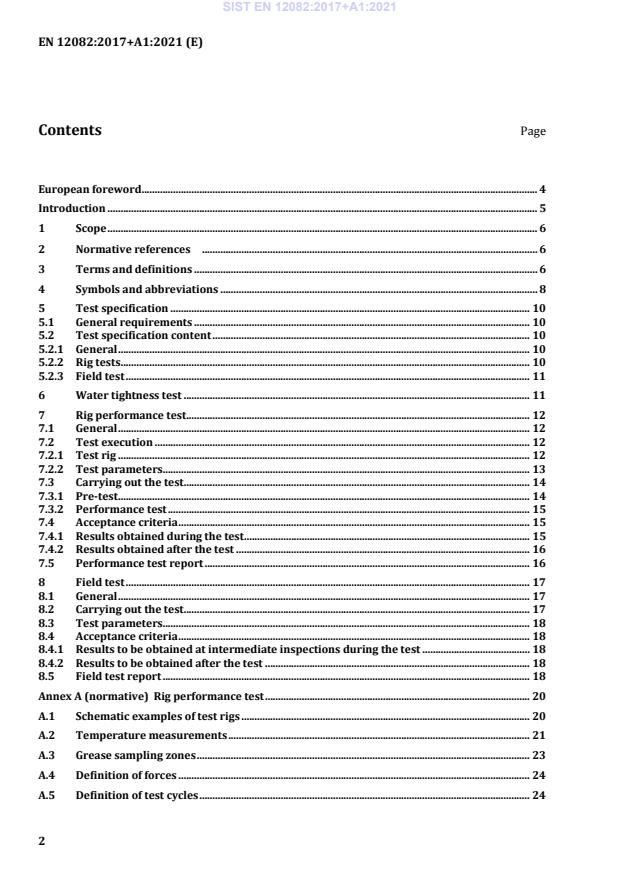
Contents Page
European foreword . 4
Introduction . 5
1 Scope . 6
2 Normative references . 6
3 Terms and definitions . 6
4 Symbols and abbreviations . 8
5 Test specification . 10
5.1 General requirements . 10
5.2 Test specification content . 10
5.2.1 General . 10
5.2.2 Rig tests . 10
5.2.3 Field test . 11
6 Water tightness test . 11
7 Rig performance test . 12
7.1 General . 12
7.2 Test execution . 12
7.2.1 Test rig . 12
7.2.2 Test parameters. 13
7.3 Carrying out the test . 14
7.3.1 Pre-test . 14
7.3.2 Performance test . 15
7.4 Acceptance criteria . 15
7.4.1 Results obtained during the test . 15
7.4.2 Results obtained after the test . 16
7.5 Performance test report . 16
8 Field test . 17
8.1 General . 17
8.2 Carrying out the test . 17
8.3 Test parameters. 18
8.4 Acceptance criteria . 18
8.4.1 Results to be obtained at intermediate inspections during the test . 18
8.4.2 Results to be obtained after the test . 18
8.5 Field test report . 18
Annex A (normative) Rig performance test . 20
A.1 Schematic examples of test rigs . 20
A.2 Temperature measurements . 21
A.3 Grease sampling zones . 23
A.4 Definition of forces . 24
A.5 Definition of test cycles . 24
A.5.1 Speed Classes and cumulative distances for testing . 24
A.5.2 Conditions for sequenced tests . 25
A.5.3 Particular conditions for similar rolling bearing(s), grease or box housing . 25
A.6 Graphical presentation of test cycles . 26
A.7 Temperature criteria . 27
A.8 Mechanical and physico-chemical acceptance criteria . 28
A.8.1 Mechanical criteria . 28
A.8.2 Physico-chemical criteria . 29
A.9 Reference to existing approval results . 31
A.9.1 General . 31
A.9.2 Preconditions for applicability of existing results . 31
Annex B (informative) Sequenced performance tests . 34
B.1 General . 34
B.2 High Speed Train example . 34
B.3 Passenger train example. 36
B.4 Freight train example. 37
B.5 Peri-urban train example . 39
Annex C (normative) Water tightness test . 41
C.1 General . 41
C.2 Test conditions . 41
C.3 Test procedure . 42
C.4 Pass/fail criterion . 42
C.5 Test report . 42
C.6 Sketches . 43
C.6.1 Classic application . 43
C.6.2 Application with dynamic seals on both sides of the axlebox . 44
Annex D (informative) Temperature evaluation examples . 45
D.1 General . 45
D.2 Nomenclature. 45
D.3 Criterion A . 45
D.4 Criterion B . 46
D.5 Criterion C . 46
D.6 Criterion D . 47
D.7 Criterion E1 . 47
D.8 Criterion E2 . 47
Bibliography . 49
European foreword
This document (EN 12082:2017+A1:2021) has been prepared by Technical Committee CEN/TC 256
“Railway Applications”, the secretariat of which is held by DIN.
This European Standard shall be given the status of a national standard, either by publication of an
identical text or by endorsement, at the latest by December 2021, and conflicting national standards
shall be withdrawn at the latest by December 2021.
Attention is drawn to the possibility that some of the elements of this document may be the subject of
patent rights. CEN [and/or CENELEC] shall not be held responsible for identifying any or all such patent
rights.
This document supersedes !EN 12082:2017".
!The main changes with respect to the previous edition are listed below:
— A clarification on how to account for stops and variations in speed is added
— A clarification on how to evaluate the first four elementary trips as well as the pre-test is added
— A clarification on which type of axlebox to be tested in the field is added
— The location of the temperature sensor position in the target zone is better specified
— The temperature criteria are clarified and Annex D (informative) gives examples on evaluation
— Formula A.4 in A.9.2 “Preconditions for applicability of existing results” is corrected
— Annex ZA is removed since it is not relevant for this norm being a testing standard
NOTE Clause 6 of the previous version of the EN (EN 12082:2007+A1:2010) is referred to in both TSI's on
rolling stock and remains mandatory. Clause 7 of this version of the EN is an improvement of the Clause 6 of the
previous version and is therefore equivalent."
This document includes Amendment 1 approved by CEN on 11 April 2021.
The start and finish of text introduced or altered by amendment is indicated in the text by tags !".
!deleted text"
According to the CEN-CENELEC Internal Regulations, the national standards organisations of the
following countries are bound to implement this European Standard: Austria, Belgium, Bulgaria,
Croatia, Cyprus, Czech Republic, Denmark, Estonia, Finland, Former Yugoslav Republic of Macedonia,
France, Germany, Greece, Hungary, Iceland, Ireland, Italy, Latvia, Lithuania, Luxembourg, Malta,
Netherlands, Norway, Poland, Portugal, Romania, Serbia, Slovakia, Slovenia, Spain, Sweden, Switzerland,
Turkey and the United Kingdom.
Introduction
To improve the reliability, availability, durability, the high speed capacity and maintenance of the
European rail transportation system, there is a need to ensure the required quality, safety and efficiency
of axleboxes that are covered by the set of standards: EN 12080, EN 12081 and EN 12082.
This European Standard has been drawn up with the purpose of standardizing the performance testing
of axleboxes for all types of rolling stock to ensure suitability for the required service, i.e. that the
assembly of box housing, bearing(s), seal(s) and grease is well suited for the service requirements.
This testing is made in two stages, a “rig test”, described in detail in this European Standard, and a “field
test”. The extent of testing to be applied depends on the novelty of bearing design, seal design, grease
formulation and/or box housing, as well as the application (see EN 12080 and EN 12081).
1 Scope
This European Standard specifies the principles and methods for a rig performance test of the system of
axlebox rolling bearing(s), housing, seal(s) and grease. Test parameters and minimum performance
requirements for vehicles in operation on main lines are specified. Different test parameters and
performance requirements may be selected for vehicles in operation on other networks (e.g. urban
rail). This standard is historically developed for outboard applications but can be used for vehicles with
other bearing arrangements (e.g.: inboard application or single wheels).
It gives some possible examples where a “sequenced performance test” addresses the broad range of
different service conditions within a specific application or vehicle platform into account.
It describes in detail the water tightness test and basic principles and minimum requirements for a field
test.
This European Standard only applies to axleboxes equipped with rolling bearings and greases according
to EN 12080 and EN 12081.
2 Normative references
The following documents, in whole or in part, are normatively referenced in this document and are
indispensable for its application. For dated references, only the edition cited applies. For undated
references, the latest edition of the referenced document (including any amendments) applies.
ASTM D7303:2012, Standard Test Method for Determination of Metals in Lubricating Greases by
Inductively Coupled Plasma Atomic Emission Spectrometry
DIN 51460-1:2007, Testing of petroleum products - Method for sample preparation - Part 1: Microwave
incineration
DIN 51829:2013, Petroleum products - Determination of additive and wear elements in greases - Analysis
by wavelength dispersive X-ray fluorescence spectrometry
EN 12080:2017, Railway applications - Axleboxes - Rolling bearings
!EN 12081", Railway applications - Axleboxes - Lubricating greases
!EN 15663", Railway applications - Definition of vehicle reference masses
!EN ISO 11885", Water quality - Determination of selected elements by inductively coupled plasma
optical emission spectrometry (ICP-OES) (ISO 11885:2007)
ISO 15243:2017, Rolling bearings — Damage and failures — Terms, characteristics and causes
3 Terms and definitions
For the purposes of this document, the following terms and definitions apply.
3.1
axlebox
assembly consisting of the following major components: rolling bearing(s), grease, seal(s) and box
housing
Note 1 to entry: Further components such as axle end cap components, bearing sleeve, box cover(s), distance
rings, fasteners, labyrinth(s) may be also part of the assembly but their presence depends on the axlebox type
design.
3.2
box housing
structural component which contains rolling bearing(s), seal(s) and grease
3.3
ovality
change (permanent deformation) in the bore's shape of an axlebox housing becoming slightly oval
3.4
rolling bearing
bearing operating with rolling motion between the parts, supporting load and moving in relation to
each other
3.5
cartridge bearing
rolling bearing with two or more rows of rolling elements within a self-contained unit, greased and
equipped with integral seals
3.6
grease
semi-solid lubricant, which consists of a thickener and additives dispersed in lubricating oil
3.7
seal
component that protects the rolling bearing(s) against ingress of water and dust and retains grease in
the rolling bearing(s)
3.8
roller set
assembly of cage and rollers
3.9.1
inboard
!with reference to an axlebox with more than one bearing row" designates the bearing row closer
to the middle of the wheelset or the test rig
3.9.2
inboard
with reference to the vehicle or application, designates a configuration with rolling bearings that are
positioned on a wheelset axle between the wheels of a wheelset
3.10.1
outboard
with reference to an axlebox with more than one bearing row, designates the bearing row that is next to
the inboard bearing row to the outside direction
3.10.2
outboard
with reference to the vehicle or application, designates a configuration with rolling bearings that are
positioned on wheelset axle ends, outside of the space between the wheels of a wheelset
3.11
maximum operational test speed
v
max
maximum operational speed for normal service (in km/h) for which the vehicle shall be homologated
3.12
nominal rotational test speed
n
test
rotational speed (using the half worn wheel diameter) corresponding to V increased by 10 % (in
max
rpm)
3.13
target zone
defined area on the underside of an axlebox that is designed to have its temperature monitored by a hot
axlebox detector (HABD)
3.14
main line
railway network open to different types of rolling stock
3.15
urban rail
public transport systems permanently guided at least by one rail, intended for the operation of local,
urban and suburban passenger services with self-propelled vehicles and operated either segregated or
not from general road and pedestrian traffic
[SOURCE: CEN-CENELEC Guide 26]
3.16
network
infrastructure, on which any railway undertaking can operate rolling stock
4 Symbols and abbreviations
For the purposes of this document, the symbols and abbreviations given in Tables 1 and 2 apply.
Table 1 — Symbols
Symbol Unit Description
average wheel diameter between new and fully worn
d
m
average
condition
d
m wheel diameter in new condition
max
d
m wheel diameter at limit of wear condition
min
maximum bore diameter under loaded condition of the
D m
max_n
new housing
minimum bore diameter under loaded condition of the
D m
min_n
new housing
maximum bore diameter under loaded condition of the
D m
max_r
reference housing
minimum bore diameter under loaded condition of the
D m
min_r
reference housing
Symbol Unit Description
F N force
F
N reference vertical force applied per wheelset on the track
F
a N axial test force
F
an N nominal axial test force
F
N radial test force
r
F
N nominal radial test force
rn
2 2
g m/s acceleration due to gravity (9,81 m/s )
j - number of wheelsets per vehicle
wheelset mass and masses on the wheelset between
m
kg
rolling circles, like brake disc, etc.
m
kg vehicle design mass according to EN 15663
max
n rpm rotational test speed corresponding to v
n
rpm !(see 3.12 nominal rotational test speed definition)"
test
estimated number of elementary trips needed to achieve
!N -
trips
the performance test (based on nominal speed)"
adjusted value of N to account for interruptions and
trips
!N -
trips_adj
variations in speed"
t s time of one test cycle (see A.6)
t s time of one elementary trip
ramp up or ramp down time from n = 0 → n = n or n =
test
t s
n → n = 0 during one elementary trip
test
t4 s time at rotational speed ntest during one elementary trip
t s stop time (n = 0)
time of one half load cycle of the alternating axial test
t s
force
time during which axial test force is applied (including
t s
ramp up and ramp down) within the period t
ramp up or ramp down time from F = 0 → F = F or
a a an
t s F = F → F = 0 during one half load cycle of the
8 a an a
alternating axial test force
t s axial test force recovery time
!ambient temperature (it is permitted to use a running
T °C average value for 30 min maximum to compensate for
a
rapid changes in the ambient temperature)"
!measured temperature at a position z and then re-
T
°C calculated to a temperature corresponding to an ambient
z20
temperature of 20 °C"
T
°C
measured temperature at a position z (measured
zm
Symbol Unit Description
positions are loading zones and target zones)
ν
km/h speed of the vehicle
!(see 3.11 maximum operational test speed
ν
km/h
max
definition)"
Table 2 — Abbreviations
Abbreviation Description
HABD hot axlebox detector
ICP inductively coupled plasma (spectrometry)
MEP mounted end play
XRF X-ray fluorescence (spectrometry)
5 Test specification
5.1 General requirements
The test specification shall consist of all the information describing test parameters and acceptance
criteria. It includes the inputs of the rig performance test, the optional water tightness test and the field
test.
The following information shall be fully documented in the test specification and shall be part of the
approval process. The requirements as specified in this European Standard shall be satisfied before a
claim of compliance with this European Standard can be made and verified.
5.2 Test specification content
5.2.1 General
The following requirements which are specified in the clauses referred to shall at least be fully
documented and included in the test specification.
5.2.2 Rig tests
a) Performance test:
— performance test report recipients list;
— quality management system accreditation and its scope;
— interface drawing showing mounting conditions of all components as in-service;
— boundary dimensions and interface tolerances of the rolling bearing(s);
— MEP requirements;
— conditions of production of the bearings (serial production, prototype);
— grease (according to EN 12081) designation, quantity and distribution, batch reference and
production date;
— specification of the test parameters according to 7.2.2;
— deviations to the test parameters in A.4 and A.6;
— approval procedure type with regard to Clause 14 and Annex E of EN 12080:2017 as well as A.9
of this standard;
— required test distance;
— deviations to the performance test report according to 7.5;
— possible extrapolation of the physico-chemical criteria according to A.8.2.
b) Water tightness test (optional):
— water tightness report recipients list;
— requirement of a water tightness test according to Annex C;
— quality management system accreditation and its scope;
— interface drawing showing mounting conditions of all components as in-service;
— conditions of production of the bearings (serial production, prototype);
— specification of the test parameters according to C.3.
5.2.3 Field test
— field test report recipients list;
— reference to the linked performance test report or proven design application;
— specification of the test parameters according to 8.3;
— required test distance;
— annual specified distance travelled of the intended service;
— minimum quantity of axleboxes to be monitored;
— duration (in terms of time or distance travelled) of each intermediate inspection interval;
— scope of monitoring and inspections activities;
— values for iron content and copper content if a grease analysis is specified and if not, for
information only.
6 Water tightness test
The test specification shall specify whether a water tightness test shall be made.
This test shall be performed as described in Annex C.
In case of a new seal, a water tightness test should be performed.
7 Rig performance test
7.1 General
The purpose of the rig performance test is to check the satisfactory design and safe function of the
axlebox during a sequence of simulated journeys.
Rig performance test and mandatory grease analyses shall be performed by a competent test facility.
NOTE Competence of a test facility is usually proven by accreditation to EN ISO/IEC 17025.
The test consists of putting a pair of axleboxes, assembled as for operating conditions, on the test rig
journals and subjecting them to one or more sequence(s) of repeated loading cycles determined from
the test specification (based on the operating conditions of the vehicles to be equipped with these
axleboxes, if available).
The bearings shall be mounted in such a way that the maximum difference in mounted clearance is
achieved with the selected bearings and available equipment. The mounted end plays (MEP) according
to the bearing specification shall be calculated taking into account: measured bearing un-mounted
clearance, measured journal diameters, measured bearing bore diameters, inner and outer raceways
angles (at the rolling element contact points), inner and outer raceways mean diameter.
The MEP shall be measured before and after the performance test (axial play for tapered bearings and
radial play for cylindrical or spherical bearings).
If the identical rolling bearing(s), seal(s) and grease have already successfully been tested, A.9 gives
guidance under which conditions the already passed test can be accepted for the intended application.
During rig operation (during a sequence), the axleboxes are subjected to constant radial force and
alternated axial force.
Before the performance test, a pre-test shall be carried out. This does not constitute part of the
evaluated approval test for the bearings or grease being tested. It is intended to observe the thermal
behaviour of the axleboxes during the grease migration at the beginning of the rig test.
The performance test consists of repeating identical cycles up to an agreed cumulative distance. The
number of cycles and the required test distance reflect the service conditions of the intended
application. !Throughout the test, the performance of the axleboxes shall be monitored by
measurement of temperatures", the values of which, both absolute and relative, shall remain within
limits. Finally, on completion of the test, the bearings and the grease shall be inspected and shall not
show any changes beyond limits imposed.
7.2 Test execution
7.2.1 Test rig
The test rig shall apply testing conditions which are derived from the service operating conditions and
ensure accurate monitoring of the axleboxes under test. The influence of the rig on the tested axleboxes
shall be minimized. Especially, the avoidance of the transfer of disturbances from one axlebox to the
other one.
The test rig shall at least include:
a) one axle or two synchronized axles, on which the axleboxes are mounted on the journals;
b) rotation mechanism to apply the nominal test speed n ;
test
c) device for measuring the rotational speed of the axle n;
d) device arranged to subject each axlebox to a radial force Fr = Frn;
e) measuring device to monitor this radial test force F ;
r
f) device arranged to subject each axlebox to an alternating axial force F ;
a
g) measuring device to monitor this alternating axial test force F ;
a
h) ventilation equipment to simulate the cooling in operation;
i) sensors permitting temperature measurement:
1) by one sensor in the loaded zone of each rolling bearing row, aligned centrally above the
bearing rows and in contact with the outer ring, with typical positions shown in Figure A.3 (for
an axlebox with two bearings);
2) in the target zone of the hot axlebox detectors (HABD), by one sensor in direct contact with the
surface of the axlebox housing as indicated in Figure A.3 (a non-contacting temperature sensor
–measuring in the same zone – shall be used only in case there are no suitable surfaces to
attach a sensor);
3) of the ambient air stream which is directed at each axlebox, measured at the outlet of the
cooling fans (see Figure A.1). For ducted air streams the sensors have to be positioned
adequately in the air flow upstream of each axlebox (see Figure A.2).
Examples of test rigs are shown in A.1.
7.2.2 Test parameters
7.2.2.1 General
The test parameters shall be defined on the basis of the operating conditions of the vehicles to be
equipped with the axleboxes and documented in accordance with the test specification in Clause 5. The
following information is required, agreed and documented in the test specification before the test and
presented in the test report:
a) design mass according to EN 15663: m , (in kg) is:
max
1) the “design mass under normal payload” (see EN 15663) when considering passenger vehicles
(including High Speed Trains) or freight vehicles;
2) the “design mass in working order” when considering locomotives. Locomotives are treated as
passenger vehicles without payload.
b) mass not carried by the bearings: m (wheelset mass and masses on the wheelset between wheel
rolling circles, like brake disc, etc.), in kg;
c) axial test force recovery time: t , in s;
d) wheel diameter new: dmax and at the limit of wear: dmin, in m;
, in km/h;
e) maximum operational speed: vmax
f) pre-test procedure;
g) required test distance, in km.
If not calculated according to A.4, the test forces: F and F (in N) have to be defined in the test
an rn
specification.
Deviations from the test parameters in A.4 and A.6 (pre-test shall not be considered) are allowed, based
on test specifications. Those deviations shall be indicated in the test report.
7.2.2.2 Rotational test speed
The maximum rotational test speed ntest (in rpm), maintained most of the time during the test, is that of
a wheelset on which the wheels are half worn and where the rotational speed is equal to the maximum
operational vehicle speed v , increased with a safety margin of 10 %.
max
110 × v
max
n = (1)
test
6 ××π d
average
where
d dd+ /2
( )
average min max
The tolerances are defined in A.6.
!Since the speed may vary within tolerances defined in A.6 and additional trips may need to be added
due to interruptions the number of elementary trips Ntrips need to be adjusted to Ntrips_adj to evaluate the
acceptance criteria in A.7."
7.2.2.3 Radial and axial forces
The test forces are applied to each axlebox inducing forces on the rolling bearings, simulating as closely
as possible the distribution of forces from the primary suspension. There shall be a constant radial force
and an alternating axial force. The axial force shall be aligned with the axis of the axle.
The methods to define the nominal radial test force F and the nominal axial test force F are described
rn an
in A.4 based on the load data specified in accordance with Clause 5. The forces are calculated for one
axlebox.
The axial test force F shall only be applied when the test speed n is greater than 20 % of the nominal
a
test speed n .
test
7.2.2.4 Air cooling
An air cooling system shall provide an average air speed of 8 m/s to 10 m/s with measurements taken
from several points across each axlebox in the area impinged by the air stream. The cooling shall be
stopped when the test speed is equal to zero. When operated, an air flow at 20 °C is recommended.
NOTE The conditions regarding the ambient temperature are defined in 7.4.1.
7.3 Carrying out the test
7.3.1 Pre-test
Before running the performance test, a pre-test shall be run. This test is designed to observe the
thermal behaviour of the bearings and to redistribute the grease.
Methods to carry out a pre-test shall be stated in the test specification described in Clause 5.
If there is no proposal in the test specification, an example of pre-test is illustrated in A.6: It consists of
four cycles, each made up of two elementary trips, one in each rotational direction. The speeds are
25 %, 50 %, 75 % and 100 % of the nominal rotational test speed, respectively. The axial force is
applied as agreed, e.g. 25 %, 50 %, 75 % and 100 % of the nominal axial force F . The radial test force is
an
=
maintained at its nominal value F . Each elementary trip is made up of a speed increase, a constant
rn
speed, a slowing down and a stop.
It is recommended that the pre-test is considered complete when at 100 % of the nominal test speed, all
the bearings temperatures have been stabilized within a 5 °C range, for a minimum of 2 h, in each
rotational direction.
The total distance of the pre-test shall not exceed 30 000 km or 250 h, whatever comes first.
!The elementary trips achieved during the pre-test are not submitted to any acceptance criteria
described in 7.4."
7.3.2 Performance test
The test consists of repeating identical cycles. A cycle consists of two elementary trips, one for each
direction of rotation, separated by a stop and composed of a starting period, a period of nominal
rotational test speed n and a slowing down period to stop.
test
The required test distance (in kilometres), as well as the time at the nominal test speed n during each
test
cycle, depend on the operating in-service vehicles to be equipped with these axleboxes. The conditions
defined in A.5 and A.6 are intended for several operational speed classes and vehicle categories.
As an alternative method, the cumulative distance of the rig performance test may be separated into
sequences using various input parameters from operation in service. Exemplified sequenced testing is
presented in Annex B.
In case of an interruption of the performance test not related to the performance of the tested
axleboxes, the following procedure shall be applied:
— interruption time less than or equal to one hour: the unfinished trip or cycle (depending on the rig
setting) shall not be post-processed according to Table A.2. The cumulative distance of the test shall
be increased by this not post-processed trip or cycle;
— interruption time longer than one hour: the unfinished trip or cycle and the two trips following the
restart of the test rig shall not be post-processed. The cumulative distance of the test shall be
increased by these not post-processed trips.
These rules shall be applied after each single interruption. !If the number of interruptions exceeds (5
+ 0,03 × N ), the performance test shall be considered as not passed."
trips_adj
7.4 Acceptance criteria
7.4.1 Results obtained during the test
Throughout the test, temperatures shall be measured, during each elementary trip, at loading zones and
target zones of both axleboxes. The measured temperatures shall be expressed relative to an ambient
temperature of 20 °C by calculation with the aid of the following formula:
T = T−×0,6 T− 20 (2)
( )
z20 zm a
where
0,6 factor of dissipation by convection. It takes into account the amount of energy that is
dissipated by the axlebox by convection, excluding the conduction and radiation effects.
This mean value is empiric (based on the experience of laboratories).
!This calculation shall be applied for the assessment of all criteria in Table A.2 except if an air-
conditioned wind flow with (20 ± 2) °C is used for cooling the axleboxes for the test period."
!The rig test shall not be carried out if the ambient temperature is not comprised between 10 °C and
40 °C."
!For each thermal sensor", the maximum temperature as well as the simultaneous differences
between axleboxes shall be registered. Sufficient temperature data points shall be registered in order
that the results may be interpreted according to the criteria of Table A.2 (a sampling period of 100 s or
less is recommended).
For the further evaluation according to the Criterion C in Table A.2, the maximum value of those
simultaneous differences shall be used.
For consecutive elementary trips, the difference of maximum temperatures for an identical load zone
sensor position shall be noted and shall be used in the further evaluation according to the Criterion E in
Table A.2.
The limits to be observed and the tolerable number of violations are given in Table A.2. One or more
occurrences per elementary trip have to be counted as a single violation of the referred criterion. If
several criteria are violated during the same elementary trip the number of violations is increased by
one for each affected criterion.
!The first 4 elementary trips of the performance test (or of each sequence, in case of sequenced test)
shall not be evaluated according to Table A.2. They are however still counted as achieved test
distance."
7.4.2 Results obtained after the test
On completion of the cumulative distance the bearings shall be dismounted for examination; similarly
grease samples from the zones indicated in A.3 shall be analysed. The mechanical criteria to be fulfilled
by the bearings and the physico-chemical criteria to be fulfilled by the grease are defined in A.8.
For cartridge bearings, the grease quantity remaining in the bearing shall be determined by weight
measurements of the cartridge before and after the test. The grease quantity before the test is
determined by subtracting the weight of all cleaned cartridge components (after the test) from the
greased cartridge weight before the test.
7.5 Performance test report
Upon completion of the test, a report shall be established including at least the content such as follows:
— designation and origin of each component of the tested axleboxes;
— conditions of production of the bearings (serial production, prototype) and how they were selected
for the test (example: randomly, from a batch production, in presence of XXX Company
representatives);
— testing organization, site, personnel who edit and authorize the test report, description of the test
rig (measuring equipment, sensors and their positions, data acquisition period, etc.);
— reference to a quality management system accreditation;
— test parameters in accordance with the test specification;
— reference, index and edition date of the test specification;
— bearing mounting parameters in accordance with 7.1;
— timing, distance and the finally observed stabilised temperature of the pre-test;
...
Questions, Comments and Discussion
Ask us and Technical Secretary will try to provide an answer. You can facilitate discussion about the standard in here.
Loading comments...