

SIST EN 17976:2025
(Main)Railway applications - Bolting of rail vehicles and components
General Information
- Abstract
This document specifies the requirements for designing, strength assessment, assembly and servicing of mechanical and electrical bolted joints made from metallic components and bolts.
This document is not intended for rivets, lock bolts, self-tapping screws, wood screws, thread-rolling screws, thread-forming and chipboards.
This document is applicable to all rail vehicles.
- Status
- Published
- Public Enquiry End Date
- 31-Jul-2023
- Publication Date
- 22-Dec-2024
- Technical Committee
- IŽNP - Reilway applications
- Current Stage
- 6060 - National Implementation/Publication (Adopted Project)
- Start Date
- 18-Dec-2024
- Due Date
- 22-Feb-2025
- Completion Date
- 23-Dec-2024

Overview
EN 17976:2024 - Railway applications: Bolting of rail vehicles and components is a CEN European standard that specifies requirements for the design, strength assessment, assembly and servicing of mechanical and electrical bolted joints made from metallic components and bolts. It applies to all rail vehicles and covers metallic fasteners only - it explicitly excludes rivets, lock bolts, self‑tapping screws, wood screws, thread‑rolling/ thread‑forming screws and chipboards.
Key topics and technical requirements
This standard provides comprehensive guidance and requirements across the bolted‑joint lifecycle. Major technical topics include:
- Safety categories and classification of mechanical and electrical bolted joints (severity levels and safety requirements).
- Design rules (Clause 7): thread engagement, bolt and nut selection, mechanical properties, component design, resilience, chamfers, clearance/counterbore details and accessibility for tools.
- Strength assessment: proof against permanent plastic deformation, functional requirements, surface pressure, creep, engagement length, fatigue assessment and failure criteria.
- Electrical connections: selection, assembly and specific requirements for bolted electrical joints.
- Corrosion protection and galvanic considerations for material and coating choices.
- Securing methods: mechanical locking, securing for electrical joints, and required measures.
- Assembly (Clause 8): tool requirements, tightening methods (torque/angle/controlled systems), tool monitoring, marking, validation at first assembly and quality assurance in serial production.
- Operational aspects: record keeping, reuse of fasteners, lifetime inspection and performance classes.
- Informative annexes for size estimation, safety category determination, mounting values for torque‑controlled assembly and statistical evaluation.
Practical applications and users
EN 17976 is intended for professionals responsible for the safety, reliability and maintainability of rail vehicle bolted joints:
- Railway mechanical and design engineers specifying fasteners and joint geometry.
- Maintenance engineers and technicians performing assembly, inspection and tightening.
- Manufacturers and suppliers of rail vehicles, components and fasteners.
- Quality assurance teams implementing assembly control, tool calibration and records.
- Regulators and conformity assessors reviewing safety class assignments and documentation.
Typical uses include design validation of bolted joints, selecting bolt grades and coatings, defining tightening procedures and traceable assembly records, corrosion mitigation, fatigue/strength assessments and lifecycle inspection plans.
Related standards
EN 17976 references and aligns with other railway standards; an example in the document is EN 15085-3:2022+A1:2023 for related classifications. Users should consult the normative references listed in the standard for complete cross‑referenced requirements.
Keywords: EN 17976:2024, bolting of rail vehicles, railway bolted joints, fasteners, bolt design, assembly, tightening, corrosion protection, fatigue assessment.
Relations
- Effective Date
- 09-Feb-2026
- Effective Date
- 28-Jan-2026
- Effective Date
- 28-Jan-2026
- Refers
SIST EN ISO 10664:2015 - Hexalobular internal driving feature for bolts and screws (ISO 10664:2014) - Effective Date
- 28-Jan-2026
- Effective Date
- 28-Jan-2026
- Effective Date
- 28-Jan-2026
- Effective Date
- 28-Jan-2026
- Effective Date
- 28-Jan-2026
- Effective Date
- 28-Jan-2026
- Refers
SIST EN ISO 4017:2022 - Fasteners - Hexagon head screws - Product grades A and B (ISO 4017:2022) - Effective Date
- 28-Jan-2026
- Refers
SIST EN ISO 4014:2022 - Fasteners - Hexagon head bolts - Product grades A and B (ISO 4014:2022) - Effective Date
- 28-Jan-2026
- Effective Date
- 28-Jan-2026
- Effective Date
- 28-Jan-2026
Get Certified
Connect with accredited certification bodies for this standard

IRIS Certification (UNIFE)
International Railway Industry Standard certification.

TÜV SÜD Rail GmbH
TÜV SÜD railway certification services.

Bureau Veritas Railway Certification
Railway and transportation certification.
Sponsored listings
Frequently Asked Questions
SIST EN 17976:2025 is a standard published by the Slovenian Institute for Standardization (SIST). Its full title is "Railway applications - Bolting of rail vehicles and components". This standard covers: This document specifies the requirements for designing, strength assessment, assembly and servicing of mechanical and electrical bolted joints made from metallic components and bolts. This document is not intended for rivets, lock bolts, self-tapping screws, wood screws, thread-rolling screws, thread-forming and chipboards. This document is applicable to all rail vehicles.
This document specifies the requirements for designing, strength assessment, assembly and servicing of mechanical and electrical bolted joints made from metallic components and bolts. This document is not intended for rivets, lock bolts, self-tapping screws, wood screws, thread-rolling screws, thread-forming and chipboards. This document is applicable to all rail vehicles.
SIST EN 17976:2025 is classified under the following ICS (International Classification for Standards) categories: 21.060.01 - Fasteners in general; 21.060.10 - Bolts, screws, studs; 21.060.20 - Nuts; 45.040 - Materials and components for railway engineering. The ICS classification helps identify the subject area and facilitates finding related standards.
SIST EN 17976:2025 has the following relationships with other standards: It is inter standard links to SIST EN 50343:2025, SIST EN ISO 10683:2018, SIST EN ISO 3506-1:2020, SIST EN ISO 10664:2015, SIST EN 17149-1:2024, SIST EN ISO 4762:2004, SIST EN 572-7:2004, SIST EN ISO 3506-2:2020, SIST EN 15865:2009, SIST EN ISO 4017:2022, SIST EN ISO 4014:2022, SIST EN ISO 23500-1:2019, SIST EN ISO 23500-4:2019. Understanding these relationships helps ensure you are using the most current and applicable version of the standard.
SIST EN 17976:2025 is available in PDF format for immediate download after purchase. The document can be added to your cart and obtained through the secure checkout process. Digital delivery ensures instant access to the complete standard document.
Standards Content (Sample)
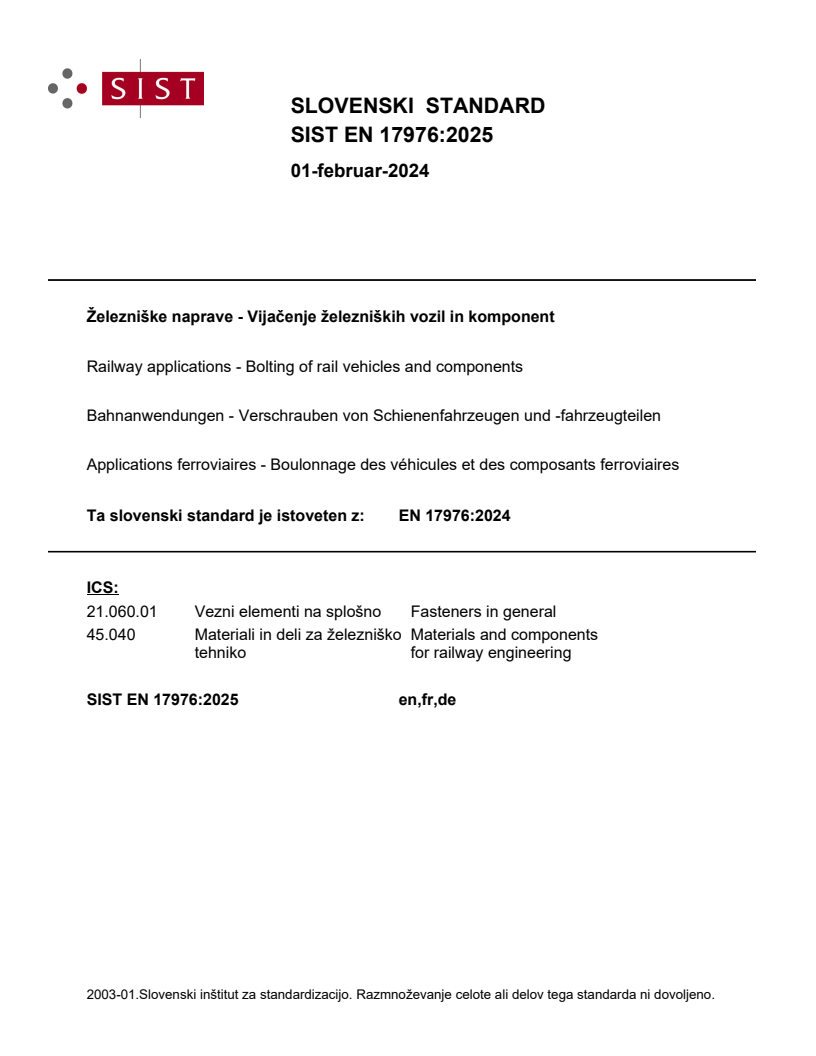
SLOVENSKI STANDARD
01-februar-2024
Železniške naprave - Vijačenje železniških vozil in komponent
Railway applications - Bolting of rail vehicles and components
Bahnanwendungen - Verschrauben von Schienenfahrzeugen und -fahrzeugteilen
Applications ferroviaires - Boulonnage des véhicules et des composants ferroviaires
Ta slovenski standard je istoveten z: EN 17976:2024
ICS:
21.060.01 Vezni elementi na splošno Fasteners in general
45.040 Materiali in deli za železniško Materials and components
tehniko for railway engineering
2003-01.Slovenski inštitut za standardizacijo. Razmnoževanje celote ali delov tega standarda ni dovoljeno.
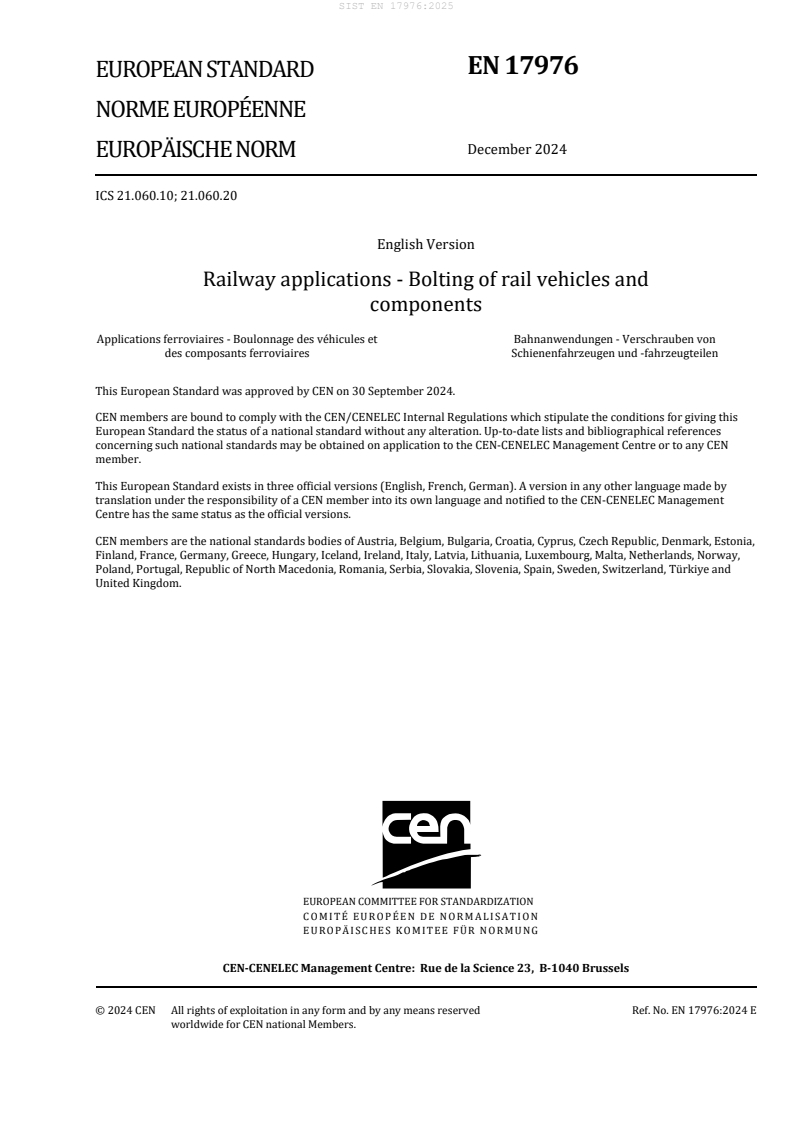
EN 17976
EUROPEAN STANDARD
NORME EUROPÉENNE
December 2024
EUROPÄISCHE NORM
ICS 21.060.10; 21.060.20
English Version
Railway applications - Bolting of rail vehicles and
components
Applications ferroviaires - Boulonnage des véhicules et Bahnanwendungen - Verschrauben von
des composants ferroviaires Schienenfahrzeugen und -fahrzeugteilen
This European Standard was approved by CEN on 30 September 2024.
CEN members are bound to comply with the CEN/CENELEC Internal Regulations which stipulate the conditions for giving this
European Standard the status of a national standard without any alteration. Up-to-date lists and bibliographical references
concerning such national standards may be obtained on application to the CEN-CENELEC Management Centre or to any CEN
member.
This European Standard exists in three official versions (English, French, German). A version in any other language made by
translation under the responsibility of a CEN member into its own language and notified to the CEN-CENELEC Management
Centre has the same status as the official versions.
CEN members are the national standards bodies of Austria, Belgium, Bulgaria, Croatia, Cyprus, Czech Republic, Denmark, Estonia,
Finland, France, Germany, Greece, Hungary, Iceland, Ireland, Italy, Latvia, Lithuania, Luxembourg, Malta, Netherlands, Norway,
Poland, Portugal, Republic of North Macedonia, Romania, Serbia, Slovakia, Slovenia, Spain, Sweden, Switzerland, Türkiye and
United Kingdom.
EUROPEAN COMMITTEE FOR STANDARDIZATION
COMITÉ EUROPÉEN DE NORMALISATION
EUROPÄISCHES KOMITEE FÜR NORMUNG
CEN-CENELEC Management Centre: Rue de la Science 23, B-1040 Brussels
© 2024 CEN All rights of exploitation in any form and by any means reserved Ref. No. EN 17976:2024 E
worldwide for CEN national Members.
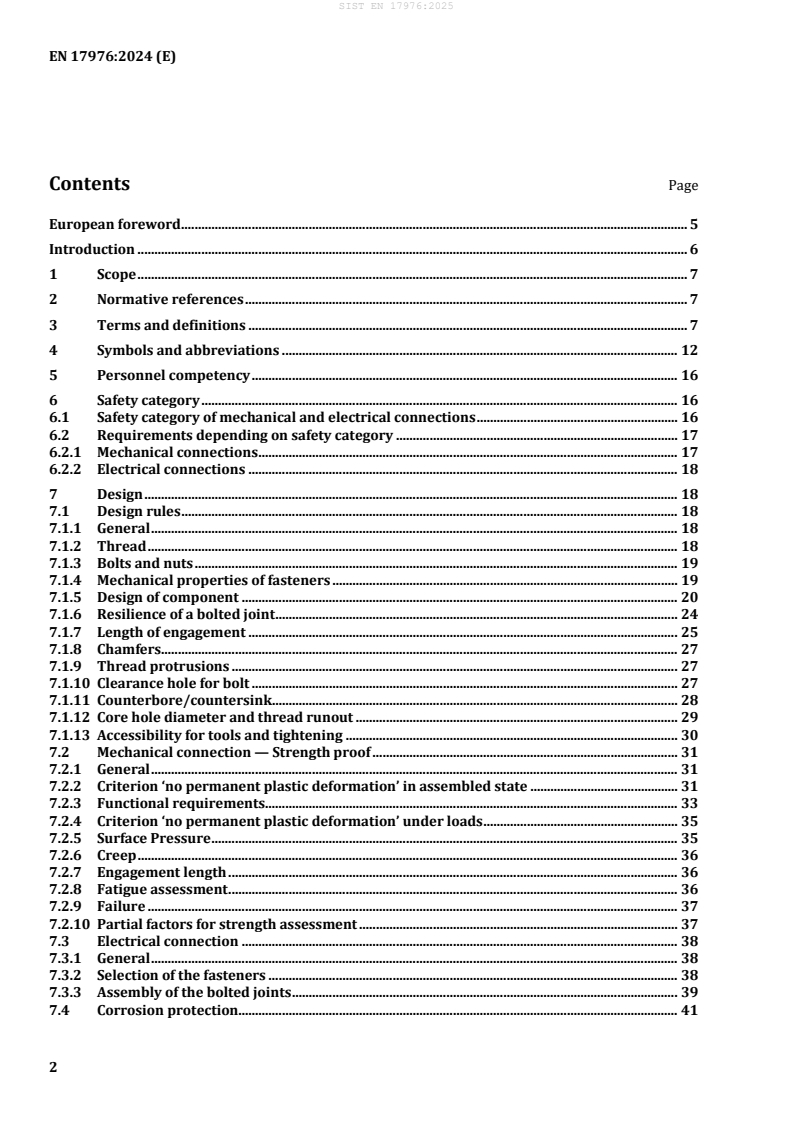
Contents Page
European foreword . 5
Introduction . 6
1 Scope . 7
2 Normative references . 7
3 Terms and definitions . 7
4 Symbols and abbreviations . 12
5 Personnel competency . 16
6 Safety category . 16
6.1 Safety category of mechanical and electrical connections . 16
6.2 Requirements depending on safety category . 17
6.2.1 Mechanical connections . 17
6.2.2 Electrical connections . 18
7 Design . 18
7.1 Design rules . 18
7.1.1 General . 18
7.1.2 Thread . 18
7.1.3 Bolts and nuts . 19
7.1.4 Mechanical properties of fasteners . 19
7.1.5 Design of component . 20
7.1.6 Resilience of a bolted joint . 24
7.1.7 Length of engagement . 25
7.1.8 Chamfers. 27
7.1.9 Thread protrusions . 27
7.1.10 Clearance hole for bolt . 27
7.1.11 Counterbore/countersink. 28
7.1.12 Core hole diameter and thread runout . 29
7.1.13 Accessibility for tools and tightening . 30
7.2 Mechanical connection — Strength proof . 31
7.2.1 General . 31
7.2.2 Criterion ‘no permanent plastic deformation’ in assembled state . 31
7.2.3 Functional requirements. 33
7.2.4 Criterion ‘no permanent plastic deformation’ under loads . 35
7.2.5 Surface Pressure . 35
7.2.6 Creep . 36
7.2.7 Engagement length . 36
7.2.8 Fatigue assessment . 36
7.2.9 Failure . 37
7.2.10 Partial factors for strength assessment . 37
7.3 Electrical connection . 38
7.3.1 General . 38
7.3.2 Selection of the fasteners . 38
7.3.3 Assembly of the bolted joints . 39
7.4 Corrosion protection. 41
7.4.1 Effect of protection of coatings and materials in fasteners . 41
7.4.2 Galvanic corrosion . 44
7.5 Securing methods . 47
7.5.1 Bolted joints for applications in terms of mechanical engineering . 47
7.5.2 Bolted joints for electrical connections . 47
7.5.3 Securing measures . 47
7.6 Documentation of the design . 52
8 Assembly of bolted joints . 52
8.1 General . 52
8.2 Tools . 53
8.2.1 Tool requirements . 53
8.2.2 Monitoring of the tightening tools and systems . 55
8.3 Tightening method . 56
8.3.1 General . 56
8.3.2 Marking of bolted joints . 56
8.3.3 Work instructions and requirements for the assembly process . 56
8.4 Environmental conditions . 58
8.5 Validation of the assembly result during first assembly review . 58
8.6 Quality assurance of the assembly result in serial production. 58
8.7 Record of assembly . 59
8.8 Reuse of fasteners . 60
8.9 Lifetime inspection . 60
9 Performance classes . 60
10 Properties of parameters . 61
10.1 General . 61
10.2 Statistical evaluation . 61
10.3 Physical properties . 65
10.3.1 Static friction coefficient in the interface . 65
10.3.2 Friction coefficients for tightening . 65
10.3.3 Limit values for surface pressure . 66
10.3.4 Embedding . 66
Annex A (informative) Size estimation . 67
A.1 General . 67
A.2 Limits for the size estimation . 67
A.3 Execution of the size estimation . 68
Annex B (informative) Determination and examples for safety categories . 74
B.1 General . 74
B.2 Determination of safety category of mechanical bolted joint basing on severity levels . 74
B.3 Determination of safety category of electrical bolted joints . 76
B.4 Examples . 76
B.5 Flow chart for classification of severity level for mechanical bolted joints . 78
B.6 Modifications to safety categories H and M . 80
B.7 Determination of safety category for bolted joints based on
EN 15085-3:2022+A1:2023. 80
Annex C (informative) Mounting values for torque controlled assembly . 81
C.1 General . 81
C.2 Limits for the listed tightening torque . 81
C.3 Formulas. 82
C.4 Maximum tightening torque and maximum preload . 82
Annex D (informative) Examples for classification of bolted joints for special vehicles . 87
D.1 Examples . 87
Annex E (informative) Statistical evaluation . 90
E.1 Procedure for statistical test evaluation of a single parameter . 90
E.2 Procedure for statistical test evaluation for an entire calculation criterion . 95
Bibliography . 99
European foreword
This document (EN 17976:2024) has been prepared by Technical Committee CEN/TC 256 “Railway
applications”, the secretariat of which is held by DIN.
This European Standard shall be given the status of a national standard, either by publication of an
identical text or by endorsement, at the latest by June 2025, and conflicting national standards shall be
withdrawn at the latest by June 2025.
Attention is drawn to the possibility that some of the elements of this document may be the subject of
patent rights. CEN shall not be held responsible for identifying any or all such patent rights.
Any feedback and questions on this document should be directed to the users’ national standards body.
A complete listing of these bodies can be found on the CEN website.
According to the CEN-CENELEC Internal Regulations, the national standards organisations of the
following countries are bound to implement this European Standard: Austria, Belgium, Bulgaria, Croatia,
Cyprus, Czech Republic, Denmark, Estonia, Finland, France, Germany, Greece, Hungary, Iceland, Ireland,
Italy, Latvia, Lithuania, Luxembourg, Malta, Netherlands, Norway, Poland, Portugal, Republic of North
Macedonia, Romania, Serbia, Slovakia, Slovenia, Spain, Sweden, Switzerland, Türkiye and the United
Kingdom.
Introduction
Screwed and bolted joints are often used to assemble safety-critical components on rail vehicles. This
document sets out key considerations for design and assembly of such joints, based on an assessment of
their criticality.
The application of this document results in an appropriate safety level for bolted joints in railway
applications considering design, assembling and service phase.
This document gives guidance on the selection and design of bolted joints for rail vehicles in mechanical
and electrical applications.
The function of a bolted joint is to connect two or more parts in a sufficient and safe manner over the
intended service life under the conditions of the railway environment. The mechanical bolted joint is
designed to transmit forces between the connected components without failure, separation or relative
movement. The electrical bolted joint is designed to ensure current transmission between electrical
conductors safely and without separation or relative movement. For this purpose, the parts are held
together by the preload of the bolt.
This document describes the safety categories of bolted joints and gives an overview of the resulting
requirements linked to these safety categories.
It specifies standards for the design and verification of bolted joints. Design includes aspects such as joint
dimensions, layout, securing of bolted joints and corrosion protection.
It is intended to support the designer in the basic selection of bolted joints for familiarisation with the
necessary systematics and terms.
Tightening of bolted joints is a special process in the railway industry in accordance with ISO 22163.
Therefore, the conformity of the resulting product cannot be readily determined without destructive
analysis prior to use but the influence parameters affecting the process can be controlled. This document
provides guidance to control these parameters.
Furthermore, this document specifies requirements for assembly, quality and maintenance.
1 Scope
This document specifies the requirements for designing, strength assessment, assembly and servicing of
mechanical and electrical bolted joints made from metallic components and bolts.
This document is not intended for rivets, lock bolts, self-tapping screws, wood screws, thread-rolling
screws, thread-forming and chipboards.
This document is applicable to all rail vehicles.
2 Normative references
The following documents are referred to in the text in such a way that some or all of their content
constitutes requirements of this document. For dated references, only the edition cited applies. For
undated references, the latest edition of the referenced document (including any amendments) applies.
EN 50343, Railway applications — Rolling stock — Rules for installation of cabling
EN 15865, Adhesives — Determination of torque strength of anaerobic adhesives on threaded fasteners
(ISO 10964)
EN ISO 3506-1, Fasteners — Mechanical properties of corrosion-resistant stainless steel fasteners — Part
1: Bolts, screws and studs with specified grades and property classes (ISO 3506-1)
EN ISO 3506-2, Fasteners — Mechanical properties of corrosion-resistant stainless steel fasteners — Part
2: Nuts with specified grades and property classes (ISO 3506-2)
EN ISO 4014, Fasteners — Hexagon head bolts — Product grades A and B (ISO 4014)
EN ISO 4017, Fasteners — Hexagon head screws — Product grades A and B (ISO 4017)
EN ISO 10683, Fasteners — Non-electrolytically applied zinc flake coating systems (ISO 10683)
EN ISO 4762, Hexagon socket head cap screws (ISO 4762)
EN ISO 10664, Hexalobular internal driving feature for bolts and screws (ISO 10664)
ISO 261, ISO general purpose metric screw threads — General plan
EN 17149-1:2024, Railway applications — Strength assessment of rail vehicle structures — Part 1: General
3 Terms and definitions
For the purposes of this document, the terms and definitions, symbols and abbreviations given in
EN 17149-1:2024 and the following terms and definitions apply.
ISO and IEC maintain terminology databases for use in standardization at the following addresses:
• ISO Online browsing platform: available at https://www.iso.org/obp
• IEC Electropedia: available at https://www.electropedia.org/
3.1
bolt
fastener with a partially threaded shaft
Note 1 to entry: In this document, when only the term bolt is used, it refers to a bolt or a screw.
3.2
screw
fastener with a fully threaded shaft
3.3
bolted joint
assembly of two or more components held together by the preload of a bolt or screw
Note 1 to entry: The bolted joint contains the clamped components, the bolt or screw, nut and washers. In this
document the term bolted joint includes the screwed joint.
3.4
screwed joint
bolted joint with an internally threaded component
Note 1 to entry: The bolt or screw is inserted into a tapped component. A nut is not used. A screwed joint contains
the clamped components, the bolt or screw and washers.
3.5
fastener
connective element used in a bolted joint
EXAMPLE Screws, bolts, nuts and washers are considered fasteners.
3.6
separation
full loss of contact in the interface between clamped components
Note 1 to entry: The surface pressure between two clamped components falls to zero due to external loads pulling
these parts apart.
3.7
permanent plastic deformation
plastification which infringes the functionality and durability of the bolt
3.8
load factor
ratio of additional bolt load to external load
Note 1 to entry: The load factor is determined using the resilience of the bolt and clamped components.
3.9
loosening
effect which results in loss of preload
3.10
slackening
loss of preload due to embedding, creep or exceeding surface pressure limits
3.11
embedding
flattening of joint surfaces, within the thread, under the head or the nut or the interface surfaces
3.12
creep
time-dependent plastic deformation under load which leads to the loss of preload in bolted joints
Note 1 to entry: In metallic materials, this usually occurs at elevated temperatures (at least 30 % to 40 % of the
melting temperature in Kelvin).
3.13
self-acting loosening by rotation
loss of preload due to relative rotational movement between the nut and bolt or screw and threaded part,
often associated with external shear loads overcoming the joint friction
3.14
fatigue load
repetitive load or combination of loads
[SOURCE: EN 17149-1:2024, 3.1.14]
3.15
exceptional load
infrequent load which represents the extreme loads or combination of loads for the relevant operation
conditions
[SOURCE: EN 17149-1:2024, 3.1.10]
3.16
exceptional design load
design load derived from an exceptional load
[SOURCE: EN 17149-1:2024, 3.1.12]
3.17
ultimate load
extreme load that the structure withstands without rupture or collapse
[SOURCE: EN 17149-1:2024, 3.1.11]
3.18
ultimate design load
design load derived from an ultimate load
[SOURCE: EN 17149-1:2024, 3.1.13]
3.19
failure
loss of function of the bolted joint
Note 1 to entry: Function is e. g. structural strength or current transfer. Depending on design and function this can
be an unacceptable loss of preload or total loss of joint.
3.20
slip-resistant
property that prevents relative transverse or radial movement between the clamped components
3.21
tightening factor
ratio between maximum and minimum assembly preload of a bolted joint due to the scatter of the
tightening process and scatter of friction coefficients
Note 1 to entry: Reduction of preload due to embedding is not taken into account.
3.22
tightening process
sequence of actions to tighten a bolted joint including all influence parameters
Note 1 to entry: The tightening process does not include the assembly of the bolted joint.
3.23
mechanical connection
bolted joint transferring loads between two or more components
3.24
electrical connection
bolted joint connecting two or more components to transfer current
3.25
severity level
severity of the consequences in case of failure of a bolted joint
3.26
safety class
resistance of a design against the feared consequences in case of failure of the bolt
3.27
safety category
classification defining the consequences of failure of the single bolted joint with respect to the effects on
persons, facilities and the environment
[SOURCE: EN 15085-1:2007+A1:2013, 3.17, modified – “classification” has been added, “welded joint”
has been substituted by “bolted joint”]
3.28
load-transmitting equipment
component or assembly which transfers loads during operation
Note 1 to entry: Examples for equipment loads are traction, braking and damper loads.
3.29
protective earthing
current-carrying electrical connection only in the event of a fault
3.30
TN-C
neutral conductor and protective earthing conductor combined in one unique line inside whole system
3.31
PEN-conductor
conductor combining the functions of both a protective earthing conductor and a neutral conductor
3.32
equipotential bonding system
provision of electrical connections between conductive parts intended to achieve equipotentiality
3.33
control parameter
parameter by which the tightening process is terminated
3.34
monitoring parameter
measured parameter used for supervision purposes
3.35
directly measured parameter
measured variable without additional physical transformation
Note 1 to entry: The control/monitoring variable is measured using a traceable calibratable sensor integrated into
the fastening tool or fastening system and which supplies measurement signals independently of the fastening
process.
3.36
indirectly measured parameter
control or control variable that is not directly measured
Note 1 to entry: e. g., current or pressure shutdown without measurement until the spindle stops.
3.37
manually actuated fastening tool
fastening tool which is unpowered
Note 1 to entry: An example of a manually actuated fastening tool is a manual torque wrench.
3.38
hand-held tightening system
motor-driven tightening system, in which the operator supports the reaction torque
Note 1 to entry: Permanent confirmation is achieved through tactile feedback to the user.
3.39
hand-guided tightening system
motor-driven tightening system, in which the operator does not support the reaction torque
Note 1 to entry: This definition also includes fully automatic robotic systems.
3.40
performance class
classified scatter of control parameter
3.41
torque wrench
handheld indicating or setting torque tool
Note 1 to entry: A tool is considered hand-held in accordance with EN ISO 6789 (series) type I and type II.
3.42
quality process
measures to ensure that the assembly result meets the requirements
3.43
statistical tolerance interval
interval determined from a random sample in such a way that one has a specified level of confidence that
the interval covers at least a specified proportion of the sampled population
Note 1 to entry: The confidence level in this context is the long-run proportion of intervals generated in this
manner that will include at least the specified proportion of the sampled population.
[SOURCE: ISO 3534-1:2006, 1.26, modified: Added Note 1 to entry]
3.44
statistical tolerance limit
statistic representing an end point of a statistical tolerance interval
Note 1 to entry: Statistical tolerance intervals may be either one-sided (with one of its limits fixed at the natural
boundary of the random variable), in which case they have either an upper or a lower statistical tolerance limit, or
two-sided, in which case they have both.
4 Symbols and abbreviations
Table 1 lists the symbols and abbreviations used in this document.
Table 1 — Symbols and abbreviations
Symbol Unit Designation
A effective area of contact
mm
c mm size of chamfer
CP - performance class
Cbs - Abbreviation for “carbodies”
D mm diameter
d mm nominal diameter of a thread which corresponds to ISO 261
d mm outside diameter of the plane head bearing
d mm diameter of a through hole
h
d mm drill sizes for metric threads
k
E mm thread run-out
e , e mm recommended edge distance
1 2
F N load (force)
F N axial load
ax
F N assembly preload when mounting/tightening
M
F N shear load
sh
Symbol Unit Designation
F N minimum preload
Vmin
f - the degree of freedom is defined as f = m⋅(n − 1)
HV - Vickers hardness
K - factor used to determine the lower or upper limit of the statistical
tolerance interval
k (n; p; 1 − α) - factor used to determine x or x when the values of μ and σ are
C L U
unknown for one-sided statistical tolerance interval. The suffix C is
chosen because this k-factor is tabulated in ISO 16269-6:2014, Annex C.
k (n; m; p;1 − α) - factor used to determine x and x (i = 1,2,.,m; m ≥ 2) when the values
D Li Ui
of the means μ and the value of the common σ are unknown for the m
i
two-sided statistical tolerance intervals. The suffix D is chosen because
this k-factor is tabulated in ISO 16269-6:2014, Annex D.
l mm tolerance in length of clamped components and fasteners
tol
M - number of samples in the population
m mm effective length of engagement
eff
m mm total engagement length
tot
N - number of observations in a sample
P mm thread pitch
p contact pressure
N/mm
p , p mm spacing distance
1 2
p , p % minimum proportion of the population asserted to be lying in the
t1 t2
statistical tolerance interval
R upper yield point
N/mm
eH
R tensile strength
N/mm
m
R maximum tensile strength
N/mm
m,max
R yield strength
N/mm
p0,2
S - estimated standard deviation of a sample: positive square root of the
mean squared standard deviation from the mean of a sample.
s - sample standard deviation of ith sample
i
s - pooled sample standard deviation of m samples with n observations
p
each
s - torque scatter
c
T Nm tightening torque
T Nm nominal tightening torque
A
Symbol Unit Designation
t mm sheet thickness or height of a geometric section (e.g. minimum depth
(t) of counterbore)
u - p-fractile of the standardized normal distribution
p
u(x ) - the uncertainty of the single input parameters is u(x )
i i
u(y) - the uncertainties of the single input parameters u(x ) lead to a total
i
uncertainty u(y) of the output parameter y = f(x ) depending on the
i
input parameters x
i
The relation between u(x ) and the total uncertainty u(y) can be
i
expressed by the law of propagation of uncertainty
v - normally distributed variable
f(v) - density function of a normally distributed variable (Gaussian bell
curve)
V , V mm minimum thread protrusion
1 2
X - the input quantities with i = 1,., m, where m is the number of input
i
quantities
x - input parameter
i
x - lower limit of the statistical tolerance interval for single population,
L
one-side tolerance interval or two-side tolerance interval
x - upper limit of the statistical tolerance interval for single population,
U
one-side tolerance interval or two-side tolerance interval
x - jth observed value
j
x - jth observed value (j = 1,2,.,n) of ith sample (i = 1,2,.,m)
ij
x - maximum value of the observed values: x = max {x , x , …, x }
max max 1 2 n
x - minimum value of the observed values: x = min {x , x , …, x }
min min 1 2 n
x̅ - sample mean: sum of all the data in a sample divided by the number of
observations
Y - Y is a function of quantities x :
i
y = f (x , ., x )
1 m
it can be expressed as Y = y ± u(y) with
y - output parameter y = f (x )
i
α - tightening factor
A
1 − α - confidence level: probability associated with an interval of statistical
tolerance
γ - partial factor for loads
L
µ - mean: sum of all the data in a population divided by the number of
observations
Symbol Unit Designation
µ - friction coefficient under bolt head or nut
b
µ - population mean of the ith population (i = 1,2,…,m)
i
µ - friction coefficient in the interface
int
µ - friction coefficient in the thread
th
µ - value of the total joint friction combining the thread friction and under
tot
bolt head or nut friction coefficients
μ - maximum value of the scatter of the total friction coefficient in
tot,max,lub
lubricated joints
μ - maximum value of the scatter of the total friction coefficient in
tot,max,unlub
unlubricated joints
μ - minimum value of the scatter of the total friction coefficient in
tot,min,lub
lubricated joints
μ - minimum value of the scatter of the total friction coefficient in
tot,min,unlub
unlubricated joints
σ - positive square root of the mean squared standard deviation from the
mean from a population
σ fatigue limit as stress amplitude
N/mm
a
σ equivalent stress in the bolt considering axial stress and torsional
N/mm
eq
stress due to torque tightening
Δσ fatigue limit as stress range
N/mm
τ shear stress
N/mm
τ shear strength of the internal thread material
N/mm
BM
τ shear resulting from tightening torque
N/mm
M
ν - utilization factor of the yield point stress during tightening
Indices
M
mounting state
max
maximum
min
minimum
5 Personnel competency
All persons involved with the subject of bolting and tightening technology shall be suitably qualified in
order to control the human factors associated with the special process of bolt tightening.
The qualification should cover the following contents and can be adapted to the role of the persons in the
specific bolting process (e.g. design, purchasing, production planning, assembly, quality). It should
include a basic explanation of a bolted joint including preload and clamping of the connected parts:
— Bolt materials: recognition and consequences of using an unsuitable bolt material (property class,
hardness);
— Bolt coating and lubrication: consequences of too high and too low friction;
— Application of the tightening torque: position of personnel when tightening, continuous torque
application;
— Tightening tools. Differences between tool types (e.g. pneumatic wrench, hand tools, electric tools);
— Safety categories with explanation of failure consequences and special requirements for mounting of
bolted joints of safety category H and safety category M;
— embedding and influence of paint, dirt, foreign materials, machining chips, surface roughness to
preload of a bolted joint;
— Quality of thread and its recognition.
NOTE An example of qualification is given in VDI 2637-1.
6 Safety category
6.1 Safety category of mechanical and electrical connections
The safety category specifies the consequences of failure of a bolted joint with respect to its effect on
persons, facilities and the environment.
Three safety categories are specified as follows:
— High = H:
Failure of the bolted joint leads to consequential events with personal injuries and fatalities,
breakdown of the overall function or severe damage to the environment;
— Medium = M:
Failure of the bolted joint leads to an impairment of the overall function or can lead to consequential
events with personal injuries or can lead to limited damage to the environment;
— Low = L:
Failure of the bolted joint does not lead to any direct impairment of the overall function.
Consequential events with personal injuries or environmental damage are unlikely.
A safety category shall be allocated to each bolted joint. The classification can be derived from an FMEA
(e.g. according to EN IEC 60812) or basing on experience.
NOTE Annex A gives hints for classification of bolted joints and as extension Annex D gives hints for
classification of bolted joints for special vehicles.
Depending on the safety category different measures shall be taken to ensure the functionality of the
joint.
If standards give other recommendations for the application of the safety category these standards may
be applied. In case of different classification, the more conservative should be used or an FMEA should be
performed.
6.2 Requirements depending on safety category
6.2.1 Mechanical connections
Table 2 summarizes the requirements of mechanical connections depending on safety category.
Table 2 — Requirements of mechanical connections
Safety category High Medium Low Subclause
Design
Consideration of common design rules for bolted joints 7.1
requirements
Detailed and unique designation of elements to use
Design documents 7.6
(e.g. material, surface treatment, lubrication, relevant installation
parameters)
Securing method See 7.5 7.5
Corrosion
See 7.4 7.4
protection
a
Strength proof Mandatory Not mandatory 7.2
Documentation of
Mandatory Mandatory Not mandatory 7.2
strength proof
Information for
assembly in
Mandatory Mandatory Not mandatory 7.6, 8.3.3
technical
documents
Record of assembly Mandatory Not mandatory Not mandatory 8.7
Quality process Mandatory Mandatory Not mandatory 8.6
Lifetime inspection Mandatory Not mandatory Not mandatory 8.9
Personnel
Mandatory Mandatory Not mandatory 5
competency
a
according to guidelines/standards for strength calculation of mechanical bolted joints following the
provisions given in 7.2 (e.g. NF E 25–030–2 or VDI 2230) and/or by testing
If other standards for railway applications also specify requirements for bolted joints, the more
conservative requirements shall be used.
6.2.2 Electrical connections
Table 3 summarizes the requirements of electrical connections depending on safety category.
Table 3 — Requirements of electrical connections
Safety category High Medium Low Subclause
Design
Consideration of common design rules for electrical connections 7.1, 7.3
requirements
Detailed and unique designation of elements to use
Design documents 7.3
(e.g. material, surface treatment, lubrication, relevant installation
parameters)
Securing method See 7.5 7.5
Corrosion
See 7.4 7.4
protection
According to
Dimensioning According to EN 50343 Recommended 7.3
EN 50343
Strength proof Not mandatory Not mandatory Not mandatory -
Information for
assembly in
Mandatory Mandatory Not mandatory 7.6, 8.3.3
technical
documents
Record of assembly Mandatory Not mandatory Not mandatory 8.7
Quality process Mandatory Mandatory Not mandatory 8.6
Lifetime inspection Mandatory Not mandatory Not mandatory 8.9
Personnel
Mandatory Mandatory Not mandatory 5
competency
If other standards for railway applications also specify requirements for bolted joints, the more
conservative requirements shall be used.
7 Design
7.1 Design rules
7.1.1 General
The design rules give provisions for the fasteners themselves and for the connected components.
7.1.2 Thread
The dimensions of the thread and the fasteners shall be in accordance with the metric system.
This document is based on the use of standard threads in accordance with ISO 261 and tolerance class
‘medium’ (6g/6H) in accordance with ISO 965-1.
The application of coatings (e.g. EN ISO 10683 for zinc flake coatings or EN ISO 4042 for galvanic
coatings) may require other tolerance classes.
7.1.3 Bolts and nuts
For standard applications, bolts should be chosen in accordance with EN ISO 4017 or EN ISO 4014. Nuts
should be chosen in accordance with EN ISO 4032. Prevailing torque nuts should be chosen in accordance
with EN ISO 7040 or EN ISO 7042. For specific applications, other types of bolts are also allowed. For
specific fasteners other than recommended (e.g. bolt and nut assemblies according to EN 14399-10),
special strength requirements shall be considered.
The shape of the driving feature for torque application of fasteners should be internal or external
hexagons as well as internal hexalobes. Table 4 gives relevant standards for the dimensions of torque
application driving features. The dimensions of torque application driving features shall be in accordance
with standards given in Table 4 depending on specific shape.
Table 4 — Shape for driving features
Shape Standard
External hexagon EN ISO 4014, EN ISO 4017
Internal hexagon EN ISO 4762
Internal hexalobe EN ISO 10664
7.1.4 Mechanical properties of fasteners
The mechanical properties of bolts and nuts shall comply with the delivery conditions of
...