

oSIST prEN 18443-1:2026
(Main)Instrumental Odour Monitoring Systems (IOMS) - Part 1: Definitions and general aspects
- Abstract
This document specifies requirements for instrumental odour monitoring systems for the monitoring of odour in ambient air and in emissions to ambient air.
This document is intended to assess the suitability of IOMS to generate relevant indicators for the presence and attributes of odour as would be perceived by human observers. A benefit of instrumental odour monitoring systems is that they can be used for continuous measurement.
Odour monitoring systems are typically limited in their ability to mimic human olfaction and its very specific sensitivity to a large number of odorants.
Odour monitoring systems currently give results limited to a reduced number of substances, that can help to estimate potential odorant impact.
In most applications, many compounds (e.g. non odorous compounds or background odorants) act as interferents for IOMS. Humidity and temperature are common interferences, too. Addictionally, some odorants that influence odour perception can be at low concentrations. This can lead to false results.
The metrological performance of IOMS and the validation of correlation of the measurement result (odour metric which is output of IOMS) with human odour perception are therefore key topics in this document.
This document is part 1 of a series of 3 standards.
The three parts of the standards are:
• Instrumental Odour Monitoring Systems (IOMS). Part 1: Definitions and general aspects
• Instrumental Odour Monitoring Systems (IOMS). Part 2: Technical specifications and QA/QC requirements
• Instrumental Odour Monitoring Systems (IOMS). Part 3: Field validation
This document is applicable to instrumental odour monitoring in:
1) ambient air;
2) ambient air at the fence line of the source installation;
3) odorous gas emissions, including waste gases upstream of odorant abatement devices
This Document is not applicable to:
a) Determination of the odour concentration in ouE/m3, for which the reference method is specified
in EN 13725. This document is not aimed to demonstrate the equivalency between the determination of odour concentration using a IOMS and the method described in EN 13725;
b) direct monitoring of hedonic tone (or pleasantness or unpleasantness) even if a qualitative data (attributes) can be supplied by a trained IOMS;
c) direct assessment of odour annoyance;
d) the technical design of the odour monitoring system;
e) the monitoring of air quality for purposes of environmental health and safety
This part 1 is related to the definitions and the general aspects that describe IOMS and its possible uses.
- Status
- Not Published
- Public Enquiry End Date
- 02-Jan-2027
- Technical Committee
- KAZ - Air quality
- Current Stage
- 4020 - Public enquire (PE) (Adopted Project)
- Start Date
- 03-Nov-2026
- Due Date
- 23-Mar-2027

oSIST prEN 18443-1:2026 is a CEN draft European Standard for Instrumental Odour Monitoring Systems (IOMS). It covers definitions and general aspects for monitoring odour in ambient air and in emissions to ambient air. The document explains what an IOMS may measure, how its results are validated, and the application contexts for which those results are intended.
What does oSIST prEN 18443-1:2026 specify?
oSIST prEN 18443-1:2026 specifies the terminology, general design and management aspects, application contexts, responsibilities, and minimum documentation for IOMS. It is part 1 of a three-part series, so it sets the framework that the later parts build on.
The document applies to instrumental odour monitoring in:
- ambient air
- ambient air at the fence line of the source installation
- odorous gas emissions, including waste gases upstream of odorant abatement devices
It excludes direct odour concentration determination in ouE/m3, direct monitoring of hedonic tone, direct assessment of odour annoyance, technical design of the system, and health and safety air monitoring. In practice, that means oSIST prEN 18443-1:2026 is about how to define, describe, validate, and document an IOMS, not about replacing dynamic olfactometry or designing the hardware.
The document is organized into these main parts:
- Clause 1 Scope
- Clause 2 Normative references
- Clause 3 Terms and definitions
- Clause 4 General aspects of IOMS design and management
- Clause 5 Contexts of application
- Clause 6 Responsibilities
- Clause 7 Documentation
- Annex A and Annex B
| Annex | What it covers |
|---|---|
| Annex A | Reference methods for the odour metrics produced by an IOMS |
| Annex B | Typical ranges of odour concentrations for different monitoring tasks and contexts |
What are the key requirements of oSIST prEN 18443-1:2026?
oSIST prEN 18443-1:2026 is built around one central idea: an IOMS result is only meaningful when it is linked to a defined odour metric, a defined context of application, and a reference method. The standard ties performance, validation, and documentation together so that the result can be interpreted consistently.
Odour metrics and metrological validity
Clause 4.1 states that an IOMS returns one or more of three odour metrics: odour presence indicator (OPI), odorant gas class indicator (OCI), and olfactory stimulus indicator (OSI). This matters because users need to know which type of output the system is designed to produce before they can compare results or write requirements.
Clause 4.2 says the series uses good laboratory practices to support metrological validity. It covers three linked stages:
- qualification in laboratory conditions using reference materials
- field validation of the calibration function established by training
- ongoing or periodic QA/QC during unattended operation
In practice, this means the IOMS is not treated as a stand-alone sensor box. Its output has to be checked against reference values, and those checks have to continue after installation.
Structure of the system and the data flow
Clause 4.3 describes an IOMS as a combination of a sampling system, a sensory/analytical system, and a processing system. The document also describes the DAHS, which generates an odour metric stream and a diagnostic data stream.
For users, this means the system is expected to produce both the result and supporting internal data. The diagnostic data are used to watch for drift, failure, or abnormal operation, which is important for QA/QC and for deciding when maintenance or recalibration is needed.
Limits on odour concentration use
Clause 4.4 separates OSI from odour concentration in EN 13725. The standard says the direct determination of odour concentration in ouE/m3 is outside its scope. It also states that OSI may be expressed as instrumental odour units per cubic meter only when the OSI is continuous, the calibration function is linear with the olfactory stimulus reference scale, and field validation has been completed successfully.
In practice, this prevents users from treating an IOMS output as a direct substitute for dynamic olfactometry unless the document’s conditions are met and the result is clearly presented as instrumental.
Application contexts and operating conditions
Clause 5 defines the contexts where the standard considers IOMS use. For ambient air and fence-line applications, the sampled air is expected to be breathable air, and the operating conditions should be close to ambient temperature and, for receptor air, ambient humidity as well.
For channelled emissions, Clause 5.2 adds conditions on dust concentration and gas temperature at the sampling location. The document also notes that it is not aimed at combustion gases, flares, or direct biogas/landfill gas sampling in the listed way.
In practice, this helps buyers and operators decide whether their gas stream fits the intended use. It also means the standard is aimed at odour-related monitoring, not at general air quality or workplace safety monitoring.
Responsibilities and documentation
Clause 6 assigns roles to the manufacturer, monitoring service provider, operator, competent authority, and user. It also states that the organization responsible for validation must be structured to safeguard impartiality, including when panel members are used for reference values.
Clause 7 requires documentation that covers usage and maintenance information, laboratory qualification outcomes, manufacturer procedures and acceptance criteria, QA/QC procedures, validation reports, and test reports for unattended operation. Test reports must include the IOMS identification, QA/QC results, site and condition information, field validation results, measurement results, operating periods, time-representativeness, and critical issues.
For practice, this is the paper trail that supports audits, internal review, regulatory discussion, and later troubleshooting.
Reference methods in Annex A
Annex A assigns the reference methods used to establish reference values for each odour metric:
- OPI uses sensory methods with a panel
- OCI may be assigned either from the way the gas is prepared or by sensory method
- OSI uses dynamic olfactometry according to EN 13725
That matters because the validation and qualification of an IOMS are not free-form comparisons. They must be anchored to the prescribed reference route for the metric being assessed.
What terms does oSIST prEN 18443-1:2026 define?
- Instrumental odour monitoring system (IOMS) - an automated monitoring system that provides odour metrics.
- Odour metric - one of the indicators defined in the document: OPI, OCI, or OSI.
- Odour presence indicator (OPI) - a binary indicator showing whether odour presence is detected.
- Odorant gas class indicator (OCI) - a categorical indicator that assigns an odorous gas sample to an odorant gas class.
- Olfactory stimulus indicator (OSI) - an indicator for olfactory stimulus quantity, on a discrete or continuous scale.
- Training - the IOMS calibration process that establishes the calibration function for a given monitoring task and context of application.
- Validation process - the field process that compares IOMS odour metrics with reference values to show metrological validity.
- QA/QC protocol - a procedure for early detection of anomalies, drift, and failures by checking diagnostic data against defined criteria.
Who uses oSIST prEN 18443-1:2026?
oSIST prEN 18443-1:2026 is used by manufacturers of IOMS, monitoring service providers, operators of plants or installations, competent authorities, and users who evaluate results and take decisions. The document is also relevant to panel members and laboratory personnel involved in reference methods.
Typical application areas named in the standard include waste treatment plants, wastewater treatment plants, intensive livestock rearing, manure and sludge treatment, food industries, animal-by-products industries, refineries, landfills, and receptor monitoring. In practice, these users apply the standard when defining a monitoring task, training an IOMS, validating it in the field, running QA/QC, and documenting the results.
Which standards are used with oSIST prEN 18443-1:2026?
- EN 13725 - provides the reference method for odour concentration by dynamic olfactometry and the odour emission rate, and it is the reference method for OSI in Annex A.
- EN 16841-1 - provides the ambient-air field inspection grid method, which supports sensory reference work for odour presence and odorant gas class assessment.
- EN 16841-2 - provides the ambient-air field inspection plume method, which also supports sensory reference work for OPI and OCI.
These references matter because oSIST prEN 18443-1:2026 relies on them to define the comparison method used in qualification and validation.
What does the oSIST prEN 18443-1:2026 document contain?
The document contains a structured vocabulary for IOMS, a description of the system’s logical architecture, and guidance on how its outputs are interpreted. Figure 1 shows the measuring process, including sampling, raw measurement data, the DAHS, the odour metric stream, and the diagnostic data stream.
Clause 4 explains the general aspects of odour metrics, metrological validity, the relation to EN 13725, and safety aspects. Clause 5 sets out the intended monitoring contexts and the conditions that define where the standard applies. Clause 6 identifies the responsible organizations and the need for impartiality during validation.
Annex A provides the reference methods used in qualification and field validation for OPI, OCI, and OSI. Annex B gives typical odour-concentration ranges for different monitoring tasks and application contexts, which helps users judge whether a planned IOMS application is realistic.
Get Certified
Connect with accredited certification bodies for this standard

CIS Institut d.o.o.
Personal Protective Equipment (PPE) certification body. Notified Body NB-2890 for EU Regulation 2016/425 PPE.

Kiwa BDA Testing
Building and construction product certification.
Kmetijski inštitut Slovenije
Agricultural Institute of Slovenia. Soil testing, plant health, agricultural product analysis.
Sponsored listings
Frequently Asked Questions
oSIST prEN 18443-1:2026 is a draft published by the Slovenian Institute for Standardization (SIST). Its full title is "Instrumental Odour Monitoring Systems (IOMS) - Part 1: Definitions and general aspects". This standard covers: This document specifies requirements for instrumental odour monitoring systems for the monitoring of odour in ambient air and in emissions to ambient air. This document is intended to assess the suitability of IOMS to generate relevant indicators for the presence and attributes of odour as would be perceived by human observers. A benefit of instrumental odour monitoring systems is that they can be used for continuous measurement. Odour monitoring systems are typically limited in their ability to mimic human olfaction and its very specific sensitivity to a large number of odorants. Odour monitoring systems currently give results limited to a reduced number of substances, that can help to estimate potential odorant impact. In most applications, many compounds (e.g. non odorous compounds or background odorants) act as interferents for IOMS. Humidity and temperature are common interferences, too. Addictionally, some odorants that influence odour perception can be at low concentrations. This can lead to false results. The metrological performance of IOMS and the validation of correlation of the measurement result (odour metric which is output of IOMS) with human odour perception are therefore key topics in this document. This document is part 1 of a series of 3 standards. The three parts of the standards are: • Instrumental Odour Monitoring Systems (IOMS). Part 1: Definitions and general aspects • Instrumental Odour Monitoring Systems (IOMS). Part 2: Technical specifications and QA/QC requirements • Instrumental Odour Monitoring Systems (IOMS). Part 3: Field validation This document is applicable to instrumental odour monitoring in: 1) ambient air; 2) ambient air at the fence line of the source installation; 3) odorous gas emissions, including waste gases upstream of odorant abatement devices This Document is not applicable to: a) Determination of the odour concentration in ouE/m3, for which the reference method is specified in EN 13725. This document is not aimed to demonstrate the equivalency between the determination of odour concentration using a IOMS and the method described in EN 13725; b) direct monitoring of hedonic tone (or pleasantness or unpleasantness) even if a qualitative data (attributes) can be supplied by a trained IOMS; c) direct assessment of odour annoyance; d) the technical design of the odour monitoring system; e) the monitoring of air quality for purposes of environmental health and safety This part 1 is related to the definitions and the general aspects that describe IOMS and its possible uses.
This document specifies requirements for instrumental odour monitoring systems for the monitoring of odour in ambient air and in emissions to ambient air. This document is intended to assess the suitability of IOMS to generate relevant indicators for the presence and attributes of odour as would be perceived by human observers. A benefit of instrumental odour monitoring systems is that they can be used for continuous measurement. Odour monitoring systems are typically limited in their ability to mimic human olfaction and its very specific sensitivity to a large number of odorants. Odour monitoring systems currently give results limited to a reduced number of substances, that can help to estimate potential odorant impact. In most applications, many compounds (e.g. non odorous compounds or background odorants) act as interferents for IOMS. Humidity and temperature are common interferences, too. Addictionally, some odorants that influence odour perception can be at low concentrations. This can lead to false results. The metrological performance of IOMS and the validation of correlation of the measurement result (odour metric which is output of IOMS) with human odour perception are therefore key topics in this document. This document is part 1 of a series of 3 standards. The three parts of the standards are: • Instrumental Odour Monitoring Systems (IOMS). Part 1: Definitions and general aspects • Instrumental Odour Monitoring Systems (IOMS). Part 2: Technical specifications and QA/QC requirements • Instrumental Odour Monitoring Systems (IOMS). Part 3: Field validation This document is applicable to instrumental odour monitoring in: 1) ambient air; 2) ambient air at the fence line of the source installation; 3) odorous gas emissions, including waste gases upstream of odorant abatement devices This Document is not applicable to: a) Determination of the odour concentration in ouE/m3, for which the reference method is specified in EN 13725. This document is not aimed to demonstrate the equivalency between the determination of odour concentration using a IOMS and the method described in EN 13725; b) direct monitoring of hedonic tone (or pleasantness or unpleasantness) even if a qualitative data (attributes) can be supplied by a trained IOMS; c) direct assessment of odour annoyance; d) the technical design of the odour monitoring system; e) the monitoring of air quality for purposes of environmental health and safety This part 1 is related to the definitions and the general aspects that describe IOMS and its possible uses.
oSIST prEN 18443-1:2026 is classified under the following ICS (International Classification for Standards) categories: 13.040.20 - Ambient atmospheres. The ICS classification helps identify the subject area and facilitates finding related standards.
oSIST prEN 18443-1:2026 is available in PDF format for immediate download after purchase. The document can be added to your cart and obtained through the secure checkout process. Digital delivery ensures instant access to the complete standard document.
Standards Content (Sample)
SLOVENSKI STANDARD
01-december-2026
Instrumentalni sistemi za monitoring vonjav (IOMS) - 1. del: Definicije in splošni
vidiki
Instrumental Odour Monitoring Systems (IOMS) - Part 1: Definitions and general aspects
Instrumentelle Geruchsüberwachungssysteme (IOMS) - Teil 1: Definitionen und
allgemeine Aspekte
Systèmes de surveillance instrumentale des odeurs (IOMS) - Partie 1: Définitions et
aspects généraux
Ta slovenski standard je istoveten z: prEN 18443-1
ICS:
13.040.20 Kakovost okoljskega zraka Ambient atmospheres
2003-01.Slovenski inštitut za standardizacijo. Razmnoževanje celote ali delov tega standarda ni dovoljeno.
DRAFT
EUROPEAN STANDARD
NORME EUROPÉENNE
EUROPÄISCHE NORM
October 2026
ICS 13.040.20
English Version
Instrumental Odour Monitoring Systems (IOMS) - Part 1:
Definitions and general aspects
Systèmes de surveillance instrumentale des odeurs Instrumentelle Geruchsüberwachungssysteme (IOMS)
(IOMS) - Partie 1: Définitions et aspects généraux - Teil 1: Definitionen und allgemeine Aspekte
This draft European Standard is submitted to CEN members for enquiry. It has been drawn up by the Technical Committee
CEN/TC 264.
If this draft becomes a European Standard, CEN members are bound to comply with the CEN/CENELEC Internal Regulations
which stipulate the conditions for giving this European Standard the status of a national standard without any alteration.
This draft European Standard was established by CEN in three official versions (English, French, German). A version in any other
language made by translation under the responsibility of a CEN member into its own language and notified to the CEN-CENELEC
Management Centre has the same status as the official versions.
CEN members are the national standards bodies of Austria, Belgium, Bulgaria, Croatia, Cyprus, Czech Republic, Denmark,
Estonia, Finland, France, Germany, Greece, Hungary, Iceland, Ireland, Italy, Latvia, Lithuania, Luxembourg, Malta, Netherlands,
Norway, Poland, Portugal, Republic of North Macedonia, Romania, Serbia, Slovakia, Slovenia, Spain, Sweden, Switzerland, Türkiye
and United Kingdom.
Recipients of this draft are invited to submit, with their comments, notification of any relevant patent rights of which they are
aware and to provide supporting documentation.
Warning : This document is not a European Standard. It is distributed for review and comments. It is subject to change without
notice and shall not be referred to as a European Standard.
EUROPEAN COMMITTEE FOR STANDARDIZATION
C O M I T É E U R O P É E N D E N O R M A L I S A T I O N
E U R O P Ä I S C H E S K O M I T E E F Ü R N O R M U N G
CEN-CENELEC Management Centre: Rue de la Science 23, B-1040 Brussels
© 2026 CEN All rights of exploitation in any form and by any means reserved Ref. No. prEN 18443-1:2026 E
worldwide for CEN national Members.
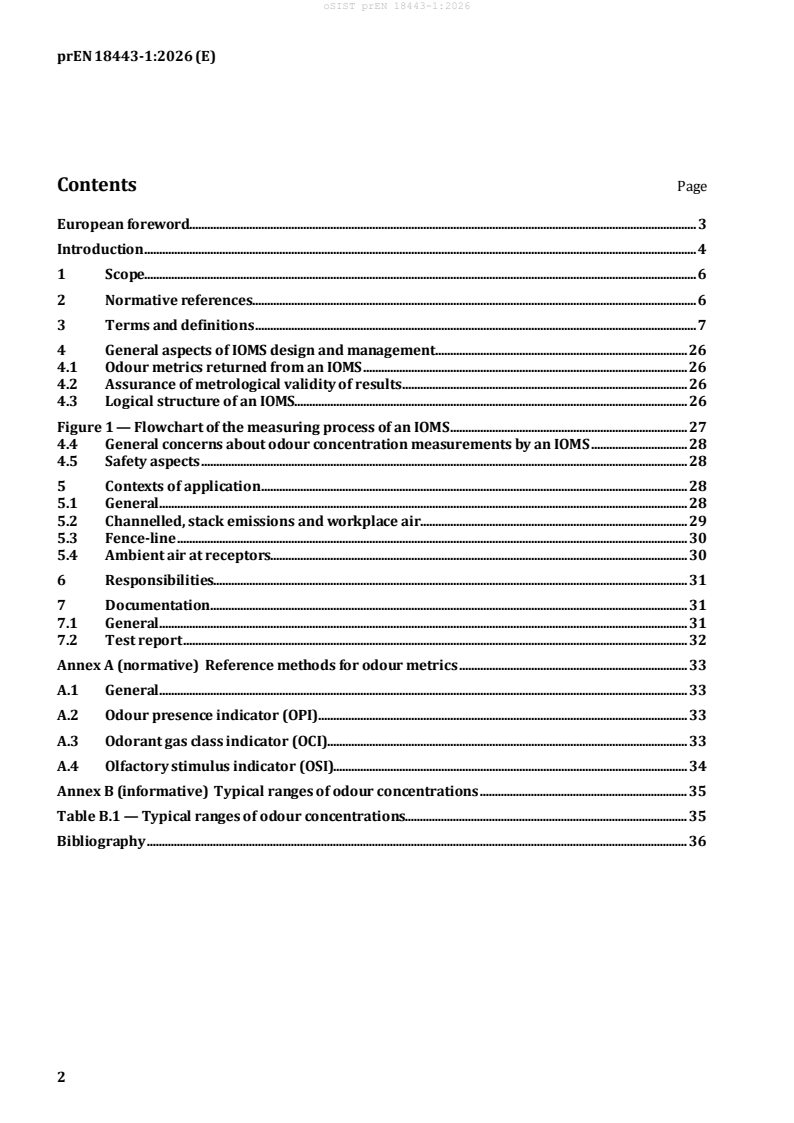
Contents Page
European foreword. 3
Introduction . 4
1 Scope. 6
2 Normative references. 6
3 Terms and definitions . 7
4 General aspects of IOMS design and management . 26
4.1 Odour metrics returned from an IOMS . 26
4.2 Assurance of metrological validity of results . 26
4.3 Logical structure of an IOMS. 26
Figure 1 — Flowchart of the measuring process of an IOMS . 27
4.4 General concerns about odour concentration measurements by an IOMS . 28
4.5 Safety aspects . 28
5 Contexts of application . 28
5.1 General . 28
5.2 Channelled, stack emissions and workplace air. 29
5.3 Fence-line . 30
5.4 Ambient air at receptors. 30
6 Responsibilities. 31
7 Documentation . 31
7.1 General . 31
7.2 Test report . 32
Annex A (normative) Reference methods for odour metrics . 33
A.1 General . 33
A.2 Odour presence indicator (OPI) . 33
A.3 Odorant gas class indicator (OCI). 33
A.4 Olfactory stimulus indicator (OSI). 34
Annex B (informative) Typical ranges of odour concentrations . 35
Table B.1 — Typical ranges of odour concentrations. 35
Bibliography . 36
European foreword
This document (prEN 18443-1:2026) has been prepared by Technical Committee CEN/TC 264 “Air
Quality”, the secretariat of which is held by DIN.
This document is currently submitted to the CEN Enquiry.
Introduction
This series of documents specifies requirements for instrumental odour monitoring systems for the
monitoring of odour in ambient air and in emissions to ambient air.
This series of documents is intended to assess the suitability of Instrumental Odour Monitoring System
(IOMS) to generate relevant indicators for the presence and attributes of odour as would be perceived
by human observers. A benefit of instrumental odour monitoring systems is that they can be used for
continuous measurement.
Instruments are limited in their ability to mimic human olfaction and its very specific sensitivity to
hundreds of odorants. Some odorants influence human odour perception even at very low
concentrations. The relation between the concentrations of odorants in a gas mixture and the resulting
human perception is highly complex and is never completely known. Instruments currently give results
limited to a reduced number of substances and are not able to replicate exactly that relation. In most
applications, many compounds (e.g. non odorous compounds or background odorants) act as
interferents for IOMS. Humidity and temperature are common influence quantities, too.
Key topics in this series of document are the qualification of metrological performance of IOMS and the
validation of correlation of the measurement result (odour metric which is output of IOMS) with human
odour perception.
The qualification of metrological performance of IOMS and the validation of the outputted odour metric
have significant peculiarities with respect to other automated measuring instruments:
— since odour presence indicator and odorant gas class indicator are categorical indicators, the
performance characteristics specified in available standards about automated measuring
instruments are not suitable.
— reference methods to validate the odour metric outputted by IOMS are based on human panels
and therefore have measurement uncertainties which are not generally negligible in the
elaboration of measurement results to obtain performance characteristics.
This series of documents does not apply to:
a) determination of the odour concentration in ou /m , for which the reference method is specified in
E
EN 13725. This document is not aimed at demonstrating equivalence between the determination of
olfactory stimulus quantity using an IOMS and the method described in EN 13725 and letting an
IOMS to implement an alternative method to EN 13725
b) monitoring of hedonic tone (or pleasantness or unpleasantness)
c) monitoring of odour annoyance
d) technical design of the odour monitoring system
e) health and safety air monitoring.
This series of documents comprises three parts:
— Instrumental Odour Monitoring Systems (IOMS) - Part 1: Definitions and general aspects
— Instrumental Odour Monitoring Systems (IOMS) - Part 2: Technical specifications and QA/QC
requirements
— Instrumental Odour Monitoring Systems (IOMS) - Part 3: Field validation
This document is part 1 of a series of documents which specifies requirements for instrumental odour
monitoring systems.
1 Scope
This document specifies:
— definitions of specific terms used in this series of documents
— general aspects of IOMS design and management
— contexts of application where the use of IOMS is examined in this series of documents
— minimal documentation for the management of an IOMS
This document covers definitions and general aspects relating to instrumental odour monitoring in:
1) ambient air
2) ambient air at the fence line of the source installation
3) odorous gas emissions, including waste gases upstream of odorant abatement devices.
This document does not apply to definitions and general aspects relating to:
a) determination of the odour concentration in ou /m , for which the reference method is specified in
E
EN 13725. This document is not aimed at demonstrating equivalence between the determination of
olfactory stimulus quantity using an IOMS and the method described in EN 13725 and letting an
IOMS to implement an alternative method to EN 13725
b) monitoring of hedonic tone (or pleasantness or unpleasantness)
c) monitoring of odour annoyance
d) health and safety air monitoring.
2 Normative references
The following documents are referred to in the text in such a way that some or all of their content
constitutes requirements of this document. For dated references, only the edition cited applies. For
undated references, the latest edition of the referenced document (including any amendments) applies.
EN 13725, Stationary source emissions - Determination of odour concentration by dynamic olfactometry
and odour emission rate
EN 16841-1, Ambient air - Determination of odour in ambient air by using field inspection - Part 1: Grid
method
EN 16841-2, Ambient air - Determination of odour in ambient air by using field inspection - Part 2: Plume
method
3 Terms and definitions
For the purposes of this document, the following terms and definitions apply.
ISO and IEC maintain terminology databases for use in standardization at the following addresses:
— ISO Online browsing platform: available at https://www.iso.org/obp/
— IEC Electropedia: available at https://www.electropedia.org/
3.1
accuracy index
AI
metrological characteristic of a measuring system producing a binary indicator, expressed as the
percentage of true results to the total (true and false) results
3.2
ambient air
outdoor air in the troposphere, excluding workplaces and places to which people do not have regular
access
[SOURCE: Directive 2008/50/EC, article 2, definition 1, modified]
3.3
assessor
somebody who participates in odour testing
[SOURCE: EN 13725:2022, 3.1.2]
3.4
background matrix
interferents that do not originate from the source of the odour under study
Note 1 to entry: In the validation process, the background matrix is a set (usually not completely known) of
interferents
3.5
binary indicator
categorical indicator on a measurement scale consisting of two categories
Note 1 to entry: No/yes, zero/one, negative/positive, fail/pass, odour absence/odour presence are examples of
couples of binary indicator values.
3.6
calibration function
calibration model
mathematical function which expresses, under specific conditions and for the odour under study, the
relation of the raw measurement data streams to the odour metric
Note 1 to entry: In this document the calibration function is a concept; the actual formulation of the function is
not of interest here.
Note 2 to entry: The calibration function is investigated and established through IOMS training.
Note 3 to entry: In the processing system, the calibration function is implemented through algorithms which
process the raw measurement data stream and generate the odour metric.
Note 4 to entry: The term calibration is used in the broad sense foreseen in the International Vocabulary of
Metrology, 2012, Clause 2.39, namely: “operation that, under specified conditions, in a first step, establishes a
relation between the quantity values with measurement uncertainties provided by measurement standards and
corresponding indications with associated measurement uncertainties and, in a second step, uses this information
to establish a relation for obtaining a measurement result from an indication”. In this definition: the values
“provided by measurement samples” are the indicator values obtained by the reference method; the
“corresponding indications” are the IOMS outputs when examining odorant gases for which the indicator value is
obtained by the reference method; “obtaining a measurement result from an indication” is obtaining the odour
metric for an odorant gas by processing the raw measurement data stream.
3.7
categorical result
result expressed in a measurement scale consisting of a set of categories
Note 1 to entry: In this document the categories are named classes.
3.8
categorical indicator
indicator on a measurement scale consisting of a set of categories
Note 1 to entry: In this document the categories are named classes.
3.9
categorical measurement
measurement where the result is a categorical indicator
Note 1 to entry: The determination of the odour presence indicator and the determination of the odorant gas
class are categorical measurements.
3.10
certified reference material
CRM
reference material, accompanied by documentation issued by an authoritative body and providing one
or more specified property values with associated uncertainties and traceability, using valid procedures
[SOURCE: ISO/IEC Guide 99:2007, 5.14]
3.11
channelled emission
odour emission through a stable structure aimed to convey the gas (through any kind of duct, pipe,
stack, etc.) to a fixed point where it is released into the atmosphere
EXAMPLES
— stacks
— vents
— open-top biofilters
3.12
chemical substance
substance
matter of constant composition best characterized by the entities (molecules, formula units, atoms) it is
composed of
Note 1 to entry: Physical properties such as density, refractive index, electric conductivity, melting point etc.
characterize the chemical substance
[SOURCE: IUPAC Compendium of Chemical Terminology, 2nd ed., modified]
3.13
class
category
attribute based on a property or combinations of properties of a set of items that allows them to be
differentiated from others
3.14
classification
method of sorting into categories
[SOURCE: ISO 5492:2008, 4.5]
3.15
competent authority
organisation which regulates and/or inspects the plant in order that the environmental impact of its
odour emissions is acceptable
3.16
confidence interval
CI
range within which a value or parameter can be expected to lie with a specified level of confidence
3.17xx
confusion matrix
table used to describe the performance of classification on a set of test data for which the true and false
values are known
3.18
context of application
outline defining the use for which the IOMS (including its training) is designed
Note 1 to entry: It typically includes: the kind of odour under study (e.g. odour emissions from a certain
wastewater treatment plant), the monitoring task (i.e. odour presence, odour classification, olfactory stimulus
quantity), the specific complexity of the background matrix, the typical environmental conditions and influence
quantities, the location where the IOMS is placed (e.g. in emission, at receptor level, at fence line).
3.19
conventional quantity value
quantity value attributed by agreement to a quantity for a given purpose
[SOURCE: ISO/IEC Guide 99:2007, 2.12]
3.20
core-class
odorant gas class denoting the odour under study
Note 1 to entry: The odour under study can be denoted by more than one odorant gas class.
3.21
data acquisition and handling system
DAHS
system, which automatically receives, processes, stores and outputs data from automated measuring
systems
[SOURCE: EN 17255-1:2019, 3.1]
3.22
dataset
structured collection of data in the processing system, generally comprising raw measurement data,
metadata (e.g. extracted features), conditions during measurements, external data
3.23
detection threshold
dilution factor at which the odorant gas has a probability of 0,5 of being
detected
[SOURCE: EN 13725:2022, 3.1.5, modified]
3.24
diagnostic data
data made available to users by the IOMS which are appropriate or aimed to monitor the performance
characteristics and the regular operation of the IOMS
Note 1 to entry: Diagnostic data can be constituted by digital streams (e.g. when they are raw measurement data
streams or are produced by processing those ones) or ensembles of single values (e.g. when a QA/QC verification
is manually performed using refence materials).
Note 2 to entry: Diagnostic data may include information about non-measuring elements (e.g. pumps, valves,
heaters) and information from basic processing of raw measurement data (e.g. averaging, baseline correction,
humidity compensation).
Note 3 to entry: Diagnostic data are not an output of the processing system; they do not depend on training.
3.25
diagnostic data stream
digital stream of diagnostic data produced by IOMS
3.26
diffuse emission
non-channelled odour emission
EXAMPLES
— open-top tanks or basins
— waste landfills
— any odorant matter stored or processed in open air
3.27
dilution factor
ratio between the flow rate or volume after dilution and the flow rate or volume of the odorous gas
[SOURCE: EN 13725:2022, 3.1.6]
3.28
drift
continuous or incremental change over time in indication, due to changes in metrological properties of
a measuring instrument
Note 1 to entry: In the context of this document, the term may apply to diagnostic data streams or odour metrics.
Note 2 to entry: The drift phenomenon can depend on the characteristics of the measured gas; it can be
accelerated, even unexpectedly, if any contaminating substance is present in the gas or in certain operating
conditions.
Note 3 to entry: Drift leads to a more or less rapid worsening of metrological performance.
[SOURCE: ISO/IEC Guide 99:2007, 4.21; the term in the source is “instrumental drift”; notes added]
3.29
drift compensation
strategy adopted in the IOMS so that, even in the presence of a certain drift phenomenon, the odour
metric remains valid, i.e. it maintains the expected metrological performance
Note 1 to entry: A drift compensation strategy is generally applied no later than a certain degree of advancement
of the drift phenomenon, beyond which an intervention is necessary (e.g. replacement of the sensor).
Note 2 to entry: Drift compensation primarily operates to stabilize the odour final output (i.e. the odour metric).
Nonetheless, a drift compensation sometimes operates on diagnostic data stream as well, for QA/QC verification
purposes.
3.30
emission under examination
odour emission which releases the substances which are monitored so that its capacity for causing
odour annoyance is under control
3.31
European Reference Odour Mass
EROM
conventional quantity value for the European odour unit, equal to a defined mass of reference odorant
Note 1 to entry: The primary reference odorant is n-butanol (CAS-Nr. 71–36–3). The conventional quantity value
of neutral gas this produces a concentration of
for 1 EROM is 123 µg n-butanol. Evaporated in 1 m
0,040 µmol/mol
[SOURCE: EN 13725:2022, 3.1.13]
3.32
European Odour unit
amount of odorant(s) that, when evaporated into one cubic metre of neutral gas at standard conditions,
elicits a physiological response from a panel (detection threshold) equivalent to that elicited by one
European Reference Odour Mass (EROM), evaporated in one cubic metre of neutral gas at standard
conditions
[SOURCE: EN 13725:2022, 3.1.12]
3.33
expected value
value approached by the average value with an increasing number of measurement values
[SOURCE: GUM:2008]
3.34
external data
data provided by instruments or services being outside the IOMS, which are input of the processing
system
EXAMPLES
— weather data
— (in)activity of certain odour emissions
3.35
false negative
FN
binary indicator value which, being negative, is not consistent with the reference value
Note 1 to entry: The terms 'false negative' and 'true negative' apply only for binary indicators (e.g. OPI); they are
meaningless for non-binary categorical indicators (e.g. OCI).
3.36
false positive
FP
binary indicator value which, being positive, is not consistent with the reference value
3.37
false result
categorical indicator value which is not consistent with the reference value
3.38
feature
characteristics derived from raw measurement data, often through signal processing or statistical
analysis (e.g. multivariate analysis)
3.39
feature extraction
procedure in which high dimensionality data is transformed into informative and non-redundant
features
3.40
field inspection
measuring odours in ambient air using panel members
[SOURCE: EN 16841-1:2016, 3.4]
3.41
field validation
provision of objective evidence that, in the intended context of application (i.e. in the field) and in
unattended operation, the odour metric produced by the IOMS, compared to reference values, fulfils
specified metrological requirements
3.42
fugitive emissions
emission to the atmosphere caused by leakage of an item which is designed to be sealed
EXAMPLES
— valve and flange leakage
— passive ventilation apertures, leakage through building cladding.
[SOURCE: EN 15446:2008, 3.1; loss of tightness replaced by leakage, tight replaced by sealed; note
added]
3.43
gas mixture
mixture of substances, consisting of at least two different chemical elements or chemical compounds
(components or constituents) which under the relevant conditions are present in a gaseous state
Note 1 to entry: One or several constituents can also be present as a vapour.
[SOURCE: VDI/VDE 3518 Blatt 1, 2, modified by deleting 'A']
3.44
global accuracy index
AI
g
metrological characteristic of a measuring system producing a categorical indicator, expressed as the
percentage of true results (summed over all categories or classes) to the total (true and false) results
(summed over all categories or classes)
3.45
good laboratory practices
GLP
set of rules and criteria for a quality system concerned with the organisational process and the
conditions under which scientific and technical activities are planned, performed, monitored, recorded,
reported and archived
3.46
indicator
measure that provides an estimate or evaluation of specified attributes derived from a model with
respect to defined information needs
[SOURCE: ISO/IEC/IEEE 15939:2017, 3.10]
3.47
indicator value
numerical or categorical result assigned to an indicator
[SOURCE: ISO/IEC/IEEE 15939:2017, 3.11]
3.48
influence quantity
quantity that is not the measurand but that affects the result of measurement (VIM:1993, 2.7), either an
interferent influence quantity (i.e. the concentration of a substance in the air under investigation that is
not the measurand), or an external influence quantity (i.e. a quantity that is not the measurand nor the
concentration of a substance in the air mass under investigation)
EXAMPLES
— presence of background matrix (interferent influence quantity)
— temperature of the surrounding air (external influence quantity)
— atmospheric pressure (external influence quantity)
— pressure of the gas sample (external influence quantity).
[SOURCE: ISO 9169:2006, 2.1.13]
3.49
installation
plant
stationary technical unit within which one or more activities generating odour emissions are carried
out
3.50
instrumental odour monitoring system
IOMS
DEPRECATED: electronic nose
DEPRECATED: e-nose
automated monitoring system providing odour metrics
3.51
instrumental response time
step response time
duration between the instant when an input quantity value of a measuring instrument or measuring
system is subjected to an abrupt change between two specified constant quantity values and the instant
when a corresponding indication settles within specified limits around its final steady value
[SOURCE: ISO/IEC Guide 99:2007, 4.23]
3.52
interferent
interfering substance
substance present in the air mass under investigation, other than the measurand, that affects the
response
[SOURCE: ISO 9169:2006, 2.1.12]
3.53
limit of detection
detection limit
LoD
measured quantity value, obtained by a given measurement procedure, for which the probability of
falsely claiming the absence of a component in a material is β, given a probability α of falsely claiming
its presence
Note 1 to entry: IUPAC recommends default values for α and β equal to 0,05. The abbreviation LoD is sometimes
used. The term “sensitivity” is discouraged for ‘detection limit’.
[SOURCE: JCGM 200, 4.18]
3.54
manufacturer
organisation with responsibility for the design, manufacture, qualification and documentation of an
IOMS before it is placed on the market under his own name, regardless of whether these operations are
carried out by that organisation itself or on its behalf by a third party
3.55
measurement
process of experimentally obtaining one or more quantity values that can reasonably be attributed to a
quantity
[SOURCE: ISO/IEC Guide 99:2007, 2.1]
3.56
measurement accuracy
closeness of agreement between a measured quantity value and a true quantity value of a measurand
[SOURCE: ISO/IEC Guide 99:2007, 2.13]
3.57
measurement bias
estimate of a systematic measurement error
[SOURCE: ISO/IEC Guide 99:2007, 2.18]
3.58
measurement precision
closeness of agreement between indications or measured quantity values obtained by replicate
measurements on the same or similar objects under specified conditions
[SOURCE: ISO/IEC Guide 99:2007, 2.15]
3.59
measurement result
set of quantity values being attributed to a measurand together with any other available relevant
information
[SOURCE: ISO/IEC Guide 99:2007, 2.9]
3.60
measurement task
kind of measurement producing the odour metric which the IOMS is trained for
Note 1 to entry: Measurement task is one of the following: producing odour presence indicators, producing
odorant gas class indicators, producing olfactory stimulus indicators.
3.61
metrological traceability
property of a measurement result whereby the result can be related to a reference through a
documented unbroken chain of calibrations, each contributing to the measurement uncertainty
[SOURCE: ISO/IEC Guide 99:2007, 2.41]
3.62
monitoring service provider
organisation with responsibility for the design and implementation of the monitoring service, including
the training of the IOMS and the validation process
3.63
monitoring system
system which executes repeated measurement to follow a measurand over time
3.64
neutral sample
substance or mixture of substances resembling, as closely as possible, the background matrix of the
actual air sample to be measured, but characterized as being odourless
Note 1 to entry: The parameter(s) to be controlled so that a gas be considered a zero sample depends on the
context of application, e.g.: the odour concentration, the analytical concentrations of identified odorants beneath a
certain threshold, the undetectability, by sensory testing, of the odour under study.
[SOURCE: ISO 6879:1995, 5.1.13, modified — the concept of “air quality characteristic” has been
contextualized]
3.65
odorant
chemical substance which, when volatilised in neutral gas, has the potential to stimulate the human
olfactory system so that an odour is perceived
[SOURCE: EN 13725:2022, 3.1.25, modified by adding “chemical”]
3.66
odorant gas
air that contains one or more odorants
[SOURCE: EN 13725:2022, 3.1.26; modified replacing “gas” with “air” and removing the note]
3.67
odorant gas class
odour class
attribute based on a property or combinations of properties of the odorous gas that allows it to be
differentiated (qualitatively) from another odorous gas in classification by human assessors
Note 1 to entry: Odorant gas class can be assigned by human assessors if the olfactory stimulus quantity is
greater than recognition threshold.
Note 2 to entry: Odorant gas class can refer to the gas released by a certain odorant gas source or by a certain
ensemble of sources or by a source in a certain odorant gas emitting process condition.
Note 3 to entry: Implementing this document in the various applications, it is irrelevant if the odorant classes are
named by representative labels (e.g. “stored manure”, “biofilter”, “sedimentation tank”) or by capital letters (“class
A”, “class B”) or by cardinal numbers, etc.
Note 4 to entry: For the aims of this document, the identification of the most relevant and characteristic odorants
of each odour class (the “tracers”) is not required.
3.68
odorant gas class indicator
OCI
categorical indicator for the odorant gas class
Note 1 to entry: OCI assumes a value from 1 to N+1, where N is the number of odorant gas classes (N > = 2), since
OCI = 1 conventionally addresses the class “no odour”/”odour absence”.
3.69
odorant gas classification
attribution of odorant gas samples to odorant gas classes
3.70
odorant matter
matter from which one or more odorants can volatilize
3.71
odorous gas
odorant gas having an odour concentration greater than 1 ou /m
E
[SOURCE: EN 13725:2022, 3.1.27]
3.72
odour
sensation perceived by means of the olfactory organ in sniffing certain airborne substances
[SOURCE: EN ISO 5492:2008, 3.18, modified replacing 'volatile' with 'airborne']
3.73
odour concentration
number of European odour units in a cubic metre of gas at standard conditions for olfactometry
Note 1 to entry: The odour concentration is not a linear measure for the intensity of an odour. Steven’s Law
describes the linear relation between odour stimulus and its perceived intensity. When using odour
concentrations in dispersion modelling, the issue is complicated by the effects of the averaging time of the
dispersion model, further complicating the use of the odour concentration as a direct measure for dose. To define
a ‘no nuisance level’, the entire method of dosage evaluation, including the dispersion model, will yield a ‘dose’.
The relation between this ‘dose’ and its effect (odour annoyance) should be validated in practical situations to be a
useful predictive tool for occurrence of odour nuisance.
[SOURCE: EN 13725:2022, 3.1.30, note added]
3.74
odour detection
awareness of the sensation resulting from adequate stimulation of the olfactory system
[SOURCE: EN 13725:2022, 3.1.31]
3.75
odour emission
discharge of odorant gas into the atmosphere
3.76
odour metric
one among the indicators described in this document: odour presence indicator, odorant gas class
indicator, olfactory stimulus indicator
3.77
odour metric stream
digital stream of indicator(s) produced by the processing system
3.78
odour observation
assessment of the presence or absence of recognizable odour in ambient air by a human assessor
Note 1 to entry: A positive observation is given when a recognizable odour is detected.
[SOURCE: EN 16841-1:2016, modified]
3.79
odour panel
panel
group of panel members
[SOURCE: EN 13725:2019, 3.1.34]
3.80
odour presence
potential of an odorant gas sample to produce in a panel both an odour detection and an exact odorant
gas classification, where the attributed odorant gas class is one of the core-classes
Note 1 to entry: The background matrix and the (above-threshold) quantity of olfactory stimulus affect the ease
of correctly assessing the odour presence.
Note 2 to entry: The threshold between odour absence and odour presence is generally at an odour concentration
3 3
greater than 1 ouE/m , but not lower than 1 ouE/m .
3.81
odour presence indicator
OPI
binary indicator assuming value one if the odorant gas sample has odour presence, otherwise assuming
value zero
Note 1 to entry: accuracy of OPI depends on the olfactory stimulus quantity of odorant gas sample. The associated
uncertainty of OPI = 1 values decreases while olfactory stimulus quantity increases from one to infinity in the
olfactory stimulus reference scale; the associated uncertainty of OPI = 0 values decreases while olfactory stimulus
quantity decreases from one to zero in the scale.
Note 2 to entry: Dealing with the OPI, “negative” corresponds to OPI = 0; “positive” corresponds to OPI = 1.
3.82
odour under study
odour which is elicited by the odorants released by the emission under examination and for which the
odour metric produced by the IOMS (including its training) is designed
Note 1 to entry: Even when the term 'odour under study' in this document is used is singular form, it can refer to
multiple odours (or odorant gas classes), emitted by more than one source, belonging to more than one plant or
installation.
Note 2 to entry: In the context of this document, the emission which releases the odorants eliciting the odour
under study is examined because of its potential ability to cause nuisance in the population.
3.83
olfactory
pertaining to the sense of smell
[SOURCE: ISO 5492:2008, 2.14]
3.84
olfactory stimulus
that which can excite an olfactory receptor
[SOURCE: EN 13725:2022, 3.1.40]
3.85
olfactory stimulus indicator
OSI
indicator for the olfactory stimulus quantity
Note 1 to entry: An IOMS can provide olfactory stimulus indicators on a discrete scale (e.g. no-
odour/low/medium/high or green/yellow/red or a scale from 1 to 10) or on a continuous scale.
3.86
olfactory stimulus quantity
quantity of olfactory stimulus in the sample gas positioned on the olfactory stimulus reference scale
3.87
olfactory stimulus reference scale
continuous scale of positive numbers where the value 1 corresponds to an olfactory stimulus of 1 EROM
of an odorant or defined molar mixture of odorants evaporated in 1 m of air under standard conditions
for odour measurement
Note 1 to entry: This scale has a linear relationship with the odour concentration C as defined in EN 13725.
od
3.88
operator
organisation who operates or controls in whole or in part the installation or plant which has the odour
emission generating the odour under study
3.89
panel threshold
odour threshold
odour detection threshold applying to a panel
[SOURCE: EN 13725:2019, 3.1.46]
3.90
performance characteristic
one of the quantities assigned to a measuring system in order to define its metrological performance
Note 1 to entry: Performance characteristic can influence measurement results
3.91
performance claim
specification of performance characteristics as documented in the information supplied to the user by
product/service provider
Note 1 to entry: Examples of relevant performance characteristics of an IOMS are the following: accuracy indexes,
confidence intervals, sensitivity, specificity, limits of agreement.
Note 2 to entry: Depending on the context, performance claims apply in laboratory conditions or in field
conditions. Verification of performance claims is planned accordingly.
3.92
preloaded calibration function
calibration function only valid for a specific reference odorant gas and for a specific IOMS, used only for
QA/QC
Note 1 to entry: Typically the preloaded calibration function is established by the manufacturer in the factory. It
is saved in the IOMS and is temporary activated for QA/QC.
3.93
processing system
ensemble of algorithms, computer code, datasets (e.g.: training / calibration dataset) through which the
IOMS manages and processes the raw measurement data streams to produce the odour metric
Note 1 to entry: The processing system is set up or optimized through training.
Note 2 to entry: The processing system can partially reside remotely. The part of the system that resides remotely
can be shared between more than one IOMS. For the purposes of this document, the processing system includes
any remotely residing part.
Note 3 to entry: The processing system is part of the data acquisition and handling system (DAHS).
3.94
QA/QC protocol
protocol aimed to early detect instrumental anomalies, drifts, failures that could affect the reliability of
the results, by examining diagnostic data with respect to defined criteria
3.95
qualification
process of obtaining and documenting metrological characteristics of an IOMS in laboratory conditions,
according to specified procedures
Note 1 to entry: Qualification is neither a verification, nor a validation, nor a calibration.
3.96
quality assurance
QA
part of quality management focused on providing confidence that quality requirements will be fulfilled
[SOURCE: ISO 9000:2015, 3.3.6]
3.97
quality control
QC
part of quality management focused on fulfilling quality requirements
[SOURCE: ISO 9000:2015, 3.3.7]
3.98
rated operating condition
operating condition required during measurement to ensure that IOMS performs as designed
Note 1 to entry: Rated operating conditions generally specify intervals of values for the odour metric and for any
odour metric indicator influence quantity.
Note 2 to entry: Rated operating conditions are determined by the extent of the operating conditions considered
in the training and by the technologies adopted in the IOMS.
[SOURCE: ISO/IEC GUIDE 99:2007(E/F), Clause 4.9, modified by specifying IOMS and odour metric and
adding note 2]
3.99
raw measurement data stream
digital stream produced by the sensory/analytical system which are elaborated by the processing
system to produce the odour metric(s)
Note 1 to entry: Depending on the techniques adopted in the sensory/analytical system, raw measurement data
streams can be, for example, sensor signals or streams of spectra.
Note 2 to entry: raw measurement data streams could be not accessible to the user; however, raw measurement
data streams can be presented in addition to the odour metric, e.g. in order to help the interpretation of results.
3.100
recall index
RI
metrological characteristic of a measuring system producing a categorical indicator, expressed, for each
class, as the percentage of true results, for that class, to the sum of true and false results, for that class
3.101
reference material
material, sufficiently homogeneous and stable with reference to specified properties, which has been
established to be fit for its intended use in measurement or in examination of nominal properties
[SOURCE: ISO/IEC Guide 99:2007, 5.13]
3.102
reference neutral gas
odourless synthetic air with a defined presence of interferents (e.g. humidity)
3.103
reference odorant gas
odorant gas serving as a reference material for QA/QC, where the established reference quantity value
is an odour metric
3.104
reference quantity value
quantity value used as a basis for comparison with values of quantities of the same kind
[SOURCE: ISO/IEC Guide 99:2007, 5.18]
3.105
reference value
reference quantity value assigned to the odour metric by means of the reference measurement method
or by means of the procedure used to prepare the gas
3.106
sampling
process consisting of the withdrawal or isolation of a fractional part of a l
...