

SIST ISO 4149:2026
(Main)Green coffee — Olfactory and visual examination and determination of foreign matter and defects (ISO 4149:2026
- Abstract
This document specifies methods for the olfactory and visual examination and determination of foreign matter and defects in green coffee from all origins. These methods can also be used for determining one or more of the characteristics of green coffee with an impact on coffee quality for technical, commercial, administrative and arbitration purposes, and for quality control or quality inspection.
This document is applicable to green coffee as defined in ISO 3509.
- Status
- Published
- Publication Date
- 05-Oct-2026
- Technical Committee
- KŽP - Agricultural food products
- Current Stage
- 6060 - National Implementation/Publication (Adopted Project)
- Start Date
- 06-Oct-2026
- Due Date
- 11-Dec-2026
- Completion Date
- 06-Oct-2026

Relations
- Effective Date
- 01-Nov-2026
Get Certified
Connect with accredited certification bodies for this standard

BSI Group
BSI (British Standards Institution) is the business standards company that helps organizations make excellence a habit.

Bureau Veritas
Bureau Veritas is a world leader in laboratory testing, inspection and certification services.

DNV
DNV is an independent assurance and risk management provider.
Sponsored listings
Frequently Asked Questions
SIST ISO 4149:2026 is a standard published by the Slovenian Institute for Standardization (SIST). Its full title is "Green coffee — Olfactory and visual examination and determination of foreign matter and defects (ISO 4149:2026". This standard covers: This document specifies methods for the olfactory and visual examination and determination of foreign matter and defects in green coffee from all origins. These methods can also be used for determining one or more of the characteristics of green coffee with an impact on coffee quality for technical, commercial, administrative and arbitration purposes, and for quality control or quality inspection. This document is applicable to green coffee as defined in ISO 3509.
This document specifies methods for the olfactory and visual examination and determination of foreign matter and defects in green coffee from all origins. These methods can also be used for determining one or more of the characteristics of green coffee with an impact on coffee quality for technical, commercial, administrative and arbitration purposes, and for quality control or quality inspection. This document is applicable to green coffee as defined in ISO 3509.
SIST ISO 4149:2026 is classified under the following ICS (International Classification for Standards) categories: 67.140.20 - Coffee and coffee substitutes. The ICS classification helps identify the subject area and facilitates finding related standards.
SIST ISO 4149:2026 has the following relationships with other standards: It is inter standard links to SIST ISO 4149:2011. Understanding these relationships helps ensure you are using the most current and applicable version of the standard.
SIST ISO 4149:2026 is available in PDF format for immediate download after purchase. The document can be added to your cart and obtained through the secure checkout process. Digital delivery ensures instant access to the complete standard document.
Standards Content (Sample)
SLOVENSKI STANDARD
01-november-2026
Nadomešča:
SIST ISO 4149:2011
Surova kava - Ugotavljanje vonja in videza ter določanje tujih primesi in napak
(ISO 4149:2025)
Green coffee — Olfactory and visual examination and determination of foreign matter
and defects (ISO 4149:2026
Café vert — Examens olfactif et visuel, et détermination des matières étrangères et des
défauts (ISO 4149:2025)
Ta slovenski standard je istoveten z: ISO 4149:2025
ICS:
67.140.20 Kava in kavni nadomestki Coffee and coffee substitutes
2003-01.Slovenski inštitut za standardizacijo. Razmnoževanje celote ali delov tega standarda ni dovoljeno.
International
Standard
ISO 4149
Third edition
Green coffee — Olfactory and visual
2025-11
examination and determination of
foreign matter and defects
Café vert — Examens olfactif et visuel, et détermination des
matières étrangères et des défauts
Reference number
© ISO 2025
All rights reserved. Unless otherwise specified, or required in the context of its implementation, no part of this publication may
be reproduced or utilized otherwise in any form or by any means, electronic or mechanical, including photocopying, or posting on
the internet or an intranet, without prior written permission. Permission can be requested from either ISO at the address below
or ISO’s member body in the country of the requester.
ISO copyright office
CP 401 • Ch. de Blandonnet 8
CH-1214 Vernier, Geneva
Phone: +41 22 749 01 11
Email: copyright@iso.org
Website: www.iso.org
Published in Switzerland
ii
Contents Page
Foreword .iv
1 Scope . 1
2 Normative references . 1
3 Terms and definitions . 1
4 Sampling . 1
5 Olfactory examination . 1
5.1 Procedure .1
5.2 Evaluation .2
6 Visual examination. 2
6.1 Procedure .2
6.2 Evaluation .2
7 Determination of foreign matter and defects . 3
7.1 Principle .3
7.2 Apparatus .3
7.3 Procedure .3
7.4 Expression of results . .3
8 Test report . 4
Annex A (informative) Example of a typical determination with the weighing method . 5
Bibliography . 6
iii
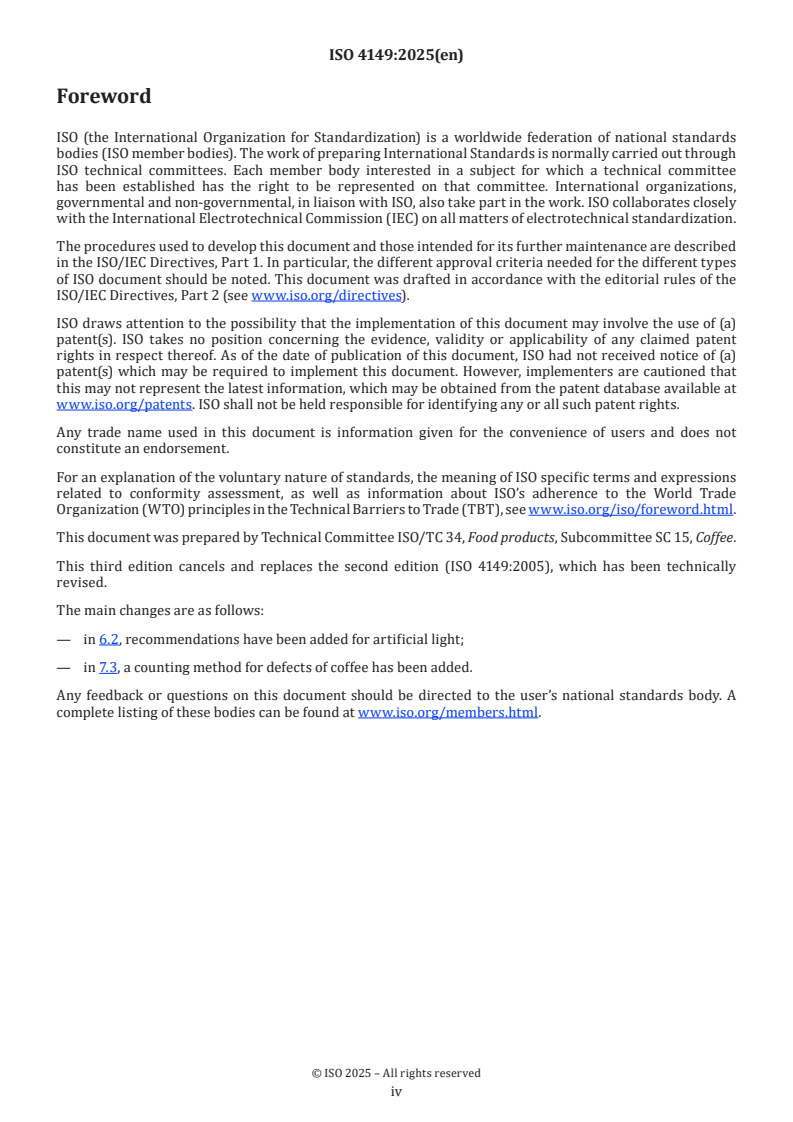
Foreword
ISO (the International Organization for Standardization) is a worldwide federation of national standards
bodies (ISO member bodies). The work of preparing International Standards is normally carried out through
ISO technical committees. Each member body interested in a subject for which a technical committee
has been established has the right to be represented on that committee. International organizations,
governmental and non-governmental, in liaison with ISO, also take part in the work. ISO collaborates closely
with the International Electrotechnical Commission (IEC) on all matters of electrotechnical standardization.
The procedures used to develop this document and those intended for its further maintenance are described
in the ISO/IEC Directives, Part 1. In particular, the different approval criteria needed for the different types
of ISO document should be noted. This document was drafted in accordance with the editorial rules of the
ISO/IEC Directives, Part 2 (see www.iso.org/directives).
ISO draws attention to the possibility that the implementation of this document may involve the use of (a)
patent(s). ISO takes no position concerning the evidence, validity or applicability of any claimed patent
rights in respect thereof. As of the date of publication of this document, ISO had not received notice of (a)
patent(s) which may be required to implement this document. However, implementers are cautioned that
this may not represent the latest information, which may be obtained from the patent database available at
www.iso.org/patents. ISO shall not be held responsible for identifying any or all such patent rights.
Any trade name used in this document is information given for the convenience of users and does not
constitute an endorsement.
For an explanation of the voluntary nature of standards, the meaning of ISO specific terms and expressions
related to conformity assessment, as well as information about ISO’s adherence to the World Trade
Organization (WTO) principles in the Technical Barriers to Trade (TBT), see www.iso.org/iso/foreword.html.
This document was prepared by Technical Committee ISO/TC 34, Food products, Subcommittee SC 15, Coffee.
This third edition cancels and replaces the second edition (ISO 4149:2005), which has been technically
revised.
The main changes are as follows:
— in 6.2, recommendations have been added for artificial light;
— in 7.3, a counting method for defects of coffee has been added.
Any feedback or questions on this document should be directed to the user’s national standards body. A
complete listing of these bodies can be found at www.iso.org/members.html.
iv
SIST ISO 4149:2
...
International
Standard
ISO 4149
Third edition
Green coffee — Olfactory and visual
2025-11
examination and determination of
foreign matter and defects
Café vert — Examens olfactif et visuel, et détermination des
matières étrangères et des défauts
Reference number
© ISO 2025
All rights reserved. Unless otherwise specified, or required in the context of its implementation, no part of this publication may
be reproduced or utilized otherwise in any form or by any means, electronic or mechanical, including photocopying, or posting on
the internet or an intranet, without prior written permission. Permission can be requested from either ISO at the address below
or ISO’s member body in the country of the requester.
ISO copyright office
CP 401 • Ch. de Blandonnet 8
CH-1214 Vernier, Geneva
Phone: +41 22 749 01 11
Email: copyright@iso.org
Website: www.iso.org
Published in Switzerland
ii
Contents Page
Foreword .iv
1 Scope . 1
2 Normative references . 1
3 Terms and definitions . 1
4 Sampling . 1
5 Olfactory examination . 1
5.1 Procedure .1
5.2 Evaluation .2
6 Visual examination. 2
6.1 Procedure .2
6.2 Evaluation .2
7 Determination of foreign matter and defects . 3
7.1 Principle .3
7.2 Apparatus .3
7.3 Procedure .3
7.4 Expression of results . .3
8 Test report . 4
Annex A (informative) Example of a typical determination with the weighing method . 5
Bibliography . 6
iii
Foreword
ISO (the International Organization for Standardization) is a worldwide federation of national standards
bodies (ISO member bodies). The work of preparing International Standards is normally carried out through
ISO technical committees. Each member body interested in a subject for which a technical committee
has been established has the right to be represented on that committee. International organizations,
governmental and non-governmental, in liaison with ISO, also take part in the work. ISO collaborates closely
with the International Electrotechnical Commission (IEC) on all matters of electrotechnical standardization.
The procedures used to develop this document and those intended for its further maintenance are described
in the ISO/IEC Directives, Part 1. In particular, the different approval criteria needed for the different types
of ISO document should be noted. This document was drafted in accordance with the editorial rules of the
ISO/IEC Directives, Part 2 (see www.iso.org/directives).
ISO draws attention to the possibility that the implementation of this document may involve the use of (a)
patent(s). ISO takes no position concerning the evidence, validity or applicability of any claimed patent
rights in respect thereof. As of the date of publication of this document, ISO had not received notice of (a)
patent(s) which may be required to implement this document. However, implementers are cautioned that
this may not represent the latest information, which may be obtained from the patent database available at
www.iso.org/patents. ISO shall not be held responsible for identifying any or all such patent rights.
Any trade name used in this document is information given for the convenience of users and does not
constitute an endorsement.
For an explanation of the voluntary nature of standards, the meaning of ISO specific terms and expressions
related to conformity assessment, as well as information about ISO’s adherence to the World Trade
Organization (WTO) principles in the Technical Barriers to Trade (TBT), see www.iso.org/iso/foreword.html.
This document was prepared by Technical Committee ISO/TC 34, Food products, Subcommittee SC 15, Coffee.
This third edition cancels and replaces the second edition (ISO 4149:2005), which has been technically
revised.
The main changes are as follows:
— in 6.2, recommendations have been added for artificial light;
— in 7.3, a counting method for defects of coffee has been added.
Any feedback or questions on this document should be directed to the user’s national standards body. A
complete listing of these bodies can be found at www.iso.org/members.html.
iv
International Standard ISO 4149:2025(en)
Green coffee — Olfactory and visual examination and
determination of foreign matter and defects
1 Scope
This document specifies methods for the olfactory and visual examination and determination of foreign
matter and defects in green coffee from all origins. These methods can also be used for determining one
or more of the characteristics of green coffee with an impact on coffee quality for technical, commercial,
ad
...