

SIST-TS CEN/TS 13387-3:2026
(Main)Child care articles - General safety guidelines - Part 3: Mechanical hazards
General Information
- Abstract
This document provides guidance information on mechanical hazards that are taken into consideration when developing safety standards for child care articles. In addition, these guidelines can assist those with a general professional interest in child safety.
This new edition of this document is a hazard based Technical Specification.
- Status
- Published
- Public Enquiry End Date
- 02-Aug-2025
- Publication Date
- 14-Dec-2025
- Technical Committee
- OTR - Child use and care article
- Current Stage
- 6060 - National Implementation/Publication (Adopted Project)
- Start Date
- 09-Dec-2025
- Due Date
- 13-Feb-2026
- Completion Date
- 15-Dec-2025

Overview
SIST-TS CEN/TS 13387-3:2026 addresses mechanical hazards in child care articles and provides vital guidance for developing safety standards. Published by SIST, this hazard-based technical specification is key for manufacturers, safety professionals, and standardization bodies concerned with mechanical risks associated with products for infants and young children. As Part 3 in the series "Child care articles - General safety guidelines," this document ensures child safety is central in design, production, and usage. The standard supersedes SIST-TP CEN/TR 13387-3:2023 and incorporates updated methodologies for assessing hazards.
Key Topics
This technical specification focuses on the following essential mechanical hazard topics:
- Accessibility of Mechanical Hazards: Guidance on how children of differing ages can access hazardous parts of products, using anthropometric data and simulated reach envelopes.
- Entrapment Hazards: Recommendations to prevent head, neck, and finger entrapment, including defining completely bound, partially bound, V-shaped, and irregular openings.
- Hazards from Moving Parts: Identification and separation of shearing and crushing hazards, with advice on reducing risk through design.
- Hazards with Foldable Products: Guidance related to locking mechanisms and the prevention of injuries due to unintentional release.
- Attachment and Closure Systems: Safety considerations for mechanisms used to attach or secure parts, emphasizing robust design and testing.
- Entanglement, Choking, and Suffocation Hazards: Highlighting risks associated with cords, small parts, and packaging materials and providing recommendations for safeguarding children.
- Hazardous Edges and Projections: Ensuring sharp points, rigid protrusions, or wires are not exposed or accessible.
- Structural Integrity and Stability: Advice on selection of materials, strength, durability, and the importance of stability under intended and foreseeable use.
- Protective Functions: Recommendations for barrier and restraint systems to prevent falls or unintentional access to hazardous areas.
Applications
The guidance in SIST-TS CEN/TS 13387-3:2026 is widely applicable to various stakeholders:
- Manufacturers of Child Care Articles: Ensures products such as cribs, high chairs, playpens, and strollers are designed to minimize mechanical hazards throughout their life cycle.
- Safety Assessors and Inspectors: Provides a reference for identifying and mitigating hazards during product evaluation, both in design studies and during in-market surveillance.
- Product Designers and Engineers: Offers anthropometric data and safety philosophies essential for integrating mechanical safety into the early product development phases.
- Regulatory and Standardization Bodies: Assists in drafting and updating national and international product safety standards through a hazard-based approach.
- Retailers and Distributors: Supports procurement decisions that prioritize child safety and regulatory compliance.
Using this standard supports legal conformity and increases consumer trust in child care articles by pro-actively addressing potential mechanical hazards.
Related Standards
SIST-TS CEN/TS 13387-3:2026 is part of a comprehensive suite of safety guidelines for child care articles under the CEN/TS 13387 series, including:
- Part 1: Safety philosophy and safety assessment
- Part 2: Chemical hazards
- Part 4: Thermal hazards
- Part 5: Product information
For holistic product safety, this document should be used in conjunction with CEN/TS 13387-1 and other parts, ensuring both mechanical and non-mechanical hazards are addressed. For terminology and definitions, reference is made to ISO and IEC standards, enhancing consistency across standards.
Keywords: Child care articles, mechanical hazards, child safety, entrapment, reach envelopes, hazard-based standard, structural integrity, product safety, safety assessment, SIST, CEN/TS 13387-3.
Relations
- Effective Date
- 01-Jan-2026
- Effective Date
- 10-Feb-2026
- Effective Date
- 28-Jan-2026
Frequently Asked Questions
SIST-TS CEN/TS 13387-3:2026 is a technical specification published by the Slovenian Institute for Standardization (SIST). Its full title is "Child care articles - General safety guidelines - Part 3: Mechanical hazards". This standard covers: This document provides guidance information on mechanical hazards that are taken into consideration when developing safety standards for child care articles. In addition, these guidelines can assist those with a general professional interest in child safety. This new edition of this document is a hazard based Technical Specification.
This document provides guidance information on mechanical hazards that are taken into consideration when developing safety standards for child care articles. In addition, these guidelines can assist those with a general professional interest in child safety. This new edition of this document is a hazard based Technical Specification.
SIST-TS CEN/TS 13387-3:2026 is classified under the following ICS (International Classification for Standards) categories: 97.190 - Equipment for children. The ICS classification helps identify the subject area and facilitates finding related standards.
SIST-TS CEN/TS 13387-3:2026 has the following relationships with other standards: It is inter standard links to SIST-TP CEN/TR 13387-3:2023, SIST-V CEN/CLC Guide 14:2009, SIST EN 13126-5:2012+A1:2015. Understanding these relationships helps ensure you are using the most current and applicable version of the standard.
SIST-TS CEN/TS 13387-3:2026 is available in PDF format for immediate download after purchase. The document can be added to your cart and obtained through the secure checkout process. Digital delivery ensures instant access to the complete standard document.
Standards Content (Sample)
SLOVENSKI STANDARD
01-januar-2026
Nadomešča:
SIST-TP CEN/TR 13387-3:2023
Izdelki za otroke - Smernice za splošno varnost - 3. del: Nevarnosti zaradi
mehanskih lastnosti
Child care articles - General safety guidelines - Part 3: Mechanical hazards
Artikel für Säuglinge und Kleinkinder - Sicherheitsleitfaden - Teil 3: Mechanische
Gefährdungen
Articles de puériculture - Conseils relatifs à la sécurité - Partie 3: Dangers mécaniques
Ta slovenski standard je istoveten z: CEN/TS 13387-3:2025
ICS:
97.190 Otroška oprema Equipment for children
2003-01.Slovenski inštitut za standardizacijo. Razmnoževanje celote ali delov tega standarda ni dovoljeno.
CEN/TS 13387-3
TECHNICAL SPECIFICATION
SPÉCIFICATION TECHNIQUE
November 2025
TECHNISCHE SPEZIFIKATION
ICS 97.190 Supersedes CEN/TR 13387-3:2023
English Version
Child care articles - General safety guidelines - Part 3:
Mechanical hazards
Articles de puériculture - Conseils relatifs à la sécurité - Artikel für Säuglinge und Kleinkinder -
Partie 3: Dangers mécaniques Sicherheitsleitfaden - Teil 3: Mechanische
Gefährdungen
This Technical Specification (CEN/TS) was approved by CEN on 22 September 2025 for provisional application.
The period of validity of this CEN/TS is limited initially to three years. After two years the members of CEN will be requested to
submit their comments, particularly on the question whether the CEN/TS can be converted into a European Standard.
CEN members are required to announce the existence of this CEN/TS in the same way as for an EN and to make the CEN/TS
available promptly at national level in an appropriate form. It is permissible to keep conflicting national standards in force (in
parallel to the CEN/TS) until the final decision about the possible conversion of the CEN/TS into an EN is reached.
CEN members are the national standards bodies of Austria, Belgium, Bulgaria, Croatia, Cyprus, Czech Republic, Denmark, Estonia,
Finland, France, Germany, Greece, Hungary, Iceland, Ireland, Italy, Latvia, Lithuania, Luxembourg, Malta, Netherlands, Norway,
Poland, Portugal, Republic of North Macedonia, Romania, Serbia, Slovakia, Slovenia, Spain, Sweden, Switzerland, Türkiye and
United Kingdom.
EUROPEAN COMMITTEE FOR STANDARDIZATION
COMITÉ EUROPÉEN DE NORMALISATION
EUROPÄISCHES KOMITEE FÜR NORMUNG
CEN-CENELEC Management Centre: Rue de la Science 23, B-1040 Brussels
© 2025 CEN All rights of exploitation in any form and by any means reserved Ref. No. CEN/TS 13387-3:2025 E
worldwide for CEN national Members.
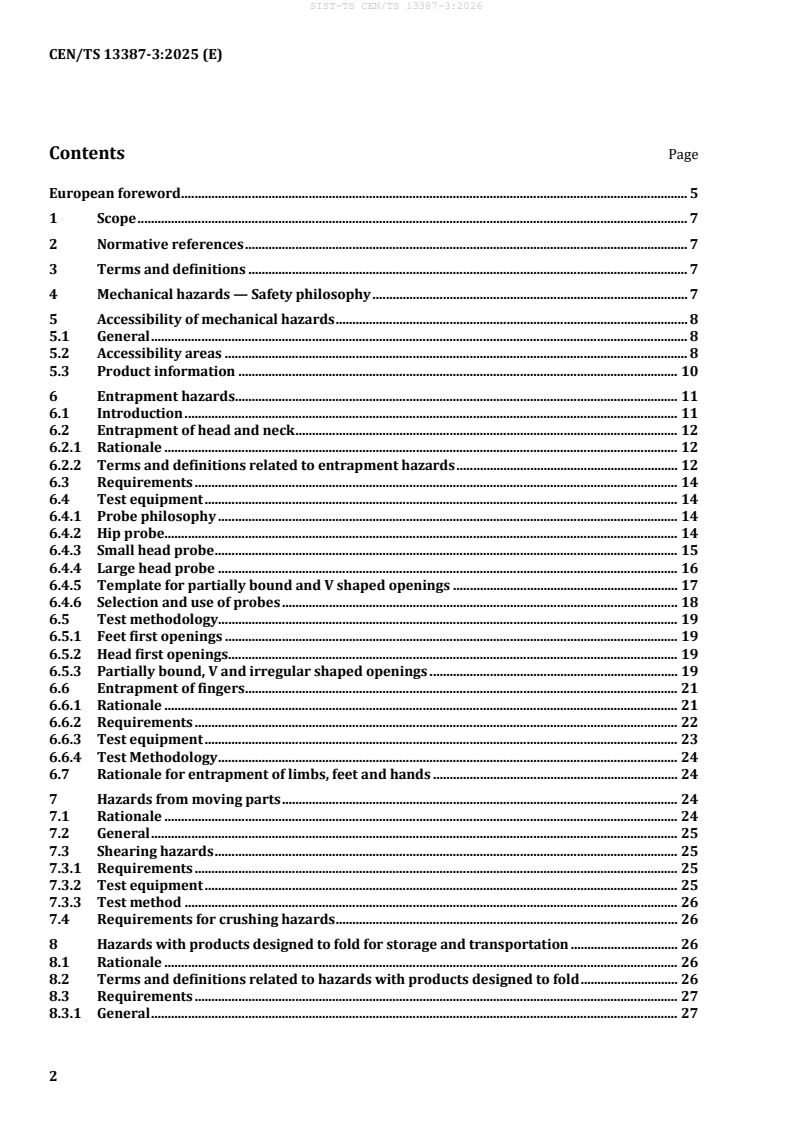
Contents Page
European foreword . 5
1 Scope . 7
2 Normative references . 7
3 Terms and definitions . 7
4 Mechanical hazards — Safety philosophy . 7
5 Accessibility of mechanical hazards . 8
5.1 General . 8
5.2 Accessibility areas . 8
5.3 Product information . 10
6 Entrapment hazards. 11
6.1 Introduction . 11
6.2 Entrapment of head and neck . 12
6.2.1 Rationale . 12
6.2.2 Terms and definitions related to entrapment hazards . 12
6.3 Requirements . 14
6.4 Test equipment . 14
6.4.1 Probe philosophy . 14
6.4.2 Hip probe. 14
6.4.3 Small head probe . 15
6.4.4 Large head probe . 16
6.4.5 Template for partially bound and V shaped openings . 17
6.4.6 Selection and use of probes . 18
6.5 Test methodology . 19
6.5.1 Feet first openings . 19
6.5.2 Head first openings . 19
6.5.3 Partially bound, V and irregular shaped openings . 19
6.6 Entrapment of fingers . 21
6.6.1 Rationale . 21
6.6.2 Requirements . 22
6.6.3 Test equipment . 23
6.6.4 Test Methodology . 24
6.7 Rationale for entrapment of limbs, feet and hands . 24
7 Hazards from moving parts . 24
7.1 Rationale . 24
7.2 General . 25
7.3 Shearing hazards . 25
7.3.1 Requirements . 25
7.3.2 Test equipment . 25
7.3.3 Test method . 26
7.4 Requirements for crushing hazards . 26
8 Hazards with products designed to fold for storage and transportation . 26
8.1 Rationale . 26
8.2 Terms and definitions related to hazards with products designed to fold . 26
8.3 Requirements . 27
8.3.1 General . 27
8.3.2 Unintentional release of locking mechanisms . 27
8.3.3 Test methodology . 27
9 Hazards related to attachment mechanisms and opening and closing systems. 27
9.1 Rationale . 27
9.2 Requirement . 27
9.3 Test methodology . 28
10 Entanglement hazards . 28
10.1 Snagging hazards . 28
10.1.1 Rationale . 28
10.1.2 Requirements . 28
10.1.3 Test equipment . 28
10.1.4 Test methodology for loop and mass . 30
10.2 Cords, ribbons and parts used as ties . 31
10.2.1 Rationale . 31
10.2.2 Requirements . 31
10.2.3 Test methodology . 32
10.3 Loops . 32
10.3.1 Rationale . 32
10.3.2 Requirements . 32
10.3.3 Test methodology . 32
11 Choking hazards . 33
11.1 Introduction. 33
11.2 Hazard due to small components . 33
11.2.1 Rationale . 33
11.2.2 Requirements . 33
11.2.3 Test equipment (also used in 12.2.3) . 34
11.2.4 Test methodology (also in 12.2.4) . 36
11.3 Accessibility of filling materials . 37
11.3.1 Rationale . 37
11.3.2 Requirement . 37
11.3.3 Test equipment . 37
11.3.4 Test methodology . 39
11.4 Airway obstruction . 39
11.4.1 Rationale . 39
11.4.2 Protective mechanisms of the airway . 40
11.4.3 Requirements . 41
11.4.4 Test equipment . 41
11.4.5 Test methodology . 42
12 Suffocation hazards. 42
12.1 Introduction. 42
12.2 Plastic decals and sheeting. 43
12.2.1 Rationale . 43
12.2.2 Requirements . 43
12.2.3 Determination of hazard . 43
12.2.4 Test equipment . 44
12.2.5 Test methodology . 44
12.3 Non air-permeable packaging . 45
12.3.1 Rationale . 45
12.3.2 Requirements - Packaging . 45
12.3.3 Test equipment . 46
12.3.4 Test methodology . 46
13 Ingestion hazards . 46
13.1 Rationale . 46
13.2 Ingestion of small components . 46
13.2.1 Requirements . 46
13.2.2 Test equipment (Also used in 12.2.3) . 47
13.2.3 Test methodology . 49
14 Hazardous edges and projections . 50
14.1 Introduction . 50
14.2 Edges . 50
14.2.1 Rationale . 50
14.2.2 Requirements - Edges on products and components . 50
14.2.3 Test methodology . 51
14.3 Rigid protruding parts . 51
14.3.1 Rationale . 51
14.3.2 Requirements . 51
14.3.3 Test methodology . 51
14.4 Points and wires . 51
14.4.1 Rationale . 51
14.4.2 Requirement . 51
15 Structural integrity . 52
15.1 Introduction . 52
15.2 Material suitability . 52
15.2.1 Rationale . 52
15.2.2 Requirements . 53
15.3 Strength and durability of the product . 53
15.3.1 Rationale . 53
15.3.2 Requirements . 53
15.3.3 Test methodology . 53
16 Protective function . 53
16.1 Introduction . 53
16.2 Barrier function . 53
16.2.1 Rationale . 53
16.2.2 Requirements . 54
16.2.3 Test equipment - Hip probe . 54
16.2.4 Test methodology . 55
16.3 Restraint systems . 55
16.3.1 Rationale . 55
16.3.2 Terms and definitions related to restraint systems . 55
16.3.3 Requirements . 56
16.3.4 Test equipment . 56
16.3.5 Footholds on a continuous . 57
16.4 Footholds . 58
16.4.1 Rationale . 58
16.4.2 Requirements . 58
16.4.3 Test equipment (Templates) . 58
16.4.4 Determination of a foothold . 59
17 Hazard associated with stability. 65
17.1 Rationale . 65
17.2 General requirement . 65
Bibliography . 66
European foreword
This document (CEN/TS 13387-3:2025) has been prepared by Technical Committee CEN/TC 252 “Child
care articles”, the secretariat of which is held by AFNOR.
Attention is drawn to the possibility that some of the elements of this document may be the subject of
patent rights. CEN shall not be held responsible for identifying any or all such patent rights.
This document supersedes CEN/TR 13387-3:2023.
CEN/TR 13387-3:2023:
— Ageing and wear: Reworded;
— Accessibility of mechanical hazards: Reworded;
— Entrapment hazards: Addition of a new finger probe and a hip probe;
— Hazards from moving parts: Moving parts separated into two main areas;
— Entanglement hazards: Improvement of the diagram for the ball and chain test; clarification of the
clause for “Cords, ribbons and parts used as ties;
— Suffocation hazards: Clarification of the clause for “Non air-permeable packaging”;
— Hazardous edges and projections: Drawings deleted;
— Protective function: Addition of a hip probe;
— Footholds: Reworded.
The CEN/TS 13387 series, with the general title Child care articles - General safety guidelines, comprises
the following five parts:
— Part 1: Safety philosophy and safety assessment;
— Part 2: Chemical hazards;
— Part 3: Mechanical hazards;
— Part 4: Thermal hazards;
— Part 5: Product information.
CEN/TS 13387-3 is intended to be used in conjunction with CEN/TS 13387-1.
Any feedback and questions on this document should be directed to the users’ national standards body.
A complete listing of these bodies can be found on the CEN website.
According to the CEN/CENELEC Internal Regulations, the national standards organisations of the
following countries are bound to announce this Technical Specification: Austria, Belgium, Bulgaria,
Croatia, Cyprus, Czech Republic, Denmark, Estonia, Finland, France, Germany, Greece, Hungary, Iceland,
Ireland, Italy, Latvia, Lithuania, Luxembourg, Malta, Netherlands, Norway, Poland, Portugal, Republic of
North Macedonia, Romania, Serbia, Slovakia, Slovenia, Spain, Sweden, Switzerland, Türkiye and the
United Kingdom.
1 Scope
This document provides guidance information on mechanical hazards that are taken into consideration
when developing safety standards for child care articles. In addition, these guidelines can assist those
with a general professional interest in child safety.
This new edition of this document is a hazard based Technical Specification.
2 Normative references
There are no normative references in this document.
3 Terms and definitions
For the purposes of this document, the following terms and definitions apply.
ISO and IEC maintain terminology databases for use in standardization at the following addresses:
— IEC Electropedia: available at https://www.electropedia.org/
— ISO Online browsing platform: available at https://www.iso.org/obp
3.1
mechanical hazards
physical factors which can give rise to injury due to the mechanical properties of products/product parts
3.2
reach envelopes
age related physical data on the reach limits of the limbs of children in different postures
Note 1 to entry: See 5.2.
3.3
ageing
change of properties of the material due to exposure to environmental factors such as temperature,
humidity, UV radiation, cleaning agents, etc
3.4
mechanical wear
change of mechanical properties due to fatigue or repeated operation of devices, mechanisms and other
parts of the product
4 Mechanical hazards — Safety philosophy
This clause addresses the most widely known mechanical hazards and is intended to provide guidance
when drafting standards for child care articles.
Anthropometric data and information on the abilities of children related to risks are given in
CEN/TS 13387-1:2025, Annex A. When using these data for setting requirements, adequate safety
margins should be considered. These data refer to static and not dynamic anthropometric data, therefore
care should be taken if using these data for anything other than static situations when drafting standards.
When drafting standards, conditions of use should be considered, bearing in mind the behaviour of
children. Also, it is to be considered whether the child is attended or unattended when using the product
and also the child’s access to hazardous features.
For each mechanical hazard a rationale is given, explaining the potential hazard to the child.
Requirements, test equipment and test methods are also given. Where appropriate, these can be used
when drafting standards.
New technologies, e.g. fingerprint or face recognition or others, could be used for opening and closing a
mechanical device or for operating a product.
When developing technical standards for child care articles, if these new technologies are identified as a
possible option for use within a product category, specific requirements and test methods to assess their
safety should be defined.
5 Accessibility of mechanical hazards
5.1 General
Within the mechanical section no reference is made to specific areas of access, known as access zones. It
would be wrong for this guidance document to specify exact areas of access as these should be
determined in relation to the hazards and risks of individual products and risks when drafting the
standard. As a general guidance to the types of contact associated with mechanical hazards, the following
examples are given:
— the hazardous part is in reach of the child from the intended position of use in particular by head,
mouth, hands or feet and there is a high probability for frequent, intensive and/or prolonged contact.
Requirements need to address this primary contact;
— the hazardous part can be reached by the child or any other child beyond the intended position of
use. The product is considered to remain in its intended position(s). Access to hazardous parts is
gained by passing/moving around the product or when proceeding to the intended position. The risk
of harm deriving from frequent, intensive and/or pro-longed contact can be less probable;
— the hazardous part exists, but cannot be reached by any child.
Irrespective of the access category, the reasonably foreseeable conditions of use should always be
considered when designing children’s products and/or writing product standards.
5.2 Accessibility areas
Information for determination of accessibility areas in connection with age group is given in Table 1 and
Figure 1. These reach envelopes are based on a computer simulation; therefore, the dimensions should
be treated with care. If in the future experiments with children are undertaken, these figures in the table
can be determined more accurately.
Table 1 — Reach envelopes for guidance in the specification of accessibility areas in standards –
anthropometric data related to Figure 1
Dimension Overhead Overhead Span Overhead
Arm Buttock- Lower
(mm)
Reach Reach on Reach Reach Foot Leg
tiptoes
Sitting Length
Age group L1 L1' L2 L3 L4 R1 R2
0 month to 760 - 660 550 250 300 150
6 months
6 months to 880 960 770 610 290 380 190
12 months
12 months to 1 160 1 260 1 020 770 420 550 275
36 months
36 months to 1 270 1 370 1 070 810 460 630 315
48 months
NOTE All dimensions are based on P95 values. L1, L1', L2, L3, L4, have been assessed with the computer
program ADAPS (© 79–93 TU-Delft University of Technology, Faculty of Industrial Design Engineering).
R1 = buttock - foot length (Annex A, Table 3). R2 = 0,5 × R1.
NOTE ©79-93 TU-Delft University of Technology Faculty of Industrial Design Engineering.
Figure 1 — Reach envelopes for determination of accessibility areas
5.3 Product information
In order to ensure mechanical safety, the information for the carer should include appropriate
instructions and warnings. For example:
— the need for restraint system and its adjustment;
— the opening and closing of products;
— the operation of safety locks for foldable parts;
— the method of attachment to fixed structures or to other products.
Instructions should also inform the carer of the need to inspect the product regularly and also to use only
replacement parts that are approved by the manufacturer/supplier.
CEN/TS 13387-5 “Product information” gives detailed advice concerning the presentation of product
information.
6 Entrapment hazards
6.1 Introduction
To avoid entrapment of head, neck, fingers, feet, and hands, safety distances are recommended in relation
to the anthropometric data (see CEN/TS 13387-1:2025, Annex A) of the growing child. It is important to
take into account the intended age and/or development level of the child. As a priority, those parts of a
product which are accessible when a child is using the product as foreseeable should be considered. It
can also be appropriate for gaps and openings beyond these accessible areas to be addressed. Gaps and
openings which are inaccessible need not to be considered. However, V-shaped openings or V-shaped
arrangements of structural members should be avoided.
Important entrapment hazards are:
— entrapment of the neck in situations where the child is incapable of raising its body weight to relieve
the pressure (e.g.: crawling child on the outside of play pen, V shapes, etc.);
— entrapment of the neck in situations where the child slips through a gap feet first (e.g.: child slipping
between bars/slats);
— entrapment of fingers, which can cause loss of blood supply to the tips.
If it is possible to position a child care article next to other furniture or a wall and create an entrapment
hazard between them, an instruction should be included to warn carers of this possible entrapment
hazard. When considering entrapment hazards dynamic situations should be considered as well as static
hazards. The dynamic situation will increase the force being applied to a trapped torso or finger through
the weight, movement or momentum of the child which will increase the risk of injury.
To assist with this an entrapment matrix has been included, see Figure 2, which was based on work done
in ISO/IEC Guide 50. This entrapment matrix does not impart any hierarchy in the severity of the hazards
shown and the specific hazard clause should be referred to.
Completely
Partially
Body V
bound openings
bound
part shapes
openings
Rigid Non-rigid
Head
neck,
head
first
Finger
Head
neck,
feet
first
Figure 2 — Entrapment matrix
6.2 Entrapment of head and neck
6.2.1 Rationale
Head and neck hazards occur when the child is in a position where its body weight is supported by its
neck and the child is incapable of lifting its body weight to relieve pressure on its neck. When this occurs,
it will cause airways to close and restrict the blood flow, leading to brain damage.
The risk of head and neck entrapment increases as the child’s mobility and ability increases, enabling the
child to access a wider range of hazards and products. The hazard is directly related to the size of the
child’s head and hip.
The hazard can be avoided by limiting the size and shape of completely bound, partially bound and ‘V’
shaped openings (see definitions in 6.2.2).
6.2.2 Terms and definitions related to entrapment hazards
6.2.2.1 completely bound opening
opening that is continuously surrounded on all sides by the material of the product, see Figure 3
Figure 3 — Examples of completely bound openings
6.2.2.2 partially bound opening
opening that is partially surrounded by the material of the product, see Figure 4
Figure 4 — Examples of partially bound openings
6.2.2.3 V shaped opening
opening where there is a slot that narrows towards the bottom, see Figure 5
Figure 5 — Examples of V shaped openings
6.2.2.4 irregular shaped opening
opening that does not have a symmetrical shape, see Figure 6
Figure 6 — Example of an irregular shaped opening
6.3 Requirements
When tested in accordance with 6.5.1 or 6.5.2, if openings allow passage of the small probe, the large
probe should pass through. The opening that allows the large probe to pass completely through should
comply with the requirement for partially bound, V and irregular shaped openings when tested in
accordance with 6.5.3.
Partially bound, V and irregular shaped openings should be constructed so that:
a) portion B of the template does not enter the opening when tested in accordance with 6.5.3,
see Figure 11 and Figure 12; or
b) the apex of portion A of the template contacts the base of the opening when tested in accordance
with 6.5.3, see Figure 13.
6.4 Test equipment
6.4.1 Probe philosophy
To cover all aspects of head and neck entrapment four types of probes are required, the hip probe, the
small head probe, the large head probe and the template for partially bound and V-shaped openings. The
size of individual probes is determined to meet the age range of the child, see the figures and tables for
the various probes.
6.4.2 Hip probe
The hip probe, Figure 7, represents the hip of the smallest child in each age range. The probe size
corresponds to the size of the child as follows:
— dimension ‘A’ represents the hip breadth;
— dimension ‘B’ represents hip depth;
— dimension ‘C’ represents the radius C after calculation based on hip circumference.
The dimensions of the hip probe are based on the anthropometric data, see Table 2.
Table 2 — Hip probe corresponding to smallest child
Age A B C
Months
0 to 2 101 42 10
3 to 5 105 65 23
6 to 8 124 67 23
Dimensions in millimetres
Key
1 handle
2 hip probe
Figure 7 — Hip probe
6.4.3 Small head probe
The small head probe, Figure 8, represents the head of the smallest child in each age range. The probe
size corresponds to the child size as follows:
— dimension ‘a’ represents head breadth;
— dimension ‘b’ represents head length;
— dimension ‘c’ represents head height;
The dimensions of the small head probe are based on anthropometric data, see Table 3.
Table 3 — Head probe corresponding to smallest child
Age
a b c Re Rd
Months
0 to 3 96 124 112 48 40
3 to 6 101 137 119 50,5 40
6 to 9 106 145 126 53 40
9 to 12 111 150 138 55,5 40
12 to 18 115 155 144 57,5 40
18 to 24 118 158 149 59 40
24 to 36 120 159 154 60 40
36 to 48 123 161 156 61,5 40
Dimensions in millimetres
Key
1 handle
Re/Rd radii
Figure 8 — Small head probe
6.4.4 Large head probe
The large head probe, Figure 9, represents the head of the largest child in the age range. The probe size
corresponds to the child size as follows:
— dimension ‘a’ represents chin to crown length.
The dimensions of the large head probe are based on the anthropometric data, see Table 4:
Table 4 — Head probe corresponding to largest child
Age months Diameter a
0 to 3 175
3 to 6 191
6 to 9 196
9 to12 205
12 to 18 210
18 to 24 215
24 to 36 223
36 to 48 229
Dimensions in millimetres
Key
1 handle
Figure 9 — Large head probe
6.4.5 Template for partially bound and V shaped openings
The template shown in Figure 10 represents head and neck dimensions:
Dimensions in millimetres
Key
1 B portion
2 A portion
Figure 10 — Template for partially bound and V shaped openings
6.4.6 Selection and use of probes
6.4.6.1 Probe size
The correct size of probe should be selected from the ranges shown in Table 2 to Table 4, to suit the age
range of the child most at risk when considering the hazard.
By checking the opening with the large head probe, Figure 9 it is possible to ascertain whether the
opening is small enough to be a hazard to a child. If the opening is found to be hazardous the opening
should be tested to determine if it is large enough for the child to enter either feet first or head first by
using one of the appropriate small probes, Figure 7 or Figure 8, as indicated below.
6.4.6.2 Feet first openings
The hip probe, Figure 7 should be used to check if the opening is small enough to prevent passage of a
child’s hip. If it does not pass through the opening the risk of entrapment is reduced.
6.4.6.3 Head first openings
The small head probe, Figure 8, should be used to check if the opening is small enough to prevent passage
of a child’s head. If the small head probe does not pass through the opening the risk of head first
entrapment is reduced.
If the small head probe passes completely through the opening, the large head probe should be used to
check if the opening
...