

SIST EN 50667:2017
(Main)Information technology - Automated infrastructure management (AIM) systems - Requirements, data exchange and applications
General Information
- Abstract
This European Standard specifies the requirements and recommendations for the attributes of automated infrastructure management (AIM) systems.
This European Standard explains how AIM systems can contribute to operational efficiency and deliver benefits to
a) cabling infrastructure and connected device administration,
b) facilities and IT management processes and systems,
c) other networked management processes and systems (e.g. intelligent building systems),
d) business information systems covering asset tracking and asset management together with event notifications and alerts that assist with physical network security.
This European Standard specifies a framework of requirements and recommendations for data exchange with other systems.
- Status
- Published
- Publication Date
- 12-Jan-2017
- Technical Committee
- ELI - Electrical and communication installations
- Current Stage
- 6060 - National Implementation/Publication (Adopted Project)
- Start Date
- 11-Jan-2017
- Due Date
- 18-Mar-2017
- Completion Date
- 13-Jan-2017

Overview - EN 50667:2016 (AIM systems)
EN 50667:2016, published by CLC/CENELEC and aligned with ISO/IEC 18598:2016, defines requirements and recommendations for Automated Infrastructure Management (AIM) systems. The standard covers the attributes, functional elements and a data‑exchange framework that allow AIM systems to document, monitor and manage cabling infrastructure, connected devices and related business processes. It explains how AIM improves operational efficiency across facilities, IT and other networked management systems while supporting physical network security through events and alerts.
Key topics and technical requirements
- System scope and components: Defines an AIM system as integrated hardware and software that detects cord insertion/removal, records connectivity and exchanges data with other systems. Includes AIM hardware (patch panels + controllers) and AIM‑enabled ports.
- Functional requirements:
- Documentation and maintenance of cabling and connectivity information
- Management, usage and integrity of AIM data
- Event and alarm generation (change of state, incidents)
- Data exchange framework:
- Framework for data exchange with other systems (APIs, commands and common data model)
- Definitions for element reference IDs, attributes, containment rules and hierarchy
- Support for commands such as work‑order management, asset queries, alarms/events and circuit tracing
- Operational recommendations:
- Design, specification, installation and operation guidance (normative and informative annexes)
- Emphasis on integration with IT processes and information security management
- Terminology: Includes standard definitions - cord, circuit, connecting hardware, closure, discoverable equipment, CMDB, BMS, etc.
Applications - who uses EN 50667 and why
EN 50667 is intended for:
- Premises owners and facility managers - to ensure accurate documentation and capacity planning
- Network and data‑centre operators - for change, incident and capacity management
- IT process managers and CMDB/DCIM integrators - to automate asset updates and correlate physical connectivity with configuration data
- AIM suppliers and software integrators - to implement interoperable APIs and common data models Practical benefits include improved asset tracking, faster fault isolation, automated work‑order workflows, enhanced physical security alerts and tighter integration with Building Management Systems (BMS), DCIM and business information systems.
Related standards
- ISO/IEC 18598:2016 - the international equivalent on AIM systems
- Referenced standards for cabling terminology and elements: EN 50174‑1, EN 50173‑1 (as sources for some definitions)
Keywords: EN 50667, AIM systems, automated infrastructure management, AIM hardware, AIM-enabled port, data exchange, API, cabling infrastructure, CMDB, DCIM, BMS.
Relations
- Effective Date
- 01-Feb-2022
Get Certified
Connect with accredited certification bodies for this standard

BSI Group
BSI (British Standards Institution) is the business standards company that helps organizations make excellence a habit.

NYCE
Mexican standards and certification body.
Sponsored listings
Frequently Asked Questions
SIST EN 50667:2017 is a standard published by the Slovenian Institute for Standardization (SIST). Its full title is "Information technology - Automated infrastructure management (AIM) systems - Requirements, data exchange and applications". This standard covers: This European Standard specifies the requirements and recommendations for the attributes of automated infrastructure management (AIM) systems. This European Standard explains how AIM systems can contribute to operational efficiency and deliver benefits to a) cabling infrastructure and connected device administration, b) facilities and IT management processes and systems, c) other networked management processes and systems (e.g. intelligent building systems), d) business information systems covering asset tracking and asset management together with event notifications and alerts that assist with physical network security. This European Standard specifies a framework of requirements and recommendations for data exchange with other systems.
This European Standard specifies the requirements and recommendations for the attributes of automated infrastructure management (AIM) systems. This European Standard explains how AIM systems can contribute to operational efficiency and deliver benefits to a) cabling infrastructure and connected device administration, b) facilities and IT management processes and systems, c) other networked management processes and systems (e.g. intelligent building systems), d) business information systems covering asset tracking and asset management together with event notifications and alerts that assist with physical network security. This European Standard specifies a framework of requirements and recommendations for data exchange with other systems.
SIST EN 50667:2017 is classified under the following ICS (International Classification for Standards) categories: 35.110 - Networking. The ICS classification helps identify the subject area and facilitates finding related standards.
SIST EN 50667:2017 has the following relationships with other standards: It is inter standard links to SIST EN 50667:2017/A1:2022. Understanding these relationships helps ensure you are using the most current and applicable version of the standard.
SIST EN 50667:2017 is available in PDF format for immediate download after purchase. The document can be added to your cart and obtained through the secure checkout process. Digital delivery ensures instant access to the complete standard document.
Standards Content (Sample)
SLOVENSKI STANDARD
01-februar-2017
Informacijska tehnologija - Avtomatizirani sistemi upravljanja infrastrukture (AIM) -
Zahteve, izmenjava podatkov in uporaba
Information technology - Automated infrastructure management (AIM) systems -
Requirements, data exchange and applications
Informationstechnik - Systeme für automatisiertes Infrastrukturmanagement (AIM) -
Anforderungen, Schnittstellen und Anwendungen
Technologies de l'information - Systèmes de gestion d'infrastructure automatisée (AIM,
Automated infrastructure management) - Exigences, interfaces et applications
Ta slovenski standard je istoveten z: EN 50667:2016
ICS:
35.110 Omreževanje Networking
2003-01.Slovenski inštitut za standardizacijo. Razmnoževanje celote ali delov tega standarda ni dovoljeno.
EUROPEAN STANDARD EN 50667
NORME EUROPÉENNE
EUROPÄISCHE NORM
December 2016
ICS 35.110; 35.240.99
English Version
Information technology - Automated infrastructure management
(AIM) systems - Requirements, data exchange and applications
Technologies de l'information - Systèmes de gestion Informationstechnik - Systeme für automatisiertes
d'infrastructure automatisée (AIM, Automated infrastructure Infrastrukturmanagement (AIM) - Anforderungen,
management) - Exigences, interfaces et applications Schnittstellen und Anwendungen
This European Standard was approved by CENELEC on 2016-10-24. CENELEC members are bound to comply with the CEN/CENELEC
Internal Regulations which stipulate the conditions for giving this European Standard the status of a national standard without any alteration.
Up-to-date lists and bibliographical references concerning such national standards may be obtained on application to the CEN-CENELEC
Management Centre or to any CENELEC member.
This European Standard exists in three official versions (English, French, German). A version in any other language made by translation
under the responsibility of a CENELEC member into its own language and notified to the CEN-CENELEC Management Centre has the
same status as the official versions.
CENELEC members are the national electrotechnical committees of Austria, Belgium, Bulgaria, Croatia, Cyprus, the Czech Republic,
Denmark, Estonia, Finland, Former Yugoslav Republic of Macedonia, France, Germany, Greece, Hungary, Iceland, Ireland, Italy, Latvia,
Lithuania, Luxembourg, Malta, the Netherlands, Norway, Poland, Portugal, Romania, Slovakia, Slovenia, Spain, Sweden, Switzerland,
Turkey and the United Kingdom.
European Committee for Electrotechnical Standardization
Comité Européen de Normalisation Electrotechnique
Europäisches Komitee für Elektrotechnische Normung
CEN-CENELEC Management Centre: Avenue Marnix 17, B-1000 Brussels
© 2016 CENELEC All rights of exploitation in any form and by any means reserved worldwide for CENELEC Members.
Ref. No. EN 50667:2016 E
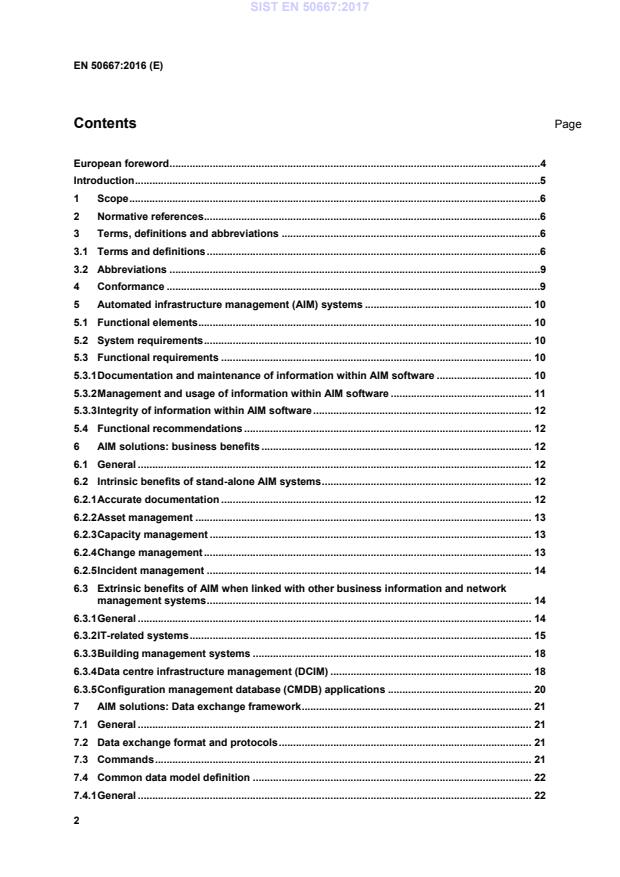
Contents Page
European foreword .4
Introduction .5
1 Scope .6
2 Normative references .6
3 Terms, definitions and abbreviations .6
3.1 Terms and definitions .6
3.2 Abbreviations .9
4 Conformance .9
5 Automated infrastructure management (AIM) systems . 10
5.1 Functional elements . 10
5.2 System requirements . 10
5.3 Functional requirements . 10
5.3.1 Documentation and maintenance of information within AIM software . 10
5.3.2 Management and usage of information within AIM software . 11
5.3.3 Integrity of information within AIM software . 12
5.4 Functional recommendations . 12
6 AIM solutions: business benefits . 12
6.1 General . 12
6.2 Intrinsic benefits of stand-alone AIM systems . 12
6.2.1 Accurate documentation . 12
6.2.2 Asset management . 13
6.2.3 Capacity management . 13
6.2.4 Change management . 13
6.2.5 Incident management . 14
6.3 Extrinsic benefits of AIM when linked with other business information and network
management systems . 14
6.3.1 General . 14
6.3.2 IT-related systems . 15
6.3.3 Building management systems . 18
6.3.4 Data centre infrastructure management (DCIM) . 18
6.3.5 Configuration management database (CMDB) applications . 20
7 AIM solutions: Data exchange framework . 21
7.1 General . 21
7.2 Data exchange format and protocols . 21
7.3 Commands . 21
7.4 Common data model definition . 22
7.4.1 General . 22
7.4.2 Element reference ID . 22
7.4.3 Element and attribute definitions . 23
7.4.4 Containment rules and hierarchy . 29
Annex A (informative) Hierarchy and containment rules . 30
Annex B (informative) Field descriptions . 32
Annex C (normative) Implementation requirements and recommendations . 34
C.1 General . 34
C.2 Design. 34
C.3 Specification . 34
C.4 Installation . 35
C.5 Operation . 35
Annex D (informative) Optional lower level data exchange framework . 36
Bibliography . 37
Figures
Figure 1 — Example of a helpdesk work flow integrated with an AIM system . 17
Figure 2 — Relationship between AIM systems and CMDB applications . 20
Figure A.1 — Spaces . 30
Figure A.2 — Telecommunications equipment . 31
Figure A.3 — Work orders . 31
Tables
Table 1 — Work order management commands . 21
Table 2 — Asset management . 22
Table 3 — Alarms and events . 22
Table 4 — Circuit tracing . 22
Table 5 — Attribute key . 23
Table 6 — Connectivity . 23
Table 7 — Premises/space . 24
Table 8 — Furniture . 24
Table 9 — Telecommunications equipment . 25
Table 10 — Organizational element . 27
Table 11 — Work Order . 28
Table 12 — Work Order Task . 28
Table 13 — Event . 28
Table 14 — Alarm . 29
Table B.1 — AIM software fields . 32
Table D.1 — Port level . 36
Table D.2 — Port level work actions . 36
European foreword
This document (EN 50667:2016) has been prepared by CLC/TC 215 “Electrotechnical aspects of
telecommunication equipment”, based upon ISO/IEC 18598:2016 “Information technology – Automated
infrastructure management (AIM) systems – Requirements, data exchange and applications”.
The following dates are fixed:
latest date by which this document has to (dop) [2017-07-24]
be implemented at national level by
publication of an identical national
standard or by endorsement
latest date by which the national standards (dow) [2019-10-24]
conflicting with this
document have to be withdrawn
Attention is drawn to the possibility that some of the elements of this document may be the subject of patent
rights. CENELEC shall not be held responsible for identifying any or all such patent rights.
Introduction
This European Standard is intended for:
a) premises owners and facility managers;
b) suppliers of AIM solutions;
c) planners of network infrastructures;
d) network operation managers;
e) data centre operation managers;
f) IT process managers;
g) suppliers of management system software;
h) software integrators.
This European Standard is one of a number of documents prepared in support of European Standards and
Technical Reports produced by CLC/TC 215.
1 Scope
This European Standard specifies the requirements and recommendations for the attributes of automated
infrastructure management (AIM) systems.
This European Standard explains how AIM systems can contribute to operational efficiency and deliver
benefits to:
a) cabling infrastructure and connected device administration;
b) facilities and IT management processes and systems;
c) other networked management processes and systems (e.g. intelligent building systems);
d) business information systems covering asset tracking and asset management together with event
notifications and alerts that assist with physical network security.
This European Standard specifies a framework of requirements and recommendations for data exchange
with other systems.
2 Normative references
The following documents, in whole or in part, are normatively referenced in this document and are
indispensable for its application. For dated references, only the edition cited applies. For undated references,
the latest edition of the referenced document (including any amendments) applies.
Not applicable.
3 Terms, definitions and abbreviations
3.1 Terms and definitions
For the purposes of this document, the following terms and definitions apply.
3.1.1
AIM-enabled port
port which is able to automatically detect the insertion and removal of a cord and process that event as part
of an automated infrastructure management system
3.1.2
AIM hardware
combination of patch panels and controllers that are designed to automatically detect the insertion or
removal of cords, to record connectivity information, and to exchange connectivity information with AIM
software
3.1.3
AIM system
integrated hardware and software system that automatically detects the insertion or removal of cords,
documents the cabling infrastructure including connected equipment enabling management of the
infrastructure and data exchange with other systems
3.1.4
alarm
event of sufficient importance to be highlighted within the AIM system
3.1.5
application programming interface
API
set of commands, functions and protocols that specify how software components should interact
3.1.6
basic connectivity configuration
list of information including, but not restricted to, number and type of ports, number of slots, expansion cards,
MAC and IP address
3.1.7
business information system
system that is used to analyse and facilitate strategic and operational activities for an organization
3.1.8
building management system
BMS
computer-based control system installed in a building that controls and monitors mechanical and electrical
equipment such as heating, ventilation and air-conditioning (HVAC), power systems and access control
systems
3.1.9
cabling connectivity information
combination of connection information automatically detected by AIM and additional cabling infrastructure
information from various sources
3.1.10
cabling infrastructure
cables, connecting hardware, panels and other closures, cabinets, frames, racks together with pathways and
spaces providing their accommodation
3.1.11
circuit
series of electromagnetically connected components or devices
3.1.12
closure
fixture or fitting of either open or closed construction intended to contain connecting hardware
[SOURCE: EN 50174-1:2009, 3.1.8]
3.1.13
command
defined method which either provides data or performs an internal operation within an AIM system based on
a request
Note 1 to entry: A command may contain zero or more parameters.
3.1.14
configuration management database
repository of information related to all the components of an information system
3.1.15
connecting hardware
device or combination of devices used to connect cables or cable elements
3.1.16
connection information
record of an event generated by the insertion or removal of a connector at an AIM-enabled port
3.1.17
cord
cable unit or cable element with a minimum of one termination
[SOURCE: EN 50173-1:2011, 3.1.30]
3.1.18
data
value or set of values that describes information within an AIM system
3.1.19
data exchange
ability of an AIM system and other systems to work together reliably
3.1.20
discoverable equipment
equipment with a network address
Note 1 to entry: Discoverable equipment could be treated as non-discoverable equipment according to end user choice.
3.1.21
end device
equipment that is either the source or the destination of a message on a networked system
3.1.22
event
change in state of an element within the AIM system
3.1.23
information security management system
part of the overall management system, based on a business risk approach, that establishes, implements,
operates, monitors, reviews, maintains and improves information security
Note 1 to entry: The management system includes organizational structure, policies, planning activities, responsibilities,
practices, procedures, processes and resources.
3.1.24
interoperability
ability for two or more independent systems to exchange data or information
3.1.25
managed network distribution equipment
discoverable network distribution equipment that uses communications protocols such as the simple network
management protocol (SNMP) to exchange management information
3.1.26
network distribution equipment
electronic equipment that provides connectivity and supports data exchange between end-devices
3.1.27
non-discoverable equipment
equipment without a network address
3.1.28
patch panel
closure designed to be mounted in a cabinet, frame or rack
3.1.29
permissions
set of rules which describe what a user or group of users may access or control within an AIM system
3.1.30
telecommunications infrastructure
cabling infrastructure together with the network distribution equipment, end devices and their
accommodation
3.1.31
work order
set of one or more actions that should be performed by a technician or user of the system
3.2 Abbreviations
For the purposes of this document, the following abbreviations apply.
AIM automated infrastructure management
API application programming interface
BMS building management system
CMDB configuration management database
DCIM data centre infrastructure management
HVAC heating, ventilation and air-conditioning
HTTP Hypertext Transfer Protocol
IP Internet Protocol
IT information technology
ITIL Information Technology Infrastructure Library
JSON JavaScript Object Notation
MAC media access control
PC personal computer
PoE Power over Ethernet
REST Representational State Transfer
SNMP simple network management protocol
SOAP Simple Object Access Protocol
WAP wireless access point
XML extended markup language
4 Conformance
For an AIM system to conform to this European Standard, it shall
a) comprise hardware and software components which together meet the requirements of Clause 5;
b) meet the requirements of Clause 7;
c) be implemented in accordance with the requirements of Annex C.
5 Automated infrastructure management (AIM) systems
5.1 Functional elements
An AIM system shall include the following two functional elements:
a) hardware that automatically detects the insertion and removal of cords;
b) software that:
— collects and stores the resulting connection information;
— relates the connection information to cabling connectivity information;
— relates the cabling connectivity information to information from other sources;
— makes the connection information accessible to either an authorized user or to other systems.
It is important to note that although the initial detection of connectivity is generally accomplished through
electrical, electronic, electro-mechanical or optical means, the different functions and features using this data
are implemented in software.
The software used for AIM systems shall include either application programming interfaces (APIs) or data
exchange formats as described in Clause 7 to allow data from the AIM system to be shared with other
systems used by the organization. This is an important aspect for enhancing and automating the
management and operational functions in the building and data centres.
5.2 System requirements
An AIM system shall be able to:
a) automatically detect connectivity between AIM-enabled panel ports;
b) automatically detect connectivity between AIM-enabled panel ports and other equipment (with AIM-
enabled ports) or document and/or infer connectivity between AIM-enabled panel ports and other
equipment (without AIM-enabled ports);
c) monitor the connections and disconnections of a) and b).
5.3 Functional requirements
5.3.1 Documentation and maintenance of information within AIM software
Once configured, an AIM system shall be able to:
a) accommodate the chosen identification scheme for the items to be documented within the AIM software
(including identification schemes in accordance with EN 81346-1 and EN 50174-1, an implementation of
which is described in ISO/IEC/TR 14763-2-1);
b) record the connections between elements within the cabling infrastructure;
c) automatically detect, document and monitor the presence of discoverable equipment connected to the
network and
1) the basic connectivity configuration of managed network distribution equipment;
2) the network-related information of end devices;
d) automatically update records when any monitored connections (including those of 5.2) are modified;
e) manually document asset information for non-discoverable equipment;
f) document the physical location of the network distribution equipment connected to the network;
g) document and/or infer connectivity between non-AIM enabled ports and other equipment;
h) document the presence and physical location of AIM hardware;
i) identify and track the physical location of end devices connected to the network;
j) maintain a history of events relating to items a) to i);
k) enable the display of mapped items documented within the AIM software to a physical location on
building plans and layouts.
5.3.2 Management and usage of information within AIM software
An AIM system shall be able to:
a) enable the user to define conditions in which an event generates an alarm;
b) enable a user to define the conditions in which an alarm generates a notification;
c) enable a user to view graphical representation of connectivity (circuit trace) and other relational
information for the items documented within the AIM software;
d) provide recommendations on the cabling connectivity tasks required within work orders for service
provision;
e) enable a user to manage work orders related to items documented within the AIM software:
1) create;
2) assign or re-assign;
3) schedule or re-schedule;
4) perform;
5) track (status);
6) close;
f) maintain a work order history;
g) provide access to electronic work orders and other information maintained by the AIM system in the
spaces where the AIM hardware is located;
h) provide a means to automatically detect the accuracy of implementation of connect/disconnect work
order tasks between AIM-enabled ports:
1) provide a means to alert of an incorrect implementation;
2) automatically update the task status following correct implementation;
i) generate reports (both automatically and on-demand) related to items documented within the AIM
software.
5.3.3 Integrity of information within AIM software
Upon recovery from disruption to an AIM system or its components, the system shall provide the ability to:
a) maintain the integrity of information within the AIM software;
b) reflect the current state of monitored connectivity.
5.4 Functional recommendations
An AIM system should be able to generate formatted data for the production of labels.
6 AIM solutions: business benefits
6.1 General
Clause 6 maps the intrinsic capabilities of AIM systems defined in Clause 5 to real-world benefits and
provides examples of where the extension of the capabilities by linkage to external systems may provide
additional benefits to an organization.
6.2 Intrinsic benefits of stand-alone AIM systems
6.2.1 Accurate documentation
Poorly documented systems are difficult to troubleshoot. AIM systems can provide automated up-to-date
documentation that can improve system availability. Easily accessible and current documentation allows
organizations to spend less time obtaining information necessary to troubleshoot cabling infrastructure and
network problems.
6.2.2 Asset management
The purpose and intent of asset management is to improve the effective utilization and availability of
business assets with the aim of reducing operating cost.
Assets include all elements of software and hardware that are found in the business environment.
Information technology (IT) asset management is an important part of an organization's strategy. It usually
involves gathering detailed hardware and software inventory information which is then used to make
decisions about hardware and software purchases and redistribution. IT inventory management helps
organizations manage their systems more effectively. It also saves time and money by avoiding unnecessary
asset purchases and promoting the harvesting of existing resources.
AIM systems are capable of manually documenting asset information for passive components and have the
capability to discover the presence of, and maintain information about the network connectivity status and
derived location of:
a) network distribution equipment, e.g. routers, switches, wireless access points (WAPs);
b) end devices, e.g. servers, personal computers (PCs), Internet Protocol (IP) telephones, IP cameras,
access control equipment, etc.
To limit disruption of business operations and information security, organizations utilize incident
management processes. AIM systems are able to enhance these processes through recording events and
generating notifications, alerts and alarms in response to the recorded events.
There are also potential benefits to the storage of acceptance test or configuration information within the
record of the connected network distribution equipment or end devices (see 6.3.2.3).
6.2.3 Capacity management
An organization is able to use the record of capacity and utilization of telecommunications infrastructure
facilities, network distribution equipment or end devices maintained by the AIM system to improve the speed
and accuracy of planning of moves, adds and changes. Examples include the following.
a) In all situations, through its ability to analyse physical status of equipment ports and correlate that
information to logical status of these ports, the AIM system is able to pinpoint unused ports that could be
freed up for production use, thereby maximizing the utilization of existing network equipment and
possibly eliminating future asset purchases.
b) In office environments, the record of switch ports with a patched connection may be related to the
number of switch ports without an end-device connection and used to create a work order to remove
cords from unused ports – ensuring the maximum use of existing ports and potentially negating the
need to purchase additional capacity.
c) In data centres, the record of total telecommunications infrastructure space and occupied
telecommunications infrastructure space may be used to accurately assess the available space to
house incoming telecommunications infrastructure equipment and to assist in the planning of the new
location.
6.2.4 Change management
Many industries have risk management regulations or recommendations that include requirements or
recommendations for change management control. For example:
a) in the finance industry: Sarbanes–Oxley Act and BASEL III;
b) in data centres: the EU Code of Conduct and ITIL;
c) in the pharmaceutical industry: US. Food and Drugs Administration – Good Manufacturing Practices.
Changes to the cabling infrastructure, network distribution equipment and end devices are maintained within
AIM systems and include but are not limited to the real-time information about:
1) authorized and unauthorized patching activities;
2) generation of move, add, change work orders or a linkage with work order management systems in
order to reduce the time required to implement connectivity changes, and to deliver improved accuracy
by minimizing possibilities of human errors;
3) automated tracking of work order completion;
4) scheduled work order history;
5) monitoring changes to connectivity, providing user defined alerts, maintaining a change history as
described in 6.3.5.
6.2.5 Incident management
AIM systems are able to record events and generate notifications, alerts and alarms in response to the
recorded events. This facility can enhance security by notification of unauthorized connections,
disconnections or access to the AIM system. This information can be provided to IT or physical security staff
within the organization. The real-time event notification may be sent using a variety of methods depending
on the functionality of the AIM system (e.g. email, text messaging, SNMP traps).
6.3 Extrinsic benefits of AIM when linked with other business information and network
management systems
6.3.1 General
Exchange of data between an AIM system and business information or network management systems can
provide enhanced functionality to both systems (IP telephony management, helpdesk applications, etc.).
Other business information systems are a broad category that may apply to many different systems or
applications within customer owned premises. The following non-exhaustive list of systems and applications
are covered because of their importance and impact when linked with AIM systems.
a) IT-related systems:
— Internet Protocol (IP) telephony management;
— netw
...