

SIST EN IEC 62933-3-1:2026
(Main)Electrical energy storage (EES) systems - Part 3-1: Planning and performance assessment of electrical energy storage systems - General specification
General Information
- Abstract
IEC 62933-3-1:2025 is applicable to EES systems designed for grid-connected indoor or outdoor installation and operation. This document considers:
necessary functions and capabilities of EES systems; sizing and design of EES system; operation of EES system; test items and performance assessment methods for EES systems; requirements for monitoring and acquisition of EES system operating parameters; exchange of system information and control capabilities required; maintenance of EES system. Stakeholders of this document comprise personnel involved with EES systems, which include:
- planners of electric power systems and EES systems;
- owners of EES systems;
- operators of electric power systems and EES systems;
- constructors;
- suppliers of EES systems and its equipment;
- aggregators.
Use-case-specific technical documentation, including planning and installation specific tasks such as system design, monitoring, measurement, tests, operation and maintenance, are very important and can be found throughout this document.
- Status
- Published
- Public Enquiry End Date
- 31-Oct-2024
- Publication Date
- 04-Feb-2026
- Technical Committee
- I11 - Imaginarni 11
- Current Stage
- 6060 - National Implementation/Publication (Adopted Project)
- Start Date
- 13-Jan-2026
- Due Date
- 20-Mar-2026
- Completion Date
- 05-Feb-2026

Overview
SIST EN IEC 62933-3-1:2026 is the European standard detailing the planning and performance assessment of electrical energy storage (EES) systems. Developed by the European Committee for Electrotechnical Standardization (CLC), this standard applies to grid-connected EES systems intended for either indoor or outdoor installation and operation. The document provides a general specification for evaluating necessary functions and capabilities, system sizing and design, operational protocols, performance tests, monitoring requirements, data exchange, and maintenance strategies. It targets a broad audience, including planners, owners, operators, constructors, suppliers, and aggregators involved in deploying and managing EES systems.
Key Topics
- System Functions and Capabilities: Defines required capabilities for EES systems, including energy accumulation, power conversion, auxiliary support, and control subsystems.
- Sizing and Design: Outlines processes for preliminary and final system sizing, taking into account capacity, efficiency, response times, and integration with the grid.
- Operational Requirements: Specifies operation states, control subsystem aspects, and protocols for routine monitoring and remote management.
- Performance Assessment: Describes testing regimes such as Factory Acceptance Testing (FAT), Site Acceptance Testing (SAT), and ongoing performance monitoring throughout service life.
- Monitoring and Data Acquisition: Emphasizes the need for real-time data acquisition, parameter monitoring, and information modeling to ensure effective operation and reporting.
- System Information Exchange and Control: Details interfaces and communication protocols required for seamless integration with external control systems and the grid.
- Maintenance and Decommissioning: Covers maintenance schedules, inspection points across service life, and robust decommissioning plans including removal, recycling, and site rehabilitation.
Applications
Implementing SIST EN IEC 62933-3-1:2026 ensures the robust and reliable deployment of EES systems across a range of scenarios:
- Renewable Energy Integration: Provides guidelines for storing intermittent renewable generation (solar, wind), smoothing power output, and supporting grid stability.
- Grid Support: EES systems designed under this standard can offer frequency control, voltage support, backup power, and power quality enhancement.
- Electric Vehicle Charging: Guides planning and assessment of storage solutions for electric charging stations, optimizing fast-charging services and peak shaving.
- Multi-Scenario Usage: Supports facility and grid operators in designing EES systems capable of serving multiple functions, improving project ROI and operational flexibility.
- Lifecycle Management: Ensures that EES systems are correctly specified for installation, operation, routine testing, and eventual decommissioning, supporting sustainability targets.
Related Standards
SIST EN IEC 62933-3-1:2026 references and aligns with several key international and European standards that address complementary aspects of EES systems:
- IEC 62933-1: Vocabulary for electrical energy storage systems.
- IEC 62933-2-1: Unit parameters and testing methods - general specifications.
- IEC 62933-5-1: Safety considerations for grid-integrated EES systems.
- IEC 61850 Series: Communication networks and systems for utility automation.
- IEC 62351 Series: Security for data and communications in power systems.
- IEC 62443 Series: Security for industrial automation and control systems.
- IEC 60721-1: Classification of environmental conditions for equipment.
- ISO/IEC 27000: Information security management systems – overview and vocabulary.
Practical Value
Adherence to SIST EN IEC 62933-3-1:2026 ensures that stakeholders:
- Achieve consistent system performance and safety across installations.
- Facilitate interoperability and grid integration.
- Meet both regulatory and technical requirements for EES planning, installation, and lifecycle management.
- Contribute to energy efficiency, grid resilience, and the wider adoption of renewable energy technologies.
By following this standard, organizations can optimize the design, operation, and sustainability of electrical energy storage systems for a modern, reliable, and flexible power grid.
Relations
- Effective Date
- 09-Feb-2026
- Effective Date
- 03-Feb-2026
- Effective Date
- 03-Feb-2026
- Effective Date
- 03-Feb-2026
- Effective Date
- 03-Feb-2026
- Effective Date
- 03-Feb-2026
- Effective Date
- 03-Feb-2026
- Effective Date
- 03-Feb-2026
- Effective Date
- 03-Feb-2026
- Effective Date
- 03-Feb-2026
- Effective Date
- 03-Feb-2026
- Effective Date
- 03-Feb-2026
- Effective Date
- 03-Feb-2026
- Effective Date
- 03-Feb-2026
- Effective Date
- 03-Feb-2026
Get Certified
Connect with accredited certification bodies for this standard

DNV
DNV is an independent assurance and risk management provider.

BSI Group
BSI (British Standards Institution) is the business standards company that helps organizations make excellence a habit.

Bureau Veritas
Bureau Veritas is a world leader in laboratory testing, inspection and certification services.
Sponsored listings
Frequently Asked Questions
SIST EN IEC 62933-3-1:2026 is a standard published by the Slovenian Institute for Standardization (SIST). Its full title is "Electrical energy storage (EES) systems - Part 3-1: Planning and performance assessment of electrical energy storage systems - General specification". This standard covers: IEC 62933-3-1:2025 is applicable to EES systems designed for grid-connected indoor or outdoor installation and operation. This document considers: necessary functions and capabilities of EES systems; sizing and design of EES system; operation of EES system; test items and performance assessment methods for EES systems; requirements for monitoring and acquisition of EES system operating parameters; exchange of system information and control capabilities required; maintenance of EES system. Stakeholders of this document comprise personnel involved with EES systems, which include: - planners of electric power systems and EES systems; - owners of EES systems; - operators of electric power systems and EES systems; - constructors; - suppliers of EES systems and its equipment; - aggregators. Use-case-specific technical documentation, including planning and installation specific tasks such as system design, monitoring, measurement, tests, operation and maintenance, are very important and can be found throughout this document.
IEC 62933-3-1:2025 is applicable to EES systems designed for grid-connected indoor or outdoor installation and operation. This document considers: necessary functions and capabilities of EES systems; sizing and design of EES system; operation of EES system; test items and performance assessment methods for EES systems; requirements for monitoring and acquisition of EES system operating parameters; exchange of system information and control capabilities required; maintenance of EES system. Stakeholders of this document comprise personnel involved with EES systems, which include: - planners of electric power systems and EES systems; - owners of EES systems; - operators of electric power systems and EES systems; - constructors; - suppliers of EES systems and its equipment; - aggregators. Use-case-specific technical documentation, including planning and installation specific tasks such as system design, monitoring, measurement, tests, operation and maintenance, are very important and can be found throughout this document.
SIST EN IEC 62933-3-1:2026 is classified under the following ICS (International Classification for Standards) categories: 13.020.30 - Environmental impact assessment; 27.010 - Energy and heat transfer engineering in general. The ICS classification helps identify the subject area and facilitates finding related standards.
SIST EN IEC 62933-3-1:2026 has the following relationships with other standards: It is inter standard links to SIST-TP CEN/TR 17603-20-21:2022, SIST EN 61850-4:2011, SIST EN 61850-6:2010/A1:2018, SIST EN 61850-3:2004, SIST EN 62351-9:2017, SIST EN IEC 62933-1:2024, SIST EN 61850-3:2014, SIST EN 62351-3:2015/A1:2018, SIST EN 61850-5:2013/A1:2022, SIST EN IEC 62443-4-1:2018, SIST EN 61850-4:2011/A1:2021, SIST EN 62351-7:2018, SIST EN 61850-5:2013, SIST EN IEC 62933-5-1:2024, SIST EN 61850-4:2004. Understanding these relationships helps ensure you are using the most current and applicable version of the standard.
SIST EN IEC 62933-3-1:2026 is available in PDF format for immediate download after purchase. The document can be added to your cart and obtained through the secure checkout process. Digital delivery ensures instant access to the complete standard document.
Standards Content (Sample)
SLOVENSKI STANDARD
01-marec-2026
Električne naprave za shranjevanje energije (EES) - 3-1. del: Načrtovanje in
ocenjevanje delovanja sistemov za shranjevanje električne energije - Splošna
specifikacija
Electrical energy storage (EES) systems - Part 3-1: Planning and performance
assessment of electrical energy storage systems - General specification
Elektrische Energiespeichersysteme - Teil 3-1: Planung und Leistungsbewertung von
elektrischen Energiespeichersystemen - Allgemeine Festlegungen
Systèmes de stockage de l’énergie électrique (EES) - Partie 3-1: Planification et
évaluation des performances des systèmes de stockage de l’énergie électrique -
Spécifications générales
Ta slovenski standard je istoveten z: EN IEC 62933-3-1:2026
ICS:
27.010 Prenos energije in toplote na Energy and heat transfer
splošno engineering in general
2003-01.Slovenski inštitut za standardizacijo. Razmnoževanje celote ali delov tega standarda ni dovoljeno.
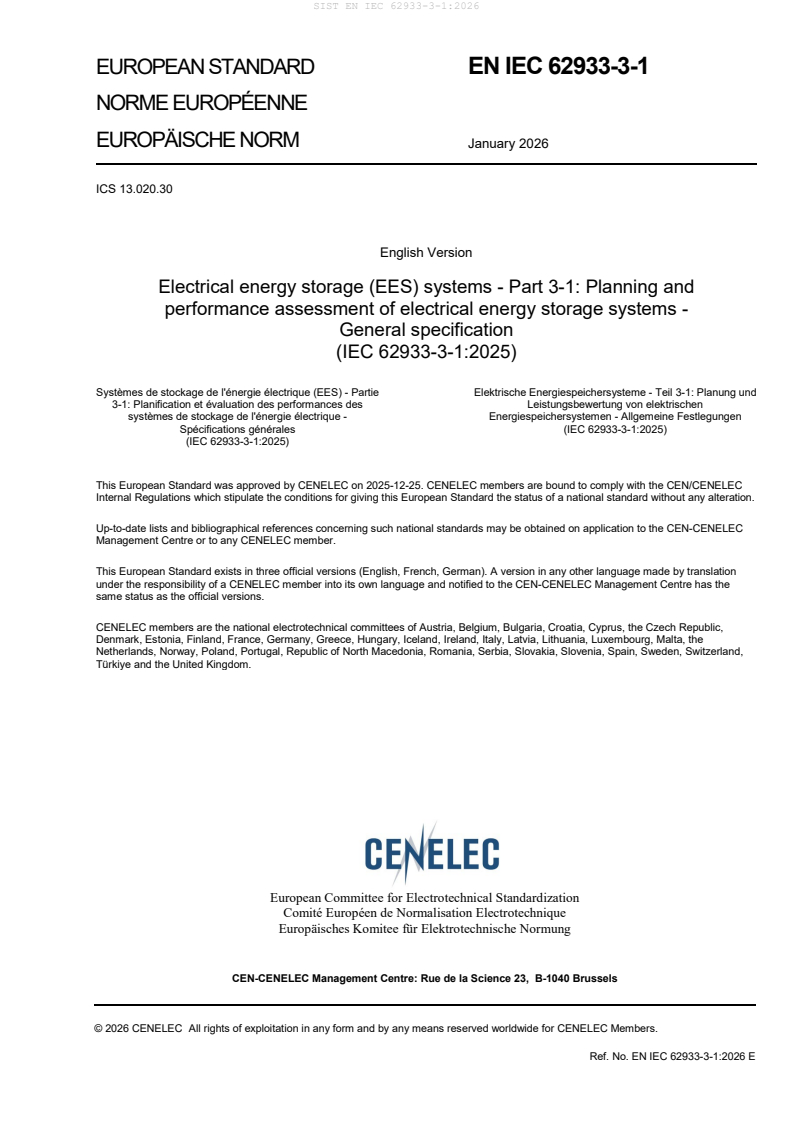
EUROPEAN STANDARD EN IEC 62933-3-1
NORME EUROPÉENNE
EUROPÄISCHE NORM January 2026
ICS 13.020.30
English Version
Electrical energy storage (EES) systems - Part 3-1: Planning and
performance assessment of electrical energy storage systems -
General specification
(IEC 62933-3-1:2025)
Systèmes de stockage de l'énergie électrique (EES) - Partie Elektrische Energiespeichersysteme - Teil 3-1: Planung und
3-1: Planification et évaluation des performances des Leistungsbewertung von elektrischen
systèmes de stockage de l'énergie électrique - Energiespeichersystemen - Allgemeine Festlegungen
Spécifications générales (IEC 62933-3-1:2025)
(IEC 62933-3-1:2025)
This European Standard was approved by CENELEC on 2025-12-25. CENELEC members are bound to comply with the CEN/CENELEC
Internal Regulations which stipulate the conditions for giving this European Standard the status of a national standard without any alteration.
Up-to-date lists and bibliographical references concerning such national standards may be obtained on application to the CEN-CENELEC
Management Centre or to any CENELEC member.
This European Standard exists in three official versions (English, French, German). A version in any other language made by translation
under the responsibility of a CENELEC member into its own language and notified to the CEN-CENELEC Management Centre has the
same status as the official versions.
CENELEC members are the national electrotechnical committees of Austria, Belgium, Bulgaria, Croatia, Cyprus, the Czech Republic,
Denmark, Estonia, Finland, France, Germany, Greece, Hungary, Iceland, Ireland, Italy, Latvia, Lithuania, Luxembourg, Malta, the
Netherlands, Norway, Poland, Portugal, Republic of North Macedonia, Romania, Serbia, Slovakia, Slovenia, Spain, Sweden, Switzerland,
Türkiye and the United Kingdom.
European Committee for Electrotechnical Standardization
Comité Européen de Normalisation Electrotechnique
Europäisches Komitee für Elektrotechnische Normung
CEN-CENELEC Management Centre: Rue de la Science 23, B-1040 Brussels
© 2026 CENELEC All rights of exploitation in any form and by any means reserved worldwide for CENELEC Members.
Ref. No. EN IEC 62933-3-1:2026 E
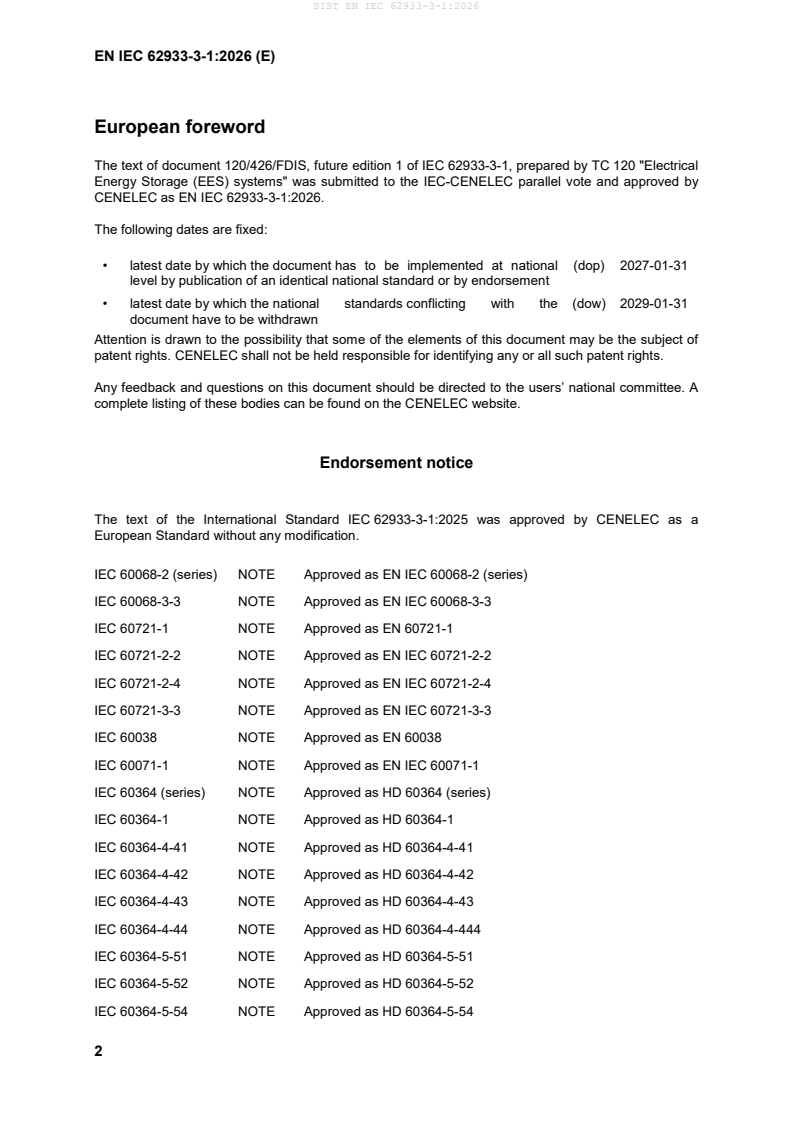
European foreword
The text of document 120/426/FDIS, future edition 1 of IEC 62933-3-1, prepared by TC 120 "Electrical
Energy Storage (EES) systems" was submitted to the IEC-CENELEC parallel vote and approved by
CENELEC as EN IEC 62933-3-1:2026.
The following dates are fixed:
• latest date by which the document has to be implemented at national (dop) 2027-01-31
level by publication of an identical national standard or by endorsement
• latest date by which the national standards conflicting with the (dow) 2029-01-31
document have to be withdrawn
Attention is drawn to the possibility that some of the elements of this document may be the subject of
patent rights. CENELEC shall not be held responsible for identifying any or all such patent rights.
Any feedback and questions on this document should be directed to the users’ national committee. A
complete listing of these bodies can be found on the CENELEC website.
Endorsement notice
The text of the International Standard IEC 62933-3-1:2025 was approved by CENELEC as a
European Standard without any modification.
IEC 60068-2 (series) NOTE Approved as EN IEC 60068-2 (series)
IEC 60068-3-3 NOTE Approved as EN IEC 60068-3-3
IEC 60721-1 NOTE Approved as EN 60721-1
IEC 60721-2-2 NOTE Approved as EN IEC 60721-2-2
IEC 60721-2-4 NOTE Approved as EN IEC 60721-2-4
IEC 60721-3-3 NOTE Approved as EN IEC 60721-3-3
IEC 60038 NOTE Approved as EN 60038
IEC 60071-1 NOTE Approved as EN IEC 60071-1
IEC 60364 (series) NOTE Approved as HD 60364 (series)
IEC 60364-1 NOTE Approved as HD 60364-1
IEC 60364-4-41 NOTE Approved as HD 60364-4-41
IEC 60364-4-42 NOTE Approved as HD 60364-4-42
IEC 60364-4-43 NOTE Approved as HD 60364-4-43
IEC 60364-4-44 NOTE Approved as HD 60364-4-444
IEC 60364-5-51 NOTE Approved as HD 60364-5-51
IEC 60364-5-52 NOTE Approved as HD 60364-5-52
IEC 60364-5-54 NOTE Approved as HD 60364-5-54
IEC 60364-7-712 NOTE Approved as FprHD 60364-7-712 to be published
IEC 62933-5-2 NOTE Approved as EN IEC 62933-5-2
IEC 61000-2-2 NOTE Approved as EN 61000-2-2
IEC 61000-3-2 NOTE Approved as EN IEC 61000-3-2
IEC 61000-3-3 NOTE Approved as EN 61000-3-3
IEC 61000-3-11 NOTE Approved as EN IEC 61000-3-11
IEC 61000-3-12 NOTE Approved as EN 61000-3-12
IEC 61000-6-1 NOTE Approved as EN IEC 61000-6-1
IEC 61000-6-2 NOTE Approved as EN IEC 61000-6-2
IEC 61000-6-3 NOTE Approved as EN IEC 61000-6-3
IEC 61000-6-4 NOTE Approved as EN IEC 61000-6-4
IEC 61000-6-5 NOTE Approved as EN 61000-6-5
IEC 60870-5-101 NOTE Approved as EN 60870-5-101
IEC 60870-5-104 NOTE Approved as EN 60870-5-104
IEC 60870-6 (series) NOTE Approved as EN 60870-6 (series)
IEC 61850-7-420 NOTE Approved as EN IEC 61850-7-420
Annex ZA
(normative)
Normative references to international publications
with their corresponding European publications
The following documents are referred to in the text in such a way that some or all of their content
constitutes requirements of this document. For dated references, only the edition cited applies. For
undated references, the latest edition of the referenced document (including any amendments)
applies.
NOTE 1 Where an International Publication has been modified by common modifications, indicated by (mod),
the relevant EN/HD applies.
NOTE 2 Up-to-date information on the latest versions of the European Standards listed in this annex is available
here: www.cencenelec.eu.
Publication Year Title EN/HD Year
IEC 60721-1 - Classification of environmental conditions - EN 60721-1 -
Part 1: Environmental parameters and their
severities
IEC 61850 series Communication networks and systems for EN 61850 series
power utility automation - Part 10:
Conformance testing
IEC 62351 series Power systems management and EN 62351 series
associated information exchange - Data
and communications security - Part 11:
Security for XML documents
IEC 62443 series Security for industrial automation and EN IEC 62443-4 series
control systems - Part 4-2: Technical
security requirements for IACS
components
IEC 62933-1 2024 Electrical energy storage (EES) systems - EN IEC 62933-1 2024
Part 1: Vocabulary
IEC 62933-2-1 2017 Electrical energy storage (EES) systems - EN IEC 62933-2-1 2018
Part 2-1: Unit parameters and testing
methods - General specification
IEC 62933-5-1 - Electrical energy storage (EES) systems - EN IEC 62933-5-1 -
Part 5-1: Safety considerations for grid-
integrated EES systems - General
specification
ISO/IEC 27000 - Information technology - Security - -
techniques - Information security
management systems - Overview and
vocabulary
IEC 62933-3-1 ®
Edition 1.0 2025-11
INTERNATIONAL
STANDARD
Electrical energy storage (EES) systems -
Part 3-1: Planning and performance assessment of electrical energy storage
systems - General specification
ICS 13.020.30 ISBN 978-2-8327-0813-2
IEC 62933-3-1:2025-11(en)
IEC 62933-3-1:2025 © IEC 2025
CONTENTS
FOREWORD . 6
INTRODUCTION . 8
1 Scope . 9
2 Normative references . 9
3 Terms, definitions and symbols . 10
3.1 Terms and definitions . 10
3.2 Symbols . 10
4 General information about EES systems . 10
4.1 Main functional aspects . 10
4.2 Architecture of an EES system . 10
4.3 Subsystem specifications . 11
4.3.1 General. 11
4.3.2 Accumulation subsystem . 12
4.3.3 Power conversion subsystem . 13
4.3.4 Auxiliary subsystem . 13
4.3.5 Control subsystem . 14
4.4 Main electrical parameters of EES systems . 15
4.4.1 General. 15
4.4.2 Active input and output power rating . 16
4.4.3 Rated energy storage capacity . 16
4.4.4 Response time. 17
4.4.5 Rated reactive power . 17
4.4.6 Auxiliary power consumption . 17
4.4.7 Self-discharge . 17
4.4.8 Roundtrip efficiency . 18
4.4.9 Duty cycle roundtrip efficiency . 18
4.4.10 Recovery time . 18
4.4.11 Asset lifetime and end-of-service life values . 18
4.4.12 Maintenance and repair time for availability . 19
5 Planning and design of EES systems . 20
5.1 General . 20
5.2 Overview EES system planning and design process . 20
5.3 Functional purpose and applications of EES systems . 23
5.3.1 General. 23
5.3.2 Power intensive applications . 23
5.3.3 Renewable energy sources integration related applications . 23
5.3.4 Energy intensive applications . 24
5.3.5 Backup power applications . 24
5.3.6 Multi-function applications. 24
5.4 Duty cycle at primary POC . 25
5.5 Selection of the EES system and preliminary sizing . 27
5.5.1 Requirements and constraints for EES system sizing . 27
5.5.2 Preliminary sizing procedure according to duty cycle and primary POC . 30
5.6 EES system environment . 32
5.6.1 General. 32
5.6.2 Grid parameters and requirements . 32
IEC 62933-3-1:2025 © IEC 2025
5.6.3 Grid integration of the EES systems . 33
5.6.4 Service conditions . 34
5.6.5 Standards and local regulations . 35
5.7 Conditions and requirements for connection to the grid . 36
5.7.1 General. 36
5.7.2 Power system profile at the POC . 37
5.7.3 System safety . 37
5.7.4 Availability . 37
5.7.5 Requirements and characteristics regarding security . 38
5.8 Operational requirements . 38
5.8.1 Monitoring . 38
5.8.2 Maintenance . 39
5.9 Final sizing . 40
5.9.1 Considerations for final sizing . 40
5.9.2 Energy storage capacity value related to specified conditions . 40
5.9.3 Efficiency value related to specified conditions. 45
5.9.4 Final sizing results . 48
5.10 Control subsystem . 50
5.10.1 Control subsystem aspects . 50
5.10.2 Operation states of control subsystem . 51
5.10.3 Operation and control . 57
5.11 Communication interface . 59
5.11.1 Communication interface (to external systems) . 59
5.11.2 Information model for an EES system. 59
5.11.3 Remote monitoring and control . 61
6 Performance assessment and service life of EES system . 66
6.1 Factory acceptance test (FAT) . 66
6.2 Installation and commissioning . 67
6.2.1 General. 67
6.2.2 Installation phase . 67
6.2.3 Commissioning phase . 68
6.3 Site acceptance test (SAT) . 70
6.4 Lifetime of EES systems . 71
6.4.1 General. 71
6.4.2 Performance assessment . 71
6.4.3 Performance monitoring phase . 71
6.5 EES system decommissioning. 73
6.6 Inspection and test aspects . 73
Annex A (informative) EES system applications . 76
A.1 EES system for power support at an electric charging station . 76
A.2 EES system designed for frequency control . 78
A.2.1 General. 78
A.2.2 Example of an EES system for primary frequency control . 78
A.2.3 Example of an EES system for secondary frequency control . 80
A.2.4 Example of an EES system for dynamic frequency control . 81
A.3 EES system in conjunction with renewable energy production . 82
A.3.1 General. 82
A.3.2 Example of EES system for renewable (energy) firming . 82
IEC 62933-3-1:2025 © IEC 2025
A.3.3 Example of EES system for renewable (power) smoothing . 83
A.3.4 Example of EES system in PV-EESS-EV charging station application . 84
A.3.5 Example of EES system as a black start resource for PV plant . 85
A.4 EES system for grid support applications . 86
A.4.1 Example of an EES system for grid voltage support (Q(U) control mode) . 86
A.4.2 Example of an EES system for power quality support by voltage-related
active power injection . 89
Annex B (informative) Aspects to consider with regard to EES system installation . 91
B.1 Feasibility and permission . 91
B.2 Basic planned activities for feasibility study . 92
B.2.1 General. 92
B.2.2 Phase – Prefeasibility activities . 92
B.2.3 Phase – Project documents . 92
B.2.4 Phase – Authorization process . 93
B.2.5 Process for obtaining a permit . 93
B.3 Site-assembling . 94
B.4 Protection against disaster – Fire prevention . 94
B.5 Transportation and on-site storage . 94
Annex C (informative) Aspects considered with regard to EES system
decommissioning . 95
C.1 General . 95
C.2 Decommissioning plan . 96
C.2.1 General. 96
C.2.2 Phase – EES system description and notification . 97
C.2.3 Phase – Estimation of decommissioning cost . 97
C.2.4 Phase – EES system decommissioning . 97
C.2.5 Phase – EES system material and components removal and recycling . 98
C.2.6 Phase – EES system dismantling, demolition, removing, packing and
site clearance . 99
C.2.7 Phase – EES system site rehabilitation . 99
Bibliography . 101
Figure 1 – Typical architectures of EES systems. 11
Figure 2 – Example of classification of EES systems according to energy form . 12
Figure 3 – EES system typical architecture with detailed structure of management
subsystem . 15
Figure 4 – Sample performance versus time characteristics for EES systems . 19
Figure 5 – Sample consideration to design the service life of EES systems . 19
Figure 6 – Overview about the aspects of planning of EES systems . 21
Figure 7 – Overview of EES system sizing process . 22
Figure 8 – Example of EES planning process with multi-scenario applications . 24
Figure 9 – Determination of auxiliary power for an EES system without auxiliary POC . 42
Figure 10 – Example of EES system operation states . 52
Figure 11 – Example for P(f) strategy . 53
Figure 12 – Example of setting of active output power at primary POC . 54
Figure 13 – Example of day pattern operation at primary POC . 55
Figure 14 – Example of peak shaving application . 55
IEC 62933-3-1:2025 © IEC 2025
Figure 15 – Example of a general control characteristic . 57
Figure 16 – Reference diagram for information exchange . 60
Figure 17 – EES system as an aggregation of several EES systems at the same
primary POC . 60
Figure 18 – Example of an information model hierarchy of an EES system . 63
Figure A.1 – Sample requirements for an EES system at an electric charging station . 76
Figure A.2 – Design duty cycle of an EES system at an electric charging station . 78
Figure A.3 – Sample duty cycle for a primary frequency control application with 30 s
power output every 30 min shown over 2 h . 79
Figure A.4 – Sample power output for a secondary frequency control application with
20 min power output over 3 h . 80
Figure A.5 – Sample output power of an EES system for a dynamic frequency control
application in spring, summer, autumn and winter . 81
Figure A.6 – Sample output power of an EES system in a renewable (solar) energy
firming application . 83
Figure A.7 – Sample output power of an EES system for a renewable (solar) power
smoothing application . 84
Figure A.8 – Sample output power of an EES system for an PV-EESS-EV charging
station application . 85
Figure A.9 – Bus voltages and active power of the PV plant in black start of the PV
plant with BESS . 86
Figure A.10 – Example of grid voltage at the POC of a photovoltaic power plant . 87
Figure A.11 – Sample reactive power supply of an EES system at the POC . 88
Figure A.12 – Sample duty cycle for power quality support by voltage-related active
power injection with 5 min power output every 45 min over 12 h . 90
Figure B.1 – Typical phases in the project cycle management . 91
Figure C.1 – Typical phases in the project cycle management . 95
Table 1 – Points of attention for planning phase . 16
Table 2 – Typical multi-scenario applications of EES systems . 25
Table 3 – Example of day pattern operation . 55
Table 4 – Example for messages of measurement and monitoring categories versus
categories of messages . 62
Table 5 – Example of messages of an EES system information model . 64
Table 6 – Example of items to be taken into account . 68
Table 7 – Points of attention for commissioning phase (parameter tests) . 70
Table 8 – Points of attention for performance monitoring phase. 72
Table 9 – Example of local measurements and monitoring of EES system . 72
Table 10 – Example of inspection items for EES system and its subsystems classified
according to different points of time in the service life time . 74
Table A.1 – Sample design duty cycle and sizing values of an EES system at an
electric charging station . 77
Table A.2 – Sample values of a duty cycle for primary frequency control for sudden
loss of generation . 79
Table A.3 – Sample values of recovery time for primary frequency control for sudden
loss of generation . 79
IEC 62933-3-1:2025 © IEC 2025
Table A.4 – Sample values of a duty cycle for secondary frequency control for sudden
loss of generation . 80
Table A.5 – Sample values of a duty cycle for dynamic primary frequency control . 82
Table A.6 – Sample values of a duty cycle for renewable (energy) firming . 83
Table A.7 – EES system’s operation mode for the case of a commercial charging
station based on common AC bus . 85
Table A.8 – Sample values of a duty cycle for a commercial PV-EESS-EV charging
station . 85
Table A.9 – Sample values of a duty cycle for grid voltage support by Q(U) control
mode. 88
Table A.10 – Sample values of a duty cycle for power quality . 89
IEC 62933-3-1:2025 © IEC 2025
INTERNATIONAL ELECTROTECHNICAL COMMISSION
____________
Electrical energy storage (EES) systems -
Part 3-1: Planning and performance assessment of
electrical energy storage systems - General specification
FOREWORD
1) The International Electrotechnical Commission (IEC) is a worldwide organization for standardization comprising
all national electrotechnical committees (IEC National Committees). The object of IEC is to promote international
co-operation on all questions concerning standardization in the electrical and electronic fields. To this end and
in addition to other activities, IEC publishes International Standards, Technical Specifications, Technical Reports,
Publicly Available Specifications (PAS) and Guides (hereafter referred to as “IEC Publication(s)”). Their
preparation is entrusted to technical committees; any IEC National Committee interested in the subject dealt with
may participate in this preparatory work. International, governmental and non-governmental organizations liaising
with the IEC also participate in this preparation. IEC collaborates closely with the International Organization for
Standardization (ISO) in accordance with conditions determined by agreement between the two organizations.
2) The formal decisions or agreements of IEC on technical matters express, as nearly as possible, an international
consensus of opinion on the relevant subjects since each technical committee has representation from all
interested IEC National Committees.
3) IEC Publications have the form of recommendations for international use and are accepted by IEC National
Committees in that sense. While all reasonable efforts are made to ensure that the technical content of IEC
Publications is accurate, IEC cannot be held responsible for the way in which they are used or for any
misinterpretation by any end user.
4) In order to promote international uniformity, IEC National Committees undertake to apply IEC Publications
transparently to the maximum extent possible in their national and regional publications. Any divergence between
any IEC Publication and the corresponding national or regional publication shall be clearly indicated in the latter.
5) IEC itself does not provide any attestation of conformity. Independent certification bodies provide conformity
assessment services and, in some areas, access to IEC marks of conformity. IEC is not responsible for any
services carried out by independent certification bodies.
6) All users should ensure that they have the latest edition of this publication.
7) No liability shall attach to IEC or its directors, employees, servants or agents including individual experts and
members of its technical committees and IEC National Committees for any personal injury, property damage or
other damage of any nature whatsoever, whether direct or indirect, or for costs (including legal fees) and
expenses arising out of the publication, use of, or reliance upon, this IEC Publication or any other IEC
Publications.
8) Attention is drawn to the Normative references cited in this publication. Use of the referenced publications is
indispensable for the correct application of this publication.
9) IEC draws attention to the possibility that the implementation of this document may involve the use of (a)
patent(s). IEC takes no position concerning the evidence, validity or applicability of any claimed patent rights in
respect thereof. As of the date of publication of this document, IEC had not received notice of (a) patent(s), which
may be required to implement this document. However, implementers are cautioned that this may not represent
the latest information, which may be obtained from the patent database available at https://patents.iec.ch. IEC
shall not be held responsible for identifying any or all such patent rights.
IEC 62933-3-1 has been prepared by IEC technical committee TC 120: Electrical Energy
Storage (EES) systems. It is an International Standard.
This first edition cancels and replaces the first edition of IEC TS 62933-3-1 published in 2018.
This edition constitutes a technical revision.
This edition includes the following significant technical changes with respect to the previous
edition:
a) improvements regarding design and sizing of an EES system;
b) adding "EES system decommissioning";
c) adding "Inspection and test aspects";
d) adding "Feasibility and permission";
IEC 62933-3-1:2025 © IEC 2025
e) adding "Basic planned activities for feasibility study";
f) adding "Aspects considered with regard to EES system decommissioning".
The text of this International Standard is based on the following documents:
Draft Report on voting
120/426/FDIS 120/442/RVD
Full information on the voting for its approval can be found in the report on voting indicated in
the above table.
The language used for the development of this International Standard is English.
This document was drafted in accordance with ISO/IEC Directives, Part 2, and developed in
accordance with ISO/IEC Directives, Part 1 and ISO/IEC Directives, IEC Supplement, available
at www.iec.ch/members_experts/refdocs. The main document types developed by IEC are
described in greater detail at www.iec.ch/publications.
A list of all parts in the IEC 62933 series, published under the general title Electrical energy
storage (EES) systems, can be found on the IEC website.
The committee has decided that the contents of this document will remain unchanged until the
stability date indicated on the IEC website under webstore.iec.ch in the data related to the
specific document. At this date, the document will be
– reconfirmed,
– withdrawn, or
– revised.
IEC 62933-3-1:2025 © IEC 2025
INTRODUCTION
IEC 62933-2-1 should be used as a reference when selecting testing items and their
corresponding evaluation methods as well as principal parameters. The principal terms used in
this document are defined in IEC 62933-1. Environmental issues are covered by
IEC TS 62933-4-1. The personnel safety issues are covered by IEC 62933-5-1.
IEC 62933-3-1:2025 © IEC 2025
1 Scope
This part of IEC 62933 is applicable to EES systems designed for grid-connected indoor or
outdoor installation and operation. This document considers:
– necessary functions and capabilities of EES systems;
– sizing and design of EES system;
– operation of EES system;
– test items and performance assessment methods for EES systems;
– requirements for monitoring and acquisition of EES system operating parameters;
– exchange of system information and control capabilities required;
– maintenance of EES system.
Stakeholders of this document comprise personnel involved with EES systems, which include:
– planners of electric power systems and EES systems;
– owners of EES systems;
– operators of electric power systems and EES systems;
– constructors;
– suppliers of EES systems and its equipment;
– aggregators.
Use-case-specific technical documentation, including planning and installation specific tasks
such as system design, monitoring, measurement, tests, operation and maintenance, are very
important and can be found throughout this document.
NOTE This document has been written for AC grids, however parts can also apply to DC grids.
2 Normative references
The following documents are referred to in the text in such a way that some or all of their content
constitutes requirements of this document. For dated references, only the edition cited applies.
For undated references, the latest edition of the referenced document (including any
amendments) applies.
IEC 60721-1, Classification of environmental conditions - Part 1: Environmental parameters and
their severities
IEC 61850 (all parts), Communication networks and systems for power utility automation
IEC 62351 (all parts), Power systems management and associated information exchange - Data
and communications security
IEC 62443 (all parts), Industrial communication networks - Network and system security
IEC 62933-1:2024, Electrical energy storage (EES) systems - Part 1: Vocabulary
IEC 62933-2-1:2017, Electrical energy storage (EES) systems - Part 2-1: Unit parameters and
testing methods - General specification
IEC 62933-5-1, Electrical energy storage (EES) systems - Part 5-1: Safety considerations for
grid-integrated EES systems - General specification
IEC 62933-3-1:2025 © IEC 2025
ISO/IEC 27000, Information technology - Security techniques - Information security
management systems - Overview and vocabulary
3 Terms, definitions and symbols
3.1 Terms and definitions
For the purposes of this document, the terms and definitions given in IEC 62933-1 apply.
ISO and IEC maintain terminological databases for use in standardization at the following
addresses:
– IEC Electropedia: available at http://www.electropedia.org
– ISO Online browsing platform: available at http://www.iso.org/obp
3.2 Symbols
cosφ power factor
E energy
E energy storage capacity
C
ɳ efficiency
f frequency
I current
P active power
Q reactive power
S apparent power
SOE state of energy
SOH state of health
U voltage
4 General information about EES systems
4.1 Main functional aspects
According to IEC 62933-1 an EES system is a grid-connected installation with defined electrical
boundaries, comprising at least one electrical energy storage unit, which extracts electrical
energy from an electric power system, stores this energy internally in some manner and injects
electrical energy into an electric power system. An EES system can include civil engineering
works, energy conversion equipment and related ancillary equipment. The EES system is
controlled and coordinated to provide services to the electric power system operators or to the
electric power system users.
4.2 Architecture of an EES system
The typical architecture of an EES system, which internally feeds the auxiliary subsystem, is
given in Figure 1 a).
IEC 62933-3-1:2025 © IEC 2025
a) EES system without auxiliary POC
b) EES system with auxiliary POC
Figure 1 – Typical architectures of EES systems
If the auxiliary subsystem is fed from another feeder, the optional architecture of an EES system
is shown in Figure 1 b).
4.3 Subsystem specifications
4.3.1 General
To meet the requirements of the entire EES system, it is necessary to break down the system
requirements to the requirements of the subsystems. The requirements for the subsystems shall
be formulated in a general and technology-independent manner but requirements arising from
the subsystems (e.g. regarding safety or maintenance), which are technology dependent, shall
also be considered.
Constraints and deratings regarding power rating, available energy, ambient conditions and
other internal or external aspects shall also be considered for all subsystems.
The requirements of the subsystems of an EES system are described in 4.3.2 to 4.3.5. In
general, for all subsystems, the contribution to the overall system efficiency, for example
roundtrip efficiency, shall be indicated.
IEC 62933-3-1:2025 © IEC 2025
4.3.2 Accumulation subsystem
The energy storage capacity of the accumulation subsystem of the EES system has to be
evaluated in an appropriate way with respect to the energy form (e.g. mechanical or
electrochemical). The energy storage capacity of the accumulation subsystem directly
influences the rated input and output energy capacity at the primary point of connection (POC),
i.e. it influences the active input and output power values at the primary POC as well as the
duration the active input and output power can be applied at the primary POC.
A widely-used approach for classifying EES systems is the determination according to the form
of energy used in the accumulation subsystem. A classification example of EES systems
according to energy form in the accumulation subsystem is shown in Figure 2.
Figure 2 – Example of classification of EES systems according to energy form
Accumulation subsystems shall meet performance specifications such as energy storage
capacity as well as input and output power throughout their service life. This includes their
service life under use conditions such as operation patterns (see IEC 62933-1:2024, Figure 1),
environmental conditions, maintenance cycle, etc.
a) General requirements
The following information shall be provided irrespective of the technology applied:
For each accumulation subsystem the energy storage capacity and the maximum charge and
discharge power shall be considered because this has a direct influence on the overall EES
system.
Also, the present energy content is important for the EES system. A forecast method, i.e. how
the resulting energy content after charging or discharging with a certain power for a certain time
can be estimated, shall be given.
Typical service life values (possibly differentiated into cyclical and calendrical ageing) shall be
specified. Information on the energy and power density shall also be given to be able to make
a comparison with other accumulation subsystems if necessary.
Information about necessary service and maintenance cycles shall be given. The auxiliary
power demand of the accumulation subsystem shall also be provided, if applicable. Furthermore,
efficiency parameters of the accumulation subsystem shall be provided:
– charging efficiency of the accumulation subsystem;
IEC 62933-3-1:2025 © IEC 2025
– discharging efficiency of the accumulation subsystem;
– self-discharge or "energy storage efficiency" of the accumulation subsystem.
b) Specific requirements
If there are requirements that are specific to the accumulation technology applied, then these
requirements shall be provided. For example, if a reduction in charging or discharging power is
necessary in certain operating areas, this shall be indicated. Special regulations can apply for
the accumulation subsystem (for example, for disposal). If
...