

SIST EN 14439:2025
(Main)Cranes - Tower cranes
General Information
- Abstract
This document specifies safety requirements:
- for tower cranes;
- for climbing systems for tower cranes erected from parts.
This document applies to tower cranes for construction works, which are either erected by parts or self-erecting cranes, including mobile self-erecting tower cranes. Tower cranes for construction works are exclusively equipped with a hook as load-handling device.
This document is applicable to tower cranes to be operated outdoors at ambient temperature between
-20 °C and +40 °C.
This document is not applicable to tower cranes, which are permanently installed on a yard or integrated in a manufacturing process, resulting in a significantly different classification of the crane and its mechanisms, or which are equipped with a grab or when a sudden release of the load is intended, resulting in significantly different load actions and number of stress cycles.
This document is not applicable to mobile cranes, mobile harbour cranes, crawler cranes, slewing jib cranes, bridge and gantry cranes, offshore cranes, floating cranes, loader cranes, hand operated cranes or railway cranes.
This document deals with significant hazards, hazardous situations and events relevant to tower cranes, it is used as intended and under conditions of misuse which are reasonably foreseeable by the manufacturer. This document specifies the appropriate technical measures to eliminate or reduce risks arising from the significant hazards (see Annex A).
The significant hazards covered by this document are identified in Annex A.
This document covers hazards related to the lifting of persons using a climbing system for tower cranes as defined in 3.6, 3.6.1 and 3.6.2. The lifting of persons by a tower crane itself is not included.
The requirements related to Electromagnetic compatibility (EMC), the specific hazards due to external influence on electrical equipment, potentially explosive atmospheres and ionising radiation are not covered by this document.
To improve readability, additional requirements for climbing systems are given in Annex E of this document. Additional requirements for mobile self-erecting tower cranes are given in Annex B of this document.
This document is not applicable to tower cranes and climbing systems which are manufactured before the date of publication by CEN of this document.
- Status
- Published
- Public Enquiry End Date
- 30-Jul-2018
- Publication Date
- 02-Oct-2025
- Technical Committee
- DTN - Lift and transport appliances
- Current Stage
- 6060 - National Implementation/Publication (Adopted Project)
- Start Date
- 02-Jul-2025
- Due Date
- 06-Sep-2025
- Completion Date
- 03-Oct-2025
- Directive
- 2006/42/EC - Directive 2006/42/EC of the European Parliament and of the Council of 17 May 2006 on machinery, and amending Directive 95/16/EC (recast)OJ Ref: L 2026/546, STANDARD TIPA C OJ Date: 13-Mar-2026
- Ref Project
EN 14439:2025 - Cranes - Tower cranes


Overview
SIST EN 14439:2025 (identical to EN 14439:2025) is the updated European standard specifying safety requirements for tower cranes and for climbing systems used when tower cranes are erected from parts. It applies to tower cranes for construction works (erected by parts or self‑erecting, including mobile self‑erecting tower cranes) that are fitted exclusively with a hook and operated outdoors at ambient temperatures between -20 °C and +40 °C. This standard supersedes EN 14439:2006+A2:2009 and addresses significant hazards, foreseeable misuse, verification and documentation required for safe design, manufacture, erection and use.
Key topics and technical requirements
The standard covers comprehensive technical and safety topics, including:
- Design requirements for load‑bearing structures (classification of parts, loads, load combinations, limit states and structural proof)
- Mechanical equipment (mechanisms, ropes, wheels, slewing bearings, hooks)
- Hydraulic systems (cylinders, system requirements)
- Electrical equipment and control systems (controls, limiters, indicators, lighting)
- Access and guarding (means of access, fall prevention, guarding requirements)
- Other design aspects (trolley stops, prevention of falling components, slew device settings, noise reduction and fire protection)
- Verification and testing (function tests, static/dynamic load tests, stability checks and noise measurement procedures)
- Information for use (instruction manuals, erection/dismantling guidance, maintenance, transport, marking and warnings)
Annexes provide focused rules:
- Annex A: significant hazards list (informative)
- Annix B: additional requirements for mobile self‑erecting tower cranes (normative)
- Annix E: additional requirements for climbing systems (normative)
- Annex C/D: verification, load tests and noise test code
Exclusions: the standard does not apply to permanently fixed cranes integrated into manufacturing processes, cranes equipped with grabs, or to other crane types (mobile, harbour, crawler, slewing jib, bridge/gantry, offshore, floating, loader, hand‑operated or railway cranes). EMC, explosive atmospheres and ionising radiation hazards are not covered.
Practical applications and who uses it
SIST EN 14439:2025 is essential for:
- Crane manufacturers and designers verifying structural, mechanical and control compliance
- Safety and compliance engineers, conformity assessors and notified bodies
- Construction companies, site planners and erection teams for safe installation, operation and dismantling
- Maintenance personnel and inspectors for periodic checks, tests and documentation
- Regulators and procurement specialists ensuring conformity with EU Machinery Directive requirements (see Annex ZA)
By following SIST EN 14439:2025, stakeholders improve on‑site safety, reduce risk of structural/mechanical failures and ensure clear, standardized documentation and marking for tower cranes used in construction.
Related standards / references
- EN 14439:2025 is part of the crane standards set; users should consult related CEN crane standards and national implementations for specific conformity procedures and complementary safety guidance.
Relations
- Effective Date
- 27-May-2026
- Effective Date
- 08-Apr-2026
- Effective Date
- 01-Apr-2026
- Effective Date
- 11-Mar-2026
- Effective Date
- 09-Feb-2026
- Effective Date
- 09-Feb-2026
- Effective Date
- 09-Feb-2026
- Effective Date
- 09-Feb-2026
- Effective Date
- 09-Feb-2026
- Effective Date
- 09-Feb-2026
- Effective Date
- 09-Feb-2026
- Effective Date
- 09-Feb-2026
- Effective Date
- 09-Feb-2026
- Effective Date
- 09-Feb-2026
- Effective Date
- 09-Feb-2026
Frequently Asked Questions
SIST EN 14439:2025 is a standard published by the Slovenian Institute for Standardization (SIST). Its full title is "Cranes - Tower cranes". This standard covers: This document specifies safety requirements: - for tower cranes; - for climbing systems for tower cranes erected from parts. This document applies to tower cranes for construction works, which are either erected by parts or self-erecting cranes, including mobile self-erecting tower cranes. Tower cranes for construction works are exclusively equipped with a hook as load-handling device. This document is applicable to tower cranes to be operated outdoors at ambient temperature between -20 °C and +40 °C. This document is not applicable to tower cranes, which are permanently installed on a yard or integrated in a manufacturing process, resulting in a significantly different classification of the crane and its mechanisms, or which are equipped with a grab or when a sudden release of the load is intended, resulting in significantly different load actions and number of stress cycles. This document is not applicable to mobile cranes, mobile harbour cranes, crawler cranes, slewing jib cranes, bridge and gantry cranes, offshore cranes, floating cranes, loader cranes, hand operated cranes or railway cranes. This document deals with significant hazards, hazardous situations and events relevant to tower cranes, it is used as intended and under conditions of misuse which are reasonably foreseeable by the manufacturer. This document specifies the appropriate technical measures to eliminate or reduce risks arising from the significant hazards (see Annex A). The significant hazards covered by this document are identified in Annex A. This document covers hazards related to the lifting of persons using a climbing system for tower cranes as defined in 3.6, 3.6.1 and 3.6.2. The lifting of persons by a tower crane itself is not included. The requirements related to Electromagnetic compatibility (EMC), the specific hazards due to external influence on electrical equipment, potentially explosive atmospheres and ionising radiation are not covered by this document. To improve readability, additional requirements for climbing systems are given in Annex E of this document. Additional requirements for mobile self-erecting tower cranes are given in Annex B of this document. This document is not applicable to tower cranes and climbing systems which are manufactured before the date of publication by CEN of this document.
This document specifies safety requirements: - for tower cranes; - for climbing systems for tower cranes erected from parts. This document applies to tower cranes for construction works, which are either erected by parts or self-erecting cranes, including mobile self-erecting tower cranes. Tower cranes for construction works are exclusively equipped with a hook as load-handling device. This document is applicable to tower cranes to be operated outdoors at ambient temperature between -20 °C and +40 °C. This document is not applicable to tower cranes, which are permanently installed on a yard or integrated in a manufacturing process, resulting in a significantly different classification of the crane and its mechanisms, or which are equipped with a grab or when a sudden release of the load is intended, resulting in significantly different load actions and number of stress cycles. This document is not applicable to mobile cranes, mobile harbour cranes, crawler cranes, slewing jib cranes, bridge and gantry cranes, offshore cranes, floating cranes, loader cranes, hand operated cranes or railway cranes. This document deals with significant hazards, hazardous situations and events relevant to tower cranes, it is used as intended and under conditions of misuse which are reasonably foreseeable by the manufacturer. This document specifies the appropriate technical measures to eliminate or reduce risks arising from the significant hazards (see Annex A). The significant hazards covered by this document are identified in Annex A. This document covers hazards related to the lifting of persons using a climbing system for tower cranes as defined in 3.6, 3.6.1 and 3.6.2. The lifting of persons by a tower crane itself is not included. The requirements related to Electromagnetic compatibility (EMC), the specific hazards due to external influence on electrical equipment, potentially explosive atmospheres and ionising radiation are not covered by this document. To improve readability, additional requirements for climbing systems are given in Annex E of this document. Additional requirements for mobile self-erecting tower cranes are given in Annex B of this document. This document is not applicable to tower cranes and climbing systems which are manufactured before the date of publication by CEN of this document.
SIST EN 14439:2025 is classified under the following ICS (International Classification for Standards) categories: 53.020.20 - Cranes. The ICS classification helps identify the subject area and facilitates finding related standards.
SIST EN 14439:2025 has the following relationships with other standards: It is inter standard links to SIST EN 13001-3-8:2026, SIST EN 13001-3-6:2018, SIST EN 13001-3-6:2026, SIST ISO 4306-1:2012, SIST ISO 8566-3:2012, SIST ISO 7752-3:2015, SIST EN 62745:2017, SIST ISO 3864-2:2017, SIST ISO 3864-3:2024, SIST ISO 3864-1:2012, SIST ISO 12488-1:2015, SIST EN IEC 61496-3:2019, SIST ISO 16625:2015, SIST EN 62745:2017/A11:2020, SIST EN IEC 61496-2:2020. Understanding these relationships helps ensure you are using the most current and applicable version of the standard.
SIST EN 14439:2025 is associated with the following European legislation: EU Directives/Regulations: 2006/42/EC, EUR-PUB; Standardization Mandates: M/396. When a standard is cited in the Official Journal of the European Union, products manufactured in conformity with it benefit from a presumption of conformity with the essential requirements of the corresponding EU directive or regulation.
SIST EN 14439:2025 is available in PDF format for immediate download after purchase. The document can be added to your cart and obtained through the secure checkout process. Digital delivery ensures instant access to the complete standard document.
Standards Content (Sample)
SLOVENSKI STANDARD
01-november-2025
Žerjavi - Stolpni žerjavi
Cranes - Tower cranes
Krane - Turmdrehkrane
Appareils de levage à charge suspendue - Grues à tour
Ta slovenski standard je istoveten z: EN 14439:2025
ICS:
53.020.20 Dvigala Cranes
2003-01.Slovenski inštitut za standardizacijo. Razmnoževanje celote ali delov tega standarda ni dovoljeno.
EN 14439
EUROPEAN STANDARD
NORME EUROPÉENNE
June 2025
EUROPÄISCHE NORM
ICS 53.020.20 Supersedes EN 14439:2006+A2:2009
English Version
Cranes - Tower cranes
Appareils de levage à charge suspendue - Grues à tour Krane - Turmdrehkrane
This European Standard was approved by CEN on 11 May 2025.
CEN members are bound to comply with the CEN/CENELEC Internal Regulations which stipulate the conditions for giving this
European Standard the status of a national standard without any alteration. Up-to-date lists and bibliographical references
concerning such national standards may be obtained on application to the CEN-CENELEC Management Centre or to any CEN
member.
This European Standard exists in three official versions (English, French, German). A version in any other language made by
translation under the responsibility of a CEN member into its own language and notified to the CEN-CENELEC Management
Centre has the same status as the official versions.
CEN members are the national standards bodies of Austria, Belgium, Bulgaria, Croatia, Cyprus, Czech Republic, Denmark, Estonia,
Finland, France, Germany, Greece, Hungary, Iceland, Ireland, Italy, Latvia, Lithuania, Luxembourg, Malta, Netherlands, Norway,
Poland, Portugal, Republic of North Macedonia, Romania, Serbia, Slovakia, Slovenia, Spain, Sweden, Switzerland, Türkiye and
United Kingdom.
EUROPEAN COMMITTEE FOR STANDARDIZATION
COMITÉ EUROPÉEN DE NORMALISATION
EUROPÄISCHES KOMITEE FÜR NORMUNG
CEN-CENELEC Management Centre: Rue de la Science 23, B-1040 Brussels
© 2025 CEN All rights of exploitation in any form and by any means reserved Ref. No. EN 14439:2025 E
worldwide for CEN national Members.
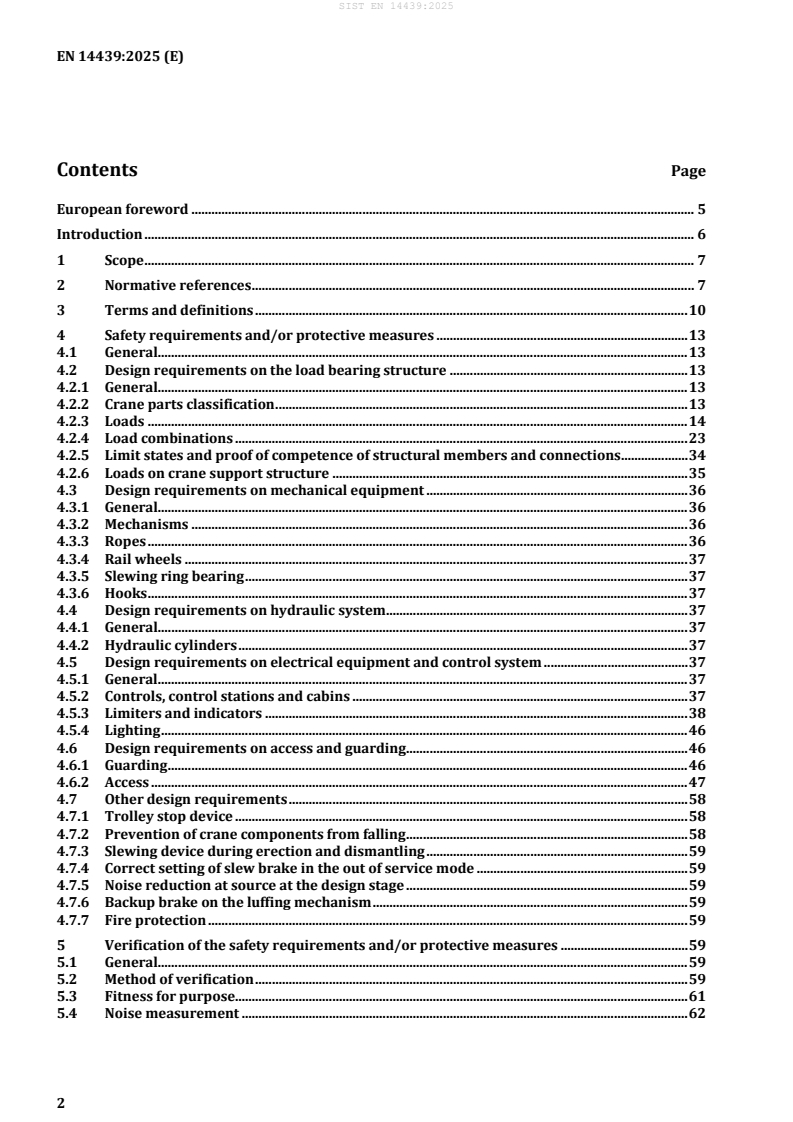
Contents Page
European foreword . 5
Introduction . 6
1 Scope . 7
2 Normative references . 7
3 Terms and definitions . 10
4 Safety requirements and/or protective measures . 13
4.1 General. 13
4.2 Design requirements on the load bearing structure . 13
4.2.1 General. 13
4.2.2 Crane parts classification . 13
4.2.3 Loads . 14
4.2.4 Load combinations . 23
4.2.5 Limit states and proof of competence of structural members and connections . 34
4.2.6 Loads on crane support structure . 35
4.3 Design requirements on mechanical equipment . 36
4.3.1 General. 36
4.3.2 Mechanisms . 36
4.3.3 Ropes . 36
4.3.4 Rail wheels . 37
4.3.5 Slewing ring bearing . 37
4.3.6 Hooks . 37
4.4 Design requirements on hydraulic system . 37
4.4.1 General. 37
4.4.2 Hydraulic cylinders . 37
4.5 Design requirements on electrical equipment and control system . 37
4.5.1 General. 37
4.5.2 Controls, control stations and cabins . 37
4.5.3 Limiters and indicators . 38
4.5.4 Lighting . 46
4.6 Design requirements on access and guarding . 46
4.6.1 Guarding . 46
4.6.2 Access . 47
4.7 Other design requirements . 58
4.7.1 Trolley stop device . 58
4.7.2 Prevention of crane components from falling . 58
4.7.3 Slewing device during erection and dismantling . 59
4.7.4 Correct setting of slew brake in the out of service mode . 59
4.7.5 Noise reduction at source at the design stage . 59
4.7.6 Backup brake on the luffing mechanism . 59
4.7.7 Fire protection . 59
5 Verification of the safety requirements and/or protective measures . 59
5.1 General. 59
5.2 Method of verification . 59
5.3 Fitness for purpose. 61
5.4 Noise measurement . 62
5.4.1 Sound power level . 62
5.4.2 Sound pressure level at control station . 62
6 Information for use . 62
6.1 General . 62
6.2 Instruction manual . 62
6.2.1 General . 62
6.2.2 Specification – General . 62
6.2.3 Instructions for erection and dismantling . 62
6.2.4 Information on noise emission . 63
6.2.5 Instructions for the users . 64
6.2.6 Instructions for maintenance . 66
6.2.7 Instructions for transportation and storage . 67
6.2.8 Instructions for the installation of an anti-collision device or a working space limiter . 67
6.3 Marking . 67
6.3.1 Identification . 67
6.3.2 Warnings and information . 68
Annex A (informative) List of significant hazards . 69
Annex B (normative) Additional and specific requirements for mobile self-erecting tower cranes
............................................................................................................................................................................. 74
B.1 General . 74
B.2 Additional and specific requirements and/or protective measures for mobile self-erecting
tower cranes . 75
B.2.1 Classification . 75
B.2.2 Design requirements on the load bearing structure . 75
B.2.3 Design requirements on mechanical equipment . 75
B.2.4 Design requirements on electrical equipment and control system . 76
B.2.5 Design requirements on means of access . 77
B.2.6 Other design requirements . 77
B.3 Verification of the safety requirements and/or protective measures . 78
B.4 Information for use . 78
Annex C (normative) Verification of the safety requirements and/or protective measures . 79
C.1 General . 79
C.2 Function test without load . 79
C.3 Load tests . 79
C.3.1 General . 79
C.3.2 Static test . 79
C.3.3 Dynamic test . 80
C.4 Verification of the rigid body stability . 80
Annex D (normative) Noise test code . 81
D.1 General . 81
D.2 A-weighted sound power level . 81
D.2.1 Mounting of the equipment . 81
D.2.2 Test method . 82
D.3 A-weighted emission sound pressure level at the control station . 85
D.3.1 General. 85
D.3.2 Calculation of emission sound pressure level . 85
D.4 Values on noise emission . 86
Annex E (normative) Additional and specific requirements for climbing systems . 87
E.1 General. 87
E.2 Safety requirements and/or protective measures . 87
E.2.1 General. 87
E.2.2 Design requirements on the load bearing structure . 87
E.2.3 Additional design requirements on hydraulic system . 89
E.2.4 Additional design requirements on electrical equipment and control system . 89
E.2.5 Additional design requirements on access and guarding . 90
E.3 Verification of the safety requirements and/or protective measures . 91
E.3.1 Method of verification . 91
E.3.2 Fitness for purpose. 92
E.4 Information for use . 92
E.4.1 Instruction manual . 92
E.4.2 Marking . 93
Annex F (informative) Marking – Examples of layout . 95
Annex G (informative) Selection of a suitable set of crane standards for a given application . 97
Annex ZA (informative) Relationship between this European Standard and the Essential
Requirements of EU Directive 2006/42/EC aimed to be covered . 99
Bibliography . 103
European foreword
This document (EN 14439:2025) has been prepared by Technical Committee CEN/TC 147 “Cranes -
Safety”, the secretariat of which is held by SFS.
This European Standard shall be given the status of a national standard, either by publication of an
identical text or by endorsement, at the latest by December 2025, and conflicting national standards shall
be withdrawn at the latest by June 2027.
Attention is drawn to the possibility that some of the elements of this document may be the subject of
patent rights. CEN shall not be held responsible for identifying any or all such patent rights.
This document supersedes EN 14439:2006+A2:2009.
This document has been prepared under a standardization request addressed to CEN by the European
Commission. The Standing Committee of the EFTA States subsequently approves these requests for its
Member States.
For the relationship with EU Legislation, see informative Annex ZA, which is an integral part of this
document.
CEN/TC 147/WG 12 “Tower cranes” has developed a revision of this document, which differs from
EN 14439:2006+A2:2009 as follows:
— integration and rules for application of EN 13001 series of standards;
— revision of 4.2, Design requirements on the load bearing structure;
— revision of 4.6.2, Access;
— integration and rules for application of EN ISO 13849-1:2023;
— integration and requirements for mobile self-erecting tower cranes, including introduction of a new
dedicated Annex B;
— revision of Annex E, Additional and specific requirements for climbing systems.
To select a suitable set of crane standards for a given application see Annex G.
Any feedback and questions on this document should be directed to the users’ national standards body.
A complete listing of these bodies can be found on the CEN website.
According to the CEN-CENELEC Internal Regulations, the national standards organisations of the
following countries are bound to implement this European Standard: Austria, Belgium, Bulgaria, Croatia,
Cyprus, Czech Republic, Denmark, Estonia, Finland, France, Germany, Greece, Hungary, Iceland, Ireland,
Italy, Latvia, Lithuania, Luxembourg, Malta, Netherlands, Norway, Poland, Portugal, Republic of North
Macedonia, Romania, Serbia, Slovakia, Slovenia, Spain, Sweden, Switzerland, Türkiye and the United
Kingdom.
Introduction
This is a harmonized European standard to provide one means for tower cranes to conform with the
relevant Essential Health and Safety Requirements of the Machinery Directive 2006/42/EC modified.
This document is a type C standard as stated in EN ISO 12100:2010.
This document is of relevance, in particular, for the following stakeholder groups representing the market
players with regard to machinery safety:
— machine manufacturers (small, medium and large enterprises);
— health and safety bodies (regulators, accident prevention organizations, market surveillance, etc.).
Others can be affected by the level of machinery safety achieved with the means of the document by the
above-mentioned stakeholder groups:
— machine users/employers (small, medium and large enterprises);
— machine users/employees (e.g. trade unions, organizations for people with special needs);
— service providers, e.g. for maintenance (small, medium and large enterprises);
— consumers (in case of machinery intended for use by consumers).
The above-mentioned stakeholder groups have been given the possibility to participate at the drafting
process of this document.
The machinery concerned and the extent to which hazards, hazardous situations and hazardous events
are covered are indicated in the scope of this document.
When provisions of this type C standard are different from those which are stated in type A or B
standards, the provisions of this type C standard take precedence over the provisions of the other
standards, for cranes that have been designed and built according to the provisions of this type C
standard.
1 Scope
This document specifies safety requirements:
— for tower cranes;
— for climbing systems for tower cranes erected from parts.
This document applies to tower cranes for construction works, which are either erected by parts or self-
erecting cranes, including mobile self-erecting tower cranes. Tower cranes for construction works are
exclusively equipped with a hook as load-handling device.
This document is applicable to tower cranes to be operated outdoors at ambient temperature between
–20 °C and +40 °C.
This document is not applicable to tower cranes, which are permanently installed on a yard or integrated
in a manufacturing process, resulting in a significantly different classification of the crane and its
mechanisms, or which are equipped with a grab or when a sudden release of the load is intended,
resulting in significantly different load actions and number of stress cycles.
This document is not applicable to mobile cranes, mobile harbour cranes, crawler cranes, slewing jib
cranes, bridge and gantry cranes, offshore cranes, floating cranes, loader cranes, hand operated cranes or
railway cranes.
This document deals with significant hazards, hazardous situations and events relevant to tower cranes,
it is used as intended and under conditions of misuse which are reasonably foreseeable by the
manufacturer. This document specifies the appropriate technical measures to eliminate or reduce risks
arising from the significant hazards (see Annex A).
The significant hazards covered by this document are identified in Annex A.
This document covers hazards related to the lifting of persons using a climbing system for tower cranes
as defined in 3.6, 3.6.1 and 3.6.2. The lifting of persons by a tower crane itself is not included.
The requirements related to Electromagnetic compatibility (EMC), the specific hazards due to external
influence on electrical equipment, potentially explosive atmospheres and ionising radiation are not
covered by this document.
To improve readability, additional requirements for climbing systems are given in Annex E of this
document. Additional requirements for mobile self-erecting tower cranes are given in Annex B of this
document.
This document is not applicable to tower cranes and climbing systems which are manufactured before
the date of publication by CEN of this document.
2 Normative references
The following documents are referred to in the text in such a way that some or all of their content
constitutes requirements of this document. For dated references, only the edition cited applies. For
undated references, the latest edition of the referenced document (including any amendments) applies.
EN 795:2012, Personal fall protection equipment — Anchor devices
EN 12077-2:2024, Cranes safety — Requirements for health and safety — Part 2: Limiting and indicating
devices
EN 13000:2010+A1:2014, Cranes — Mobile cranes
EN 13001-1:2015, Cranes — General design — Part 1: General principles and requirements
EN 13001-2:2021, Crane safety — General design — Part 2: Load actions
EN 13001-3-1:2012+A2:2018, Cranes — General Design — Part 3-1: Limit States and proof of competence
of steel structures
EN 13001-3-3:2014, Cranes — General design — Part 3-3: Limit states and proof of competence of
wheel/rail contacts
EN 13001-3-4:2018, Cranes — General design — Part 3–4: Limit states and proof of competence of
machinery — Bearings
EN 13001-3-5:2016+A1:2021, Cranes — General design — Part 3-5: Limit states and proof of competence
of forged hooks
EN 13001-3-6:2018+A1:2021, Cranes — General design — Part 3–6: Limit states and proof of competence
of machinery — Hydraulic cylinders
EN 13135:2013+A1:2018, Cranes — Safety — Design — Requirements for equipment
EN 13557:2024, Cranes — Controls and control stations
EN 13586:2020, Cranes — Access
EN 14502-2:2005+A1:2008, Cranes — Equipment for the lifting of persons — Part 2: Elevating control
stations
EN 17076:2020, Tower cranes — Anti-collision systems — Safety requirements
EN 60204-32:2008, Safety of machinery — Electrical equipment of machines — Part 32: Requirements for
hoisting machines (IEC 60204-32:2008)
EN IEC 61496-1:2020, Safety of machinery — Electro-sensitive protective equipment — Part 1: General
requirements and tests (IEC 61496-1:2020)
EN IEC 61496-2:2020, Safety of machinery — Electro-sensitive protective equipment — Part 2: Particular
requirements for equipment using active opto-electronic protective devices (AOPDs) (IEC 61496-2:2020)
EN IEC 61496-3:2019, Safety of machinery — Electro-sensitive protective equipment — Part 3: Particular
requirements for active opto-electronic protective devices responsive to diffuse Reflection (AOPDDR) (IEC
61496-3:2019)
, Safety of machinery — Requirements for cableless control systems of machinery
EN 62745:2017
(IEC 62745:2017)
EN ISO 3744:2010, Acoustics — Determination of sound power levels and sound energy levels of noise
sources using sound pressure — Engineering methods for an essentially free field over a reflecting plane
(ISO 3744:2010)
EN ISO 4413:2010, Hydraulic fluid power — General rules and safety requirements for systems and their
components (ISO 4413:2010)
As impacted by EN 62745:2017/A11:2020.
EN ISO 4871:2009, Acoustics — Declaration and verification of noise emission values of machinery and
equipment (ISO 4871:1996)
EN ISO 7010:2020, Graphical symbols — Safety colours and safety signs — Registered safety signs
(ISO 7010:2019, Corrected version 2020-06)
EN ISO 11201:2010, Acoustics — Noise emitted by machinery and equipment — Determination of emission
sound pressure levels at a work station and at other specified positions in an essentially free field over a
reflecting plane with negligible environmental corrections (ISO 11201:2010)
EN ISO 11203:2009, Acoustics — Noise emitted by machinery and equipment — Determination of emission
sound pressure levels at a work station and at other specified positions from the sound power level
(ISO 11203:1995)
EN ISO 12100:2010, Safety of machinery — General principles for design — Risk assessment and risk
reduction (ISO 12100:2010)
EN ISO 13849-1:2023, Safety of machinery — Safety-related parts of control systems — Part 1: General
principles for design (ISO 13849-1:2023)
EN ISO 13849-2:2012, Safety of machinery — Safety-related parts of control systems — Part 2: Validation
(ISO 13849-2:2012)
EN ISO 13856-1:2013, Safety of machinery —Pressure-sensitive protective devices — Part 1: General
principles for design and testing of pressure-sensitive mats and pressure-sensitive floors (ISO 13856-1:2013)
EN ISO 13856-2:2013, Safety of machinery — Pressure-sensitive protective devices — Part 2: General
principles for design and testing of pressure-sensitive edges and pressure-sensitive bars (ISO 13856-2:2013)
EN ISO 13856-3:2013, Safety of machinery — Pressure-sensitive protective devices — Part 3: General
principles for design and testing of pressure-sensitive bumpers, plates, wires and similar devices (ISO 13856-
3:2013)
EN ISO 13857:2019, Safety of machinery — Safety distances to prevent hazard zones being reached by
upper and lower limbs (ISO 13857:2019)
EN ISO 14119:2013, Safety of machinery — Interlocking devices associated with guards — Principles for
design and selection (ISO 14119:2013)
EN ISO 14120:2015, Safety of machinery — Guards — General requirements for the design and
construction of fixed and movable guards (ISO 14120:2015)
EN ISO 20607:2019, Safety of machinery — Instruction handbook — General drafting principles (ISO
20607:2019)
ISO 3864-1:2011, Graphical symbols — Safety colours and safety signs — Part 1: Design principles for safety
signs and safety markings
ISO 3864-2:2016, Graphical symbols — Safety colours and safety signs — Part 2: Design principles for
product safety labels
ISO 3864-3:2024, Graphical symbols — Safety colours and safety signs — Part 3: Design principles for
graphical symbols for use in safety signs
ISO 3864-4:2011, Graphical symbols — Safety colours and safety signs — Part 4: Colorimetric and
photometric properties of safety sign materials
ISO 4301-1:2016, Cranes — Classification — Part 1: General
ISO 4301-3:2021, Cranes — Classification — Part 3: Tower cranes
ISO 4306-1:2007, Cranes — Vocabulary — Part 1: General
ISO 4306-3:2016, Cranes — Vocabulary — Part 3: Tower cranes
ISO 7296-3:2006, Cranes — Graphical symbols — Part 3: Tower cranes
ISO 7752-3:2013, Cranes — Control layout and characteristics — Part 3: Tower cranes
ISO 8566-3:2010, Cranes — Cabins and control stations — Part 3: Tower cranes
ISO 12488-1:2012, Cranes — Tolerances for wheels and travel and traversing tracks — Part 1: General
ISO 16625:2013, Cranes and hoists — Selection of wire ropes, drums and sheaves
3 Terms and definitions
For the purposes of this document, the terms and definitions given in in EN ISO 12100:2010,
ISO 4306-1:2007 and ISO 4306-3:2016 and the following apply.
ISO and IEC maintain terminology databases for use in standardization at the following addresses:
— ISO Online browsing platform: available at https://www.iso.org/obp
— IEC Electropedia: available at https://www.electropedia.org/
3.1
rated capacity
maximum net load that the crane is designed to lift for a given crane configuration, radius and operating
conditions
Note 1 to entry: The rated capacity is composed of the pay load plus the mass of the non-fixed load-lifting
attachment(s).
3.1.1
standard load chart
rated capacity for a given crane configuration under normal operating conditions, allowing all
mechanisms to operate with their maximum performance and maximum wind loading
3.1.2
special load chart
increased rated capacity for a given crane configuration under special operating conditions, considering
reduced performance of the mechanisms and reduced wind loading
3.2
tower crane
power-driven slewing jib type crane intended for the lifting of loads, with the jib located at the top of a
tower which stays approximately vertical in the working position
Note 1 to entry: A tower crane is equipped with means for raising and lowering suspended loads and for the
movement of such loads by changing the load-lifting radius, travelling of the load, slewing or travelling of the
complete appliance. Some tower cranes perform several, but not necessarily all of these movements.
3.2.1
tower crane erected from parts
tower crane which is transported to site in component parts and assembled by a separate lifting
appliance, where the design of the crane allows the crane to remain in the erected position in out-of-
service conditions and to be dismantled for movement to another site
3.2.2
self-erecting tower crane
tower crane which is transported to site and mostly assembled without use of a separate lifting appliance,
where the design of the crane allows the crane to remain in the erected position in out-of-service
conditions and to be lowered for transportation to another site
3.2.3
mobile self-erecting tower crane
self-erecting tower crane mounted on a self-propelled chassis
3.3
crane reference bottom level
interface of an erected tower crane with the supporting structure or rail track (see Figure 1)
Note 1 to entry: The top level of a concrete foundation is considered the crane reference bottom level.
Key
1 crane reference bottom level
Figure 1 — Crane reference bottom level
3.4
working range limiting device
set of components installed on the same crane whose combined actions enable management of prohibited
zones only
[EN 17076:2020, 3.7]
3.5
anti-collision device
set of components installed on the same crane whose combined actions enable management of
interference zones and/or prohibited zones
[EN 17076:2020, 3.5]
Note 1 to entry: Several anti-collision devices are connected in a network to form an anti-collision system to
prevent collisions between tower cranes with overlapping working areas.
3.6
climbing system
specific equipment optionally installed on a tower crane erected from parts to increase or to decrease the
height under hook of the crane
3.6.1
external climbing system
climbing system where the tower of a crane is extended or reduced by the use of a climbing frame jacking
system to add or to remove tower sections
3.6.2
internal climbing system
climbing system where the height of a tower crane is raised or lowered by the use of a jacking system
acting directly onto the structure on which the crane is supported
3.7
balancing moment
moment generated by horizontal displacement of the lifted load or part of the crane in order to achieve
equilibrium of the crane components to be climbed including the lifted load before starting the climbing
operation
3.8
deviation moment
moment by which the balancing moment is assumed to deviate during a climbing sequence
Note 1 to entry: The deviation moment is the design moment to be used at the proof of competence of the
climbing system but also one of the limit values incorporated in the safety function "Limitation of motions of
balancing weight inside the tolerance range around the balancing point", see Table E.2.
4 Safety requirements and/or protective measures
4.1 General
Tower cranes and climbing systems shall comply with the safety requirements and/or protective
measures of this clause. In addition, tower cranes and climbing systems shall be designed according to
the principles of EN ISO 12100:2010 for hazards relevant but not significant, which are not dealt with by
this document.
The classification as given in ISO 4301-3:2021 shall be used as a minimum design requirement for the
proof of fatigue strength of tower cranes, its mechanisms and components.
4.2 Design requirements on the load bearing structure
4.2.1 General
The proof calculation (proof of strength and proof of stability) shall be done using the standards
EN 13001-1:2015, EN 13001-2:2021 and EN 13001-3-1:2012+A2:2018 with requirements and
recommendation of 4.2.1 to 4.2.6 of this document.
General principles of calculation shall be done according to EN 13001-1:2015. Calculations shall be based
on the assumption of a deformed system in a state of equilibrium (second order theory).
4.2.2 Crane parts classification
Structural crane parts classification and the computational proof of fatigue strength shall be done in
accordance with EN 13001-1:2015 and EN 13001-3-1:2012+A2:2018. Stress history parameters and
consequently the S-classes for different structural details shall be calculated based on the specified U-
and Q-classes together with the average displacements of relevant crane movements (trolley travelling,
slewing).
For tower cranes, the S-class for structural details shall not be taken lower than those given in
ISO 4301-3:2021.
NOTE Alternatively, in case of better knowledge of the loading conditions of the design detail under
consideration, a specific stress history parameter s can be calculated.
m
4.2.3 Loads
4.2.3.1 General
For each jib length and configuration of the tower crane, a standard load chart is determined by the crane
manufacturer. Thereby all loads that are acting during the crane's life shall be considered and shall reflect
unfavourable but realistic operating conditions and sequences of actions by the crane driver (see Table 1
and Table 4).
With the use of a programmable logic control, it is possible that for the same jib length and configuration
of the tower crane an additional special load chart is provided by the crane manufacturer. Thereby all
loads shall be considered as stated above, however it is admissible to disable a crane motion, e.g. crane
travelling, which provides a significant load effect, or to modify control parameter of a crane mechanism
to reduce inertia loads. Further, at a special load chart it is allowed to reduce the minimum in-service
wind level according to the requirements given in Table 1.
All loads shall be defined and classified as regular loads (for load combinations A), occasional loads (for
load combinations B) and exceptional loads (for load combinations C) according to EN 13001-2:2021,
4.2.
4.2.3.2 Loads and values for dynamic factors ϕ
i
Table 1 gives loads that are generally relevant for tower cranes, and gives guidance on values for
appropriate dynamic factors. All dynamic factors ϕ shall be considered according to EN 13001-2:2021.
i
NOTE Alternatively other values for dynamic factors can be used when determined by recognized theoretical
analysis or a practical test.
In case of a tower crane designed for a special use and/or with dedicated requirements additional loads
and relevant values of dynamic factors shall be considered and specified according to EN 13001-2:2021,
4.2 and 4.3.
Table 1 — Loads and guidance on values for dynamic factors ϕ for tower cranes
i
Dyn. factor Definitions and guidance on values for dynamic
Load
ϕ factors ϕ and load determination
i i
Hoisting and gravity effects ϕ The value δ specified for tower cranes is:
acting on the mass of the crane
δ = 0,05
Inertial and gravity effects by ϕ Hoisting class HC1 is typical for tower cranes and
hoisting an unrestrained shall be used.
grounded load
For load combinations A1 and B1: ϕ = 1,3
2,max
For load combination C1: ϕ without limitation
Due to the nature of tower cranes, only the hoist
drive classes HD1 or HD4 shall be used. The classes
HD2, HD3 and HD5 are not allowed to be used
unless all requirements of EN 13001-2:2021 are
met.
Dyn. factor Definitions and guidance on values for dynamic
Load
ϕ factors ϕ and load determination
i i
Inertial and gravity effects by ϕ Not applicable for tower cranes, see 6.2.5.
sudden release of a part of the
hoist load
Loads caused by travelling on ϕ The rail track tolerances for a tower crane shall be
uneven surface in accordance with ISO 12488-1:2012, Class 2.
With this condition, this load action doesn’t need to
be considered.
NOTE See also 6.2.5.
Loads caused by acceleration of ϕ Usual values of the dynamic coefficient ϕ for
5 5
drives
tower cranes are:
ϕ = 1,0 for centrifugal forces;
ϕ = 1,5 for drive forces for all drives of tower
cranes with no backlash or in case where existing
backlash does not affect the dynamic forces and
with smooth change of forces.
Loads determined by - The erection tolerances for the supporting
displacements structure for a tower crane shall comply with the
requirements given in 6.2.5 n). Under this
condition, this load action doesn’t need to be
considered.
In case of different condition, the load action shall
be considered according to EN 13001-2:2021.
Loads due to in-service wind - The minimum in-service wind level that shall be
considered for a standard load chart is state 2
(normal winds). The wind pressure to consider is
q = 250 N/m (wind speed v = 20 m/s).
(3) (3)
The minimum in-service wind level that shall be
considered for a special load chart is state 1 (light
winds). The wind pressure to consider is
q = 125 N/m (wind speed v = 14,1 m/s).
(3) (3)
Loads due to snow and ice - This load shall be considered only on special
request from a user or local regulation.
Loads due to temperature - Not applicable for tower cranes.
variation
Loads caused by skewing - Skewing forces are insignificant and doesn’t need
to be considered when the guide ratio, i.e. distance
between the guide means divided by the span of
the undercarriage is 1 or higher.
In case of different condition, the load action shall
be considered according to EN 13001-2:2021.
Dyn. factor Definitions and guidance on values for dynamic
Load
ϕ factors ϕ and load determination
i i
nd
Loads caused by hoisting a ϕ Refer to 2 row of this table. (Inertial and gravity
grounded load at maximum effects by hoisting an unrestrained grounded load).
hoisting speed
Loads due to out-of-service - Refer to 4.2.3.3.
wind
Test loads ϕ According to EN 13001-2:2021 and Annex C of this
document.
The minimum wind pressure to consider for test
loads is q = 40 N/m (Wind speed v = 8 m/s).
(3) (3)
Loads due to buffer forces ϕ A verification of the energy absorption capacity of
the b
...