

SIST EN 13001-3-1:2025
(Main)Cranes - General design - Part 3-1: Limit states and proof of competence of steel structures
General Information
- Abstract
This document specifies limit states, requirements and methods to prevent mechanical hazards in steel structures of cranes by design and theoretical proof of competence.
The significant hazardous situations and hazardous events that could result in risks to persons during intended use are identified in an informative Annex L (informative). Clauses 4 to 8 of this document provide requirements and methods to reduce or eliminate these risks:
a) exceeding the limits of strength (yield, ultimate, fatigue);
b) exceeding temperature limits of material or components;
c) elastic instability of the crane or its parts (buckling, bulging).
This document does not apply to cranes which are designed before the date of its publication as EN.
NOTE This document deals only with the limit state method in accordance with reference [44].
- Status
- Published
- Publication Date
- 08-Apr-2025
- Technical Committee
- DTN - Lift and transport appliances
- Current Stage
- 6060 - National Implementation/Publication (Adopted Project)
- Start Date
- 26-Feb-2025
- Due Date
- 03-May-2025
- Completion Date
- 09-Apr-2025
- Directive
- 2006/42/EC - Directive 2006/42/EC of the European Parliament and of the Council of 17 May 2006 on machinery, and amending Directive 95/16/EC (recast)OJ Ref: L 2026/546, STANDARD TIPA C OJ Date: 13-Mar-2026


Overview
EN 13001-3-1:2025 - "Cranes - General design - Part 3-1: Limit states and proof of competence of steel structure" (CEN) defines the limit-state design approach and verification methods to prevent mechanical hazards in steel crane structures. The standard specifies requirements and analytical proof procedures for static strength, fatigue resistance and elastic stability of steel members, joints and connections. An informative Annex L lists significant hazardous situations; Annex ZA relates the standard to the EU Machinery Directive.
Key topics and technical requirements
- Limit states method: Uses limit-state principles for strength, fatigue and stability (note: the document deals only with the limit state method referenced in the standard).
- Static strength proofs: Requirements and calculation methods for structural members, bolted, pinned and welded connections (Clauses 5 and Annex C).
- Fatigue strength: Modern assessment methods including nominal stress, geometric (hot‑spot) method and effective notch method, stress-history classification and characteristic fatigue strengths (Clause 6 and Annex I).
- Elastic stability: Buckling and lateral‑torsional stability of members, plate-field buckling and critical load/moment calculations (Clause 8 and Annex J).
- Materials and fabrication: Requirements for steel grades, impact toughness, bolt materials and preloaded bolt guidance (Clause 4, Annex M and Annex B).
- Special elements: Proof procedures for hollow section girder joints and distribution of weld stresses (Clauses 7 and Annex H/C).
- Documentation and execution: Required design documentation and stepwise execution of proofs for members and connections (Clause 4 and throughout).
- Safety context: Informative Annex L identifies hazardous events relevant to intended use; Annex ZA maps essential requirements to Directive 2006/42/EC.
Practical applications and users
EN 13001-3-1:2025 is intended for professionals involved in the design, verification and conformity assessment of cranes and crane components:
- Structural and mechanical engineers designing crane steelwork
- Crane manufacturers and fabricators (welding / bolting requirements)
- Notified bodies, conformity assessors and safety regulators
- Inspection and maintenance engineers assessing fatigue and buckling risks
- Procurement specialists specifying design safety and compliance with the EU Machinery Directive
Applying this standard helps reduce mechanical hazards such as yield/fatigue failure, temperature-related material limits and buckling, improving safety, reliability and regulatory compliance of steel crane structures.
Related standards
- Other parts of EN 13001 (general design series) for dimensional, loading and performance requirements
- National and European welding, steel material and bolting standards referenced in EN 13001-3-1:2025
- Directive 2006/42/EC (see Annex ZA for alignment)
Relations
- Effective Date
- 18-Mar-2026
- Effective Date
- 28-Jan-2026
- Effective Date
- 28-Jan-2026
- Effective Date
- 28-Jan-2026
- Effective Date
- 28-Jan-2026
- Effective Date
- 28-Jan-2026
- Effective Date
- 28-Jan-2026
- Effective Date
- 28-Jan-2026
- Effective Date
- 28-Jan-2026
- Effective Date
- 28-Jan-2026
- Effective Date
- 28-Jan-2026
- Effective Date
- 28-Jan-2026
- Effective Date
- 28-Jan-2026
- Effective Date
- 28-Jan-2026
- Effective Date
- 28-Jan-2026
Frequently Asked Questions
SIST EN 13001-3-1:2025 is a standard published by the Slovenian Institute for Standardization (SIST). Its full title is "Cranes - General design - Part 3-1: Limit states and proof of competence of steel structures". This standard covers: This document specifies limit states, requirements and methods to prevent mechanical hazards in steel structures of cranes by design and theoretical proof of competence. The significant hazardous situations and hazardous events that could result in risks to persons during intended use are identified in an informative Annex L (informative). Clauses 4 to 8 of this document provide requirements and methods to reduce or eliminate these risks: a) exceeding the limits of strength (yield, ultimate, fatigue); b) exceeding temperature limits of material or components; c) elastic instability of the crane or its parts (buckling, bulging). This document does not apply to cranes which are designed before the date of its publication as EN. NOTE This document deals only with the limit state method in accordance with reference [44].
This document specifies limit states, requirements and methods to prevent mechanical hazards in steel structures of cranes by design and theoretical proof of competence. The significant hazardous situations and hazardous events that could result in risks to persons during intended use are identified in an informative Annex L (informative). Clauses 4 to 8 of this document provide requirements and methods to reduce or eliminate these risks: a) exceeding the limits of strength (yield, ultimate, fatigue); b) exceeding temperature limits of material or components; c) elastic instability of the crane or its parts (buckling, bulging). This document does not apply to cranes which are designed before the date of its publication as EN. NOTE This document deals only with the limit state method in accordance with reference [44].
SIST EN 13001-3-1:2025 is classified under the following ICS (International Classification for Standards) categories: 53.020.20 - Cranes. The ICS classification helps identify the subject area and facilitates finding related standards.
SIST EN 13001-3-1:2025 has the following relationships with other standards: It is inter standard links to SIST ISO 4306-1:2012, SIST EN ISO 6892-1:2020, SIST EN ISO 9013:2017, SIST EN 10163-3:2005, SIST EN 840-3:2014, SIST EN 10025-2:2019, SIST EN 10160:2001, SIST EN 10088-3:2024, SIST EN 10025-3:2019, SIST EN 10029:2011, SIST EN 10149-2:2014, SIST EN ISO 5817:2023, SIST EN 10025-4:2019+A1:2023, SIST EN ISO 17635:2017, SIST EN ISO 17659:2004. Understanding these relationships helps ensure you are using the most current and applicable version of the standard.
SIST EN 13001-3-1:2025 is associated with the following European legislation: EU Directives/Regulations: 2006/42/EC, 98/37/EC, EUR-PUB; Standardization Mandates: M/079, M/396. When a standard is cited in the Official Journal of the European Union, products manufactured in conformity with it benefit from a presumption of conformity with the essential requirements of the corresponding EU directive or regulation.
SIST EN 13001-3-1:2025 is available in PDF format for immediate download after purchase. The document can be added to your cart and obtained through the secure checkout process. Digital delivery ensures instant access to the complete standard document.
Standards Content (Sample)
SLOVENSKI STANDARD
01-maj-2025
Dvigala (žerjavi) - Konstrukcija, splošno - 3-1. del: Mejna stanja in dokaz varnosti
jeklene nosilne konstrukcije
Cranes - General design - Part 3-1: Limit states and proof of competence of steel
structures
Krane - Konstruktion allgemein - Teil 3-1: Grenzzustände und Sicherheitsnachweis von
Stahltragwerken
Appareils de levage à charge suspendue - Conception générale - Partie 3-1: États-
limites et vérification d'aptitude des structures en acier
Ta slovenski standard je istoveten z: EN 13001-3-1:2025
ICS:
53.020.20 Dvigala Cranes
2003-01.Slovenski inštitut za standardizacijo. Razmnoževanje celote ali delov tega standarda ni dovoljeno.
EN 13001-3-1
EUROPEAN STANDARD
NORME EUROPÉENNE
March 2025
EUROPÄISCHE NORM
ICS 53.020.20 Supersedes EN 13001-3-1:2012+A2:2018
English Version
Cranes - General design - Part 3-1: Limit states and proof
competence of steel structure
Appareils de levage à charge suspendue - Conception Krane - Konstruktion allgemein - Teil 3-1:
générale - Partie 3-1 : Etats limites et vérification Grenzzustände und Sicherheitsnachweis von
d'aptitude des charpentes en acier Stahltragwerken
This European Standard was approved by CEN on 22 December 2024.
CEN members are bound to comply with the CEN/CENELEC Internal Regulations which stipulate the conditions for giving this
European Standard the status of a national standard without any alteration. Up-to-date lists and bibliographical references
concerning such national standards may be obtained on application to the CEN-CENELEC Management Centre or to any CEN
member.
This European Standard exists in three official versions (English, French, German). A version in any other language made by
translation under the responsibility of a CEN member into its own language and notified to the CEN-CENELEC Management
Centre has the same status as the official versions.
CEN members are the national standards bodies of Austria, Belgium, Bulgaria, Croatia, Cyprus, Czech Republic, Denmark, Estonia,
Finland, France, Germany, Greece, Hungary, Iceland, Ireland, Italy, Latvia, Lithuania, Luxembourg, Malta, Netherlands, Norway,
Poland, Portugal, Republic of North Macedonia, Romania, Serbia, Slovakia, Slovenia, Spain, Sweden, Switzerland, Türkiye and
United Kingdom.
EUROPEAN COMMITTEE FOR STANDARDIZATION
COMITÉ EUROPÉEN DE NORMALISATION
EUROPÄISCHES KOMITEE FÜR NORMUNG
CEN-CENELEC Management Centre: Rue de la Science 23, B-1040 Brussels
© 2025 CEN All rights of exploitation in any form and by any means reserved Ref. No. EN 13001-3-1:2025 E
worldwide for CEN national Members.
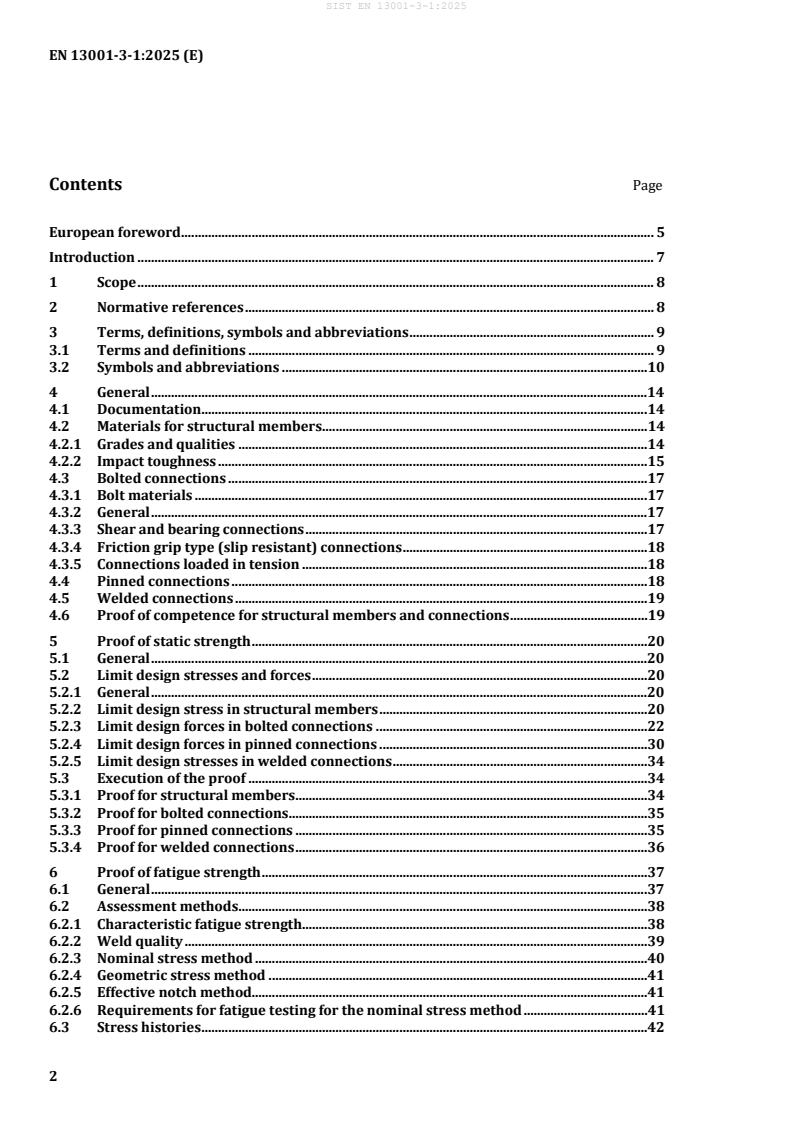
Contents Page
European foreword . 5
Introduction . 7
1 Scope . 8
2 Normative references . 8
3 Terms, definitions, symbols and abbreviations . 9
3.1 Terms and definitions . 9
3.2 Symbols and abbreviations .10
4 General .14
4.1 Documentation .14
4.2 Materials for structural members .14
4.2.1 Grades and qualities .14
4.2.2 Impact toughness .15
4.3 Bolted connections .17
4.3.1 Bolt materials .17
4.3.2 General .17
4.3.3 Shear and bearing connections .17
4.3.4 Friction grip type (slip resistant) connections .18
4.3.5 Connections loaded in tension .18
4.4 Pinned connections .18
4.5 Welded connections .19
4.6 Proof of competence for structural members and connections .19
5 Proof of static strength .20
5.1 General .20
5.2 Limit design stresses and forces .20
5.2.1 General .20
5.2.2 Limit design stress in structural members .20
5.2.3 Limit design forces in bolted connections .22
5.2.4 Limit design forces in pinned connections .30
5.2.5 Limit design stresses in welded connections .34
5.3 Execution of the proof .34
5.3.1 Proof for structural members .34
5.3.2 Proof for bolted connections .35
5.3.3 Proof for pinned connections .35
5.3.4 Proof for welded connections .36
6 Proof of fatigue strength .37
6.1 General .37
6.2 Assessment methods .38
6.2.1 Characteristic fatigue strength .38
6.2.2 Weld quality .39
6.2.3 Nominal stress method .40
6.2.4 Geometric stress method .41
6.2.5 Effective notch method.41
6.2.6 Requirements for fatigue testing for the nominal stress method .41
6.3 Stress histories .42
6.3.1 General . 42
6.3.2 Frequency of occurrence of stress cycles . 42
6.3.3 Stress history parameter . 42
6.3.4 Stress history classes S . 43
6.4 Execution of the proof . 45
6.5 Determination of the limit design stress range . 45
6.5.1 Applicable methods . 45
6.5.2 Direct use of stress history parameter . 45
6.5.3 Use of class S . 46
6.5.4 Combined effect of normal and shear stresses . 47
7 Proof of static strength of hollow section girder joints . 48
8 Proof of elastic stability . 48
8.1 General . 48
8.2 Lateral buckling of members loaded in compression . 48
8.2.1 Critical buckling load . 48
8.2.2 Limit compressive design force . 50
8.3 Buckling of plate fields subjected to compressive and shear stresses . 52
8.3.1 General . 52
8.3.2 Limit design stress with respect to longitudinal stress . 54
8.3.3 Limit design stress with respect to transverse stress . 56
8.3.4 Limit design stress with respect to shear stress . 57
8.4 Lateral-torsional stability of beams . 58
8.4.1 General . 58
8.4.2 Limit design moment for lateral-torsional buckling . 59
8.4.3 Reduction factor for lateral-torsional buckling – General case . 59
8.4.4 Critical buckling moment in lateral-torsional buckling . 61
8.5 Execution of the proof . 62
8.5.1 Members loaded in compression . 62
8.5.2 Plate fields . 62
8.5.3 Lateral-torsional stability of beams . 63
Annex A (informative) Limit design shear force F per bolt and per shear plane for
v,Rd
multiple shear plane connections . 64
Annex B (informative) Preloaded bolts . 65
B.1 General . 65
B.2 Tightening torques . 65
B.3 Limit design slip force F . 67
S,Rd
Annex C (normative) Design weld stresses . 68
C.1 General method . 68
C.2 Simple examples . 70
C.3 Reduction factor for long welds . 71
C.4 Effective distribution length under concentrated load . 72
C.5 Other types of welds . 73
Annex D (normative) Values of slope constant m and characteristic fatigue strength Δσ ,
c
Δτ . 74
c
Annex E (normative) Sequence of notch classes (NC) . 95
Annex F (informative) Evaluation of stress cycles (example) . 96
Annex G (informative) Calculation of stiffnesses for connections loaded in tension .98
Annex H (normative) Hollow sections . 101
Annex I (normative) Characteristic fatigue strengths for the geometric stress method and
the effective notch method . 113
Annex J (informative) General formula for elastic critical moment in lateral-torsional
buckling of a simple beam . 115
Annex K (informative) Selection of a suitable set of crane standards for a given application
................................................................................................................................................................. 118
Annex L (informative) List of hazards . 119
Annex M (normative) Specific values of steels for structural members . 120
Annex ZA (informative) Relationship between this European Standard and the essential
requirements of Directive 2006/42/EC aimed to be covered . 122
Bibliography . 123
European foreword
This document (EN 13001-3-1:2025) has been prepared by Technical Committee CEN/TC 147 “Cranes -
Safety”, the secretariat of which is held by SFS.
This European Standard shall be given the status of a national standard, either by publication of an
identical text or by endorsement, at the latest by September 2025, and conflicting national standards shall
be withdrawn at the latest by September 2025.
Attention is drawn to the possibility that some of the elements of this document may be the subject of
patent rights. CEN shall not be held responsible for identifying any or all such patent rights.
This document supersedes EN 13001-3-1:2012+A2:2018.
This document has been prepared under a standardization request addressed to CEN by the European
Commission. The Standing Committee of the EFTA States subsequently approves these requests for its
Member States.
For the relationship with EU Legislation, see informative Annex ZA, which is an integral part of this
document.
CEN/TC 147 WG 2 has reviewed EN 13001-3-1:2012+A2:2018 to adapt the document to technical
progress. The main changes are:
— design values for standardized steels (4.2.1) were moved to a new Annex M (normative);
— design values for bolt materials were changed (Table 4);
— limit design values for welded connection were changed (5.2.5);
— static proof of welded connections was changed (5.3.4 and Annex C (normative));
— proof of fatigue strength was revised to include additional modern methods (6.1);
— fatigue strength specific resistance factors were modified (Table 8);
— the geometric stress (Hot Spot) method was added (6.2.4 and Annex I (normative));
— the effective notch method was added (6.2.5 and Annex I (normative));
— lateral-torsional stability of beams was added (8.4 and 8.5.3 and Annex J (informative));
— recommended tightening torques for preloaded bolts were modified (Annex B (informative));
— characteristic fatigue strengths for plates in shear were modified (Table D.1);
— Annex L (informative) with a list of hazards was inserted;
— Annex ZA (informative) was significantly revised.
This document is one part of the EN 13001 series of standards. The other parts are:
— Part 1: General principles and requirements;
— Part 2: Load actions;
— Part 3-2: Limit states and proof of competence of wire ropes in reeving systems;
— Part 3-3: Limit states and proof of competence of wheel/rail contacts;
— Part 3-4: Limit states and proof of competence of machinery;
— Part 3-5: Limit states and proof of competence of forged hooks and cast hooks;
— Part 3-6: Limit states and proof of competence of hydraulic cylinders.
An overview of European Standards for cranes is provided in Annex K (informative).
Any feedback and questions on this document should be directed to the users’ national standards body.
A complete listing of these bodies can be found on the CEN website.
According to the CEN-CENELEC Internal Regulations, the national standards organisations of the
following countries are bound to implement this European Standard: Austria, Belgium, Bulgaria, Croatia,
Cyprus, Czech Republic, Denmark, Estonia, Finland, France, Germany, Greece, Hungary, Iceland, Ireland,
Italy, Latvia, Lithuania, Luxembourg, Malta, Netherlands, Norway, Poland, Portugal, Republic of North
Macedonia, Romania, Serbia, Slovakia, Slovenia, Spain, Sweden, Switzerland, Türkiye and the United
Kingdom.
Introduction
This document has been prepared to be a harmonized standard to provide one means for the mechanical
design and theoretical verification of cranes to conform to the essential health and safety requirements
of the Machinery Directive, as amended.
This document is a type-C standard as stated in EN ISO 12100:2010.
This document is of relevance, in particular, for the following stakeholder groups representing the market
players with regard to machinery safety:
— machine manufacturers (small, medium and large enterprises);
— health and safety bodies (regulators, accident prevention organizations, market surveillance, etc.).
Others can be affected by the level of machinery safety achieved with the means of the document by the
above-mentioned stakeholder groups:
— machine users/employers (small, medium and large enterprises);
— machine users/employees (e.g. trade unions, organizations for people with special needs);
— service providers, e.g. for maintenance (small, medium and large enterprises);
— consumers (in case of machinery intended for use by consumers).
The above-mentioned stakeholder groups have been given the possibility to participate in the drafting
process of this document.
The machinery concerned and the extent to which hazards, hazardous situations or hazardous events are
covered are indicated in the scope of this document.
When provisions of this type-C standard are different from those which are stated in type-A
or B standards, the provisions of this type-C standard take precedence over the provisions of the other
standards, for machines that have been designed and built according to the provisions of this type-C
standard.
1 Scope
This document specifies limit states, requirements and methods to prevent mechanical hazards in steel
structures of cranes by design and theoretical proof of competence.
The significant hazardous situations and hazardous events that could result in risks to persons during
intended use are identified in an informative Annex L (informative). Clauses 4 to 8 of this document
provide requirements and methods to reduce or eliminate these risks:
a) exceeding the limits of strength (yield, ultimate, fatigue);
b) exceeding temperature limits of material or components;
c) elastic instability of the crane or its parts (buckling, bulging).
This document does not apply to cranes which are designed before the date of its publication as EN.
NOTE This document deals only with the limit state method in accordance with reference [44].
2 Normative references
The following documents are referred to in the text in such a way that some or all of their content
constitutes requirements of this document. For dated references, only the edition cited applies. For
undated references, the latest edition of the referenced document (including any amendments) applies.
EN 1993-1-8:2024, Eurocode 3 — Design of steel structures — Part 1-8: Joints
EN 10025-2:2019, Hot rolled products of structural steels — Part 2: Technical delivery conditions for non-
alloy structural steels
EN 10025-3:2019, Hot rolled products of structural steels — Part 3: Technical delivery conditions for
normalized/normalized rolled weldable fine grain structural steels
EN 10025-4:2019+A1:2022, Hot rolled products of structural steels — Part 4: Technical delivery conditions
for thermomechanical rolled weldable fine grain structural steels
EN 10025-6:2019+A1:2022, Hot rolled products of structural steels — Part 6: Technical delivery conditions
for flat products of high yield strength structural steels in the quenched and tempered condition
EN 10029:2010, Hot-rolled steel plates 3 mm thick or above — Tolerances on dimensions and shape
EN 10088-2:2024, Stainless steels — Part 2: Technical delivery conditions for sheet/plate and strip of
corrosion resistant steels for general purposes
EN 10088-3:2023, Stainless steels — Part 3: Technical delivery conditions for semi-finished products, bars,
rods, wire, sections and bright products of corrosion resistant steels for general purposes
EN 10149-2:2013, Hot rolled flat products made of high yield strength steels for cold forming — Part 2:
Technical delivery conditions for thermomechanically rolled steels
EN 10149-3:2013, Hot rolled flat products made of high yield strength steels for cold forming — Part 3:
Technical delivery conditions for normalized or normalized rolled steels
EN 10160:1999, Ultrasonic testing of steel flat product of thickness equal or greater than 6 mm (reflection
method)
EN 10163-1:2004, Delivery requirements for surface condition of hot-rolled steel plates, wide flats and
sections — Part 1: General requirements
EN 10163-2:2004, Delivery requirements for surface condition of hot-rolled steel plates, wide flats and
sections — Part 2: Plate and wide flats
EN 10163-3:2004, Delivery requirements for surface condition of hot-rolled steel plates, wide flats and
sections — Part 3: Sections
EN 10164:2018, Steel products with improved deformation properties perpendicular to the surface of the
product — Technical delivery conditions
EN 13001-2:2021, Crane safety — General design — Part 2: Load actions
EN ISO 148-1:2016, Metallic materials — Charpy pendulum impact test — Part 1: Test method (ISO 148-
1:2016)
EN ISO 286-2:2010, Geometrical product specifications (GPS) — ISO code system for tolerances on linear
sizes — Part 2: Tables of standard tolerance classes and limit deviations for holes and shafts (ISO 286-
2:2010)
EN ISO 898-1:2013, Mechanical properties of fasteners made of carbon steel and alloy steel — Part 1: Bolts,
screws and studs with specified property classes — Coarse thread and fine pitch thread (ISO 898-1:2013)
EN ISO 5817:2023, Welding — Fusion-welded joints in steel, nickel, titanium and their alloys (beam welding
excluded) — Quality levels for imperfections (ISO 5817:2023)
EN ISO 6892-1:2019, Metallic materials — Tensile testing — Part 1: Method of test at room temperature
(ISO 6892-1:2019)
EN ISO 9013:2017, Thermal cutting — Classification of thermal cuts — Geometrical product specification
and quality tolerances (ISO 9013:2017)
EN ISO 12100:2010, Safety of machinery — General principles for design — Risk assessment and risk
reduction (ISO 12100:2010)
EN ISO 17635:2016, Non-destructive testing of welds — General rules for metallic materials
(ISO 17635:2016)
EN ISO 17659:2004, Welding — Multilingual terms for welded joints with illustrations (ISO 17659:2002)
ISO 4306-1:2007, Cranes — Vocabulary — Part 1: General
3 Terms, definitions, symbols and abbreviations
3.1 Terms and definitions
For the purposes of this document, the terms and definitions given in EN ISO 12100:2010 apply. For the
definitions of loads, Clause 6 of ISO 4306-1:2007 applies.
ISO and IEC maintain terminology databases for use in standardization at the following addresses:
— ISO Online browsing platform: available at https://www.iso.org/obp/
— IEC Electropedia: available at https://www.electropedia.org/
3.2 Symbols and abbreviations
The symbols and abbreviations used in this document are given in Table 1.
Table 1 — Symbols and abbreviations
Symbols,
Description
abbreviations
A cross section
A net cross section
n
A stress area of a bolt
S
A shear area of the tear-out section (pinned connections)
S
a length of plate in buckling
a throat thickness of fillet welds
r
b width of plate
c edge stress ratio factor (buckling)
D , D outer, inner diameter of hollow pin
o i
d diameter (shank of bolt, pin)
d diameter of hole
o
E modulus of elasticity
F tensile force in bolt
b
F limit force
d
F characteristic value (force)
k
F preloading force in bolt
p
F limit design force
Rd
F external tensile force on bolted connection
e,t
F limit design bearing force
b, Rd
F ; F design bearing force
b, Sd bi, Sd
F limit design tensile force
cs, Rd
F design preloading force
p, d
F reduction in compression force due to external tension
cr
F limit design tensile force in bolt
t, Rd
external tensile force per bolt
F
t,Sd
F design shear force per bolt and shear plane
v, Sd
F limit design shear force per pin and shear plane
vp, Rd
F design shear force per pin and shear plane
vp, Sd
Symbols,
Description
abbreviations
F limit design slip force per bolt and shear plane
s,Rd
F limit design shear force of the connected part
vs, Rd
F design force in the connected part
vd, Sd
F limit design tensile force of the connected part
vt, Rd
F acting normal/shear force
σ,τ
f maximum imperfection
f limit stress
d
f characteristic value (stress)
k
f limit design stress
Rd
f ultimate strength of material
u
f ultimate strength of bolts
ub
f limit design weld stress
w, Rd
f limit design weld stress with respect to the weld material
w, Rd,1
f limit design weld stress with respect to the material of the connected
w, Rd,2
members
f yield stress of material, specified or measured
y
f yield stress of bolts
yb
f yield stress of pins, specified or measured
yp
h distance between weld and contact level of acting load
d
I, I moments of inertia of members
i
k stress concentration factor (pinned connections)
K stiffness of bolt
b
K stiffness of connected parts
c
k* specific spectrum ratio factor
k stress spectrum factor based on m of the detail under consideration
m
k stress spectrum factor based on m = 3
k , k k buckling factors
σx σy, τ
L element length (buckling)
l gauge length
m
l relevant weld length
r
l weld length
W
M limit design bending moment
Rd
Symbols,
Description
abbreviations
M design bending moment
Sd
m slope constant of log Δσ/log N-curve
N compressive force (buckling)
NC notch class
N critical buckling load
k
N reference number of cycles
ref
min σ, max σ extreme values of stresses
P probability of survival
S
p penetration of weld
Q shear (evaluation of stress cycles)
q impact toughness parameter
i
s effective throat thickness
r
α cross section parameter (lateral buckling)
α characteristic factor for bearing connection
b
α load introduction factor (bolted connection)
L
γ general resistance factor
m
γ fatigue strength specific resistance factor
mf
γ partial safety factor
p
γ resulting resistance factor
R
γ specific resistance factor
S
γ resulting resistance factor of bolt
Rb
γ , γ , γ specific resistance factors of bolted connections
sbb sbs sbt
γ resulting resistance factor of members
Rm
γ specific resistance factor of members
sm
γ resulting resistance factor of pins
Rp
γ γ γ specific resistance factors of pins
spm, sps, spb,
γ
spt
γ resulting resistance factor of slip-resistance connection
Rs
γ specific resistance factor of slip-resistance connection
ss
γ resulting resistance factor for tension on section with holes
Rc
γ specific resistance factor for tension on section with holes
st
γ resulting resistance factor of welding connection
Rw
Symbols,
Description
abbreviations
γ specific resistance factor of welding connection
sw
δ elongation from preloading
p
ϕ dynamic factor
κ dispersion angle (wheel pressure)
κ, κ , κ , κ reduction factors (buckling)
x y τ
λ width of contact area in weld direction
λ , λ , λ non-dimensional plate slenderness (buckling)
x y τ
Ψ edge stress ratio (buckling)
ΔF additional force
b
Δδ additional elongation
t
µ slip factor
ν relative total number of stress cycles
ν ratio of diameters
D
Δσ characteristic value of stress range (normal stress)
c
Δτ characteristic value of stress range (shear stress)
c
σ reference stress (buckling)
e
σ lower extreme value of stress range
b
σ upper extreme value of stress range
u
σ design stress (normal)
Sd
τ design stress (shear)
Sd
σ design weld stress (normal)
w, Sd
design weld stress (shear)
τ
w, Sd
limit design stress range (normal)
Δσ
Rd
Δσ limit design stress range for k* = 1
Rd,1
Δτ limit design stress range (shear)
Rd
Δσ design stress range (normal)
Sd
Δτ design stress range (shear)
Sd
4 General
4.1 Documentation
The documentation of the proof of competence shall include:
— design assumptions including calculation models,
— applicable loads and load combinations,
— material grades and qualities,
— weld quality levels, in accordance with EN ISO 5817:2023,
— materials of connecting elements,
— relevant limit states,
— results of the proof of competence calculation and tests when applicable.
4.2 Materials for structural members
4.2.1 Grades and qualities
For structural members, steels in accordance with the following European Standards shall be used:
a) Non-alloy structural steels EN 10025-2:2019;
b) Weldable fine grain structural steels in conditions:
1) normalized (N) EN 10025-3:2019;
2) thermomechanical (M) EN 10025-4:2019+A1:2022;
c) High yield strength structural steels in the quenched and tempered condition
EN 10025-6:2019+A1:2022;
d) High yield strength steels for cold forming in conditions:
1) thermomechanical (M) EN 10149-2:2013;
2) normalized (N) EN 10149-3:2013.
e) Austenitic stainless steels EN 10088-2:2024 and EN 10088-3:2023.
Alternatively, grades and qualities other than those mentioned in the above standards may be used, if the
mechanical properties and the chemical composition are specified in a manner corresponding to relevant
European Standard, and the following conditions are fulfilled:
— the design value of f is limited to f /1,05 for materials with f /f < 1,05;
y u u y
— the percentage elongation at fracture A ≥ 7 % on a gauge length Ls5,65× (where S is the
original cross-sectional area);
— the weldability or non-weldability of the material is specified and, if intended for welding, weldability
is demonstrated;
— if the material is intended for cold forming, the pertinent parameters are specified.
=
Where stainless steels are welded, special attention shall be given to the welding process and corrosion
effects. Only austenitic stainless steels are covered by this document.
Specific values for the nominal value of strength f , f are given in Annex M (normative). For limit design
u y
stresses f , see 5.2. The values given are applicable for temperatures up to 100 °C for stainless steels and
Rd
up to 150 °C for all other steels.
To allow the use of nominal values of plate thicknesses in the proof calculations, the minus tolerance of
the plate shall be equal or better than that of class A of EN 10029:2010. Otherwise, the actual minimum
value of plate thickness shall be used. Nominal dimensions for other steel products than plates may be
used, provided those products comply with their standardized minus tolerances.
4.2.2 Impact toughness
When selecting grade and quality of the steel for tensile members, the sum of impact toughness
parameters q shall be taken into account. Table 2 gives the impact toughness parameters q for various
i i
influences. Table 3 gives the required steel quality and the required Charpy V impact energy/test
temperature in accordance with EN ISO 148-1:2016 and in dependence of Σq . The direction of loading
i
shall be considered when assessing the impact toughness. Grades and qualities of steel other than
mentioned in Table 3 may be used, if an impact energy/temperature is tested in accordance with
EN ISO 148-1:2016, specified and meet the requirements given in first two rows of Table 3.
Table 2 — Impact toughness parameters q
i
i Influence q
i
1 0 ≤ T 0
−10 ≤ T < 0 1
−20 ≤ T < −10 2
Operating temperature T (°C)
−30 ≤ T < −20 3
−40 ≤ T < −30 4
−50 ≤ T < −40 6
2 f ≤ 300 0
y
300 < f ≤ 460 1
y
460 < f ≤ 700 2
Yield stress f (N/mm )
y
y
700 < f ≤ 1 000 3
y
1 000 < f ≤ 1 300 4
y
3 t ≤ 10 0
Material thickness t (mm)
Equivalent thickness t for solid bars: 10 < t ≤ 20 1
20 < t ≤ 40 2
40 < t ≤ 60 3
60 < t ≤ 80 4
80 < t ≤ 100 5
d bb
100 < t ≤ 125 6
for
t= <=1, 8 : t
18, h 18,
125 < t ≤ 150 7
i Influence q
i
4 Δσ > 125 0
c
80 < Δσ ≤ 125 1
c
Characteristic value of stress range Δσ
56 < Δσ ≤ 80 2
c
c
(N/mm ) (see normative Annex D and
40 < Δσ ≤ 56 3
c
normative Annex H)
30 < Δσ ≤ 40 4
c
Δσ ≤ 30 5
c
5 Utilization of static strength (see 5.3.1) 0
σ >×0,75 f
sd Rdσ
−1
0,5× f <σ
Rdσ sd
and
σ ≤×0,75 f
sd Rdσ
−2
0,25× f <σ
Rsddσ
and
σ ≤×0,5 f
sd Rdσ
−3
σ ≤×0,25 f
sd Rdσ
Table 3 — Impact toughness requirement and corresponding steel quality for ∑q
i
∑q ≤ 5 6 ≤ ∑q ≤ 8 9 ≤ ∑q ≤ 11 12 ≤ ∑q ≤ 14
i i i i
Impact energy/ test
temperature requirement
27 J / +20 °C 27 J / 0 °C 27 J / −20 °C 27 J / −40 °C
Grades and qualities which meet the impact energy/test temperature requirement
a
EN 10025-2:2019 JR J0 J2
EN 10025-3:2019 N N N NL
EN 10025-4:2019+A1:2022 M M M ML
EN 10025-6:2019+A1:2022 Q Q Q QL
a
EN 10149-2:2013 MC MC MC
a
EN 10149-3:2013 NC NC NC
b b b b
EN 10088-2:2024
b b b b
EN 10088-3:2023
a
May be used if the impact toughness is at least 27 J at –40 °C, tested in accordance with EN ISO 148-1:2016 and
specified.
b
All steels of EN 10088-2:2024 and EN 10088-3:2023. The impact energy is not explicitly given at these
temperatures, however the impact energy/ test temperature requirement in the row two is fulfilled.
4.3 Bolted connections
4.3.1 Bolt materials
For bolted connections, bolts of the property classes (bolt grades) in accordance with EN ISO 898-1:2013
or EN ISO 3506-1:2020 shall be used. Table 4 shows specific strength values for a selection of bolt grades
from EN ISO 898-1:2013.
Table 4 — Specific strength values for a selection of bolt grades
Property class 4.6 5.6 8.8 10.9 12.9
(Bolt grade)
d ≤ 16 mm d > 16 mm
240 300 640 660 940 1100
f (N/mm )
yb
400 500 800 830 1040 1220
f (N/mm )
ub
For the property classes (bolt grades) 10.9 and 12.9 the compliance regarding the protection against
hydrogen brittleness shall be demonstrated.
In addition, for bolt grade 12.9 the characteristics tested in accordance with EN ISO 898-1:2013 and given
in Table 5 shall apply to load carrying bolts.
Table 5 — Bolt grade 12.9 characteristics
Bolt grade Impact energy (single minimum) / Percentage elongation A5
Test temperature according to EN ISO 6892-1:2019
12.9 25 J / −20 °C ≥ 10 %
NOTE Technical requirements are given in EN ISO 15330:1999, EN ISO 4042:2022 and ISO 9587:2007.
4.3.2 General
For the purposes of this document, bolted connections are connections between members and/or
components utilizing bolts.
In general, bolted connections are tensioned wrench tight. A controlled bolt tightening method is a
method, where the tightening force in the bolt is measured during tightening, either directly or indirectly
through tightening torque, rotation angle or bolt elongation.
Where slippage (e.g. caused by vibrations or fluctuations in loading) causes deleterious changes in
geometry, bolts shall be tightened to avoid slippage or the connected members shall be secured against
relative displacement by form closed locking means.
4.3.3 Shear and bearing connections
For the purposes of this document, shear and bearing connections are those connections where the loads
act perpendicular to the bolt axis and cause shear and bearing stresses in the bolts and bearing stresses
in the connected parts, and where:
— clearance between bolt and hole shall conform to EN ISO 286-2:2010, tolerances h13 and H11 or
closer, where bolts are exposed to load reversal or where slippage can cause deleterious changes in
geometry;
— in other cases, wider clearances in accordance with EN 20273:1991 [46] may be used;
— special surface treatment of the contact surfaces is not needed.
4.3.4 Friction grip type (slip resistant) connections
For the purposes of this document, friction grip connections are those connections where the loads are
transmitted by friction between the joint surfaces. The following requirements apply:
— bolts of property classes (bolt grades) 8.8, 10.9, 12.9, A2-80, A4-80 or A4-100 shall be used;
— bolts shall be tightened by a controlled method to a specified preloading state;
— the surface condition of the contact surfaces shall be specified and taken into account in accordance
with 5.2.3.2;
— washers compatible in strength and size with the bolts and compatible with the hole shape shall be
used;
— plastic deformation resulting in loss of pretension and stripping of internal threads shall be
prevented;
— friction grip connections where the connected parts are made of stainless steel shall not be used
unless their performance in a particular application is qualified by testing.
4.3.5 Connections loaded in tension
For the purposes of this document, connections loaded in tension are those connections where the loads
act in the direction of the bolt axis and cause axial stresses in the bolts. The following requirements apply:
— bolts of property classes (bolt grades) 8.8, 10.9 or 12.9 shall be used and tightened by a controlled
method to a specified preloading state;
— washers compatible in strength and size with the bolts shall be used;
— plastic deformation resulting in loss of pretension and stripping of internal threads shall be
prevented.
Axially loaded bolts that are not preloaded shall be designed as structural members.
4.4 Pinned connections
For the purposes of this document, pinned connections are connections that do not constrain rotation
between connected parts. Only round pins are considered.
The requirements herein apply to pinned connections designed to carry loads, i.e. they do not apply to
connections made only as a convenient means of attachment.
Clearance between pin and hole shall be in accordance with EN ISO 286-2:2010, tolerances h13 and H13
or closer. In case of forces with varying directions, closer tolerances shall be applied.
The material used for pinned connections shall comply with the requirements in 4.2.1 and 4.2.2.
All pins shall be furnished with retaining means to prevent the pins from becoming displaced from the
hole.
4.5 Welded connections
For the purposes of this document, welded connections are joints between members and/or components
which utilize fusion welding processes, and where connected parts are 3 mm or larger in thickness except
for hollow sections.
Quality levels of EN ISO 5817:2023 shall be applied, and m
...