

SIST EN 13967:2005/oprA2:2008
(Amendment)Flexible sheets for waterproofing - Plastic and rubber damp proof sheets including plastic and rubber basement tanking sheet - Definitions and characteristics
General Information
- Abstract
2007-07-27:ADC:DOW= DAV+21 months
- Status
- Not Published
- Public Enquiry End Date
- 09-Sep-2008
- Technical Committee
- VLA - Water proofing
- Current Stage
- 98 - Abandoned project (Adopted Project)
- Start Date
- 03-Aug-2012
- Due Date
- 08-Aug-2012
- Completion Date
- 03-Aug-2012


Overview
SIST EN 13967:2005/oprA2:2008 is a European standard developed by CEN that defines and specifies the characteristics of flexible sheets for waterproofing, specifically focusing on plastic and rubber damp proof sheets, including those used for basement tanking. The amendment prA2 updates definitions and requirements to facilitate consistency and reliability in waterproofing solutions across Europe. This standard is essential for manufacturers, designers, contractors, and regulatory bodies involved in the specification, installation, and quality assurance of waterproof membranes in construction.
Key Topics
- Scope and Definitions: Clarifies terminology around damp proof sheets, basement tanking, and waterproofing layers made from plastic and rubber, including polyolefin-based materials.
- Product Characteristics: Outlines essential properties that flexible waterproofing sheets must meet, such as:
- Resistance to impact
- Durability against chemical exposure
- Compatibility with bitumen
- Joint strength
- Water vapor transmission properties
- Reaction to fire
- Testing and Evaluation: Details standardized approaches for testing these characteristics, including references to related EN test methods and criteria for regulatory compliance.
- Regulatory Requirements: Specifies when certain characteristics must be evaluated, supporting both mandated regulatory oversight and voluntary quality assurance.
Applications
Flexible waterproofing sheets addressed by SIST EN 13967:2005/oprA2:2008 are vital in modern construction for maintaining the integrity and longevity of buildings. Typical applications include:
- Basement Tanking: Ensures the watertightness of below-ground structures by preventing water ingress through walls and floors, which is critical for both residential and commercial foundations.
- Damp Proof Courses (DPC): Installed in ground-level and below-ground masonry to block capillary rise of moisture, protecting building fabric and indoor environments from damp-related damage.
- Vapour Control Layers: Used in combination with insulation and structural layers to manage moisture within walls and floors, preserving structural performance and indoor comfort.
- General Waterproofing: Shields concrete slabs, walls, and other construction elements against ground moisture, making these sheets suitable for civil engineering, industrial, and infrastructure projects.
These applications help prevent structural deterioration, improve indoor air quality, and comply with building regulations concerning moisture and damp protection.
Related Standards
Professionals referencing SIST EN 13967:2005/oprA2:2008 should also consider the following related European and international standards for comprehensive compliance:
- EN 1548: Test method for determining the compatibility of waterproofing sheets with bitumen.
- EN 12691: Method for assessing resistance to impact.
- EN 1847: Procedure for chemical resistance testing.
- EN 1928: Guidance on watertightness assessment.
- EN 12317-2: Measuring joint strength in waterproofing sheets.
- EN 1931: Determination of water vapor transmission properties.
- EN 13501-1: Fire classification of construction products.
- EN ISO 11925-2: Fire testing under flame exposure.
Summary
SIST EN 13967:2005/oprA2:2008 sets the foundation for reliable, consistent, and safe application of flexible waterproofing sheets in construction. By unifying definitions and establishing robust performance criteria, the standard supports manufacturers and professionals in delivering high-quality waterproof solutions that meet regulatory and functional demands of modern building projects. For anyone involved in waterproofing, damp-proofing, or basement tanking, adherence to this standard and its related documents is essential for quality, safety, and compliance.
Relations
- Effective Date
- 01-Sep-2012
- Effective Date
- 01-Jul-2008
Get Certified
Connect with accredited certification bodies for this standard

DIBt (Deutsches Institut für Bautechnik)
German Institute for Building Technology.
DIN CERTCO
DIN Group product certification.

Aboma Certification B.V.
Specialized in construction, metal, and transport sectors.
Sponsored listings
Frequently Asked Questions
SIST EN 13967:2005/oprA2:2008 is a draft published by the Slovenian Institute for Standardization (SIST). Its full title is "Flexible sheets for waterproofing - Plastic and rubber damp proof sheets including plastic and rubber basement tanking sheet - Definitions and characteristics". This standard covers: 2007-07-27:ADC:DOW= DAV+21 months
2007-07-27:ADC:DOW= DAV+21 months
SIST EN 13967:2005/oprA2:2008 is classified under the following ICS (International Classification for Standards) categories: 01.040.91 - Construction materials and building (Vocabularies); 91.100.50 - Binders. Sealing materials. The ICS classification helps identify the subject area and facilitates finding related standards.
SIST EN 13967:2005/oprA2:2008 has the following relationships with other standards: It is inter standard links to SIST EN 13967:2012, SIST EN 13967:2005. Understanding these relationships helps ensure you are using the most current and applicable version of the standard.
SIST EN 13967:2005/oprA2:2008 is associated with the following European legislation: EU Directives/Regulations: 305/2011, 89/106/EEC; Standardization Mandates: M/120. When a standard is cited in the Official Journal of the European Union, products manufactured in conformity with it benefit from a presumption of conformity with the essential requirements of the corresponding EU directive or regulation.
SIST EN 13967:2005/oprA2:2008 is available in PDF format for immediate download after purchase. The document can be added to your cart and obtained through the secure checkout process. Digital delivery ensures instant access to the complete standard document.
Standards Content (Sample)
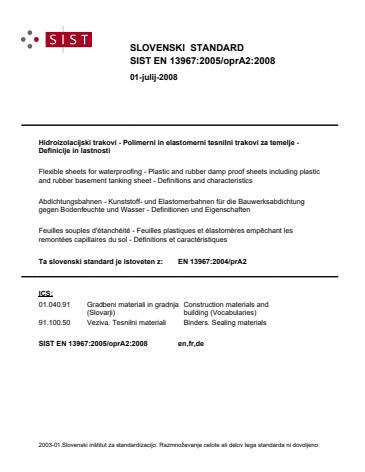
SLOVENSKI STANDARD
01-julij-2008
Hidroizolacijski trakovi - Polimerni in elastomerni tesnilni trakovi za temelje -
Definicije in lastnosti
Flexible sheets for waterproofing - Plastic and rubber damp proof sheets including plastic
and rubber basement tanking sheet - Definitions and characteristics
Abdichtungsbahnen - Kunststoff- und Elastomerbahnen für die Bauwerksabdichtung
gegen Bodenfeuchte und Wasser - Definitionen und Eigenschaften
Feuilles souples d'étanchéité - Feuilles plastiques et élastomères empêchant les
remontées capillaires du sol - Définitions et caractéristiques
Ta slovenski standard je istoveten z: EN 13967:2004/prA2
ICS:
01.040.91 Gradbeni materiali in gradnja Construction materials and
(Slovarji) building (Vocabularies)
91.100.50 Veziva. Tesnilni materiali Binders. Sealing materials
2003-01.Slovenski inštitut za standardizacijo. Razmnoževanje celote ali delov tega standarda ni dovoljeno.
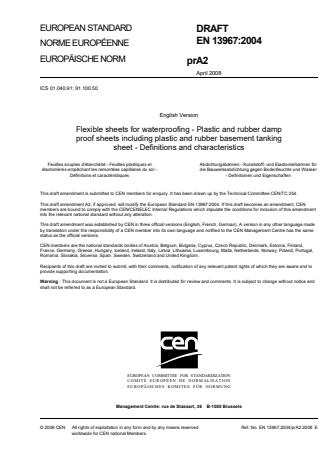
EUROPEAN STANDARD
DRAFT
EN 13967:2004
NORME EUROPÉENNE
EUROPÄISCHE NORM
prA2
April 2008
ICS 01.040.91; 91.100.50
English Version
Flexible sheets for waterproofing - Plastic and rubber damp
proof sheets including plastic and rubber basement tanking
sheet - Definitions and characteristics
Feuilles souples d'étanchéité - Feuilles plastiques et Abdichtungsbahnen - Kunststoff- und Elastomerbahnen für
élastomères empêchant les remontées capillaires du sol - die Bauwerksabdichtung gegen Bodenfeuchte und Wasser
Définitions et caractéristiques - Definitionen und Eigenschaften
This draft amendment is submitted to CEN members for enquiry. It has been drawn up by the Technical Committee CEN/TC 254.
This draft amendment A2, if approved, will modify the European Standard EN 13967:2004. If this draft becomes an amendment, CEN
members are bound to comply with the CEN/CENELEC Internal Regulations which stipulate the conditions for inclusion of this amendment
into the relevant national standard without any alteration.
This draft amendment was established by CEN in three official versions (English, French, German). A version in any other language made
by translation under the responsibility of a CEN member into its own language and notified to the CEN Management Centre has the same
status as the official versions.
CEN members are the national standards bodies of Austria, Belgium, Bulgaria, Cyprus, Czech Republic, Denmark, Estonia, Finland,
France, Germany, Greece, Hungary, Iceland, Ireland, Italy, Latvia, Lithuania, Luxembourg, Malta, Netherlands, Norway, Poland, Portugal,
Romania, Slovakia, Slovenia, Spain, Sweden, Switzerland and United Kingdom.
Recipients of this draft are invited to submit, with their comments, notification of any relevant patent rights of which they are aware and to
provide supporting documentation.
Warning : This document is not a European Standard. It is distributed for review and comments. It is subject to change without notice and
shall not be referred to as a European Standard.
EUROPEAN COMMITTEE FOR STANDARDIZATION
COMITÉ EUROPÉEN DE NORMALISATION
EUROPÄISCHES KOMITEE FÜR NORMUNG
Management Centre: rue de Stassart, 36 B-1050 Brussels
© 2008 CEN All rights of exploitation in any form and by any means reserved Ref. No. EN 13967:2004/prA2:2008: E
worldwide for CEN national Members.
Contents Page
Foreword.3
Introduction .4
2 Normative references .5
5.7 Resistance to impact.5
5.8.2 Against chemicals .5
5.9 Compatibility with bitumen.5
5.11 Joint strength.5
5.12 Water vapour transmission properties.5
5.16 Reaction to fire.6
C.1 Principle.6
--------
...