

SIST EN 459-2:2021
(Main)Building lime - Part 2: Test methods
General Information
- Abstract
This document specifies the test methods for all building limes covered by EN 459 1. They can also be applied to other lime materials, the standards for which call up these methods.
This document specifies in Table 2 the methods used for the chemical analyses and the determination of physical properties of building limes.
This document specifies the reference methods and, in certain cases, an alternative method which can be considered to be equivalent. In the case of a dispute, only the reference methods are used.
Any other methods may be used provided they are calibrated, either against the reference methods or against internationally accepted reference materials, in order to demonstrate their equivalence.
- Status
- Published
- Public Enquiry End Date
- 09-Nov-2019
- Publication Date
- 16-Aug-2021
- Technical Committee
- CAA - Mineral binders and masonry
- Current Stage
- 6060 - National Implementation/Publication (Adopted Project)
- Start Date
- 22-Jul-2021
- Due Date
- 26-Sep-2021
- Completion Date
- 17-Aug-2021

Overview
SIST EN 459-2:2021 - Building lime: Part 2: Test methods defines the standardized laboratory and field test procedures for building limes covered by EN 459-1. It specifies methods for sampling, chemical analysis and the determination of physical properties. The standard lists reference methods and, where appropriate, alternative methods that can be considered equivalent; in the event of dispute only the reference methods apply. Other test methods may be used only if calibrated against the reference methods or internationally accepted reference materials.
Key topics and technical requirements
The standard covers a comprehensive set of test protocols and related requirements, including:
- Sampling and sample preparation
- Procedures for powdered, granular lime, lime putty and milk of lime, and preparation of test portions.
- General testing requirements
- Number of tests, repeatability/reproducibility, expression of results, reagents and blank determinations.
- Chemical analyses
- Extraction with hydrochloric acid (reference method) and fusion with lithium tetraborate (alternative) for elemental analysis.
- Determination of CaO (calcium oxide) and MgO (magnesium oxide).
- Sulfate (as SO4) determination, free water content.
- Carbon dioxide (CO2) content by volumetric (reference) and gravimetric (alternative) methods.
- Loss on ignition and available lime determinations (including specific procedures for calcium lime and limes with hydraulic properties).
- Physical tests
- Particle size by dry sieving and air‑jet sieving.
- Bulk density measurement.
- Soundness tests for hydrated and hydraulic limes.
- Evaluation and reporting
- How to calculate, express and report results; calibration and equivalence rules for alternative methods.
Practical applications
SIST EN 459-2:2021 is used to ensure consistent, reproducible assessment of building lime quality and performance. Typical practical uses include:
- Quality control in lime production and batching.
- Verification testing for product conformity with EN 459-1 specification classes.
- Laboratory testing for research, formulation of mortars and restoration materials.
- Pre‑construction testing to select appropriate lime types for masonry, plastering or conservation.
Keywords: SIST EN 459-2:2021, building lime test methods, lime chemical analysis, particle size, bulk density, available lime, CO2 determination.
Who should use this standard
- Lime manufacturers and quality assurance teams
- Construction material testing laboratories
- Specifiers, architects and conservation specialists selecting lime products
- Contractors and mortar formulators requiring validated test data
- Regulatory bodies assessing compliance with EN 459 series
Related standards
- EN 459-1 (Building lime - Part 1: Definitions, specifications and conformity criteria) - specifies the product classes that EN 459-2 test methods apply to.
This standard supports reliable product specification, conformity assessment and consistent laboratory practice for building limes across Europe.
Relations
- Effective Date
- 01-Sep-2021
- Refers
SIST EN 459-1:2015 - Building lime - Part 1: Definitions, specifications and conformity criteria - Effective Date
- 28-Jan-2026
- Effective Date
- 28-Jan-2026
- Effective Date
- 28-Jan-2026
- Effective Date
- 28-Jan-2026
- Effective Date
- 28-Jan-2026
- Refers
SIST EN 932-1:1999 - Tests for general properties of aggregates - Part 1: Methods for sampling - Effective Date
- 28-Jan-2026
- Effective Date
- 28-Jan-2026
- Effective Date
- 28-Jan-2026
- Effective Date
- 28-Jan-2026
- Effective Date
- 28-Jan-2026
- Effective Date
- 28-Jan-2026
- Effective Date
- 28-Jan-2026
- Effective Date
- 28-Jan-2026
- Effective Date
- 28-Jan-2026
Get Certified
Connect with accredited certification bodies for this standard

DIBt (Deutsches Institut für Bautechnik)
German Institute for Building Technology.
DIN CERTCO
DIN Group product certification.

Aboma Certification B.V.
Specialized in construction, metal, and transport sectors.
Sponsored listings
Frequently Asked Questions
SIST EN 459-2:2021 is a standard published by the Slovenian Institute for Standardization (SIST). Its full title is "Building lime - Part 2: Test methods". This standard covers: This document specifies the test methods for all building limes covered by EN 459 1. They can also be applied to other lime materials, the standards for which call up these methods. This document specifies in Table 2 the methods used for the chemical analyses and the determination of physical properties of building limes. This document specifies the reference methods and, in certain cases, an alternative method which can be considered to be equivalent. In the case of a dispute, only the reference methods are used. Any other methods may be used provided they are calibrated, either against the reference methods or against internationally accepted reference materials, in order to demonstrate their equivalence.
This document specifies the test methods for all building limes covered by EN 459 1. They can also be applied to other lime materials, the standards for which call up these methods. This document specifies in Table 2 the methods used for the chemical analyses and the determination of physical properties of building limes. This document specifies the reference methods and, in certain cases, an alternative method which can be considered to be equivalent. In the case of a dispute, only the reference methods are used. Any other methods may be used provided they are calibrated, either against the reference methods or against internationally accepted reference materials, in order to demonstrate their equivalence.
SIST EN 459-2:2021 is classified under the following ICS (International Classification for Standards) categories: 91.100.10 - Cement. Gypsum. Lime. Mortar. The ICS classification helps identify the subject area and facilitates finding related standards.
SIST EN 459-2:2021 has the following relationships with other standards: It is inter standard links to SIST EN 459-2:2010, SIST EN 459-1:2015, SIST EN 196-7:2008, SIST EN 196-3:2017, SIST EN ISO 6506-1:2014, SIST EN 196-1:2016, SIST EN 932-1:1999, SIST EN 14679:2005, SIST EN 459-3:2011, SIST EN 12485:2017, SIST EN 13043:2002, SIST EN 13282-2:2015, SIST EN 12004-2:2017, SIST EN 19694-5:2017, SIST EN 12946:2001. Understanding these relationships helps ensure you are using the most current and applicable version of the standard.
SIST EN 459-2:2021 is associated with the following European legislation: EU Directives/Regulations: 305/2011; Standardization Mandates: M/114. When a standard is cited in the Official Journal of the European Union, products manufactured in conformity with it benefit from a presumption of conformity with the essential requirements of the corresponding EU directive or regulation.
SIST EN 459-2:2021 is available in PDF format for immediate download after purchase. The document can be added to your cart and obtained through the secure checkout process. Digital delivery ensures instant access to the complete standard document.
Standards Content (Sample)
SLOVENSKI STANDARD
01-september-2021
Nadomešča:
SIST EN 459-2:2010
Gradbeno apno - 2. del: Metode preskušanja
Building lime - Part 2: Test methods
Baukalk - Teil 2: Prüfverfahren
Chaux de Construction - Partie 2: Méthodes d'essais
Ta slovenski standard je istoveten z: EN 459-2:2021
ICS:
91.100.10 Cement. Mavec. Apno. Malta Cement. Gypsum. Lime.
Mortar
2003-01.Slovenski inštitut za standardizacijo. Razmnoževanje celote ali delov tega standarda ni dovoljeno.
EN 459-2
EUROPEAN STANDARD
NORME EUROPÉENNE
July 2021
EUROPÄISCHE NORM
ICS 91.100.10 Supersedes EN 459-2:2010
English Version
Building lime - Part 2: Test methods
Chaux de Construction - Partie 2: Méthodes d'essais Baukalk - Teil 2: Prüfverfahren
This European Standard was approved by CEN on 8 February 2021.
CEN members are bound to comply with the CEN/CENELEC Internal Regulations which stipulate the conditions for giving this
European Standard the status of a national standard without any alteration. Up-to-date lists and bibliographical references
concerning such national standards may be obtained on application to the CEN-CENELEC Management Centre or to any CEN
member.
This European Standard exists in three official versions (English, French, German). A version in any other language made by
translation under the responsibility of a CEN member into its own language and notified to the CEN-CENELEC Management
Centre has the same status as the official versions.
CEN members are the national standards bodies of Austria, Belgium, Bulgaria, Croatia, Cyprus, Czech Republic, Denmark, Estonia,
Finland, France, Germany, Greece, Hungary, Iceland, Ireland, Italy, Latvia, Lithuania, Luxembourg, Malta, Netherlands, Norway,
Poland, Portugal, Republic of North Macedonia, Romania, Serbia, Slovakia, Slovenia, Spain, Sweden, Switzerland, Turkey and
United Kingdom.
EUROPEAN COMMITTEE FOR STANDARDIZATION
COMITÉ EUROPÉEN DE NORMALISATION
EUROPÄISCHES KOMITEE FÜR NORMUNG
CEN-CENELEC Management Centre: Rue de la Science 23, B-1040 Brussels
© 2021 CEN All rights of exploitation in any form and by any means reserved Ref. No. EN 459-2:2021 E
worldwide for CEN national Members.
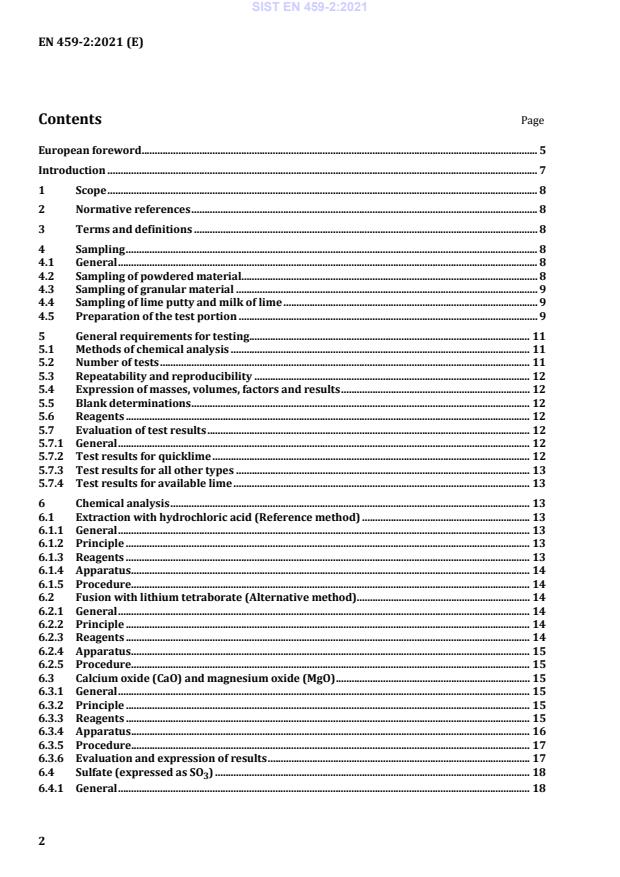
Contents Page
European foreword . 5
Introduction . 7
1 Scope . 8
2 Normative references . 8
3 Terms and definitions . 8
4 Sampling . 8
4.1 General . 8
4.2 Sampling of powdered material. 8
4.3 Sampling of granular material . 9
4.4 Sampling of lime putty and milk of lime . 9
4.5 Preparation of the test portion . 9
5 General requirements for testing . 11
5.1 Methods of chemical analysis . 11
5.2 Number of tests . 11
5.3 Repeatability and reproducibility . 12
5.4 Expression of masses, volumes, factors and results . 12
5.5 Blank determinations . 12
5.6 Reagents . 12
5.7 Evaluation of test results . 12
5.7.1 General . 12
5.7.2 Test results for quicklime . 12
5.7.3 Test results for all other types . 13
5.7.4 Test results for available lime . 13
6 Chemical analysis . 13
6.1 Extraction with hydrochloric acid (Reference method) . 13
6.1.1 General . 13
6.1.2 Principle . 13
6.1.3 Reagents . 13
6.1.4 Apparatus . 14
6.1.5 Procedure. 14
6.2 Fusion with lithium tetraborate (Alternative method). 14
6.2.1 General . 14
6.2.2 Principle . 14
6.2.3 Reagents . 14
6.2.4 Apparatus . 15
6.2.5 Procedure. 15
6.3 Calcium oxide (CaO) and magnesium oxide (MgO) . 15
6.3.1 General . 15
6.3.2 Principle . 15
6.3.3 Reagents . 15
6.3.4 Apparatus . 16
6.3.5 Procedure. 17
6.3.6 Evaluation and expression of results . 17
6.4 Sulfate (expressed as SO ) . 18
6.4.1 General . 18
6.4.2 Principle . 18
6.4.3 Reagents . 18
6.4.4 Apparatus . 19
6.4.5 Procedure . 19
6.4.6 Evaluation and expression of results . 19
6.5 Free water . 20
6.5.1 General . 20
6.5.2 Principle . 20
6.5.3 Apparatus . 20
6.5.4 Procedure . 20
6.5.5 Evaluation and expression of results . 21
6.6 Volumetric determination of carbon dioxide (CO ) (reference method) . 21
6.6.1 Principle . 21
6.6.2 Reagents . 21
6.6.3 Apparatus . 21
6.6.4 Procedure . 22
6.6.5 Calibration of the apparatus . 23
6.6.6 Evaluation and expression of results . 24
6.7 Gravimetric determination of carbon dioxide (CO ) (alternative method) . 24
6.7.1 Principle . 24
6.7.2 Reagents . 24
6.7.3 Apparatus . 25
6.7.4 Procedure . 27
6.7.5 Evaluation and expression of results . 28
6.8 Loss on ignition . 28
6.8.1 General . 28
6.8.2 Principle . 28
6.8.3 Apparatus . 28
6.8.4 Procedure . 28
6.8.5 Evaluation and expression of results . 29
6.9 Available lime . 29
6.9.1 General . 29
6.9.2 Principle . 29
6.9.3 Reagents . 29
6.9.4 Apparatus . 30
6.9.5 Procedure . 30
6.9.6 Sugar extraction . 30
6.9.7 Determination for calcium lime . 30
6.9.8 Determination for lime with hydraulic properties . 31
6.9.9 Evaluation and expression of results . 31
7 Physical tests . 31
7.1 Particle size by dry sieving . 31
7.1.1 General . 31
7.1.2 Principle . 31
7.1.3 Apparatus . 31
7.1.4 Preparation of test portions . 32
7.1.5 Procedure . 32
7.1.6 Evaluation and expression of results . 32
7.2 Particle size by air-jet sieving . 33
7.2.1 General . 33
7.2.2 Apparatus . 33
7.2.3 Procedure . 34
7.2.4 Evaluation and expression of results . 35
7.3 Bulk density . 35
7.3.1 Apparatus . 35
7.3.2 Procedure. 37
7.3.3 Evaluation and expression of results . 37
7.4 Soundness . 37
7.4.1 General . 37
7.4.2 For hydrated calcium lime and all types of lime with hydraulic properties . 38
7.4.3 For hydrated calcium lime, lime putty and hydrated dolomitic lime which include
grains larger than 0,2 mm . 41
7.4.4 For quicklime, lime putty, dolomitic lime and hydrated dolomitic lime . 42
7.5 Setting times . 45
7.5.1 Principle . 45
7.5.2 Laboratory, apparatus and materials . 45
7.5.3 Standard consistence test . 45
7.5.4 Setting time test . 48
7.6 Reactivity . 49
7.6.1 General . 49
7.6.2 Apparatus . 49
7.6.3 Quality check of the test equipment . 50
7.6.4 Sample preparation . 54
7.6.5 Procedure. 54
7.6.6 Evaluation and expression of test results . 54
7.7 Yield . 55
7.7.1 Slaking vessel . 55
7.7.2 Procedure. 56
7.7.3 Evaluation and expression of results . 56
7.8 Standard mortar by mass and water demand for values of flow and penetration . 56
7.8.1 General . 56
7.8.2 Composition and preparation of standard mortar . 57
7.8.3 Water demand for values of flow and penetration . 62
7.9 Water retention . 62
7.9.1 Principle . 62
7.9.2 Apparatus . 62
7.9.3 Preparation of specimen material . 62
7.9.4 Procedure. 62
7.9.5 Evaluation . 63
7.10 Determination of air content . 64
7.10.1 Apparatus . 64
7.10.2 Calibration of apparatus . 65
7.10.3 Preparation of test mortar . 65
7.10.4 Procedure. 65
7.10.5 Reporting of results . 65
7.11 Compressive strength . 66
7.11.1 General . 66
7.11.2 Modifications to EN 196-1 . 66
Annex A (informative) Example for the calculation of the results on sieving . 70
Annex B (informative) Precision data for the test methods . 71
Bibliography . 74
European foreword
This document (EN 459-2:2021) has been prepared by Technical Committee CEN/TC 51 “Cement and
building limes”, the secretariat of which is held by NBN.
This European Standard shall be given the status of a national standard, either by publication of an
identical text or by endorsement, at the latest by January 2022, and conflicting national standards shall
be withdrawn at the latest by January 2022.
Attention is drawn to the possibility that some of the elements of this document may be the subject of
patent rights. CEN shall not be held responsible for identifying any or all such patent rights.
This document supersedes EN 459-2:2010.
In comparison with EN 459-2:2010, the following modifications have been made:
— description of fusion with lithium tetraborate;
— a new Clause 5.1 included;
— amendments for the determinations of CaO and MgO;
— change of the order of methods for determination of CO ;
— Phenolphthalein as indicator replaced by thymolphthalein;
— Amendments for the determination of available lime;
— amendments of the methods for particle size determination;
— amendment for the description of bulk density;
— amendments for the determination of reactivity;
— amendments for the Table B.1 and Table B.2 in Annex B;
— editorial changes were made and minor mistakes corrected.
EN 459, Building lime, is currently composed of the following parts:
— Part 1: Definitions, specifications and conformity criteria;
— Part 2: Test methods;
— Part 3: Conformity evaluation.
The existing standards from the EN 196 series were used as a basis for the testing of physical and
mechanical properties in EN 459-2. For the testing of chemical properties of building limes, test
methods described in EN 12485 have been incorporated into this document.
Any feedback and questions on this document should be directed to the users’ national standards body.
A complete listing of these bodies can be found on the CEN website.
According to the CEN-CENELEC Internal Regulations, the national standards organisations of the
following countries are bound to implement this European Standard: Austria, Belgium, Bulgaria,
Croatia, Cyprus, Czech Republic, Denmark, Estonia, Finland, France, Germany, Greece, Hungary, Iceland,
Ireland, Italy, Latvia, Lithuania, Luxembourg, Malta, Netherlands, Norway, Poland, Portugal, Republic of
North Macedonia, Romania, Serbia, Slovakia, Slovenia, Spain, Sweden, Switzerland, Turkey and the
United Kingdom.
Introduction
The objective in this document has been to adopt as many European standardized methods as possible,
and where this has not been possible, to use other appropriate proven methods.
Unless otherwise stated, tolerance class m of ISO 2768-1 apply (Indications on drawings by
“ISO 2768-1”).
All dimensions are in millimetres.
1 Scope
This document specifies the test methods for all building limes covered by EN 459-1. They can also be
applied to other lime materials, the standards for which call up these methods.
This document specifies in Table 2 the methods used for the chemical analyses and the determination of
physical properties of building limes.
This document specifies the reference methods and, in certain cases, an alternative method which can
be considered to be equivalent. In the case of a dispute, only the reference methods are used.
Any other methods may be used provided they are calibrated, either against the reference methods or
against internationally accepted reference materials, in order to demonstrate their equivalence.
2 Normative references
The following documents are referred to in the text in such a way that some or all of their content
constitutes requirements of this document. For dated references, only the edition cited applies. For
undated references, the latest edition of the referenced document (including any amendments) applies.
EN 196-1:2016, Methods of testing cement - Part 1: Determination of strength
EN 196-3, Methods of testing cement - Part 3: Determination of setting times and soundness
EN 196-7, Methods of testing cement - Part 7: Methods of taking and preparing samples of cement
EN 459-1, Building lime - Part 1: Definitions, specifications and conformity criteria
EN 932-1, Tests for general properties of aggregates - Part 1: Methods for sampling
EN ISO 6506-1, Metallic materials - Brinell hardness test - Part 1: Test method (ISO 6506-1)
3 Terms and definitions
No terms and definitions are listed in this document.
ISO and IEC maintain terminological databases for use in standardization at the following addresses:
• IEC Electropedia: available at http://www.electropedia.org/
• ISO Online browsing platform: available at https://www.iso.org/obp
4 Sampling
4.1 General
Sampling shall be carried out as specified in 4.2 to 4.4 taking into account the need to minimize
moisture and carbon dioxide absorption. Samples shall therefore be transported and stored in air-tight
containers and all the handling shall be carried out as quickly as possible.
4.2 Sampling of powdered material
Sampling shall be carried out in accordance with EN 196-7.
4.3 Sampling of granular material
Sampling shall be carried out in accordance with EN 932-1.
4.4 Sampling of lime putty and milk of lime
The spot sample size shall be (10 ± 5) dm .
Where lime putty or milk of lime is sampled, the increments shall be blended thoroughly.
4.5 Preparation of the test portion
Before carrying out the analysis, the sample shall be reduced in mass by means of a sample divider
and/or by any homogenization process (quartering, mixing, etc.) to produce a representative
homogeneous test sample of suitable mass for the intended determinations.
Lime putty and milk of lime shall be dried before the chemical analysis (see 6.5.4.2).
The sample preparation for the appropriate test is described in Table 1.
Table 1 — Sample preparation for the single tests
Clause in this Type and form of the
Test Sample preparation
document building lime
The sample of granular material
Chemical shall be crushed and ground. All
6 All types of building lime
analysis tests shall be performed on
materials of a grain size ≤ 0,2 mm
Grain size
distribution 7.1 and 7.2 Quicklime Material in the as-delivered state
by sieving
Grain size
Hydrated lime, hydrated
distribution
7.2 dolomitic lime, lime with Material in the as-delivered state
by air-jet
hydraulic properties
sieving
All types of lime with
Bulk density 7.3 See 7.3.2
hydraulic properties
Hydrated lime, lime with
7.4.2.1 and 7.4.2.2 Material in the as-delivered state
hydraulic properties
Hydraulic lime with an SO
7.4.2.3 Material in the as-delivered state
content of more than 3 % and
up to 7 %
Soundness
Hydrated lime, lime putty und
7.4.3 Material in the as-delivered state
hydrated dolomitic lime
Quicklime, lime putty,
7.4.4 dolomitic quicklime, hydrated See 7.4.4.3.1
dolomitic lime
Lime with hydraulic
Setting times 7.5 Material in the as-delivered state
properties
Clause in this Type and form of the
Test Sample preparation
document building lime
Method 1:
The test shall be performed in
the as delivered state.
If material contains particles
coarser than 5 mm, the
fraction above 5 mm shall be
crushed to get 100 % of the
Quicklime, dolomitic material ≤ 5 mm.
Reactivity 7.6
quicklime
Method 2:
The test shall be performed on
materials of a grain size
of ≥ 95 % passing 0,2 mm
sieve.
The method used for the test shall
be declared in the test report.
Yield 7.7 Quicklime See 7.7.2
Hydrated lime, hydrated
Mortar tests 7.8 to 7.10 dolomitic lime, lime with Material in the as-delivered state
hydraulic properties
Compressive Lime with hydraulic
7.11 Material in the as-delivered state
strength properties
5 General requirements for testing
5.1 Methods of chemical analysis
The methods to be used for the chemical analysis of building lime products and the principle of each
method are listed in Table 2.
Table 2 — Methods of chemical analysis
Determination Method Principle
Calcium oxide 6.3 Complexometric titration
XRF melting tablet
XRF powder tablet
Magnesium oxide 6.3 Complexometric titration
XRF melting tablet
XRF powder tablet
ICP-OES
AAS-Flame technique
Sulfate, expressed as SO 6.4 Gravimetry
XRF melting tablet
XRF powder tablet
ICP-OES
Combustion at 1 300 °C minimum
temperature and IR detection
Free water 6.5 Gravimetry, drying oven
Gravimetry, moisture balance
Carbon dioxide 6.6 Volumetry
6.7 Gravimetry
Combustion at 900 °C minimum
temperature and IR detection
Loss on ignition at 1 050 °C 6.8 Gravimetry
Available lime 6.9 Acidimetric titration
5.2 Number of tests
Analysis of a building lime may require the determination of a number of its chemical properties. For
each determination one or more tests shall be carried out in which the number of measurements to be
taken shall be as specified in the relevant clause of this document.
Where the analysis is one of a series subject to statistical control, determination of each chemical
property by a single test shall be the minimum required.
Where the analysis is not part of a series subject to statistical control, the number of tests for
determination of each chemical property shall be two (see also 5.3).
5.3 Repeatability and reproducibility
Repeatability — Precision under repeatability conditions where independent test results are obtained
with the same method on identical test items (material) in the same laboratory by the same operator
using the same equipment within short intervals of time.
Reproducibility — Precision under reproducibility conditions where test results are obtained with the
same method on identical test items (material) in different laboratories with different operators using
different equipment.
Repeatability and reproducibility in this document (see Annex B) are expressed as repeatability
standard deviation(s) and reproducibility standard deviation(s) in e.g. absolute percent, grams, etc.,
according to the property tested.
5.4 Expression of masses, volumes, factors and results
Express masses in grams to the nearest 0,001 g and volumes from burettes in millilitres to the nearest
0,05 ml.
Express the factors of solutions, given by the mean of three measurements, to three decimal places.
Express the results generally to one decimal place, except for results below 1.
If the result is below 1, then express the results, generally to two decimal places.
If the test is in duplicate, express the result as a mean value. If the two test results differ by more than
twice the standard deviation of repeatability, repeat the test and take the mean of the two closest test
results.
The results of all individual tests shall be recorded.
5.5 Blank determinations
Carry out a blank determination without a sample, where relevant, following the same procedure and
using the same amounts of reagents. Correct the results obtained for the analytical determination
accordingly.
5.6 Reagents
Use only reagents of analytical quality. References to water mean distilled or deionised water having an
electrical conductivity ≤ 0,5 mS/m.
Unless otherwise stated percent means percent by mass.
For the concentrated liquids used to make up the reagents in this document, the densities (ρ) are given
in grams per millilitre at 20 °C. The degree of dilution is always given as a volumetric sum, for example:
dilute hydrochloric acid 1 + 2 means that 1 volume of concentrated hydrochloric acid is to be mixed
with 2 volumes of water.
The concentrations of reference and standard volumetric solutions are specified as amount-of-
substance concentrations, c (mol/l).
5.7 Evaluation of test results
5.7.1 General
The chemical requirements for building limes are specified in the relevant tables in EN 459-1.
5.7.2 Test results for quicklime
For quicklime the specified values correspond to the as-delivered product.
5.7.3 Test results for all other types
For all other types (hydrated lime, lime putty, milk of lime, lime with hydraulic properties) the values
are based on the product after subtraction of its free water and bound water content. The values
obtained by application of procedures described in this document for total calcium oxide and
magnesium oxide (6.3), magnesium oxide (6.3), sulfate (6.4) and carbon dioxide (6.6 or 6.7) are for the
products without subtraction of the free water and bound water content. To compare these values with
EN 459-1 (see clauses for calcium lime or dolomitic lime), they shall first be corrected by multiplication
by factor F. Factor F shall be determined in the following way:
Determine the carbon dioxide content as described in 6.6 or 6.7 and the loss on ignition as described in
6.8. The loss on ignition is the sum of the free water, bound water and carbon dioxide, provided that the
sample does not contain any highly volatile compounds or oxidizable constituents. Calculate the total
as a mass fraction in % of the sample using:
(free + bound) water content W
T
W = loss on ignition in % — carbon dioxide content in % (1)
T
Calculate the factor F from the following formula:
FW 100 / 100− (2)
( )
T
5.7.4 Test results for available lime
The values for available lime, obtained by the application of the procedure described in 6.9 correspond
to either available CaO for quicklime or available Ca(OH) for all other types (hydrated lime, lime putty
milk of lime, lime with hydraulic properties).
6 Chemical analysis
6.1 Extraction with hydrochloric acid (Reference method)
6.1.1 General
Extraction with hydrochloric acid is used to dissolve building lime in order to determine appropriate
parameters (see Table 2).
6.1.2 Principle
The sample is boiled with hydrochloric acid and the solution filtered. The pH value is adjusted to 6 to 7
to precipitate the iron (III) and aluminium oxides. After refiltering, the filtrate is transferred to a
suitable volumetric flask.
6.1.3 Reagents
6.1.3.1 Hydrochloric acid, ρ(HCI) = 1,16 g/ml to 1,19 g/ml.
6.1.3.2 Hydrogen peroxide solution, c(H O ) = 30 %.
2 2
6.1.3.3 Hydrogen peroxide solution; diluted, 1 + 9.
6.1.3.4 Ammonium hydroxide solution, c(NH OH) = 25 %.
6.1.3.5 Ammonium hydroxide solution, diluted, 1 + 9.
6.1.3.6 Ammonium chloride, NH Cl.
=
6.1.4 Apparatus
6.1.4.1 Ordinary laboratory equipment.
6.1.4.2 Hot plate.
6.1.4.3 Analytical balance accurate to 1 mg.
6.1.4.4 Magnetic stirrer and magnetic rod, inert e.g. PTFE covered.
6.1.4.5 pH-meter with glass electrode, capable of measuring to an accuracy of 0,05.
6.1.4.6 Fluted filter paper with particle retention size 2,5 microns.
6.1.5 Procedure
Weigh (1 ± 0,1) g of the sample to the nearest 1 mg (m ), transfer it to a 250 ml beaker, moisten with
10 ml of water, then gradually add 30 ml of hydrochloric acid (6.1.3.1). Make the solution up to about
100 ml with water then boil it for 10 min. After boiling, filter the solution immediately through a filter
paper (6.1.4.6) into a 400 ml beaker and wash the residue well with hot water.
Add about 4 g of ammonium chloride (6.1.3.6) and a few drops of hydrogen peroxide (6.1.3.3) to the
solution, then dilute with about 150 ml of water and heat to boiling. During boiling, add ammonium
hydroxide solution (6.1.3.4) to adjust the pH value to 6 to 7 and precipitate aluminium hydroxides and
iron hydroxides and the soluble silicic acid.
Continue boiling for 3 min and, after the precipitate has settled, filter the solution immediately through
a filter paper (6.1.4.6) into a 500 ml volumetric flask. Wash the filter residue three times with
ammonium hydroxide solution (6.1.3.5) and three times with water. After the solution has cooled to
room temperature, make the solution up to the mark with water and shake the contents of the flask
thoroughly. This solution (V ) is ready for further chemical analyses.
6.2 Fusion with lithium tetraborate (Alternative method)
6.2.1 General
Fusion with lithium tetraborate is used to dissolve building lime in order to determine appropriate
parameters (see Table 2).
6.2.2 Principle
After fusing the sparingly soluble oxide constituents of the sample with lithium tetraborate, the fusion
cake is dissolved in hydrochloric acid and transferred to a suitable volumetric flask.
6.2.3 Reagents
6.2.3.1 Lithium tetraborate, Li B O .
2 4 7
6.2.3.2 Hydrochloric acid, ρ = 1,16 g/ml.
6.2.3.3 Hydrochloric acid, diluted, (1 + 5).
6.2.4 Apparatus
6.2.4.1 Ordinary laboratory apparatus and the following:
6.2.4.2 Platinum-gold crucible.
6.2.4.3 Hot plate.
6.2.5 Procedure
Weigh (0,25 ± 0,02) g to the nearest 0,1 mg (m ) of the sample into a platinum-gold crucible and add
1,5 g of lithium tetraborate (6.2.3.1). Roast at (1 000 ± 25) °C until the melt is clear. Remove from the
heat, cover the crucible with a watch glass and stand the crucible in water for a few seconds, remove
and allow it to stand until it has cooled completely.
Transfer the cold melt to a beaker using approximately 50 ml of hydrochloric acid (6.2.3.3) and dissolve
while stirring and heating at 100 °C. Then transfer the solution to a 250 ml volumetric flask and, after
cooling to room temperature make up to the mark with water. This solution (V ) is ready for further
chemical analyses.
6.3 Calcium oxide (CaO) and magnesium oxide (MgO)
6.3.1 General
The method is suitable for determining calcium oxide and magnesium oxide.
6.3.2 Principle
Calcium oxide is first deter
...