

ISO/IEC 19989-1:2020
(Main)Information security — Criteria and methodology for security evaluation of biometric systems — Part 1: Framework
General Information
- Abstract
For security evaluation of biometric recognition performance and presentation attack detection for biometric verification systems and biometric identification systemsthis document specifies: — extended security functional components to SFR Classes in ISO/IEC 15408-2; — supplementary activities to methodology specified in ISO/IEC 18045 for SAR Classes of ISO/IEC 15408-3. This document introduces the general framework for the security evaluation of biometric systems, including extended security functional components, and supplementary activities to methodology, which is additional evaluation activities and guidance/recommendations for an evaluator to handle those activities. The supplementary evaluation activities are developed in this document while the detailed recommendations are developed in ISO/IEC 19989-2 (for biometric recognition aspects) and in ISO/IEC 19989-3 (for presentation attack detection aspects). This document is applicable only to TOEs for single biometric characteristic type. However, the selection of a characteristic from multiple characteristics in SFRs is allowed.
- Status
- Published
- Publication Date
- 28-Sep-2020
- Current Stage
- 9092 - International Standard to be revised
- Start Date
- 03-May-2024
- Completion Date
- 12-Sep-2026
Buy Documents


ISO/IEC 19989-1:2020 - Information security -- Criteria and methodology for security evaluation of biometric systems

ISO/IEC 19989-1:2020 - Information security — Criteria and methodology for security evaluation of biometric systems — Part 1: Framework/29/2020
Overview - ISO/IEC 19989-1:2020 (Framework)
ISO/IEC 19989-1:2020 defines a general framework for the security evaluation of biometric systems. It specifies extended security functional components and supplementary evaluation activities to be used when assessing:
- biometric recognition performance (verification and identification), and
- presentation attack detection (PAD) for biometric systems.
This part (Part 1: Framework) introduces the evaluation structure, vulnerability categorization, and the additional evaluator guidance. Detailed recommendations for biometric recognition and PAD evaluation are provided in companion documents ISO/IEC 19989-2 and ISO/IEC 19989-3.
Key technical topics and requirements
- Extended Security Functional Components - Adds biometric-specific components to Common Criteria SFR classes (notably Class FPT: protection of the TSF, and Class FIA: identification and authentication). Examples in the standard include FPT_PAD, FPT_BCP, FIA_EBR, FIA_BVR, and FIA_BID (see standard for full definitions and component levelling).
- Supplementary Activities to ISO/IEC 18045 - Provides additional evaluation activities and guidance for methodology classes (e.g., APE, ASE, ADV, AGD, ALC, ATE, AVA) to address biometric-specific concerns.
- Vulnerability Categorization - Describes common biometric system vulnerabilities, categorization of Targets of Evaluation (TOEs), and how those relate to recognition and PAD evaluation.
- Evaluation Scope - Applicable to TOEs implementing a single biometric characteristic type (selection from multiple characteristics in SFRs is allowed).
- Guidance for Evaluators - Recommends extra evaluator activities, audit items, and management considerations (e.g., capture quality checks, failure-to-enrol/performance requirements, PAD management and audit).
Practical applications
- Use ISO/IEC 19989-1 when planning or performing security evaluations of biometric verification and identification systems to ensure:
- Consistent, repeatable evaluation against Common Criteria SFRs augmented for biometric functions.
- PAD assessment is incorporated into security testing and lifecycle activities.
- Vulnerability analysis and attack potential specific to biometric modalities are considered.
Practical settings:
- Certification laboratories and Common Criteria evaluation teams
- Biometric product vendors and developers preparing security targets
- Procurement teams specifying evaluation criteria for biometric systems
- System integrators and risk managers validating biometric component security
Who should use this standard
- Evaluators and test laboratories performing Common Criteria evaluations of biometric TOEs
- Product developers creating biometric systems seeking evaluated assurance levels
- Certification bodies and auditors that need consistent biometric evaluation frameworks
- Procurement and security architects specifying biometric security requirements
Related standards and keywords
- Related: ISO/IEC 15408 (Common Criteria), ISO/IEC 18045 (evaluation methodology), ISO/IEC 19989-2, ISO/IEC 19989-3
- Keywords: biometric security, biometric evaluation, presentation attack detection (PAD), security functional requirements (SFR), Common Criteria, TOE evaluation, biometric recognition performance.
Relations
- Effective Date
- 02-Sep-2026
- Effective Date
- 01-Jul-2026
Buy Documents
ISO/IEC 19989-1:2020 - Information security -- Criteria and methodology for security evaluation of biometric systems
ISO/IEC 19989-1:2020 - Information security — Criteria and methodology for security evaluation of biometric systems — Part 1: Framework/29/2020
Get Certified
Connect with accredited certification bodies for this standard

BSI Group
BSI (British Standards Institution) is the business standards company that helps organizations make excellence a habit.

Bureau Veritas
Bureau Veritas is a world leader in laboratory testing, inspection and certification services.

DNV
DNV is an independent assurance and risk management provider.
Sponsored listings
Frequently Asked Questions
ISO/IEC 19989-1:2020 is a standard published by the International Organization for Standardization (ISO). Its full title is "Information security — Criteria and methodology for security evaluation of biometric systems — Part 1: Framework". This standard covers: For security evaluation of biometric recognition performance and presentation attack detection for biometric verification systems and biometric identification systemsthis document specifies: — extended security functional components to SFR Classes in ISO/IEC 15408-2; — supplementary activities to methodology specified in ISO/IEC 18045 for SAR Classes of ISO/IEC 15408-3. This document introduces the general framework for the security evaluation of biometric systems, including extended security functional components, and supplementary activities to methodology, which is additional evaluation activities and guidance/recommendations for an evaluator to handle those activities. The supplementary evaluation activities are developed in this document while the detailed recommendations are developed in ISO/IEC 19989-2 (for biometric recognition aspects) and in ISO/IEC 19989-3 (for presentation attack detection aspects). This document is applicable only to TOEs for single biometric characteristic type. However, the selection of a characteristic from multiple characteristics in SFRs is allowed.
For security evaluation of biometric recognition performance and presentation attack detection for biometric verification systems and biometric identification systemsthis document specifies: — extended security functional components to SFR Classes in ISO/IEC 15408-2; — supplementary activities to methodology specified in ISO/IEC 18045 for SAR Classes of ISO/IEC 15408-3. This document introduces the general framework for the security evaluation of biometric systems, including extended security functional components, and supplementary activities to methodology, which is additional evaluation activities and guidance/recommendations for an evaluator to handle those activities. The supplementary evaluation activities are developed in this document while the detailed recommendations are developed in ISO/IEC 19989-2 (for biometric recognition aspects) and in ISO/IEC 19989-3 (for presentation attack detection aspects). This document is applicable only to TOEs for single biometric characteristic type. However, the selection of a characteristic from multiple characteristics in SFRs is allowed.
ISO/IEC 19989-1:2020 is classified under the following ICS (International Classification for Standards) categories: 35.030 - IT Security. The ICS classification helps identify the subject area and facilitates finding related standards.
ISO/IEC 19989-1:2020 has the following relationships with other standards: It is inter standard links to CEN/TS 18212-1:2026, CEN/TS 18212-5:2026. Understanding these relationships helps ensure you are using the most current and applicable version of the standard.
ISO/IEC 19989-1:2020 is available in PDF format for immediate download after purchase. The document can be added to your cart and obtained through the secure checkout process. Digital delivery ensures instant access to the complete standard document.
Standards Content (Sample)
INTERNATIONAL ISO/IEC
STANDARD 19989-1
First edition
2020-09
Information security — Criteria and
methodology for security evaluation
of biometric systems —
Part 1:
Framework
Sécurité de l'information — Critères et méthodologie pour
l'évaluation de la sécurité des systèmes biométriques —
Partie 1: Cadre
Reference number
©
ISO/IEC 2020
© ISO/IEC 2020
All rights reserved. Unless otherwise specified, or required in the context of its implementation, no part of this publication may
be reproduced or utilized otherwise in any form or by any means, electronic or mechanical, including photocopying, or posting
on the internet or an intranet, without prior written permission. Permission can be requested from either ISO at the address
below or ISO’s member body in the country of the requester.
ISO copyright office
CP 401 • Ch. de Blandonnet 8
CH-1214 Vernier, Geneva
Phone: +41 22 749 01 11
Email: copyright@iso.org
Website: www.iso.org
Published in Switzerland
ii © ISO/IEC 2020 – All rights reserved
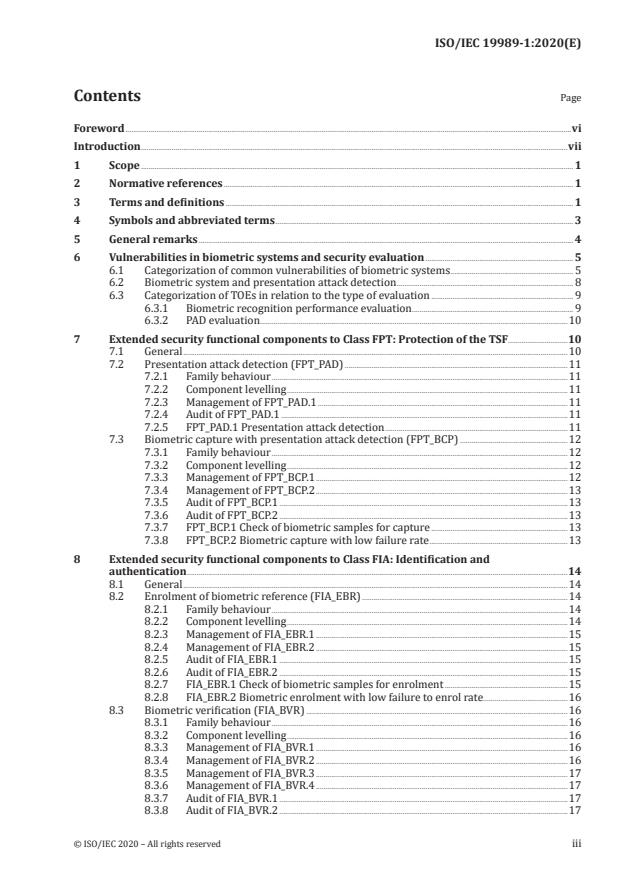
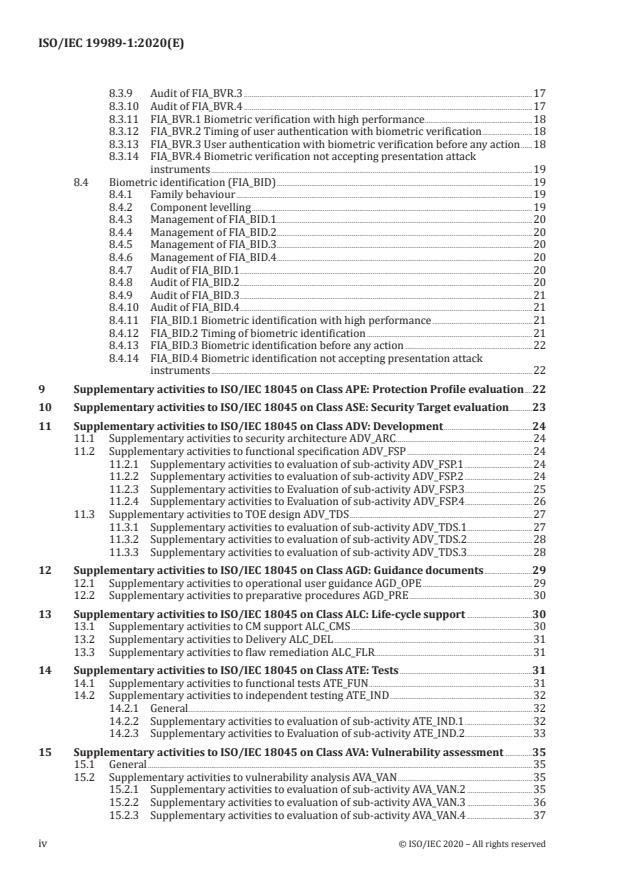
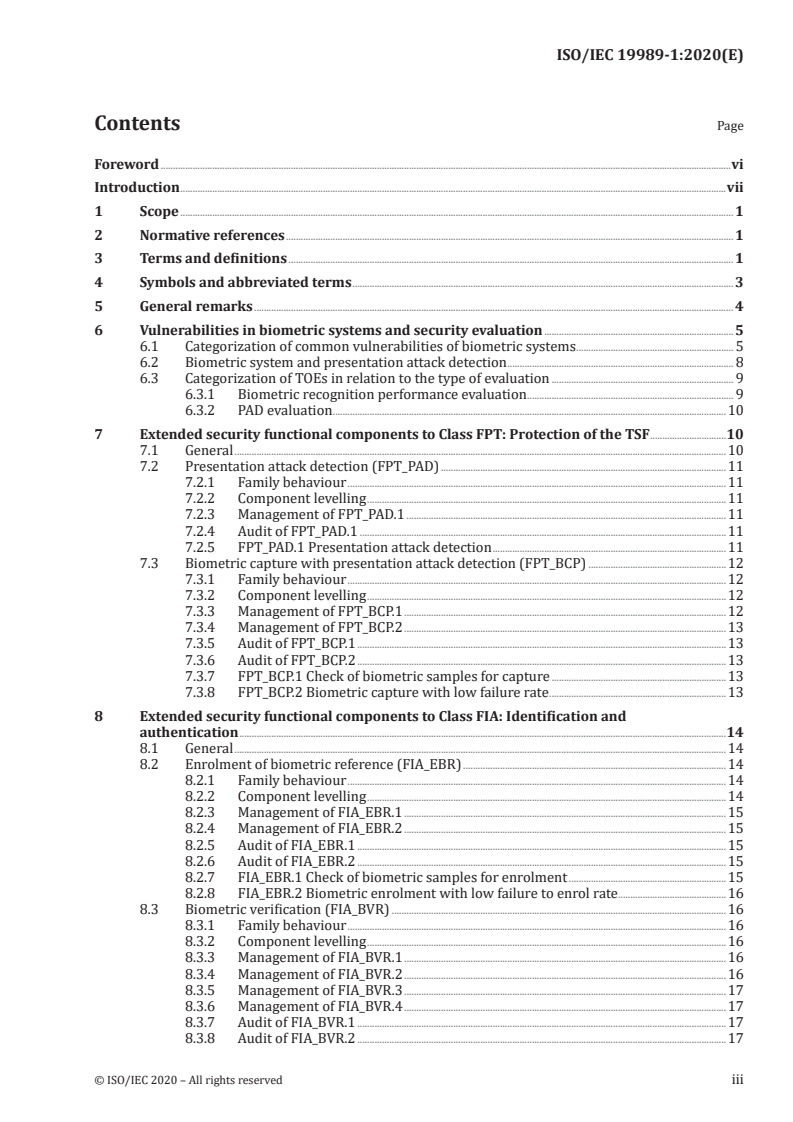
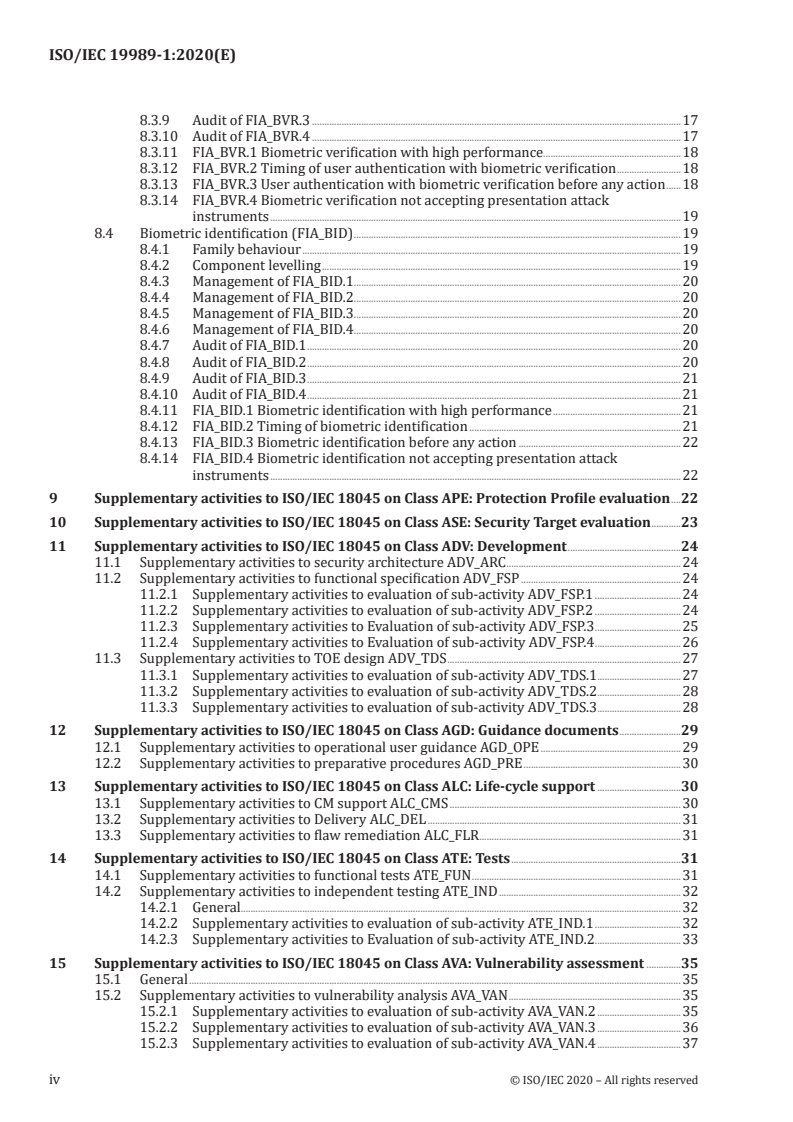
Contents Page
Foreword .vi
Introduction .vii
1 Scope . 1
2 Normative references . 1
3 Terms and definitions . 1
4 Symbols and abbreviated terms . 3
5 General remarks . 4
6 Vulnerabilities in biometric systems and security evaluation . 5
6.1 Categorization of common vulnerabilities of biometric systems . 5
6.2 Biometric system and presentation attack detection . 8
6.3 Categorization of TOEs in relation to the type of evaluation . 9
6.3.1 Biometric recognition performance evaluation . 9
6.3.2 PAD evaluation .10
7 Extended security functional components to Class FPT: Protection of the TSF .10
7.1 General .10
7.2 Presentation attack detection (FPT_PAD) .11
7.2.1 Family behaviour .11
7.2.2 Component levelling .11
7.2.3 Management of FPT_PAD.1 .11
7.2.4 Audit of FPT_PAD.1 .11
7.2.5 FPT_PAD.1 Presentation attack detection .11
7.3 Biometric capture with presentation attack detection (FPT_BCP) .12
7.3.1 Family behaviour .12
7.3.2 Component levelling .12
7.3.3 Management of FPT_BCP.1 .12
7.3.4 Management of FPT_BCP.2 .13
7.3.5 Audit of FPT_BCP.1 .13
7.3.6 Audit of FPT_BCP.2 .13
7.3.7 FPT_BCP.1 Check of biometric samples for capture .13
7.3.8 FPT_BCP.2 Biometric capture with low failure rate .13
8 Extended security functional components to Class FIA: Identification and
authentication .14
8.1 General .14
8.2 Enrolment of biometric reference (FIA_EBR) .14
8.2.1 Family behaviour .14
8.2.2 Component levelling .14
8.2.3 Management of FIA_EBR.1 .15
8.2.4 Management of FIA_EBR.2 .15
8.2.5 Audit of FIA_EBR.1 .15
8.2.6 Audit of FIA_EBR.2 .15
8.2.7 FIA_EBR.1 Check of biometric samples for enrolment .15
8.2.8 FIA_EBR.2 Biometric enrolment with low failure to enrol rate.16
8.3 Biometric verification (FIA_BVR) .16
8.3.1 Family behaviour .16
8.3.2 Component levelling .16
8.3.3 Management of FIA_BVR.1 .16
8.3.4 Management of FIA_BVR.2 .16
8.3.5 Management of FIA_BVR.3 .17
8.3.6 Management of FIA_BVR.4 .17
8.3.7 Audit of FIA_BVR.1 .17
8.3.8 Audit of FIA_BVR.2 .17
© ISO/IEC 2020 – All rights reserved iii
8.3.9 Audit of FIA_BVR.3 .17
8.3.10 Audit of FIA_BVR.4 .17
8.3.11 FIA_BVR.1 Biometric verification with high performance.18
8.3.12 FIA_BVR.2 Timing of user authentication with biometric verification .18
8.3.13 FIA_BVR.3 User authentication with biometric verification before any action .18
8.3.14 FIA_BVR.4 Biometric verification not accepting presentation attack
instruments .19
8.4 Biometric identification (FIA_BID) .19
8.4.1 Family behaviour .19
8.4.2 Component levelling .19
8.4.3 Management of FIA_BID.1 .20
8.4.4 Management of FIA_BID.2 .20
8.4.5 Management of FIA_BID.3 .20
8.4.6 Management of FIA_BID.4 .20
8.4.7 Audit of FIA_BID.1 .20
8.4.8 Audit of FIA_BID.2 .20
8.4.9 Audit of FIA_BID.3 .21
8.4.10 Audit of FIA_BID.4 .21
8.4.11 FIA_BID.1 Biometric identification with high performance .21
8.4.12 FIA_BID.2 Timing of biometric identification .21
8.4.13 FIA_BID.3 Biometric identification before any action .22
8.4.14 FIA_BID.4 Biometric identification not accepting presentation attack
instruments .22
9 Supplementary activities to ISO/IEC 18045 on Class APE: Protection Profile evaluation .22
10 Supplementary activities to ISO/IEC 18045 on Class ASE: Security Target evaluation .23
11 Supplementary activities to ISO/IEC 18045 on Class ADV: Development .24
11.1 Supplementary activities to security architecture ADV_ARC .24
11.2 Supplementary activities to functional specification ADV_FSP .24
11.2.1 Supplementary activities to evaluation of sub-activity ADV_FSP.1 .24
11.2.2 Supplementary activities to evaluation of sub-activity ADV_FSP.2 .24
11.2.3 Supplementary activities to Evaluation of sub-activity ADV_FSP.3 .25
11.2.4 Supplementary activities to Evaluation of sub-activity ADV_FSP.4 .26
11.3 Supplementary activities to TOE design ADV_TDS .27
11.3.1 Supplementary activities to evaluation of sub-activity ADV_TDS.1.27
11.3.2 Supplementary activities to evaluation of sub-activity ADV_TDS.2.28
11.3.3 Supplementary activities to evaluation of sub-activity ADV_TDS.3.28
12 Supplementary activities to ISO/IEC 18045 on Class AGD: Guidance documents .29
12.1 Supplementary activities to operational user guidance AGD_OPE .29
12.2 Supplementary activities to preparative procedures AGD_PRE .30
13 Supplementary activities to ISO/IEC 18045 on Class ALC: Life-cycle support .30
13.1 Supplementary activities to CM support ALC_CMS .30
13.2 Supplementary activities to Delivery ALC_DEL .31
13.3 Supplementary activities to flaw remediation ALC_FLR.31
14 Supplementary activities to ISO/IEC 18045 on Class ATE: Tests .31
14.1 Supplementary activities to functional tests ATE_FUN .31
14.2 Supplementary activities to independent testing ATE_IND .32
14.2.1 General.32
14.2.2 Supplementary activities to evaluation of sub-activity ATE_IND.1 .32
14.2.3 Supplementary activities to Evaluation of sub-activity ATE_IND.2 . .33
15 Supplementary activities to ISO/IEC 18045 on Class AVA: Vulnerability assessment .35
15.1 General .35
15.2 Supplementary activities to vulnerability analysis AVA_VAN .35
15.2.1 Supplementary activities to evaluation of sub-activity AVA_VAN.2 .35
15.2.2 Supplementary activities to evaluation of sub-activity AVA_VAN.3 .36
15.2.3 Supplementary activities to evaluation of sub-activity AVA_VAN.4 .37
iv © ISO/IEC 2020 – All rights reserved
Annex A (informative) Introduction to the basic concepts of ISO/IEC 15408.39
Annex B (normative) Class FPT: Protection of the TSF .41
Annex C (normative) Class FIA: Identification and authentication .43
Annex D (informative) Background information on supplementary activities for PAD evaluation 47
Annex E (informative) Other general vulnerabilities .54
Annex F (normative) Attack potential and TOE resistance .56
Bibliography .62
© ISO/IEC 2020 – All rights reserved v
Foreword
ISO (the International Organization for Standardization) and IEC (the International Electrotechnical
Commission) form the specialized system for worldwide standardization. National bodies that
are members of ISO or IEC participate in the development of International Standards through
technical committees established by the respective organization to deal with particular fields of
technical activity. ISO and IEC technical committees collaborate in fields of mutual interest. Other
international organizations, governmental and non-governmental, in liaison with ISO and IEC, also
take part in the work.
The procedures used to develop this document and those intended for its further maintenance are
described in the ISO/IEC Directives, Part 1. In particular, the different approval criteria needed for
the different types of document should be noted. This document was drafted in accordance with the
editorial rules of the ISO/IEC Directives, Part 2 (see www .iso .org/ directives).
Attention is drawn to the possibility that some of the elements of this document may be the subject
of patent rights. ISO and IEC shall not be held responsible for identifying any or all such patent
rights. Details of any patent rights identified during the development of the document will be in the
Introduction and/or on the ISO list of patent declarations received (see www .iso .org/ patents) or the IEC
list of patent declarations received (see http:// patents .iec .ch).
Any trade name used in this document is information given for the convenience of users and does not
constitute an endorsement.
For an explanation of the voluntary nature of standards, the meaning of ISO specific terms and
expressions related to conformity assessment, as well as information about ISO's adherence to the
World Trade Organization (WTO) principles in the Technical Barriers to Trade (TBT), see www .iso .org/
iso/ foreword .html.
This document was prepared by Joint Technical Committee ISO/IEC JTC 1, Information technology,
Subcommittee SC 27, Information security, cybersecurity and privacy protection.
A list of all parts in the ISO/IEC 19989 series can be found on the ISO website.
Any feedback or questions on this document should be directed to the user’s national standards body. A
complete listing of these bodies can be found at www .iso .org/ members .html.
vi © ISO/IEC 2020 – All rights reserved
Introduction
Biometric systems can be vulnerable to presentation attacks where attackers attempt to subvert
the system security policy by presenting their natural biometric characteristics or artefacts holding
copied or faked characteristics. Presentation attacks can occur during enrolment or identification/
verification events. Techniques designed to detect presentation artefacts are generally different from
those to counter attacks where natural characteristics are used. Defence against presentation attacks
with natural characteristics typically relies on the ability of a biometric system to discriminate
between genuine enrolees and attackers based on the differences between their natural biometric
characteristics. This ability is characterized by the biometric recognition performance of the system.
Biometric recognition performance and presentation attack detection have a bearing on the security
of biometric systems. Hence, the evaluation of these aspects of performance from a security viewpoint
will become important considerations for the procurement of biometric products and systems.
Biometric products and systems share many of the properties of other IT products and systems which
are amenable to security evaluation using the ISO/IEC 15408 series and ISO/IEC 18045 in the standard
way. However, biometric systems embody certain functionality that needs specialized evaluation
criteria and methodology which is not addressed by the ISO/IEC 15408 series and ISO/IEC 18045.
Mainly these relate to the evaluation of biometric recognition and presentation attack detection. These
are the functions addressed in the ISO/IEC 19989 series.
ISO/IEC 19792 describes these biometric-specific aspects and specifies principles to be considered
during the security evaluation of biometric systems. However, it does not specify the concrete criteria
and methodology that are needed for security evaluation based on the ISO/IEC 15408 series.
The ISO/IEC 19989 series provides a bridge between the evaluation principles for biometric products
and systems defined in ISO/IEC 19792 and the criteria and methodology requirements for security
evaluation based on the ISO/IEC 15408 series. The ISO/IEC 19989 series supplements the ISO/IEC 15408
series and ISO/IEC 18045 by providing extended security functional components together with
supplementary activities related to these requirements. The extensions to the requirements and
supplementary activities found in the ISO/IEC 15408 series and ISO/IEC 18045 relate to the evaluation
of biometric recognition and presentation attack detection which are particular to biometric systems.
This document consists of the introduction of the general framework for the security evaluation
of biometric systems, including extended security functional components, and supplementary
methodology and evaluation activities for the evaluator. The detailed recommendations are developed
for biometric recognition aspects in ISO/IEC 19989-2 and for presentation attack detection aspects in
ISO/IEC 19989-3.
In this document, the term "user" is used to mean the term "capture subject" used in biometrics.
© ISO/IEC 2020 – All rights reserved vii
INTERNATIONAL STANDARD ISO/IEC 19989-1:2020(E)
Information security — Criteria and methodology for
security evaluation of biometric systems —
Part 1:
Framework
1 Scope
For security evaluation of biometric recognition performance and presentation attack detection for
biometric verification systems and biometric identification systemsthis document specifies:
— extended security functional components to SFR Classes in ISO/IEC 15408-2;
— supplementary activities to methodology specified in ISO/IEC 18045 for SAR Classes of
ISO/IEC 15408-3.
This document introduces the general framework for the security evaluation of biometric systems,
including extended security functional components, and supplementary activities to methodology,
which is additional evaluation activities and guidance/recommendations for an evaluator to handle
those activities. The supplementary evaluation activities are developed in this document while the
detailed recommendations are developed in ISO/IEC 19989-2 (for biometric recognition aspects) and
in ISO/IEC 19989-3 (for presentation attack detection aspects). This document is applicable only to
TOEs for single biometric characteristic type. However, the selection of a characteristic from multiple
characteristics in SFRs is allowed.
2 Normative references
The following documents are referred to in the text in such a way that some or all of their content
constitutes requirements of this document. For dated references, only the edition cited applies. For
undated references, the latest edition of the referenced document (including any amendments) applies.
ISO/IEC 2382:2008, Information technology — Vocabulary
ISO/IEC 2382-37:2017, Information technology — Vocabulary— Part 37: Biometrics
ISO/IEC 15408-1:2009, Information technology — Security techniques — Evaluation criteria for IT
security — Part 1: Introduction and general model
ISO/IEC 15408-2:2008, Information technology — Security techniques — Evaluation criteria for IT
security — Part 2: Security functional components
ISO/IEC 15408-3:2008, Information technology — Security techniques — Evaluation criteria for IT
security — Part 3: Security assurance
ISO/IEC 18045:2008, Information technology — Security techniques — Methodology for IT security
evaluation
3 Terms and definitions
For the purposes of this document, the terms and definitions given in ISO/IEC 2382:2008,
ISO/IEC 2382-37:2017, ISO/IEC 15408-1:2009, ISO/IEC 18045:2008, and the following apply.
© ISO/IEC 2020 – All rights reserved 1
ISO and IEC maintain terminological databases for use in standardization at the following addresses:
— IEC Electropedia: available at http:// www .electropedia .org/
— ISO Online browsing platform: available at https:// www .iso .org/ obp
3.1
attack presentation classification error rate
APCER
proportion of attack presentations using the same PAI species incorrectly classified as bona fide
presentations in a specific scenario
[SOURCE: ISO/IEC 30107-3:2017, 3.2.1]
3.2
attack type
element and characteristic of a presentation attack, including PAI species, concealer or impostor attack,
degree of supervision, and method of interaction with the capture device
[SOURCE: ISO/IEC 30107-3:2017, 3.1.3]
3.3
bona fide presentation
interaction of the biometric capture subject and the biometric data capture subsystem in the fashion
intended by the policy of the biometric system
Note 1 to entry: Bona fide is analogous to normal or routine, when referring to a bona fide presentation.
Note 2 to entry: Bona fide presentations can include those in which the user has a low level of training or
skill. Bona fide presentations encompass the totality of good-faith presentations to a biometric data capture
subsystem.
[SOURCE: ISO/IEC 30107-3:2017, 3.1.2]
3.4
bona fide presentation classification error rate
BPCER
proportion of bona fide presentations incorrectly classified as presentation attacks in a specific
scenario
[SOURCE: ISO/IEC 30107-3:2017, 3.2.2]
3.5
PAI species
class of presentation attack instruments created using a common production method and based on
different biometric characteristics
EXAMPLE 1 A set of fake fingerprints all made in the same way with the same materials but with different
friction ridge patterns would constitute a PAI species.
EXAMPLE 2 A specific type of alteration made to the fingerprints of several data capture subjects would
constitute a PAI species.
Note 1 to entry: The term “recipe” is often used to refer to how to make a PAI species.
Note 2 to entry: Presentation attack instruments of the same species may have different success rates due to
variability in the production process.
[SOURCE: ISO/IEC 30107-3:2017, 3.1.6]
2 © ISO/IEC 2020 – All rights reserved
3.6
penetration testing
testing used in vulnerability analysis for vulnerability assessment, trying to defeat vulnerabilities of
the TOE based on the information about the TOE gathered during the relevant evaluation activities
Note 1 to entry: In the ISO/IEC 15408 series, this term is used without definition.
3.7
presentation attack
presentation to the biometric data capture subsystem with the goal of interfering with the operation of
the biometric system
Note 1 to entry: Presentation attack can be implemented through a number of methods, e.g. artefact, mutilations,
replay, etc.
Note 2 to entry: Presentation attacks may have a number of goals, e.g. impersonation or not being recognized.
Note 3 to entry: Biometric systems may not be able to differentiate between biometric presentation attacks with
the goal of interfering with the systems operation and non-conformant presentations.
[SOURCE: ISO/IEC 30107-1:2016, 3.5]
3.8
presentation attack detection
PAD
automated determination of a presentation attack
Note 1 to entry: PAD cannot infer the subject’s intent. In fact it may be impossible to derive that difference from
the data capture process or acquired sample.
[SOURCE: ISO/IEC 30107-1:2016, 3.6]
3.9
presentation attack instrument
PAI
biometric characteristic or object used in a presentation attack
Note 1 to entry: The set of PAI includes artefacts but would also include lifeless biometric characteristics (i.e.
stemming from dead bodies) or altered biometric characteristics (e.g. altered fingerprints) that are used in
an attack.
[SOURCE: ISO/IEC 30107-1:2016, 3.7]
Note 2 to entry: Examples of altered biometric characteristics are mutilation, surgical switching of fingerprints
between hands and/or toes (See Table 1 in 5.2 of ISO/IEC 30107-1:2016).
4 Symbols and abbreviated terms
APCER attack presentation classification error rate
BPCER bona fide presentation classification error rate
IT information technology
FAR false acceptance rate
FAU SFR class of audit
NOTE The class name is defined in ISO/IEC 15408-2. Here, F of FAU stands for functional
requirement, AU for audit. The class name is defined in this way in the ISO/IEC 15408 series. For
details, see Annex A.
© ISO/IEC 2020 – All rights reserved 3
FMR false match rate
FNIR false-negative identification-error rate
FNMR false non-match rate
FPIR false-positive identification-error rate
FPT SFR class of protection of the TSF
NOTE See NOTE to FAU.
FRR false rejection rate
FTAR failure-to-acquire rate
FTER failure-to-enrol rate
PAD presentation attack detection
PAI presentation attack instrument
PP protection profile
SAR security assurance requirement
SFR security functional requirement
ST security target
TOE target of evaluation
TSF TOE security functionality
TSFI TSF interface
5 General remarks
In addition to the requirements and recommendations provided in Clause 7 and Clause 8, those in
ISO/IEC 15408-2 shall be applied.
In addition to the requirements and recommendations provided in Clause 9 to Clause 15, those in
ISO/IEC 15408-3 and ISO/IEC 18045 shall be applied.
Annex D provides background information on supplementary activities for PAD evaluation.
The definition of authentication can be found in ISO/IEC 2382.
The definitions of biometric (adjective), biometric capture, assurance, biometric capture device,
biometric characteristic, biometric concealer, biometric enrolee, biometric enrolment, biometric
enrolment database, biometric feature, biometric identification, biometric impostor, biometric
presentation, biometric recognition, biometrics, biometric reference, biometric sample, biometric
system, biometric verification, comparison, enrol, failure-to-acquire rate, failure-to-enrol rate, alse
match rate, false-negative identification-error rate, false non-match rate, false-positive identification-
error rate, identify, match (noun) and threshold (noun) can be found in ISO/IEC 2382-37.
NOTE 1 In this document, the expression "capture device" is sometimes used instead of "biometric capture
device".
NOTE 2 In this document, the expression "concealer" is sometimes used instead of "biometric concealer".
NOTE 3 In this document, the expression "impostor" is sometimes used instead of "biometric impostor".
4 © ISO/IEC 2020 – All rights reserved
The definitions of administrator, assignment, assurance, attack potential, class, component, confirm,
delivery, describe, determine, developer, development, element, ensure, evaluation, extension, family,
guidance documentation, identity, interaction, interface, life-cycle, object, operation 〈on a component
of ISO/IEC 15408〉, operation, operational environment, potential vulnerability, Protection Profile,
Protection Profile evaluation, security requirement, Security Target, ST evaluation, subject, target
of evaluation, TOE security functionality, TSF data, TSF interface, TSF self-protection, verify and
vulnerability can be found in ISO/IEC 15408-1.
NOTE 4 The second "operation" is related to the AGD class.
The definitions of action, activity, check, examine, methodology, report, scheme, sub-activity and
work unit can be found in ISO/IEC 18045.
6 Vulnerabilities in biometric systems and security evaluation
6.1 Categorization of common vulnerabilities of biometric systems
In ISO/IEC 19792:2009, 8.3, common vulnerabilities of biometric systems are categorized into the
following ten factors:
a) performance limitations;
b) artefact of biometric characteristics;
c) modification of biometric characteristics;
d) difficulty of concealing biometric characteristics;
e) similarity due to blood relationship;
f) special biometric characteristics;
g) synthesized wolf biometric samples;
h) hostile environment;
i) procedural vulnerabilities around the enrolment process; and
j) leakage and alteration of biometric data.
NOTE 1 All of the factors listed above are not vulnerabilities of biometric systems but each is related to them.
In this document, the vulnerabilities of the factors or those related to factors, and their relations to security
evaluation are considered.
Figure 1 shows the relationship between the vulnerability factors described in ISO/IEC 19792 and the
types of evaluation described in this document.
© ISO/IEC 2020 – All rights reserved 5
Figure 1 — The relation of vulnerability factors in biometric systems
Factor j) is important as related to the protection of TSF-data/used data (see ISO/IEC 19792). In this
document, however, factor j) is considered only from the standpoint of its exploitation by attackers to
facilitate the construction of PAIs or mounting attacks related to biometric recognition performance.
The evaluation of measures to protect biometric data from leakage or alteration is not addressed here.
Factor a), inherent in all biometric systems, can lead to false acceptances and false rejections, and is
addressed in the biometric recognition performance evaluation. However, it can be also considered
in relation to the zero-effort attack (presentation from impostor attempts under the policy of the
intended use following the TOE guidance documentation). Thus, the biometric recognition performance
evaluation and the PAD evaluation interrelate to each other. This factor is relevant to enrolment,
verification, and identification.
Other factors are relevant to presentation attacks. However, factors e) and f) are out of scope for a
PAD evaluation. Factor f) relates to individuals who have unusual natural biometric characteristics
that make them more than usually liable to generate an apparent match against those of other people.
However, such individuals are likely to be very difficult to find for the purpose of testing during an
evaluation. They can be accidentally found as the result of the evaluation of biometric recognition
performance. For factor e), it is difficult to collect such samples for the security evaluation. Outlier
subjects giving rise to abnormally high biometric recognition performance can be encountered during
biometric recognition performance testing. This can reveal a potential vulnerability in the TOE and
relevant information should be used to inform the AVA evaluation activity.
Factor c) may be seen as a means of presentation attack that would exploit recognition weaknesses
such as those revealed with a) and f) but thus to be considered in the vulnerability analysis phase.
However, it requires extra elements beyond the scope of the objective evaluation. For example, surgery
to embed the biometric characteristic of another person requires a sacrifice by the test subject and
mimicry requires special skills to be developed by them.
Therefore, factors b), d), g), h), and i) are the factors to be evaluated in ISO/IEC 15408 evaluation
for PAD. Factor i) needs to be considered only in enrolment. Factors b), g), and h) are relevant to
6 © ISO/IEC 2020 – All rights reserved
enrolment, verification, and identification, but note that factor i) is influenced by factor h) as described
in ISO/IEC 19792. A hostile environment can cause an enrolment of poor-quality biometric references
that can later be compared to similarly poor quality biometric samples (see ISO/IEC 19792:2009, 8.3.9
and 8.3.10 for further information). Note that factors h) and i) are to be evaluated in ISO/IEC 15408
evaluation for biometric recognition performance. Factor d) refers to the fact that many biometric
characteristics are not hidden and Hence, are potentially vulnerable to capture and recording for use
in the construction of PAIs to make presentation attacks (e.g. latent fingerprint images, photographs of
faces, recordings of voices). Hence, it shall be taken into account when calculating the attack potential
of an attack (see F.1). Factor g) should also be considered in biometric recognition performance
evaluation, as wolf samples can be exploited by an attack on the system elsewhere than on the data
capture subsystem (e.g. via logical injection of a sample during the recognition process). This is related
to the vulnerability analysis tasks in ISO/IEC 19989-2.
NOTE 2 Factor g) is indirectly related to factor f). Factor f) can be regarded as a naturally occurring variant of
factor g) so that evaluation of the resistance of a TOE to synthesied wolf samples can provide an insight into the
potential vulnerability to naturally occurring special biometric characteristics.
An attacker can have a variety of objectives: A biometric impostor would try to be recognized as a
biometric enrolee other than themselves. A biometric concealer would try to avoid being matched to
their own biometric reference.
Figure 2 — Examples of points of attack in a biometric system (from ISO/IEC 30107-1)
Figure 2 illustrates generic attacks against a biometric system. Among these attacks, the attack
indicated with arrow 1 is a presentation attack and those indicated with arrows 2 and 4 mark places
where attacks can be made against captured biometric sample data and relate to biometric recognition
performance. Points of attack 2 and 4 are considered in ISO/IEC 19989-2 only when the attack
scenario is related to exploiting specific behaviour of biometric recognition performance (for example
algorithm weaknesses). The other aspects are covered by generic IT security evaluation approaches
and are not specific to the security evaluation of a biometric system. As a summary, the objectives of
ISO/IEC 19989-2 and ISO/IEC 19989-3 are the following.
For ATE, ISO/IEC 19989-2 deals with the testing of biometric recognition performance in order to
evaluate presentations from impostor attempts under the policy of the intended use following the TOE
guidance documentation.
ISO/IEC 19989-3 deals with the testing of presentation attack detection mechanism.
For AVA, ISO/IEC 19989-2 is for all vulnerabilities that are biometric-specific (i.e. related to some extent
to biometric recognition performances), excluding those with presentation at the capture subsystem
© ISO/IEC 2020 – All rights reserved 7
against the policy of the intended use following the TOE guidance documentation; ISO/IEC 19989-3 is
related to any vulnerability with a presentation attack at the capture subsystem which is made against
the policy of the intended use following the TOE guidance documentation.
NOTE 3 Vulnerabilities possibly combined with IT vulnerabilities to those above mentioned are also in scope
of security evaluation based on ISO/IEC 15408.
6.2 Biometric system and presentation attack detection
A common purpose of a biometric system is to recognize individuals by means of their biometric
characteristics. A data subject presents one or more biometric characteristics to a biometric capture
device of the biometric system for enrolment, verification, or identification. During the capture process,
biometric samples are acquired from which the biometric features are extracted. At the enrolment
stage, the extracted biometric features are used to create a biometric reference that is stored in the
enrolment database. At the verification/identification stage, the biometric features are used to create
a biometric sample for comparison against the relevant biometric reference(s). Figure 3 is a conceptual
representation of a biometric system containing a PAD subsystem. The PAD subsystem functionality is
typically not implemented as a distinct subsystem as indicated in Figure 3 but is incorporated within
the one or more subsystems comprising the biometric system (e.g. data capture subsystem, signal
processing subsystem).
Figure 3 is a conceptual representation of a biometric system containing a PAD subsystem. The PAD
subsystem mechanism is typically not implemented as a distinct subsystem as indicated in Figure 3 but
is incorporated within the one or more subsystems comprising the biometric system (e.g. data capture
subsystem, signal processing subsystem). A presentation attack can be performed by presenting a
presentation attack instrument (e.g. an an artificial object and others used in the attack) to a biometric
system. The PAD subsystem is used at the verification/identification stage and also at the enrolment stage.
Figure 3 — General biometric framework incorporating PAD subsystem (conceptual
representation)
8 © ISO/IEC 2020 – All rights reserved
NOTE Figure 3 is taken from ISO/IEC 30107-1 and modified replacing an old term with bona fide
presentation. A dashed line in Figure 3 shows an interaction between the PAD subsystem and another subsystem.
"Biometric Claim" in Figure 3 means claim of biometric reference.
Figure 4, also taken from ISO/IEC 30107-1, provides additional details of the PAD subsystem which
is explained in ISO/IEC 30107-1:2016, 6.4.1, as follows:"Some PAD subsystems may not need the PAD
feature extractor. The PAD comparator and the stored PAD criteria
...
INTERNATIONAL ISO/IEC
STANDARD 19989-1
First edition
2020-09
Information security — Criteria and
methodology for security evaluation
of biometric systems —
Part 1:
Framework
Sécurité de l'information — Critères et méthodologie pour
l'évaluation de la sécurité des systèmes biométriques —
Partie 1: Cadre
Reference number
©
ISO/IEC 2020
© ISO/IEC 2020
All rights reserved. Unless otherwise specified, or required in the context of its implementation, no part of this publication may
be reproduced or utilized otherwise in any form or by any means, electronic or mechanical, including photocopying, or posting
on the internet or an intranet, without prior written permission. Permission can be requested from either ISO at the address
below or ISO’s member body in the country of the requester.
ISO copyright office
CP 401 • Ch. de Blandonnet 8
CH-1214 Vernier, Geneva
Phone: +41 22 749 01 11
Email: copyright@iso.org
Website: www.iso.org
Published in Switzerland
ii © ISO/IEC 2020 – All rights reserved
Contents Page
Foreword .vi
Introduction .vii
1 Scope . 1
2 Normative references . 1
3 Terms and definitions . 1
4 Symbols and abbreviated terms . 3
5 General remarks . 4
6 Vulnerabilities in biometric systems and security evaluation . 5
6.1 Categorization of common vulnerabilities of biometric systems . 5
6.2 Biometric system and presentation attack detection . 8
6.3 Categorization of TOEs in relation to the type of evaluation . 9
6.3.1 Biometric recognition performance evaluation . 9
6.3.2 PAD evaluation .10
7 Extended security functional components to Class FPT: Protection of the TSF .10
7.1 General .10
7.2 Presentation attack detection (FPT_PAD) .11
7.2.1 Family behaviour .11
7.2.2 Component levelling .11
7.2.3 Management of FPT_PAD.1 .11
7.2.4 Audit of FPT_PAD.1 .11
7.2.5 FPT_PAD.1 Presentation attack detection .11
7.3 Biometric capture with presentation attack detection (FPT_BCP) .12
7.3.1 Family behaviour .12
7.3.2 Component levelling .12
7.3.3 Management of FPT_BCP.1 .12
7.3.4 Management of FPT_BCP.2 .13
7.3.5 Audit of FPT_BCP.1 .13
7.3.6 Audit of FPT_BCP.2 .13
7.3.7 FPT_BCP.1 Check of biometric samples for capture .13
7.3.8 FPT_BCP.2 Biometric capture with low failure rate .13
8 Extended security functional components to Class FIA: Identification and
authentication .14
8.1 General .14
8.2 Enrolment of biometric reference (FIA_EBR) .14
8.2.1 Family behaviour .14
8.2.2 Component levelling .14
8.2.3 Management of FIA_EBR.1 .15
8.2.4 Management of FIA_EBR.2 .15
8.2.5 Audit of FIA_EBR.1 .15
8.2.6 Audit of FIA_EBR.2 .15
8.2.7 FIA_EBR.1 Check of biometric samples for enrolment .15
8.2.8 FIA_EBR.2 Biometric enrolment with low failure to enrol rate.16
8.3 Biometric verification (FIA_BVR) .16
8.3.1 Family behaviour .16
8.3.2 Component levelling .16
8.3.3 Management of FIA_BVR.1 .16
8.3.4 Management of FIA_BVR.2 .16
8.3.5 Management of FIA_BVR.3 .17
8.3.6 Management of FIA_BVR.4 .17
8.3.7 Audit of FIA_BVR.1 .17
8.3.8 Audit of FIA_BVR.2 .17
© ISO/IEC 2020 – All rights reserved iii
8.3.9 Audit of FIA_BVR.3 .17
8.3.10 Audit of FIA_BVR.4 .17
8.3.11 FIA_BVR.1 Biometric verification with high performance.18
8.3.12 FIA_BVR.2 Timing of user authentication with biometric verification .18
8.3.13 FIA_BVR.3 User authentication with biometric verification before any action .18
8.3.14 FIA_BVR.4 Biometric verification not accepting presentation attack
instruments .19
8.4 Biometric identification (FIA_BID) .19
8.4.1 Family behaviour .19
8.4.2 Component levelling .19
8.4.3 Management of FIA_BID.1 .20
8.4.4 Management of FIA_BID.2 .20
8.4.5 Management of FIA_BID.3 .20
8.4.6 Management of FIA_BID.4 .20
8.4.7 Audit of FIA_BID.1 .20
8.4.8 Audit of FIA_BID.2 .20
8.4.9 Audit of FIA_BID.3 .21
8.4.10 Audit of FIA_BID.4 .21
8.4.11 FIA_BID.1 Biometric identification with high performance .21
8.4.12 FIA_BID.2 Timing of biometric identification .21
8.4.13 FIA_BID.3 Biometric identification before any action .22
8.4.14 FIA_BID.4 Biometric identification not accepting presentation attack
instruments .22
9 Supplementary activities to ISO/IEC 18045 on Class APE: Protection Profile evaluation .22
10 Supplementary activities to ISO/IEC 18045 on Class ASE: Security Target evaluation .23
11 Supplementary activities to ISO/IEC 18045 on Class ADV: Development .24
11.1 Supplementary activities to security architecture ADV_ARC .24
11.2 Supplementary activities to functional specification ADV_FSP .24
11.2.1 Supplementary activities to evaluation of sub-activity ADV_FSP.1 .24
11.2.2 Supplementary activities to evaluation of sub-activity ADV_FSP.2 .24
11.2.3 Supplementary activities to Evaluation of sub-activity ADV_FSP.3 .25
11.2.4 Supplementary activities to Evaluation of sub-activity ADV_FSP.4 .26
11.3 Supplementary activities to TOE design ADV_TDS .27
11.3.1 Supplementary activities to evaluation of sub-activity ADV_TDS.1.27
11.3.2 Supplementary activities to evaluation of sub-activity ADV_TDS.2.28
11.3.3 Supplementary activities to evaluation of sub-activity ADV_TDS.3.28
12 Supplementary activities to ISO/IEC 18045 on Class AGD: Guidance documents .29
12.1 Supplementary activities to operational user guidance AGD_OPE .29
12.2 Supplementary activities to preparative procedures AGD_PRE .30
13 Supplementary activities to ISO/IEC 18045 on Class ALC: Life-cycle support .30
13.1 Supplementary activities to CM support ALC_CMS .30
13.2 Supplementary activities to Delivery ALC_DEL .31
13.3 Supplementary activities to flaw remediation ALC_FLR.31
14 Supplementary activities to ISO/IEC 18045 on Class ATE: Tests .31
14.1 Supplementary activities to functional tests ATE_FUN .31
14.2 Supplementary activities to independent testing ATE_IND .32
14.2.1 General.32
14.2.2 Supplementary activities to evaluation of sub-activity ATE_IND.1 .32
14.2.3 Supplementary activities to Evaluation of sub-activity ATE_IND.2 . .33
15 Supplementary activities to ISO/IEC 18045 on Class AVA: Vulnerability assessment .35
15.1 General .35
15.2 Supplementary activities to vulnerability analysis AVA_VAN .35
15.2.1 Supplementary activities to evaluation of sub-activity AVA_VAN.2 .35
15.2.2 Supplementary activities to evaluation of sub-activity AVA_VAN.3 .36
15.2.3 Supplementary activities to evaluation of sub-activity AVA_VAN.4 .37
iv © ISO/IEC 2020 – All rights reserved
Annex A (informative) Introduction to the basic concepts of ISO/IEC 15408.39
Annex B (normative) Class FPT: Protection of the TSF .41
Annex C (normative) Class FIA: Identification and authentication .43
Annex D (informative) Background information on supplementary activities for PAD evaluation 47
Annex E (informative) Other general vulnerabilities .54
Annex F (normative) Attack potential and TOE resistance .56
Bibliography .62
© ISO/IEC 2020 – All rights reserved v
Foreword
ISO (the International Organization for Standardization) and IEC (the International Electrotechnical
Commission) form the specialized system for worldwide standardization. National bodies that
are members of ISO or IEC participate in the development of International Standards through
technical committees established by the respective organization to deal with particular fields of
technical activity. ISO and IEC technical committees collaborate in fields of mutual interest. Other
international organizations, governmental and non-governmental, in liaison with ISO and IEC, also
take part in the work.
The procedures used to develop this document and those intended for its further maintenance are
described in the ISO/IEC Directives, Part 1. In particular, the different approval criteria needed for
the different types of document should be noted. This document was drafted in accordance with the
editorial rules of the ISO/IEC Directives, Part 2 (see www .iso .org/ directives).
Attention is drawn to the possibility that some of the elements of this document may be the subject
of patent rights. ISO and IEC shall not be held responsible for identifying any or all such patent
rights. Details of any patent rights identified during the development of the document will be in the
Introduction and/or on the ISO list of patent declarations received (see www .iso .org/ patents) or the IEC
list of patent declarations received (see http:// patents .iec .ch).
Any trade name used in this document is information given for the convenience of users and does not
constitute an endorsement.
For an explanation of the voluntary nature of standards, the meaning of ISO specific terms and
expressions related to conformity assessment, as well as information about ISO's adherence to the
World Trade Organization (WTO) principles in the Technical Barriers to Trade (TBT), see www .iso .org/
iso/ foreword .html.
This document was prepared by Joint Technical Committee ISO/IEC JTC 1, Information technology,
Subcommittee SC 27, Information security, cybersecurity and privacy protection.
A list of all parts in the ISO/IEC 19989 series can be found on the ISO website.
Any feedback or questions on this document should be directed to the user’s national standards body. A
complete listing of these bodies can be found at www .iso .org/ members .html.
vi © ISO/IEC 2020 – All rights reserved
Introduction
Biometric systems can be vulnerable to presentation attacks where attackers attempt to subvert
the system security policy by presenting their natural biometric characteristics or artefacts holding
copied or faked characteristics. Presentation attacks can occur during enrolment or identification/
verification events. Techniques designed to detect presentation artefacts are generally different from
those to counter attacks where natural characteristics are used. Defence against presentation attacks
with natural characteristics typically relies on the ability of a biometric system to discriminate
between genuine enrolees and attackers based on the differences between their natural biometric
characteristics. This ability is characterized by the biometric recognition performance of the system.
Biometric recognition performance and presentation attack detection have a bearing on the security
of biometric systems. Hence, the evaluation of these aspects of performance from a security viewpoint
will become important considerations for the procurement of biometric products and systems.
Biometric products and systems share many of the properties of other IT products and systems which
are amenable to security evaluation using the ISO/IEC 15408 series and ISO/IEC 18045 in the standard
way. However, biometric systems embody certain functionality that needs specialized evaluation
criteria and methodology which is not addressed by the ISO/IEC 15408 series and ISO/IEC 18045.
Mainly these relate to the evaluation of biometric recognition and presentation attack detection. These
are the functions addressed in the ISO/IEC 19989 series.
ISO/IEC 19792 describes these biometric-specific aspects and specifies principles to be considered
during the security evaluation of biometric systems. However, it does not specify the concrete criteria
and methodology that are needed for security evaluation based on the ISO/IEC 15408 series.
The ISO/IEC 19989 series provides a bridge between the evaluation principles for biometric products
and systems defined in ISO/IEC 19792 and the criteria and methodology requirements for security
evaluation based on the ISO/IEC 15408 series. The ISO/IEC 19989 series supplements the ISO/IEC 15408
series and ISO/IEC 18045 by providing extended security functional components together with
supplementary activities related to these requirements. The extensions to the requirements and
supplementary activities found in the ISO/IEC 15408 series and ISO/IEC 18045 relate to the evaluation
of biometric recognition and presentation attack detection which are particular to biometric systems.
This document consists of the introduction of the general framework for the security evaluation
of biometric systems, including extended security functional components, and supplementary
methodology and evaluation activities for the evaluator. The detailed recommendations are developed
for biometric recognition aspects in ISO/IEC 19989-2 and for presentation attack detection aspects in
ISO/IEC 19989-3.
In this document, the term "user" is used to mean the term "capture subject" used in biometrics.
© ISO/IEC 2020 – All rights reserved vii
INTERNATIONAL STANDARD ISO/IEC 19989-1:2020(E)
Information security — Criteria and methodology for
security evaluation of biometric systems —
Part 1:
Framework
1 Scope
For security evaluation of biometric recognition performance and presentation attack detection for
biometric verification systems and biometric identification systemsthis document specifies:
— extended security functional components to SFR Classes in ISO/IEC 15408-2;
— supplementary activities to methodology specified in ISO/IEC 18045 for SAR Classes of
ISO/IEC 15408-3.
This document introduces the general framework for the security evaluation of biometric systems,
including extended security functional components, and supplementary activities to methodology,
which is additional evaluation activities and guidance/recommendations for an evaluator to handle
those activities. The supplementary evaluation activities are developed in this document while the
detailed recommendations are developed in ISO/IEC 19989-2 (for biometric recognition aspects) and
in ISO/IEC 19989-3 (for presentation attack detection aspects). This document is applicable only to
TOEs for single biometric characteristic type. However, the selection of a characteristic from multiple
characteristics in SFRs is allowed.
2 Normative references
The following documents are referred to in the text in such a way that some or all of their content
constitutes requirements of this document. For dated references, only the edition cited applies. For
undated references, the latest edition of the referenced document (including any amendments) applies.
ISO/IEC 2382:2008, Information technology — Vocabulary
ISO/IEC 2382-37:2017, Information technology — Vocabulary— Part 37: Biometrics
ISO/IEC 15408-1:2009, Information technology — Security techniques — Evaluation criteria for IT
security — Part 1: Introduction and general model
ISO/IEC 15408-2:2008, Information technology — Security techniques — Evaluation criteria for IT
security — Part 2: Security functional components
ISO/IEC 15408-3:2008, Information technology — Security techniques — Evaluation criteria for IT
security — Part 3: Security assurance
ISO/IEC 18045:2008, Information technology — Security techniques — Methodology for IT security
evaluation
3 Terms and definitions
For the purposes of this document, the terms and definitions given in ISO/IEC 2382:2008,
ISO/IEC 2382-37:2017, ISO/IEC 15408-1:2009, ISO/IEC 18045:2008, and the following apply.
© ISO/IEC 2020 – All rights reserved 1
ISO and IEC maintain terminological databases for use in standardization at the following addresses:
— IEC Electropedia: available at http:// www .electropedia .org/
— ISO Online browsing platform: available at https:// www .iso .org/ obp
3.1
attack presentation classification error rate
APCER
proportion of attack presentations using the same PAI species incorrectly classified as bona fide
presentations in a specific scenario
[SOURCE: ISO/IEC 30107-3:2017, 3.2.1]
3.2
attack type
element and characteristic of a presentation attack, including PAI species, concealer or impostor attack,
degree of supervision, and method of interaction with the capture device
[SOURCE: ISO/IEC 30107-3:2017, 3.1.3]
3.3
bona fide presentation
interaction of the biometric capture subject and the biometric data capture subsystem in the fashion
intended by the policy of the biometric system
Note 1 to entry: Bona fide is analogous to normal or routine, when referring to a bona fide presentation.
Note 2 to entry: Bona fide presentations can include those in which the user has a low level of training or
skill. Bona fide presentations encompass the totality of good-faith presentations to a biometric data capture
subsystem.
[SOURCE: ISO/IEC 30107-3:2017, 3.1.2]
3.4
bona fide presentation classification error rate
BPCER
proportion of bona fide presentations incorrectly classified as presentation attacks in a specific
scenario
[SOURCE: ISO/IEC 30107-3:2017, 3.2.2]
3.5
PAI species
class of presentation attack instruments created using a common production method and based on
different biometric characteristics
EXAMPLE 1 A set of fake fingerprints all made in the same way with the same materials but with different
friction ridge patterns would constitute a PAI species.
EXAMPLE 2 A specific type of alteration made to the fingerprints of several data capture subjects would
constitute a PAI species.
Note 1 to entry: The term “recipe” is often used to refer to how to make a PAI species.
Note 2 to entry: Presentation attack instruments of the same species may have different success rates due to
variability in the production process.
[SOURCE: ISO/IEC 30107-3:2017, 3.1.6]
2 © ISO/IEC 2020 – All rights reserved
3.6
penetration testing
testing used in vulnerability analysis for vulnerability assessment, trying to defeat vulnerabilities of
the TOE based on the information about the TOE gathered during the relevant evaluation activities
Note 1 to entry: In the ISO/IEC 15408 series, this term is used without definition.
3.7
presentation attack
presentation to the biometric data capture subsystem with the goal of interfering with the operation of
the biometric system
Note 1 to entry: Presentation attack can be implemented through a number of methods, e.g. artefact, mutilations,
replay, etc.
Note 2 to entry: Presentation attacks may have a number of goals, e.g. impersonation or not being recognized.
Note 3 to entry: Biometric systems may not be able to differentiate between biometric presentation attacks with
the goal of interfering with the systems operation and non-conformant presentations.
[SOURCE: ISO/IEC 30107-1:2016, 3.5]
3.8
presentation attack detection
PAD
automated determination of a presentation attack
Note 1 to entry: PAD cannot infer the subject’s intent. In fact it may be impossible to derive that difference from
the data capture process or acquired sample.
[SOURCE: ISO/IEC 30107-1:2016, 3.6]
3.9
presentation attack instrument
PAI
biometric characteristic or object used in a presentation attack
Note 1 to entry: The set of PAI includes artefacts but would also include lifeless biometric characteristics (i.e.
stemming from dead bodies) or altered biometric characteristics (e.g. altered fingerprints) that are used in
an attack.
[SOURCE: ISO/IEC 30107-1:2016, 3.7]
Note 2 to entry: Examples of altered biometric characteristics are mutilation, surgical switching of fingerprints
between hands and/or toes (See Table 1 in 5.2 of ISO/IEC 30107-1:2016).
4 Symbols and abbreviated terms
APCER attack presentation classification error rate
BPCER bona fide presentation classification error rate
IT information technology
FAR false acceptance rate
FAU SFR class of audit
NOTE The class name is defined in ISO/IEC 15408-2. Here, F of FAU stands for functional
requirement, AU for audit. The class name is defined in this way in the ISO/IEC 15408 series. For
details, see Annex A.
© ISO/IEC 2020 – All rights reserved 3
FMR false match rate
FNIR false-negative identification-error rate
FNMR false non-match rate
FPIR false-positive identification-error rate
FPT SFR class of protection of the TSF
NOTE See NOTE to FAU.
FRR false rejection rate
FTAR failure-to-acquire rate
FTER failure-to-enrol rate
PAD presentation attack detection
PAI presentation attack instrument
PP protection profile
SAR security assurance requirement
SFR security functional requirement
ST security target
TOE target of evaluation
TSF TOE security functionality
TSFI TSF interface
5 General remarks
In addition to the requirements and recommendations provided in Clause 7 and Clause 8, those in
ISO/IEC 15408-2 shall be applied.
In addition to the requirements and recommendations provided in Clause 9 to Clause 15, those in
ISO/IEC 15408-3 and ISO/IEC 18045 shall be applied.
Annex D provides background information on supplementary activities for PAD evaluation.
The definition of authentication can be found in ISO/IEC 2382.
The definitions of biometric (adjective), biometric capture, assurance, biometric capture device,
biometric characteristic, biometric concealer, biometric enrolee, biometric enrolment, biometric
enrolment database, biometric feature, biometric identification, biometric impostor, biometric
presentation, biometric recognition, biometrics, biometric reference, biometric sample, biometric
system, biometric verification, comparison, enrol, failure-to-acquire rate, failure-to-enrol rate, alse
match rate, false-negative identification-error rate, false non-match rate, false-positive identification-
error rate, identify, match (noun) and threshold (noun) can be found in ISO/IEC 2382-37.
NOTE 1 In this document, the expression "capture device" is sometimes used instead of "biometric capture
device".
NOTE 2 In this document, the expression "concealer" is sometimes used instead of "biometric concealer".
NOTE 3 In this document, the expression "impostor" is sometimes used instead of "biometric impostor".
4 © ISO/IEC 2020 – All rights reserved
The definitions of administrator, assignment, assurance, attack potential, class, component, confirm,
delivery, describe, determine, developer, development, element, ensure, evaluation, extension, family,
guidance documentation, identity, interaction, interface, life-cycle, object, operation 〈on a component
of ISO/IEC 15408〉, operation, operational environment, potential vulnerability, Protection Profile,
Protection Profile evaluation, security requirement, Security Target, ST evaluation, subject, target
of evaluation, TOE security functionality, TSF data, TSF interface, TSF self-protection, verify and
vulnerability can be found in ISO/IEC 15408-1.
NOTE 4 The second "operation" is related to the AGD class.
The definitions of action, activity, check, examine, methodology, report, scheme, sub-activity and
work unit can be found in ISO/IEC 18045.
6 Vulnerabilities in biometric systems and security evaluation
6.1 Categorization of common vulnerabilities of biometric systems
In ISO/IEC 19792:2009, 8.3, common vulnerabilities of biometric systems are categorized into the
following ten factors:
a) performance limitations;
b) artefact of biometric characteristics;
c) modification of biometric characteristics;
d) difficulty of concealing biometric characteristics;
e) similarity due to blood relationship;
f) special biometric characteristics;
g) synthesized wolf biometric samples;
h) hostile environment;
i) procedural vulnerabilities around the enrolment process; and
j) leakage and alteration of biometric data.
NOTE 1 All of the factors listed above are not vulnerabilities of biometric systems but each is related to them.
In this document, the vulnerabilities of the factors or those related to factors, and their relations to security
evaluation are considered.
Figure 1 shows the relationship between the vulnerability factors described in ISO/IEC 19792 and the
types of evaluation described in this document.
© ISO/IEC 2020 – All rights reserved 5
Figure 1 — The relation of vulnerability factors in biometric systems
Factor j) is important as related to the protection of TSF-data/used data (see ISO/IEC 19792). In this
document, however, factor j) is considered only from the standpoint of its exploitation by attackers to
facilitate the construction of PAIs or mounting attacks related to biometric recognition performance.
The evaluation of measures to protect biometric data from leakage or alteration is not addressed here.
Factor a), inherent in all biometric systems, can lead to false acceptances and false rejections, and is
addressed in the biometric recognition performance evaluation. However, it can be also considered
in relation to the zero-effort attack (presentation from impostor attempts under the policy of the
intended use following the TOE guidance documentation). Thus, the biometric recognition performance
evaluation and the PAD evaluation interrelate to each other. This factor is relevant to enrolment,
verification, and identification.
Other factors are relevant to presentation attacks. However, factors e) and f) are out of scope for a
PAD evaluation. Factor f) relates to individuals who have unusual natural biometric characteristics
that make them more than usually liable to generate an apparent match against those of other people.
However, such individuals are likely to be very difficult to find for the purpose of testing during an
evaluation. They can be accidentally found as the result of the evaluation of biometric recognition
performance. For factor e), it is difficult to collect such samples for the security evaluation. Outlier
subjects giving rise to abnormally high biometric recognition performance can be encountered during
biometric recognition performance testing. This can reveal a potential vulnerability in the TOE and
relevant information should be used to inform the AVA evaluation activity.
Factor c) may be seen as a means of presentation attack that would exploit recognition weaknesses
such as those revealed with a) and f) but thus to be considered in the vulnerability analysis phase.
However, it requires extra elements beyond the scope of the objective evaluation. For example, surgery
to embed the biometric characteristic of another person requires a sacrifice by the test subject and
mimicry requires special skills to be developed by them.
Therefore, factors b), d), g), h), and i) are the factors to be evaluated in ISO/IEC 15408 evaluation
for PAD. Factor i) needs to be considered only in enrolment. Factors b), g), and h) are relevant to
6 © ISO/IEC 2020 – All rights reserved
enrolment, verification, and identification, but note that factor i) is influenced by factor h) as described
in ISO/IEC 19792. A hostile environment can cause an enrolment of poor-quality biometric references
that can later be compared to similarly poor quality biometric samples (see ISO/IEC 19792:2009, 8.3.9
and 8.3.10 for further information). Note that factors h) and i) are to be evaluated in ISO/IEC 15408
evaluation for biometric recognition performance. Factor d) refers to the fact that many biometric
characteristics are not hidden and Hence, are potentially vulnerable to capture and recording for use
in the construction of PAIs to make presentation attacks (e.g. latent fingerprint images, photographs of
faces, recordings of voices). Hence, it shall be taken into account when calculating the attack potential
of an attack (see F.1). Factor g) should also be considered in biometric recognition performance
evaluation, as wolf samples can be exploited by an attack on the system elsewhere than on the data
capture subsystem (e.g. via logical injection of a sample during the recognition process). This is related
to the vulnerability analysis tasks in ISO/IEC 19989-2.
NOTE 2 Factor g) is indirectly related to factor f). Factor f) can be regarded as a naturally occurring variant of
factor g) so that evaluation of the resistance of a TOE to synthesied wolf samples can provide an insight into the
potential vulnerability to naturally occurring special biometric characteristics.
An attacker can have a variety of objectives: A biometric impostor would try to be recognized as a
biometric enrolee other than themselves. A biometric concealer would try to avoid being matched to
their own biometric reference.
Figure 2 — Examples of points of attack in a biometric system (from ISO/IEC 30107-1)
Figure 2 illustrates generic attacks against a biometric system. Among these attacks, the attack
indicated with arrow 1 is a presentation attack and those indicated with arrows 2 and 4 mark places
where attacks can be made against captured biometric sample data and relate to biometric recognition
performance. Points of attack 2 and 4 are considered in ISO/IEC 19989-2 only when the attack
scenario is related to exploiting specific behaviour of biometric recognition performance (for example
algorithm weaknesses). The other aspects are covered by generic IT security evaluation approaches
and are not specific to the security evaluation of a biometric system. As a summary, the objectives of
ISO/IEC 19989-2 and ISO/IEC 19989-3 are the following.
For ATE, ISO/IEC 19989-2 deals with the testing of biometric recognition performance in order to
evaluate presentations from impostor attempts under the policy of the intended use following the TOE
guidance documentation.
ISO/IEC 19989-3 deals with the testing of presentation attack detection mechanism.
For AVA, ISO/IEC 19989-2 is for all vulnerabilities that are biometric-specific (i.e. related to some extent
to biometric recognition performances), excluding those with presentation at the capture subsystem
© ISO/IEC 2020 – All rights reserved 7
against the policy of the intended use following the TOE guidance documentation; ISO/IEC 19989-3 is
related to any vulnerability with a presentation attack at the capture subsystem which is made against
the policy of the intended use following the TOE guidance documentation.
NOTE 3 Vulnerabilities possibly combined with IT vulnerabilities to those above mentioned are also in scope
of security evaluation based on ISO/IEC 15408.
6.2 Biometric system and presentation attack detection
A common purpose of a biometric system is to recognize individuals by means of their biometric
characteristics. A data subject presents one or more biometric characteristics to a biometric capture
device of the biometric system for enrolment, verification, or identification. During the capture process,
biometric samples are acquired from which the biometric features are extracted. At the enrolment
stage, the extracted biometric features are used to create a biometric reference that is stored in the
enrolment database. At the verification/identification stage, the biometric features are used to create
a biometric sample for comparison against the relevant biometric reference(s). Figure 3 is a conceptual
representation of a biometric system containing a PAD subsystem. The PAD subsystem functionality is
typically not implemented as a distinct subsystem as indicated in Figure 3 but is incorporated within
the one or more subsystems comprising the biometric system (e.g. data capture subsystem, signal
processing subsystem).
Figure 3 is a conceptual representation of a biometric system containing a PAD subsystem. The PAD
subsystem mechanism is typically not implemented as a distinct subsystem as indicated in Figure 3 but
is incorporated within the one or more subsystems comprising the biometric system (e.g. data capture
subsystem, signal processing subsystem). A presentation attack can be performed by presenting a
presentation attack instrument (e.g. an an artificial object and others used in the attack) to a biometric
system. The PAD subsystem is used at the verification/identification stage and also at the enrolment stage.
Figure 3 — General biometric framework incorporating PAD subsystem (conceptual
representation)
8 © ISO/IEC 2020 – All rights reserved
NOTE Figure 3 is taken from ISO/IEC 30107-1 and modified replacing an old term with bona fide
presentation. A dashed line in Figure 3 shows an interaction between the PAD subsystem and another subsystem.
"Biometric Claim" in Figure 3 means claim of biometric reference.
Figure 4, also taken from ISO/IEC 30107-1, provides additional details of the PAD subsystem which
is explained in ISO/IEC 30107-1:2016, 6.4.1, as follows:"Some PAD subsystems may not need the PAD
feature extractor. The PAD comparator and the stored PAD criteria
...