

ISO/IEC 27404:2025
(Main)Cybersecurity — IoT security and privacy — Cybersecurity labelling framework for consumer IoT
General Information
- Abstract
This document defines a cybersecurity labelling framework for the development and implementation of cybersecurity labelling programmes for consumer Internet of things (IoT) products. It provides requirements and guidance on the following topics: — risks and threats associated with consumer IoT products; — stakeholders, roles and responsibilities; — relevant standards and guidance documents; — conformity assessment; — labelling issuance and maintenance; — mutual recognition. This document is limited to consumer IoT products, such as: — IoT gateways, base stations and hubs to which multiple devices connect; smart cameras, televisions, and speakers; — wearable devices; — connected smoke detectors, door locks and window sensors; — connected home automation and alarm systems; — connected appliances, such as washing machines and fridges; — smart home assistants; and — connected children’s toys and baby monitors. Products that are not intended for consumer use are excluded from this document. Examples of excluded devices are those that are primarily intended for manufacturing, healthcare and other industrial purposes. This document is applicable to consumers, developers, issuing bodies of cybersecurity labels and conformity assessment bodies.
- Status
- Published
- Publication Date
- 16-Oct-2025
- Current Stage
- 6060 - International Standard published
- Start Date
- 17-Oct-2025
- Due Date
- 03-Feb-2026
- Completion Date
- 17-Oct-2025
Overview
ISO/IEC 27404:2025 defines a cybersecurity labelling framework for consumer IoT. The standard guides development and implementation of labelling programmes that indicate whether consumer Internet of Things products meet defined cybersecurity and privacy expectations. It focuses on transparency for consumers, international alignment, and reducing duplicative testing and compliance costs across markets. The scope is limited to consumer devices (smart cameras, TVs, speakers, gateways, wearables, connected appliances, smart home assistants, children’s toys, etc.) and excludes primarily industrial, healthcare, or manufacturing devices.
Key topics and technical requirements
- Risk and threat analysis for consumer IoT, covering security and privacy threats and assumptions about typical consumer use.
- Stakeholders, roles and responsibilities for developers, issuing bodies and conformity assessment bodies.
- Selection of relevant standards and guidance to derive labelling requirements (for example, referenced documents such as ETSI EN 303 645, NIST IRs and related ISO/IEC 27xxx guidance are suggested).
- Conformity assessment: requirements and guidance on assessment activities, surveillance, monitoring and validation of applications.
- Labelling issuance and maintenance: acceptance criteria, label validity, renewal, revocation, change-management when underlying standards evolve, and label design characteristics.
- Binary and multi‑level labelling schemes: guidance on single pass/fail labels versus graded (multi-level) labels and the basis for defining levels.
- Mutual and cross‑recognition: methods for determining equivalency among schemes to facilitate international recognition and reduce duplicate testing.
Practical applications
- Enables manufacturers and IoT developers to design products that meet labelling requirements and prove compliance through conformity assessment.
- Helps scheme owners and national authorities create consistent consumer IoT cybersecurity labels and set transparent acceptance criteria.
- Assists conformity assessment bodies in structuring tests, surveillance and certification lifecycles.
- Empowers consumers and retailers with clearer information about device security and privacy resilience.
Who should use this standard
- Product developers and OEMs of consumer IoT devices
- Certification bodies and issuing authorities of cybersecurity labels
- Regulators and policy makers designing consumer-facing cybersecurity programmes
- Test laboratories and conformity assessment organizations
Related standards
ISO/IEC 27404 is intended to be used alongside other IoT security guidance and standards (examples referenced in the standard include ETSI EN 303 645, NIST IR 8259 series, ISO/IEC 27400–27403). Using these references helps derive concrete technical requirements, test cases and security‑by‑design provisions that underpin label criteria.
Keywords: ISO/IEC 27404:2025, cybersecurity labelling, consumer IoT, IoT security, privacy, conformity assessment, mutual recognition, security-by-design.
Get Certified
Connect with accredited certification bodies for this standard

BSI Group
BSI (British Standards Institution) is the business standards company that helps organizations make excellence a habit.

Bureau Veritas
Bureau Veritas is a world leader in laboratory testing, inspection and certification services.

DNV
DNV is an independent assurance and risk management provider.
Sponsored listings
Frequently Asked Questions
ISO/IEC 27404:2025 is a standard published by the International Organization for Standardization (ISO). Its full title is "Cybersecurity — IoT security and privacy — Cybersecurity labelling framework for consumer IoT". This standard covers: This document defines a cybersecurity labelling framework for the development and implementation of cybersecurity labelling programmes for consumer Internet of things (IoT) products. It provides requirements and guidance on the following topics: — risks and threats associated with consumer IoT products; — stakeholders, roles and responsibilities; — relevant standards and guidance documents; — conformity assessment; — labelling issuance and maintenance; — mutual recognition. This document is limited to consumer IoT products, such as: — IoT gateways, base stations and hubs to which multiple devices connect; smart cameras, televisions, and speakers; — wearable devices; — connected smoke detectors, door locks and window sensors; — connected home automation and alarm systems; — connected appliances, such as washing machines and fridges; — smart home assistants; and — connected children’s toys and baby monitors. Products that are not intended for consumer use are excluded from this document. Examples of excluded devices are those that are primarily intended for manufacturing, healthcare and other industrial purposes. This document is applicable to consumers, developers, issuing bodies of cybersecurity labels and conformity assessment bodies.
This document defines a cybersecurity labelling framework for the development and implementation of cybersecurity labelling programmes for consumer Internet of things (IoT) products. It provides requirements and guidance on the following topics: — risks and threats associated with consumer IoT products; — stakeholders, roles and responsibilities; — relevant standards and guidance documents; — conformity assessment; — labelling issuance and maintenance; — mutual recognition. This document is limited to consumer IoT products, such as: — IoT gateways, base stations and hubs to which multiple devices connect; smart cameras, televisions, and speakers; — wearable devices; — connected smoke detectors, door locks and window sensors; — connected home automation and alarm systems; — connected appliances, such as washing machines and fridges; — smart home assistants; and — connected children’s toys and baby monitors. Products that are not intended for consumer use are excluded from this document. Examples of excluded devices are those that are primarily intended for manufacturing, healthcare and other industrial purposes. This document is applicable to consumers, developers, issuing bodies of cybersecurity labels and conformity assessment bodies.
ISO/IEC 27404:2025 is classified under the following ICS (International Classification for Standards) categories: 35.030 - IT Security; 35.240.95 - Internet applications. The ICS classification helps identify the subject area and facilitates finding related standards.
ISO/IEC 27404:2025 is available in PDF format for immediate download after purchase. The document can be added to your cart and obtained through the secure checkout process. Digital delivery ensures instant access to the complete standard document.
Standards Content (Sample)
International
Standard
ISO/IEC 27404
First edition
Cybersecurity — IoT security and
2025-10
privacy — Cybersecurity labelling
framework for consumer IoT
Cybersécurité — Sécurité et protection de la vie privée pour l'IDO
— Cadre d'étiquetage de cybersécurité pour l'IDO grand public
Reference number
© ISO/IEC 2025
All rights reserved. Unless otherwise specified, or required in the context of its implementation, no part of this publication may
be reproduced or utilized otherwise in any form or by any means, electronic or mechanical, including photocopying, or posting on
the internet or an intranet, without prior written permission. Permission can be requested from either ISO at the address below
or ISO’s member body in the country of the requester.
ISO copyright office
CP 401 • Ch. de Blandonnet 8
CH-1214 Vernier, Geneva
Phone: +41 22 749 01 11
Email: copyright@iso.org
Website: www.iso.org
Published in Switzerland
© ISO/IEC 2025 – All rights reserved
ii
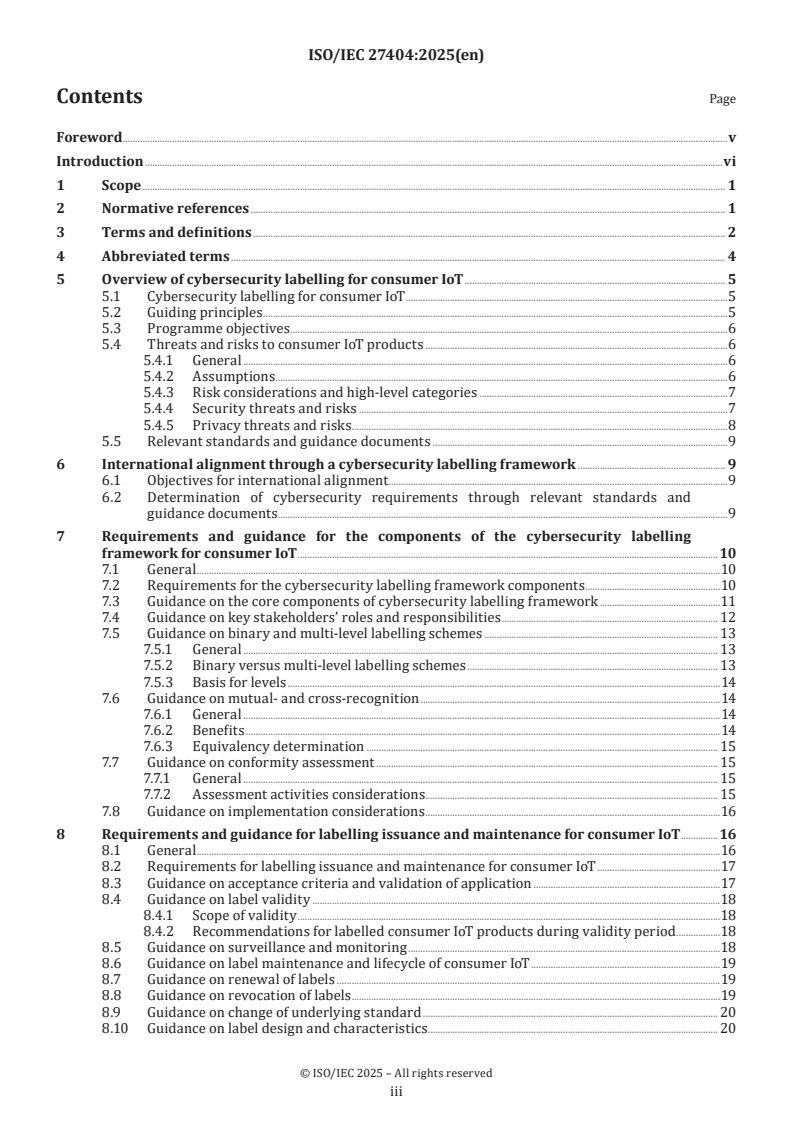
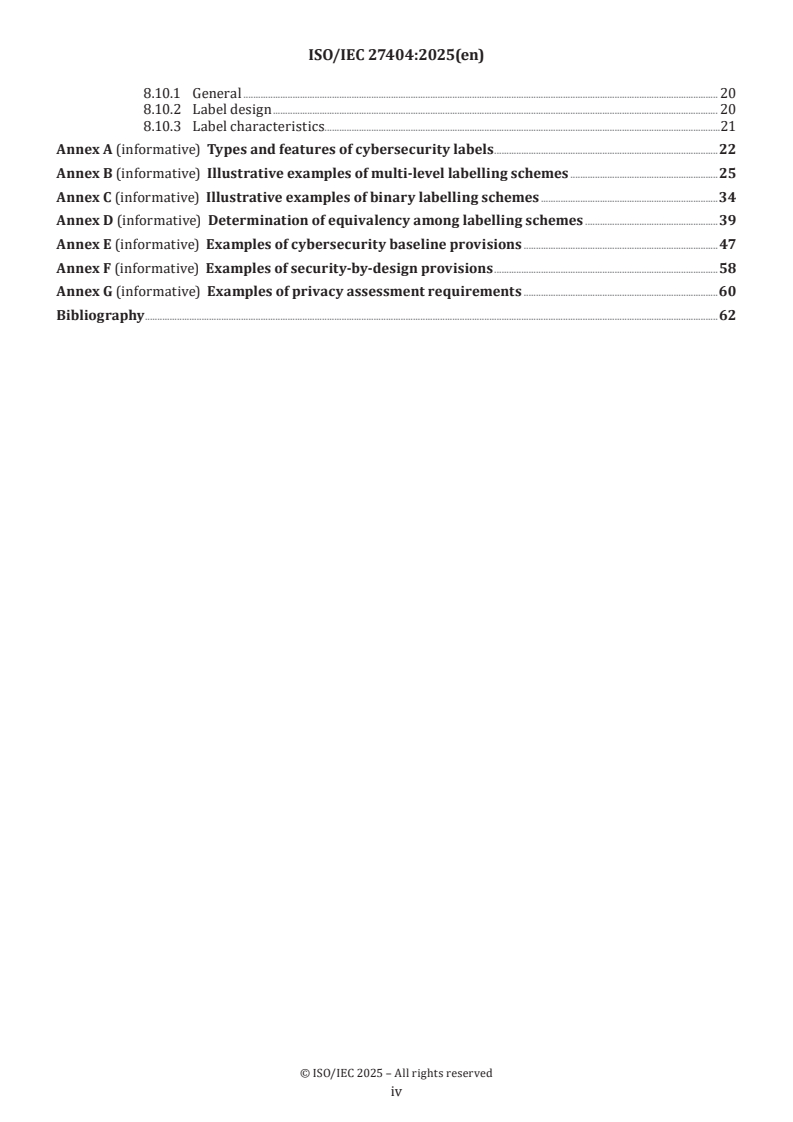
Contents Page
Foreword .v
Introduction .vi
1 Scope . 1
2 Normative references . 1
3 Terms and definitions . 2
4 Abbreviated terms . 4
5 Overview of cybersecurity labelling for consumer IoT . 5
5.1 Cybersecurity labelling for consumer IoT .5
5.2 Guiding principles .5
5.3 Programme objectives .6
5.4 Threats and risks to consumer IoT products .6
5.4.1 General .6
5.4.2 Assumptions .6
5.4.3 Risk considerations and high-level categories .7
5.4.4 Security threats and risks .7
5.4.5 Privacy threats and risks.8
5.5 Relevant standards and guidance documents .9
6 International alignment through a cybersecurity labelling framework . 9
6.1 Objectives for international alignment .9
6.2 Determination of cybersecurity requirements through relevant standards and
guidance documents . .9
7 Requirements and guidance for the components of the cybersecurity labelling
framework for consumer IoT .10
7.1 General .10
7.2 Requirements for the cybersecurity labelling framework components .10
7.3 Guidance on the core components of cybersecurity labelling framework .11
7.4 Guidance on key stakeholders’ roles and responsibilities . 12
7.5 Guidance on binary and multi-level labelling schemes . 13
7.5.1 General . 13
7.5.2 Binary versus multi-level labelling schemes . 13
7.5.3 Basis for levels .14
7.6 Guidance on mutual- and cross-recognition .14
7.6.1 General .14
7.6.2 Benefits .14
7.6.3 Equivalency determination . 15
7.7 Guidance on conformity assessment . 15
7.7.1 General . 15
7.7.2 Assessment activities considerations . 15
7.8 Guidance on implementation considerations .16
8 Requirements and guidance for labelling issuance and maintenance for consumer IoT .16
8.1 General .16
8.2 Requirements for labelling issuance and maintenance for consumer IoT .17
8.3 Guidance on acceptance criteria and validation of application .17
8.4 Guidance on label validity .18
8.4.1 Scope of validity .18
8.4.2 Recommendations for labelled consumer IoT products during validity period .18
8.5 Guidance on surveillance and monitoring .18
8.6 Guidance on label maintenance and lifecycle of consumer IoT .19
8.7 Guidance on renewal of labels .19
8.8 Guidance on revocation of labels .19
8.9 Guidance on change of underlying standard . 20
8.10 Guidance on label design and characteristics. 20
© ISO/IEC 2025 – All rights reserved
iii
8.10.1 General . 20
8.10.2 Label design . 20
8.10.3 Label characteristics.21
Annex A (informative) Types and features of cybersecurity labels .22
Annex B (informative) Illustrative examples of multi-level labelling schemes .25
Annex C (informative) Illustrative examples of binary labelling schemes .34
Annex D (informative) Determination of equivalency among labelling schemes .39
Annex E (informative) Examples of cybersecurity baseline provisions . 47
Annex F (informative) Examples of security-by-design provisions .58
Annex G (informative) Examples of privacy assessment requirements .60
Bibliography .62
© ISO/IEC 2025 – All rights reserved
iv
Foreword
ISO (the International Organization for Standardization) and IEC (the International Electrotechnical
Commission) form the specialized system for worldwide standardization. National bodies that are
members of ISO or IEC participate in the development of International Standards through technical
committees established by the respective organization to deal with particular fields of technical activity.
ISO and IEC technical committees collaborate in fields of mutual interest. Other international organizations,
governmental and non-governmental, in liaison with ISO and IEC, also take part in the work.
The procedures used to develop this document and those intended for its further maintenance are described
in the ISO/IEC Directives, Part 1. In particular, the different approval criteria needed for the different types
of document should be noted. This document was drafted in accordance with the editorial rules of the ISO/
IEC Directives, Part 2 (see www.iso.org/directives or www.iec.ch/members_experts/refdocs).
ISO and IEC draw attention to the possibility that the implementation of this document may involve the
use of (a) patent(s). ISO and IEC take no position concerning the evidence, validity or applicability of any
claimed patent rights in respect thereof. As of the date of publication of this document, ISO and IEC had not
received notice of (a) patent(s) which may be required to implement this document. However, implementers
are cautioned that this may not represent the latest information, which may be obtained from the patent
database available at www.iso.org/patents and https://patents.iec.ch. ISO and IEC shall not be held
responsible for identifying any or all such patent rights.
Any trade name used in this document is information given for the convenience of users and does not
constitute an endorsement.
For an explanation of the voluntary nature of standards, the meaning of ISO specific terms and expressions
related to conformity assessment, as well as information about ISO's adherence to the World Trade
Organization (WTO) principles in the Technical Barriers to Trade (TBT) see www.iso.org/iso/foreword.html.
In the IEC, see www.iec.ch/understanding-standards.
This document was prepared by Joint Technical Committee ISO/IEC JTC 1, Information technology,
Subcommittee SC 27, Information security, cybersecurity and privacy protection.
Any feedback or questions on this document should be directed to the user’s national standards
body. A complete listing of these bodies can be found at www.iso.org/members.html and
www.iec.ch/national-committees.
© ISO/IEC 2025 – All rights reserved
v
Introduction
Globally, there is an accelerated increase in the number of IoT (Internet of Things) products. Consumer
IoT products often have short time-to-market and quick obsolescence lifecycles. Coupled with low price-
points and low profit margins for consumer items, it is often the case that such products are not designed or
manufactured with adequate cybersecurity provisions, meaning that these products can have fundamental
security weaknesses and common flaws. As these connected products proliferate, the lack of adequate
provisions for cybersecurity in such products creates extensive attack surfaces, causing them to be
susceptible to cyber attacks using malware and penetration testing tools that are easily available.
Consumer IoT labelling schemes are instances of conformity assessment programmes, providing information
on whether labelled products are resilient to common cybersecurity attacks. These consumer IoT labelling
schemes follow the concepts and functional approach defined in ISO/IEC 17000 and ISO/IEC 17067,
providing guidance on essential security traits for consumer IoT that is intended to encourage developers to
proactively incorporate cybersecurity when designing their products.
The development of individual consumer IoT labelling schemes, which are designed to address the
cybersecurity concerns in a particular region or market, has the potential to create confusion in the
international marketplace by making it difficult to compare across labelled products. A cybersecurity
labelling framework is therefore needed to help align the concepts and cybersecurity requirements
represented by each of the consumer IoT cybersecurity labels.
This document outlines a consumer IoT cybersecurity labelling framework that is intended to reduce the
need for duplicative testing, reduce the cost of compliance, and help facilitate a global market for developers.
In addition, this framework can help facilitate the development of mutual- and cross-recognition agreements
by providing the basis for repeatable and meaningful comparison between the standards- and guidance-
based requirements that underpin consumer IoT labelling schemes that use this framework.
The cybersecurity labelling framework facilitates international alignment by providing guidance on
[1] [2]
selecting relevant standards and guidance documents (e.g. ETSI EN 303 645, ETSI TS 103 701, NIST IR
[3] [4] [5]
8259, NIST IR 8259A, NIST IR 8425, ISO/IEC 27400, ISO/IEC 27402 and ISO/IEC 27403) for labelling
schemes to derive their cybersecurity requirements. Implementing a consumer IoT cybersecurity labelling
scheme based on this framework can simplify the mutual- and cross- recognition process. Furthermore, the
implementation of cybersecurity labelling schemes, which provide additional specificities (such as test cases
and capacities) are complementary to this framework.
The document explains the fundamental concepts of the cybersecurity labelling framework and provides
the underlying requirements to help producers and suppliers participate in the process of improving
cybersecurity protections for consumer IoT products and to develop products which meet or exceed
minimum cybersecurity requirements.
This cybersecurity labelling framework addresses the expected and intended use of consumer IoT
products by consumers, that is, the general public and non-technical users. Due to potentially more serious
implications if compromised, IoT products used in an enterprise context are not classified as consumer IoT
products. Furthermore, threat models of consumer IoT products assume the products are not being centrally
managed by a professional system administrator.
The cybersecurity labelling framework provides guidance for binary or multi-level schemes based on
common requirements in relevant standards and guidance documents. Products developed referencing
these labelling schemes can be mutually- or cross-recognized when scheme owners of the corresponding
negotiated schemes have determined that they are compatible. Developers can develop products referencing
these labelling schemes, and then achieve mutual- or cross- recognition by examining the interoperability
among schemes.
The cybersecurity labelling framework seeks to achieve outcomes in the following aspects:
— Transparency for consumers: The cybersecurity provision of consumer IoT products is opaque to general
consumers. The cybersecurity labelling framework for consumer IoT aims to specify the requirements for
cybersecurity labelling to make such cybersecurity provisions transparent to consumers, and to enhance
consumer awareness of cybersecurity risks. Through the use of cybersecurity labelling, consumers can
© ISO/IEC 2025 – All rights reserved
vi
make informed choices when purchasing consumer IoT products and adopt a cybersecurity mindset in a
digital world.
— Developer branding: Cybersecurity labelling can cultivate a more proactive and sustainable industry,
with developers differentiating their products and enhancing their brand quality. It also incentivises
developers to produce more secure products and monetise their efforts spent in provisioning
cybersecurity in their products.
— Mutual- and cross-recognition for the economy/ecosystem: As the digital economy grows, compatibility
of cybersecurity labelling can help to reduce the need for duplicated testing across borders, reduce the
cost of compliance for developers for improved market access and pave the way for mutual- or cross-
recognition of labelling initiatives across countries.
The cybersecurity labelling framework supports a basis to detail the security features in consumer IoT
products. With a framework, scheme owners can specify their labelling schemes, developers are incentivised
to identify common requirements and implement better security features, and consumers can make
informed purchasing decisions. The result can lead to a safer and more secure cyberspace.
Cybersecurity labelling for consumer IoT products does not offer formal security assurance. Users seeking
higher security assurance in sectors such as enterprises, manufacturing, industrial applications and
healthcare are recommended to consider products certified under formal evaluation and certification
schemes (e.g. as described in ISO/IEC 15408-1).
© ISO/IEC 2025 – All rights reserved
vii
International Standard ISO/IEC 27404:2025(en)
Cybersecurity — IoT security and privacy — Cybersecurity
labelling framework for consumer IoT
1 Scope
This document defines a cybersecurity labelling framework for the development and implementation
of cybersecurity labelling programmes for consumer Internet of things (IoT) products. It provides
requirements and guidance on the following topics:
— risks and threats associated with consumer IoT products;
— stakeholders, roles and responsibilities;
— relevant standards and guidance documents;
— conformity assessment;
— labelling issuance and maintenance;
— mutual recognition.
This document is limited to consumer IoT products, such as:
— IoT gateways, base stations and hubs to which multiple devices connect; smart cameras, televisions, and
speakers;
— wearable devices;
— connected smoke detectors, door locks and window sensors;
— connected home automation and alarm systems;
— connected appliances, such as washing machines and fridges;
— smart home assistants; and
— connected children’s toys and baby monitors.
Products that are not intended for consumer use are excluded from this document. Examples of excluded
devices are those that are primarily intended for manufacturing, healthcare and other industrial purposes.
This document is applicable to consumers, developers, issuing bodies of cybersecurity labels and conformity
assessment bodies.
2 Normative references
The following documents are referred to in the text in such a way that some or all of their content constitutes
requirements of this document. For dated references, only the edition cited applies. For undated references,
the latest edition of the referenced document (including any amendments) applies.
ISO/IEC 27000, Information technology — Security techniques — Information security management systems —
Overview and vocabulary
© ISO/IEC 2025 – All rights reserved
3 Terms and definitions
For the purposes of this document, the terms and definitions given in ISO/IEC 27000 and the following apply.
ISO and IEC maintain terminology databases for use in standardization at the following addresses:
— ISO Online browsing platform: available at https:// www .iso .org/ obp
— IEC Electropedia: available at https:// www .electropedia .org/
3.1
binary scheme
labelling scheme with a list of cybersecurity features which must be included for the device to pass and
obtain a label
3.2
conformity assessment
demonstration that specified requirements are fulfilled
[SOURCE: ISO/IEC 17000:2020, 4.1, modified — notes to entry have been deleted.]
3.3
conformity assessment programme
conformity assessment scheme
set of rules and procedures that describes the objects of conformity assessment, identifies the specified
requirements and provides the methodology for performing conformity assessment (3.2)
Note 1 to entry: A conformity assessment programme can be managed within a conformity assessment system.
Note 2 to entry: A conformity assessment programme can be operated at an international, regional, national sub-
national, or industry sector level.
Note 3 to entry: A conformity assessment programme can cover all or part of the conformity assessment functions.
[SOURCE: ISO/IEC 17000:2020, 4.9, modified — “Annex A” has been removed from Note 3 to entry for
contextual reasons.]
3.4
conformity assessment body
CAB
body that performs conformity assessment (3.2) activities, excluding accreditation
[SOURCE: ISO/IEC 17000:2020, 4.6]
3.5
consumer
natural person who is acting for purposes that are outside their trade, business, craft or profession
Note 1 to entry: This can include a person who is a potential buyer of a labelled product.
3.6
cyber attack
attack
malicious attempts to exploit vulnerabilities in information systems or physical systems in cyberspace and
to damage, disrupt or gain unauthorized access to these systems
Note 1 to entry: Expression of an offensive operation in or through the cyberspace leading to unauthorized use of
services, creating illicit services, orchestrating denial of service, altering or deleting data or resources.
Note 2 to entry: Common cyber attacks to consumer IoT are basic attacks that could be carried out by script kiddies
and amateur hackers.
[SOURCE: ISO/IEC TS 27100:2020, 3.1, modified — Note 2 to entry has been added.]
© ISO/IEC 2025 – All rights reserved
3.7
developer
entity that creates an assembled final Internet of things (IoT) device (3.10) or IoT product (3.11)
Note 1 to entry: “Final” in this definition means the stage of delivery to the IoT service developer in the assembly
process.
Note 2 to entry: A developer is usually the applicant for a cybersecurity label or the holder of the issued label, i.e. the
party responsible for the security characteristics of a product.
3.8
evidence
directly measurable characteristics of an Internet of things product (3.11) that represent objective and
demonstrable proof that a specific activity satisfies a specified requirement
Note 1 to entry: Test reports, handbooks, files, checklists, scripts or images.
[SOURCE: ISO/IEC 21827:2008, 3.19, modified — “process and/or product” has been replaced with “Internet
of things product”; the Example has been added.]
3.9
Internet of Things
IoT
infrastructure of interconnected entities, people, systems and information resources together with services
which processes and reacts to information from the physical world and virtual world
[SOURCE: ISO/IEC 20924:2024, 3.2.8]
3.10
Internet of Things device
IoT device
entity of an IoT system (3.13) or IoT solution (3.12) that interacts and communicates with the physical world
through sensing or actuating
Note 1 to entry: In this document, an IoT device is usually a physical product, which can be bought off the shelf by a
consumer, e.g. a router, bulb or toy.
[SOURCE: ISO/IEC 27400:2022, 3.3, modified — note 1 to entry has been added.]
3.11
Internet of Things product
IoT product
Internet of Things good or service
Note 1 to entry: A good in this context can take the form of an IoT device (3.10), IoT solution (3.12), or IoT system (3.13)
along with bundled software.
Note 2 to entry: Services can include connectivity, cloud computing resources, maintenance, technical support, etc.
3.12
Internet of Things solution
IoT solution
seamlessly integrated bundle of technologies, potentially including sensors, gateways and actuators
Note 1 to entry: These can solve a specific problem or need, or they can be used to build additional functionality in
other non-IoT solutions.
Note 2 to entry: Within the scope of this document, a solution typically combines hardware components (physical
devices like a router, bulb, toy or sensors/actuators) and associated IoT services (e.g. an application for remote control
or cloud space) and can be bought e.g. off the shelf by a consumer.
[SOURCE: ISO/IEC 27400:2022, 3.7, modified — note 2 to entry has been added.]
© ISO/IEC 2025 – All rights reserved
3.13
Internet of Things system
IoT system
system providing functionalities of Internet of Things
Note 1 to entry: IoT system is inclusive of IoT devices (3.10), IoT solutions (3.12), IoT gateways, sensors and actuators.
Note 2 to entry: In the context of this document, this also includes applications and backend that support IoT solutions.
[SOURCE: ISO/IEC 27400:2022, 3.6]
3.14
independent test laboratory
ITL
security testing body that conducts third-party security evaluations of products
3.15
labelling scheme
application or instantiation of the conformity assessment programme (3.3) for the labelling of consumer
Internet of Things, taking into account the additional administrative or regulatory requirements of each
nation or region
Note 1 to entry: A labelling scheme is an example of a conformity assessment scheme from ISO/IEC 17000.
3.16
object of labelling
Internet of Things product (3.11) seeking eligibility and currently being assessed for a particular
cybersecurity label
3.17
product
any good or service
[SOURCE: ISO 14050:2020, 3.5.12]
4 Abbreviated terms
API application programming interface
BOM bill of materials
CAB conformity assessment body
DAST dynamic analysis security testing
DDoS distributed denial of service
HCI human computer interface
ITL independent test laboratory
PII personally identifiable information
SAST static application security testing
© ISO/IEC 2025 – All rights reserved
5 Overview of cybersecurity labelling for consumer IoT
5.1 Cybersecurity labelling for consumer IoT
Consumer IoT cybersecurity labelling schemes designed and implemented based on this framework share
common elements that contribute to greater cybersecurity outcomes for consumer IoT products within the
target market. Furthermore, when this framework is used as the basis for mutual and cross-recognition
agreements, these cybersecurity benefits can be realized across jurisdictions and markets.
The development of a consumer IoT cybersecurity labelling scheme involves deliberating on the core
components presented in this framework and determining how these components will be employed by the
scheme. Developing a labelling scheme involves:
— defining the objectives of the scheme (5.3);
— assessing the threats and risks associated with consumer IoT (5.4);
— identifying stakeholders and roles (7.4);
— selecting relevant standards and guidance documents to serve as the basis for requirements, controls
and assessment (5.5 and 6.2);
— defining the type of scheme (single or multi-level) (7.5) and conformity assessment methodology or
methodologies (7.7);
— developing the labelling and maintenance process (Clause 8).
5.2 Guiding principles
The guiding principles specified below provide the foundation for this framework and are intended to
promote the benefits associated with cybersecurity labelling.
— Appropriateness with product characteristics and profile – The choice of relevant standards and
guidance documents, number of labelling levels, conformity assessment options and label characteristics
should be appropriate to the type of consumer IoT product, associated threats and risks and intended
cybersecurity outcomes.
— Consistency – Labelling schemes leverage standards, guidance documents and conformity assessment
programmes for alignment among certification bodies and testing laboratories to:
— ensure consistency in test and assessment methods,
— facilitate the acceptance of tests conducted across boundaries, and
— promote mutual- or cross-recognition.
— Outcomes-based approach – Consumer IoT encompasses a plethora of applications which are developed
by a variety of developer organizations. A minimum security baseline can be coupled with flexibility
to define additional requirements or security levels to accelerate ecosystem improvements. If multiple
labelling levels are available, attaining the requirements of the appropriate level of the cybersecurity
labelling scheme are assessed based on outcomes and impact on cybersecurity, with flexibility that
allows for additional security functional requirements to be assessed across different products. This can
include the degree of quality in the implementation of the IoT device application software and security
controls.
— Consumer awareness and understanding – Offering a cybersecurity label can make it easier for consumers
to select an IoT product by enabling them to identify which IoT product has been evaluated to a specific
security level. This can have a positive impact on the market for secure IoT solutions, thus indirectly
helping to increase the overall level of security for the benefit of consumers and network infrastructures.
Improving the security design of consumer IoT products can enable consumers to be better protected
against cyber attacks. In addition, a visible label will lead to more IoT security awareness with consumers.
© ISO/IEC 2025 – All rights reserved
5.3 Programme objectives
Programme objectives capture the strategic purpose of a consumer IoT cybersecurity labelling programme
and are often stated in terms of desired benefits. Along with the scope of covered consumer IoT products and
the risks associated with those products, the programme objectives serve as a basis for selecting standards
and guidelines documents that serve as source(s) of technical and non-technical requirements. Programme
objectives also provide a way to measure the overall effectiveness of labelling once the programme is
operational. In addition, programme objectives can be used as points of comparison when comparing
consumer IoT labelling schemes for the purposes of negotiating mutual- and cross-recognition agreements.
Scheme owners can define one or more objectives that align to their strategic outcomes.
Examples of objectives include:
— facilitating IoT product consumers to make informed purchasing decisions;
— reducing the risks associated with consumer IoT products;
— providing a market incentive for IoT product developers to incorporate cybersecurity protection and
controls into their consumer IoT products;
— protecting public and private infrastructure from threats associated with consumer IoT products;
— aligning to other consumer IoT labelling schemes, in order to promote cybersecurity and privacy-
enhancing benefits across markets and jurisdictions;
— incentivising developer adoption by reducing the need for duplicative testing and assessments.
5.4 Threats and risks to consumer IoT products
5.4.1 General
Consumer IoT is subject to threats and risks beyond those traditionally associated with connected devices.
The nature of consumer IoT products is that they are commonly integrated into people’s homes and personal
spaces, and sometimes even worn on people’s bodies. As such, special consideration can be made to ensure
that consumer IoT products are safe and secure for use in these conditions.
Threats and risks to consumer IoT products pertain to security and privacy, affecting the confidentiality,
integrity and availability attributes of consumer IoT products and services. When considering threats and
risks to consumer IoT products, it is important to address both technical vulnerabilities and potential misuse
of the technology. For example, some consumer IoT products have recording and remote access components
that can, when misused, have a direct impact on consumers’ privacy and home networks. In addition, their
high computing power and network resources makes them attractive targets for larger-scale exploits, such
as botnets.
5.4.2 Assumptions
The following assumptions were used to differentiate risks associated with consumer IoT products from
those associated with IoT products and connected devices used in other environments.
— Consumer IoT products are often used by individuals or families in the context of their personal lives.
— By purchasing and using the IoT product, consumers are assuming the product is secure and will not put
them at risk.
— Consumer IoT products are most often not employed in managed environments and therefore not subject
to enterprise management policies and oversight.
— It cannot be expected that the average consumer possesses a minimum level of cybersecurity knowledge
or experience.
© ISO/IEC 2025 – All rights reserved
— Consumer IoT can be used by vulnerable populations, such as children, the elderly, or persons with
mental or physical disabilities.
— A compromised IoT product can impact one or more person’s privacy, health, comfort, safety, or wellbeing.
5.4.3 Risk considerations and high-level categories
The risks associated with consumer IoT can be considered from two different perspectives:
— risks to individuals or families, and
— risks to communities or society in general.
Potential risks to individuals or families can include:
— Compromised privacy: Personal or sensitive information that was expected to be confidential is exposed
through the use of a consumer IoT product, with potentially harmful impacts to the subject(s) of that
information.
— Civil liberties: Information is obtained from the use of a consumer IoT product, which is then used to deny
a person or persons fair treatment or access to benefits, rights, or services to which they are legitimately
entitled.
— Well-being: The effects of a compromised consumer IoT product negatively impact the psychological,
social, or physical well-being of a person or persons.
— Physical safety: The use of a consumer IoT product results in injury or death.
Potential risks to communities or society can include:
— Public safety: A compromised consumer IoT product impacts the safety of people in a public context.
— Public and private services: One or more compromised consumer IoT products are used to affect the
confidentiality, availability or integrity of a public or private service, such as in the case of a DDoS attack.
— National security: Data collected from consumer IoT products is used to compromise some aspect of
national security, such as the aggregation of anonymised data to identify a secret location or expose
confidential information.
5.4.4 Security threats and risks
The security threats and risks associated with consumer IoT products can include:
— Weak credential management and authentication: Weak credential management and a lack of multi-
factor authentication for the user and administrative interfaces of products, devices, gateways or back-
ends is a common vulnerability.
EXAMPLE Consumer IoT products that do not require users to change default usernames (e.g. “admin”) and
passwords on first use are easy targets for attackers.
— Security vulnerabilities in product software: Consumer IoT products depend on software that can contain
poor design choices or security bugs such as buffer overflows and improper exception handling. This
makes them vulnerable to many different attacks that can compromise data confidentiality or integrity.
Vulnerable software in products can be exploited by hackers to gain unauthorized access, launch attacks,
or take control of the product. Furthermore, it is possible that developers do not provide timely security
updates or patches, leaving products vulnerable to newly discovered vulnerabilities.
— Malware: Products can be infected with programmes designed to carry out unauthorized actions on
a system, possibly using existing vulnerabilities in software or firmware. This can inflict significant
damage as the infection of one product can potentially impact other products and systems in the same
network.
© ISO/IEC 2025 – All rights reserved
— Denial of Service: Consumer IoT products are susceptible to denial of service attacks launched by
attackers sending continuous requests to deplete product resources. On the other hand, compromised
products can themselves be recruited by botnets and used to disrupt the operation of other networks or
systems via a DDoS attack.
— Eavesdropping: If the communication channel is not sufficiently protected with encryption or
authentication, communication over an IoT network can be intercepted, deciphered and tampered with
(e.g. security parameters, or configuration settings). Related attacks include man-in-the-middle, session
hijacking, or message replay. This can affect the confidentiality and integrity of data in consumer IoT
products.
— Supply chain and third-party threats: Compromised components or software from third-party suppliers
can introduce vulnerabilities.
— Weak physical security measures: Lack of secure hardware design can make it easier for attackers to
physically manipulate or tamper with products.
5.4.5 Privacy threats and risks
The privacy threats and risks to consumer IoT products can include:
— Unauthorized access and data leakage: Inadequate data protection measures can result in unintended
data sharing to unauthorized parties, leading to privacy breaches. Confidential data can be captured by
an attacker from individual devices (at rest), during transit, or from the back-end.
— Device and user tracking: Device location tracking poses a privacy risk to users as an attacker can infer
sensitive information from data gathered and communicated by devices. Such information can be sold
to interested parties for marketing purposes or used for unauthorized surveillance. Furthermore, it
is possible that devices do not adhere to necessary privacy regulations, putting consumers and their
confidential data (medical, financial, PII) at risk.
— Manipulation or intimidation: Data collected or processed by a consumer IoT product has been altered
in order to manipulate a person’s behaviour. An example is the alteration of health data, which can result
in a person not taking medical action when it is actually necessary. The configuration or functioning of
a consumer IoT product can also be changed without the user’s knowledge or permission, for example,
by overriding the settings on a smart refrigerator and causing medicines or food to spoil. A consumer
IoT product’s functionality can also be reconfigured to intimidate or threaten the user, for example, by
taking over the speaker function of a baby monitor and using it to make threatening or offensive speech.
— Overcollection: Data are collected or processed by a consumer IoT product without end user notification.
For example, a microphone can be set to be always on rather than when triggered. This type of
overcollection violates the core privacy principles of data minimization and transparency.
To mitigate the risks arising from such threats, it is important for cybersecurity labelling schemes to specify:
— requirements for consumer IoT products,
— how compliance with such requirements are assessed; and
— the roles and responsibilities of key stakeholders throughout the entire labelling issuance and
maintenance lifecycle.
Consumer IoT cybersecurity labelling schemes play a valuable role in encouraging developers to employ
cybersecurity and privacy-protecting capabilities to help protect consumers and the public infrastructure
from risks associated with these products. Furthermore, mutual- or cross-recognition among labelling
schemes ensures these cybersecurity and privacy-enhancing benefits are maintained across markets and
jurisdictions.
© ISO/IEC 2025 – All rights reserved
5.5 Relevant standards and guidance documents
Consumer IoT cybersecurity labelling
...