


ISO/TS 7815-1:2025
(Main)Intelligent transport systems — Telematics applications for regulated commercial freight vehicles (TARV) using ITS stations — Part 1: Secure vehicle interface framework and architecture
Intelligent transport systems — Telematics applications for regulated commercial freight vehicles (TARV) using ITS stations — Part 1: Secure vehicle interface framework and architecture
This document specifies the following elements for cooperative telematics applications for regulated commercial freight vehicles directly communicating via a secure vehicle interface: a) a framework for the provision of cooperative telematics application services for regulated commercial freight vehicles; b) a description of the concept of operation, regulatory aspects and options and the role models; c) a conceptual architecture using an on-board platform and wireless communications to a regulator or their agent; d) references for the key documents on which the architecture is based; e) the architecture of the facilities layer; f) a taxonomy of the organization of generic procedures. This document does not replace, but is complementary to ISO 15638-1. It provides an alternative communication architecture for achieving similar service provision by means of a standardized secure vehicle interface.
Systèmes de transport intelligents — Cadre pour applications télématiques collaboratives pour véhicules de fret commercial réglementé (TARV) via les stations ITS — Partie 1: Cadre et architecture de l'interface sécurisée du véhicule
General Information
Standards Content (Sample)
Technical
Specification
ISO/TS 7815-1
First edition
Intelligent transport systems —
2025-01
Telematics applications for
regulated commercial freight
vehicles (TARV) using ITS
stations —
Part 1:
Secure vehicle interface framework
and architecture
Systèmes de transport intelligents — Cadre pour applications
télématiques collaboratives pour véhicules de fret commercial
réglementé (TARV) via les stations ITS —
Partie 1: Cadre et architecture de l'interface sécurisée du véhicule
Reference number
© ISO 2025
All rights reserved. Unless otherwise specified, or required in the context of its implementation, no part of this publication may
be reproduced or utilized otherwise in any form or by any means, electronic or mechanical, including photocopying, or posting on
the internet or an intranet, without prior written permission. Permission can be requested from either ISO at the address below
or ISO’s member body in the country of the requester.
ISO copyright office
CP 401 • Ch. de Blandonnet 8
CH-1214 Vernier, Geneva
Phone: +41 22 749 01 11
Email: copyright@iso.org
Website: www.iso.org
Published in Switzerland
ii
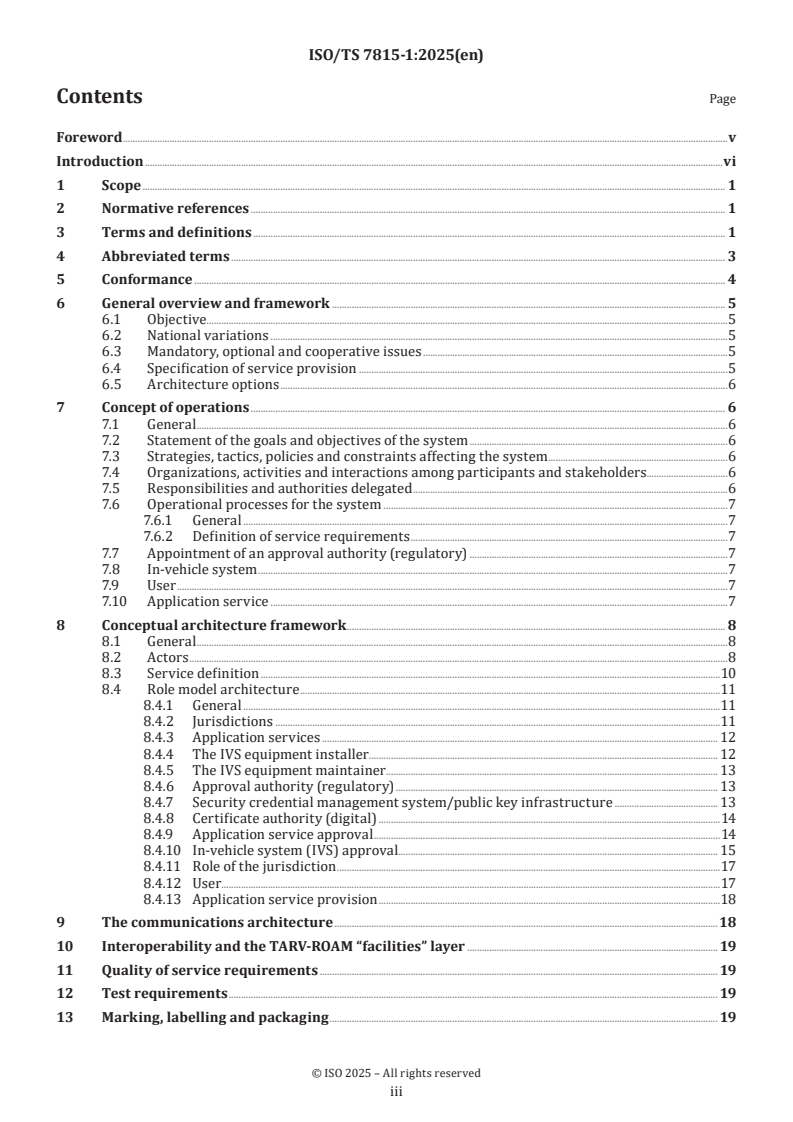
Contents Page
Foreword .v
Introduction .vi
1 Scope . 1
2 Normative references . 1
3 Terms and definitions . 1
4 Abbreviated terms . 3
5 Conformance . 4
6 General overview and framework . 5
6.1 Objective.5
6.2 National variations .5
6.3 Mandatory, optional and cooperative issues .5
6.4 Specification of service provision .5
6.5 Architecture options .6
7 Concept of operations . 6
7.1 General .6
7.2 Statement of the goals and objectives of the system .6
7.3 Strategies, tactics, policies and constraints affecting the system .6
7.4 Organizations, activities and interactions among participants and stakeholders.6
7.5 Responsibilities and authorities delegated .6
7.6 Operational processes for the system .7
7.6.1 General .7
7.6.2 Definition of service requirements .7
7.7 Appointment of an approval authority (regulatory) .7
7.8 In-vehicle system .7
7.9 User .7
7.10 Application service .7
8 Conceptual architecture framework . 8
8.1 General .8
8.2 Actors .8
8.3 Service definition .10
8.4 Role model architecture .11
8.4.1 General .11
8.4.2 Jurisdictions .11
8.4.3 Application services . 12
8.4.4 The IVS equipment installer . . 12
8.4.5 The IVS equipment maintainer . 13
8.4.6 Approval authority (regulatory) . 13
8.4.7 Security credential management system/public key infrastructure . 13
8.4.8 Certificate authority (digital) .14
8.4.9 Application service approval .14
8.4.10 In-vehicle system (IVS) approval . . 15
8.4.11 Role of the jurisdiction .17
8.4.12 User.17
8.4.13 Application service provision .18
9 The communications architecture .18
10 Interoperability and the TARV-ROAM “facilities” layer . 19
11 Quality of service requirements . 19
12 Test requirements . 19
13 Marking, labelling and packaging . 19
iii
14 Declaration of patents and intellectual property . 19
Bibliography .20
iv
Foreword
ISO (the International Organization for Standardization) is a worldwide federation of national standards
bodies (ISO member bodies). The work of preparing International Standards is normally carried out through
ISO technical committees. Each member body interested in a subject for which a technical committee
has been established has the right to be represented on that committee. International organizations,
governmental and non-governmental, in liaison with ISO, also take part in the work. ISO collaborates closely
with the International Electrotechnical Commission (IEC) on all matters of electrotechnical standardization.
The procedures used to develop this document and those intended for its further maintenance are described
in the ISO/IEC Directives, Part 1. In particular, the different approval criteria needed for the different types
of ISO document should be noted. This document was drafted in accordance with the editorial rules of the
ISO/IEC Directives, Part 2 (see www.iso.org/directives).
ISO draws attention to the possibility that the implementation of this document may involve the use of (a)
patent(s). ISO takes no position concerning the evidence, validity or applicability of any claimed patent
rights in respect thereof. As of the date of publication of this document, ISO had not received notice of (a)
patent(s) which may be required to implement this document. However, implementers are cautioned that
this may not represent the latest information, which may be obtained from the patent database available at
www.iso.org/patents. ISO shall not be held responsible for identifying any or all such patent rights.
Any trade name used in this document is information given for the convenience of users and does not
constitute an endorsement.
For an explanation of the voluntary nature of standards, the meaning of ISO specific terms and expressions
related to conformity assessment, as well as information about ISO's adherence to the World Trade
Organization (WTO) principles in the Technical Barriers to Trade (TBT), see www.iso.org/iso/foreword.html.
This document was prepared by Technical Committee ISO/TC 204, Intelligent transport systems.
A list of all parts in the ISO 7815 series can be found on the ISO website.
Any feedback or questions on this document should be directed to the user’s national standards body. A
complete listing of these bodies can be found at www.iso.org/members.html.
v
Introduction
Many intelligent transport system (ITS) technologies have been embraced by commercial transport
operators and freight owners in the areas of fleet management, safety and security. Telematics applications
have also been developed for governmental use. Such regulatory services in use or under consideration
vary from region to region, but include electronic on-board recorders, vehicle charging, digital tachograph,
on-board mass monitoring, emissions monitoring, vehicle access monitoring, hazardous goods tracking
and eCall. Additional applications with a regulatory impact currently under development include fatigue
management, speed monitoring and heavy vehicle charging based on mass, location, distance and time.
In this emerging environment of regulatory and commercial applications, between 2008 and 2012,
ISO 15638-1 was developed and approved, enabling on-board equipment and back-office systems to be
commercially designed in an open market, meeting the common requirements of jurisdictions.
Although the concept of co-operative ITS (C-ITS) was well advanced at this time, its implementation was not.
In particular, provisions for achieving the “bounded secure managed domain,” required by ISO 21217, were
still in their early stages of development. Security (i.e. “cybersecurity”) was a significant concern, given
that the communications means themselves were not necessarily very secure. Telematics applications for
regulated commercial freight vehicles (TARV), designed to work with whatever wireless communications
interface are available in the vehicle, offered a solution to this problem: the enquirer would provide
a requested destination address and reference for the data. The vehicle response would then be to send
the data (along with the requested destination address and reference) directly and only to its landside
“application service provider” (ASP), a contracted secure provider. As a trusted party approved by the
jurisdiction, the ASP would validate the request and destination address before forwarding the information
to that address. TARV was flexible in concept, and could be adapted to different jurisdictional arrangements.
ISO 15638-2 provided a migration path to C-ITS enabled vehicles, but remained devoid of the necessary
security parameters, so the passage to data to the jurisdiction remained via the secure and trusted ASP.
In the decade since 2010, with the publication of ISO 21177, the necessary security and data exchange
protocols have been finalized to provide a “secure vehicle interface” (SVI) in which two devices can
cooperate in a trusted way, i.e. exchange information in secure application sessions with optional explicit
bi-directional protection. The devices can thus only access data or request data for which they have the
appropriate access credentials. The trust relation between two devices is illustrated in Figure 1.
Figure 1 — Interconnection of trusted devices (ISO 21177)
Taking these developments into account, while the ISO 15638 series remains valid and appropriate in many
cases, it is also appropriate to provide specifications for the direct transfer of data using a secure vehicle
interface. This document provides the specification of the architecture and framework within which such
transactions can be undertaken.
vi
Technical Specification ISO/TS 7815-1:2025(en)
Intelligent transport systems — Telematics applications
for regulated commercial freight vehicles (TARV) using ITS
stations —
Part 1:
Secure vehicle interface framework and architecture
1 Scope
This document specifies the following elements for cooperative telematics applications for regulated
commercial freight vehicles directly communicating via a secure vehicle interface:
a) a framework for the provision of cooperative telematics application services for regulated commercial
freight vehicles;
b) a description of the concept of operation, regulatory aspects and options and the role models;
c) a conceptual architecture using an on-board platform and wireless communications to a regulator or
their agent;
d) references for the key documents on which the architecture is based;
e) the architecture of the facilities layer;
f) a taxonomy of the organization of generic procedures.
This document does not replace, but is complementary to ISO 15638-1. It provides an alternative
communication architecture for achieving similar service provision by means of a standardized secure
vehicle interface.
2 Normative references
The following documents are referred to in the text in such a way that some or all of their content constitutes
requirements of this document. For dated references, only the edition cited applies. For undated references,
the latest edition of the referenced document (including any amendments) applies.
ISO/TS 7815-2, Intelligent transport systems — Telematics applications for regulated commercial freight
vehicles (TARV) using ITS stations — Part 2: Specification of the secure interface
3 Terms and definitions
For the purposes of this document, the following terms and definitions apply.
ISO and IEC maintain terminology databases for use in standardization at the following addresses:
— ISO Online browsing platform: available at https:// www .iso .org/ obp
— IEC Electropedia: available at https:// www .electropedia .org/
3.1
application service
service provided by a service provider accessing data from the in-vehicle system (IVS) of a regulated
commercial freight vehicle via a wireless communications network
3.2
appoint
assign officially to take responsibility for a role
3.3
architecture
formalized description of the design of the structure of the telematics applications for regulated commercial
freight vehicles secure vehicle interface (TARV-SVI) and its framework
3.4
controller area networking bus
CAN bus
network designed for use in automotives
Note 1 to entry: See ISO 11898-1, ISO 11898-2 and ISO 11898-3 for further information.
Note 2 to entry: CAN uses a single terminated twisted pair cable and is multi-master. The maximum signal frequency
used is 1 Mbit/s, with a typical length of 40 m at 1 Mbit/s up to 10 km at 5 Kbit/s.
Note 3 to entry: CAN has high reliability with extensive error checking. The typical maximum data rate achievable is
40 KB/s. The maximum latency of a high priority message < 120 µs at 1 Mbit/s.
Note 4 to entry: CAN is unusual in that the entities on the network, called nodes, are not given specific addresses.
Instead, it is the messages themselves that have an identifier which also determines the messages' priority. For this
reason there is no theoretical limit to the number of nodes, although in practice it is approximately 63.
3.5
certificate authority
organization which issues digital certificates for use by other parties, specifically in the context of
communications security
3.6
commercial application
intelligent transport systems (ITS) application in regulated commercial freight vehicles for commercial
(non-regulated) purposes
EXAMPLE Asset tracking, vehicle and engine monitoring, cargo security, driver management, etc.
3.7
framework
particular set of beliefs or ideas referred to in order to describe a scenario or solve a problem
3.8
global navigation satellite system
GNSS
several networks of satellites that transmit radio signals containing time and distance data that can be
picked up by a receiver, allowing the user to identify the location of its receiver anywhere around the globe
[SOURCE: ISO 15638-1:2012, 4.21, modified — "comprises" has been removed from the beginning of the
definition.]
3.9
in-vehicle system
IVS
intelligent transport system (ITS) station and connected equipment on board a vehicle
3.10
jurisdiction
government, road or traffic authority which owns the regulatory applications
EXAMPLE Country, state, city council, road authority, government department (customs, treasury, transport), etc.
3.11
map
spatial dataset that defines the road system
3.12
on-board unit
OBU
integrated telematics unit installed on board which provides the specified telematics functionality required
for the in-vehicle system (IVS)
3.13
regulated application
regulatory application approval arrangement utilized by jurisdictions for granting certain categories of
commercial vehicle rights to operate in regulated circumstances subject to certain conditions
Note 1 to entry: Each jurisdiction may use their own terminology including, but not limited to, "permit", "application",
"scheme", "concession", "exemption", "gazettal" and "notice".
3.14
regulated application service
telematics applications for regulated commercial freight vehicles (TARV) application service that is
mandated by a regulation imposed by a jurisdiction, or an option supported by a jurisdiction
3.15
regulated commercial freight vehicle
vehicle (often but not always designed to haul commercial freight) that is subject to regulations determined
by the jurisdiction as to its use on the road system of the jurisdiction in regulated circumstances, subject to
certain conditions, and in compliance with specific regulations for that class of vehicle
Note 1 to entry: Jurisdictions can choose to require the provision of information via telematics applications for
regulated commercial freight vehicles (TARV) or provide operators with the option to do so.
3.16
specification
explicit and detailed description of the nature and functional requirements and minimum performance of
equipment, service or a combination of both
3.17
Unified Modeling Language
UML
graphical language for visualizing, specifying, constructing and documenting the artifacts of a software-
intensive system
Note 1 to entry: UML offers a standard way to write a system's blueprints, including conceptual elements such as
business processes and system functions as well as concrete elements such as programming language statements,
database schemas, and reusable software components, and is standardized as ISO/IEC 19501.
3.19
user
party that makes use of the vehicle
EXAMPLE Driver, transport operator, freight owner, etc.
4 Abbreviated terms
For the purposes of this document, the following abbreviated terms apply.
app application programme
CAN controller area network
C-ITS cooperative intelligent transport systems
CONOPS concept of operations
ExVe extended vehicle (ISO 20077-1)
GNSS global navigation satellite system
ITS intelligent transport system
IVS in-vehicle system
OBU on-board unit
OEM original equipment manufacturer
PKI public key infrastructure
PKC public key certificate
RAM random access memory
TARV telematics applications for regulated commercial freight vehicles
SCMS security credential management system
SSP secure service provider
SVI secure vehicle interface
UML Unified Modeling Language (ISO))19501)
V2I vehicle to infrastructure (communication)
V2V vehicle to vehicle communication
VRU vulnerable road user
5 Conformance
This document specifies an adaptation of the TARV general architecture. It contains no specific conformance
tests. It is possible that some aspects defined within will have conformance tests defined in other parts of
the ISO 7815 series, or in the ISO 15638 series.
Conformance declarations for the various parts of the SVI shall be based on the relevant referenced SVI
International Standards.
Conformance to any other International Standard or specification referenced in this document shall be
ascertained according to the requirements of the referenced document.
Conformance to this document can therefore be attained by self-declaration of conformance, or submission
to a test house to ascertain adherence to the provisions of the clauses of this document.
6 General overview and framework
6.1 Objective
This clause describes a generic framework for the provision of cooperative telematics application services
for regulated commercial freight vehicles. Clause 7 provides the general concept of operations for which this
architecture is designed. Clause 8 provides a framework, role definition and elaboration of the architecture
at a conceptual level. Clause 9 defines the communications architecture. The objectives regarding service
provision in this document are the same as those defined in ISO 15638-1, but are delivered by different means.
6.2 National variations
6.2.1 As stated in the scope of ISO 15638-1, the definition of what comprises a “regulated” vehicle is
regarded as an issue for national decision and can vary from region to region.
6.2.2 It is likely that the instantiation of interoperable on-board platforms for regulated commercial
freight vehicles with common features will vary from region to region, as will the provision of regulated, or
supported, services.
6.2.3 It is possible that some regions will mandate the use of such a platform, whereas others will offer it
as an option to meet the requirements of a given regulation with minimum administration and paperwork
(thereby providing a good business case for operators to fit and use the equipment).
6.2.4 It is possible that some regions will choose to implement a single, government-operated, controlled,
or contracted service provider, which will be the single communication manager between the vehicle and
the service. Other regions will potentially provide a market-based solution with multiple service providers
competing for the business of vehicle operators.
6.3 Mandatory, optional and cooperative issues
6.3.1 As stated in 6.2.1, the definition of what comprises a “regulated” service is regarded as an issue for
national decision, and can vary from region to region. Furthermore, services can be required by a regulator,
or alternatively, they can be supported by a regulator, but not required.
EXAMPLE The choice can be provided to use electronic means to plan, approve and monitor the movement of a
hazardous cargo journey, or to use a traditional paper request, approval and monitoring option.
6.3.2 The IVS may also support the provision of other commercial application services that are not
required by the regulator.
6.3.3 No requirements are imposed by the ISO 7815 series and the ISO 15638 series regarding which
services for regulated commercial freight vehicles a given region will require, or which they will support
as an option. Instead, the ISO 7815 series and the ISO 15638 series provide a generic common architecture
within which regions can achieve their own objectives regarding application services for regulated
commercial freight vehicles. The ISO 7815 series and the ISO 15638 series also provide standardized sets
of requirements descriptions for identified services to enable consistent and cost-efficient implementations
where instantiated.
6.3.4 Within the context of this document, cooperative ITS applications refer to the use of a common on-
board platform to meet both regulated and commercial service provision.
6.4 Specification of service provision
Cooperative ITS applications for regulated commercial freight vehicles (both regulated services and
commercial services) are specified in terms of service provision, and not in terms of hardware and software.
6.5 Architecture options
Architecturally, it is necessary for a vehicle operator to be able to use the services of different service
providers. The in-vehicle system can be a vehicle original equipment specification option, inbuilt at the time
of manufacture of the vehicle, with the service provider selection being a subsequent user choice, or it can be
aftermarket equipment that has access rights to the required data. Other options are possible and should be
able to be supported within the conceptual architecture.
7 Concept of operations
7.1 General
A “concept of operations” (CONOPS) generally evolves from a concept and is a description of how a set of
capabilities can be employed to achieve desired objectives. This clause describes the characteristics
of a proposed system from the viewpoint of an individual who will use that system. Its objective is to
communicate the quantitative and qualitative system characteristics to all stakeholders.
This document describes the roles and responsibilities of the classes and actors involved in the provision of
regulated services for regulated commercial freight vehicles using a secure vehicle interface.
This document recognizes that there will be variations between jurisdictions. It does not attempt, nor
recommend, homogeneity between jurisdictions. Rather, it is designed to provide common standard features
in order to make it possible to have equipment of common specification, which supports a standardized SVI
and common features of service provision. The intention is to enable referencing by a jurisdiction within
its regulatory or legislative regime by way of a simple reference to an International Standard, meaning that
only the additional requirements of that jurisdiction will need to be further specified.
7.2 Statement of the goals and objectives of the system
The overall objective of TARV is the assessment, monitoring, management, and in some cases control, of
regulated commercial freight vehicles to meet the requirements of the jurisdiction within it is operating
domain, using telematics.
This is achieved by the provision of application services for specific aspects of the control and management
of regulated commercial freight vehicles (for examples, see ISO 15638-9 to ISO 15638-25). These services
are required by regulation of the jurisdiction or are provided by agreement with the user, to meet the
requirements of the jurisdiction using an in-vehicle system with an SVI communications capability between
the vehicle and the jurisdiction and access to relevant data from the regulated commercial freight vehicle.
NOTE ISO/TS 5616 includes a specification of an SVI.
7.3 Strategies, tactics, policies and constraints affecting the system
Strategies, tactics, policies, constraints and even the services that are regulated as mandatory or optionally
supported can vary from jurisdiction to jurisdiction. Clause 6 provides detail of the options for such aspects.
7.4 Organizations, activities and interactions among participants and stakeholders
The classes, attributes and key relationships are described in Clause 8.
7.5 Responsibilities and authorities delegated
Clause 6 describes the high-level options and issues. The actors involved, their responsibilities and
authorities are described in Clause 8. The roles are described in Clause 8 and in this clause (Clause 7).
7.6 Operational processes for the system
7.6.1 General
The following description of operational processes is at a high abstracted level (above that of any particular
application service). Specific services can have additional requirements not described herein. Guidance and
specification for additional aspects can be obtained from ISO 15638-6 and ISO 15638-7.
7.6.2 Definition of service requirements
A jurisdiction passes legislation or regulations to require or support the provision of a particular application
service. The legislation or regulation needs to provide a clear and unambiguous definition of what is
required.
7.7 Appointment of an approval authority (regulatory)
The jurisdiction creates or appoints an authority to approve and audit the process. The structure of that
authority is a matter for the jurisdiction and it can be a separate appointed organization, or a department
of the jurisdiction. Within the context of this document, it is the actor (role) of “approval authority” that is
important, not its structure, ownership or business model.
An approval authority (regulatory) may preside over only the instantiation and operation of one particular
application service, or may preside over the instantiation and operation of some or all application services
for regulated commercial freight vehicles (at the discretion of the jurisdiction).
The approval authority (regulatory) will, where appropriate, approve service providers, IVS, and will
provide an audit as described in Clause 6, in accordance with the requirements of the jurisdiction.
NOTE The TARV approval authority is described throughout as the “approval authority (regulatory)” to
clearly distinguish it from a certificate authority which issues digital certificates (particularly in the context of
communications security).
7.8 In-vehicle system
In TARV-SVI, the in-vehicle system (IVS) that provides the application service is an ITS trusted device that
meets the requirements of ISO/TS 7815-2.
7.9 User
The user is usually the operator of the regulated commercial freight vehicle, but in some cases it can be the driver.
It is the responsibility of the operator of the vehicle to have its vehicle equipped to enable it to provide the
service (regardless of whether the user of the service is the vehicle operator or the driver of the vehicle).
7.10 Application service
In the TARV-SVI paradigm, the vehicle IVS is designed to provide the requested data, either cyclically, or on
request.
In a cyclical implementation, the IVS is pre-programmed to provide the information at predetermined times,
or in the event of pre-defined parameters being exceeded, to an address predetermined by the jurisdiction,
with that address offering the appropriate credentials to the SVI.
In an “on request” implementation, an ITS trusted device of the jurisdiction, offering the appropriate
credentials via the SVI will request pre-specified information from the IVS, which, on confirmation of the
credentials of the requestor for the requested information will provide this requested information via the SVI.
An IVS can be, but is not necessarily, set up to deal with one or both cyclical and on request demands for
information.
The nature and definition of the information supplied shall be the subject of a regulation, formal notification
or shall be defined in a standard.
8 Conceptual architecture framework
8.1 General
Clause 7 provided the generic concept of operations which actors and classes enact in order to provide
application service(s). In order to specify a generic framework standard of the ITS service platform, this
document identifies core actors and classes in 8.2 to 8.4, which are described as elements which are
independent of any specific application.
8.2 Actors
This document defines a role model where the roles and responsibilities of three key actor classes are
defined to provide an entity known as an “application service”:
a) the “Jurisdiction(s)”;
b) the “Users”;
c) the “Service provider(s)”;
Figure 2 provides the general attributes and the responsibilities of these parties, illustrating a conceptual
role model architecture for TARV-SVI.
Figure 2 — Role model conceptual architecture
Using a UML approach, the relationships between the classes can be represented as shown in Figure 3.
Key
entity
associate
aggregate
generalize
realize
dependency
Figure 3 — UML model overview of the classes
8.3 Service definition
The service definition for each application service comprises:
a) a clear description of the service provided and its inputs, outputs and results;
b) basic vehicle data content and quality that an IVS is required to deliver;
c) core application data content to meet the requirements of the jurisdiction;
d) any additional application-specific data content for the provision of that particular service;
e) service elements (such as “retrieve data from IVS”, “map data to a map with access conditions”, “report
non-compliance”, etc.);
f) rules for the approval of IVSs and application services.
8.4 Role model architecture
8.4.1 General
This subclause considers the roles of the actors defined in 8.2 and their interrelationship in greater detail,
and their relationship to the provision of the applications service(s).
8.4.2 Jurisdictions
The jurisdiction is the body that has official power to make legal decisions and impose regulations. How this
operates will vary from region according to the relevant constitution or legal structure. Regions can have a
single jurisdiction, or can delegate such authorities to their constituent states, or, as in the case in Europe,
independent states can concede part of their independent national jurisdiction to a common jurisdiction
union (e.g. European Union) to achieve common goals and interoperability within common conditions, while
retaining independent jurisdiction in other matters.
Regardless of the differences between jurisdictions, what is common for the purposes of this document,
is the concept that at any specific location and time, there is a single jurisdiction that has official power to
make legal decisions and impose regulations in respect of the regulation of commercial freight transport.
While the specific regulated application services that are offered or imposed on regulated commercial
freight vehicles will vary from jurisdiction to jurisdiction, the generic requirements to offer or impose such
regulated application services are largely similar.
The jurisdictions are the owners of the regulated applications. These can be required by regulation, or can
be offered by a jurisdiction as an option to demonstrate compliance to a regulation, according to the choice
of the jurisdiction and the regulations that it enforces.
Within the context of this document the role of the jurisdiction is to:
— define the regulated application services;
— determine if they are mandatory or optional;
— pass legislation to determine and regulate;
— manage and regulate the provision of the regulated application services.
Without prescribing the domestic arrangements within any jurisdiction, the management and regulation of
the provision of the regulated application services can be architecturally described as:
— laws and regulations;
— adopted standards;
— adjudication and mediation;
— auditing;
— approval of equipment;
— approval of service providers (where appropriate);
— approval of application services;
— trusted third party (or third parties).
This involves seven further classes/subclasses of actors in addition to the jurisdiction:
— the jurisdiction;
— the security credential management system (SCMS);
— the certificate issuer;
— the IVS;
— the equipment installer (subclass);
— the IVS equipment maintainer (subclass);
— the approval authority (regulatory);
— the user.
Single entities may perform the roles of multiple classes of actor. For example, the SCMS and the certificate
authority may be the same actor. Other actors will also be embraced within these key roles (such as a
communications provider), but these can be regarded as additional subclasses that support one of the key
actor roles.
At the specific jurisdiction level, this architecture can be elaborated in greater detail, and specifically to the
instantiation of TARV-SVI within that jurisdiction. For the purposes of this document, however, abstracting
to the level of Figure 1 and Figure 2 provides a generic common framework that can be instantiated with
variations from jurisdiction to jurisdiction, yet remain a generic common framework according to which
equipment can be built and application services can be specified.
8.4.3 Application services
Application services, whether regulated or commercial, need clear definition in terms of the requirements
on the IVS.
As there is no application service provider (ASP) in the TARV-SVI model, it is necessary for the jurisdiction
to develop the application service which, in the case of cyclical provision of data, receives and processes
data, and in the case of a request-based service, requests then processes the received data.
It is also necessary for the jurisdiction to provide sufficiently accurate specification of what is required from
the vehicle to enable the original equipment manufacturer (OEM), or aftermarket provider to design the IVS.
In this circumstance, responsibilities for any deficiencies in that specification will lie with the jurisdiction.
Part of that specification will normally prohibit any intermediary processing of the data on board the vehicle
or via an ExVe cloud or similar.
8.4.4 The IVS equipment installer
This is the actor who installs the IVS into the vehicle and connects it to additional equipment that is required,
so that it is able to perform the application service.
If this is part of the original equipment specification for the vehicle, the IVS equipment installer will be the
vehicle manufacturer or its agent.
In all circumstances where the IVS is not part of the original equipment, it is expected that in most
jurisdictions these equipment installers will have to be registered with, and approved by, the approval
authority (regulatory).
The IVS equipment installer has the role of installing the IVS communications equipment and also
connecting it to other equipment required in order to deliver the application service. For example, in the
case of remotely monitoring an electronic tachograph, the tachograph is required to be connected into the
IVS. The IVS equipment installer also has the role of testing the functionality of the installed equipment,
and ensuring that where multiple equipment is connected, all regulated services can be provided
...
Questions, Comments and Discussion
Ask us and Technical Secretary will try to provide an answer. You can facilitate discussion about the standard in here.
Loading comments...