

ISO 25661
(Main)Traditional Chinese medicine — Polygonatum kingianum, Polygonatum sibiricum, and Polygonatum cyrtonema rhizome
General Information
- Abstract
This document specifies the minimum requirements and test methods for Polygonati rhizome, which is derived from the plant of Polygonatum kingianum Coll.et Hemsl., Polygonatum sibiricum Red., and Polygonatum cyrtonema Hua (Fam. Liliaceace). This document is applicable to Polygonati rhizome that is sold and used as herbal raw materials in the international trade, including Chinese materia medica (whole medicinal materials) and decoction pieces derived from this plant.
- Status
- Not Published
- Technical Committee
- ISO/TC 249 - Traditional Chinese medicine
- Current Stage
- 6000 - International Standard under publication
- Start Date
- 10-Sep-2026
- Completion Date
- 12-Sep-2026
Buy Documents
ISO/FDIS 25661 - Traditional Chinese medicine — Polygonatum kingianum, Polygonatum sibiricum, and Polygonatum cyrtonema rhizome
REDLINE ISO/FDIS 25661 - Traditional Chinese medicine — Polygonatum kingianum, Polygonatum sibiricum, and Polygonatum cyrtonema rhizome
Overview
ISO 25661:2026 is an international standard developed by ISO for the specification and quality assessment of Polygonati rhizome, the dried rootstock from Polygonatum kingianum, Polygonatum sibiricum, and Polygonatum cyrtonema. These botanical species are significant in Traditional Chinese Medicine (TCM) and international herbal trade. This standard outlines the minimum requirements, descriptions, and reliable test methods for Polygonati rhizome, encompassing both whole medicinal materials and decoction pieces.
Polygonati rhizome is widely used as a health food supplement and medicinal herb, prized for its nutritional and therapeutic properties. The harmonization of quality standards through ISO 25661 enables consistent safety, efficacy, and trade reliability across global markets.
Key Topics
Scope and Species Coverage
The standard applies to dried rhizomes of three principal species: P. kingianum, P. sibiricum, and P. cyrtonema, used in TCM and international herbal products.Quality Requirements
Polygonati rhizome must be:- Clean and free from fibrous roots or foreign matter
- Devoid of live insects and visible contaminants
- Without unpleasant or rancid odours
Morphological and Microscopic Identification
The standard describes key features for verification, supporting authenticity and preventing adulteration.Chemical and Biological Assays
Test methods are detailed for:- Moisture content
- Total ash
- Ethanol-soluble extractives
- Marker compounds such as solomonseal polysaccharides
- Heavy metals (e.g. arsenic, mercury, lead, cadmium, copper)
- Sulfur dioxide
- Pesticide residues
- Aflatoxins
Thin-Layer Chromatography (TLC) Identification
TLC procedures ensure that test samples match reference herbal materials in chromatographic characteristics.Packaging, Storage, and Labelling
Guidelines ensure product integrity during distribution and compliance with ISO's labelling practices for herbal raw materials.
Applications
ISO 25661 supports multiple stakeholders in the herbal and pharmaceutical industry by:
Manufacturers and Suppliers:
Ensuring consistency and confidence in bulk supply and finished herbal products for international markets.Quality Control Laboratories:
Utilizing standardized sampling, microscopic examination, TLC identification, and assay methods to verify compliance.Regulators and Importers:
Facilitating inspection, import/export certification, and harmonized enforcement to protect consumer safety and promote fair trade.Herbal Product Formulators:
Providing a baseline for the selection and verification of high-quality Polygonati rhizome in health supplements, functional foods, and traditional medicines.Retailers and Consumers:
Enhancing trust in product authenticity, purity, and quality across all stages of the supply chain.
Related Standards
ISO 25661 references and complements several other key ISO standards in traditional Chinese medicine and herbal product quality assurance, including:
- ISO 23723 - General requirements for herbal raw materials and materia medica
- ISO 21371 - Labelling requirements for products intended for oral or topical use
- ISO 22217 - Storage requirements for raw materials and decoction pieces
- ISO 18664 - Determination of heavy metals in herbal medicines
- ISO/TS 21310 - Microscopic examination of medicinal herbs
- ISO 22258 - Determination of pesticide residues
- ISO 22283 - Determination of aflatoxins
- ISO 22590 - Determination of sulfur dioxide
These related standards provide further test methods and regulatory criteria that complement the implementation of ISO 25661 for Polygonati rhizome in international trade and healthcare applications.
By adhering to ISO 25661, the herbal medicine industry improves standardization, safeguards consumer health, and enhances the global reputation of Polygonati rhizome as a valuable medicinal and nutritional resource. For detailed implementation or national adaptations, consult the referenced standards and local regulatory bodies.
Buy Documents
ISO/FDIS 25661 - Traditional Chinese medicine — Polygonatum kingianum, Polygonatum sibiricum, and Polygonatum cyrtonema rhizome
REDLINE ISO/FDIS 25661 - Traditional Chinese medicine — Polygonatum kingianum, Polygonatum sibiricum, and Polygonatum cyrtonema rhizome
Get Certified
Connect with accredited certification bodies for this standard

BSI Group
BSI (British Standards Institution) is the business standards company that helps organizations make excellence a habit.

TÜV Rheinland
TÜV Rheinland is a leading international provider of technical services.

TÜV SÜD
TÜV SÜD is a trusted partner of choice for safety, security and sustainability solutions.
Sponsored listings
Frequently Asked Questions
ISO 25661 is a draft published by the International Organization for Standardization (ISO). Its full title is "Traditional Chinese medicine — Polygonatum kingianum, Polygonatum sibiricum, and Polygonatum cyrtonema rhizome". This standard covers: This document specifies the minimum requirements and test methods for Polygonati rhizome, which is derived from the plant of Polygonatum kingianum Coll.et Hemsl., Polygonatum sibiricum Red., and Polygonatum cyrtonema Hua (Fam. Liliaceace). This document is applicable to Polygonati rhizome that is sold and used as herbal raw materials in the international trade, including Chinese materia medica (whole medicinal materials) and decoction pieces derived from this plant.
This document specifies the minimum requirements and test methods for Polygonati rhizome, which is derived from the plant of Polygonatum kingianum Coll.et Hemsl., Polygonatum sibiricum Red., and Polygonatum cyrtonema Hua (Fam. Liliaceace). This document is applicable to Polygonati rhizome that is sold and used as herbal raw materials in the international trade, including Chinese materia medica (whole medicinal materials) and decoction pieces derived from this plant.
ISO 25661 is classified under the following ICS (International Classification for Standards) categories: 11.120.10 - Medicaments. The ICS classification helps identify the subject area and facilitates finding related standards.
ISO 25661 is available in PDF format for immediate download after purchase. The document can be added to your cart and obtained through the secure checkout process. Digital delivery ensures instant access to the complete standard document.
Standards Content (Sample)
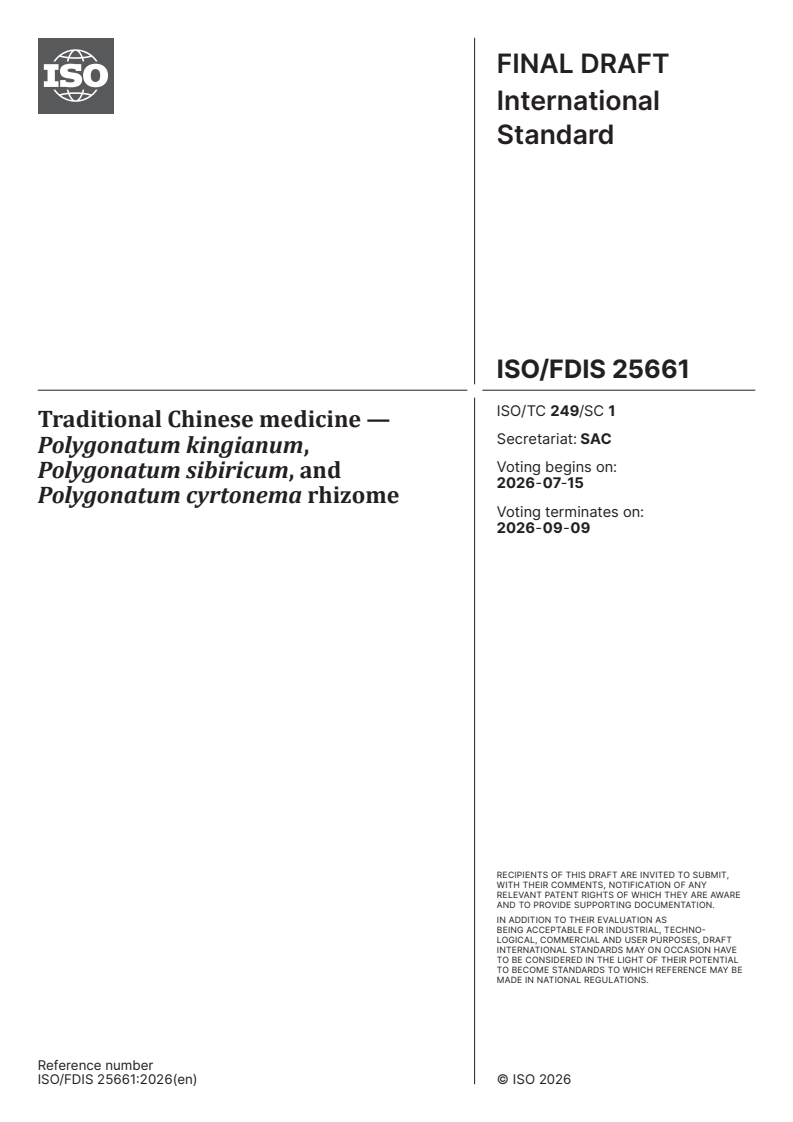
FINAL DRAFT
International
Standard
ISO/FDIS 25661
ISO/TC 249/SC 1
Traditional Chinese medicine —
Secretariat: SAC
Polygonatum kingianum,
Voting begins on:
Polygonatum sibiricum, and
2026-07-15
Polygonatum cyrtonema rhizome
Voting terminates on:
2026-09-09
RECIPIENTS OF THIS DRAFT ARE INVITED TO SUBMIT,
WITH THEIR COMMENTS, NOTIFICATION OF ANY
RELEVANT PATENT RIGHTS OF WHICH THEY ARE AWARE
AND TO PROVIDE SUPPOR TING DOCUMENTATION.
IN ADDITION TO THEIR EVALUATION AS
BEING ACCEPTABLE FOR INDUSTRIAL, TECHNO
LOGICAL, COMMERCIAL AND USER PURPOSES, DRAFT
INTERNATIONAL STANDARDS MAY ON OCCASION HAVE
TO BE CONSIDERED IN THE LIGHT OF THEIR POTENTIAL
TO BECOME STAN DARDS TO WHICH REFERENCE MAY BE
MADE IN NATIONAL REGULATIONS.
Reference number
ISO/FDIS 25661:2026(en) © ISO 2026
FINAL DRAFT
ISO/FDIS 25661:2026(en)
International
Standard
ISO/FDIS 25661
ISO/TC 249/SC 1
Traditional Chinese medicine —
Secretariat: SAC
Polygonatum kingianum,
Voting begins on:
Polygonatum sibiricum, and
Polygonatum cyrtonema rhizome
Voting terminates on:
RECIPIENTS OF THIS DRAFT ARE INVITED TO SUBMIT,
WITH THEIR COMMENTS, NOTIFICATION OF ANY
RELEVANT PATENT RIGHTS OF WHICH THEY ARE AWARE
AND TO PROVIDE SUPPOR TING DOCUMENTATION.
© ISO 2026
IN ADDITION TO THEIR EVALUATION AS
All rights reserved. Unless otherwise specified, or required in the context of its implementation, no part of this publication may
BEING ACCEPTABLE FOR INDUSTRIAL, TECHNO
LOGICAL, COMMERCIAL AND USER PURPOSES, DRAFT
be reproduced or utilized otherwise in any form or by any means, electronic or mechanical, including photocopying, or posting on
INTERNATIONAL STANDARDS MAY ON OCCASION HAVE
the internet or an intranet, without prior written permission. Permission can be requested from either ISO at the address below
TO BE CONSIDERED IN THE LIGHT OF THEIR POTENTIAL
or ISO’s member body in the country of the requester.
TO BECOME STAN DARDS TO WHICH REFERENCE MAY BE
MADE IN NATIONAL REGULATIONS.
ISO copyright office
CP 401 • Ch. de Blandonnet 8
CH-1214 Vernier, Geneva
Phone: +41 22 749 01 11
Email: copyright@iso.org
Website: www.iso.org
Published in Switzerland Reference number
ISO/FDIS 25661:2026(en) © ISO 2026
ii
ISO/FDIS 25661:2026(en)
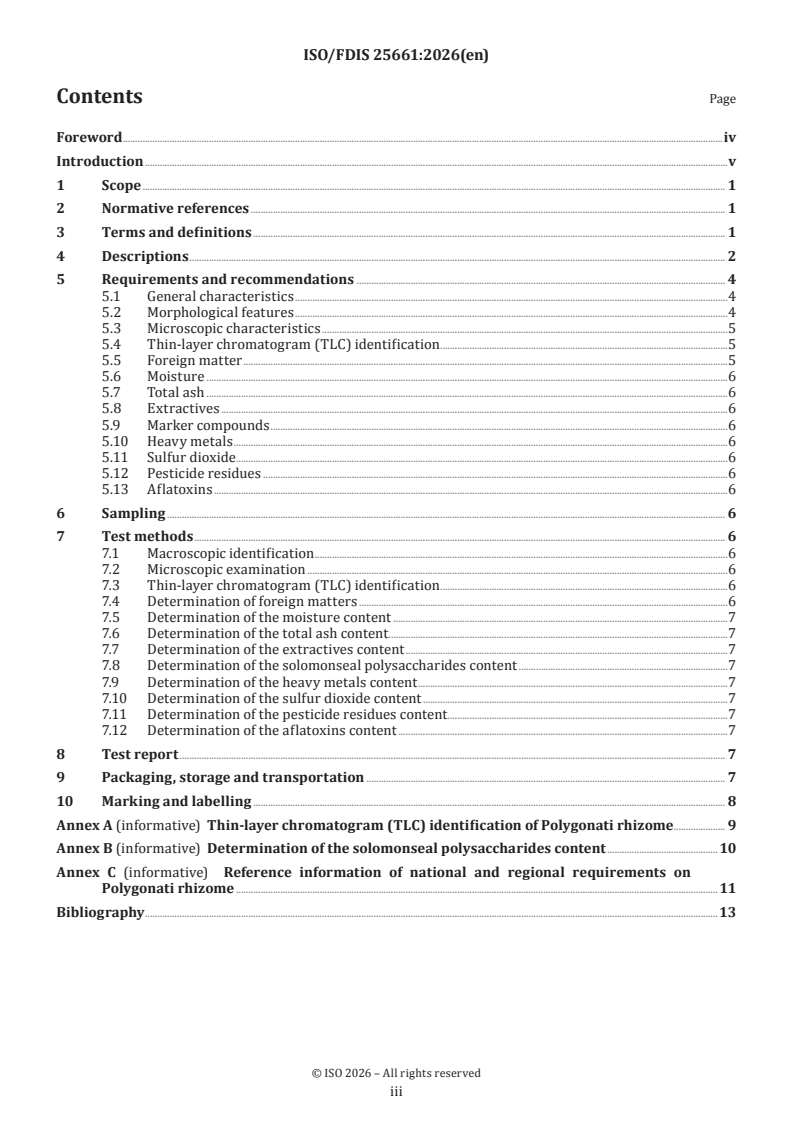
Contents Page
Foreword .iv
Introduction .v
1 Scope . 1
2 Normative references . 1
3 Terms and definitions . 1
4 Descriptions . 2
5 Requirements and recommendations . 4
5.1 General characteristics .4
5.2 Morphological features .4
5.3 Microscopic characteristics .5
5.4 Thin-layer chromatogram (TLC) identification .5
5.5 Foreign matter .5
5.6 Moisture .6
5.7 Total ash .6
5.8 Extractives .6
5.9 Marker compounds .6
5.10 Heavy metals .6
5.11 Sulfur dioxide . .6
5.12 Pesticide residues .6
5.13 Aflatoxins .6
6 Sampling . 6
7 Test methods . 6
7.1 Macroscopic identification .6
7.2 Microscopic examination .6
7.3 Thin-layer chromatogram (TLC) identification .6
7.4 Determination of foreign matters .6
7.5 Determination of the moisture content .7
7.6 Determination of the total ash content .7
7.7 Determination of the extractives content .7
7.8 Determination of the solomonseal polysaccharides content .7
7.9 Determination of the heavy metals content .7
7.10 Determination of the sulfur dioxide content .7
7.11 Determination of the pesticide residues content .7
7.12 Determination of the aflatoxins content .7
8 Test report . 7
9 Packaging, storage and transportation . 7
10 Marking and labelling . 8
Annex A (informative) Thin-layer chromatogram (TLC) identification of Polygonati rhizome . 9
Annex B (informative) Determination of the solomonseal polysaccharides content .10
Annex C (informative) Reference information of national and regional requirements on
Polygonati rhizome .11
Bibliography .13
iii
ISO/FDIS 25661:2026(en)
Foreword
ISO (the International Organization for Standardization) is a worldwide federation of national standards
bodies (ISO member bodies). The work of preparing International Standards is normally carried out through
ISO technical committees. Each member body interested in a subject for which a technical committee
has been established has the right to be represented on that committee. International organizations,
governmental and non-governmental, in liaison with ISO, also take part in the work. ISO collaborates closely
with the International Electrotechnical Commission (IEC) on all matters of electrotechnical standardization.
The procedures used to develop this document and those intended for its further maintenance are described
in the ISO/IEC Directives, Part 1. In particular, the different approval criteria needed for the different types
of ISO document should be noted. This document was drafted in accordance with the editorial rules of the
ISO/IEC Directives, Part 2 (see www.iso.org/directives).
ISO draws attention to the possibility that the implementation of this document may involve the use of (a)
patent(s). ISO takes no position concerning the evidence, validity or applicability of any claimed patent
rights in respect thereof. As of the date of publication of this document, ISO had not received notice of (a)
patent(s) which may be required to implement this document. However, implementers are cautioned that
this may not represent the latest information, which may be obtained from the patent database available at
www.iso.org/patents. ISO shall not be held responsible for identifying any or all such patent rights.
Any trade name used in this document is information given for the convenience of users and does not
constitute an endorsement.
For an explanation of the voluntary nature of standards, the meaning of ISO specific terms and expressions
related to conformity assessment, as well as information about ISO's adherence to the World Trade
Organization (WTO) principles in the Technical Barriers to Trade (TBT), see www.iso.org/iso/foreword.html.
This document was prepared by Technical Committee ISO/TC 249, Traditional medicine, SC 1, Traditional
Chinese medicine.
Any feedback or questions on this document should be directed to the user’s national standards body. A
complete listing of these bodies can be found at www.iso.org/members.html.
iv
ISO/FDIS 25661:2026(en)
Introduction
Polygonati rhizome (Huang Jing) is the dried rhizome of Polygonatum kingianum Collett & Hemsl.,
Polygonatum sibiricum Redouté, and Polygonatum cyrtonema Hua (Fam. Liliaceace). It is found in China,
Korea, Japan, Vietnam, Myanmar, Laos, Thailand, Mongolia, and eastern Siberia, Russia. The dried rhizome
of Polygonatum falcatum A. Gray is also used as Polygonati rhizome in Japanese Pharmacopoeia and Korean
Pharmacopoeia.
Polygonati rhizome has been commonly consumed as a health food supplement and in traditional Chinese
medicine (TCM) for thousands of years due to high nutritional and medicinal values. In Mingyi Bielu (220 AD
to 450 AD), a classic medical text from ancient China, Polygonati rhizome was recorded as one of extremely
valuable herbs. According to the traditional Chinese medicine theory, Polygonati rhizome has the functions
of tonifying the Qi and the Yin, strengthening the spleen, moistening the lung and tonifying the kidney.
Modern pharmacological studies have shown that Polygonati rhizome not only has the effects of lowering
blood sugar, lowering blood lipids, anti-oxidation, anti-cancer, anti-inflammation and antibacterial, but also
has the pharmacological effects of anti-fatigue, immune regulation and anti-aging. This is related to the rich
chemical components of Polygonati rhizome, such as polysaccharide, saponins, flavonoids, alkaloids and
amino acids. Along with a growing number of studies on Polygonati rhizome, various beneficial nutrients
within Polygonati rhizome are being proposed, including carbohydrate, dietary fibre, mineral, vitamin,
sugar, amino acid, fatty acid and protein. Thus, Polygonati rhizome is considered as a popular nutritious
food and herb worldwide.
Polygonati rhizome as a special medicinal and edible material, has a lot of international attention and
demand. Searching publications on Polygonati rhizome in the PubMed database for the past ten years reveals
that more than 25 countries and regions have carried out relevant research. The global average annual trade
volume of Polygonati rhizome from 2018 to 2022 was about 5 962 t, and the global average annual trade value
is about 57,43 million US dollars. The world's main export countries of Polygonati rhizome are concentrated
in China, Myanmar and India. Among them, China and Myanmar account for about 95,1 % of the world's
annual exports. The main import countries and regions of Polygonati rhizome are: Japan, South Korea, Hong
Kong, Taiwan, Vietnam, Malaysia, the United States, Singapore, Thailand, Germany, Ireland, France, New
Zealand, Spain, Canada, Australia, Italy, Indonesia, Sudan, the Netherlands, the Russian Federation, India, the
United Kingdom, etc. According to Chinese customs data, China's export trade volume of Polygonati rhizome
was 2 809 t (in 2018), 2 911 t (in 2019), 3 399 t (in 2020), 6 236 t (in 2021) and 7 001 t (in 2022) with an
annual average export trade value of about 45,57 million US dollars. The analysis of international trade data
shows that the growing demand for Polygonati rhizome in the global market has provided a market basis for
the development of a Polygonati rhizome International Standard.
However, the quality of Polygonati rhizome provided from different areas or by different cultivators varies
a lot. Although Polygonati rhizome has been recorded in Chinese Pharmacopoeia, Japanese Pharmacopoeia,
Korean pharmacopoeia and Hong Kong Chinese Medicinal Material Standards, these standards are not
harmonized and can be unsuitable for the purpose of international trade of Polygonati rhizome. Thus, there
is a clear and urgent need to develop an International Standard for harmonizing the existing standards, as
well as ensuring the safety and quality of Polygonati rhizome.
As national implementation can differ, national standards bodies can modify the values given in 5.7 in their
national standards. Examples of national and regional values are given in Annex C.
v
FINAL DRAFT International Standard ISO/FDIS 25661:2026(en)
Traditional Chinese medicine — Polygonatum kingianum,
Polygonatum sibiricum, and Polygonatum cyrtonema rhizome
1 Scope
This document specifies the requirements and test methods for Polygonati rhizome, which is derived from
the plant of Polygonatum kingianum Collett & Hemsl., Polygonatum sibiricum Redouté, and Polygonatum
cyrtonema Hua (Fam. Liliaceace).
This document is applicable to Polygonati rhizome that is sold and used as herbal raw materials in the
international trade, including Chinese materia medica (whole medicinal materials) and decoction pieces
derived from this plant.
2 Normative references
The following
...
Style Definition: List Continue 1: Indent: Left: 0 cm,
ISO/DISFDIS 25661
Hanging: 0.63 cm, Bulleted + Level: 1 + Aligned at: 0
cm + Indent at: 0.63 cm
ISO/TC 249/SC 1
Formatted: French (France)
Secretariat: SAC
Formatted: French (France)
Date: 2026-04-2107-01
Traditional Chinese medicine — Polygonatum kingianum,,
Polygonatum sibiricum, and Polygonatum cyrtonema rhizome
DISFDIS stage
VVVVVVVoooooootttttttiiiiiiing bng bng bng bng bng bng beeeeeeegigigigigigiginsnsnsnsnsnsns o o o o o o on:n:n:n:n:n:n: 202 202 202 202 202 202 2025555555-------11111111111111-------10101010101010
VoVoVoVoVoVoVotintintintintintintinggggggg t t t t t t terererererererminminminminminminminatatatatatatateseseseseseses o o o o o o onnnnnnn::::::: 2222222000000022222226666666-------00000002222222-------02020202020202
ISO/DISFDIS 25661:2026(en)
All rights reserved. Unless otherwise specified, or required in the context of its implementation, no part of this publication
may be reproduced or utilized otherwise in any form or by any means, electronic or mechanical, including photocopying,
or posting on the internet or an intranet, without prior written permission. Permission can be requested from either ISO
at the address below or ISO’s member body in the country of the requester.
ISO copyright office
CP 401 • Ch. de Blandonnet 8
CH-1214 Vernier, Geneva
Phone: + 41 22 749 01 11
Formatted: French (France)
E-mail: copyright@iso.org
Website: www.iso.org
Published in Switzerland
ii
ISO/DISFDIS 25661:2026(en)
Contents
Foreword . iii
Introduction . iii
Scope . iii
Normative references . iii
Terms and definitions . iii
Descriptions . iii
Requirements and recommendations . iii
General characteristics . iii
Morphological features . iii
Microscopic characteristics . iii
Thin-layer chromatogram (TLC) identification . iii
Foreign matter . iii
Moisture . iii
Total ash . iii
Extractives . iii
Marker compounds . iii
Heavy metals . iii
Sulfur dioxide . iii
Pesticide residues . iii
Aflatoxins . iii
Sampling . iii
Test methods . iii
Macroscopic identification . iii
Microscopic examination . iii
Thin-layer chromatogram (TLC) identification . iii
Determination of foreign matters . iii
Determination of the moisture content . iii
Determination of the total ash content . iii
Determination of the extractives content . iii
Determination of the solomonseal polysaccharides content . iii
Determination of the heavy metals content . iii
Determination of the sulfur dioxide content . iii
Determination of the pesticide residues content . iii
Determination of the aflatoxins content . iii
Test report . iii
Packaging, storage and transportation . iii
Marking and labelling . iii
(informative) Thin-layer chromatogram (TLC) identification of Polygonati rhizome . iii
(informative) Determination of the solomonseal polysaccharides content . iii
(informative) Reference information of national and regional requirements on Polygonati
rhizome . iii
Bibliography . iii
Foreword . v
Introduction . vi
iii
ISO/DISFDIS 25661:2026(en)
1 Scope . 1
2 Normative references . 1
3 Terms and definitions . 1
4 Descriptions . 2
5 Requirements and recommendations . 5
5.1 General characteristics . 5
5.2 Morphological features . 5
5.3 Microscopic characteristics. 6
5.4 Thin-layer chromatogram (TLC) identification . 8
5.5 Foreign matter . 8
5.6 Moisture . 8
5.7 Total ash . 8
5.8 Extractives . 8
5.9 Marker compounds . 8
5.10 Heavy metals . 8
5.11 Sulfur dioxide . 8
5.12 Pesticide residues . 8
5.13 Aflatoxins . 8
6 Sampling . 8
7 Test methods . 8
7.1 Macroscopic identification . 8
7.2 Microscopic examination . 9
7.3 Thin-layer chromatogram (TLC) identification . 9
7.4 Determination of foreign matters . 9
7.5 Determination of the moisture content . 9
7.6 Determination of the total ash content . 9
7.7 Determination of the extractives content . 9
7.8 Determination of the solomonseal polysaccharides content . 9
7.9 Determination of the heavy metals content . 9
7.10 Determination of the sulfur dioxide content . 9
7.11 Determination of the pesticide residues content . 9
7.12 Determination of the aflatoxins content . 9
8 Test report . 9
9 Packaging, storage and transportation . 10
10 Marking and labelling . 10
Annex A (informative) Thin-layer chromatogram (TLC) identification of Polygonati rhizome . 11
Annex B (informative) Determination of the solomonseal polysaccharides content . 13
Annex C (informative) Reference information of national and regional requirements on
Polygonati rhizome . 14
Bibliography . 16
iv
ISO/DISFDIS 25661:2026(en)
Foreword
ISO (the International Organization for Standardization) is a worldwide federation of national standards
bodies (ISO member bodies). The work of preparing International Standards is normally carried out through
ISO technical committees. Each member body interested in a subject for which a technical committee has been
established has the right to be represented on that committee. International organizations, governmental and
non-governmental, in liaison with ISO, also take part in the work. ISO collaborates closely with the
International Electrotechnical Commission (IEC) on all matters of electrotechnical standardization.
The procedures used to develop this document and those intended for its further maintenance are described
in the ISO/IEC Directives, Part 1. In particular, the different approval criteria needed for the different types of
ISO document should be noted. This document was drafted in accordance with the editorial rules of the
ISO/IEC Directives, Part 2 (see www.iso.org/directives).
ISO draws attention to the possibility that the implementation of this document may involve the use of (a)
patent(s). ISO takes no position concerning the evidence, validity or applicability of any claimed patent rights
in respect thereof. As of the date of publication of this document, ISO had not received notice of (a) patent(s)
which may be required to implement this document. However, implementers are cautioned that this may not
represent the latest information, which may be obtained from the patent database available at
www.iso.org/patents. ISO shall not be held responsible for identifying any or all such patent rights.
Any trade name used in this document is information given for the convenience of users and does not
constitute an endorsement.
For an explanation of the voluntary nature of standards, the meaning of ISO specific terms and expressions
related to conformity assessment, as well as information about ISO's adherence to the World Trade
Organization (WTO) principles in the Technical Barriers to Trade (TBT), see www.iso.org/iso/foreword.html.
This document was prepared by Technical Committee ISO/TC 249, Traditional medicine, SC 1, Traditional
Chinese medicine.
Any feedback or questions on this document should be directed to the user’s national standards body. A
complete listing of these bodies can be found at www.iso.org/members.html.
v
ISO/DISFDIS 25661:2026(en)
Introduction
Polygonati rhizome (Huang Jing) is the dried rhizome of Polygonatum kingianum Collett & Hemsl.,
Polygonatum sibiricum Redouté, and Polygonatum cyrtonema Hua (Fam. Liliaceace). It is found in China, Korea,
Japan, Vietnam, Myanmar, Laos, Thailand, Mongolia, and eastern Siberia, Russia. The dried rhizome of
Polygonatum falcatum A. Gray is also used as Polygonati rhizome in Japanese Pharmacopoeia and Korean
Pharmacopoeia.
Polygonati rhizome has been commonly consumed as a health food supplement and in traditional Chinese
medicine (TCM) for thousands of years due to high nutritional and medicinal values. In Mingyi Bielu (220 AD
to 450 AD), a classic medical text from ancient China, Polygonati rhizome was recorded as one of extremely
valuable herbs. According to the traditional Chinese medicine theory, Polygonati rhizome has the functions of
tonifying the Qi and the Yin, strengthening the spleen, moistening the lung and tonifying the kidney. Modern
pharmacological studies have shown that Polygonati rhizome not only has the effects of lowering blood sugar,
lowering blood lipids, anti-oxidation, anti-cancer, anti-inflammation and antibacterial, but also has the
pharmacological effects of anti-fatigue, immune regulation and anti-aging. This is related to the rich chemical
components of Polygonati rhizome, such as polysaccharide, saponins, flavonoids, alkaloids and amino acids.
Along with a growing number of studies on Polygonati rhizome, various beneficial nutrients within Polygonati
rhizome are being proposed, including carbohydrate, dietary fibre, mineral, vitamin, sugar, amino acid, fatty
acid and protein. Thus, Polygonati rhizome is considered as a popular nutritious food and herb worldwide.
Polygonati rhizome as a special medicinal and edible material, has a lot of international attention and demand.
Searching publications on Polygonati rhizome in the PubMed database for the past ten years reveals that more
than 25 countries and regions have carried out relevant research. The global average annual trade volume of
Polygonati rhizome from 2018 to 2022 was about 5 962 t, and the global average annual trade value is about
57,43 million US dollars. The world's main export countries of Polygonati rhizome are concentrated in China,
Myanmar and India. Among them, China and Myanmar account for about 95,1 % of the world's annual exports.
The main import countries and regions of Polygonati rhizome are: Japan, South Korea, Hong Kong, Taiwan,
Vietnam, Malaysia, the United States, Singapore, Thailand, Germany, Ireland, France, New Zealand, Spain,
Canada, Australia, Italy, Indonesia, Sudan, the Netherlands, the Russian Federation, India, the United Kingdom,
etc. According to Chinese customs data, China's export trade volume of Polygonati rhizome was 2 809 t (in
2018), 2 911 t (in 2019), 3 399 t (in 2020), 6 236 t (in 2021) and 7 001 t (in 2022) with an annual average
export trade value of about 45,57 million US dollars. The analysis of international trade data shows that the
growing demand for Polygonati rhizome in the global market has provided a market basis for the development
of a Polygonati rhizome International Standard.
However, the quality of Polygonati rhizome provided from different areas or by different cultivators varies a
lot. Although Polygonati rhizome has been recorded in Chinese Pharmacopoeia, Japanese Pharmacopoeia,
Korean pharmacopoeia and Hong Kong Chinese Medicinal Material Standards, these standards are not
harmonized and can be unsuitable for the purpose of international trade of Polygonati rhizome. Thus, there is
a clear and urgent need to develop an International Standard for harmonizing the existing standards, as well
as ensuring the safety and quality of Polygonati rhizome.
As national implementation can differ, national standards bodies can modify the values given in 5.7 in their
national standards. Examples of national and regional values are given in Annex C.
vi
ISO/DISFDIS 25661:2026(en)
Traditional Chinese medicine — Polygonatum kingianum,
Polygonatum sibiricum, and Polygonatum cyrtonema rhizome
1 Scope
This document specifies the requirements and test methods for Polygonati rhizome, which is derived from the
plant of Polygonatum kingianum Collett & Hemsl., Polygonatum sibiricum Redouté, and Polygonatum
cyrtonema Hua (Fam. Liliaceace).
This document is applicable to
...