

ISO 361:1975
(Main)Basic ionizing radiation symbol
General Information
- Abstract
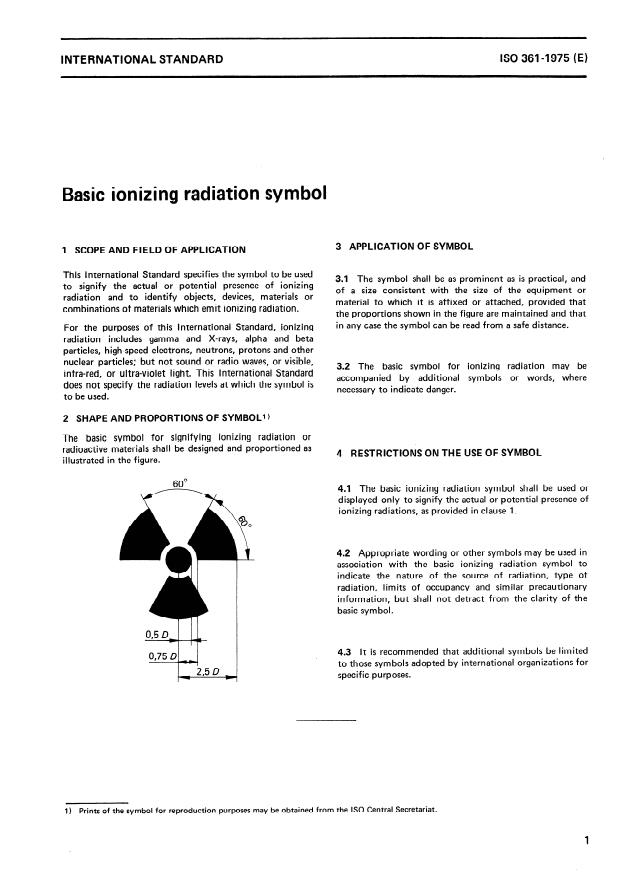
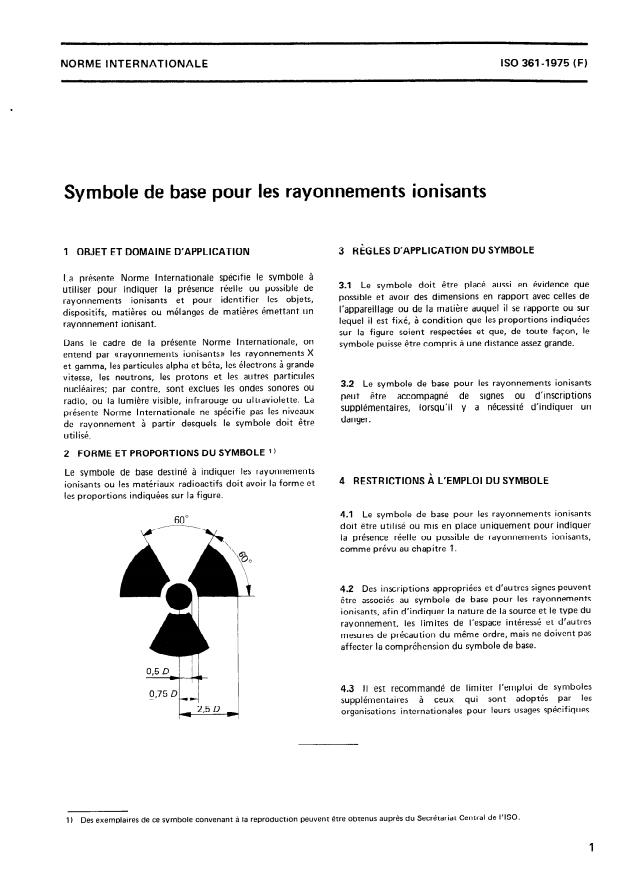
Specifies shape, proportions, application, restrictions on the use of the symbol (possibly accompanied by additional symbols or words). Shall be used to signify the actual or potential presence of ionizing radiation (including gamma and X-rays. alpha and beta particles, high-speed electrons, neutrons, protons and other nuclear particles, but not sound waves and other types of electromagnetic waves). Does not specify the radiation levels at which it is to be used.
- Status
- Published
- Publication Date
- 30-Sep-1975
- Current Stage
- 9093 - International Standard confirmed
- Start Date
- 16-Sep-2025
- Completion Date
- 29-Aug-2026
Buy Documents

ISO 361:1975 - Basic ionizing radiation symbol Released:10/1/1975

ISO 361:1975 - Symbole de base pour les rayonnements ionisants Released:10/1/1975

ISO 361:1975 - Symbole de base pour les rayonnements ionisants Released:10/1/1975
Overview
ISO 361:1975 - Basic Ionizing Radiation Symbol is an international standard developed by the International Organization for Standardization (ISO). It establishes the design, proportions, and application guidelines for the universal ionizing radiation warning symbol. This symbol is essential for safety in environments where there is actual or potential exposure to ionizing radiation, such as gamma rays, X-rays, alpha and beta particles, high-speed electrons, neutrons, and protons. The standard ensures consistency in communicating radiation hazards across various sectors and regions.
Key Topics
Symbol Design and Proportions
The standard specifies the precise shape and proportions of the ionizing radiation warning symbol to ensure recognizability and uniformity.Scope of Application
ISO 361:1975 applies to objects, devices, materials, or locations associated with ionizing radiation, but specifically excludes non-ionizing sources such as sound waves or visible, infrared, or ultraviolet light.Use Restrictions
The symbol is reserved exclusively for circumstances indicating actual or potential presence of ionizing radiation. Misuse for non-radiation hazards or unrelated purposes is prohibited.Accompanying Words or Symbols
Additional wording or internationally recognized symbols may be used alongside the basic symbol to enhance hazard communication, provided they do not obscure or detract from the primary warning sign.Visibility and Placement
The symbol must be sufficiently prominent and sized appropriately for its context. It should be readable from a safe distance, maintaining the standard proportions regardless of scale.
Applications
ISO 361:1975 plays a vital role in:
Nuclear Energy Facilities
Standardized radiation warning signs are used across nuclear power plants, research reactors, and radioactive material handling areas, promoting workplace safety and regulatory compliance.Medical and Industrial Equipment
Equipment emitting ionizing radiation, such as X-ray machines and radiotherapy devices, require clear signage conforming to ISO 361 for user and patient safety.Laboratory and Research Settings
The symbol is a key element in safety protocols in institutions where radioactive materials or ionizing radiation sources are used.Transportation and Storage
Packages, containers, and rooms used for storage or transport of radioactive substances display the symbol to ensure proper hazard recognition by handlers and emergency personnel.
The inclusion of the standard symbol in these applications helps reduce the risk of accidental exposure, ensures legal and regulatory compliance, and enhances international understanding of radiation hazards.
Related Standards
To ensure comprehensive radiation safety management, ISO 361:1975 is often used in conjunction with:
- ISO 21482:2007 - Symbols for ionizing radiation sources; supplementary to the ISO 361 symbol for specific harm warning scenarios
- ISO 7010 - Graphical symbols - Safety colours and safety signs
- IAEA Safety Standards - For nuclear safety protocols and signage requirements
- IEC and ANSI standards covering radiation safety symbols and signage in electronics and occupational safety sectors
Conclusion
ISO 361:1975 defines the standardized ionizing radiation symbol, providing essential guidance for its use, appearance, and application across diverse industries worldwide. Consistent utilization of this symbol supports effective hazard communication, workplace safety, and compliance with international regulations concerning ionizing radiation.
Relations
- Effective Date
- 25-Aug-2026
- Effective Date
- 25-Aug-2026
- Effective Date
- 10-Feb-2026
- Effective Date
- 10-Feb-2026
Buy Documents
ISO 361:1975 - Basic ionizing radiation symbol Released:10/1/1975
ISO 361:1975 - Symbole de base pour les rayonnements ionisants Released:10/1/1975
ISO 361:1975 - Symbole de base pour les rayonnements ionisants Released:10/1/1975
Get Certified
Connect with accredited certification bodies for this standard

CIS Institut d.o.o.
Personal Protective Equipment (PPE) certification body. Notified Body NB-2890 for EU Regulation 2016/425 PPE.

Kiwa BDA Testing
Building and construction product certification.
Kmetijski inštitut Slovenije
Agricultural Institute of Slovenia. Soil testing, plant health, agricultural product analysis.
Sponsored listings
Frequently Asked Questions
ISO 361:1975 is a standard published by the International Organization for Standardization (ISO). Its full title is "Basic ionizing radiation symbol". This standard covers: Specifies shape, proportions, application, restrictions on the use of the symbol (possibly accompanied by additional symbols or words). Shall be used to signify the actual or potential presence of ionizing radiation (including gamma and X-rays. alpha and beta particles, high-speed electrons, neutrons, protons and other nuclear particles, but not sound waves and other types of electromagnetic waves). Does not specify the radiation levels at which it is to be used.
Specifies shape, proportions, application, restrictions on the use of the symbol (possibly accompanied by additional symbols or words). Shall be used to signify the actual or potential presence of ionizing radiation (including gamma and X-rays. alpha and beta particles, high-speed electrons, neutrons, protons and other nuclear particles, but not sound waves and other types of electromagnetic waves). Does not specify the radiation levels at which it is to be used.
ISO 361:1975 is classified under the following ICS (International Classification for Standards) categories: 01.080.20 - Graphical symbols for use on specific equipment; 13.280 - Radiation protection. The ICS classification helps identify the subject area and facilitates finding related standards.
ISO 361:1975 has the following relationships with other standards: It is inter standard links to EN ISO 2919:2014, EN ISO 3925:2015, EN IEC 61010-2-010:2020, EN IEC 61010-2-201:2018. Understanding these relationships helps ensure you are using the most current and applicable version of the standard.
ISO 361:1975 is available in PDF format for immediate download after purchase. The document can be added to your cart and obtained through the secure checkout process. Digital delivery ensures instant access to the complete standard document.
Standards Content (Sample)
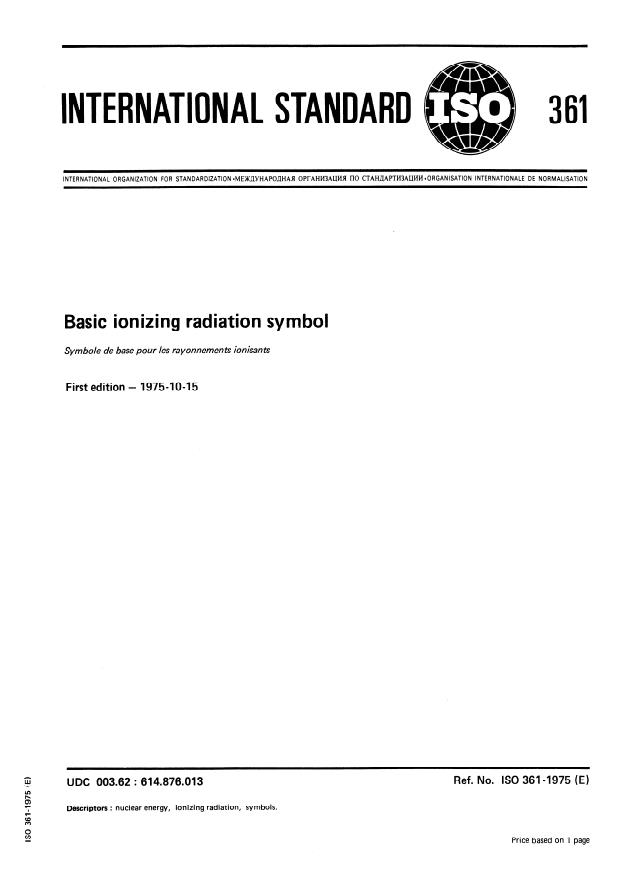
INTERNATIONAL STANDARD
INTERNATIONAL ORGANIZATION FOR STANDARDIZATION l MEXfiYHAPODHA(I OPI-AHM3AUMR no CTAHAAPTM3AUMM~ORGANISATION INTERNATIONALE DE NORMALISATION
Basic ionizing radiation symbol
Symbole de base pour les ra yonnemen ts ionisan ts
First edition - 1975-10-15
UDC 003.62 : 614.876.013
Ref. No. IS0 361-1975 (E)
Descriptors : nuclear energy, ionizing radiation, symbols.
Price based on 1 page
FOREWORD
IS0 (the International Organization for Standardization) is a worldwide federation
of national standards institutes (IS0 Member Bodies). The work of developing
International Standards is carried out through IS0 Technical Committees. Every
Member Body interested in a subject for which a Technical Committee has been set
up has the right to be represented on that Committee. International organizations,
governmental and non-governmental, in liaison with ISO, also take part in the work.
Draft International Standards adopted by the Technical Committees are circulated
to the Member Bodies for approval before their acceptance as International
Standards by the IS0 Council.
Prior to 1972, the results of the work of the Technical Committees were published
as IS0 Recommendations; these documents are now in the process of being
transformed into International Standards. As part of this process, Technical
Committee lSO/TC 85 has reviewed IS0 Recommendation R 361 and found it
technically suitable for transformation. International Standard IS0 361 therefore
replaces IS0 Recommendation R 361-1963 to which it is technically identical.
IS0 Recommendation R 361 was approved by the Member Bodies of the following
countries :
Austral i a Ireland Spain
Belgium Israel Sweden
Switzerland
Canada Japan
Chile Netherlands Turkey
Czechoslovakia New Zealand United Kingdom
Denmark Norway U.S.A.
Finland Poland U.S.S.R.
Germany Portugal Yugoslavia
Romania
Greece
South Africa, Rep. of
Hungary
following countries expressed disapproval of the
The Member Bodies of the
Recommendation on technical grounds :
Austria
France*
* Subsequently, this Member Body approved the Recommendation.
No Member Body disapproved the transformation of lSO/R 361 into an
International Standard.
G3 International Organization for Standardization, 19
...
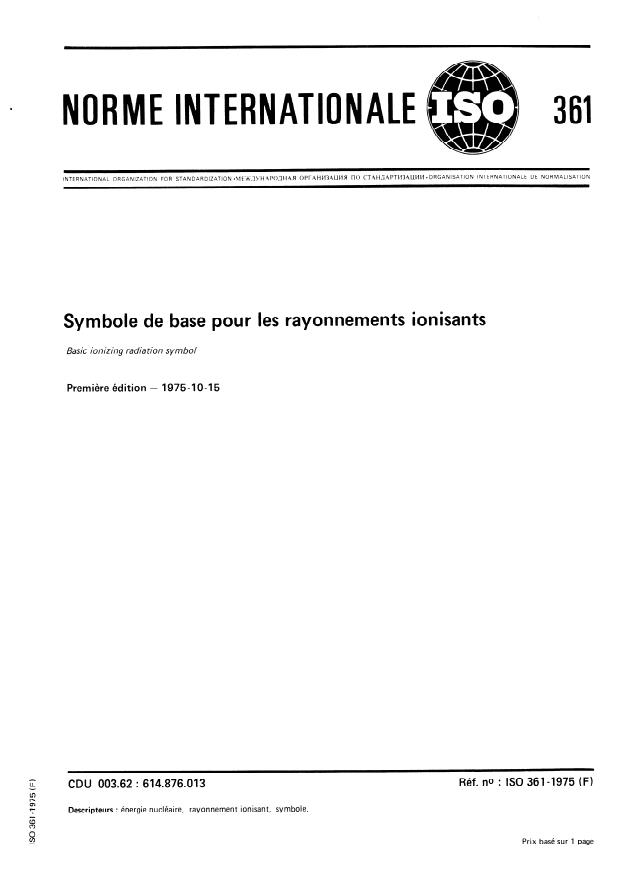
NORME INTERNATIONALE
INTERNATIONAL ORGANlZA-/-j(-JN FOR STANDARDlZATlON .\lF-AJ)‘H 4P()JHAFI OPI-AHM34UMR I-IO CT4HX4PTC13AUMM .ORGANISATION INTERNATIONALE DE NORMALlSATlON
Symbole de base pour les rayonnements ionisants
Basic ionizing radiation symbol
Premiere bdition - 1975-10-15
CDU 003.62 : 614.876.013 Rbf. no : IS0 361-1975 (F)
Descripteurs : hergie nuclkaire, rayonnement ionisant, symbole.
Prix bad sur 1 page
AVANT-PROPOS
L’ISO (Organisation lnternationale de Normalisation) est une federation mondiale
d’organismes nationaux de normalisation (Corn ites Membres ISO). L’elaboration de
Normes lnternationales est confide aux Comites Techniques ISO. Chaque Comite
Membre interesse par une etude a le droit de faire partie du Comite Technique
correspondant. Les organisations internationales, gouvernementales et non
gouvernementales, en liaison avec I’ISO, participent egalement aux travaux.
Les Projets de Normes lnternationales adopt& par les Comites Techniques sont
soumis aux Comites Membres pour approbation, avant leur acceptation comme
Normes Internationales par le Conseil de I’ISO.
Avant 1972, les resultats des travaux des Comites Techniques etaient publies
comme Recommandations ISO; maintenant, ces documents sont en tours de
transformation en Normes Internationales. Compte tenu de cette procedure, le
Comite Technique ISOnC 85 a examine la Recommandation ISO/R 361 et est
d’avis qu’elle peut, du point de vue technique, etre transformee en Norme
lnternationale. La presente Norme I nternationale remplace done la
Recommandation ISO/R 361-1963 a laquelle elle est techniquement identique.
La Recommandation ISO/R 361 avait et@ approuvee par les Comites Membres des
pays suivants :
Afrique du Sud, Rep. d’ Hongrie Royaume-Uni
Allemagne I rlande Suede
Austral ie Israel Su isse
Belgique Japon Tchecoslovaquie
Canada Norvege Turquie
Chili Nouvelle-Zelande U.R.S.S.
Danemark Pays-Bas U.S.A.
Espagne Pologne Yougoslavie
Finlande Portugal
G r&e Roumanie
Les Corn it& Mem bres des pays suivants avaient desapprouve la
Recommandation
r des raisons techniques
Pou
Autriche
France*
* Ult6rieurement, ce Cornit Membre a approuk la Recommandation.
Aucun Comite Membre n’a desapprouve la transformation de la Recommandation
ISO/R 361 en Norme Internationale.
0 Organisation Dnternationale de Normalisation, 1975 l
Imprim en Suisse
NORME INTERNATIONALE
IS0 361-1975 (F)
Symbole de base pou
...
NORME INTERNATIONALE
INTERNATIONAL ORGANlZA-/-j(-JN FOR STANDARDlZATlON .\lF-AJ)‘H 4P()JHAFI OPI-AHM34UMR I-IO CT4HX4PTC13AUMM .ORGANISATION INTERNATIONALE DE NORMALlSATlON
Symbole de base pour les rayonnements ionisants
Basic ionizing radiation symbol
Premiere bdition - 1975-10-15
CDU 003.62 : 614.876.013 Rbf. no : IS0 361-1975 (F)
Descripteurs : hergie nuclkaire, rayonnement ionisant, symbole.
Prix bad sur 1 page
AVANT-PROPOS
L’ISO (Organisation lnternationale de Normalisation) est une federation mondiale
d’organismes nationaux de normalisation (Corn ites Membres ISO). L’elaboration de
Normes lnternationales est confide aux Comites Techniques ISO. Chaque Comite
Membre interesse par une etude a le droit de faire partie du Comite Technique
correspondant. Les organisations internationales, gouvernementales et non
gouvernementales, en liaison avec I’ISO, participent egalement aux travaux.
Les Projets de Normes lnternationales adopt& par les Comites Techniques sont
soumis aux Comites Membres pour approbation, avant leur acceptation comme
Normes Internationales par le Conseil de I’ISO.
Avant 1972, les resultats des travaux des Comites Techniques etaient publies
comme Recommandations ISO; maintenant, ces documents sont en tours de
transformation en Normes Internationales. Compte tenu de cette procedure, le
Comite Technique ISOnC 85 a examine la Recommandation ISO/R 361 et est
d’avis qu’elle peut, du point de vue technique, etre transformee en Norme
lnternationale. La presente Norme I nternationale remplace done la
Recommandation ISO/R 361-1963 a laquelle elle est techniquement identique.
La Recommandation ISO/R 361 avait et@ approuvee par les Comites Membres des
pays suivants :
Afrique du Sud, Rep. d’ Hongrie Royaume-Uni
Allemagne I rlande Suede
Austral ie Israel Su isse
Belgique Japon Tchecoslovaquie
Canada Norvege Turquie
Chili Nouvelle-Zelande U.R.S.S.
Danemark Pays-Bas U.S.A.
Espagne Pologne Yougoslavie
Finlande Portugal
G r&e Roumanie
Les Corn it& Mem bres des pays suivants avaient desapprouve la
Recommandation
r des raisons techniques
Pou
Autriche
France*
* Ult6rieurement, ce Cornit Membre a approuk la Recommandation.
Aucun Comite Membre n’a desapprouve la transformation de la Recommandation
ISO/R 361 en Norme Internationale.
0 Organisation Dnternationale de Normalisation, 1975 l
Imprim en Suisse
NORME INTERNATIONALE
IS0 361-1975 (F)
Symbole de base pou
...